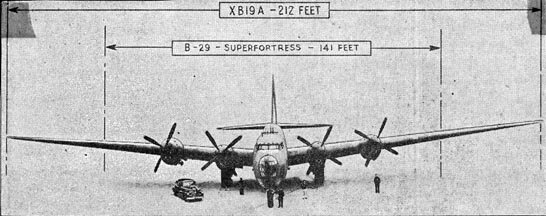
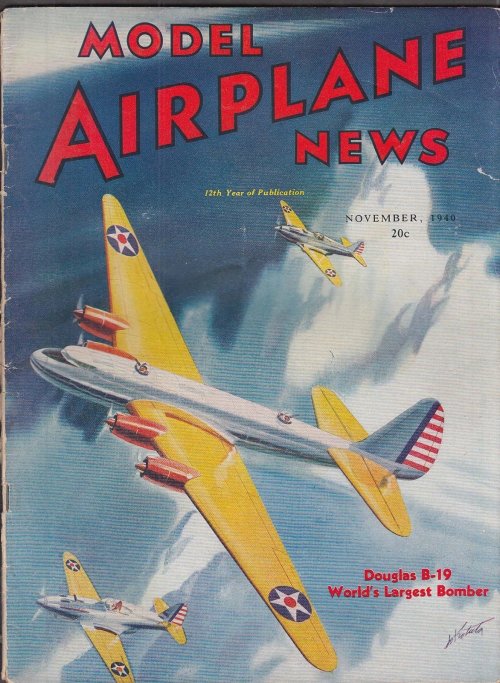
Its funny in the video they claim it took off and landed really smoothly, but in W. Wolf's book he mentions how the pilot was scared the plane was going to stall and then the landing was actually pretty rough too.

Edit: I know what I said is pretty vague, I don't have the book with me at the moment, so I'm going only off memory. SORRY!
 
As some have already mentioned, the XB-19 is based upon the XBLR-2. Are any specifications of the XBLR-2 (more specifically performance and size) available?
 
As some have already mentioned, the XB-19 is based upon the XBLR-2. Are any specifications of the XBLR-2 (more specifically performance and size) available?
I think there's a misunderstanding here, the XBLR-2 was a USAAC classification, not part of the acquisition of the plane. The B-19 was ordered through Project D.

From Military Affair Summer 1958 Vol 22, Iss 2: "the Air Corps Materiel Division early in 1935 carried out an engineering study that showed it feasible to construct a multi-engine bomber weighing about eighty tons loaded, capable of a range of 8,000 miles with a 2,400-Ib bomb load or a 3,000 mile range with a 10,000 to 12,000-lb. bomb load. It would be able to transport its entire ground crew as well as the air crew on a change of base, achieve a high speed of 200 to 230 miles per hour, and have a ceiling of 25,000 ft.°? The War Department in October approved negotiation of a contract with the Douglas Aircraft Company for design and engineering data for an aircraft to meet these specifications, with an option for subsequent purchase of a prototype"

The term XBLR-2 (Experimental Bomber, Long Range) was just a way to classify the two bombers they had acquired, the XBLR-1 (the XB-15 of Project A) and the XBLR-2 (XB-19 of Project D). Then they later started calling them the XB-15 and XB-19.

It's the same plane

But I hope the quotation in the middle answered your question.
 
Last edited:
Please excuse my ignorance to the Douglas XB-19 program. But was there any official Douglas models/drawings of proposed/ percieved definitive production model?

Regards
Pioneer
 
Please excuse my ignorance to the Douglas XB-19 program. But was there any official Douglas models/drawings of proposed/ percieved definitive production model?

Regards
Pioneer
It was never intended for mass production. Earlier on this forum someone found a study Douglas had done to try and sell more of the B19s to the US by saying they were more cost effective than naval ships, but presumably it would have been with the B19 that they had developed already.

Unfortunately there is very little information outside of really a couple sources. I reached out to the National Archives recently so they could look for one of the main cited sources which was in the Attorney General's Records, however when I had them look for me they said they found the box and section where the file should be, but there was no file for the specific date mentioned in all the old citations.

This is what I received after sending in the proper form:
"This email is in response to your inquiry to the National Archives concerning your interest in obtaining records of the Adjutant General's Office from 1936. Your inquiry was forwarded to me for response.

From the information provided we believe the file of interest to be located within the Record Group 407 Records of the Adjutant General's Office series Central Files, 1926 - 1939 (Entry PI-17 37-H). After consulting with the records in the stacks we were able to locate decimal 452.1 for the time period of interest in box 2581 (Loc: 370/81/25/01). However, after performing a cursory search of these materials we were not able to locate any documents for the specific date August 8, 1936"

The only 1 or 2 manuals of the plane are either owned privatly by the folks who sell the scans of it for 15 bucks on the internet and Then there is one in the Special Collections & Archives at Wright State University, however, to order a PDF scan of it from them costs $50.

Then there is Air Corps Technical Report 4803 in the Naval Historical Center's Files, which is the only actual document I've managed to find after years of scouring the internet and academic libraries. I tried to attach it below however the file was too large.

- Stannum
 
My understanding is that while the Boeing XB-15 was to be build in series (the YB-15s were canned circa 1937, with early B-17s barely escaping with their lives) the XB-19 never was.
Remember their denominations : XBLR-1 and XBLR-2, standing for eXperimental Bomber, Long Range. There were a lot of hesitations and fiery debates, related to four engine, large bombers: Douhet, Mitchell theories were quite controversial. Plus rivalry with the US Navy for coastal defense and beyond.
 
Last edited:
Tangential, do we know anything of what German authorities thought of these proposed sky-monsters ?

IMHO, the '6 vs 4' history sorta parallels the Trimotor issue: Two of that era's engines were not powerful / reliable enough, so three were fitted.
But, as engines improved, both power / reliability, fitting two could be trusted...

OT: FWIW, the six-engine, twin-boom design still looks very nice...
 
Antonio went over a lot of the XBLR program here: https://www.secretprojects.co.uk/threads/us-bombers.242/post-2217 back in 2006
For the XB-19, I'll recommend as a well-organized presentation of the facts, Bill Yenne's article in International Air Power Journal Vol 5. The plan for extreme long range bombers consisting developing bigger aircraft, step by step. As earlier Soviet attempts to demonstrated, that approach was necessary because available engine power was limiting. Besides, contemporary US economy couldn't afford such an expensive weapons.

First step was Project A (April 1934) asking for 5,000 miles range, single experimental bomber prototype.
Next, on February 1935, it was launched Project D. It was aimed to produce an experimental bomber aircraft capable of 8,000 miles range.
This aircraft were never intended to be series produced.

While Boeing put the XB-15 in the air by October 1937, the Douglas XB-19 lacked adequate funding until March 1938. By then, the design was already becoming obsolescent, loosing their raison d'être as a development laboratory. It was USAAC that pressed Douglas to get the aircraft in the air and, finally that was achieved on June, 1941.

Through a long series of designs from the experimental Model 294 / XB-15, a 5,000 miles operational bomber was series produced as Model 345 / B-29.

Intercontinental bomber development, instead, followed an unrelated path to Douglas XB-19 research. That was USAAC April 1941 RFP for a 12,000 miles range bomber which resulted in the B-36.
 
Another interesting thing about the B-19 is the Cost. While Wikipedia until recently quoted a source that claimed the project cost 3.25 million, I looked through the financial documents of Douglas and it actually cost $4,033,801.61. A crazy amount. Rougly 89.9941139 million US$ today. (which is actually surprising little haha)

I adjusted the Wikipedia to be accurate.
 
The US only paid like 1.3 million or something of that cost, so it was a huge loss for Douglas but they had put too much money in to cancel the project. Sunk Cost fallacy...

$1.389 Million from US to pay for costs
 
The US only paid like 1.3 million or something of that cost, so it was a huge loss for Douglas but they had put too much money in to cancel the project. Sunk Cost fallacy...

$1.389 Million from US to pay for costs

Contrary to what modern pragmatism and bankers would have us believe, gain or loss cannot be measured merely in figures.

The XB-19 did not serve its initial purpose, it was never produced, it remained a lone prototype for sure... but in terms of showing off what Douglas was capable of, both on the military and commercial markets, its impact was immeasurable. World press reported on the company building the world's then-largest aircraft, and it no doubt helped establish further the company's credibility. And at a time when rumors of war were getting heard more and more, also a time when U.S. air power was widely considered in several respects as inferior to some of its foreign counterparts, being able to boast the world's largest bomber, an airplane unmatched in range and ordnance capacity, also added to U.S. credibility as a major military power.
 
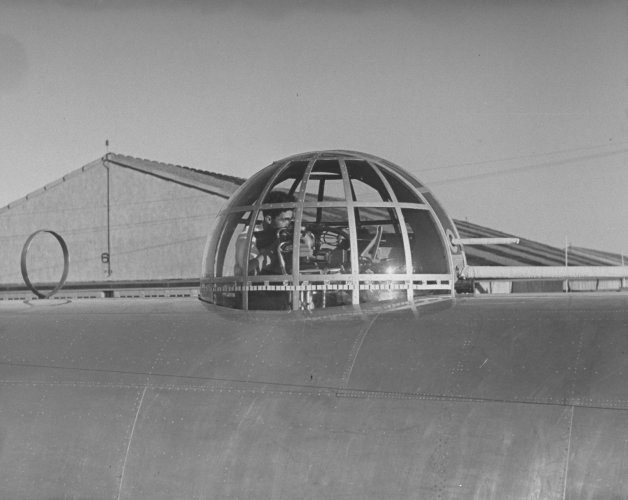
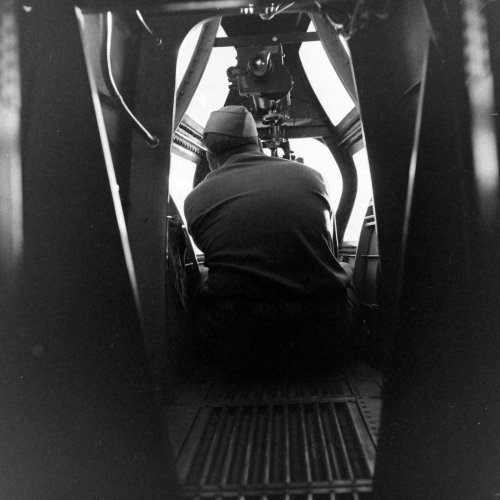
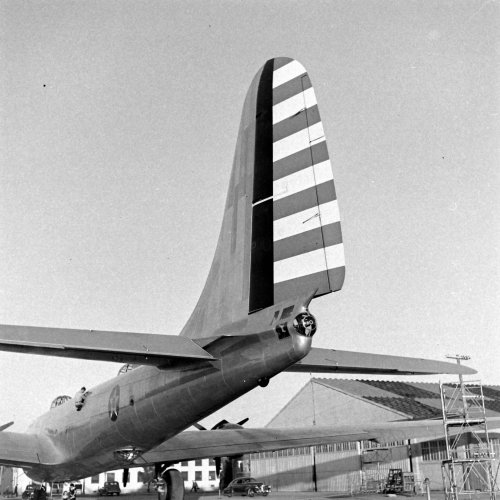
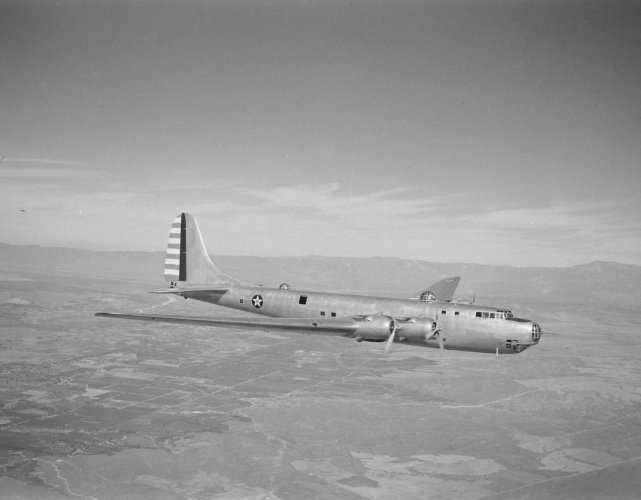
Here are some very neat photos of the XB-19 of either specific points of interest or rare photos I think are interesting:

Photograph of the upper front turret, which had one 37 mm cannon and one .30 Cal machine gun. You can actually see how one would aim the turret, and its interesting how it uses a rifle butt or stock. TimeLife_image_563467.jpg

Then in this photo you get a look at the tail gunner position. There was a catwalk that led from the galley to the impressively spacious tail gunner area.

TimeLife_image_116580789.jpg

In this next photo you see the B-19 from an angle you don't usually see, In this photo you can see on the side right behind the USAAF Roundel you can see the hole where a .30 cal Browning machine would go. You can also below that see the "lower rear manual turret" which was a .50 Cal Browning Machine gun, the gunner would be leaning against a support to hold and aim it.
TimeLife_image_116580787.jpg


To end this, here's just a really neat photo I found in the same collection, which by the way was Time-Life Magazine's photos
They can be found here: https://artsandculture.google.com/search/asset?q=b-19 stackpole&p=life-photo-collection

TimeLife_image_116580813.jpg
 
Here is a link to the Internet Archive of the Handbook of Operation and Flight Instructions for the Model XB-19 Long Range Bombardment Airplane. https://archive.org/details/xb-19-flight-instructions-1|

Here is the link for Air Corps Technical Report 4803: https://archive.org/details/xb-19-technical-report-18-july-1942
I had to reupload the Handbook of Operation.

Here it is: https://archive.org/details/xb-19-flight-instructions_20260831


Historical artifacts like this should not be behind paywalls like it was before I bought and published this for free.
 

Similar threads

Back
Top Bottom