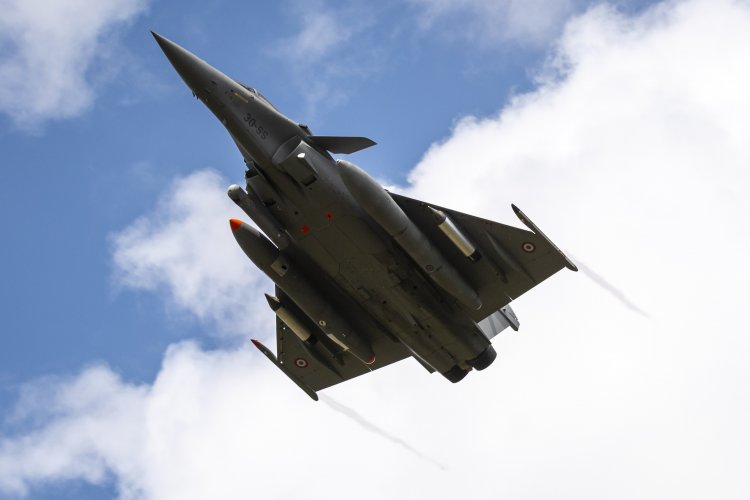
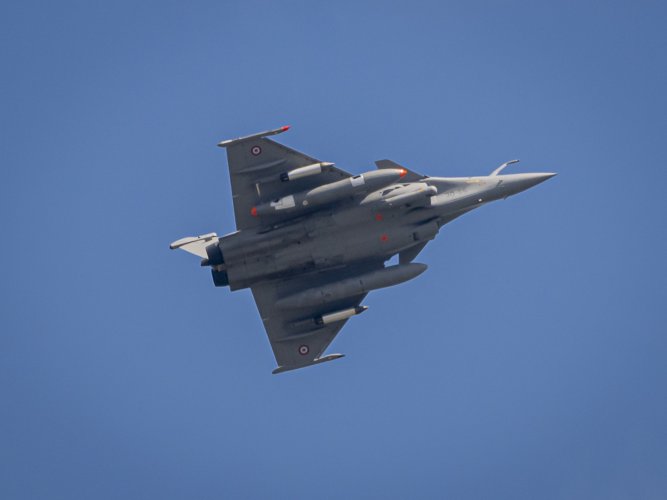
Not a bad idea !
at the very beginning of Rafale program, S530D was in fact imagined as a potential air to air missile for it !
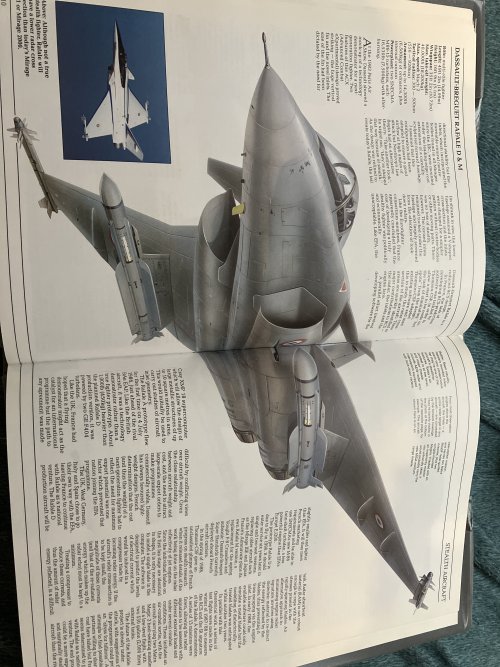
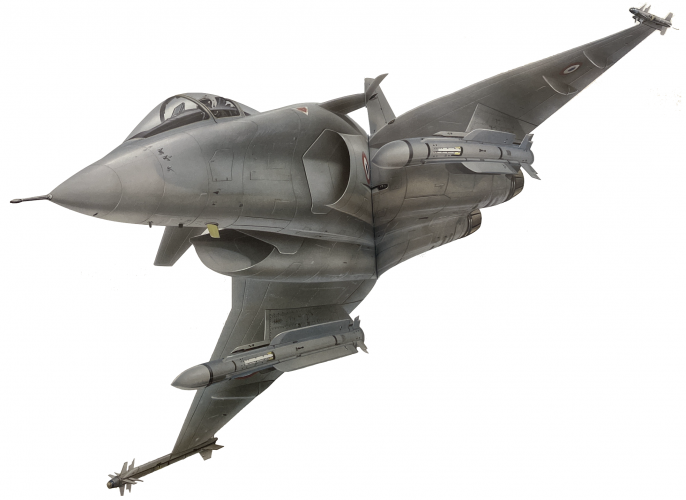
Old artists impression from the book “Stealth Warplanes” with 530f I always thought looked cool. I think the Swiss mirage 2000 documents mentioned something about 530d on Rafale.
 

Attachments

  • IMG_4792.jpeg
    IMG_4792.jpeg
    2.6 MB · Views: 205
Old artists impression from the book “Stealth Warplanes” with 530f I always thought looked cool.
Here's the full text describing the Rafale and a cleaned up view of the artists impression.

Always interesting to travel back in time... this would be about 1989, almost 40 years ago!
At the 1983 Paris Air Show, Dassault showed a mock-up of a technology demonstrator for a next-generation fighter. Two features of this ACX (Advanced Combat eXperimental) design proved striking—the huge vertical fin and the novel inlets.

The size of the fin had been dictated by the need for directional stability but the inlets, which incorporated the moveable conical centrebodies found in all Mirages since the IIIC, were mounted under the leading-edge root extensions of a carefully sculptured forward fuselage. I assumed that this configuration had been adopted to ensure a good airflow at high angles of attack but Northrop's Lee Begin had an alternative theory. "Take another look", he urged me, "they're shaped that way because of stealth."

As the design was refined to create today's Rafale, the tail fin shrank in size, the lower fuselage assumed a V-shaped cross-section and the inlets were changed for a simpler pattern without centrebodies or other moving parts. There was no loss of stealth, however. The revised inlets remained tucked under the fuselage and largely screened from the attention of look-down radars.

Like the Eurofighter consortium members, France apparently concluded that the cost of developing a truly stealthy fighter was politically and economically unacceptable. Like EFA, the Dassault-Breguet Rafale is a reduced-RCS detail design.

In France, the task of developing RCS reduction software was tackled by Thomson-CSF. In order to allow a start to be made on the task of eliminating "hot spots" from the design, Thomson-CSF adapted existing software and used this to study the radar cross section of the aircraft. Three areas were quickly identified as major contributors to RCS: the radar, the inlets and the engine face. A parallel effort involved developing software for the Cray XMP 18 supercomputer which will allow the design of large metallic structures of up to 10 square metres in area. This would initially be used to carry out studies of external inlet geometry.

The Rafale A prototype flew for the first time on 4 July 1986, just ahead of the rival BAE EAP. Like the British aircraft, it was a technology demonstrator rather than a true fighter prototype. About 1,000 lb (450 kg) heavier than the planned Rafale D production version, it was powered by two General Electric F404 turbofans.

Like the UK, France had hoped that a flying demonstrator might act as the catalyst for an international programme but the path to any agreement was made difficult by conflicting views over aircraft weight. Given the close relationship between aircraft weight and cost, and the need to attract large-scale export orders to make programmes commercially viable, Dassault has always favoured lightweight designs. France's determination that the cost (and thus the weight) of a next-generation fighter had to reflect the need for maximum export potential was one factor which prevented it from joining the EFA programme.

The UK, West Germany, Italy and Spain chose to go their own way with the EFA, leaving France to continue with Rafale as a national venture. The Rafale D production aircraft will be slightly smaller and lighter than EFA. It will thus meet French marketing requirements and be able to use SNECMA's new M88 twin-shaft turbofan, a less powerful engine than EFA's Eurojet EJ200.

The prototype Rafale D is due to fly in 1990. It should enter service six years later in single and two-seat versions, replacing older aircraft such as the Mirage IIIE and Jaguar. France's Aéronavale plans its own Rafale M version, replacement for the ageing Vought F-8 Crusaders and Super Étendards currently deployed aboard French aircraft carriers.

In the spring of 1988, Thomson-CSF gave an unclassified glimpse of French progress on stealth when it released details of the work being done on the radar reflectivity of jet engines. Since the individual blades on the first fan stage are identical in shape, it is only necessary to model a single blade in the computer. The software is designed to predict the levels of electrical current which would be induced in a compressed radar wave incoming radar energy. If the aircraft's radar cross-section is to be kept small, the magnitude of these currents (and that of the re-radiated energy which makes up the radar echo) must be kept to a minimum.

Treating a compressor to reduce these currents, and thus the amount of radar energy reflected, is a difficult task. Radar-absorbent material (RAM) is too robust enough to cope with the stresses present in the rapidly-spinning blades. An alternative approach to minimising engine radar signature involves using dielectric materials to re-direct the energy reflected by the blades, thus preventing it from escaping via the engine inlet. In early 1988, the available software could only simulate a metal blade but the modelling of dielectricly treated blades was anticipated within another two years.

In parallel with this theoretical work, a series of test flights were made in the winter of 1987/88 to measure the RCS and the IR signature of the Rafale A demonstrator. A series of 13 missions were flown, allowing the radar signature to be assessed with different external loads and under several combat conditions. These included an air-combat sortie, with the aircraft carrying two Matra Magic 2 heat-seeking missiles and a low-level flight, with two 530 gallon (2,000 litre) external tanks.

The future of the Rafale project is already under attack, with suggestions that the programme could provide "an abyss for billions". Attempts to find suitable partners willing to share the cost have failed but France seems determined to press ahead with Rafale as a national venture. The end product could be a more expensive and marginally stealthier aircraft than the rival [EF2000?].

 

Attachments

  • Rafale 1989.png
    Rafale 1989.png
    1.7 MB · Views: 127
Last edited:
https://www.dassault-aviation.com/e...mpletes-a-collaborative-flight-with-a-rafale/

NAMIB, the New Electronic Warfare Payload Successfully Completes a Collaborative Flight with a Rafale​


Dassault Aviation and Harmattan AI today announced the successful execution of a collaborative in-flight engagement between a Rafale F4 and an unmanned aerial system equipped with the NAMIB payload, a new electronic warfare device jointly developed by both companies.
https://images.dassault-aviation.co...auto-upload/2/files/2026/07/IMG_0143_OK-1.jpg
NAMIB is an electronic warfare payload capable of detecting, identifying, and geolocating electromagnetic emissions, in particular those from air defense systems. It can be carried by tactical drones, including quadcopters, as well as by longer-endurance, fixed-winged unmanned aircraft.

During the flight, NAMIB discreetly detected and precisely geolocated a radar located several dozen kilometers away. The target’s location was transmitted to the Rafale, which then simulated a strike on the target.

The development of NAMIB, initiated in January 2026, is one of the key initiatives under the strategic partnership between Dassault Aviation and Harmattan AI, which aims to integrate advanced autonomous capabilities into the next generation of air combat systems.

“This flight demonstrates the Rafale’s real and tangible multi-domain collaborative combat capabilities. The F4 standard architecture enables seamless communication with a very broad range of operational assets, including ground forces, allowing it to effectively leverage new capabilities, such as NAMIB’s electromagnetic detection and geolocation functions”, said Eric Trappier, Chairman and CEO of Dassault Aviation. “It also provides another illustration of the Rafale’s continuous adaptation to evolving operational requirements, and, in this case, to ‘high-low mix’, that is, the combination of highly sophisticated systems with autonomous and expendable effectors.”

“Electronic warfare has become a decisive factor in achieving operational superiority. Through NAMIB, we are demonstrating that these capabilities can now be deployed on lightweight autonomous systems operating close to the threat. This achievement highlights the complementary strengths of Dassault Aviation and Harmattan AI, combining decades of experience in air combat systems with our expertise in autonomy and embedded intelligence. Together, we are demonstrating that it is possible to accelerate the integration of disruptive technologies for the benefit of the armed forces and lay the groundwork for the collaborative combat architectures of tomorrow”,
said Mouad M’Ghari, Co-Founder and CEO of Harmattan AI.
 
The laser-guided rocket on Rafale is validated!
The DICOD confirms the arrival of the LADAC capability (Anti-Drone Warfare on Combat Aircraft). In just a few months, the DGA and the CEAM have integrated the 68mm rocket via the TALIOS pod.
View: https://x.com/Bruno_Aviation/status/2076597170510201024?s=20

On July 6 and 7, the naval aviation group trained at the Karavia firing range (Greece). The CEPA/10S also participated by catapulting, from the Charles de Gaulle, two Marine Rafale jets armed with two AASM 1000s. A first that validates a new capability.
View: https://x.com/MarineNationale/status/2075596656737976338?s=20
 
Pretty big —> Just heard Macron announce 16 Rafales to Ukraine, 2029 delivery
Also licence production for Scalp and other missiles

I don't have a link for now
Was just now on Le Monde live :

L’Ukraine compte acquérir 16 Rafale et des batteries antiaériennes SAMP/T NG, annonce Emmanuel Macron​

La France et l’Ukraine se sont entendues lundi sur une « feuille de route » prévoyant l’acquisition par Kiev de 16 avions de combat Rafale et leurs armements, « dont les premiers doivent voler dans les airs ukrainiens dès 2028-2029 », a annoncé le président de la République.
Dans le domaine de la défense aérienne, Kiev va également se doter « d’une première série de batteries SAMP/T de nouvelle génération qui vient compléter les systèmes qui seront livrés avec leurs missiles dans les semaines à venir », a poursuivi Emmanuel Macron, à l’issue du sommet de la « coalition des volontaires », à Paris.
L’accord prévoit, par ailleurs, la fourniture de radars et la production sous licence en Ukraine de bombes guidées AASM, de missiles antiaériens Aster 30 et de missiles de croisière Scalp, a-t-il ajouté.
 
2028 delivery ?
may be some french jets (taken on the assembly line or 2nd hand).... Strange as the french air force already sold some of it and the replenishment not made so far, and strange because the backlog is important and I see not a single customer to give some slots to Ukraine.
The only other precision was by Zelensky himself , saying :
Finally, Volodymyr Zelensky confirmed Emmanuel Macron’s comments regarding Ukraine’s acquisition of 16 Rafale fighter jets for the Ukrainian armed forces. “The training of our pilots and mechanics in France is due to begin this year,” he explained. “The first four Rafale aircraft will then be handed over to the Ukrainian armed forces.”
From Le Monde again.
So, once enough crew are trained on the type, apparently four rafales are to go to Ukraine to begin with.
 
https://www.president.gov.ua/en/new...zidenta-ukrayini-ta-prezidenta-francuz-105425
1. Combat AviationUkrainian Rafale pilots as early as 2026; licensed production of AASM bombs and SCALP missiles authorized in Ukraine.

Ukraine announces the order of 16 initial Rafale aircraft and their armaments, out of the 100 planned for acquisition in November 2025. The related financing will be requested under the 2026 and 2027 Ukraine Support Loan and any other sources of financing.

4 initial Rafale aircraft will be transferred to the Ukrainian armed forces upon the completion of the training cycle for Ukrainian pilots and mechanics, which can begin in France as early as 2026
. This immediate training will enable the deployment of this first capability in Ukraine as soon as possible.

Air-to-ground and air-to-air armaments, including AASM bombs, laser-guided anti-drone rockets, and MICA and METEOR missiles, will be delivered in coherence with the operational deployment of the aircraft advances. Each Rafale aircraft shall be dispatched with an armament capacity equivalent to the quantity agreed during consultations between the bilateral technical teams.

Furthermore, France authorizes the licensed production of AASM bombs and SCALP missiles in Ukraine before the end of 2026 and starting as soon as possible.
 
https://www.daher.com/daher-partenaire-industriel-de-dassault-aviation-sur-le-programme-rafale/

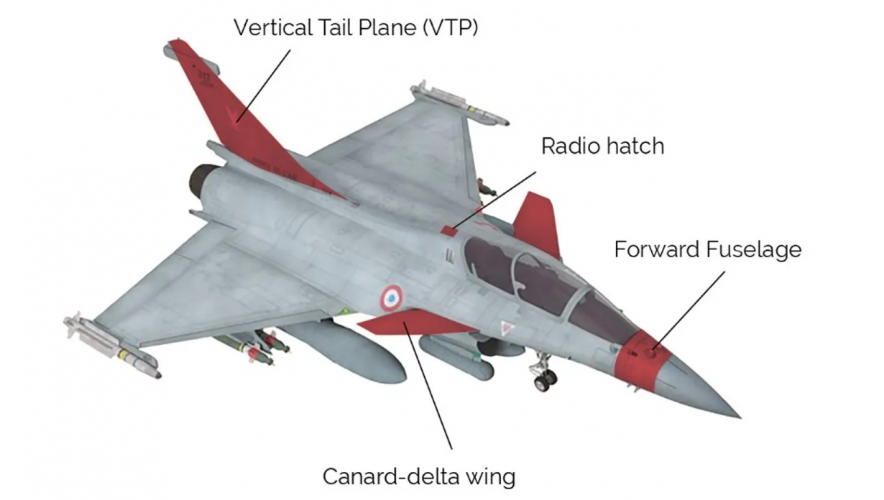
Daher manufactures the canard foreplanes and the vertical tails for the Rafale, two components that are critical to the aircraft's maneuverability, stability, and overall flight performance.

Responsibility for these major structural assemblies was transferred from Dassault Aviation's Biarritz facility as part of the Rafale program's production ramp-up.

Made from high-performance thermoset composite materials, these components rely on particularly demanding manufacturing processes that require advanced expertise in composite materials and their implementation. Daher operates a fully integrated production chain, including fabric cutting, automated lay-up, autoclave curing, followed by high-precision machining and final fitting.

The canard foreplanes have successfully completed the key stages of industrial qualification, paving the way for increased production rates. The vertical tails, major structural components subjected to significant aerodynamic loads, are progressively entering their final validation phase.

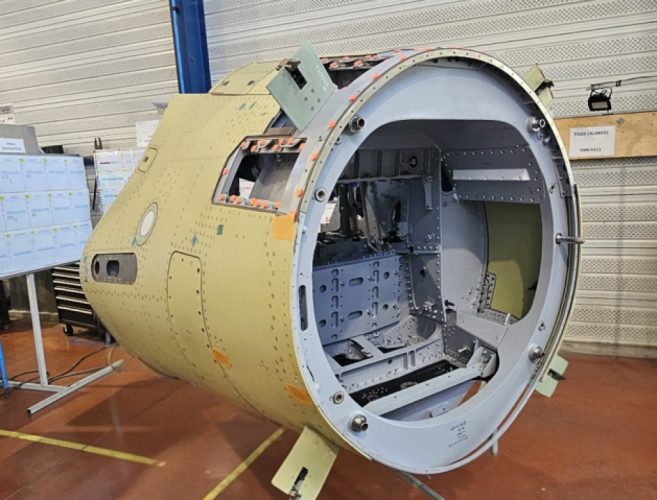
Daher also assembles the C1-C7 fuselage section of the Rafale, a key structural subassembly located immediately behind the aircraft's nose section, adjacent to the cockpit canopy. This section notably incorporates the structural reinforcement for the air-to-air refueling probe, a critical feature supporting the aircraft's operational capabilities.

Comprising approximately 800 individual parts, primarily metallic sheet-metal components, this assembly requires exceptional geometric accuracy and precise control of all interfaces to ensure structural integrity and repeatable assembly quality.

Positioned at the very beginning of Dassault Aviation's final assembly line, the C1-C7 section is a critical production-line component whose quality and timely delivery directly influence the overall flow of Rafale production.

Daher also manufactures and assembles the T34 equipped skins, some of which form integral fuel tank sections, requiring extremely stringent sealing performance and the use of dedicated manufacturing processes.

Finally, Daher manufactures the radio access door for the two-seat Rafale variant, a dedicated component providing access to the radio systems located behind the cockpit canopy. This illustrates the company's ability to maintain specialized industrial expertise for components with high functional value.
 

Attachments

  • image.png
    image.png
    1.1 MB · Views: 69
  • image.png
    image.png
    405.6 KB · Views: 91
"Transferred" isn't "delivered", so the odds are for some of those Rafale would be ex-AdlAE jets. At least the first four examples.

We probably have the complementary explanation today: France is reportedly delaying their Rafale F4 intake for one year to wait for the next standard, the F5. This should open delivery spots for Ukraine order.
 
12 Rafale ( 2 France + 10 Export ) deliveries for H1 2026, guidance still at 28 for the year ( likely 3 France + 25 Export )
Also :
Safran, which also powers the French combat aircraft, has also delivered "33 M88 engines for the Rafale, three times more than in the first half of 2025, in line with the announced rate increase from 2 to 4 Rafale per month between 2025 and 2029," added Olivier Andriès.
 
French air force chief on the Comet missile :
So AIM-260 or PL-15 range, not AIM-174B or PL-17

General Jérôme Bellanger
Then, regarding the Comet missile, the — ambitious — objective is to be able to quickly field an air-to-air missile with a range equivalent to the air-to-air missiles currently available worldwide by 2030. There is also a real issue of timelines. This range–schedule challenge concerns both our operational requirement and the DGA, in order to meet the 2030 deadline for the shock scenario so often described by the CEMA.

Mr. Cédric Perrin
So Comet is indeed the replacement for Meteor, and not an interim solution between the end of Meteor and a new Meteor?

General Jérôme Bellanger
At this stage, it is a different missile from Meteor
. Due to schedule constraints, we are not giving ourselves the time to develop a very long-range missile: by 2030, we want a missile with an equivalent range. However, from an incremental development perspective, it is not impossible that we could build upon it with a longer-range missile after 2030. Whether this will use the same technology, or whether it will rely on a new technology that could draw inspiration, in particular, from the Stratus RS missile, remains to be seen.
 
Egypt has issued an RFP for 24 more Rafale. This would bring the fleet to 78 aircraft : 24(-1) + 31 + 24
https://www.latribune.fr/article/de...l-egypte-commandait-24-rafale-supplementaires
Cairo could order 24 additional Rafale fighters from Dassault Aviation. Egypt would then have a fleet of nearly 80 French-made combat aircraft.

After a quiet period linked to financial difficulties, Egypt apparently intends to resume its arms acquisitions. According to our information, it recently sent France, more specifically Dassault Aviation, an RFP (Request for Proposal), a call for proposals in the technical and commercial sense, for the purchase of 24 additional Rafale fighters. Contacted by La Tribune, the aircraft manufacturer declined to comment. By the end of 2026, Cairo will have a fleet of 54 combat aircraft in service delivered by Dassault Aviation. These aircraft were ordered in two batches (24 in February 2015 and 31 in May 2021). In total, if it confirms its interest, the Egyptian Air Force would have a fleet of nearly 80 Rafale fighters (78).
 
Old artists impression from the book “Stealth Warplanes” with 530f I always thought looked cool. I think the Swiss mirage 2000 documents mentioned something about 530d on Rafale.
Old, very old picture.
It showed a Rafale without optronic system, and with Magic 2...
Something only possible if the Rafale was ready in 1995/1996 as expected before the iron wall collapse. MICA was only ready in 1996, so a stop gap possibility may have been S 530 D (and not F, a older variant).
 
Old, very old picture.
It showed a Rafale without optronic system, and with Magic 2...
Something only possible if the Rafale was ready in 1995/1996 as expected before the iron wall collapse. MICA was only ready in 1996, so a stop gap possibility may have been S 530 D (and not F, an older variant).
I always wanted to see rbe2 guide SAHR, a few articles mentioned it and apparently their was talk of the Serbian Rafale’s intergrating R27ER.
 
I always wanted to see rbe2 guide SAHR, a few articles mentioned it and apparently their was talk of the Serbian Rafale’s intergrating R27ER.

There seems to be no illuminator in the RBE2 architecture, so it certainly doesn't provide that capability, which would be superfluous anyway. You are better of with AHR missiles anyway.
 
The Rafale of the future is taking shape a little more: the French fighter jet has tested two new sovereign AI systems

By Julien Lausson

Dassault Aviation has flown two artificial intelligence systems on board a Rafale. The stated aim: sovereign algorithms that assist the pilot on missions.
The announcement came from the aircraft manufacturer itself, in a press release published on Tuesday 22 September 2026. Two algorithms described as ‘sovereign’ (meaning: designed and developed in France, without reliance on foreign technology) were installed on the Rafale, the flagship of the French air force, to be tested under real-world flight conditions.

These are two new artificial intelligence systems with different origins: the first was developed in-house by teams at Dassault Aviation, whilst the second was developed in partnership with cortAIx, the AI accelerator set up by Thales, one of France’s defence heavyweights, specialising in electronics and communications systems.

A virtual co-pilot with no firing authority.

What, exactly, do these two new algorithms do? Dassault does not specify. The press release merely states the intention to integrate into the cockpit ‘a controlled and supervised AI to assist the human crew’. The system sorts and prioritises the stream of data coming on board so that the pilot can make decisions more quickly, without ever taking away their control over firing or the aircraft.

The French aircraft manufacturer asserts that these systems have reached a sufficient ‘level of maturity’ to be fitted to future versions of the Rafale. In short, these new capabilities are not intended for the current generations of the fighter aircraft, which are already in service with the armed forces, but rather for future variants due to be introduced in the coming years.

For the time being, the announcement is primarily a demonstration of technical expertise: two algorithms that have taken flight, functions kept secret, and a red line maintained behind the scenes – that of the human pilot retaining control whilst the AI remains at the pilot’s service. The next stage will take place on the F5, where these AI systems will have to prove their worth when faced with a real mission.

The strategic direction of the F5 standard.

Currently, the standard Rafale is the F4 version, which has undergone two minor upgrades with the F4.1 (in 2023) and F4.2 (in 2025) updates. In the short term, the next step will be the F4.3 upgrade, which is currently under evaluation. But the real technological leap will come with the Rafale F5, which is described as a technological breakthrough.

However, the F5 is still some way off. Production of the future variant is scheduled to begin in late 2026, and it will take several more years of development before it actually enters service with the armed forces. The on-board AI components currently in use will therefore only find their true place in the aircraft by the end of the decade.

The integration of AI into the Rafale is simply the logical next step in Dassault’s strategy over recent years: a partnership formed with Thales in late 2025 to integrate AI into the Rafale, followed by an investment in the French start-up Harmattan AI in January 2026, which is set to provide part of the Rafale F5’s digital brain.

More recently, in July, Dassault had already announced the first collaborative combat trial between a Rafale and a drone. The aim was to test the NAMIB payload, designed for electronic warfare by Dassault and Harmattan AI. More broadly speaking, the future of the Rafale will certainly involve joint flights with drones.

All these developments are driven by a single objective: sovereignty. The same AI-driven approach is also evident in naval combat, where Thales is supporting Naval Group. It is also a way of nurturing its autonomy and its own capabilities (particularly its industrial base) whilst the major European SCAF programme remains bogged down, undermined by tensions between Dassault and Airbus.
 
There seems to be no illuminator in the RBE2 architecture, so it certainly doesn't provide that capability, which would be superfluous anyway. You are better of with AHR missiles anyway.
Surely the lack of a dedicated illuminator can be overcome via slaving a group of TRMs to operate as a software defined CW Illuminator?
Via ICW in a similar manner to naval use of ICW & ICWI via AESA for ESSM & SM2?
Not a huge hurdle to overcome, but one that does carry the risk of turning an LPI radar into an easily seen floodlight.
Fully agree with you that ARH is a better option, and certainly so for peer/near peer combat.
But for poorer nations with existing stockpiles of SARH and an Air Policing need?
I can see the attraction.
 

Similar threads

Back
Top Bottom