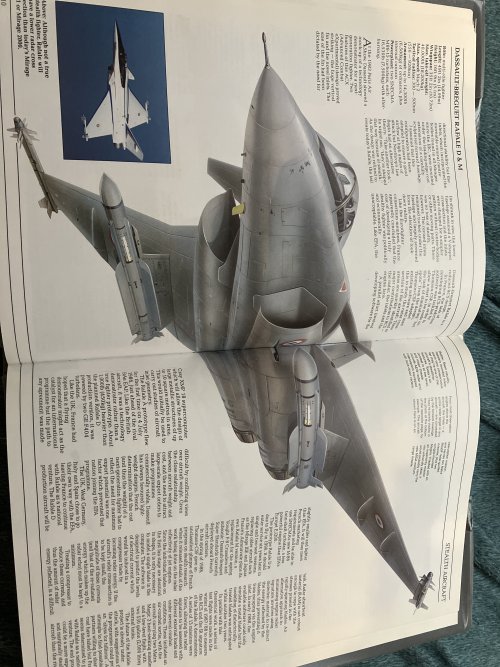
At the 1983 Paris Air Show, Dassault showed a mock-up of a technology demonstrator for a next-generation fighter. Two features of this ACX (Advanced Combat eXperimental) design proved striking—the huge vertical fin and the novel inlets.
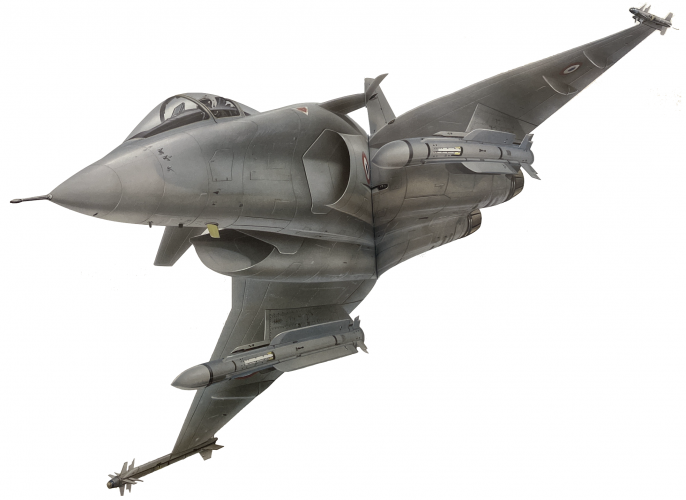
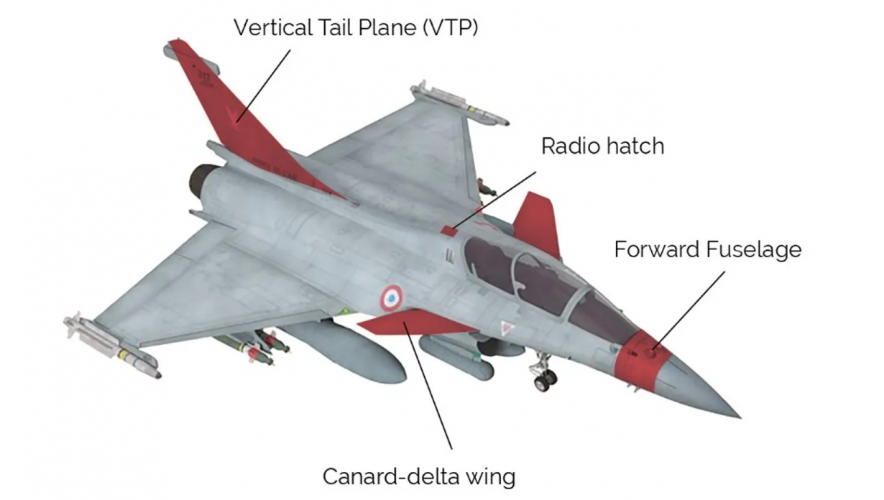
The size of the fin had been dictated by the need for directional stability but the inlets, which incorporated the moveable conical centrebodies found in all Mirages since the IIIC, were mounted under the leading-edge root extensions of a carefully sculptured forward fuselage. I assumed that this configuration had been adopted to ensure a good airflow at high angles of attack but Northrop's Lee Begin had an alternative theory. "Take another look", he urged me, "they're shaped that way because of stealth."
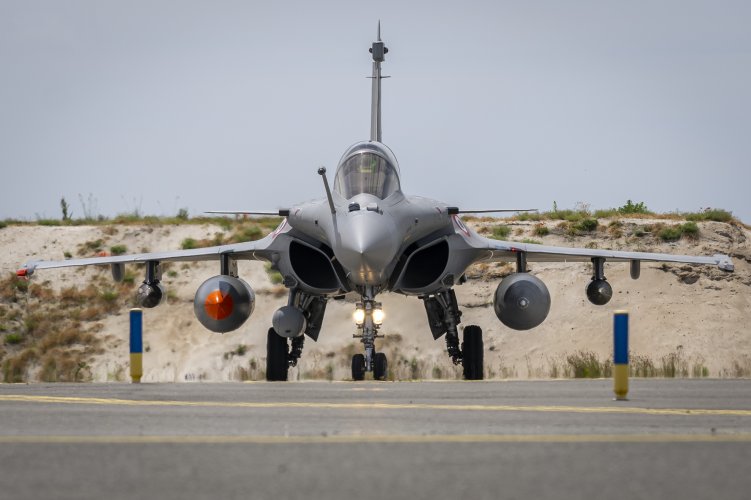
As the design was refined to create today's Rafale, the tail fin shrank in size, the lower fuselage assumed a V-shaped cross-section and the inlets were changed for a simpler pattern without centrebodies or other moving parts. There was no loss of stealth, however. The revised inlets remained tucked under the fuselage and largely screened from the attention of look-down radars.
Like the Eurofighter consortium members, France apparently concluded that the cost of developing a truly stealthy fighter was politically and economically unacceptable. Like EFA, the Dassault-Breguet Rafale is a reduced-RCS detail design.
In France, the task of developing RCS reduction software was tackled by Thomson-CSF. In order to allow a start to be made on the task of eliminating "hot spots" from the design, Thomson-CSF adapted existing software and used this to study the radar cross section of the aircraft. Three areas were quickly identified as major contributors to RCS: the radar, the inlets and the engine face. A parallel effort involved developing software for the Cray XMP 18 supercomputer which will allow the design of large metallic structures of up to 10 square metres in area. This would initially be used to carry out studies of external inlet geometry.
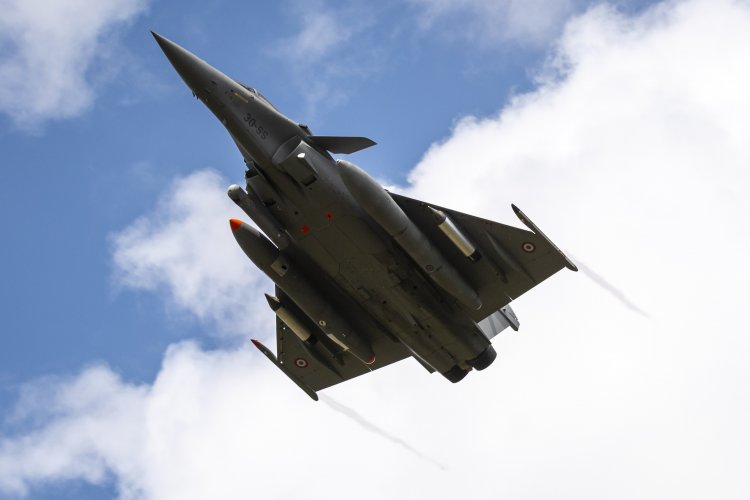
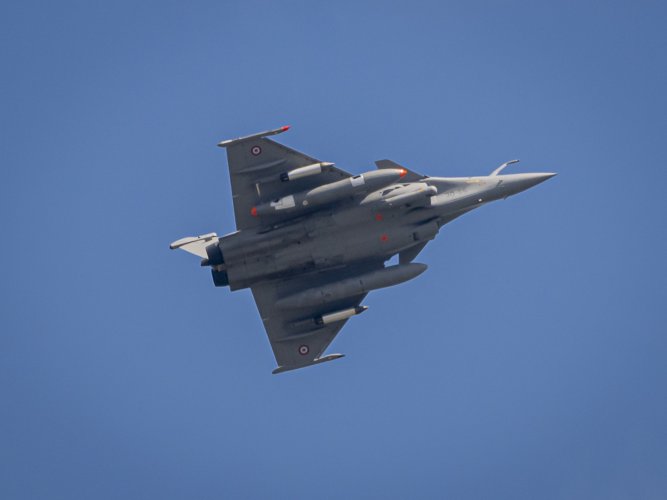
The Rafale A prototype flew for the first time on 4 July 1986, just ahead of the rival BAE EAP. Like the British aircraft, it was a technology demonstrator rather than a true fighter prototype. About 1,000 lb (450 kg) heavier than the planned Rafale D production version, it was powered by two General Electric F404 turbofans.
Like the UK, France had hoped that a flying demonstrator might act as the catalyst for an international programme but the path to any agreement was made difficult by conflicting views over aircraft weight. Given the close relationship between aircraft weight and cost, and the need to attract large-scale export orders to make programmes commercially viable, Dassault has always favoured lightweight designs. France's determination that the cost (and thus the weight) of a next-generation fighter had to reflect the need for maximum export potential was one factor which prevented it from joining the EFA programme.
The UK, West Germany, Italy and Spain chose to go their own way with the EFA, leaving France to continue with Rafale as a national venture. The Rafale D production aircraft will be slightly smaller and lighter than EFA. It will thus meet French marketing requirements and be able to use SNECMA's new M88 twin-shaft turbofan, a less powerful engine than EFA's Eurojet EJ200.
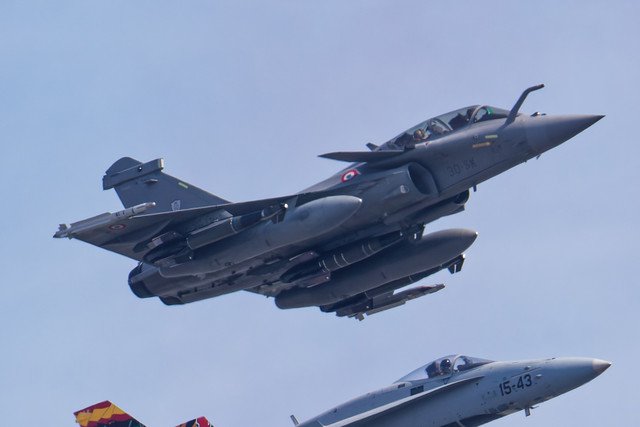
The prototype Rafale D is due to fly in 1990. It should enter service six years later in single and two-seat versions, replacing older aircraft such as the Mirage IIIE and Jaguar. France's Aéronavale plans its own Rafale M version, replacement for the ageing Vought F-8 Crusaders and Super Étendards currently deployed aboard French aircraft carriers.
In the spring of 1988, Thomson-CSF gave an unclassified glimpse of French progress on stealth when it released details of the work being done on the radar reflectivity of jet engines. Since the individual blades on the first fan stage are identical in shape, it is only necessary to model a single blade in the computer. The software is designed to predict the levels of electrical current which would be induced in a compressed radar wave incoming radar energy. If the aircraft's radar cross-section is to be kept small, the magnitude of these currents (and that of the re-radiated energy which makes up the radar echo) must be kept to a minimum.
Treating a compressor to reduce these currents, and thus the amount of radar energy reflected, is a difficult task. Radar-absorbent material (RAM) is too robust enough to cope with the stresses present in the rapidly-spinning blades. An alternative approach to minimising engine radar signature involves using dielectric materials to re-direct the energy reflected by the blades, thus preventing it from escaping via the engine inlet. In early 1988, the available software could only simulate a metal blade but the modelling of dielectricly treated blades was anticipated within another two years.
In parallel with this theoretical work, a series of test flights were made in the winter of 1987/88 to measure the RCS and the IR signature of the Rafale A demonstrator. A series of 13 missions were flown, allowing the radar signature to be assessed with different external loads and under several combat conditions. These included an air-combat sortie, with the aircraft carrying two Matra Magic 2 heat-seeking missiles and a low-level flight, with two 530 gallon (2,000 litre) external tanks.
The future of the Rafale project is already under attack, with suggestions that the programme could provide "an abyss for billions". Attempts to find suitable partners willing to share the cost have failed but France seems determined to press ahead with Rafale as a national venture. The end product could be a more expensive and marginally stealthier aircraft than the rival [EF2000?].