Some news about F5 standard.
Rafale: the winning strategy of step-by-step evolution
...
From F1 to F4: Two Decades of Continuous Integration
The Rafale F1, delivered to the French Navy in 2004, was initially only capable of air-to-air combat.
The F2 (2006) paved the way for air-to-ground operations.
The F3 (2008) enabled multiple missions to be completed on a single flight. The F3-R (2018) integrated an AESA radar, the Meteor missile, a TALIOS pod, and an enhanced SPECTRA system.
The F4 standard is being introduced in three phases. The F4.1, qualified in 2023, brings a Scorpion helmet-mounted display, a 1,000 kg AASM bomb, and improvements to the RBE2 radar, OSF, and SPECTRA systems. The F4.2, currently in the experimental phase, enhances connectivity with SATCOM, Link 16 Block 2, the
TRAGEDAC system,
CAPOEIRA, and the CONTACT software-defined radio. It also adds predictive maintenance capabilities. The F4.3, scheduled for 2026, will integrate the MICA NG missile, a digitized version of the SPECTRA and an enhanced TALIOS pod.
F5: The Next Step
The F5, slated for 2030, aims for a new level of capability. Its objective: to enable the Rafale to operate in contested environments, including nuclear missions. The centerpiece is the RBE2 XG radar. Based on gallium nitride (GaN), it promises a 50 to 70% greater range, improved resistance to jamming, and enhanced electronic warfare capabilities.
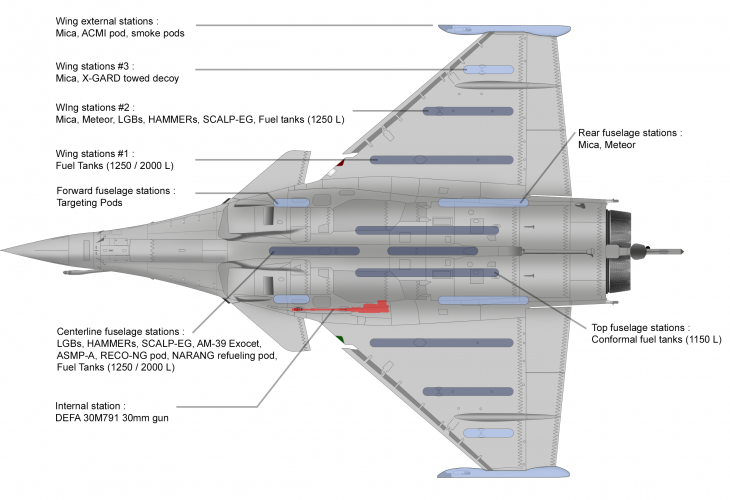
The M88 T-REX engine, developed by Safran, will offer 20% more thrust while remaining compatible with current modules. Range will be increased thanks to conformal fuel tanks (CFTs) integrated into the fuselage, without impacting hardpoints.
The F5 also ushers in a new era in weaponry. It will be able to carry the ASN4G hypersonic missile, successor to the ASMP-A, designed to penetrate advanced defenses at Mach 6 or even faster. The Smart Cruiser, a tactical swarm-deployment missile, will restore SEAD/DEAD capability. Up to 18 can be carried by aircraft using multiple launchers. The RJ10 missile, planned for 2035, will complete the arsenal with a supersonic anti-radar capability.
The Rafale F5 will no longer fly alone. It will be accompanied by a stealth combat drone, derived from the nEUROn demonstrator. Controlled from the cockpit, it will detect, strike, or jam targets. Similar in size to the Mirage 2000, with an M88 engine and an internal payload: the human-machine partnership is entering its most challenging phase. The first flight is targeted before 2033.
...
https://lessentieldeleco.fr/5232-rafale-evolution/