Well.....SAAB did offer up a large A26 SSK with three short length Trident sized silos.......

Supposedly for TLAM like cruise missiles.
But.......they were Trident silo diameter size.........
2-stage D-5?
 
Well.....SAAB did offer up a large A26 SSK with three short length Trident sized silos.......

Supposedly for TLAM like cruise missiles.
But.......they were Trident silo diameter size.........

2-stage D-5?

The D5 is roughly 44 ft tall.

If you cut off the first stage (variant 1), it would be roughly 21 ft tall.

If you cut off the second stage (variant 2), it would be roughly 35 ft tall.

Based on the size of the A26, it could probably only fit the variant 1 configuration.

Based on the size of the Virginia class (specifically the block V+ variant equipped with the VPM), it is likely to only be able to fit the variant 1 configuration without substantial redesign work, but there is a possibility of it fitting the variant 2 configuration if sufficiently extensive modifications were made to the submarine's design.

According to my current model for the Trident II D5 (which is slightly flawed in that it insists that max loading with W88s results in only 3677 nmi of range on a MET instead of the claimed 4000–4100 nmi), these variants would have the following performance:

Variant 1 (delete stage 1; approx 21 ft tall):

895 nmi (1658 km) range at MET

Variant 2 (delete stage 2; approx 35 ft tall):

2667 nmi (4939 km) range at MET

These variants did not have their stage-specific Isp parameters adjusted/corrected.

As a result, I believe that the results calculated for variant 1 are likely a significant over representation of the actual performance attainable due to it using the stage 2 Isp for stage 1, which assumes vacuum levels of performance at sea level, which would be highly unrealistic. Therefore the actual results for variant 1 would probably be significantly lower than this.

Both variants likely also have inaccurate Isp for the upper stage as well, which I suspect means that both variants 1 and variants 2 have significantly overrepresented performance relative to actual real world performance. Therefore the actual results for both variants 1 and variants 2 would probably be significantly lower than this.

The flaws in my model mean that any estimate produced is possibly underestimated by up to 10%. I suspect multiple factors account for this discrepancy, but unfortunately most of them cannot be addressed at this time. For the time being, this is the best estimate I can produce for this particular missile.

Now, with all that being said, I'm quite doubtful as to the practical usefulness of a 895 nmi range ballistic missile. Even the very first primitive naval ballistic missiles had 57% more range than this (1400 nmi for Polaris A-1), and 2500 nmi rapidly became the bare minimum range for US SLBMs with the Polaris A-3 and Poseidon C-3. It's also notable that there was a major effort to increase this to 4000 nmi with the Trident I C-4 and Trident II D-5. I think introducing even just a 2500 nmi SLBM today would be a major challenge, and introducing a 895 nmi SLBM today would be outright absurd and unlikely to succeed.

Variant 2 would have much more practical utility thanks to its 2667 nmi range, but I'm not sure that you could cram it into the VA-class without a major redesign. At minimum, it would only fit into the VA-class block V+ variants equipped with a VPM. The VPM has only four tubes, and it's unclear what the exact dimensions of said tubes are beyond width.

HI Sutton claims that VPM tubes require a minimum boat height of 32 feet to accommodate, which implies the maximum size of a missile that can be loaded into a VPM would be less than 32 feet tall. If this is true, then there is no possible chance of fitting a variant 2 missile into a VPM-equipped VA class submarine without a complete redesign of the VPM segment to add significant extra vertical height.

I'm not sure that such a major redesign would be worth doing in order to accommodate carrying only four missiles. It certainly wouldn't be cheap. Not sure what it would do to the performance or acoustics of the submarine either – likely nothing good.

Just a nice video by the CEA on the trajectory of a TNO warhead
Lots of cool CGI

View: https://www.youtube.com/watch?v=G20onYpEISo

Does it really wobble like that? Is it really shaped like that and not like a cone?

The wobbling is probably intentionally being exaggerated there to help demonstrate how spin stabilization helps correct for external sources of errors during reentry (such as high altitude winds) that would otherwise cause major loss of accuracy if spin stabilization was not being used.

With regards to the RB shape, it looks like an ancient ultra-low-beta RB design. It is somewhat realistic because RBs with that shape were actually deployed in the past (albeit like 70 years ago). However it is highly unlikely to be an accurate depiction of what the currently deployed French RBs look like.

(It is possible that they clung onto a RV design straight out of the 1960s? Sure. But is it likely? Not at all.)

I expect they use something much closer to the Mk3/W68 or Mk4/W76 RB designs. There's no good reason not to, and plenty of great reasons to use these newer RB designs. They aren't exactly ground-breaking either – the Mk4 only has a beta of 1800, which is far from bleeding edge, even for naval RBs. The Mk3's beta has never been disclosed, but I expect it to probably be somewhere in the 1400–1700 range. Both of these are quite old designs now.

There's not a ton of information available about the French naval warheads online unfortunately, unlike US naval warheads. So all we really have is informed speculation based on mirror-imaging and behavioral cues (e.g. the French blurring out all of their nuclear power plants in public satellite imagery out of paranoia, the lack of publicly available information and imagery regarding the French nuclear arsenal, etc). Mirror-imaging suggests that they would use a Mk3/Mk4-like RB design. Behavioral cues suggest that they would not disclose realistic depictions of their RBs in public media.

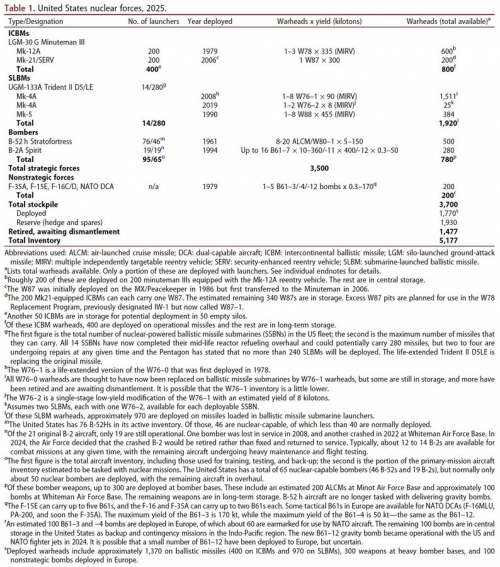
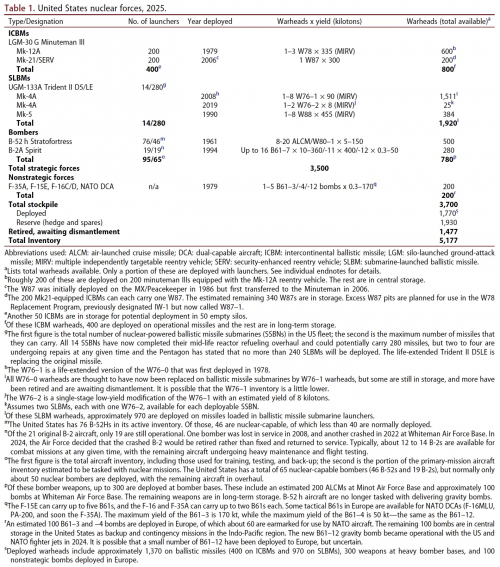
Sentinel’s delays do not alter the fact that the US has far more warheads in storage than it has deployed, and that its current fleet of ICBMs and SLBMs could roughly double their current load of ~1400 warheads. Additionally the number of deployed AGM-86s (~250) could be roughly doubled as well.

For SLBMs, there are enough warheads available that you could double current warhead loadings with a little bit left over.

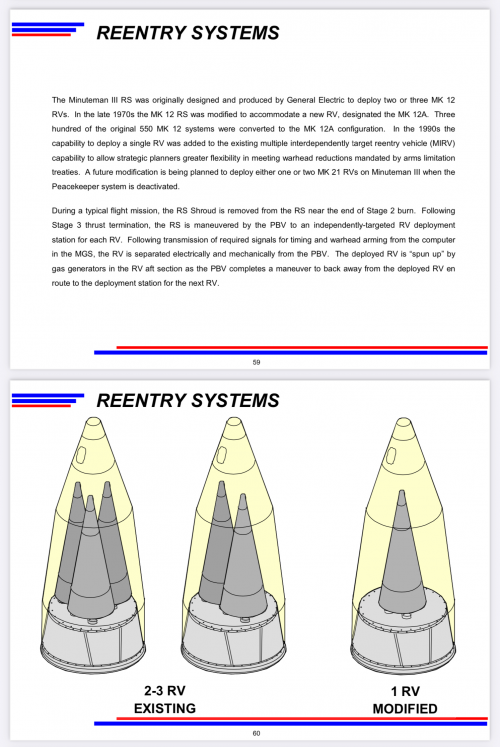
For ICBMs, that's trickier. The existing ICBMs have single-RV clear decks. New clear decks would need to be manufactured before we could upload any ICBMs. You would need to manufacture two different variants of clear decks, as the W78-equipped and W87-equipped ICBMs require different clear deck designs. If new clear decks were manufactured, then the W87-equipped ICBMs would become capable of carrying up to two W87s, while the W78-equipped ICBMs would become capable of carrying up to three W78s.

With regards to available inventory, that's a different matter.

We only have 600 W78s available. Although that is technically enough to load all 200 of the W78-carrying ICBMs with a 3-1 MIRV loading, it would leave zero warheads left over for maintenance activities. Realistically, we probably could not load all 200 with 3-1 MIRV. Still, if we did, that'd allow for tripling the warhead loading on these 200 ICBMs.

For the W87, we have tons of these in inventory, more than enough to load all 200 of the W87-carrying ICBMs with a 2-1 MIRV loading. In fact, we'd be able to load all 200 W87-carrying IBCMs with 2-1 MIRV, then if enough MM III missiles are available to fill the 50 empty silos, we could also fill every one of those silos with a 2-1 MIRV equipped W87-carrying MM III, and still have a modest amount of W87s left over for a (somewhat thin) maintenance pool afterwards.

So for ICBMs, if we stuck to the existing 400 missiles, we could increase total warhead loadings from 400 warheads to up to roughly 1000 warheads, although realistically probably a little lower than this due to the shortage of W78s.

If we added 50 extra missiles in the empty hot silos (which may or may not actuall be possible depending on how much MM III inventory is actually left at this point), then we could increase total warhead loadings from 400 warheads up to roughly 1100 warheads, although realistically probably a little lower than this due to the shortage of W78s.

In a crisis, there are extra W78 pits (and various other components) in central storage that could theoretically be remanufactured into new W78s (although a number of critical components would still need to be newly manufactured), however doing so would be an immensely expensive and slow project, so it probably isn't practical to consider. It's also unclear if certain critical components were preserved or discarded. For example, it's likely that many of the components were preserved, but it's unclear if the RV aeroshells were preserved. If those were lost, then that'd add a tremendous amount of additional difficulty and delay to remanufacturing additional W78s. And regardless of how much is preserved, you'd definitely need to produce new build primary explosives, interstages, radiation cases, and gas transfer systems, all of which would be quite difficult to do in a hurry without compromising the warhead's reliability.

 
For the W87, we have tons of these in inventory, more than enough to load all 200 of the W87-carrying ICBMs with a 2-1 MIRV loading. In fact, we'd be able to load all 200 W87-carrying IBCMs with 2-1 MIRV, then if enough MM III missiles are available to fill the 50 empty silos, we could also fill every one of those silos with a 2-1 MIRV equipped W87-carrying MM III, and still have a modest amount of W87s left over for a (somewhat thin) maintenance pool afterwards.
Or just dig out 34 LGM-118s for the remmaining 340 W87s (note d).

1770912306262.png


Minus checks.
 
Last edited:
Since old nuclear warheads and delivery vehicles are part of the nuclear balance constructed by the START/New START treaties.Even if New START has ended, I don’t think the U.S. can redirect warheads aimed at Russia toward East Asia unless it completely abandons its nuclear commitment to Europe. And China doesn’t have that burden.
Russia and China into a de facto alliance, thanks to Sleepy Joe again.

Then, are you sure you want to compare production capacity with China? The U.S. military’s 21st-century track record of procurement and delays could wallpaper an entire wall—including but not limited to the M10 Booker, Arleigh Burke Flight III, Arleigh Burke Flight IIA, Columbia-class submarine, various hypersonic programs, F-35 upgrades, Constellation-class frigate, etc. The Navy even had to ask South Korea to refurbish a shipyard. At this rate, maybe Elon Musk should take over the Sentinel project?

There are sufficient nuclear warheads to deter China and Russia already built, and enough delivery systems to double the number of deployed weapons if necessary. Additionally, the introduction of the B-21 introduces a brand new nuclear capability, as does the LRSO (which unlike Sentinel has experienced no delays). There will be no gap in capability. Russia has far less ability to upload its existing delivery systems and also has to factor in the nuclear capabilities of UK and France, along with US shared tactical weapons that are compatible with 5th gen platforms and now have sub 30m CEP.

I do not see any cause for concern. Ohio and MM3 will simply be maintained until the delayed replacements come online, and if necessary more warheads will be added to the boosters.
 
Or just dig out 34 LGM-118s for the remmaining 340 W87s (note d).

View attachment 801800
All of the Peacekeeper silos were demolished, and converting existing MM III silos to accept the Peacekeeper missile would be an extraordinarily slow and expensive multi-year project.

The reliability of the retired Peacekeeper boosters would also fail to meet the minimum standards for use in nuclear applications, as said boosters reached the end of their maximum service life 20 years ago (the Peacekeeper boosters were only designed for a 20-year service life). Therefore you would have to remanufacture all of the first, second, and third stage boosters. Because Peacekeeper uses composite boosters, the booster casing cannot be washed out and refilled. Instead, the entire booster casing must be newly manufactured before it can be filled with propellant. In essence, you would be re-building nearly the entire missile from scratch.

The Peacekeeper was the most expensive ICBM the US ever fielded, with an acquisition cost of $243 million dollars per missile (in 2025 USD). That does not even include the costs of R&D, silo conversion, etc, all of which were tremendous. It would be painfully expensive to try to start building new boosters, and it would not happen quickly.

I also doubt that all of the original peacekeeper components were retained. The nosecone, clear deck, guidance system, and PBV are critical items. Even if all of these were retained, it is extremely unlikely that all of the AIRS units remain 100% functional, and there is no remaining parts supply chain for the AIRS (which was notoriously difficult to maintain and keep functional at scale).

In short, this is not even the slightest bit realistic or feasible.
 
The 600 number for the W78 seems a little low, but I cannot find any good source for a count. My understanding is that the 200 W78 equipped missiles could be uploaded rather easily, and the last several MM3 tests did in fact utilize three RBs suggesting that this capability was retained. The missiles converted to mk21 RVs I think were never intended to MiRV and I doubt there is a cost effective way of doing so. I have generally assumed half the fleet could triple its warhead count, roughly doubling the total count. A shortage of W78 might truncate such a deployment.
 
The MMIII Mk78 can be MIRVed up to 3, Mk 87 cannot at least on MMIII (Sentinel will likely be able to carry MIRVed Mk87). Note that you don't need full warheads on the MIRVed MMIIIs, 1-2 full size decoys would significantly increase the survivavility of the actual warheads.
 
The 600 number for the W78 seems a little low, but I cannot find any good source for a count. My understanding is that the 200 W78 equipped missiles could be uploaded rather easily, and the last several MM3 tests did in fact utilize three RBs suggesting that this capability was retained. The missiles converted to mk21 RVs I think were never intended to MiRV and I doubt there is a cost effective way of doing so. I have generally assumed half the fleet could triple its warhead count, roughly doubling the total count. A shortage of W78 might truncate such a deployment.
The original W78 manufacturing run was far larger (estimated at 1083 warheads), but the 483 excess warheads were dismantled at Pantex when the MM III force was (repeatedly) downsized. The 600 number is the number that were remaining in use on the 200 MM III missiles carrying the W78 prior to these missiles finally being de-MIRVed. In all likeliness, the total number deployed aboard those 200 missiles was less than 600 because not all missiles can be fully MIRVed while still being able to reach their targets. However extra warheads would have been retained to allow for maintenance activity to take place without disrupting the number of deployed warheads, and therefore 600 warheads is a reasonable estimate to service 200 MIRVed MM III missiles.

The original design for the Mk21 clear deck was explicitly intended to carry 1–2x RVs, not 1x RV. It was always capable of being MIRVed, it simply could not carry the same maximum loading as with the W62 or W78, as the W87 is significantly heavier (and possibly also larger), which makes it impossible to deploy 3x Mk21 RVs aboard the MM III. But it absolutely can carry 2x Mk21 RVs.

The original 1–2x RV clear deck design for the Mk21 was later scrapped when it became necessary to deploy all Minutemen in a single RV only configuration, as SALT II treaty requirements had demanded that the capability to upload land based missiles be completely and permanently eliminated, therefore new clear decks capable of carrying only a single RV had to be designed (and the old W62 MIRV clear decks had to be removed and physically destroyed).

Similarly, the W62/W78 clear deck was originally only capable of carrying 2–3x RVs; an entirely new clear deck design had to be created in order to permit carrying a single RV. This new clear deck design was deployed to all of the 200 Minuteman III missiles that carry W78s during the process of de-MIRVing said missiles.

Screenshot 2026-02-12 at 11.19.07 AM.png

If you look at more recent photos/videos of the Minuteman III missile that show the RV, you can see that there are only a single set of ball lock attachments on the clear decks. There aren't a lot of recent (post de-MIRVing) photos/videos, and the ones that exist are heavily biased towards showing the SERV (Mk21/W87) MM IIIs, but I've come across a handful of photos/videos of the non-SERV (Mk12A/W78) MM IIIs confirming that the same is true for the Mk12A.
 
@JTR

There have been tests with three RBs on MM3, in fact I believe the last three. So either some equipment to host three warheads was stored for future use or some mechanism for building them still exists. I suspect the former.
 
Now, with all that being said, I'm quite doubtful as to the practical usefulness of a 895 nmi range ballistic missile.
In the context of a Swedish submarine firing such a missile from the Baltic or Gulf of Bothinia, the distance from Stockholm to St.Petersburg is.....694km?
Call it 375nm
And the distance from Sweden to Moscow is.....1231km according to one website. Call it 665nm

So in the context of a Swedish Submarine possibly arming itself with a cut down version of Trident. The system seems to offer a valid Deterrent capability to hit major population centres in Northwestern Russia, Kaliningrad and Belarus.
 
In the context of a Swedish submarine firing such a missile from the Baltic or Gulf of Bothinia, the distance from Stockholm to St.Petersburg is.....694km?
Call it 375nm
And the distance from Sweden to Moscow is.....1231km according to one website. Call it 665nm

So in the context of a Swedish Submarine possibly arming itself with a cut down version of Trident. The system seems to offer a valid Deterrent capability to hit major population centres in Northwestern Russia, Kaliningrad and Belarus.
Except for the ease of finding a sub in the Baltic, under land-based MPA backed up by ASW ships and their helicopters.

I did a guesstimate of how to maximally upload the USN a while back, IIRC it worked out to a mixed loadout of a couple of minimally-loaded W76mod2s, ~4x max loaded W88s, and the rest max loaded W76s. (Sorry, don't remember which thread it was in here)
 
(Sorry, don't remember which thread it was in here)
Found it! https://www.secretprojects.co.uk/threads/current-nuclear-weapons-development.13965/post-810907

8x W88, 12x W76.
  • W88s are 475kt.
  • W76-0 are 100kt.
  • W76-1 are 90kt. (not sure for the reason behind the reduced yield)
  • W76-2 are about 5-7kt (references aren't clear).
An advantage of using W76s is that they're a lot lighter than W88s, ~95kg versus ~175-180kg. So 8x W76 is roughly the same weight as 4x W88, which gets you more range. Per a 2007 report that I have attached, loading 4x W88s would get you a range of ~11,500km in a mathematical guesstimate. The tables in question are on Page 43 of the PDF.

There were ~400x W88 warheads made (production run greatly cut short), so W76s got recycled from Trident I. ~3400x W76s built, and the -1 and -2 variants were made by remanufacturing older warheads. There's about 2000 W76-1 warheads, and an unspecified number of -2s. For our purposes, I'm assuming less than 120x W76-2s deployed on boats, (14 boats * 3 warheads per missile * 2 missiles per boat makes 84, 14*4*2 makes 112).

400x W88s spread across 14 subs is 28.5 warheads per sub. I'm going to assume that a small number of W88/Mk5 RBAs would be held in reserve in case one bird tests bad. I'm going to assume 24x W88s per sub (336 at sea, leaving 64 ashore). Several different ways we could assign those out, I'm actually thinking 4 per bird to get all the missiles to have about the same range. So that's 6 birds per boat, and probably no change from reported deployed numbers.

Then we can grab 8x W76-1 per bird and 16 birds per boat, 1792 warheads at sea. This is the only actual increase of deployed warheads, and we're only doubling what's in use. So an increase of 896 warheads.

Now comes the unexpected habanero. W76-2 low yield warheads. I'm assuming 2 birds per boat, loaded with 4 or fewer warheads each. (no change from reported deployed numbers!) If the boats have more Low Yield birds, that reduces the number of warheads going from stockpile to deployed.


This plan moves ~900 warheads from stockpile to deployed for the US. That leaves ~1000 in stockpile and ~1500 dismantled.

But that's just Trident, we also have Minuteman.

There are 400x MM3s to upload back to 3x W78s or W87s each. There are ~1000x W78s and 525x W87s made. 175 of the MM3 could get 3x W87s (525 total, an increase of 350), and the remaining 225 MM3s would get 3x W78s (675 total, increase of 450). This moves another 800 warheads from stockpile to deployed.
So I greatly misremembered.

~6x 4xW88, ~2x 2-4xW76-2, 16x 8xW76-1 was the heavy upload plan.
 
Found it! https://www.secretprojects.co.uk/threads/current-nuclear-weapons-development.13965/post-810907


So I greatly misremembered.

~6x 4xW88, ~2x 2-4xW76-2, 16x 8xW76-1 was the heavy upload plan.
You claim that there are about 2000 W76-1 warheads. This is incorrect. There were only around 1600 W76-1 warheads manufactured in total, and FAS estimates that there are only 1511 W76-1 warheads in total within the active stockpile as of 2025. While it's possible that the active stockpile is slightly larger than this, it definitely is no larger than 1600 at the utmost, and I am inclined to believe that FAS's estimate is probably the most realistic estimate with regards to the number of warheads that are actually currently available for unrestricted use. Either way, your 1792 W76-1 warheads at sea plan is impossible.

You claim that there are 120 W76-2 warheads. This is most likely incorrect. While we do not have firm knowledge on the exact number of W76-2 warheads manufactured, FAS estimates that there are only 25 W76-2 warheads in total within the active stockpile as of 2025. While it is possible that slightly more than that were manufactured, I seriously doubt that more than about 50 or so were ever manufactured at the very most. Either way, your 84–112 W76-2 warheads at sea plan is impossible.

You claim that there are 400 W88 warheads. This is also incorrect. Attrition has been a serious issue for the W88 force, and while the limited pit manufacturing campaign helped partially offset this, that campaign could not sufficiently offset the number being lost to attrition from mandatory destructive testing to avoid a decrease in the total stockpile. FAS estimates that there are only 384 W88 warheads in total within the active stockpile as of 2025. I think their estimate is reasonably accurate, and if anything may be a bit overly optimistic. Unlike the other two warhead types, these corrections would not impact the results of your analysis, as you had planned on only deploying 336 of these warheads, which still leaves 48 left over. Therefore your W88 plans remain possible.

Your Minuteman III warhead figures have similar flaws.

Only 600 W78s are still available, as the rest have been dismantled at Pantex. Therefore your plan to deploy 675 of these is impossible. Additionally, your figures for the total number of W78s manufactured are inaccurate (1083 were manufactured, not 1000).

The MM III is incapable of 3x W87 MIRV, as it tops out at 2x W87 MIRV. Therefore your plan to deploy 525 aboard 175 missiles is impossible. Additionally, your figures for the total number of W87s manufactured are inaccurate (567 were manufactured, not 525), and your figures for current stockpiles of W87s are also inaccurate (540 are available, not 525).
 
Except for the ease of finding a sub in the Baltic, under land-based MPA backed up by ASW ships and their helicopters.

While I think the idea of a Nordic country adopting nukes or the US supplying Trident tech rather far fetched, it seems super unlikely Russia will be running surface ships or especially MPAs over the Baltic in any war with NATO.
 
You claim that there are about 2000 W76-1 warheads. This is incorrect. There were only around 1600 W76-1 warheads manufactured in total, and FAS estimates that there are only 1511 W76-1 warheads in total within the active stockpile as of 2025. While it's possible that the active stockpile is slightly larger than this, it definitely is no larger than 1600 at the utmost, and I am inclined to believe that FAS's estimate is probably the most realistic estimate with regards to the number of warheads that are actually currently available for unrestricted use. Either way, your 1792 W76-1 warheads at sea plan is impossible.
That whole post was in terms of maximally uploading the US. If the real total warhead numbers for W88 or W76-1 don't support that, they don't support it. The reason for going with 8x W76 and 4x W88s was so that the missiles all nominally had the same range.

The next step down that is balanced on the missile and likely doesn't require a full new-production annulus for W76-1s would be 6 warheads per bird, and that would mean 1344 total warheads deployed. This would impact missile range for the better, though it would change the minimum-energy trajectories involved.


You claim that there are 120 W76-2 warheads. This is most likely incorrect. While we do not have firm knowledge on the exact number of W76-2 warheads manufactured, FAS estimates that there are only 25 W76-2 warheads in total within the active stockpile as of 2025. While it is possible that slightly more than that were manufactured, I seriously doubt that more than about 50 or so were ever manufactured at the very most. Either way, your 84–112 W76-2 warheads at sea plan is impossible.
Now, as to the W76-2.

A nuclear mission requires backups. Backups all the way to warhead release.

Especially one as critical as the escalate-to-deescalate (or "pre-strategic," to use the French term) W76-2. So, minimum of two warheads per bird for balance or in case one warhead tests bad (if both test good one does not detonate and gives some target an impact crater instead), two birds per boat in case one bird tests bad, times all 14 boats because the boats do not offload or onload between patrols as a general practice. Missile Moves are a rare thing!

Following that logic, that makes at least (2*2*14=) 56x W76-2 deployed.

The higher numbers are for examples as to why I said "for our purposes, I'm assuming less than 120x W76-2s deployed on boats."


Giving all the boats the same warhead mix is for simplicity, as I suspect that there would be a variation based on Pacific or Atlantic and the different targets assigned to boats in those different oceans. IIRC the boat split is 8 in the Pacific and 6 in the Atlantic. We could make assumptions that the LANT boats would have more or even total W88 loads, but I don't have the research depth to say if that is a reasonable assumption. So I'm sticking with every boat gets the same loadout, the only difference is the serial numbers.


You claim that there are 400 W88 warheads. This is also incorrect. Attrition has been a serious issue for the W88 force, and while the limited pit manufacturing campaign helped partially offset this, that campaign could not sufficiently offset the number being lost to attrition from mandatory destructive testing to avoid a decrease in the total stockpile. FAS estimates that there are only 384 W88 warheads in total within the active stockpile as of 2025. I think their estimate is reasonably accurate, and if anything may be a bit overly optimistic. Unlike the other two warhead types, these corrections would not impact the results of your analysis, as you had planned on only deploying 336 of these warheads, which still leaves 48 left over. Therefore your W88 plans remain possible.
Was not aware that attrition had been so severe.


Your Minuteman III warhead figures have similar flaws.

Only 600 W78s are still available, as the rest have been dismantled at Pantex. Therefore your plan to deploy 675 of these is impossible.
Was not aware that so many had been disassembled. This greatly reduces potential upload.


Additionally, your figures for the total number of W78s manufactured are inaccurate (1083 were manufactured, not 1000).
Rounding to nearest 1000.


The MM III is incapable of 3x W87 MIRV, as it tops out at 2x W87 MIRV.
When I wrote that I was under the impression that W87s were the same bulk as W78s so a Minuteman could carry 3. I don't remember now if that was a misreading, a bad source, or just a bad brain.


Therefore your plan to deploy 525 aboard 175 missiles is impossible.
Shrug.

So we load 500x W87s on 250x MM3s if we can only physically fit 2x W87 per MM3. The point of that post was to maximally upload.


Additionally, your figures for the total number of W87s manufactured are inaccurate (567 were manufactured, not 525), and your figures for current stockpiles of W87s are also inaccurate (540 are available, not 525).
Rounding and rounding.

450x MM3, 3*175=525 W87, 3x275=650 W78

There's 275 MM3 that could have W78s if 175 were getting W87s. If there's only 600x W78 left we're stuck with not being able to deploy the entire quantity. That said, 190x3=570.

Which would change the MM3 maximum upload plan to 500x W87s onto 250x MM3s, 570x W78s onto 190x MM3s, and leave 10x MM3s as single W87 for deep targets.
 
That whole post was in terms of maximally uploading the US. If the real total warhead numbers for W88 or W76-1 don't support that, they don't support it. The reason for going with 8x W76 and 4x W88s was so that the missiles all nominally had the same range.

The next step down that is balanced on the missile and likely doesn't require a full new-production annulus for W76-1s would be 6 warheads per bird, and that would mean 1344 total warheads deployed. This would impact missile range for the better, though it would change the minimum-energy trajectories involved.

There is no reason why all missiles would need to have identical nominal ranges. The original design was intended to support 8x W88 or 12x W78 (or 8x W76), which going by your math would already produce a wide array of significantly different ranges all on its own even before downloading is brought into the picture. The Minuteman III shows how having a wide range of different missile configurations offering wildly different ranges can be a significant advantage, and even a necessity. The original version with the W62 offered four different loading options; the introduction of the W78 added four more, and a mix of all eight configurations was used until the de-MIRVing project began.

The range of targets from submarine launching areas is going to vary substantially depending on the exact combination of launching area and target locations being targeted. It's quite unlikely that most (let alone all) missiles will be flying METs.

Now, as to the W76-2.

A nuclear mission requires backups. Backups all the way to warhead release.

Especially one as critical as the escalate-to-deescalate (or "pre-strategic," to use the French term) W76-2. So, minimum of two warheads per bird for balance or in case one warhead tests bad (if both test good one does not detonate and gives some target an impact crater instead), two birds per boat in case one bird tests bad, times all 14 boats because the boats do not offload or onload between patrols as a general practice. Missile Moves are a rare thing!

Following that logic, that makes at least (2*2*14=) 56x W76-2 deployed.

The higher numbers are for examples as to why I said "for our purposes, I'm assuming less than 120x W76-2s deployed on boats."

You can simply load ballast on the missile in lieu of a second W76-2.

It is not customary to have multiple warheads released from a single missile impact the same target, as this creates severe difficulty with providing enough separation between detonations of each warhead to avoid fratricide effects.

Having two warheads on the same missile for targeting the same target "in case one tests bad" is a very poor strategy that needlessly wastes nuclear warheads for no good reason. This is not done for any other warhead. Why would it be done here?

Two birds per boat seems like immense overkill. Why waste two precious tubes on useless W76-2 equipped Tridents? They are of effectively nearly zero utility in most second-strike scenarios, and force you to upload all of your other missiles even more heavily. Even in their intended role, they are of extremely limited utility. A stealth bomber equipped with a B61 is a far better option 99% of the time. And if one were to be deployed, how time sensitive would it even be? Odds are in a scenario where you're considering using one, if the missile is unavailable due to some fault, you can simply send a bomber instead.

I don't see any reason why a single missile per boat loaded with a single W76-1 (and ballast) wouldn't be sufficient.

Was not aware that attrition had been so severe.

I alluded to this in some of my previous posts a while back, although admittedly it is perhaps unfair to assume that you read them.

Rounding to nearest 1000.

Fair enough.

When I wrote that I was under the impression that W87s were the same bulk as W78s so a Minuteman could carry 3. I don't remember now if that was a misreading, a bad source, or just a bad brain.

The W62 is 160 kg (350 lbs), the W78 is 175 kg (385 lbs), and the W87 is 200 kg (440 lbs).

The original missile struggled to deliver the W62 to all targets, especially if penaids were carried. A significant number of targets could only be reached by missiles with 2-1 MIRV.

The W78 made this significantly worse, so much so that the W62 had to be retained to handle the most distant target sets.

The W87 is even worse than the W78 in terms of weight, and may also be slightly larger. If it is slightly larger, then it is likely that this physically prohibits loading more than two W87s onto a MM III. Even if it is not larger, the sheer weight is high enough that loading it in 3-1 MIRV would be crippling in terms of its effects on missile range.

Shrug.

So we load 500x W87s on 250x MM3s if we can only physically fit 2x W87 per MM3. The point of that post was to maximally upload.

No major argument against that revised plan, outside of pointing out that it's not quite clear if we can actually sustain a 450-missile MM III force given the shortage of boosters and the Sentinel delays. It's already unclear if we'll be able to sustain a 400-missile MM III force long enough to transition over to Sentinel without being forced to start pulling missiles off of alert to use as test articles.

Rounding and rounding.

450x MM3, 3*175=525 W87, 3x275=650 W78

There's 275 MM3 that could have W78s if 175 were getting W87s. If there's only 600x W78 left we're stuck with not being able to deploy the entire quantity. That said, 190x3=570.

Which would change the MM3 maximum upload plan to 500x W87s onto 250x MM3s, 570x W78s onto 190x MM3s, and leave 10x MM3s as single W87 for deep targets.

This isn't rounding. Rounding would be saying 500 were available.

A mixed force would likely have some unknown portion of the W78-carrying missiles configured for 2-1 MIRV. Back in the day, a substantial portion of both the W62 and W78 force was configured for 2-1 MIRV. A 2-1 MIRV W78-carrying MM III can throw its RVs to a longer range than a 2-1 MIRV W87-carrying MM III, and is substantially more efficient in terms of missile utilization than a single-RV W87-carrying MM III. Some targets would still require single-RV MM III configurations since the 2-1 MIRV W62-carrying MM III option is no longer available. I suspect there would probably be significantly more than just 10 targets in this class.
 
You claim that there are about 2000 W76-1 warheads. This is incorrect. There were only around 1600 W76-1 warheads manufactured in total, and FAS estimates that there are only 1511 W76-1 warheads in total within the active stockpile as of 2025. While it's possible that the active stockpile is slightly larger than this, it definitely is no larger than 1600 at the utmost, and I am inclined to believe that FAS's estimate is probably the most realistic estimate with regards to the number of warheads that are actually currently available for unrestricted use. Either way, your 1792 W76-1 warheads at sea plan is impossible.
Based on latest figures:

1511 W76-1
25 W76-2
384 W88
Some W76-0 in storage?

1770974807527.png
 
Based on latest figures:

1511 W76-1
25 W76-2
384 W88
Some W76-0 in storage?

View attachment 801850
Nearly all of the W76-0 warheads have already been dismantled at Pantex. In theory all of them should have been dismantled by now (dismantlement was scheduled to be 100% complete as of a number of years ago).

I suspect any remaining W76-0 warheads are special test articles used to test the results of extended aging effects on the original design (the results of which are of use for validating certain assumptions regarding the expected life of the W76-1, which is expected to significantly exceed the design life of the original W76-0), and likely number no more than a few dozen at most.
 
You can simply load ballast on the missile in lieu of a second W76-2.
You can.

What happens when you prepare to launch it and the lone warhead says "I no go boom" for some reason? (probably the fuze saying "nope, not working")

With a second warhead onboard you get two chances for that bird to fly and only one of the warheads needs to say "I go boom today".

With 2 birds per boat, the guidance of one bird can fail, so you launch the backup bird.

And in that case you only ARM one warhead, the other makes a kinetic crater somewhere. Where is not important, but if you can make a military point by dropping a 400lb DU cone on someplace your "pre-strategic" launch gets a bonus. (Downside being that the impact crater would be extra-spicy for a while till the Pu and HEU all decayed)


It is not customary to have multiple warheads released from a single missile impact the same target, as this creates severe difficulty with providing enough separation between detonations of each warhead to avoid fratricide effects.
Good thing we're not actually dropping two armed nukes, then. Only 1. The other one lawn darts with no boom, as if it was ballast.


Having two warheads on the same missile for targeting the same target "in case one tests bad" is a very poor strategy that needlessly wastes nuclear warheads for no good reason. This is not done for any other warhead. Why would it be done here?
Because this usage profile is the last warning before a full strategic launch.

So you want to make sure the message is received.


Two birds per boat seems like immense overkill. Why waste two precious tubes on useless W76-2 equipped Tridents?
What happens when, in the time of use, the missile says "I no fly today"? (This assumes a missile fault that the crew cannot correct, not a failure that the crew can correct, likely guidance related)

There's no way for the sub to tell STRATCOM "send another boat". Only a strange lack of a missile flying on schedule.

Also, remember that we're talking about needing another 112 W76-1s if we went with a single tube loadout. 1344+112=1456, so it's just barely possible under the 1500 limit.


This isn't rounding. Rounding would be saying 500 were available.
Depends on what you're rounding to. Nearest hundred, nearest quarter, nearest 10...

A mixed force would likely have some unknown portion of the W78-carrying missiles configured for 2-1 MIRV. Back in the day, a substantial portion of both the W62 and W78 force was configured for 2-1 MIRV. A 2-1 MIRV W78-carrying MM III can throw its RVs to a longer range than a 2-1 MIRV W87-carrying MM III, and is substantially more efficient in terms of missile utilization than a single-RV W87-carrying MM III. Some targets would still require single-RV MM III configurations since the 2-1 MIRV W62-carrying MM III option is no longer available. I suspect there would probably be significantly more than just 10 targets in this class.
Possible, though the wiki article suggests that most of the targets in the max range class were in the Soviet Stans, where modern Russia no longer has silos or road-mobile TELs. Which is why I went with such a low number of single-warhead MM3s.

If there's more max-range targets we adjust.

Based on latest figures:

1511 W76-1
25 W76-2
384 W88
Some W76-0 in storage?

View attachment 801850
Note K on that page says "Assumes 2 SLBMs, each with one W76-2 for each deployable SSBN."
 
You can.

What happens when you prepare to launch it and the lone warhead says "I no go boom" for some reason? (probably the fuze saying "nope, not working")

With a second warhead onboard you get two chances for that bird to fly and only one of the warheads needs to say "I go boom today".

With 2 birds per boat, the guidance of one bird can fail, so you launch the backup bird.

And in that case you only ARM one warhead, the other makes a kinetic crater somewhere. Where is not important, but if you can make a military point by dropping a 400lb DU cone on someplace your "pre-strategic" launch gets a bonus. (Downside being that the impact crater would be extra-spicy for a while till the Pu and HEU all decayed)
Good thing we're not actually dropping two armed nukes, then. Only 1. The other one lawn darts with no boom, as if it was ballast.
Because this usage profile is the last warning before a full strategic launch.

So you want to make sure the message is received.
What happens when, in the time of use, the missile says "I no fly today"? (This assumes a missile fault that the crew cannot correct, not a failure that the crew can correct, likely guidance related)

There's no way for the sub to tell STRATCOM "send another boat". Only a strange lack of a missile flying on schedule.

All of these "issues" would be solved by loading two missiles per boat, each containing a single W76-2 and some ballast. This would neatly avoid all of the problems that loading two W76-2 warheads per bird causes.

You still haven't provided adequate justification for why warhead failure cannot be compensated for by simply sending another bird, or why wasting extra warheads (which cost an obscene amount of money and actively reduce the number of useful warheads available for strategic targeting) would be justifiable here. Remember, this is a weapon that was developed and deployed while New START constraints on total warhead numbers were still in effect.

With 12 boats at sea, that results in only 24 warheads needed. If we assume warheads are not offloaded while boats are in overhaul, that's still only 28 warheads needed. Throw in a couple extra for maintenance, and that's still well under 50 warheads needed in total.

Also, remember that we're talking about needing another 112 W76-1s if we went with a single tube loadout. 1344+112=1456, so it's just barely possible under the 1500 limit.

That's not my problem, it's your problem. You're the one who made assumptions that contradict the reality of the situation (as indicated by the best available sources on the subject, all of which agree that no more than a few dozen of these warheads were manufactured). You're also rigidly assuming that every missile carries the exact same payload, an assumption that we already know to be false.

Depends on what you're rounding to. Nearest hundred, nearest quarter, nearest 10...

Except you yourself rounded the W78 numbers down from 1083 to 1000 instead of to 1075 or 1050, so you've contradicted your own rules for rounding here.

Possible, though the wiki article suggests that most of the targets in the max range class were in the Soviet Stans, where modern Russia no longer has silos or road-mobile TELs. Which is why I went with such a low number of single-warhead MM3s.

If there's more max-range targets we adjust.

There are plenty of Chinese targets now that are even harder to reach than the Russian targets ever were. In fact, I'd argue that the Chinese target set is far more challenging to the land based missile force than the Russian target set ever was.

This is especially true now that China is adding at least 500 brand-new ICBM silos. It was already bad enough before this, but with the new target set, the capabilities of MM III are going to be strained to their limit. Indeed, the current single-RV minuteman force is now outright incapable of being used as a credible counterforce threat against the modern Chinese land-based missile force. Unlike modern day Russia, China has been more than capable of emulating the Cold War era US practice of building a ridiculous number of individual missile silos.

In addition, the Minuteman force should ideally be capable of being used for counter-value targeting, which is extremely difficult against China given the locations of their most major cities. While the existing single-RV force isn't as badly disadvantaged here (although this is still an issue), an uploaded re-MIRVed force would be severely disadvantaged for counter-value targeting of China.

Hopefully the Sentinel will be designed with a substantial increase in both range and throw weight to counter the Chinese threat. The best way to prevent a future nuclear exchange with China is to ensure we retain a fully credible nuclear deterrent capability, and our current nuclear deterrent capability is simply no longer up to that task with modern-day Chinese nuclear force capabilities (which is no surprise, as it was never designed with China as a superpower-level nuclear threat in mind).

Note K on that page says "Assumes 2 SLBMs, each with one W76-2 for each deployable SSBN."

So it agrees with me that only one warhead is loaded per missile...
 
All of these "issues" would be solved by loading two missiles per boat, each containing a single W76-2 and some ballast. This would neatly avoid all of the problems that loading two W76-2 warheads per bird causes.
No, because it is possible to have guidance on bird 1 go down (missile no fly) and warhead on bird 2 go down (no go boom)

I'd need access to reliability data that should be classified "never releasable ever" for how likely this actually is.

Having 2 warheads per bird (when we have around 200 unused) is trivial.


You still haven't provided adequate justification for why warhead failure cannot be compensated for by simply sending another bird, or why wasting extra warheads (which cost an obscene amount of money and actively reduce the number of useful warheads available for strategic targeting) would be justifiable here. Remember, this is a weapon that was developed and deployed while New START constraints on total warhead numbers were still in effect.
You were the one saying that there was only 1 W76-2 per boat:
Why waste two precious tubes on useless W76-2 equipped Tridents?
So now it's okay?


With 12 boats at sea, that results in only 24 warheads needed. If we assume warheads are not offloaded while boats are in overhaul, that's still only 28 warheads needed. Throw in a couple extra for maintenance, and that's still well under 50 warheads needed in total.
Or we field 2 warheads per bird and 2 birds, plus a couple extras and we're still at around 60. And again, there's around 200 unused W76s to work with.


So it agrees with me that only one warhead is loaded per missile...
No, it ASSUMES only 1 warhead is loaded per missile. When the easiest ballast is in fact a live reentry body. (and ignoring the fact that the Bus is also dropping in to visit the target)
 
No, because it is possible to have guidance on bird 1 go down (missile no fly) and warhead on bird 2 go down (no go boom)

I'd need access to reliability data that should be classified "never releasable ever" for how likely this actually is.

Correct me if I'm mistaken, but I was under the impression that the Ohio-class submarines were equipped to make repairs to the guidance system of Trident missiles while underway, and carried a stock of spare components onboard to repair most types of guidance system failures.

Having 2 warheads per bird (when we have around 200 unused) is trivial.

Where is your source that we manufactured 200+ W76-2 warheads?

The sources I have read say that the W76-2 production run was done by redirecting a small number of the existing W76-1 warhead production for modifications to create the W76-2. In other words, every single W76-2 warhead is a warhead that was originally planned to be a W76-1, and the final W76-1 production run produced a total number of W76-1 warheads that was short from the planned number of W76-1 warheads by the number of W76-2 warheads produced.

The sources I have read also universally agree that the size of the W76-2 production run was extremely small. The largest estimates were that at most a few dozen warheads in total were produced (~24–48), or that approximately 50 were produced (~50). The smallest estimate were that as few as a dozen or less were produced (~6–12).

I have not seen ANY credible estimates anywhere in the vicinity of 200. Where are you getting these numbers from?

This isn't the Cold War anymore, we don't have unlimited resources to throw at building ultra-niche warhead variants, and the W76-2 is a program that has been widely reported to be extremely low priority, largely unwanted by the military, and only produced in tiny numbers in order to satisfy a political mandate that was foisted on them unwillingly for purely political reasons.

Additionally, since every W76-2 built is a planned W76-1 that no longer exists, building 200 W76-2 warheads implies that the W76-1 production run was actually closer to 1400 warheads instead of the planned 1600 warheads. I seriously doubt that the Navy would tolerate such a large reduction in their stockpile of W76-1 warheads on top of all the cuts that had already been made just to get to the 1600 warhead number (remember, there were originally 3400 of the W76-0 warheads in the stockpile).

You were the one saying that there was only 1 W76-2 per boat:
So now it's okay?

I personally think it's foolish to deploy more than one missile per boat. However, I also trust FAS's estimates, and I believe that if two missiles are deployed per boat, then they are most likely only equipped with single warheads.

I can see an argument for deploying missiles with two W76-2 warheads on them, but only for the purposes of allowing strikes on more than one location simultaneously, not for the purpose of striking the same location with two warheads.

And given the limited available stockpile of W76-2 warheads, I believe that if any missiles are deployed with two W76-2 warheads on them, then either these are only a tiny subset of the total number of W76-2 equipped missiles out there, or they are being deployed on only one missile per boat (with no other W76-2 equipped missile carried on most or all boats).

Or we field 2 warheads per bird and 2 birds, plus a couple extras and we're still at around 60. And again, there's around 200 unused W76s to work with.

Once again, you have produced no sources to support your extremely unlikely assertion that 200 W76-2 warheads were manufactured.

No, it ASSUMES only 1 warhead is loaded per missile. When the easiest ballast is in fact a live reentry body. (and ignoring the fact that the Bus is also dropping in to visit the target)

The easiest ballast is a piece of metal (or metal coated concrete) equipped with a set of attachment points on the bottom to attach it to the adapter plate on the Trident PBV. It is cheap and simple. All it needs to do is weigh the exact same as the weight of a Mk4 RB + external spin-up mechanism (can't remember the correct name for this part). It does not need to be sophisticated. It's serving as ballast only, not as a decoy or a penaid (no US SLBM uses decoys or penaids).

The perfect ABM decoy is a warhead. But we don't need ABM decoys here, we only need ballast. The perfect ballast is something cheap and rugged with the exact same weight as a live RB + spin-up mechanism and dimensions that do not exceed the allowable space aboard the Trident annulus. It does not even need to be capable of surviving reentry, nor does it even need to be ejected from the PBV. It can simply burn up on reentry with the rest of the PBV.
 
Correct me if I'm mistaken, but I was under the impression that the Ohio-class submarines were equipped to make repairs to the guidance system of Trident missiles while underway, and carried a stock of spare components onboard to repair most types of guidance system failures.
I'm not sure I could say what types of repairs would be possible onboard, but yes a lot of things could have been repaired onboard then.

I know that some types of failures aren't. Or rather, weren't back when I was in and the Navy's ability to repair things onboard/in-house has only decreased since I got out.


Where is your source that we manufactured 200+ W76-2 warheads?
~200 unused W76-1s that we could turn into W76-2.

My plan only needs around 60 W76-2s.
 
Btw. what about the W83? The B83 was meant to phase out and replace by B61-12. But the situation has changed. Wouldn't it be convenient to keep them to "increase" inventory? They would need to be refurbished/updated/or recycled into a new design for other delivery systems. Similar to the B61 a JDAM tail kit replacement for the parachute might also work. They would need to be lofted for airburst, though.
 
Btw. what about the W83? The B83 was meant to phase out and replace by B61-12. But the situation has changed. Wouldn't it be convenient to keep them to "increase" inventory? They would need to be refurbished/updated/or recycled into a new design for other delivery systems. Similar to the B61 a JDAM tail kit replacement for the parachute might also work. They would need to be lofted for airburst, though.
The B83s are carried by B-2s aren't they?
 
Btw. what about the W83? The B83 was meant to phase out and replace by B61-12. But the situation has changed. Wouldn't it be convenient to keep them to "increase" inventory? They would need to be refurbished/updated/or recycled into a new design for other delivery systems. Similar to the B61 a JDAM tail kit replacement for the parachute might also work. They would need to be lofted for airburst, though.

They were never taken out of service. They have a big bang but the accuracy is very poor unless it is deployed in a low altitude “lay down” release with time delay. Even then, you could probably get better results with a B-61 mod 13 (340 kT max guided strategic mod 7).
 
Given how the PLA is rapidly increasing the number of nuclear warheads in its' inventory what are the odds that a JDAM style tail-kit modification will be developed for the B83?
 
Given how the PLA is rapidly increasing the number of nuclear warheads in its' inventory what are the odds that a JDAM style tail-kit modification will be developed for the B83?

IMO, very low. It seems more likely that more B-61-13 would be produced instead since the design is already developed and tested. There’s really not much that can possibly resist 340kT with 30m CEP, plus B-61 is about 1/3 of the weight.
 
Last edited:
Given how the PLA is rapidly increasing the number of nuclear warheads in its' inventory what are the odds that a JDAM style tail-kit modification will be developed for the B83?
Very little.

The B61Mod13 was designed to replace the B83. Basically a Mod12's INS-guidance system on a Mod11 ~340-400kt boom.

Because you don't need 1.2MT when you're putting the warhead within 30m.
 
Well I think existing mod7 was used for mod 13 and mod 11s with earth penetrating ability were retained as is, despite previous statements that mod 12 would replace all B-61 types. It now looks like the only type being completely retired are tacticals mod 3/4 (replaced with -12).
 
Well I think existing mod7 was used for mod 13 and mod 11s with earth penetrating ability were retained as is, despite previous statements that mod 12 would replace all B-61 types. It now looks like the only type being completely retired are tacticals mod 3/4 (replaced with -12).
The odd thing is that there seems to be no push to replace the B61-7. I'm not sure if that's because they feel they need to retain a parachute retarded option, or if it's because they simply don't have enough funding to convert all of the B61-7s into B61-13s. My guess would be that it's probably the later.

At one point a number of decades back an earth-penetrating version of the B83 was under development. Now that would have been a truly terrifying bunker busting weapon, especially so if it was married to a modern guidance kit. Imagine a B83 EPW with the B61-12 guidance kit! 1200 kilotons of bunker busting EPW with a 30 m CEP would make short work out of Kosvinsky Kamen or Mount Yamantau.

With that being said, the B61-12 is more than capable enough to replace the existing B83, as long as enough B61-12s are manufactured to maintain parity (or near parity) on capabilities. Unfortunately it doesn't look like there are any plans to manufacture more than a tiny number of B61-12 bombs, so that makes the push to get rid of the B83 look more than a little suspect.
 
At one point a number of decades back an earth-penetrating version of the B83 was under development. Now that would have been a truly terrifying bunker busting weapon, especially so if it was married to a modern guidance kit. Imagine a B83 EPW with the B61-12 guidance kit! 1200 kilotons of bunker busting EPW with a 30 m CEP would make short work out of Kosvinsky Kamen or Mount Yamantau.
For sure.


With that being said, the B61-12 is more than capable enough to replace the existing B83, as long as enough B61-12s are manufactured to maintain parity (or near parity) on capabilities. Unfortunately it doesn't look like there are any plans to manufacture more than a tiny number of B61-12 bombs, so that makes the push to get rid of the B83 look more than a little suspect.
But how many targets really need 350kt within 30m to destroy?
 

Similar threads

Back
Top Bottom