
You are using an out of date browser. It may not display this or other websites correctly.
You should upgrade or use an alternative browser.
You should upgrade or use an alternative browser.
Current Nuclear Weapons Development
- Thread starter bobbymike
- Start date

- Joined
- 21 April 2009
- Messages
- 14,361
- Reaction score
- 9,461
Scott Kenny
ACCESS: USAP
- Joined
- 15 May 2023
- Messages
- 19,595
- Reaction score
- 28,069
The B61 won't fit into the F-35B's bays, the LiftFan takes up a little bit of bay volume. B61 will fit into -Alpha and -Charlie bays.
All the Nimitz-class carriers should have secure storage already built in, and someone should have archive copies of the old response plans for who goes where etc in a drill.
The Ford-class may not have a secure storage designed in.
All the Nimitz-class carriers should have secure storage already built in, and someone should have archive copies of the old response plans for who goes where etc in a drill.
The Ford-class may not have a secure storage designed in.
The Ford-class may not have a secure storage designed in.
IMO that would be a very serious overbite if the Ford-class doesn't secure storage for special stores.
Scott Kenny
ACCESS: USAP
- Joined
- 15 May 2023
- Messages
- 19,595
- Reaction score
- 28,069
Carriers would have been prohibited from carrying any for 20ish years, why would they deliberately include special weapons storage areas?IMO that would be a very serious overbite if the Ford-class doesn't secure storage for special stores.
- Joined
- 21 April 2009
- Messages
- 14,361
- Reaction score
- 9,461
If someone at USNI wrote the article my guess would be the Fords have this capability.Carriers would have been prohibited from carrying any for 20ish years, why would they deliberately include special weapons storage areas?
Hopefully when they were building a ship that will probably sail beyond 2080 someone said “ya know the world may change in the next 55 years”
Scott Kenny
ACCESS: USAP
- Joined
- 15 May 2023
- Messages
- 19,595
- Reaction score
- 28,069
You greatly overestimate the fun of federal compliance.Hopefully when they were building a ship that will probably sail beyond 2080 someone said “ya know the world may change in the next 55 years”
"Why did you include a special weapons magazine in the design, there is no such requirement in the design?!?"
- Joined
- 21 April 2009
- Messages
- 14,361
- Reaction score
- 9,461

Forest Green
ACCESS: USAP
- Joined
- 11 June 2019
- Messages
- 14,557
- Reaction score
- 31,651
Air Force to Take Back on Looking Glass Mission for Nuclear C3
https://www.airandspaceforces.com/air-force-looking-glass-mission-nuclear-c3/https://breakingdefense.com/2025/12/air-force-poised-to-retake-looking-glass-mission-from-navy/
Last edited:
Scott Kenny
ACCESS: USAP
- Joined
- 15 May 2023
- Messages
- 19,595
- Reaction score
- 28,069
There's not really a good airframe for them to use that is still in production. There aren't any 4-engine planes still in production.Air Force to Take Back on Looking Glass Mission for Nuclear C3
https://www.airandspaceforces.com/air-force-looking-glass-mission-nuclear-c3/
You could buy a few lightly-used 747-8s, but that's about it.
P-1?There's not really a good airframe for them to use that is still in production. There aren't any 4-engine planes still in production.
You could buy a few lightly-used 747-8s, but that's about it.
There's not really a good airframe for them to use that is still in production. There aren't any 4-engine planes still in production.
You could buy a few lightly-used 747-8s, but that's about it.
Why would a twin be problematic? But yeah, nothing US made.
Scott Kenny
ACCESS: USAP
- Joined
- 15 May 2023
- Messages
- 19,595
- Reaction score
- 28,069
Mission reliability. The US has required more than 2 engines for AF1, Nightwatch, etc.Why would a twin be problematic? But yeah, nothing US made.
There's probably also some power generation needs, too, but IIRC it's for reliability over potentially multiple day missions.
Forgot about that one, but I'm not sure the Japanese would sell it. Assuming that the Looking Glass equipment would fit in there.P-1?
Forest Green
ACCESS: USAP
- Joined
- 11 June 2019
- Messages
- 14,557
- Reaction score
- 31,651
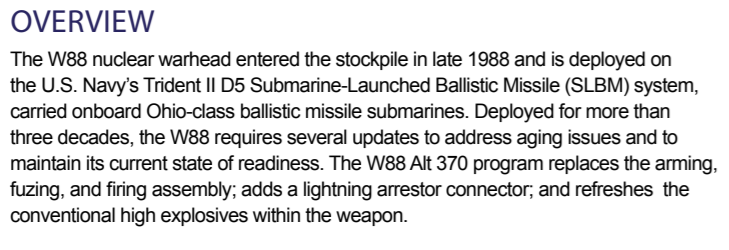
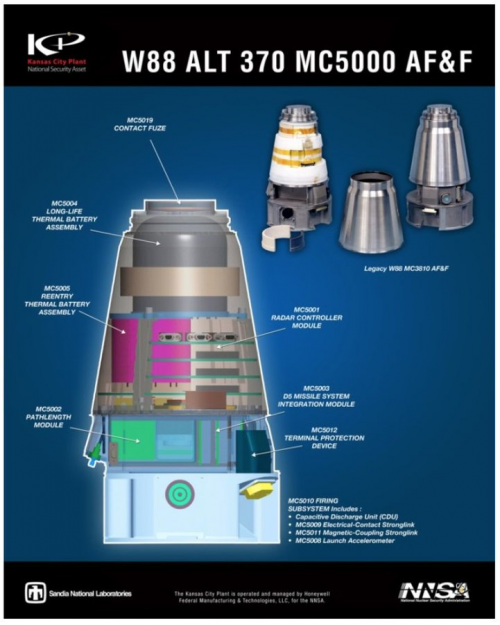
Upgraded sub-launched nuclear warhead program wraps production
The last production unit of the W88 Alt 370, an upgraded version of the legacy W88 used on Ohio-class ballistic missile submarines, has rolled off the line.https://breakingdefense.com/2025/12/upgraded-sub-launched-nuclear-warhead-program-wraps-production/
The W88 Alteration (Alt) 370 allows the submarine launched ballisticmissile warhead to meet modern safety and reliability standards.
https://www.energy.gov/sites/default/files/2023-11/W88-ALT370_1123.pdf
On UK deterrent and W93
https://www.nuclearinfo.org/wp-content/uploads/2022/08/Extreme-Circumstances-report.pdf
Last edited:
- Joined
- 15 July 2007
- Messages
- 5,735
- Reaction score
- 6,317
French Air nuclear strike exercise Poker, had RAF observers.
A landmark event.
The soundest critique of UK nuclear weapons is it's current reliance on the US, and the distortion on UK defence planning this exerts.
A landmark event.
The soundest critique of UK nuclear weapons is it's current reliance on the US, and the distortion on UK defence planning this exerts.
Last edited:
- Joined
- 21 April 2009
- Messages
- 14,361
- Reaction score
- 9,461
- Joined
- 21 April 2009
- Messages
- 14,361
- Reaction score
- 9,461

- Joined
- 3 June 2011
- Messages
- 20,946
- Reaction score
- 19,187
Good thing they told us they weren't real.F-35 Dropped Inert Nukes in Flight Tests
https://www.airandspaceforces.com/f-35-dropped-inert-nukes-in-flight-tests/

- Joined
- 3 June 2011
- Messages
- 20,946
- Reaction score
- 19,187
It's been "Time to Decide" for about 15 years now.

- Joined
- 21 April 2009
- Messages
- 14,361
- Reaction score
- 9,461
- Joined
- 21 April 2009
- Messages
- 14,361
- Reaction score
- 9,461
This one interesting talking about building production capacity.

Grey Havoc
ACCESS: USAP
- Joined
- 9 October 2009
- Messages
- 24,500
- Reaction score
- 18,175
- Joined
- 21 April 2009
- Messages
- 14,361
- Reaction score
- 9,461
Scott Kenny
ACCESS: USAP
- Joined
- 15 May 2023
- Messages
- 19,595
- Reaction score
- 28,069
It's kinda the point that it would be very difficult to detect an explosive yield below a ton or so.Is there evidence that other nations are conducting sub detectable yield testing?
I mean, mining etc shots are, in total, often equal to nuclear blasts, but divided into pretty small individual shots but with many shots in a sequence. In fact, a large number of small blasts is the usual way to tell the difference between a 20kt ANFO mining blast and a 20kt nuclear test.
You'd need to look for other things, like fission products.
According to the Lawrence Livermore National Laboratory, the W87 program is a “modification program” which will be the “…first newly manufactured nuclear warhead in three decades, which will replace the aging W78.”[47] The W78 started its life as a warhead for the Minuteman III ICBM. Originally, the W78 was to be life extended as a hedge against problems with the W87.[48] This changed apparently mainly due to cost. The W87-1 will involve substantial changes in the nuclear physics package without nuclear testing – using insensitive high explosive and a new pit.[49] It is being designed to be “…interoperable with the USAF Mk-21 and the U.S. Navy Mk-5 reentry vehicles.”[50] Reportedly, “…10 nuclear tests were required to certify the W-87 for stockpiling….”[51] However, the W87-1 will not be subject to a nuclear test.
This is misrepresenting the history of the W78–W87–W88-1 replacement program (which to be fair was a total clusterfuck). The W87-1 was settled upon as the final choice not because of cost (it was actually extremely expensive compared to a simple LEP of the W78), but rather because of the desire for IHE, FRP, newly manufactured warheads, lack of a need for interoperability (which collapsed because of the same reasons that every other prior interoperability initiative had collapsed), and possibly also a desire for a higher yield option.
The W87-1 involves zero substantial changes in the physics package without nuclear testing. It is literally just the W87-0, a design that was extensively tested and validated at both full and partial yields, but with newly manufactured components. The use of IHE is identical to the original design, which used IHE from the very beginning. The new pit is simply a newly manufactured pit, machined to exactly the same specifications as the original pit, using exactly the same materials. The secondary might use a HEU pusher/tamper for a higher yield, but if it does, this is not a departure from the original design – the original design was actually supposed to have a HEU pusher/tamper, and was only redesigned to omit it because of a shortage of HEU.
There is no interoperability in the W87-1. It physically cannot fit into the Mk5 RB. The Navy is on their own for a W88 successor.
If the author is getting so many major details wrong about just this one program, what else are they wrong about?
They continuously complain that costs have gone up, and attribute this to the lack of nuclear testing. But even if nuclear testing came back, we would still incur most of those costs, as most of the costs are related to the failure to maintain the capability (in terms of facilities and workforce) to manufacture nuclear weapons, and bringing back nuclear testing would not fix show-stopping problems like the lack of Rocky Flats (oops, no pit manufacturing line), or the fact that we haven't been building new nuclear weapons for decades (which is not because of a lack of nuclear testing, but because of post Cold War cutbacks in defense spending).
Even if we had never banned nuclear testing, we would still be just as screwed by the post Cold War dismantlement of the nuclear weapons establishment in the name of saving money as we are today.
Sure, nuclear testing would decrease stockpile stewardship costs to some extent...but testing wasn't actually cheap, it was quite incredibly expensive in fact, and a lot of extremely expensive stockpile stewardship activities would still be required with or without testing.
Also, without full yield testing, you would still be severely restricted in how much continued innovation is possible in weapons development. The threshold test ban treaty effectively froze the development of nuclear weapons. Sure, some innovation in primary testing was still possible afterwards, and you could do validation testing on existing weapons to a certain extent, but radical new secondary designs were no longer possible to develop through testing alone. Every single weapon in the US arsenal uses a secondary that was proof tested at full yield prior to implementation of the TTBT.
The myopic focus on nuclear testing is missing the point entirely. The nuclear enterprise is extremely expensive, and it was severely neglected after the Cold War ended. When you shut down production facilities and starve labs of work, is it any real surprise that when you finally do life extension on the remaining weapons, the cost to do it is higher than ever? Also, modern occupational health and safety standards have dramatically increased costs and timelines for all aspects of nuclear weapons work, both directly and indirectly. Restarting nuclear testing wouldn't make that go away.
The author has a few good points about the B83 and B61. I agree that retirement of the B83 without at least procuring a much more substantial number of B61-13s is probably not a wise move. But I don't agree with his crackpot theories about other nations conducting covert nuclear tests (which no reputable source agrees with him on). And I don't see the utility in the SLCM-N. There are better weapons to devote scarce budgetary resources towards.
I am curious in even somewhat credible rumors, not necessarily hard evidence.It's kinda the point that it would be very difficult to detect an explosive yield below a ton or so.
I mean, mining etc shots are, in total, often equal to nuclear blasts, but divided into pretty small individual shots but with many shots in a sequence. In fact, a large number of small blasts is the usual way to tell the difference between a 20kt ANFO mining blast and a 20kt nuclear test.
You'd need to look for other things, like fission products.
Scott Kenny
ACCESS: USAP
- Joined
- 15 May 2023
- Messages
- 19,595
- Reaction score
- 28,069
I haven't seen anything, but this forum is one of my primary military-news sources.I am curious in even somewhat credible rumors, not necessarily hard evidence.
If there was a nuclear detonation, even one down in the tens of tons range, the best way to detect it is airborne fission products. Say, via the Constant Phoenix aircraft.
- Joined
- 21 April 2009
- Messages
- 14,361
- Reaction score
- 9,461
- Joined
- 21 April 2009
- Messages
- 14,361
- Reaction score
- 9,461
Forest Green
ACCESS: USAP
- Joined
- 11 June 2019
- Messages
- 14,557
- Reaction score
- 31,651
NNSA administrator declines to clarify Trump's nuclear testing comments
https://insidedefense.com/daily-new...lines-clarify-trumps-nuclear-testing-comments
- Joined
- 21 April 2009
- Messages
- 14,361
- Reaction score
- 9,461
- Joined
- 21 April 2009
- Messages
- 14,361
- Reaction score
- 9,461
Forest Green
ACCESS: USAP
- Joined
- 11 June 2019
- Messages
- 14,557
- Reaction score
- 31,651
Congress Trims USAF’s Nuclear Spending in ’26 Spending Package
https://www.airandspaceforces.com/congress-trims-funding-air-force-nuclear-programs-2026/The measure reduces B-21 and LRSO spending slightly and directs more oversight over the Sentinel, which has suffered delays and cost overruns.
LRSO
Air Force officials have generally offered positive—if sparing—updates on LRSO, but after the Air Force trimmed the program’s funding by $146.1 million to $693 million total in fiscal 2025, they cut further in 2026, cutting requested funds by nearly $217 million to $582 million.
Lawmakers wrote that some procurement funding was “early to need” and nearly a quarter of the research and development money could be cut as “program carryover.”
B-21
The B-21 was among the biggest winners in the reconciliation package, gaining $4.5 billion to expand production capacity. But lawmakers trimmed $620 million from the administration’s B-21 procurement request in the 2026 budget bill and instead added $409 million for research and development, effecting a net cut of $211 million. Appropriators cited “classified adjustments” to explain the changes.
Sentinel
Lawmakers endorsed the $2.65 billion the adminstration sought for the Sentinel ICBM, but pressed for more information on the program.
There's not really a good airframe for them to use that is still in production. There aren't any 4-engine planes still in production.
You could buy a few lightly-used 747-8s, but that's about it.
C-130. Admittedly slower than a jet, but speed really isn't that critical for the application.
https://warontherocks.com/2026/01/is-it-time-for-a-nordic-nuke/
Discussion on the merits, ethics and practicalities of this. Just one example of what has become far more than mere chatter recently. In any case this is the time for European democracies (and democratic "middle powers" as defined by Canadian PM Carney in his seminal Davos speech) to push the pedal to the metal on sovereign systems, whatever they may be. Nordic nuclear latency (technologically speaking) must be among the lowest in the World.
Discussion on the merits, ethics and practicalities of this. Just one example of what has become far more than mere chatter recently. In any case this is the time for European democracies (and democratic "middle powers" as defined by Canadian PM Carney in his seminal Davos speech) to push the pedal to the metal on sovereign systems, whatever they may be. Nordic nuclear latency (technologically speaking) must be among the lowest in the World.
Chancellor Merz has in the past few days acknowledged serious but early talks about Germany's role in the development of EU's nuclear deterrent. This will come about in a roundabout way, i.e. financing, technological development and basing but the weapons themselves, legally and technically, will not be under German sovereign control as per agreements and conventions. Discussion on the subject on Deutsche Welle with Marina Henke, professor of international relations at the Hertie School:
View: https://youtu.be/iGMDH5yg9wc
The subject was taken up by fmr. German foreign minister Joschka Fischer (Die Grüne) who advocates the creation of a European "nuclear umbrella":
https://www.welt.de/politik/deutsch...pas-us-schutzgarantie-ab-sofort-ungewiss.html
In a brief Welt TV interview, the head of the parliamentary defense committee Thomas Röwekamp (CDU) has backed up Merz's statement by highlighting German technical capabilities which could be used in the development program:
https://www.welt.de/politik/deutsch...ran-systeme-auf-den-ernstfall-ausrichten.html
The subject was taken up by fmr. German foreign minister Joschka Fischer (Die Grüne) who advocates the creation of a European "nuclear umbrella":
https://www.welt.de/politik/deutsch...pas-us-schutzgarantie-ab-sofort-ungewiss.html
In a brief Welt TV interview, the head of the parliamentary defense committee Thomas Röwekamp (CDU) has backed up Merz's statement by highlighting German technical capabilities which could be used in the development program:
https://www.welt.de/politik/deutsch...ran-systeme-auf-den-ernstfall-ausrichten.html

FighterJock
ACCESS: Above Top Secret
- Joined
- 29 October 2007
- Messages
- 7,244
- Reaction score
- 8,557
So what will happen to France in this situation? France has their own nuclear programe, I wonder what they will make of it.
Similar threads
-

-

-
New Plan for Sub Launched Conventional Ballistic Missile for PGS Mission?
- Started by bobbymike
- Replies: 0
-
 9M730 Burevestnik (SSC-X-9 Skyfall) cruise nuclear-powered missile
- Started by Brickmuppet
- Replies: 532
-