Yes, that’s what I meant. The situation will solve itself.You can't change the fuzing on the fly, but you could launch two warheads close enough that the second one gets fratricide if the first one works.

You are using an out of date browser. It may not display this or other websites correctly.
You should upgrade or use an alternative browser.
You should upgrade or use an alternative browser.
Current Nuclear Weapons Development
- Thread starter bobbymike
- Start date
For mobile targets or conventional weapons sure, for nukes hitting stationary targets its less mass intensive to just make the system more accurate and match the CEP to the yield for said target. A Mk12 will beat a Pershing MARV on mass and PK any day.@JTR - As you pointed out MARVs are only good for terminal defence ABMs but there is another reason to use MARVs, refining the RV's trajectory to improve terminal accuracy.

- Joined
- 21 April 2009
- Messages
- 14,361
- Reaction score
- 9,461
From the latest DOE Stockpile Stewardship Management Plan pg. 2-13
2.2.8 W93 Program
The W93 modernization program addresses an evolving set of Navy ballistic missile requirements by incorporating modern technologies that improve safety and security and ease of manufacturing, maintenance, and certification. All key nuclear components will be based on currently deployed and/or previously tested nuclear designs, as well as extensive stockpile component and materials experience. It will not require underground nuclear explosive testing to certify. The program is utilizing the Phase X Process for integrated nuclear weapons system acquisition, rather than the Phase 6.X Process.
2.2.8.1 Status
The Nuclear Weapons Council authorized the program to proceed into Phase 2, Feasibility Study and Design Options, in May 2022. Phase 2’s scope for FY 2024 includes maturing DoD military characteristics and stockpile-to-target sequences to inform DOE/NNSA requirements, technical trade decisions, component down-selections, and production concepts. The W93 Design Agencies and Production Agencies will continue to improve integration engagements for requirements definition. The W93 assessment of the available technical trade-space is facilitating decisions of major subsystem designs and potential component designs. The formulation of programmatic schedules, resourcing, business practices, and risk management practices is also underway. The W93 Design Agencies are supporting the product realization teams for manufacturing of pre-development components in support of the W93 down select process.
2.2.9 Future Warheads
DOE/NNSA is coordinating with DoD to define the appropriate warheads to support anticipated future threats. These warheads currently include the Future Strategic Land-Based Warhead, the Future Strategic Sea-Based Warhead, the Future Air-Delivered Warhead, and a Submarine-Launched Warhead (to replace the W76-1/2).
2.2.8 W93 Program
The W93 modernization program addresses an evolving set of Navy ballistic missile requirements by incorporating modern technologies that improve safety and security and ease of manufacturing, maintenance, and certification. All key nuclear components will be based on currently deployed and/or previously tested nuclear designs, as well as extensive stockpile component and materials experience. It will not require underground nuclear explosive testing to certify. The program is utilizing the Phase X Process for integrated nuclear weapons system acquisition, rather than the Phase 6.X Process.
2.2.8.1 Status
The Nuclear Weapons Council authorized the program to proceed into Phase 2, Feasibility Study and Design Options, in May 2022. Phase 2’s scope for FY 2024 includes maturing DoD military characteristics and stockpile-to-target sequences to inform DOE/NNSA requirements, technical trade decisions, component down-selections, and production concepts. The W93 Design Agencies and Production Agencies will continue to improve integration engagements for requirements definition. The W93 assessment of the available technical trade-space is facilitating decisions of major subsystem designs and potential component designs. The formulation of programmatic schedules, resourcing, business practices, and risk management practices is also underway. The W93 Design Agencies are supporting the product realization teams for manufacturing of pre-development components in support of the W93 down select process.
2.2.9 Future Warheads
DOE/NNSA is coordinating with DoD to define the appropriate warheads to support anticipated future threats. These warheads currently include the Future Strategic Land-Based Warhead, the Future Strategic Sea-Based Warhead, the Future Air-Delivered Warhead, and a Submarine-Launched Warhead (to replace the W76-1/2).
He did address that; I believe he said in some cases it could actually harm accuracy. In any case, the CEP for mk4/5 is something like 100m, even before considering smart fuses. Accuracy is practically as good as it gets sans GPS, and the U.S. has avoided external/emitting guidance modes for all of nuclear weapons for decades outside TERCOM on AGM-86. AFAIK everything else is inertial or astronavigation assisted inertial.@JTR - As you pointed out MARVs are only good for terminal defence ABMs but there is another reason to use MARVs, refining the RV's trajectory to improve terminal accuracy.

Titus K
ACCESS: Top Secret
- Joined
- 6 September 2025
- Messages
- 829
- Reaction score
- 2,803
On the restart of Tritium production in France's Civaux NPP, project "Trident"
https://www.cli-civaux.fr/fileadmin...x/La_lettre_de_la_CLI/EXE-E-Lettre-CLI-63.pdf
Notably :
https://www.cli-civaux.fr/fileadmin...x/La_lettre_de_la_CLI/EXE-E-Lettre-CLI-63.pdf
Notably :
7. When will this activity begin?
Given the time required for its techno-scientific analysis, the ASN’s safety review, and the practical conditions for its implementation, the first lithium irradiation test can only take place in 2025, during a reactor outage. This experimental phase will involve only a single fuel rod, which, after an 18-month reactor cycle, will be sent to the CEA for in-depth analysis.
Moreover, several points still need to be clarified. Indeed, the amount of tritium that could migrate through the cladding is not yet known, but tritium releases will in any case remain below current regulatory limits. After irradiation, the assemblies of target rods containing the pellets with irradiated lithium will have to be dismantled in the spent fuel pool, and the rods will need to be cut at very precise locations in order to recover the pellets (or targets), which requires specific technical expertise. These targets will then be sent to the CEA.
The importance of this experimental phase is therefore clear. Series production is scheduled for 2028 and will be carried out using target rods mounted on fixed assemblies designed and manufactured by the CEA.
- Joined
- 15 July 2007
- Messages
- 5,735
- Reaction score
- 6,317
You have official lists of the sale to the UK of the items you mentioned?I have literally dozens of papers covering different aspects of this topic, please be specific about what you want me to provide citations for.
Or be we talking of mainstream media pieces and anti-nuclear 'papers'?
Relevent statement in Parliament.
On 25 February 2020 then Secretary of
State for Defence, Ben Wallace, subsequently made a Written Statement to
the House confirming the existence of a replacement warhead programme.
In its 2020 Annual Report to Parliament, and in subsequent parliamentary
questions, the MOD confirmed that:
• The warhead will be designed, developed, and manufactured in the UK.
• The warhead will be housed in the US Mk7 aeroshell, which will also
house the US W93 warhead. The Mk7 aeroshell will be procured from the
US along with some other non-nuclear components under existing
nuclear treaty arrangements.29 The UK’s replacement programme has
since been designated the A21/ Mk7/ Astraea programme.30
• The UK will continue to work with the US to ensure that the warhead
remains compatible with the Trident missile system. 31
Last edited:
Scott Kenny
ACCESS: USAP
- Joined
- 15 May 2023
- Messages
- 19,594
- Reaction score
- 28,066
First problem is that there were only 400 W88s made. So there's ~32 warheads per boat for high-yield targets (D5s are either W76 or W88, no mix&match). At 4 warheads per that's 8 birds per boat. Half the load of a Columbia, 1/3 the load of an Ohio. And doing any kind of refurbishment plan would remove birds from service since there's only ~2 spare birds per coast (assuming that all W88s are still serviceable).if the W76/88 are remaining in service, what need does the W93 address? You mentioned diversifying stockpile risk - since two types of warhead are already available, what are the concerns? If the design is much more conservative, is this something of a return to reliable warhead in design philosophy, even if not it actual design?
All the rest of the birds are W76, 90-100kt (ignoring the Mod2s).
Adding W93s (assuming high yields) means that as the W88s age out we have warheads to immediately replace them.
Combined response:Previously were there not efforts to increase the accuracy of weapons using very small control surfaces/tabs to nudge the RV dozens of meters close to the aim point? Do you think there is any chance this be used with the smart fusing system to adjust downrange accuracy?
The problem is that a guided MARV like the one on Pershing 2 is 88" long and some 1450lbs.@JTR - As you pointed out MARVs are only good for terminal defence ABMs but there is another reason to use MARVs, refining the RV's trajectory to improve terminal accuracy.
You could stuff that into a Minuteman, not a Trident. Not enough length in the tube, and not enough diameter either.

chimeric oncogene
ACCESS: Secret
- Joined
- 23 May 2019
- Messages
- 460
- Reaction score
- 726
There was a lot of hullabaloo over whether it would be best to set a threshold for nuclear testing back in the 1990s rather than ban it altogether; the Russians wanted 10 tons, the French wanted 300 tons, and the US under Clinton wanted 1.8kg (zero yield, essentially).
Part of the reasoning was the difficulty of detecting anything far below 10 tons, rendering a treaty calling for zero-yield unverifiable; a 2012 report basically concludes that they can detect a 5 ton (ish) test at Novaya Zemlya if it is fully coupled; if decoupled with a big steel tank or something, underground, the estimate goes to tens or hundreds of tons.
If you review the 60 minutes video, the American President has made some fairly explicit accusations to the effect that the Chinese, Russians, Pakistanis, and others are conducting supercritical nuclear testing, possibly in underground chambers. The US has not put forward detailed evidence of such testing, but one assumes that it can only be a conclusion borne of either extremely impressive national technical means, spycraft, or potentially falliable circumstantial multisource analysis and assessment, and thus I doubt detailed incontrivable evidence can be produced for our persual, regardless of the truth or untruth of these statements.
Part of the reasoning was the difficulty of detecting anything far below 10 tons, rendering a treaty calling for zero-yield unverifiable; a 2012 report basically concludes that they can detect a 5 ton (ish) test at Novaya Zemlya if it is fully coupled; if decoupled with a big steel tank or something, underground, the estimate goes to tens or hundreds of tons.
If you review the 60 minutes video, the American President has made some fairly explicit accusations to the effect that the Chinese, Russians, Pakistanis, and others are conducting supercritical nuclear testing, possibly in underground chambers. The US has not put forward detailed evidence of such testing, but one assumes that it can only be a conclusion borne of either extremely impressive national technical means, spycraft, or potentially falliable circumstantial multisource analysis and assessment, and thus I doubt detailed incontrivable evidence can be produced for our persual, regardless of the truth or untruth of these statements.
I had thought the USN experimented with an add on kit for mk4 that made it more or less mk5 sized but used GPS for high precision as a conventional strike option. The RB had no significant maneuvering; it just used some tabs or other small control surfaces to nudge the RB that extra hundred or two meters on target. But I am going from memory; I cannot remember a publication or project name or anything.Combined response:
The problem is that a guided MARV like the one on Pershing 2 is 88" long and some 1450lbs.
You could stuff that into a Minuteman, not a Trident. Not enough length in the tube, and not enough diameter either.
The military characteristics are not public, but were defined by Phase 2. The NNSA has stated it is in part to ameliorate overreliance on W76. Link Hereif the W76/88 are remaining in service, what need does the W93 address? You mentioned diversifying stockpile risk - since two types of warhead are already available, what are the concerns? If the design is much more conservative, is this something of a return to reliable warhead in design philosophy, even if not it actual design?
Basically that's what Pershing II did. It's not clear this is necessary for strategic ballistic missiles, which are already capable of quite intense accuracy given their range and mass budgets.Previously were there not efforts to increase the accuracy of weapons using very small control surfaces/tabs to nudge the RV dozens of meters close to the aim point? Do you think there is any chance this be used with the smart fusing system to adjust downrange accuracy?
I'm going to be honest, I don't think W-76-2 is a well thought through concept, given that the adversaries don't know what payload the SLBM has. I really don't think "trust me bro" is going to work for keeping them from launching under attack under the presumption that it is a strategic nuclear strike. It's just more bad idea fairy shit from the 2000s.Regarding W76 mod2, I had always assumed two warheads were loaded and fired on the same target, with the second being disabled if the first fused correctly. I figured even with low yield, a double tap is in order, especially since such a weapon would likely be used at a pivotal moment to restore deterrence (I strongly disagree Iran or North Korea would be likely targets).
Seems like a good opportunity to get 1400 LEP'd W76s for theater forces tbqh...(actually 3400, but only 2000 of these went through LEP).
Frankly I suspect we'll see a 20 tube Columbia and probably more than the current number, though build time is a bastard there.A lot of concerns are raised regarding the transition to the much smaller Columbia fleet, and the need to ensure adequate capabilities despite this significant downsize in the number of available tubes. It's implied that the goal for the W93 is to be a lighter warhead than the W88, with a premium being placed on lighter weight instead of on higher yields, but also with the goal of having higher yields than the W76 in order to provide semi-adequate counterforce capabilities. The W76 yield is apparently unacceptably low for this use case.
Last edited:
What would they be carried on and what would be the goal?Seems like a good opportunity to get 1400 LEP'd W76s for theater forces tbqh...
As someone noted in the Columbia thread, it already is the length of Ohio and any increase might make it incompatible with existing logistics. I think the conclusion was that another 4 missile plug *might* be possible with existing infrastructure but that it would be a tight squeeze.Frankly I suspect we'll see a 20 tube Columbia and probably more than the current number, though build time is a bastard there.
A notional IRBM, either something small like Pershing II or large in the SS-20 class, e.g. ~35 ton that fits in a 40' ISO SWAP (i.e. UGM-96 on a truck). Presumably it would be unsuitable for an AGM-69/131 type weapon, but that would be desirable as well, IMO. Give us options to respond to Russian nuclear threats that don't involve flying over and dropping a gravity bomb.What would they be carried on and what would be the goal?
I mean the question then becomes if new infrastructure is cheaper than building the however many more boats and crews to field a similar number of D5 to currently (or potentially return to the planned/fielded Cold War D5 numbers) given the threat environment and addition of the PLA as a nuclear near-peer...As someone noted in the Columbia thread, it already is the length of Ohio and any increase might make it incompatible with existing logistics. I think the conclusion was that another 4 missile plug *might* be possible with existing infrastructure but that it would be a tight squeeze.
I would assume just adding more boats would be cheaper.
I do agree that W76-2 wasn't well thought out and neither is SLCM-N. I would have rather replaced both with a nuclear LRHW. It would give the Zumwalts a nuclear messaging role, can be carried by the Columbias, and give select Virginias more capability, while keeping the surface ships away from nuclear roles and having a very distinct signature from either Trident or Tomahawk.
I do agree that W76-2 wasn't well thought out and neither is SLCM-N. I would have rather replaced both with a nuclear LRHW. It would give the Zumwalts a nuclear messaging role, can be carried by the Columbias, and give select Virginias more capability, while keeping the surface ships away from nuclear roles and having a very distinct signature from either Trident or Tomahawk.
I don't really care about your unattainable demands for impossible to produce standards of evidence.You have official lists of the sale to the UK of the items you mentioned?
Or be we talking of mainstream media pieces and anti-nuclear 'papers'?
Relevent statement in Parliament.
On 25 February 2020 then Secretary of
State for Defence, Ben Wallace, subsequently made a Written Statement to
the House confirming the existence of a replacement warhead programme.
In its 2020 Annual Report to Parliament, and in subsequent parliamentary
questions, the MOD confirmed that:
• The warhead will be designed, developed, and manufactured in the UK.
• The warhead will be housed in the US Mk7 aeroshell, which will also
house the US W93 warhead. The Mk7 aeroshell will be procured from the
US along with some other non-nuclear components under existing
nuclear treaty arrangements.29 The UK’s replacement programme has
since been designated the A21/ Mk7/ Astraea programme.30
• The UK will continue to work with the US to ensure that the warhead
remains compatible with the Trident missile system. 31
You and I both know full well that the official lists of sale you're asking for are classified.
You insist that anti nuclear organizations are an unacceptable source.
However, anti nuclear organizations have the money to invest in high quality research, research that no other organization can afford to do.
And while their political reporting may reflect their marked anti nuclear slant, their technical working papers generally do not have much (if any) observable bias from their mission.
This is unsurprising, as in order to advocate most effectively for nuclear disarmament, you must be intimately familiar with the technical details of the existing nuclear arsenal, so that you can craft the most effective possible arguments.
These working papers are an invaluable source.
Now let's focus on the meat of the argument, shall we?
Wow, it'll be designed, developed, and manufactured in the UK. And it'll use an aeroshell that will be procured from the US, along with some other non-nuclear components. All of this sounds suspiciously familiar...oh wait, yeah, that's literally the exact same party line used to describe the current "Holbrook" warhead.Relevant statement in Parliament.
On 25 February 2020 then Secretary of
State for Defence, Ben Wallace, subsequently made a Written Statement to
the House confirming the existence of a replacement warhead programme.
In its 2020 Annual Report to Parliament, and in subsequent parliamentary
questions, the MOD confirmed that:
• The warhead will be designed, developed, and manufactured in the UK.
• The warhead will be housed in the US Mk7 aeroshell, which will also
house the US W93 warhead. The Mk7 aeroshell will be procured from the
US along with some other non-nuclear components under existing
nuclear treaty arrangements.29 The UK’s replacement programme has
since been designated the A21/ Mk7/ Astraea programme.30
• The UK will continue to work with the US to ensure that the warhead
remains compatible with the Trident missile system. 31
The only components in the Holbrook warhead that were manufactured in Britain are the NEP and the tritium gas within the boost gas reservoirs.
The aeroshell, nosetip, radar sensors, and release assembly are all US designed and manufactured parts. Specifically, these were all manufactured by Lockheed Martin. British warheads use the exact same model of aeroshell, nosetip, radar sensors, and release assembly as the W76.
The gas transfer system is a US designed and manufactured system. The original warhead would have used the Heather GTS, while the refurbished warheads use the Acorn GTS. All GTS components (transfer lines, squib valves, reservoirs, etc) were designed and manufactured in the United States. British warheads use the exact same model of gas transfer system as the W76.
The boost gas reservoir is a US designed and manufactured part. Heather reservoirs were used for the original warheads, while Acorn reservoirs are used by the refurbished warheads. The entire reservoir (body halves, burst disk assembly, fill tube, etc) is designed and manufactured in the US. British warheads use the exact same model of boost gas reservoir as the W76.
The boost gas reservoirs are filled with boost gas in a US facility (Sandia labs). The tritium used for the original warheads is UK origin tritium, which was flown to the US to be used at Sandia to fill Sandia-manufactured reservoirs. The filled reservoirs containing UK-origin tritium were then flown back to the UK to be installed in the warhead aeroshells.
The neutron guns are a US designed and manufactured part. The neutron gun design would have likely changed between refurb generations. British warheads use the exact same model of neutron guns as the W76.
The arming fusing and firing (AF&F) system is a US designed and manufactured part. This was designed and manufactured in the US for the sole use on the W76. British warheads use the exact same model of AF&F as the W76.
Now we come to the NEP. This is claimed by British politicians to be a British design. In a technical sense, this is not 100% false. What happened is that the US gave Britain the W76 blueprints. Britain then made two sets of changes to these blueprints.
The first change was to modify the manufacturing methods to better suit the small scale domestic British industry's manufacturing capabilities. This does not materially affect the end result, but does technically constitute a design change, albeit a very minor one.
The second change was to change the explosives from PBX 9501 to EDC 37.
PBX 9501 is a US designed CHE formulation. EDC 37 is a UK designed CHE formulation. Between the two, EDC 37 has slightly superior sensitivity characteristics (it is slightly less shock sensitive). However, this is an extremely small difference. Both explosives are classified as sensitive conventional high explosives. Neither comes anywhere close to being classifiable as an insensitive high explosive.
The reason for this change is unclear. Some sources claim it is because British safety standards required the use of a less sensitive high explosive. While EDC37 is indeed slightly less sensitive than PBX9501, it is still a CHE, which are all exceptionally dangerous to work with.
Either way, the qualification testing on the EDC37 was done by the US.
Ironically, there turned out to be severe downsides to this change in high explosive, although they did not become apparent until much later. I am of course referring to the fact that EDC37's aging characteristics are apparently markedly inferior to PBX9501, which has left the UK MOD in a pickle, as their refurbished Holbrook warheads employing EDC37 cannot attain anywhere near the length of service life that the refurbished W76-1 warhead employing PBX9501 can attain (10–12 years vs 30 years).
So with the different HE and the minor design changes to better suit domestic small scale manufacturing, you ended up with a W76 that used a different HE and used a slightly different manufacturing process. Is this a British design now?
Well, it's definitely not a 100% US design anymore, so if you want to call it a British design, you're not 100% wrong. But it's still not a truly domestic design, nowhere even close.
British politicians love to call the Holbrook warhead a British design. They aren't even lying directly, just lying by omission.
The Holbrook warhead is a British design, of which virtually every single component outside of the NEP and tritium was designed and manufactured in the US.
The tritium is truly of British origin, so they aren't wrong about that.
But the NEP? That's where semantics start playing a huge role.
Claiming the NEP is a British design isn't a direct lie, but it is a lie by omission. Yes, it's not a W76. But only because of two changes, neither of which materially affect the structure or function of the resulting NEP.
The changes Britain made to the W76 are not substantive design changes of the type that would define a new design. They are merely minor adaptations to make the warhead more suitable for their use.
Changing the high explosive does not affect the nuclear performance of the NEP. Yes, it's a significant design change to use a different CHE formulation from an engineering standpoint that requires a lot of validation work (which the US assisted in), but it is one that does not touch the core nuclear function of the NEP. It is not a change to the core nuclear design. It is a substitution of a functionally equivalent material. The role of the HE remained the same. The goal was to replicate the function of the W76's HE, not a create a new performance characteristic.
Changing a manufacturing process for small-scale production is a matter of industrial engineering and economics, not warhead design. It affects how the warhead is built, not how it functions. This is the very definition of an adaptation, not a new design. It's like changing from an automated assembly line to a craftsman-based workshop to build the same product. Will you need to modify some things about how the warhead is produced? Yes. But will this result in a materially different end product in terms of its nuclear characteristics? No.
Fundamentally, the UK did not design a new warhead. They took a fully matured, tested, and proven US design (the W76) and made two specific, minor alterations to it. This is analogous to a car manufacturer taking a Ford F-150, swapping out the seat material and changing a paint process to suit their local factory, and then calling it a "British-designed truck." The core engine, chassis, transmission, and electronics remain Ford's design. The Holbrook's physics package, its primary nuclear components, and its fundamental operational parameters are all W76.
The claim of a "British design" serves a vital political purpose, which explains why it is made despite the technical reality.
The entire premise of the UK's nuclear deterrent is that it is sovereign and independent. Politically, it is untenable for the UK government to admit that its ultimate guarantor of national security relies on a foreign-designed warhead. Admitting it is a slightly modified W76 would open the government to accusations from opponents that the deterrent is not truly independent and that the UK is wholly dependent on US technical largesse. Therefore, there is a powerful incentive to use the term "British design" loosely to maintain the political fiction of complete independence.
The argument relies on stretching the definition of "design." By focusing on the two changes they made, proponents can technically claim it is "a distinct design." However, in the broader context of weapons development, where a "design" refers to the entire conceptual and engineering blueprint, the Holbrook is overwhelmingly a US W76 design.
To argue that the Holbrook is a British design is to prioritize political rhetoric over technical fact. The arguments against this viewpoint are compelling:
- It's a modification of a US blueprint.
- It is functionally identical to the W76 for strategic interchangeability. (Notably, it directly reuses virtually every single one of the W76's components outside of the NEP (the aeroshell, nosetip, radar sensors, release assembly, gas transfer system, boost gas reservoir, neutron guns, and arming fusing and firing system are all identical).)
- The specific UK changes are adaptations, not fundamental redesigns.
- The "British design" claim is a political necessity to preserve the myth of total independence.

BonPlan2
ACCESS: Top Secret
- Joined
- 5 June 2025
- Messages
- 577
- Reaction score
- 738
Once the missile is studied, built and maintained in USA, where is the independance?The "British design" claim is a political necessity to preserve the myth of total independence.

Forest Green
ACCESS: USAP
- Joined
- 11 June 2019
- Messages
- 14,557
- Reaction score
- 31,650
I've always wondered whether the UK warheads use Pu239 instead of U235 due to THORP output.
I've always wondered whether the UK warheads use Pu239 instead of U235 due to THORP output.
Is that in reference to the warhead's primary or secondary?

Grey Havoc
ACCESS: USAP
- Joined
- 9 October 2009
- Messages
- 24,500
- Reaction score
- 18,175
Unfortunately, the seismic sensors can and have also been spoofed, even before recent (as well as ongoing) events gutted international non-proliferation sensor networks. One popular trick as I understand it is to have underground test detonations trigger in the middle of normal higher level seismic activity in the region. Using seismographs as part of the triggering mechanism, ironically enough.We detected the North Korean 2006 test with USGS seismographs, and that was under a kiloton. They might be testing like... sub 500t yields, but the necessary operational security and physical obfuscation to hide such activity from national technical means and the geological community seem somewhat farfetched. This also would preclude testing (AIUI) of thermonuclear devices, so they'd be limited to primaries? This would likely not help the reliability question. I know this is one of Bob Peter's bug bears, but my impression is that if there was actual evidence behind it there would be more hullabaloo.
Anyway, as I understand it a great deal of work went into figuring out how to detect clandestine tests in the 2000s.
https://nap.nationalacademies.org/read/12849/chapter/13
Given that China for one has already been suspected of playing fast and loose with the CTBT, not really.At the latest meeting urging all countries to bring the Comprehensive Nuclear-Test-Ban Treaty into effect, the United States cast the sole opposing vote. The CTBTO is not a important international organization... but... it is still a signal?
- Joined
- 15 July 2007
- Messages
- 5,735
- Reaction score
- 6,317
The problem with non official sources, especially those intent on building the argument for disarmament is that they will mix facts and supposition together. In order to convince the reader they should advocate for disarmament.
Now it is entirely possible for the UK to be engaged in this sophistry and subterfuge.
However.....
What can we be certain of is the following. Which can be confirm by multiple media sources and from Official statements.
The UK has invested in new facilities to sustain warhead design, diagnostic and manufacturing capabilities without explosive nuclear testing under the Nuclear Weapons Capability Sustainment Programme initiated in 2005. The Ministry of Defence says that the Nuclear Weapons Capability Sustainment Programme is designed “To deliver and sustain the capability (skills, technology, science, personnel, production and support) to underwrite the UK nuclear warhead stockpile now and in the future”.
Key facilities include:
• Orion Laser facility that began operations in 2012 to investigate how nuclear materials respond under intense temperatures and pressures (now in a mid-life upgrade).
• Teutates facilities - a joint UK-France Technology Development Centre at Aldermaston to support hydrodynamic research to study the effects of ageing and manufacturing processes on nuclear warheads without nuclear explosive testing and the main UK-France Teutates-Epure hydrodynamics facility in Valduc, France.
• Vulcan 7.42 PetaFLOPs supercomputer installed in 2020 for executing complex simulations to certify nuclear warheads.
• Circinus High Explosives fabrication facility.
• Phoenix Conventional Manufacturing Facility precision manufacturing site. AWE Burghfield is responsible for the assembly, disassembly and refurbishment.
Officially...
In 2005 the AWE began the Nuclear Warhead Capability Sustainment
Programme (NWCSP). Over an estimated period of 20 years, and at an initially estimated cost of £20 billion, the NWCSP aims to sustain key nuclear skills and technological capability and deliver improved infrastructure, to both manage the UK’s current nuclear stockpile and to underpin any future nuclear warhead replacement programme.
There are two main infrastructure projects underway at AWE under the remit of the NWCSP:
• Project MENSA – a new nuclear warhead assembly and disassembly facility at the AWE site in Burghfield. The project was expected to be completed in 2024, seven years late and at £2 billion, more than £1.2 billion over its original forecast cost estimate.
In March 2023 the cost of the programme was revised to £2.16 billion and in December 2023, the MOD said it was withholding information on planned in-service dates for reasons of national security.
• Project Pegasus – a new enriched uranium storage and manufacturing facility at the AWE site in Aldermaston. The project was paused in 2018 following a review of the programme which concluded that an “overly complex technical solution” had been chosen which had resulted in significant additional construction and safety costs and led to severe delays to the programme. The programme restarted in 2021 and will now be run in two phases: completion of the storage facility by 2025 and completion of the manufacturing facility by 2030.
In December 2023, however, the MOD said it was withholding information on planned in-service dates for reasons of national security.
The original in-service date for the project was 2019.
Estimates for the overall project in March 2023 were £1.7 billion.
The original approved cost of the programme was £634 million.
A third infrastructure project, Project Aurora, was taken out of the NWCSP in 2022.11 The project, which will deliver a new plutonium manufacturing facility at AWE Aldermaston, was added to the government’s major projects portfolioas an independent programme in 2023. The project is in its early design phase and currently forecast to cost £2.3 billion.
The UK-French Teutates project on nuclear stockpile stewardship, which includes the construction of a new hydrodynamics facility in Valduc, France, also forms part of the NWCSP.
All of the above is a substantial amount of money, personnel and administrative 'churn' for copy of a US design.
Perhaps it's all unnecessary?
BTW 'acorn' threw me, as that was the codename of a domestic design, a primary I seem to recall. Possibly amongst the last.
Now it is entirely possible for the UK to be engaged in this sophistry and subterfuge.
However.....
What can we be certain of is the following. Which can be confirm by multiple media sources and from Official statements.
The UK has invested in new facilities to sustain warhead design, diagnostic and manufacturing capabilities without explosive nuclear testing under the Nuclear Weapons Capability Sustainment Programme initiated in 2005. The Ministry of Defence says that the Nuclear Weapons Capability Sustainment Programme is designed “To deliver and sustain the capability (skills, technology, science, personnel, production and support) to underwrite the UK nuclear warhead stockpile now and in the future”.
Key facilities include:
• Orion Laser facility that began operations in 2012 to investigate how nuclear materials respond under intense temperatures and pressures (now in a mid-life upgrade).
• Teutates facilities - a joint UK-France Technology Development Centre at Aldermaston to support hydrodynamic research to study the effects of ageing and manufacturing processes on nuclear warheads without nuclear explosive testing and the main UK-France Teutates-Epure hydrodynamics facility in Valduc, France.
• Vulcan 7.42 PetaFLOPs supercomputer installed in 2020 for executing complex simulations to certify nuclear warheads.
• Circinus High Explosives fabrication facility.
• Phoenix Conventional Manufacturing Facility precision manufacturing site. AWE Burghfield is responsible for the assembly, disassembly and refurbishment.
Officially...
In 2005 the AWE began the Nuclear Warhead Capability Sustainment
Programme (NWCSP). Over an estimated period of 20 years, and at an initially estimated cost of £20 billion, the NWCSP aims to sustain key nuclear skills and technological capability and deliver improved infrastructure, to both manage the UK’s current nuclear stockpile and to underpin any future nuclear warhead replacement programme.
There are two main infrastructure projects underway at AWE under the remit of the NWCSP:
• Project MENSA – a new nuclear warhead assembly and disassembly facility at the AWE site in Burghfield. The project was expected to be completed in 2024, seven years late and at £2 billion, more than £1.2 billion over its original forecast cost estimate.
In March 2023 the cost of the programme was revised to £2.16 billion and in December 2023, the MOD said it was withholding information on planned in-service dates for reasons of national security.
• Project Pegasus – a new enriched uranium storage and manufacturing facility at the AWE site in Aldermaston. The project was paused in 2018 following a review of the programme which concluded that an “overly complex technical solution” had been chosen which had resulted in significant additional construction and safety costs and led to severe delays to the programme. The programme restarted in 2021 and will now be run in two phases: completion of the storage facility by 2025 and completion of the manufacturing facility by 2030.
In December 2023, however, the MOD said it was withholding information on planned in-service dates for reasons of national security.
The original in-service date for the project was 2019.
Estimates for the overall project in March 2023 were £1.7 billion.
The original approved cost of the programme was £634 million.
A third infrastructure project, Project Aurora, was taken out of the NWCSP in 2022.11 The project, which will deliver a new plutonium manufacturing facility at AWE Aldermaston, was added to the government’s major projects portfolioas an independent programme in 2023. The project is in its early design phase and currently forecast to cost £2.3 billion.
The UK-French Teutates project on nuclear stockpile stewardship, which includes the construction of a new hydrodynamics facility in Valduc, France, also forms part of the NWCSP.
All of the above is a substantial amount of money, personnel and administrative 'churn' for copy of a US design.
Perhaps it's all unnecessary?
BTW 'acorn' threw me, as that was the codename of a domestic design, a primary I seem to recall. Possibly amongst the last.
You're thinking of the E2 reentry vehicle from the D5 Enhanced Effectiveness (E2) Program/Initiative.I had thought the USN experimented with an add on kit for mk4 that made it more or less mk5 sized but used GPS for high precision as a conventional strike option. The RB had no significant maneuvering; it just used some tabs or other small control surfaces to nudge the RB that extra hundred or two meters on target. But I am going from memory; I cannot remember a publication or project name or anything.
Congress repeatedly declined to fund this original nuclear version of the E2 RV, so it was later developed into a family of non-nuclear RV concepts for the conventional trident modification (CTM) program. This was part of the conventional prompt strike (CPS) or prompt global strike (PGS) concepts, which were briefly really big topics for a couple of short years.
All of these programs eventually got killed off when people finally came to their senses and realized just how awful of an idea the entire conventional trident concept was. Launching conventional munitions from a ballistic missile platform capable of carrying nuclear warheads is simply beyond stupid. The whole concept is practically tailor-made for accidentally starting a nuclear war without launching a single nuclear warhead.
The capabilities from the CPS program were also kinda disappointing, especially given their absurd cost. Conventional munitions from conventional bomber platforms simply gave you far better bang for the buck, all without the "exciting" risks of accidental nuclear war (or the downsides of taking up scarce Trident missile tubes).
Some relevant quotes:
(quoted from https://apps.dtic.mil/sti/tr/pdf/ADA439830.pdf, see pdf pages 57–58)Today, the Navy’s emphasis for increased conventional striking power is placed on the SSGN conversion effort. There are no funded plans to arm the Trident II (D-5) with conventional warheads, but there was an effort to increase the missile’s effectiveness in its nuclear role that could have implications for future conventional warhead efforts. The D-5 Enhanced Effectiveness (E2) Program was to have been a three-year effort culminating in a flight test of a more accurate reentry vehicle. Unfortunately, the Navy’s initial funding requests for this initiative were rejected by Congress in fiscal years 2003 and 2004 and it has not requested funds again since then.
The goal of the E2 program was to enhance the missile’s ability to conduct prompt, highly accurate strikes and reduce collateral damage through the use of a lower-yield warhead. The project combined the existing Mark 4 reentry vehicle and W-76 100 kt warhead from the Trident I (C-4) with a reentry vehicle body extension that integrates existing inertial measurement unit (IMU) and GPS technologies and a flap steering system. The integrated assembly is similar in size and weight to the Mark 5 reentry vehicle/W-88 warhead combination that the Trident II (D-5) normally carries. The E2 program sought increased accuracy through a three-step process: 1) the modified reentry vehicle’s integrated IMU initializes with inputs from the D-5’s missile guidance set, 2) the reentry vehicle receives and applies a GPS update to the IMU while in exoatmospheric flight, and 3) during reentry the IMU provides steering inputs to the control flaps to steer the warhead to its target with GPS-like accuracy. While the E2 Program is intended to upgrade the D-5’s nuclear warfighting capability, the program’s technology could be applied to a conventional PGS system. Despite the lack of official program funding, Lockheed Martin conducted E2-related reentry vehicle flight tests in conjunction with Trident launches in 2002 and 2005. These tests demonstrated the modified reentry vehicle’s ability to maneuver to the target with greater accuracy and decelerate to “control impact conditions.”
(quoted from https://apps.dtic.mil/sti/pdfs/ADA482910.pdf, see pdf pages 12–14)In FY2003, the Navy requested funding for research on a new type of reentry vehicle that could significantly improve the accuracy of the Trident II (D-5) missiles. This program, known as the Enhanced Effectiveness (E2) Initiative, included an initial funding request of $30 million, a three-year study, and a full-scale flight test in early 2007. Congress rejected the initial funding request in FY2003 and FY2004, but Lockheed Martin Corporation, the contractor pursuing the study, continued with a low level of research into this system.
The E2 reentry vehicle would integrate the existing inertial measurement unit (IMU) guidance system (the system currently used to guide long-range ballistic missiles) with global positioning system (GPS) technologies so that the reentry vehicle could receive guidance updates during its flight. A standard MK4 reentry vehicle, which is the reentry vehicle deployed on many Trident SLBMs, would be modified with flap-based steering system, allowing it to maneuver when approaching its target to improve its accuracy and increase its angle of penetration. This steering system, which the Navy has referred to as a “backpack extension,” would increase the size of the reentry vehicle, making it comparable in size to the MK5 reentry vehicle that is also deployed on Trident missiles. The E2 warhead could possibly provide Trident missiles with the accuracy to strike within 10 meters of their intended, stationary, targets. This accuracy would not only improve the lethality of the nuclear warheads but it would also permit the missiles to destroy some types of targets with conventional warheads.
Lockheed Martin, has flown two reentry vehicles in test flights of Trident missiles. In a test conducted in 2002, it demonstrated that the new reentry vehicle could steer towards a target and strike with improved accuracy. In a test conducted in early 2005, a modified version of its reentry vehicle demonstrated that it could not only steer towards a target with improved accuracy, but also slow down and “control the impact conditions,” capabilities that would be needed for the delivery of some types of conventional warheads to their targets. Lockheed estimated that, if the program received funding from Congress beginning in FY2006, its reentry vehicle could enter production in FY2010 and achieve an initial operational capability in 2011. The Navy, however, did not seek funding for this program in FY2004, 2005, or 2006.
The Lockheed reentry vehicle has, however, become a part of the plan to deploy conventional warheads on Trident submarine-launched ballistic missiles, and has been included in the Navy’s budget request for FY2007 and FY2008. The Navy began to speak publicly about its plans for the Conventional Trident modification (CTM) in early March 2006, in anticipation of congressional testimony by General Cartwright. The budget prepared for in FY2007 included a total of $503 million over five years, with $127 million for FY2007, $225 million for FY2008, $118 million for FY2009 and $33 million for FY2010. As is noted below, Congress denied the funding request in FY2007. The Pentagon has again sought funding for the program, requesting a total of $175.4 million for FY2008, but Congress did not approve the specific funding again. Instead, as is noted in more detail below, it provided research and development funding for a more general category of “prompt global strike” initiatives.
The budget request for FY2008 indicated that most of the work needed to design and develop the reentry vehicle for the conventional Trident would be completed in FY2008, with an additional $20 million request planned for FY2009. The FY2008 funding would support, among other things, efforts to finalize the guidance and flap system on the maneuvering body extension of the reentry body, design an interface between the new guidance system and the missile system flight controls, begin development of a conventional payload that could fit within the reentry body, and initiate efforts to modify existing facilities so that they can test the CTM designs.
If it had received the requested funding in FY2008, and proceeded with the expected work plan, the Navy could have conducted system development and demonstration activities in FY2008 and FY2009, and could have planned to begin production and deployment in FY2010. With this timeline, the system would reach its full operational capability by the end of 2012. The Navy is now likely to adjust this schedule, however, in response to congressional action for FY2008. Such adjustments may be evident in the budget submission for FY2009, which is likely to be released in February 2008.
Press reports indicate that the CTM concept would plan for the Navy to deploy each of its 12 Trident submarines on patrol (2 would be in overhaul at any given time) with 2 missiles equipped to carry 4 conventional warheads each. The remaining 22 missiles on each submarine would continue to carry nuclear warheads, and the submarines would continue to patrol in areas that would allow them to reach targets specified in the nuclear war plan, although the patrol areas could be adjusted to accommodate targeting requirements for the CTM. Only four submarines would be within range of their targets, with two in the Pacific Ocean and two in the Atlantic ocean. Consequently, only eight conventional missiles would be available for use at any time, and only one or two of the submarines would likely be within range of the targets specified for attack with conventional ballistic missiles.
The Navy has considered two types of warheads for the CTM program in the near-term. One warhead would be designed to destroy or disable soft, area targets, using a reentry vehicle loaded with tungsten rods — known as flechettes — that would rain down on the target and destroy everything within an area of up to 3,000 square feet. The other might be able to destroy hardened targets if it were accurate enough to strike very close to the target. Each would be deployed within the reentry body developed and tested under the E2 program. The Navy is also exploring, for possible future deployment, technologies that might be able to penetrate to destroy hardened, buried targets.
If Congress approved the program and the funding, these warheads would provide the Navy with the ability to contribute to the prompt global strike mission in the near term, a goal that was identified in the 2006 QDR. The report indicated that the Navy would seek to deploy an “initial capability to deliver precision-guided conventional warheads using long-range Trident” missiles within two years, although many expect it to take four years to field the full complement of 96 warheads. The capability, even when fully deployed, would be limited by the small number of available warheads. Hence, it seems likely that the Pentagon would only plan to use these missiles in limited circumstances to meet specific goals.
The UK likes to argue that they own their missiles, and technically they do own title to them, even if they do come from a rotating common pool.Once the missile is studied, built and maintained in USA, where is the independance?
What they definitely don't mention is that the accuracy of these missiles depends on continuing to receive ballistic parameter data updates from the United States every 12 hours. If the US cut off access to those broadcasts to UK submarines, it would cripple the UK trident fleet's accuracy within just 12 hours. The missiles and warheads would still remain effective for a while longer after this, but they would never be capable of attaining the design accuracy specs without updated ballistic parameter data, which can only be produced by the US.
But yeah, I agree, it's really pointless political semantics to argue so vehemently about the alleged independence of your nuclear deterrent when so much of it relies on capabilities that are sole-sourced from the US. I guess as long as it appears to be sufficiently independent, then the perception alone is enough, at least from a political perspective.
And to be fair, it technically is an independent deterrent, at least in the very short term. If the UK vanished in a nuclear fireball today, their submarines could retaliate immediately even if the US didn't want them to. So from that perspective, it's "independent enough" for British purposes.
My understanding is that there isn't much (if any) political appetite/will to spend the amount of money it'd cost to develop a truly independent nuclear deterrent in Britain. The existing arrangement is admittedly much more affordable than the alternative option. The British are getting the bargain of a century, and they're taking full advantage.
I vet the claims in the sources I use. I don't rely on anything with a poor technical record, or with any significant claims (even unrelated to the primary ones) that fail verification.The problem with non official sources, especially those intent on building the argument for disarmament is that they will mix facts and supposition together. In order to convince the reader they should advocate for disarmament.
Many of the critical papers on this topic area are from a series of internal technical working papers produced by a certain group that have an extremely dry technical tone and focus almost exclusively on summarizing technical facts and history with nearly zero political commentary. The (very few) exceptions I can recall were all cases where the opinion was very clearly marked as commentary within the text. None of these papers were seeking to convince the reader of anything – they were clearly for internal use as a reference library to assist with crafting evidence-based advocacy efforts.
The same organization has also published public-facing advocacy papers, which generally do contain the expected heavy slant and mixing of facts and supposition, and I generally disregard public papers from them because of that issue.
Obviously I am not infallible, and it is possible that some claims based on shoddy referencing have slipped past me. I try my best to check every marginal claim against other sources, but in some cases there are no direct sources to confirm or deny the claim. Usually in those cases I will seek to establish the validity or at least plausibility of the claim through indirect methods.
None of this refutes any of my claims.Now it is entirely possible for the UK to be engaged in this sophistry and subterfuge.
However.....
What can we be certain of is the following. Which can be confirm by multiple media sources and from Official statements.
The UK has invested in new facilities to sustain warhead design, diagnostic and manufacturing capabilities without explosive nuclear testing under the Nuclear Weapons Capability Sustainment Programme initiated in 2005. The Ministry of Defence says that the Nuclear Weapons Capability Sustainment Programme is designed “To deliver and sustain the capability (skills, technology, science, personnel, production and support) to underwrite the UK nuclear warhead stockpile now and in the future”.
Key facilities include:
• Orion Laser facility that began operations in 2012 to investigate how nuclear materials respond under intense temperatures and pressures (now in a mid-life upgrade).
• Teutates facilities - a joint UK-France Technology Development Centre at Aldermaston to support hydrodynamic research to study the effects of ageing and manufacturing processes on nuclear warheads without nuclear explosive testing and the main UK-France Teutates-Epure hydrodynamics facility in Valduc, France.
• Vulcan 7.42 PetaFLOPs supercomputer installed in 2020 for executing complex simulations to certify nuclear warheads.
• Circinus High Explosives fabrication facility.
• Phoenix Conventional Manufacturing Facility precision manufacturing site. AWE Burghfield is responsible for the assembly, disassembly and refurbishment.
Officially...
In 2005 the AWE began the Nuclear Warhead Capability Sustainment
Programme (NWCSP). Over an estimated period of 20 years, and at an initially estimated cost of £20 billion, the NWCSP aims to sustain key nuclear skills and technological capability and deliver improved infrastructure, to both manage the UK’s current nuclear stockpile and to underpin any future nuclear warhead replacement programme.
There are two main infrastructure projects underway at AWE under the remit of the NWCSP:
• Project MENSA – a new nuclear warhead assembly and disassembly facility at the AWE site in Burghfield. The project was expected to be completed in 2024, seven years late and at £2 billion, more than £1.2 billion over its original forecast cost estimate.
In March 2023 the cost of the programme was revised to £2.16 billion and in December 2023, the MOD said it was withholding information on planned in-service dates for reasons of national security.
• Project Pegasus – a new enriched uranium storage and manufacturing facility at the AWE site in Aldermaston. The project was paused in 2018 following a review of the programme which concluded that an “overly complex technical solution” had been chosen which had resulted in significant additional construction and safety costs and led to severe delays to the programme. The programme restarted in 2021 and will now be run in two phases: completion of the storage facility by 2025 and completion of the manufacturing facility by 2030.
In December 2023, however, the MOD said it was withholding information on planned in-service dates for reasons of national security.
The original in-service date for the project was 2019.
Estimates for the overall project in March 2023 were £1.7 billion.
The original approved cost of the programme was £634 million.
A third infrastructure project, Project Aurora, was taken out of the NWCSP in 2022.11 The project, which will deliver a new plutonium manufacturing facility at AWE Aldermaston, was added to the government’s major projects portfolioas an independent programme in 2023. The project is in its early design phase and currently forecast to cost £2.3 billion.
The UK-French Teutates project on nuclear stockpile stewardship, which includes the construction of a new hydrodynamics facility in Valduc, France, also forms part of the NWCSP.
All of the above is a substantial amount of money, personnel and administrative 'churn' for copy of a US design.
Perhaps it's all unnecessary?
BTW 'acorn' threw me, as that was the codename of a domestic design, a primary I seem to recall. Possibly amongst the last.
Most of these are facilities that are required to continue to maintain and refurbish existing warheads. MENSA is the equivalent of the US Pantex plant. Pegasus sounds similar to the existing capabilities at the US Y12 plant.
The new plutonium manufacturing facility (Aurora) will be required to manufacture pits for the angelicized W93. It is similar to the US projects to restore high-volume domestic pit manufacturing capabilities at LANL (PF-4) and SRS, as our previous capabilities depended exclusively on Rocky Flats, which was permanently shut down 30 years ago. The UK previously manufactured the angelicized W76 pits domestically, so this is no different, and hardly breaking new ground or bringing new capabilities that the UK hasn't had before.
Circinus sounds similar to the US Pantex plant. Orion is analogous to the US NIF at LLNL. Vulcan is analogous to any of the countless different supercomputers operated by the US for the past 30+ years.
All it shows is that the UK is (still) playing belated catch-up to the US in certain limited capabilities, ones which the US pioneered decades ago, and many of which the US never even lost in the first place.
The hydronuclear, laser ignition, and supercomputer facilities are likely primarily required to maintain stockpile confidence. I'm honestly surprised the UK didn't already have these capabilities.
It is also important to note that the UK is required to maintain a certain level of nuclear expertise in order to continue to receive information via the US-UK MDA nuclear sharing agreement. It is possible that some of these new capabilities were only invested in in order to continue to remain eligible to receive new information through the nuclear sharing agreement, such as information on the W93.
There is some precedent for this, as there is evidence to suggest that the UK was denied access to information on the W76 until they had successfully tested their own indigenous miniaturized warhead design analogous in capabilities to the US W68. It is possible that maintaining a certain minimum level of domestic stockpile confidence and simulation activity capabilities is a prerequisite in order to obtain access to new designs (such as the W93).
Alternatively, it is possible that in the modern environment where nuclear testing is no longer allowed, Britain may have been forced to develop these capabilities in order to be capable of handling integration work on the new warhead. After all, the W76 was developed in an era where nuclear testing could be used to validate every design change, and the British fired a number of shots at US facilities while developing Holbrook. The same will not be possible for the W93 and its angelicized counterpart.
For info on that historical precedent, see https://www.nuclearinfo.org/wp-cont...elopment_at_Aldermaston_1976-1980_no_date.pdf. I've quoted the three most relevant excerpts from it below:
(from pdf page 2)He also wrote that a further test would be needed in 1979 and that this additional test could unlock design information from the US -
"If this test were successful it would open the door to far more exchange with the Americans on their devices of a similar nature".
(from pdf page 4)The UK Trident warhead is probably not derived from the lightweight warhead tested in 1976-1980. However the development of this warhead will have opened up access to information on the US W76 design.
(from pdf pages 3–4)There are a number of indications that the UK Trident warhead was based on the US W76 design:
However the British warhead is not identical to the US warhead. It uses a British explosive, EDC 37, rather than the US explosive, PBX9501. [Because of the safety standards referred to above]
- The National Archives guide to archiving nuclear weapons information says of Trident - "The warheads were anglicised by the AWE". The term anglicised [means] that AWE [adapted] a US design [to British low-scale manufacturing methods and differing safety standards]. [A long-running saga with AWE and safety regulators. Brian.]... [See additional ref 21]
- In 1995 Harold Agnew, former Director of Los Alamos National Laboratory, said in a BBC interview that the British Trident warhead was a "Dutch copy" of the US warhead. [British Civil Servants had used the term 'Chinese copy' when referring to the original Polaris warhead proposal, and it had been rejected by the UK for the same reasons, - that the PBX-9404 HE used was to shock-sensitive to meet UK safety standards. Ironically, although the UK rejected it for that reason, down the river at the Holy Loch, the USN Polaris subs based there used the 'unsafe' HE in their warheads. Refs to this appear in the PRO.]
- The British Trident warhead uses the same Neutron Generators as the US W76.
And where would you put it?A notional IRBM, either something small like Pershing II or large in the SS-20 class, e.g. ~35 ton that fits in a 40' ISO SWAP (i.e. UGM-96 on a truck). Presumably it would be unsuitable for an AGM-69/131 type weapon, but that would be desirable as well, IMO. Give us options to respond to Russian nuclear threats that don't involve flying over and dropping a gravity bomb.
While I agree Enhanced Effectiveness on Global Prompt Strike was a horrible idea, I wonder if you could not still resurrect the tab control surfaces for the mk7 as a fully integrated solution instead of an add on for increased accuracy. This might lower the requirement for absolute yield. The INS could be retained and potentially integrated with the smart fuse.
The counter argument is it is not worth the weight and complexity over just making a bigger boom.
The counter argument is it is not worth the weight and complexity over just making a bigger boom.
- Joined
- 15 July 2007
- Messages
- 5,735
- Reaction score
- 6,317
Interesting, but perhaps exaggerated. Ballistic flight with INS and stella reference does not require this 'update'. So accuracy might be 'degraded', but not to the point of worthlessness. Depending on your targets.What they definitely don't mention is that the accuracy of these missiles depends on continuing to receive ballistic parameter data updates from the United States every 12 hours. If the US cut off access to those broadcasts to UK submarines, it would cripple the UK trident fleet's accuracy within just 12 hours. The missiles and warheads would still remain effective for a while longer after this, but they would never be capable of attaining the design accuracy specs without updated ballistic parameter data, which can only be produced by the US.
A group you're not naming?Many of the critical papers on this topic area are from a series of internal technical working papers produced by a certain group that have an extremely dry technical tone and focus almost exclusively on summarizing technical facts and history with nearly zero political commentary.
Why?
Forest Green
ACCESS: USAP
- Joined
- 11 June 2019
- Messages
- 14,557
- Reaction score
- 31,650
My idea to address these problems would be nuclear-tipped ARRWs (maybe W68 or similar) on the UK's F-35As (which would obviously be called Skybolt IIsA notional IRBM, either something small like Pershing II or large in the SS-20 class, e.g. ~35 ton that fits in a 40' ISO SWAP (i.e. UGM-96 on a truck). Presumably it would be unsuitable for an AGM-69/131 type weapon, but that would be desirable as well, IMO. Give us options to respond to Russian nuclear threats that don't involve flying over and dropping a gravity bomb.
I mean the question then becomes if new infrastructure is cheaper than building the however many more boats and crews to field a similar number of D5 to currently (or potentially return to the planned/fielded Cold War D5 numbers) given the threat environment and addition of the PLA as a nuclear near-peer...
 ) instead of gravity bombs and W93-equipped Dark(er) Eagles on mobile launchers based at RAF Molehill, possibly using the old GAMA (Gryphon Alert and Maintenance Area) stations. Dark Eagles equipped with a lighter warhead like the W93 might well produce a mobile ICBM capability and a fairly potent first strike weapon for bypassing adversary missile defences. When the Dreadnoughts enter service, Vanguard SSGNs could be created carrying maybe 12 Darker Eagles each along with conventional versions and cruise missiles in VPMs (Virginia Payload Modules).
Last edited:
- Joined
- 21 April 2009
- Messages
- 14,361
- Reaction score
- 9,461
https://www.defensenews.com/global/...ailthru&utm_medium=email&utm_campaign=dfn-dnr“Experts” I don’t see anyone other than the usual cast of anti nuclear everything organizations. Obviously intentionally done.
Forest Green
ACCESS: USAP
- Joined
- 11 June 2019
- Messages
- 14,557
- Reaction score
- 31,650
Experts Explain How Long It Would Take Russia To Resume Nuclear Weapons Detonation Tests
https://www.twz.com/nuclear/how-lon...ume-nuclear-detonation-tests-experts-weigh-in
- Joined
- 21 April 2009
- Messages
- 14,361
- Reaction score
- 9,461
Wow the same organizations over and over again. You know I attend many Teams meetings of the National Institute for Deterrence Studies led by nuclear experts - let call them the “pro” side of the nuclear debate - many who have been around DC for decades. Yet none ever quoted in these articles.
@JTR : you mentioned the patrol stations need to be precisely surveyed for both their oceanic information and local magnetic and gravity anomalies, and that the U.S. needed to provide continuous updates of other information to achieve the stated accuracy of D5. If it is something you are allowed to talk about, I was under the impression that the D5 bus made mid course corrections based on astronavigation near apogee; would that not correct for any minor inaccuracies due to local conditions so long as the geographical fix of the launch point was fairly accurate?
There is zero excess room inside naval RBs. They are even more jam packed full of stuff than land RVs.While I agree Enhanced Effectiveness on Global Prompt Strike was a horrible idea, I wonder if you could not still resurrect the tab control surfaces for the mk7 as a fully integrated solution instead of an add on for increased accuracy. This might lower the requirement for absolute yield. The INS could be retained and potentially integrated with the smart fuse.
The counter argument is it is not worth the weight and complexity over just making a bigger boom.
The Mk5/W88 has half the radar antennas vs the Mk21/W87. The Mk4/W76 and Mk5/W88 have ultra-miniaturized single-component AF&F/WES modules instead of separate and much less compact stacked AF&F and WES modules like on the W78/Mk12A or W87/Mk21. All naval RBs lack spin rockets, instead opting to install them on an external release assembly. They already use CHE and the W88 uses the tiniest possible primary, so there's no further room for improvement there either.
Bottom line, there is absolutely no spare space whatsoever inside these naval RBs, so if you want to add MARV-like capabilities to a naval RB, then you've gotta enlarge the RB significantly.
Fitting control flaps alone is a serious challenge. Fitting the GPS receivers, power supply, batteries, and control circuitry is even worse. The strapdown INS is probably the bulkiest component though, and presumably takes up most of the room.
The E2 is dead on arrival anyways because it inherently relies on GPS in order to achieve its design accuracy level.
As I have explained in previous comments, GPS fixes cannot be used on strategic missile systems.
It is not safe to assume the availability of GPS during a strategic missile exchange, during which GPS satellites are likely to be destroyed, jammed, and/or spoofed. For that reason, all strategic ballistic missile systems are designed to be capable of carrying out their mission with zero reliance on GPS or other GNSS sources. It would be exceptionally foolish to change this design approach, as if you did so, then in a strategic missile exchange, the enemy could cause unacceptable degradation to the accuracy of our missiles by interfering with GPS satellites. That would be an unacceptable vulnerability for our nuclear deterrent, and that is why the use of GPS in nuclear ballistic missiles has been strictly restricted.
A purely INS based solution would be possible, but it would either have markedly inferior accuracy (if it were to remain limited to the same space/weight budget), or would require substantially larger and heavier RBs.
I never claimed it was worthless, just that it was severe.Interesting, but perhaps exaggerated. Ballistic flight with INS and stella reference does not require this 'update'. So accuracy might be 'degraded', but not to the point of worthlessness. Depending on your targets.
You are very incorrect about ballistic flight with INS and stellar reference not requiring this update. Let me explain:
BALPARs correct for errors induced by the effects of weather conditions over the target. They appear to have been introduced on naval SLBMs with the Trident I C4, and were refined with the Trident II D5 to include additional data in order to enhance their effect on accuracy even further, which was necessary to be able to achieve the much tighter accuracy spec for the D5.
There is a fallback mechanism for if up to date BALPARs are unavailable, which uses an onboard database of historical weather data and BALPAR algorithms in lieu of the externally computed BALPARs based on up to date weather condition/forecast data. However, relying on this fallback database results in accuracy degradation.
Weather effects during reentry are one of the single largest error sources. Yes, high beta RVs are slightly less susceptible to these effects vs the older low beta RVs, however they are still extremely susceptible to these effects. If you have inaccurate weather data, you can end up with massive deviations from the target.
This didn't matter as much back when CEPs were measured in kilometers, but now that CEPs are measured in hundreds of meters, it matters quite a lot.
The PBV adjusts the aiming conditions prior to RV release in order to attempt to correct for the effects of weather during reentry.
If it corrects based on a forecast created using current weather data, it can in theory eliminate most of the error from weather during reentry.
If it corrects based on a historical model, if that model deviates from current conditions (which is often the case), then it can do anything from only eliminating part of the error from weather during reentry (the best possible case scenario) all the way to creating extreme new error by sending the RV on a trajectory opposite of what is necessary based on current weather conditions (the worst case scenario).
This is why it is so crucial to have current BALPAR data available in order to mitigate these effects. Even the C4, with its far more lenient ~400m accuracy spec, was only able to attain that design accuracy spec with the aid of BALPAR updates.
AFAIK land based missiles use the same scheme as the Trident for introducing BALPAR updates, only because they have a hardwired connection at all times, there's never any issue of stale BALPAR data (with the exception of unfired silos that survive a incoming nuclear strike, but those would presumably rely on a local fallback model similar to the Tridents in that edge case scenario, and odds are they'd end up launching before their BALPAR data became stale anyways).
I thought that was obvious given that I literally linked to them in the same post, but oh well, that's what I get for making assumptions.A group you're not naming?
Why?
The group is: nuclearinfo.org
The star sighting can only correct for two major types of errors:@JTR : you mentioned the patrol stations need to be precisely surveyed for both their oceanic information and local magnetic and gravity anomalies, and that the U.S. needed to provide continuous updates of other information to achieve the stated accuracy of D5. If it is something you are allowed to talk about, I was under the impression that the D5 bus made mid course corrections based on astronavigation near apogee; would that not correct for any minor inaccuracies due to local conditions so long as the geographical fix of the launch point was fairly accurate?
- Errors in initial position and orientation in the horizontal plane
Let me just quote from Inventing Accuracy again here, as it directly addresses your question:
Guidance changes alone, were, however, understood as not enough to meet the accuracy requirement without improvements in navigation. With the stellar sensor believed capable of correcting for errors in initial position and orientation in the horizontal plane, attention switched to other aspects of launch condition. As we saw, errors in knowledge of initial velocity came to be agreed not correctable by star sighting, and so measuring the submarine’s velocity was seen as critical. A Doppler sonar system was chosen to measure velocity from ocean bottom reflections. It will “be operated only moments before missile launching and [will] provide a very accurate initial velocity determination for the guidance initializations.”
The increased accuracy demanded of Trident D5 brought back into prominence, at least amongst “insiders,” the “problem of the vertical.” Anomalies in the gravity field (caused for example by underwater mountains) are believed to lead to what are at this level of accuracy significant errors both in knowledge of submarine velocity and of the local vertical. Like errors in the former, errors in the latter are held to be uncorrectable by the star-sighting.
(quoted from page 291 of Inventing Accuracy: A Historical Sociology of Nuclear Missile Guidance by Donald MacKenzie)
By conducting detailed gravimetric and bathymetric surveys of SLBM patrol areas, you can pre-measure the local gravity field anomalies at high resolution. You then compile that into a huge database, and load that database onto every Trident submarine. Then when it's time to launch, you load up the correct local gravity field anomaly data for your exact location from said database, and use the anomaly data to correct for the errors in submarine velocity and in the local vertical induced by said gravitational anomalies.
Combine that with the Doppler sonar sensor to correct for errors in the initial velocity (both gravity survey data and Doppler sonar data are used to correct the initial velocity), and now you've largely eliminated most of the major error sources that are uncorrectable by star sighting.
The continuous BALPAR updates are to correct for the effects of weather over the target during reentry. This is a different category of error sources entirely, and one that cannot be corrected by the INS or star sighting. See my reply to zen two quotes above this one for more info on this and why it's important.
Last edited:
- Joined
- 15 July 2007
- Messages
- 5,735
- Reaction score
- 6,317
Now my understanding has been, the UK wasn't interested in high accuracy when negotiating over Trident to replace Polaris. Rather that was part of the package and at least fits into easing NATO plans revised for Trident.
But as far as 'national' (Union) planning, this wasn't as demanding.
The twin objectives being senior Soviet party leadership and as much population as reasonable.
Less scaples, more lump hammers.
One should be careful with pieces, no matter how 'dry' and technical they may seem. When the underlying assumption will run through every word and even concept as it describes it.
The UK was essential to the development of accurate simulation and affordable testing regimes. Which was realised when the walls came down after '58. Much as a bunch of other elements now taken for granted.
It's exactly that legacy that sits behind changes to the chemical explosive, for example.
It's also an assumption the UK nuclear weapons establishment had no input into post 60's developments. Not one I'd trust. Since sharing was likely the only way to get their ideas into production.
But as far as 'national' (Union) planning, this wasn't as demanding.
The twin objectives being senior Soviet party leadership and as much population as reasonable.
Less scaples, more lump hammers.
One should be careful with pieces, no matter how 'dry' and technical they may seem. When the underlying assumption will run through every word and even concept as it describes it.
The UK was essential to the development of accurate simulation and affordable testing regimes. Which was realised when the walls came down after '58. Much as a bunch of other elements now taken for granted.
It's exactly that legacy that sits behind changes to the chemical explosive, for example.
It's also an assumption the UK nuclear weapons establishment had no input into post 60's developments. Not one I'd trust. Since sharing was likely the only way to get their ideas into production.
Circling back to the guidance method and tab control - it occurs to be if you only wanted to correct for down range errors (and I think the smart fuse system is only capable of measuring that type of error), you would not even need control surfaces or a guidance system. You would just need precisely timed air brakes. The smart fuse system works by deliberately over shooting the target and using a course measurement method, supposedly a radar altimeter, to judge the error between desired trajectory and actual trajectory in the down range component. The fuse then sets the proper time delay to fire as it passes over the target to help cancel out down range errors. If you were ignoring cross range errors, then you don’t need to actually need to change the RVs flight path in every velocity vector…you just need to slow it down, if needed, with an intentional overshoot programmed in to allow the retarding system some latitude for choosing aim point. Shoot over the target and have the retarding system deployed at a calculated time based on the difference between measured downrange trajectory and the ideal aim point.
ETA: the consequence of that is that instead of a complex control system, you just have some blasting caps deploying fixed tabs. Much simpler, much less weight, and located in the base of the RV where there is already probably a bit of extra usable volume.
ETA: the consequence of that is that instead of a complex control system, you just have some blasting caps deploying fixed tabs. Much simpler, much less weight, and located in the base of the RV where there is already probably a bit of extra usable volume.
Last edited:
Scott Kenny
ACCESS: USAP
- Joined
- 15 May 2023
- Messages
- 19,594
- Reaction score
- 28,066
Still takes open volume and extra boom to address inside.Circling back to the guidance method and tab control - it occurs to be if you only wanted to correct for down range errors (and I think the smart fuse system is only capable of measuring that type of error), you would not even need control surfaces or a guidance system. You would just need precisely timed air brakes. The smart fuse system works by deliberately over shooting the target and using a course measurement method, supposedly a radar altimeter, to judge the error between desired trajectory and actual trajectory in the down range component. The fuse then sets the proper time delay to fire as it passes over the target to help cancel out down range errors. If you were ignoring cross range errors, then you don’t need to actually need to change the RVs flight path in every velocity vector…you just need to slow it down, if needed, with an intentional overshoot programmed in to allow the retarding system some latitude for choosing aim point. Shoot over the target and have the retarding system deployed at a calculated time based on the difference between measured downrange trajectory and the ideal aim point.
ETA: the consequence of that is that instead of a complex control system, you just have some blasting caps deploying fixed tabs. Much simpler, much less weight, and located in the base of the RV where there is already probably a bit of extra usable volume.
IIRC the Mk4 and Mk5 RBAs are essentially solid. No open/empty space anywhere.
Fair enough, just food for thought.Still takes open volume and extra boom to address inside.
IIRC the Mk4 and Mk5 RBAs are essentially solid. No open/empty space anywhere.
Scott Kenny
ACCESS: USAP
- Joined
- 15 May 2023
- Messages
- 19,594
- Reaction score
- 28,066
Make no mistake, I wish it was possible to stick a guided MARV into Trident. But the packaging just doesn't work without completely redesigning the 3rd stage.Fair enough, just food for thought.
See, the 3rd stage rocket actually takes up the middle of the bus on Trident II. Or rather, the bus is wrapped around the outside of the 3rd stage rocket, so there's little extra length and basically zero extra diameter available to use. At best, you'd be looking at a conical RV with wings at an angle, and wings limited to roughly one RV diameter from the RV. Load 4x warheads and have the wings overlap where normally you'd have another warhead in the full bus. And that's assuming wings thin enough to overlap.
A W88 is apparently 18"/460mm base diameter and 60"/1500mm tall, plus they're carried angled in towards the rocket.
I am aware of how the warhead bus works. My thought was that an airbrake system would take up far less volume and mass than a full multi vector MaRV system. We know it was at least thought to be possible to add a GPS guidance system to a mk4 for a conventional load that was roughly mk5 sized. What I am proposing is much simpler: just an air brake, baked into the mk 7 from its inception, triggered by the same smart fusing that already exists on mk76 mod1 LEP. Perhaps that’s a mass and a volume too far, but it is far, far less weight and volume than a MaRV.
Forest Green
ACCESS: USAP
- Joined
- 11 June 2019
- Messages
- 14,557
- Reaction score
- 31,650
You could make the RV bigger to do it though. The Mk7 is probably smaller than the Mk5, so a MARV'd Mk7 (something like AMARV or HPMARV) might still fit as an 8x warhead load. At the moment though, US Tridents are only carry 4 W76 or W88s AFAIK.There is zero excess room inside naval RBs. They are even more jam packed full of stuff than land RVs.
View: https://x.com/masao_dahlgren/status/1182697351510745088?s=20
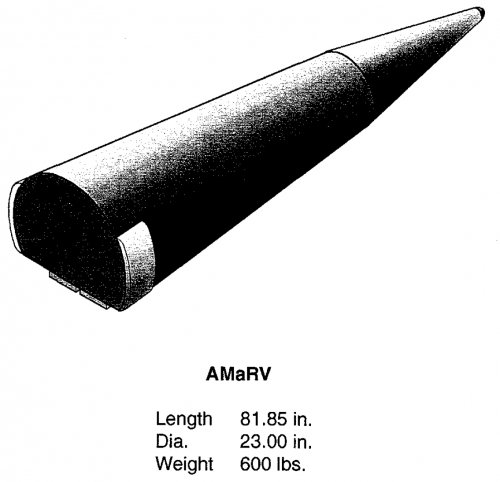
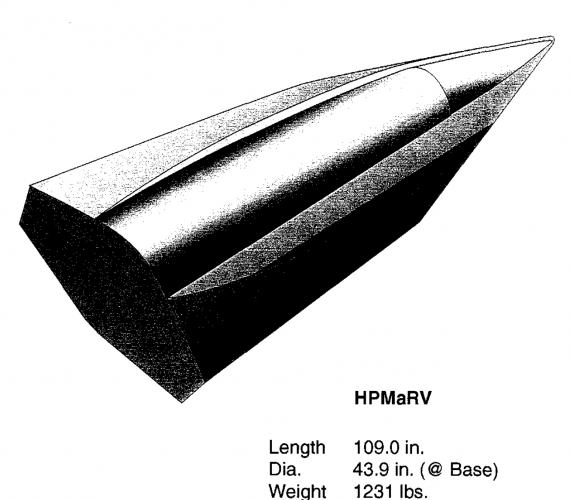
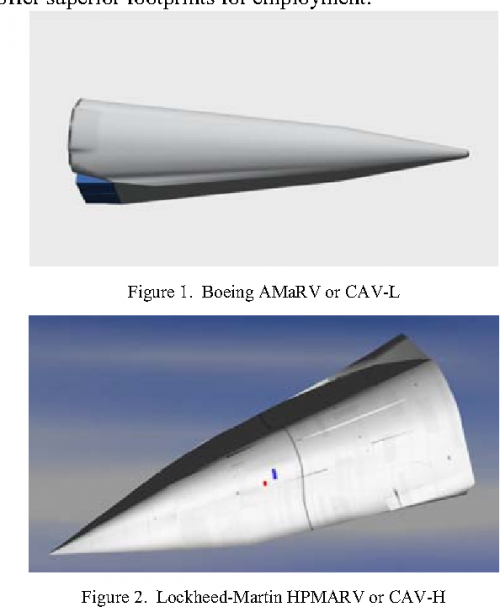
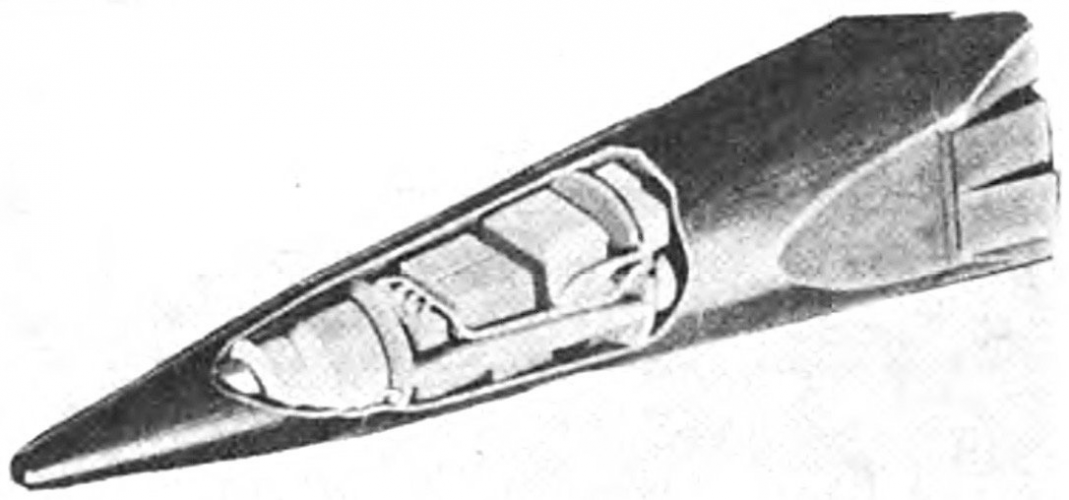
Last edited:
You could make the RV bigger to do it though. The Mk7 is probably smaller than the Mk5, so a MARV'd Mk7 (something like AMARV or HPMARV) might still fit as an 8x warhead load. At the moment though, US Tridents are only carry 4 W76 or W88s AFAIK.
RV size is heavily constrained by the missile though. Even with fewer RVs, it's an annular bus, so RV diameter can be no larger than the distance between 3rd stage motor and the outer fairing. Likewise, length can be no longer than the distance available under the fairing. Outer diameter and missile length in turn are both constrained by tube size, which is for all intents and purposes going to be impossible to change.
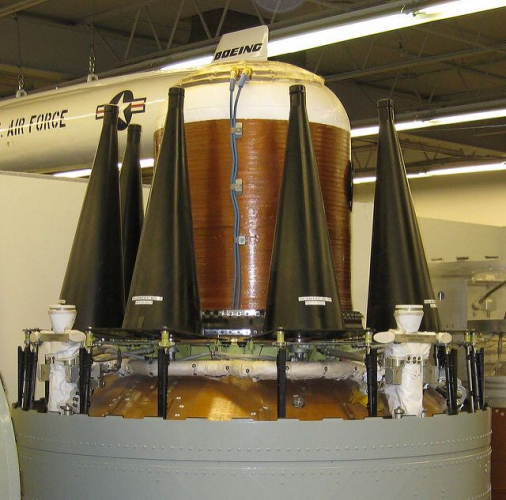
Similar threads
-

-

-
New Plan for Sub Launched Conventional Ballistic Missile for PGS Mission?
- Started by bobbymike
- Replies: 0
-
 9M730 Burevestnik (SSC-X-9 Skyfall) cruise nuclear-powered missile
- Started by Brickmuppet
- Replies: 532
-