Castel, Castel-Mauboussin & Fouga aircraft designations

From Ailes 13/10/1956,

CM-172 was a twin turbojets version of CM-171,intended for high altitude duty.

A second machine, CM-172, similar to CM-171,must fly in the coming months,Primarily, this second device was to receive two more reactors of the same program that "Gabizo", that is, SNECMA.R 105 "Vesta",or, Hispano-Suiz R.-800.
Since the success of "Gabizo",the development of these two reactors was suspended from less in an official capacity.
. As a result, CM-172 will also receive two "Gabizo" but it will be more carefully treated from the point of view
the pressurization, being intended for flights at very high altitude.It will have, in fact, a ceiling greater than 20,000 m. and will serve
to real scuba tests survival.

Also from Aviation magazine 1956.
 

Attachments

  • Aviation_magazine___président-directeur_général_[...]_bpt6k5323231f_10.jpeg
    Aviation_magazine___président-directeur_général_[...]_bpt6k5323231f_10.jpeg
    1.8 MB · Views: 25
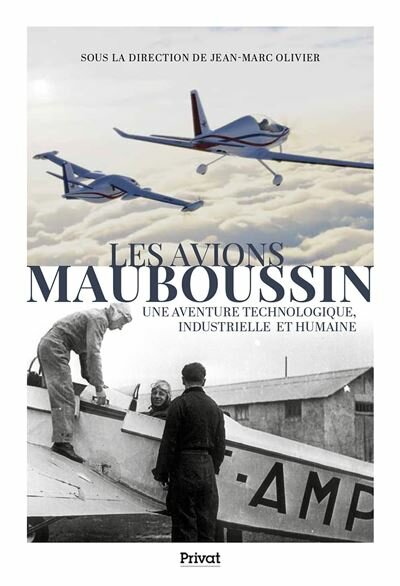
Very disappoint,in the book Les Avions Mauboussin,there is nothing new
at all ?!.
 

Attachments

  • 12.jpg
    12.jpg
    39.1 KB · Views: 19
What does your link refer to? That thread doesn't make any connection between the Projet Centaur and 'CM.140' ...

In this book,the Centaure was taken a CM.1xx series,and that's a logical
suggesting,it was came before CM.160.
 

Attachments

  • 9.jpg
    9.jpg
    27.4 KB · Views: 11
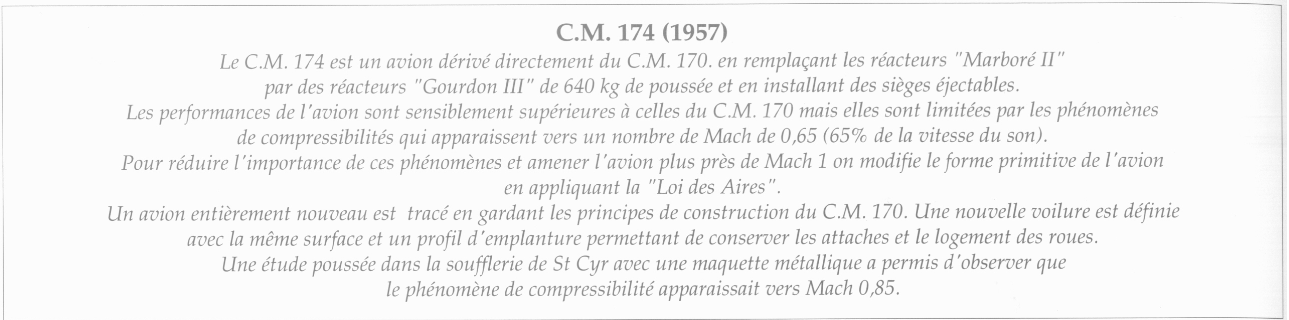
C.M. 174 (1957)

Le C.M. 174 est un avion dérivé directement du C.M. 170. en remplaçant les réacteurs "Marbore II" par des réacteurs "Gourdon III" de 640 kg de poussée et en installant des sièges éjectables. Les performances de l'avion sont sensiblement supérieures à celles du C.M. 170 mais elles sont limitées par les phénomènes de compressibilités qui apparaissent vers mobre de Mach de 0,65 (65% de la vitesse du son).

Pour réduire l'importance de ces phenomenes et amener l'avion plus pres de Mach 1 on modifie le forme primitive de l'avion en appliquant la "Loi des Aires".

Un avion entièrement nouveau est tracé en gardant les principes de construction du C.M. 170. Une nouvelle voilure est définie avec la même surface et un profil d'emplanture permettant de conserver les attaches et le logement des roues. Une étude poussée dans la soufflerie de St Cyr avec une maquette métallique a permis d'observer que le phénomène de compressibilitié apparaissait vers Mach 0,85.

C.M. 174 (1957)

The C.M. 174 was an aircraft derived directly from the C.M. 170 by replacing the "Marbore II" reactors with [Turbomeca] "Gourdon III" reactors of 640 kg thrust and installing ejection seats. The performance of the [C.M. 174] aircraft was significantly higher than those of the C.M. 170 but are also limited by compressibility phenomena which appear around Mach 0.65 (65% of the speed of sound).

To reduce the effects of the compressibility phenomena and to bring the aircraft closer to Mach 1, the primitive shape of the aircraft was modified to incorporate "Area Rule" forms.

An entirely new airframe was designed while keeping the construction principles of the C.M. 170. A new wing of the same surface area with a refined root profile allowed the original undercarriage attachments and wheel housings to be retained. Extensive study of a metal model in the St Cyr wind tunnel made it possible to observe that the compressibility phenomenon was delayed until about Mach 0.85.
 
C.M. 174 (1957)

The C.M. 174 was an aircraft derived directly from the C.M. 170 by replacing the "Marbore II" reactors with [Turbomeca] "Gourdon III" reactors of 640 kg thrust and installing ejection seats. The performance of the [C.M. 174] aircraft was significantly higher than those of the C.M. 170 but are also limited by compressibility phenomena which appear around Mach 0.65 (65% of the speed of sound).

To reduce the effects of the compressibility phenomena and to bring the aircraft closer to Mach 1, the primitive shape of the aircraft was modified to incorporate "Area Rule" forms.

An entirely new airframe was designed while keeping the construction principles of the C.M. 170. A new wing of the same surface area with a refined root profile allowed the original undercarriage attachments and wheel housings to be retained. Extensive study of a metal model in the St Cyr wind tunnel made it possible to observe that the compressibility phenomenon was delayed until about Mach 0.85.

By the way,there are twice CM.174,CM.176 & CM.190,as all were in re-allocation
category.
 
Can you expand on this? What were those reallocated CM.174, CM.176, and CM.190s?

All of them,even CM.175,I can talk about the years only,

CM.174 1957
CM.174 1958
CM.175 1951 project
CM.175 1956 (Zéphyr)
CM.176 1951
CM.176 1958
CM.190 1951
CM.190 1953
 
Last edited:
Also see: Louis Peyret & Peyret-Mauboussin Aircraft Designations
-- https://www.secretprojects.co.uk/threads/louis-peyret-peyret-mauboussin-aircraft-designations.45741/

_____________________________________________________________________

Castel-Mauboussin CM Designations

Pierre Mauboussin joined forces with glider designer Robert Castello in 1942, their designs being known under the Castel-Mauboussin name and assigned CM designations. Fouga had been producing designs by Mauboussin since 1936 and, in 1944, made Mauboussin their Director of Aviation Services working alongside Robert Castello.

Fouga retained the CM designation sequence (which was distinct from their earlier Castel C- numbers). In May 1958, Fouga was bought by Potez which also retained CM designations for Castello-Mauboussin designs and their derivatives.

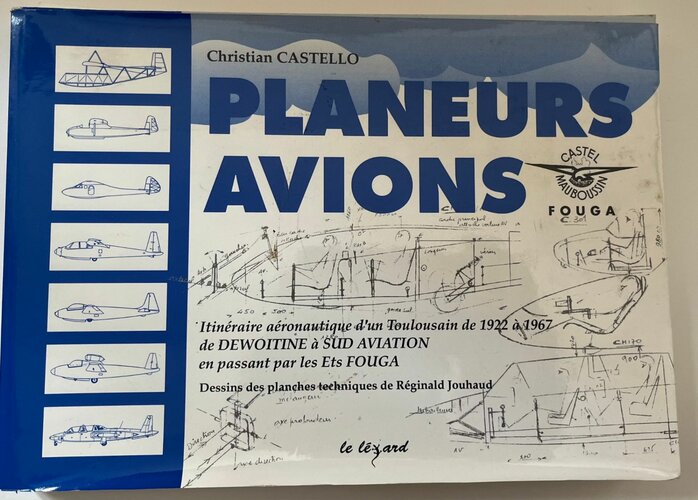
Here, I am presuming that, as the first built Castel-Mauboussin design, the CM Jalon would also be the CM.1. But I cannot be sure. Does anyone have access to 'Planeurs et avions Castel Mauboussin' by Christian Castello, Editions Le Lézard, 1994?

That book by Robert Castello's son has a chapter on CM projects and the index lists a CM "Mach 1" but no designation number is given. Another designation mystery is the 8-10 pax light transport project (2 x Bastan mounted on butterfly tail) mentioned by Jens.
-- http://www.secretprojects.co.uk/forum/index.php/topic,1448.msg47098.html#msg47098

_____________________________________________________________


CM Jalon - 1944 2-seat tandem, 14.1 m span, experimental glider, 2 built
- CM Jalon: n° 1 first flown Nov 1944, n° 2 first flown 22 Sept1945
-- aka CM-ONERA Jalon (n° 2 based at ONERA, Brétigny from 1947)

CM.2 - CM.5 - (??) hypothetical designations

CM.6 --- (Project) 1941 Adour 1-seat wooden sailplane, 18.00 m span, unbuilt
- CM.6: Antipates the 2-seat CM.7 but with ungulled & straight-tapered wings
-- j2mc Planeurs - Castel-Mauboussin CM-06 Adour - specs & 3 view
-- http://www.j2mcl-planeurs.net/dbj2mcl/planeurs-machines/planeur-fiche_0int.php?code=2864

CM.7 --- Adour, 1948 2-seat wooden gull-winged sailplane, span 18.00 m
- CM.7 Adour: (Project) 1941; for the Commissariat général aux Sports
-- Intended for sports flying, blind flying, and acrobatics instruction
- CM.7: Fouga-built model (hence aka Fouga CM.7 Adour); 2 x built
-- 1947: 2 x slightly different CM.7s later broke several height/distance records

CM.8 --- (Project) 1942 1-seat wooden gull-wing acrobatic glider, span 13.50 m
- CM.8 Acro: scaled-down, single-seat devel. of CM.7 Adour; led to CM-8/13

CM.8 --- 1949 single-seat sailplane, aka Fouga CM.8, aka CM-8/13 ... et al
- CM.8 Acro: (Project) 1942; (qv) above
- CM.8/13: 13.00 m span aerobatic prototype; conventional empennage; x 1
- CM.8/15: 15.00 m span aerobatic prototype; sim. to CM.8/13 but V-tail; x 1
-- CM.8/13 & CM.8/15 photo: http://pletav.free.fr/album/CM/73p114.jpg
- CM.8R: Turbomeca Piméné-powered vers.; 13m span with V-tail, aka CM.8R13
-- CM.8R13: 1949 Sylph I, aka Cyclone (renamed at the insistence of Wright)
-- CM.8R15: 1949 Sylph I, aka Cyclone (renamed at the insistence of Wright)
--- Cyclone/Sylphe I: July 1949; 2 x built; F-WFOI/F-BFOI & F-WFOJ/F-BFOJ
-- CM.8R13: 1950 Sylphe II (mod. Sylphe I); changes to Piméné & a canopy
-- CM.8R13: 1952 Sylphe III, 100+ kg Piméné jet, revised canopy & u/c
--- Sylphe III, 4 x built; F-WFDH/F-BFDH, F-BFDI, F-BFDJ, and F-BFDK
-- CM-08R9.8 Cyclope I: 1951 short-span Sylphe; 1 x 110 kg Piméné, 1 x built
-- CM-08R9.8 Cyclope II: 1951 short-span Sylphe; 1 x 160 kg Palas, 1 x built
-- CM.8R-8.3 Midjet : (Midget Jet) 1952 racer; shortened Cyclope fuselage
-- CM.8R-8.3 Midjet : 1 x 160 kg Turbomeca Palas (enlarged Piméné); x 8
-- CM.8R-8.3 Midjet : F-WGKF/BGKF, F-WGKG, F-WGKH, F-BGKI to F-BGKM
- CM.8/13 Sylphe démotorisé: CM-8R/13 with motorization option removed
- CM.82R: Lutin (Goblin) 3/4 scale model for the CM.821R (see below)
-- CM.82R: 2 x Turbomeca Palas turbojets mounted underwing
- CM.821R: (Project) trainer/ground attack, 2 x Turbomeca Marboré
-- CM.821R: 1 x 20mm HS 404 M.49 cannon, 12 x underwing RPs
-- https://www.flightglobal.com/FlightPDFArchive/1951/1951 - 1232.PDF
- CM.88: twin-fuselage version of CM.8R as an engine testbed, 1 x built
-- CM.88R Gémeaux I: Mar 1951; 2 x 100 kg Piméné turbojets; aka CM.88.R I
-- CM.88R Gémeaux II: June 1951; 1 x 300 kg Marboré I; aka CM.88.R II
-- CM.88R Gémeaux III: Aug 1951; 2 x 380 kg Marboré I; aka CM.88.R III
--- NB: CM.88.RIII/Gémeaux III was the re-engined Gémeaux II (F-WFKN)
-- CM.88R Gémeaux III: Jan 1952; 2 x 400 kg Marboré I; aka CM.88.R III
--- CM.88.RIII/Gémeaux III re-engined with 400 kg Marboré IIC; Jan 1952
-- CM.88R Gémeaux IV: Nov 1951; 2 x 200 kg Turbomeca Aspin I; aka CM.88.R IV
--- NB: Gémeaux IV was Gémeaux I F-WEPJ re-engined with ducted turbojet
-- CM.88R Gémeaux IV: June 1952; 2 x 360 kg Turbomeca Aspin II; aka CM.88.R V
--- NB: CM.88.RV/Gémeaux 5 was CM.88.RIV/Gémeaux IV re-engined with Aspin II

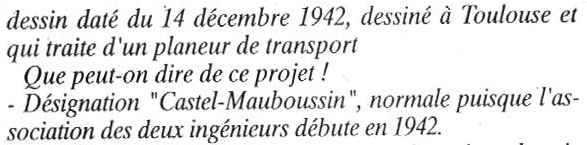
CM.9 --- (??) Possibly a 14 Dec 1942 cargo glider concept (speculation)
-- CM.9 : (??) Cargo glider; pod-boom with rear clamshell doors

CM.10 -- 1947 wooden assault glider, 35 troops; span 26.96 m; 2 x prototypes
- CM.10: Fouga-built glider prototypes evaluated by Armée de terre in 1947
-- Prod'n order for 25 (SNCAN-built) cancelled after crash of CM.10 n° 1
- CM.100: 1949 powered version; 2 x Snecma 12S (As 411); 1 built (F-WFAV)
-- NB: study begun Nov 1944 for Armée (but civil vers. envisioned by SGAC)
-- CM.100 photo http://pletav.free.fr/album/CM/68p108.jpg
- CM.101R: F-WFAV with added wingtip-mounted Turboméca Piméné turbojets
- CM.102 : CM.100 development with retractable undercarriage
- CM.103R: (Project) military CM.101R variant; 2 x Turboméca Marbore turbojets

CM.10 -- (Project) 1952 17m span; V-tailed sailplane; CM-8/15 replacement

CM.11 - CM.16 -- (??) hypothetical designations

CM.17 -- (Project) 1952 single-seat sailplane; V-tail; 17 m span; unbuilt
CM.17: CM-8/15 repl.; poss. unseq. desig., referring instead to wing span

CM.18 - CM.23 - (??) hypothetical designations

CM.24 -- (??) 1950 glider; no details (Project?)

CM.25 - CM.70 - (??) hypothetical designations
-- NB: 30-32, 34-36, and 38 were Castel C- numbers

CM.71 -- 1952 2-seat CM-7 repl. sailplane; orig. V tail;* 18m span; 3 x built
- CM.71: Unseq. desig. may refer to CM.71's intended role as a CM-7 repl.**
-- * CM.71 n° 1 & n° 2 with V-tails; CM.71 n° 3 with cruciform empennage
-- ** CM 71 devel., straight wing/no gull dihedral; built by Fouga;1951-52
-- j2mc Planeurs - Castel-Mauboussin CM-71 - photo, specs, & 3 views
-- http://www.j2mcl-planeurs.net/dbj2mcl/planeurs-machines/planeur-fiche_0int.php?code=360

CM.72 - (Project ??) sailplane (??) speculation

CM.73 - CM.90 - (??) hypothetical designations

CM.91 - CM.99 - (??) hypothetical designations
-- NB: For CM.10x numbers, see CM.10 (above)

CM.104 - CM.119 - (??) hypothetical designations

CM.120 - CM.100 military development (possibly with retractable u/c)

CM.121 - CM.129 - (??) hypothetical designations

CM.130 - (Project) 1948 Fouga jet primary trainer; 2 x Turbomeca Palas turbojets
- CM.130: aka CM.130R; AdA considered underpowered with twin Palas engines
- CM.131: aka CM.131R; 2 x Turbomeca Palas turbojets; 13m2 wing area

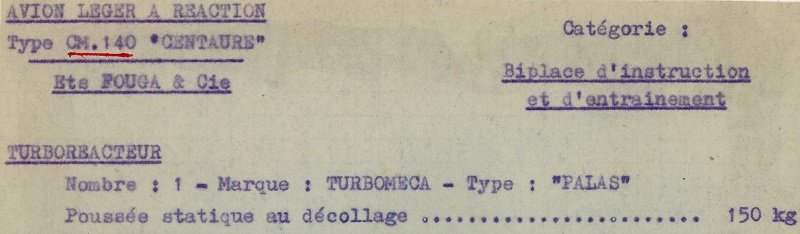
CM.140 - (Project) Pre-Magister primary jet trainer
- CM.140: «Projet Centaur» 2-seat tandem trainer
- CM.140: 2 x 330 kg Turbomeca Palas jets; span (??) m
- CM.140: V-tail; engine above fuselage (Sylphe-style)

CM.150 - (??) hypothetical designation

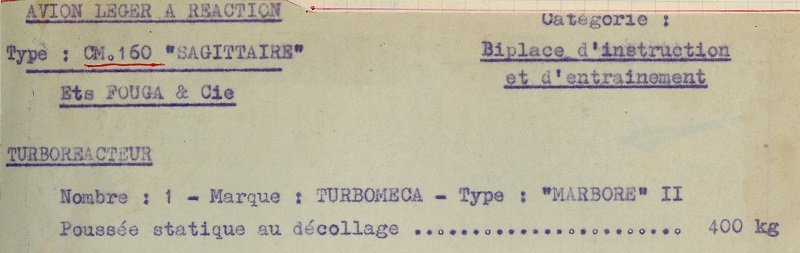
CM.160 - (Project) 1949 Sagittaire primary jet trainer
- CM.160: Lighter CM.170R variant for grass-field ops
- CM.160: 2 x 880 lbf Turbomeca Marbore II jets
-- Same 17.30 m2 area as CM.170; longer 11.35 m span
- CM.160: Led to Fouga CM.170 Magister jet trainer

CM.160 - (Project) 1949 Fouga jet primary trainer, led to CM.170 Magister

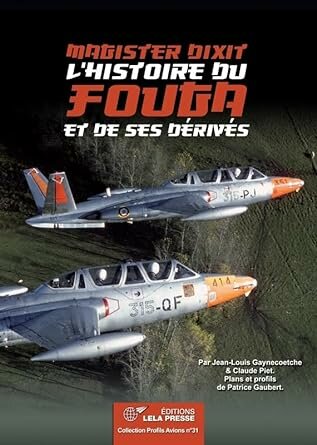
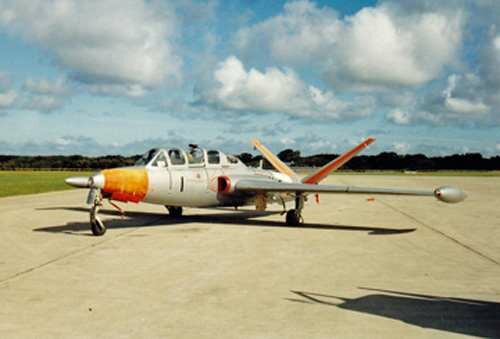
CM.170 - 1950 Fouga Magister trainer; designed w/ Eng Szydlowski of Turbomeca
- CM.170: Magister,; 3 prototypes (1952); 10 x pre-production aircraft (1955)
-- aka CM.170R ('R' for Réaction = Jet-propelled)
-- NB: CM.170 No 2 first fitted with cruciform tail; then with the 'V' type
- CM.170-1: Magister; 1955, 1st production version; 2 x Marboré IIA; 761 x built
- CM.170M Magister : 1956, CM-170 Marin; 2 x Aéronavale PoC a/c, led to Zéphyr
-- CM.170M aka as CM.170 Esquif ('Wherry')
- CM.170-2 Magister: 1960, 2nd production variant; 2 x Marboré IV, 137 x built
-- CM.170-2 prototype designation may have been CM.209 (qv)

CM.171 - 1956 Makalu; engine testbed aircraft for CM.195 project
- CM.171: CM.170 n°15 conv. for 2 x Turbomeca Gabizo turbojets
-- http://pletav.free.fr/avionsplan/photosavions/makaluph.jpg

CM.172 - (Project) 1956 twin-turbojet testbed akin to CM.171
- CM.172: 2 x 2,645 lbf SNECMA R 105 Vesta turbojets; or
- CM.172: 2 x (??) lbf Hispano Suiza R 800 turbojet engines*
-- * Gabizo chosen by MdA over R 105 and R 800 types

CM.173 - 1966 Super Magister; for South African market; x 1
- CM.173: aka Potez 94; a higher-powered CM.170 derivative
- CM.173: 2 x 480 kg Turbomeca Marboré VI (Marboré Super VI)

CM.174 (I) - (Project) 1957 high-speed CM.170 development
- CM.174 (I): Redesigned airframe incorporating 'Area Rule'
- CM.174 (I): 2 x 1,411 lbf Turbomeca Gourdon III turbojets
-- St Cyr wind tunnel showed compressibility delayed to M 0.85

CM.174 (II) - (Project) 1958 shipboard variant of CM.174 (I)
- CM.174 (II): Gourdon-powered; catapult/arrestor hook

CM.175 (I) - (Project) 1951; single-seat ground attack variant
- CM.175 (I) dating suggests Fouga CM.160/CM.170 connection
- CM.175 (I): 2 x (??) lbf Turbomeca Marbore turbojets

CM.175 Zéphyr - 1958 Aéronavale shipboard trainer deriv.
- CM.175 Zéphyr: 2 x prototypes orig. CM.170 M Esquif
- CM.175 Zéphyr: Prod'n type for carrier training; x 30

CM.176 (I) - (Project) 1951 single-seat ground attack variant
- CM.176 (I): CM.170 deriv.; more powerful than CM.175 (I)*
-- * Also heavier than the CM.175 (I) (at 4.35 tonnes vs 3.0 t)

CM.176 (II) - (Project) 1958 close support/ground attacker
- CM.176 (II): CM.170 deriv.; 2 x 20 mm HS 404 cannons*
-- * Also underwing pods for 18 x 68 mm unguided rockets
-- http://www.secretprojects.co.uk/forum/index.php/topic,441.msg5544.html#msg5544

CM.177 - (??) hypothetical designation

CM.178 - (Project) CM.170 deriv. with over-wing turboprops, 2 x Turbomeca Astazous
-- http://www.secretprojects.co.uk/forum/index.php/topic,441.msg5272.html#msg5272

CM.179 - (??) hypothetical designation

CM.180R - 1953 Magister testbed, single engine above fuselage
- CM.180R: 1 x 800 kg (1,765 lbf) Turbomeca Ossau turbojet
- CM.180R: Akin to an enlarged and single-fuselaged CM.88

CM.181 - CM.189 - (??) hypothetical designations

CM.190 - (Project) 1953; 4-seat derivative of the CM.170 2-seater
- CM.190: Project eclipsed by CM.191 (below) and CM.192 (qv)
-- NB: 'CM-190' also a common typo for Fouga CM.170 Magister
CM.191 (I) - (Project) 1951; (??) no details

CM.191 - 1956-62 4-seat liaison/trainer deriv. of CM.170; 2 x built*
- CM.191: aka Potez-Heinkel C.M.191 or Heinkel P.191; flown 1962
- CM.191: 2 x 1,056 lbf Turbomeca Marboré VI; span 12.70 m
-- * CM.191 N°1; double registration of both D-9504 and D-IHAM
-- * CM.191 N°2; D-9532; to Erprobungsstelle 61; Manching, BDR
- CM.191: Intended as prototypes for prod'n Potez-Heinkel C.M.192

CM.192 - (Project) Production version of 4-seat CM.191 prototypes
- CM.192: Serial prod'n type; uncompetitive with the MS.760 Paris
- CM.192: 2 x 1,100 lbf Turbomeca Marboré VI; span 12.70 m
- CM.192: aka Potez-Heinkel C.M.192 (no sign of a 'Heinkel P.192')
- CM.192: Messier u/c project nos. 48046/48007 & 27457/48008*
-- * Repeated online claims for series prod'n performed by Messier
-- * Unlikely and can be discounted - Messier wasn't an airframer
-- Flight 01 June 1961 mis-IDs CM.191 prototype as 'CM.192'
-- http://www.flightglobal.com/pdfarchive/view/1961/1961 - 0729.html
-- Similar mis-indentification by Interavia, Vol XVI, 1/1961

CM.193 - CM.194 - (??) hypothetical designations

CM.195 - (Project) 1955 light transonic interceptor, 2 x 1100 kg Turbomeca Gabizo
-
CM.195: 2-seat, enlarged CM.170 layout with swept wings and swept tail
-- Flight 24 June 1955 ident. CM.195 as a trainer, CM.171 as the testbed
-- aka Fouga Mach 1
-- http://www.flightglobal.com/pdfarchive/view/1955/1955 - 0873.html

CM.196 - CM.208 - (??) hypothetical designations

CM.209 - 1960 Fouga Magister derivative with different engines
- CM.209: 2 x 1,055 lbf Marboré IV (versus 880 lbf for Marboré IIA)
-- Alternative or prototype desig. for prod'n CM.170-2 Magister

CM.210 - (Project) 1954 twin-engined, delta-winged tactical attack a/c
- CM.210: 2 x 1200 kg Hispano-Suiza R-800, CM.170-like intakes, bicycle u/c
-- http://www.secretprojects.co.uk/forum/index.php?topic=1448.0
-- Note CM.210/CM.212 desig. confusion
- CM.210 armament: 1 x 30mm cannon, 32 small-calibre rockets

CM.211 - (??) hypothetical designation

CM.212 - (??) Widely confused with C.210 project
-- 'CM.212' misprint originated with Docavia 28

CM.213 - CM.219 - (??) hypothetical designations

CM.220 - (Project) 1956 COIN a/c; 2 x Turbomeca Astazous over-wing turboprops
- CM.220: wing similar to CM.178 but shoulder-mounted, fixed u/c, conventional tail
-- http://www.secretprojects.co.uk/forum/index.php/topic,441.msg5340.html#msg5340

CM.221 - CM.229 - (??) hypothetical designations

CM.230 - (Project) 1956 high-wing monoplane AOP a/c, 1 x 305 hp inline Potez 6D
- CM.230: Slatted wing; tandem 2-seater (plus space for a stretcher case)
-- http://www.secretprojects.co.uk/forum/index.php/topic,1448.msg12159.html#msg12159

CM.311P - 1950 Castel C 310P devel. with improved de-rigging, longer oval-shaped fuselage, new air brakes

___________________________

 
Last edited:
Thank you my dear Apophenia,and I can add,

CM.174 (II) 1958 - was a project version,with Gourdon engine, and catapult
and deck landing devices
CM.175 (I) 1951 - was a single seat ground attack project version,powered
by either two Marbore or Turbomeca engines,weight 3 ton
CM.176 (I) 1951 - was also a single seat ground attacke project version,a heavier
than CM.175 (I),4.35 ton,and more powerful engines
CM.190 (II) 1953 - was a side-by-side two-seat project version,derivative
of the CM.170,with the "Vautour" bicycle landing gear

* CM.190 (I) was from 1951
 
FWIW, in my files I have a photo titled "Fouga CM-170M Esquif aka CM-175 Zéphir No1 at Jersey". It could explain the shortcut by the journos.
Unfortunately no details on source.
The two Zéphyr prototypes were produced initially as the CM.170 M Esquif and redesignated later on into the CM.175 sequence.
By the way, "Zéphyr" is the correct spelling (I can't understand how a website such as Minijets can't even write the name properly, jumping constantly from "zéphir" to zéphyr in the same page!)
 
Last edited:
Here, I am presuming that, as the first built Castel-Mauboussin design, the CM Jalon would also be the CM.1. But I cannot be sure. Does anyone have access to 'Planeurs et avions Castel Mauboussin' by Christian Castello, Editions Le Lézard, 1994?
You may be wrong... Castel and Mauboussin started working on several projects as early as 1941: the CM.6 and CM.7 Adour are from that period. We have no indication as to when the Jalon was designed — it could be before the CM.6, or after. My guess, judging from its design, is that it can't have been conceived after the CM.8, so it has to be among the CM.1 to CM.5 sequence. However, there are other designs in that early undocumented sequence, such as the large 6-ton assault troop transport. It is also possible that the former Castel types that became Castel-Mauboussin products (C.30 S, C.310 P, C.311 P) may have been given an inside CM designation for record purposes... So as you see, it is very difficult to allocate a designation, even tentatively.
That book by Robert Castello's son has a chapter on CM projects and the index lists a CM "Mach 1" but no designation number is given.
"Mach 1" was simply a working designation for the CM.195 transonic trainer/interceptor.
 
Last edited:
--- Cyclone/Sylph I: July 1949; 2 built; F-WFOI and F-WFOJ (later F-BFOJ)
Later F-BFOI and F-BFOJ.
Also, please mind the French spelling, please. It's SYLPHE.
-- CM.8R13: 1950 Sylph II; changes to Piméné jet engine and canopy, 1 x built
No. The Sylphe II was just the first Sylphe I [F-BFOI] modified.
-- CM.8R13: 1952 Sylph III, 100+ kg Piméné, revised canopy & undercarriage
--- Sylph III, 4 xbuilt; F-BFDH, F-BFDI, F-BFDJ, and F-BFDK
First one started off as F-WFDH.
- CM.88: twin-fuselage version of CM.8R as an engine testbed, 1 x built
-- CM.88R Gémeaux I: Mar 1951; 2 x 100 kg Piméné turbojets; aka CM.88.R I
-- CM.88R Gémeaux II: June 1951; 2 x 300 kg Marboré I; aka CM.88.R II
-- CM.88R Gémeaux III: Aug 1951; 2 x 380 kg Marboré I; aka CM.88.R III
--- NB: CM.88.RIII/Gémeaux III was re-engined CM.88.R II/Gémeaux II
-- CM.88R Gémeaux III: Jan 1952; 2 x 400 kg Marboré I; aka CM.88.R III
--- CM.88.RIII/Gémeaux III re-engined with 400 kg Marboré II; Jan 1952
-- CM.88R Gémeaux IV: Nov 1951; 2 x 200 kg Turbomeca Aspin I; aka CM.88.R IV
--- NB: CM.88.RIV/Gémeaux IV was Gémeaux I re-engined with ducted turbojet
-- CM.88R Gémeaux IV: June 1952; 2 x 360 kg Turbomeca Aspin II; aka CM.88.R V
--- NB: CM.88.RV/Gémeaux 5 was CM.88.RIV/Gémeaux IV re-engined with Aspin II
You have fixed a few mistakes from your previous version of the list, but you are still wrong about the number of engines.
Only the Gémeaux I had two turbojets. The others had only one.
The Gémeaux III 's second engine version was the Marboré IIC.
Only two Gémeaux airframes existed: F-WEPJ was the Gémeaux I, IV and V; F-WFKN was the Gémeaux II and III.

In the CM.8 family, you forgot to mention the Centaure project (of which very little is known except for part of a plan), and most importantly the CM.8R-8.3 Midjet (a play on the words "Midget racer" and "jet"), a 1952 racer based on the Cyclope, but shortened. It was powered by a 160 kg Turbomeca Palas, and no less than EIGHT WERE BUILT ! [F-WGKF/BGKF, F-WGKG, F-WGKH, F-BGKI to F-BGKM]

CM.9 --- (Project) Possibly a cargo glider; pod-boom with rear clamshell doors
That designation is totally incoherent with the fact that it was a 1941 project, and could not therefore have been designed after the CM-8 Acro, which came out in 1948. A typical example of how some heshamism turns into a de facto legend...
CM.10 -- 1947 wooden assault glider, 35 troops; span 26.96 m; 2 x prototypes
- CM.10: Fouga-built glider prototypes evaluated by Armée de terre in 1947
-- Prod'n order for 25 (SNCAN-built) cancelled after crash of CM.10 n° 1
It is said that the first production item had already been built (but probably not finalized).
- CM.100: 1949 powered version; 2 x Snecma 12S (As 411); 1 built (F-WFAV)
- CM.101R: F-WFAV with added wingtip-mounted Turboméca Piméné turbojets
There is a mystery here: although I have no photographic proof, it seems like there were actually TWO CM.101R aircraft (-01 and -02), registered as F-WFAV and F-WFAX. Was the second one never completed?
- CM.102 : CM.100 development with retractable undercarriage
- CM.103R: [Project] military CM.101R variant; 2 x Turboméca Marbore turbojets
The lack of an "R" (for "réacteur", or jet) suffix suggests that this would have been a piston-engined version.
CM.10 -- [Project] 1952 17m span; V-tailed sailplane; CM-8/15 replacement
I have this one as a 1950 project.
CM.17 -- (Project) 1952 single-seat sailplane; V-tail; 17 m span; unbuilt
CM.17: CM-8/15 repl.; poss. unseq. desig., referring instead to wing span
The CM-17 was studied for SNCASE as a possible replacement for the CM.8/15.
CM.24 -- (??) 1950 glider; no details (Project?)
I have never come across this one, but I should think this was a reworking of the Castel C.24 design.
CM.90 -- (unseq., error?) Potez (Aerospatiale) CM.170 evol.; 2 x Astafans
This is WRONG. It is a commonly-found mistake but the "90" was a Potez, not Fouga, designation. The name "Fouga" in the designation "Fouga 90" was an homage or evocation of the Magister and had no basis in the Fouga design line.
CM.171 - 1956 Makalu; CM.170 n°15 conv. to take 2 x Turbomeca Gabizo turbojets
- CM.171: considered as an engine testbed aircraft for the CM.195 project
This one carried temporary civilian registration F-ZWUF.
CM.173 - 1966 Super Magister, 2 x 480 kg Marobé VI (Marboré Super VI); x 1
- CM.173: aka Potez 94, higher-power CM.170 deriv. for South African market
This one carried temporary civilian registration F-ZWWL.
The typo on "Marboré" was carrier over from your previous version of the list...
CM.174 (I) - (Project) 1957 high-speed CM.170 development
CM.174 (II) - (Project) 1958; (??) no details
There is no reason to believe that these could have been two distinct projects.
Just the same area-ruled design, unless some evidence can prove me wrong.
CM.180R - 1953 Magister testbed, single engine above fuselage
- CM.180R: Akin to an enlarged and single-fuselaged CM.88
This was a testbed for the 800 kg Turbomeca Ossau engine.

Worthy of a passing mention is the Delta Magister proposal (Pa.562, design K89) that Roland Payen made to Fouga in 1954. Although quite different from the regular Magister and not a CM- project, it may have become a proper Fouga if the company's financial difficulties had not led to its bankrupcy (Fouga was taken over by Potez and renamed Potez-Air-Fouga).

CM.190 - (Project) 195?; 4-seat derivative of the CM.170 2-seater
This was a 1953 project.
- CM.191: 2 x 1,056 lbf Turbomeca Marboré VI; span 12.70 m
Or 480 kg. It is annoying that some books give the thrust in pounds, and others in kilos!
CM.195 - (Project) 1955 light transonic interceptor, 2 x 1100 kg Turbomeca Gabizo
-- Flight
24 June 1955 ident. CM.195 as a trainer, CM.171 as the testbed
Trainer or interceptor? Probably both... Anyway, this was the Fouga "Mach 1".


One last remark: I've noticed you always the need to cover ranges of unallocated designations with the mention (??)
Creating these fictitious "CM.211 to CM.219 (??)"-type entries will probably give many readers the wrong impression that these designations certainly existed but that they are not documented... However, the fact that there are no sub-versions for a certain type should not be a problem... It makes EVERY sense to jump from CM.210 to CM.220 to CM.230, with nothing in between...
 
That designation is totally incoherent with the fact that it was a 1941 project, and could not therefore have been designed after the CM-8 Acro, which came out in 1948. A typical example of how some heshamism turns into a de facto legend...

How do you know it was from 1941 ?,just guessing,nothinf else,but possible it was from early 1940s or more ?,so the logical to speculate it after CM.8,also CM.8 was designed in 1942 ?!.
There is no reason to believe that these could have been two distinct projects.
Just the same area-ruled design, unless some evidence can prove me wrong.

You have no enough Info to reject this,it's from a reliable source !.
This was a 1953 project.
The CM.190 (I) was from 1951,and the CM.190 (II) was from 1953
 
Last edited:
Once again, instead of appreciating the work that has been done, you step in only to criticize.
I have NEVER pretended I was right about everything; I for one have the humility to admit I can be wrong... But at least I've done my share of research... and if someone can correct or show me evidence of something I omitted, I am more than willing to make the necessary adjustments to my work!

How do youknow it was from 1941 ?,just guessing,nothinf else,but possible it was from early 1940s or more ?,so the logical to speculate it after CM.8,also CM.8 was designed in 1942 ?!.
  1. The Castel-Mauboussin association didn't exist in 1940.
  2. Assault troop transport glider designs didn't exist in 1940.
  3. Several sources give the date "1941" for the design of the CM.6 and CM.7, I didn't invent it.
  4. As for the 6-ton troop glider, my bad, it was actually drafted in 1942, not 1941:
    1742683877604.png
  5. Indeed, the CM-8 Acro was also conceived in 1942.
So you may be right about that design being the CM-9 after all. However, it's pure speculation to call it so, unless you have a shred of evidence to back it up. I can't emphasize enough how something you write even once becomes fact in some readers' minds, so as researchers we need to be careful and not assert things unless we are sure! At least put a big "maybe" next to it, or say "I may be wrong, but I think that..."

You have no enough Info to reject this,it's from a reliable source !
Can you read?? I wrote "unless some evidence can prove me wrong."
So far I have not found sufficient data to show me that the 1954 and 1955 mentions of the CM.174 refered to two different projects. But apparently you know more than I do on the subject... So prove me wrong! Show me the evidence!
 
Can you read?? I wrote "unless some evidence can prove me wrong."
So far I have not found sufficient data to show me that the 1954 and 1955 mentions of the CM.174 refered to two different projects. But apparently you know more than I do on the subject... So prove me wrong! Show me the evidence!

The evidence is from that book,but I can't display anything from it.
 

Attachments

  • 22.jpg
    22.jpg
    34.7 KB · Views: 19
The mess that used to be Peyret/Peyret-Mauboussin/Castel/Castel-Mauboussin topics has finally been sorted out, hopefully for good this time (special thanks to Apophenia for helping me clear some unnecessary duplicate posts).

So here's what we have now:

"Early" section:
"Postwar" section:
  • Fouga Projects
    Everything produced by Fouga after the war (CM. series, Potez-Heinkel)
"Designations" section:
Hope this helps!
 
The CM.190 (I) was from 1951,and the CM.190 (II) was from 1953

CM.190 (I) was a four seat light jet aircraft with Marbore engines,
1951 project.
CM.190 (II) was a side-by-side two-seat aircraft,derivative of CM.170,
1953 project.
 

Attachments

  • Fouga CM.140 Centaure (PhR).jpg
    Fouga CM.140 Centaure (PhR).jpg
    69.7 KB · Views: 11
  • Fouga CM.160 Sagittaire (PhR).jpg
    Fouga CM.160 Sagittaire (PhR).jpg
    72.3 KB · Views: 12
Wow,amazing find my dear Philippe,

and my speculation is right,and what about CM.200 ?.
 
Thank you my dear Apophenia,and I can add,

CM.174 (II) 1958 - was a project version,with Gourdon engine, and catapult
and deck landing devices
CM.175 (I) 1951 - was a single seat ground attack project version,powered
by either two Marbore or Turbomeca engines,weight 3 ton
CM.176 (I) 1951 - was also a single seat ground attacke project version,a heavier
than CM.175 (I),4.35 ton,and more powerful engines
CM.190 (II) 1953 - was a side-by-side two-seat project version,derivative
of the CM.170,with the "Vautour" bicycle landing gear

* CM.190 (I) was from 1951

Please add those designations,and thanks.
 

Similar threads

Back
Top Bottom