Castel, Castel-Mauboussin & Fouga aircraft designations

hesham

ACCESS: USAP
Senior Member
Joined
26 May 2006
Messages
38,288
Reaction score
20,424
Re: Avions Mauboussin M Designations

Apophenia said:
Avions Mauboussin

M.40 - Hémiptère, 1936 single-seat tandem-wing research a/c, 1 x 40 hp Train 4A
- M.40: c/n 01 F-AOYZ, endplate fins on high rear wing, infl. by Peyret project
-- Flight 17 Sept 1936 - Reviving the Tandem - details & photo
-- http://www.flightglobal.com/pdfarchive/view/1936/1936%20-%202533.html

Does anyone happen to know of any other tandem-winged designs or projects by Mauboussin that may have been inspired by the M.40 Hémiptère?
 
The book "French Post-war Transport Aircraft" (Air Britain, 1980) by Chillon, Dubois and Wegg has an unbuilt Castel-Mauboussin derivitive of CM.10/CM.-100 family ....

CM.103R - as CM.101R with the two Turbomeca Marbore auxiliary turbojets. A military variant that was not built.
 
Excellent. Thanks for that Cy-27! But, if there was a CM.101R and a CM.103R project, there must be a 'CM.102' lurking out there ;D
 
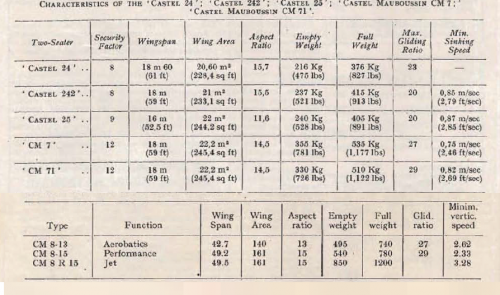
Castel 24 tandem two seat glider with an 18 metre span from 1936.

The Castel 242 was a 1941 development from the "Air Sports Service" with a new swept wing which offered poor handling built good soaring performance. One glider was lost in a fatal accident at the Challes les Eaux Centre in 1945. Other examples set a series of duration records 1946-1948.

Castel 25 was the side-by-side tandem two seat glider

The Castel-Mauboussin CM 7 was built in two slightly different versions in 1947 and later broke several height and distance records.

The CM 71 was a development of the CM 7 with a straight wing and no gull dihedral. Constructed at the Fouga factory 1951-52.

Castel-Mauboussin CM 8-13 aerobatic sailplane. 13 metre wing span.

CM 8-15 high-performance sailplane with 15 metre span.

Castel-Mauboussin CM 8-R15 jet sailplane known as Cyclone powered by a Turbomeca 011.

A Castel Castel-Mauboussin CM 310P development from 1950 was the Castel-Mauboussin CM 311P with improved de-rigging arrangement. It also had a longer fuselage, oval in shape (the 310 was flat-sided). New air brakes with opening above and below the wings.

CM 311P Data

Wing span: 45 ft
Wing Area: 158 sq ft
Wing Aspect Ratio: 13.3
Empty Weight: 346 lb
Maximum Weight: 540 lb


Some notes on Castel-Mauboussin types attached.


Sources:
Various cuttings that I am fairly sure are from British Gliding Magazines from the early 1950's.
 

Attachments

  • CM_Types_Table.png
    CM_Types_Table.png
    635.6 KB · Views: 88
Thanks Cy-27. Aren't the 310P and 311P usually listed as purely Castel designs?
 
You are dead right, Apophenia, about the 310P being a Castel design, I was too enthusiastic with my cutting and pasting! I will edit the earlier entry.

The CM 311P is described as Castel-Mauboussin in the article though, together with the CM prefix in all cases.
 
Interesting ... and confusing :eek: Thanks for checking Cy-27! The CM 311P has been added to the designation list.
 
Hi,

CM.102 was developed from CM.100 with retractable landing gear.

CM.120 was a military version of CM.100,maybe also with retractable landing gear.
 
Hi,

CM.131R was a project developed from CM.130.
 

Attachments

  • 1.png
    1.png
    218.6 KB · Views: 291
Thanks Hesham ... that's been added. With its reduced wing area, the CM.131R would have been a better performer.
 
hesham said:
CM.120 was a military version of CM.100,maybe also with retractable landing gear.

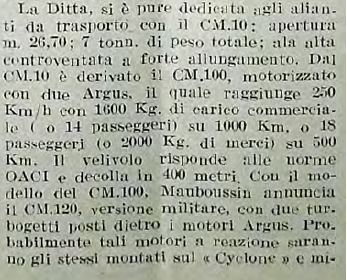
A small Info about CM.120.

http://www.avia-it.com/act/biblioteca/periodici/PDF%20Riviste/Ala/L'Ala%201949%2007.pdf
 

Attachments

  • 1.png
    1.png
    210.7 KB · Views: 238
Thanks Hesham. Those same-as-'Cyclone' turbojets would, of course, be the Turboméca Piméné.

Above in the text, when L'Ala says 'CM.10', they are actually referring to the CM.101R ... with the "turbogetti posti dietro i motori Argus" being Piméné jets mounted behind the Snecma 12S piston engines. Presumably, aft of the 12S engines was the originally intended position for the twin turbojets which ended up being wingtip-mounted.
 
My dear Apophenia,

please add this;
 

Attachments

  • a.png
    a.png
    218.8 KB · Views: 213
OK my dear Apophenia,

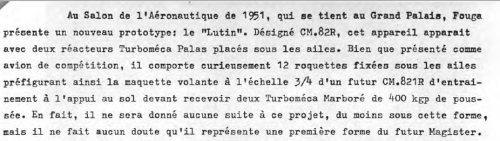
and also this new,it's offered in French language,but here is a google translate;

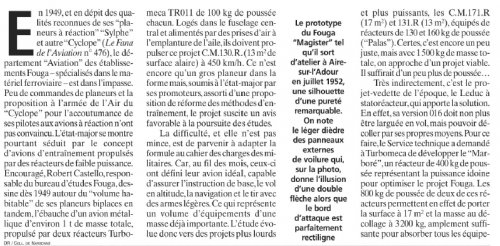
This testbed after the CM-170 takes the designation CM-180 and is expected to receive
the test reactor on top of the fuselage to the manner of CM-88.
 
Thanks Hesham. Was this CM.180 'testbed' actually built or did it remain a project?

@éro-Index lists a 'CM 180 R' as being mentioned in Aviation Magazine. Just what this CM.180R was to be a testbed for is a bit of a puzzle ... assuming that, like the CM.88 Gemeaux, the CM.180R was to be a testbed for Turbomeca.

It makes sense that the single engine mounted above the fuselage would produce somewhere in the range of the 1,760 lbf combined thrust of a standard Magister. The Turbomeca Aubisque put out 1,543 lbf but, with first run in 1961, seems a little late. As for other French engine makers, AFAIK, SNECMA's smallest 1950s turbojet was the R.105 Vesta producing 3,308 lbf ... which doesn't seem very probably either.

All a bit of mystery ???
 
Does anyone have any images for the unbuilt, lower-powered designs that preceded the Fouga CM.170 Magister?

CM.130 - [Project] 1948 Fouga jet primary trainer, 2 x Turbomeca Palas turbojets
- CM.130: aka CM.130R, AdA considered underpowered with twin Palas engines
- CM.131: aka CM.131R,2 x Turbomeca Palas turbojets, 13m2 wing area
 
My dear Cluttonfred,

here is a drawing to CM.130R;

https://www.secretprojects.co.uk/forum/index.php/topic,262.0.html
 
Re: Castel-Mauboussin CM Designations

Apophenia said:
CM-212 - [Project] 1954 twin-engined, delta-winged tactical attack a/c
- CM-212: 2 x 1200 kg Hispano-Suiza R-800, CM.170-like intakes, bicycle u/c
-- http://www.secretprojects.co.uk/forum/index.php?topic=1448.0
- CM-212 armament: 1 x 30mm cannon, 32 small-calibre rockets

That was a misprint,it was called CM-210.
 
From Ailes 28/5/1949,

the translation;

[that the CM-101 will include a fully retractable landing, and, the CM-120 military transport,
small turbines gas that will be used for 'assisted' takeoffs with a payload more important than
that of the civil versions to private users./quote]
 
Re: Castel-Mauboussin CM Designations

hesham said:
That was a misprint,it was called CM-210.

So, that misprint originated with Docavia 28 ?
 
Re: Castel-Mauboussin CM Designations

Apophenia said:
So, that misprint originated with Docavia 28 ?

Yes my dear Apophenia,

and that is explained in TU magazine.
 
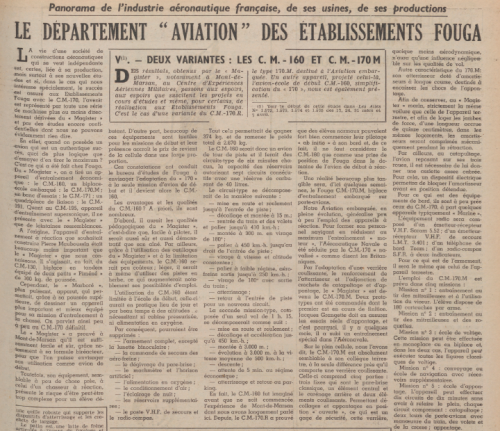
From Ailes 14/4/1956,

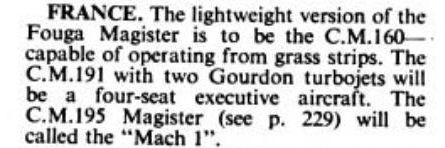
here is some Info Fouga aircraft and Projects,included ,CM-130,CM-160 and CM-195.
 

Attachments

  • 1.png
    1.png
    895.3 KB · Views: 48
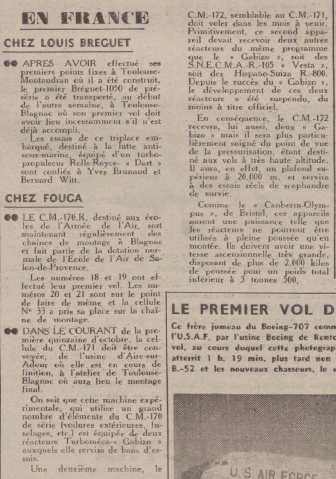
From Ailes 13/10/1956,

CM-172 was a twin turbojets version of CM-171,intended for high altitude duty.

A second machine, CM-172, similar to CM-171,must fly in the coming months,Primarily, this second device was to receive two more reactors of the same program that "Gabizo", that is, SNECMA.R 105 "Vesta",or, Hispano-Suiz R.-800.
Since the success of "Gabizo",the development of these two reactors was suspended from less in an official capacity.
. As a result, CM-172 will also receive two "Gabizo" but it will be more carefully treated from the point of view
the pressurization, being intended for flights at very high altitude.It will have, in fact, a ceiling greater than 20,000 m. and will serve
to real scuba tests survival.
 

Attachments

  • 1.png
    1.png
    281.2 KB · Views: 43
Last edited:
From Ailes 1/10/1960,

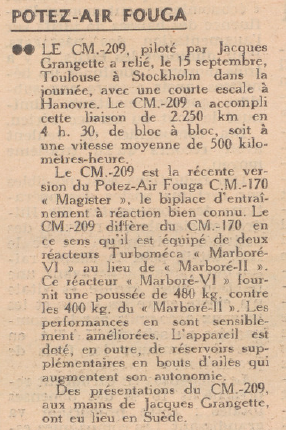
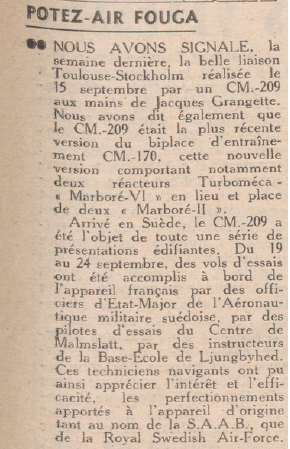
here is an Info about CM.209,to believe there was no CM.212,but CM.210.

CM-209 piloted by Jacques Grangette connected, September 15,
Toulouse to Stockholm in the day, with a short stop at
Hanover. CM-209 completed this connection of 2.250 km in
4 hrs. 30, from block to block, is an average speed of 500 kilometers per hour.

CM-209 and the recent version of the Potez-Air Fouga C.M-170 "Magister". the well
known reaction training two-seater. The CM-209 differs from CM-170 in that sense
that it is equipped with two Turbomeca reactors "Marboré-VI "instead of" Marboré-II ".
This "Marboré-VI" reactor provides a thrust of 480 kg. against the 400 kg. of "Marboré II". The
performance are significantly improved. The apparatus is further provided with additional tanks
at the ends of the wings which increase its autonomy. Presentations from CM-209,
in the hands of Jacques Grangette, took place in Sweden.
 

Attachments

  • 1.png
    1.png
    256.1 KB · Views: 33
Last edited:
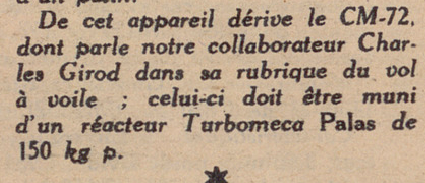
From Aviation Magazine 1951,

the CM-72 was derivative of CM-71.
 

Attachments

  • 1.png
    1.png
    145.8 KB · Views: 24
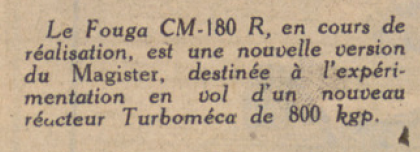
From Aviation magazine 1953,

here is a small Info about CM.180R.
 

Attachments

  • 1-718.png
    1-718.png
    133.3 KB · Views: 38

Attachments

  • 20.png
    20.png
    528.9 KB · Views: 22
  • 21.png
    21.png
    348.8 KB · Views: 22
Last edited:
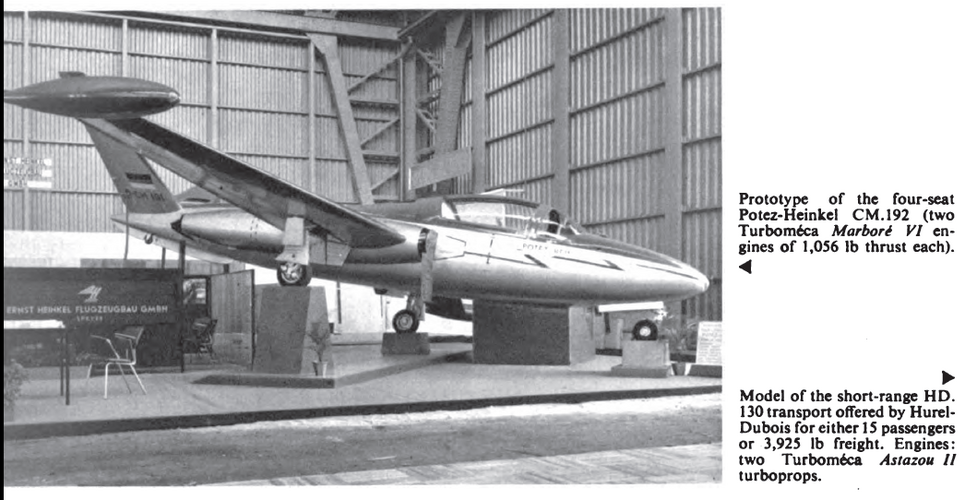
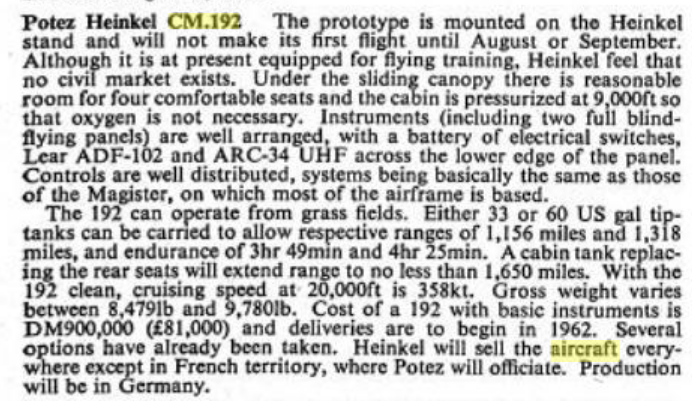
but in these two captions,it could be a misprints,but the designation is right as in Messier's site.

Yes, these are "misprints". The aircraft shown is the first prototype CM.191 (D-9504/D-IHAM).

Doubtless the confusion came from Potez-Heinkel reps at the show who would have been pushing the production-version CM.192.

The latter was never built but online sources claim that SFMA Messier was to series-build the CM.192 variant. That can be safely discounted since Messier was never an airframer (IIRC, the 1934 Avion laboratoire Messier undercarriage testbed was the firm's sole foray into whole aircraft construction). The quoted Messier project numbers - 48046/48007 and 27457/48008 - were doubtless separate design requirements for nose and main undercarriages for the series CM.192.

I have updated post #3 with some details on the built CM.191 prototypes and the unbuilt CM.190 and CM.192 projects.
 

Similar threads

Back
Top Bottom