This thread conflates two related RCAF programmes (this has been covered elsewhere in some detail by
@fortrena).
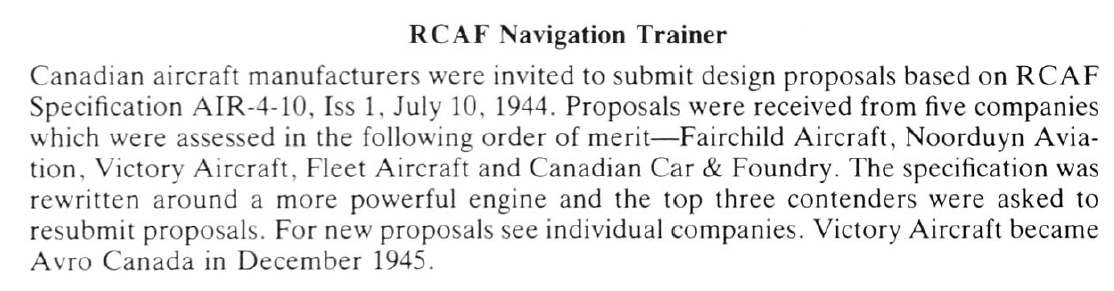
The first was a July 1944 specification for a multirole trainer (bombing/gunnery, navigation, and wireless/radar training) - the Specification AIR-4-10 of 10 July 1944 mentioned by Kenneth Molson in the first clipping (1-1). The Crown corporation Federal Aircraft of Ottawa acted as lead contractor/coordinator (but, in this management role, Federal produced no aircraft design itself).
Four Canadian companies received this spec for review in November 1944. Later, after protests, Crown corporation Victory Aircraft of Malton, ON, was added. As @heshem listed, submissions were received from Canadian Car & Foundry; Fairchild Canada; Fleet Aircraft; Noorduyn Aviation; and, later, Victory Aircraft. (Note that of @heshem's list, for the 1944 contest, the Fairchild F-8 is incorrect while the 'Victory Model 10' and 'Fleet Model 70' attributions are purely conjectural.)
In April 1945, the RCAF reviewed the submitted proposals but found all of them wanting. In the end, it was concluded that the RCAF specification itself had over-reached and this programme, in its original form, was terminated. In September 1945 a new specification was issued restricted solely to the "Navigation Trainer" role in the hope that this requirement was more realistic.
The top three respondents to AIR-4-10 were invited to submit proposals for this September 1945 specification - these being Fairchild Aircraft; Noorduyn Aviation; and Victory Aircraft. Each submitted a design but, with most wartime contracts ending, Noorduyn Aviation Limited decided to cease operations almost immediately. At the same time, Crown corporation Victory Aircraft had been sold to Hawker Siddeley to become A.V. Roe Canada (aka 'Avro Canada').
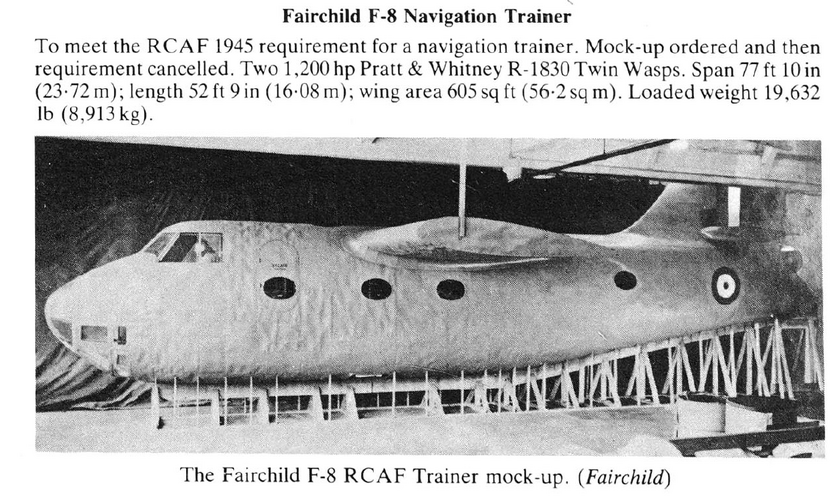
Fairchild and Avro Canada were commissioned to build ergonomic fuselage mockups for their designs. The former was for
@hesham's Fairchild F-8 and featured stub wings and a partial tailplane (giving a fair indication of the design's intended appearance). The latter was for Avro Canada's C.101 Navigational Trainer concept. [1] This C.101 mockup was restricted to the fuselage alone.
Molson [2] provides basic specs for the Avro Canada C.101: 2 x P&W R-1830 radials; span 73 ft (22.25 m); length 58 ft (17.68 m); wing area 655 sq ft (60.85 m2); loaded weight 20,295 lbs (9,234 kg). Overall, the C.101 specs are very close to those of the Fairchild F-8.
So, my turn to speculate: For Avro Canada, we are looking at an aircraft with half the wing area of a
Lancaster and about 70% of its span. Still, the fuselage's rear end looks not unlike that of a
Lancastrian. That suggests that a chopped-down derivative of the wartime Victory 5 making use of
Lancaster tails and modified wing components is not out of the question.
__________________________________
[1] Some sources have claimed that the parent company submitted its Avro 702 aircrew trainer design to AIR-4-10 in December 1945. There are a few problems there. First, the dating. Second, the Sept 1945 submissions were by invitation only to established Canadian companies (eliminating the possibility of an unsolicited submission from the UK). Third, work on the Victory/Avro Canada C.101 mockup had already been approved.
If the connection made between the Avro Type 702 and AIR-4-10 is not erroneous, perhaps the original lister got the order back-to-front. Might the Avro Type 702 be the parent firm's designation for a potential UK variant of the Avro Canada C.101?
[2]
Canadian Aircraft since 1909, KM Molson & KM Talor, Canada's Wings, Stittsville, ON, 1982, page 508