

You are using an out of date browser. It may not display this or other websites correctly.
You should upgrade or use an alternative browser.
You should upgrade or use an alternative browser.
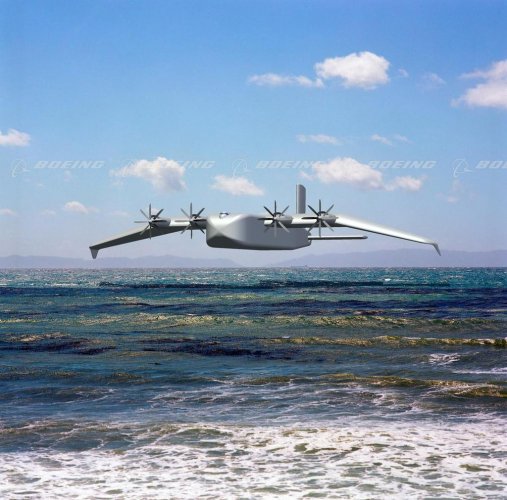
Boeing Pelican ULTRA (Ultra Large TRansport Aircraft)
- Thread starter Orionblamblam
- Start date

- Joined
- 1 April 2006
- Messages
- 12,286
- Reaction score
- 15,112
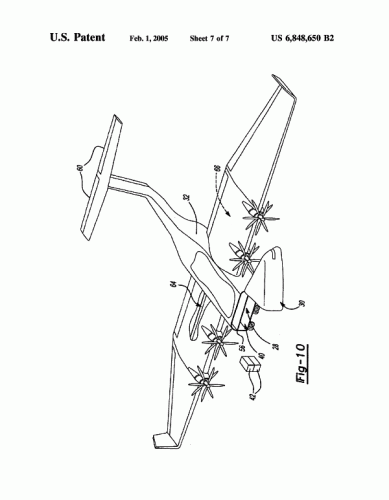
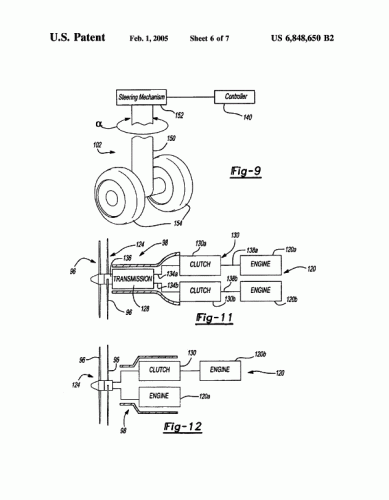
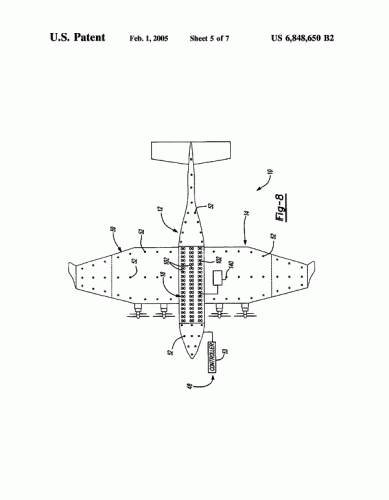
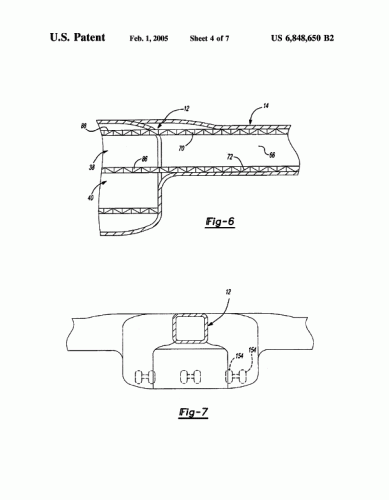
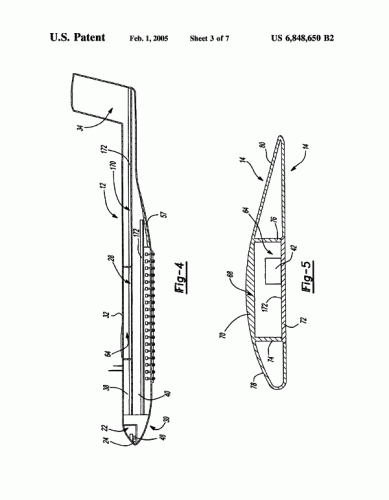
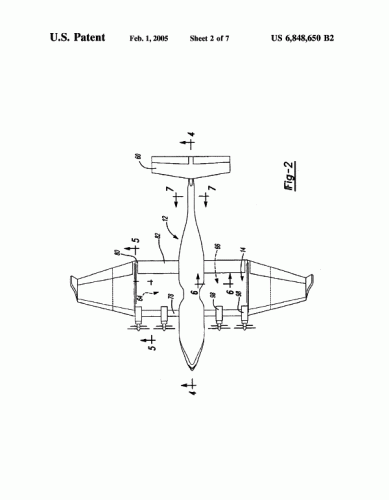
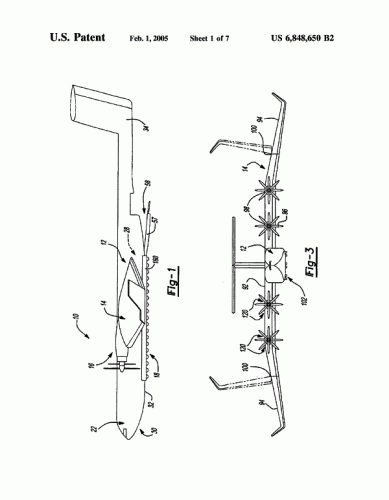
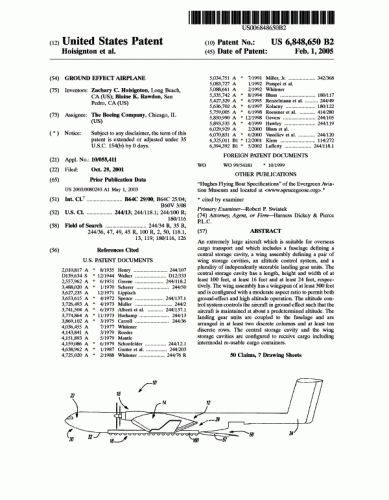
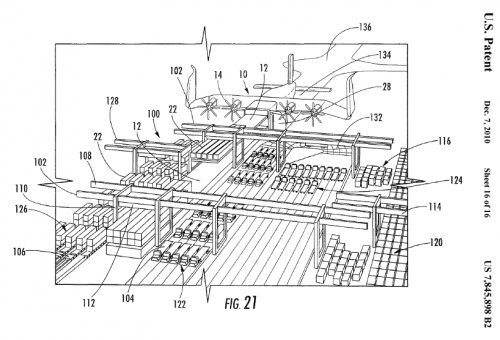
Boeing Pelican patent
Attachments
-
 us006848650-008.gif34.8 KB · Views: 464
 -
 us006848650-007.gif35.8 KB · Views: 303
 -
 us006848650-006.gif22.8 KB · Views: 272
 -
 us006848650-005.gif25.3 KB · Views: 263
 -
 us006848650-004.gif39.2 KB · Views: 575
 -
 us006848650-003.gif21.1 KB · Views: 575
 -
 us006848650-002.gif34.7 KB · Views: 678
 -
 us006848650-001.gif87.1 KB · Views: 743
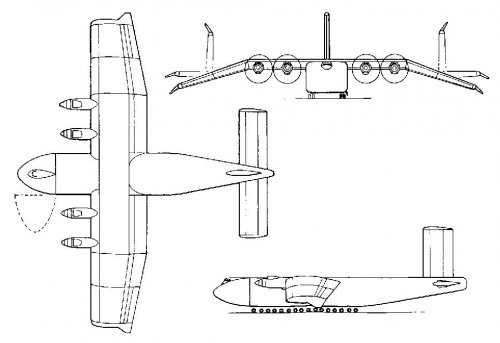
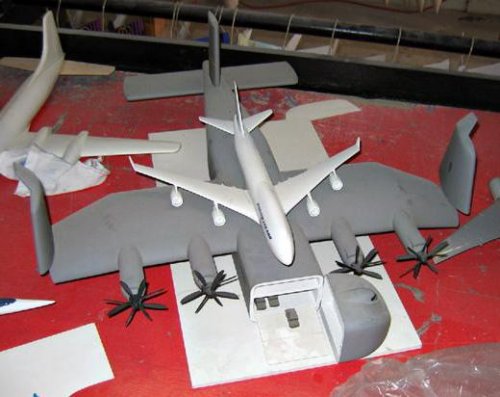
Not *quite* the same Pelican. There are some notable design differences, not least of which is beign smaller. The questions is... are these differences due to actual design changes, or has the design been modified specifically or the patent?
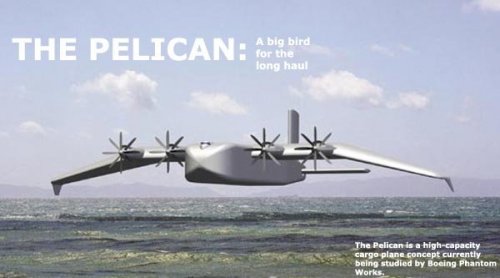
Another Pelican drawing.(source unknown)
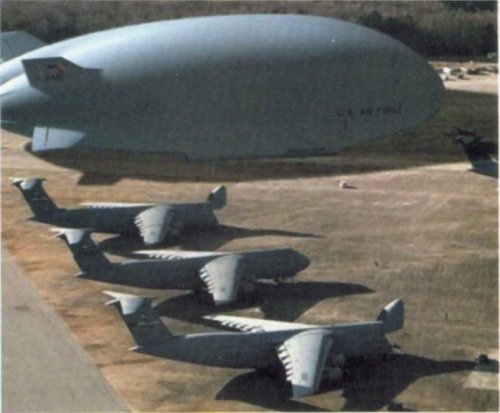
And the SkyCat200 "a non-rigid hybrid air vehicle would have a payload in excess of the C-17 airlifter, able to carry 200t over a range of 3000-5000 nm" (source: Jane's International Defense Review Oct.2001)
And the SkyCat200 "a non-rigid hybrid air vehicle would have a payload in excess of the C-17 airlifter, able to carry 200t over a range of 3000-5000 nm" (source: Jane's International Defense Review Oct.2001)
Attachments

- Joined
- 3 January 2006
- Messages
- 1,405
- Reaction score
- 1,375
flateric said:Boeing Pelican patent
This a great find - it's new to me. It must have been recently posted by the patent office.
If only I could find the patent drawings for the new morphing wing UAV?
- Joined
- 3 January 2006
- Messages
- 1,405
- Reaction score
- 1,375
overscan said:Tinwing: the 1 bit GIF format is ok, but its not very good for actually viewing onscreen.
This is entirely true, although I typicaly save any interesting line drawings for later viewing.
overscan said:If you want to keep the images, I'd download them from the patent office in the original TIF files.
Indeed, the patent office website is a great place to find all sorts of thing.

overscan said:I made the smaller size jpegs for viewing purposes.
Flateric resized the pics to small as monochrome, which is the worst of both worlds.
Monochrome images don't resize very well at all, but they do have their place.
You can turn a very large (3.0+MB!) grayscale .jpeg into 500kb monochrome .gif with very little discernible loss of detail or quality.
- Joined
- 1 April 2006
- Messages
- 12,286
- Reaction score
- 15,112
OK, OK, I've resized them and saved as GIFs ;D
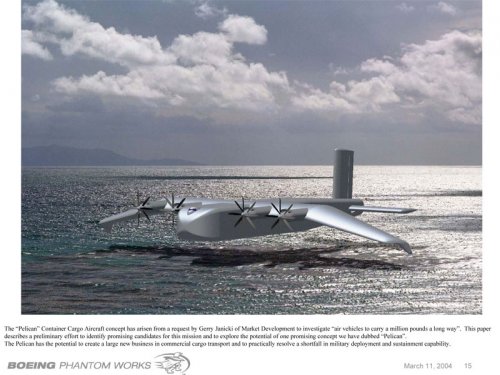
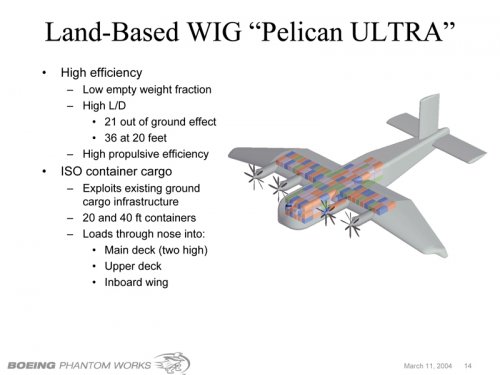
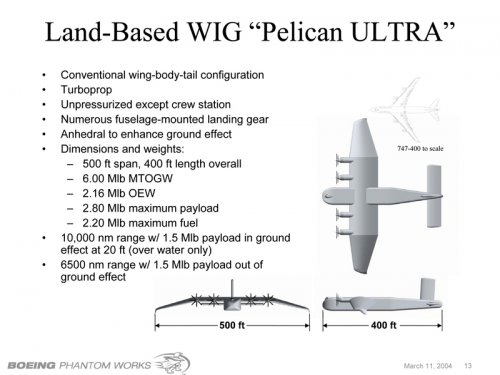
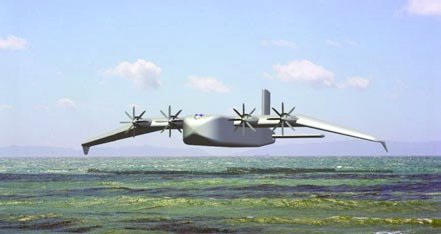
To Scott - you see that this Boeing propaganda paper dated March 2004 with Pelican appearence that changed 0% since it was unveiled in september 2002, while patent is February 2005. So it seems that if previous was Pelican ULTRA, this is Mini-M-Pelican My thoughts that all the money now pulled in Walrus backet and Pelican pretty RIP.
BTW, I'm sometimes shocked with maniac way Boeing patents every possible configuration of what they suppose worth a cent, like Sonic Cruiser.
To Scott - you see that this Boeing propaganda paper dated March 2004 with Pelican appearence that changed 0% since it was unveiled in september 2002, while patent is February 2005. So it seems that if previous was Pelican ULTRA, this is Mini-M-Pelican
My thoughts that all the money now pulled in Walrus backet and Pelican pretty RIP.BTW, I'm sometimes shocked with maniac way Boeing patents every possible configuration of what they suppose worth a cent, like Sonic Cruiser.
Attachments

Schorsch
ACCESS: Restricted
- Joined
- 17 January 2006
- Messages
- 28
- Reaction score
- 13
flateric said:OK, OK, I've resized them and saved as GIFs ;D
To Scott - you see that this Boeing propaganda paper dated March 2004 with Pelican appearence that changed 0% since it was unveiled in september 2002, while patent is February 2005. So it seems that if previous was Pelican ULTRA, this is Mini-M-Pelican
BTW, I'm sometimes shocked with maniac way Boeing patents every possible configuration of what they suppose worth a cent, like Sonic Cruiser.
I agree on this point. I heard remarks that for a WIG-aircraft the engines are positioned rather bad, being in the wet upwash of the wing. The Russian put their eingine right in the front or on the tip of the fin, away from any wet upwash.
You final sentence hits the point, keeping the shareholders happy with "breath-taking innovations". I guess the project engineers are less optimistic when they report to the board. Also it would be interesting, how much money is put in those projects.
- Joined
- 1 April 2006
- Messages
- 12,286
- Reaction score
- 15,112
Last edited:

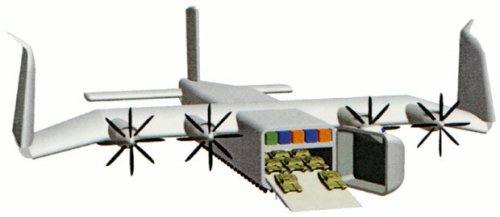
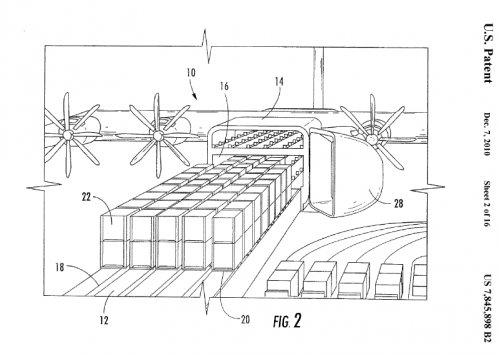
A two-deck 29,000-sq-ft cargo compartment, which extends into the wings, can accommodate 17 M1-A1 Abrams tanks, or a combination of tanks, helicopters, dozens of cargo containers, and passengers.
Text source: Sweetman, Bill "Monster at 20 ft" Popular Science February 2003 page 71
Image source: http://sistemasdearmas.com.br/not/not2003.html
Source: http://sistemasdearmas.com.br/not/not2003.html
Text source: Sweetman, Bill "Monster at 20 ft" Popular Science February 2003 page 71
Image source: http://sistemasdearmas.com.br/not/not2003.html
Source: http://sistemasdearmas.com.br/not/not2003.html
Attachments

Matej
Multiuniversal creator
I am still wondering why it was proposed and marketed. Is anybody on this planet, who really thinks, that such a monstrosity can be designed, developed, BUILT and OPERATED in a reasonable time and with the reasonable costs? My opinion is, that it is the PR stuff: "Look, we are able to design the impossible." ...or at least to think about it.
Matej said:I am still wondering why it was proposed and marketed. Is anybody on this planet, who really thinks, that such a monstrosity can be designed, developed, BUILT and OPERATED in a reasonable time and with the reasonable costs? My opinion is, that it is the PR stuff: "Look, we are able to design the impossible." ...or at least to think about it.
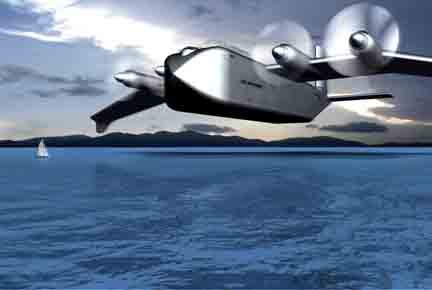
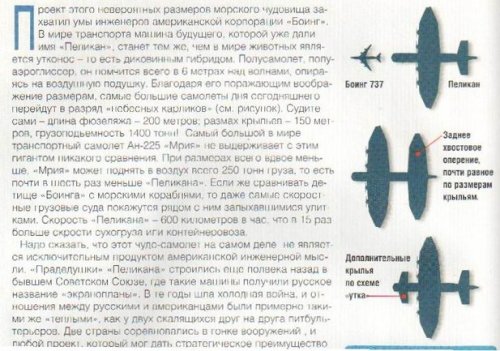
It started out as a Boeing Phantom Works research project in 2000 from a Department of Defense goal of placing a full brigade --moving 3,000 troops and 8,000 tons of cargo--on the ground anywhere in the world within 96 hours. Boeing chose to look at Wing-In-Ground effect (WIG) vehicles for this task.
Source: Sweetman, Bill "Monster at 20 ft" Popular Science February 2003 page 70
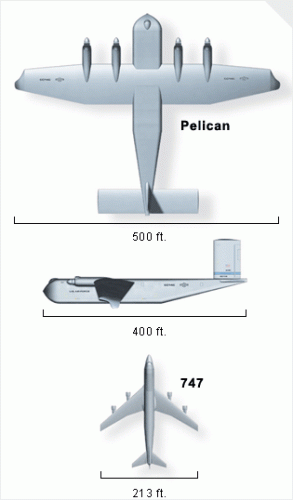
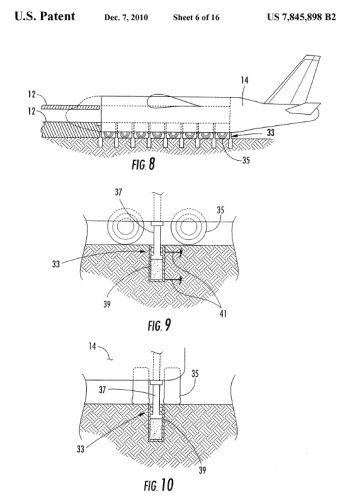
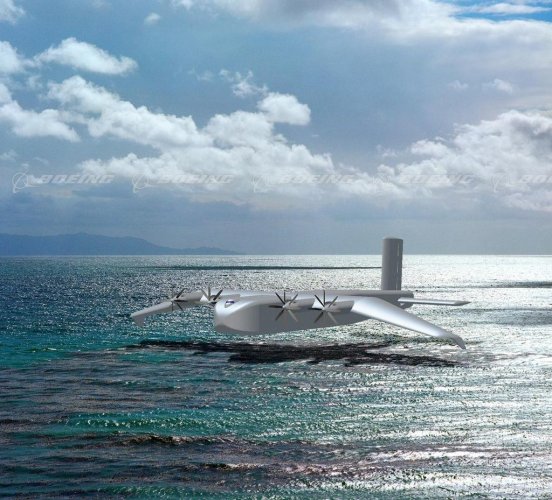
Intended as a large-capacity transport craft for military or civilian use, it would have a wingspan of 500 feet (150 m), a cargo capacity of 1,400 tons (1,300 metric tonnes), and a range of about 10,000 nautical miles (18,000 km). Powered by four turboprop engines, its main mode would be to fly 20-50 ft (6-15 m) over water, though it would also be capable of overland flight at an altitude as high as 20,000 ft (6,100 m) albeit with a decreased range of about 6,500 nautical miles (12,000 km). It would operate from conventional runways, with its weight distributed over 38 fuselage-mounted landing gears with 76 wheels.
General characteristics
Length: 400 ft (122 m)
Wingspan: 500 ft (152 m)
Height: 18.3 ft (fuselage bay interior) (6 m)
Wing area: > 1 acre (>4,000 square meters[1])
Useful load: 2,800,000 lb (1,400 tons) (1,272,727 kg (1,273 metric tonnes))
Powerplant: 4 × , () each
Cruise speed: 240 kts in ground effect (445 km/h)
Source:
http://en.wikipedia.org/wiki/Boeing_Pelican
http://www.editinternational.com/read.php?id=47ddf0fe4b9ca
General characteristics
Length: 400 ft (122 m)
Wingspan: 500 ft (152 m)
Height: 18.3 ft (fuselage bay interior) (6 m)
Wing area: > 1 acre (>4,000 square meters[1])
Useful load: 2,800,000 lb (1,400 tons) (1,272,727 kg (1,273 metric tonnes))
Powerplant: 4 × , () each
Cruise speed: 240 kts in ground effect (445 km/h)
Source:
http://en.wikipedia.org/wiki/Boeing_Pelican
http://www.editinternational.com/read.php?id=47ddf0fe4b9ca
Attachments

- Joined
- 25 June 2009
- Messages
- 15,515
- Reaction score
- 9,447
Triton said:It started out as a Boeing Phantom Works research project in 2000 from a Department of Defense goal of placing a full brigade --moving 3,000 troops and 8,000 tons of cargo--on the ground anywhere in the world within 96 hours. Boeing chose to look at Wing-In-Ground effect (WIG) vehicles for this task
The amusing thing here is that Phantom Works is usually about secret aircraft that can be test-flown away from the public eye. Now try to fly a beast like this anywhere and keep it a secret...

- Joined
- 3 June 2011
- Messages
- 20,999
- Reaction score
- 19,278
Matej said:I am still wondering why it was proposed and marketed. Is anybody on this planet, who really thinks, that such a monstrosity can be designed, developed, BUILT and OPERATED in a reasonable time and with the reasonable costs? My opinion is, that it is the PR stuff: "Look, we are able to design the impossible." ...or at least to think about it.
How 'bout the Lockheed, 1000ft-span, nuclear powered, BWB? ;D

Nik
ACCESS: Top Secret
- Joined
- 15 July 2009
- Messages
- 1,374
- Reaction score
- 1,211
I doubt the Heathrow locals would be amused by the down-wash from this monster as it clawed out of ground effect over their roof-tops...
FWIW, I'm very surprised it came with wheels. Air-cushion would allow un-made field work, snow etc... Even swamp ??
And, instant 'kneeling'...
FWIW, I'm very surprised it came with wheels. Air-cushion would allow un-made field work, snow etc... Even swamp ??
And, instant 'kneeling'...
- Joined
- 1 April 2006
- Messages
- 12,286
- Reaction score
- 15,112

- Joined
- 26 May 2006
- Messages
- 38,288
- Reaction score
- 20,425
Apparently, in 2020 there was a revival of interest in large WIG craft, mainly due to "the significant interest in WIG from potential U.S. adversaries". Advantages of the WIG are revisited in a US Naval Institute report which mentions that "[A Soviet] WIG design, known as the Lun, weighed 380 tons and was considered to be a threat by Russia’s Scandinavian neighbors because a fleet of 10 could have crossed the Baltic Sea with minimal radar signature in 12 minutes and deposited 5,000 troops without warning... While not invulnerable, WIG craft offset many of China’s antiaccess/area-denial (A2AD) investments. Flying at approximately 200 feet, they would be almost invisible to Chinese radars, hidden by the curvature of the Earth and flying much too fast for real-time satellite detection. At low altitude above the water, they would be largely immune to threats from long-range surface-to-air-missiles, antiship ballistic missiles, submarines, and mines. As such, they would be significantly more survivable than amphibious ships, EPFs, or strategic sealift ships."
https://www.usni.org/magazines/proceedings/2020/september/modern-sea-monsters
https://www.usni.org/magazines/proceedings/2020/september/modern-sea-monsters
Last edited:

Grey Havoc
ACCESS: USAP
- Joined
- 9 October 2009
- Messages
- 24,500
- Reaction score
- 18,175
Though with the new administration, it is highly unlikely we will see any progress in this area, for the next four years or so at least.


- Joined
- 30 May 2023
- Messages
- 674
- Reaction score
- 1,451
Grey Havoc
ACCESS: USAP
- Joined
- 9 October 2009
- Messages
- 24,500
- Reaction score
- 18,175
Via the Wikipedia article on the Pelican, a 2002 Sun-Sentinel piece on it:
https://web.archive.org/web/2019010.../news/fl-xpm-2002-11-15-0211141264-story.html
Extract:
Also via the Wikipedia page, from 2004:
https://web.archive.org/web/2018092...erst-story/magazine/issues/2004_spring/unseen
EDIT:
Updated link to original.
https://web.archive.org/web/2019010.../news/fl-xpm-2002-11-15-0211141264-story.html
Extract:
In a single hop, it would be able haul 17 Army M-1 tanks, which weigh more than 80 tons apiece. Currently, the U.S. Air Force C-5, the largest U.S. military aircraft, can only carry one of those tanks.
Eventually, it might become available as a commercial cargo hauler, likely to fly only to about a dozen major global cargo centers, such as Los Angeles, New York, Tokyo and Miami.
The plane would be welcome at Miami International Airport, which ranks No.1 in the nation and No. 4 in the world for international freight -- if the airport's runways could accommodate its girth, MIA Marketing Manager Chris Mangos said.
He said the air cargo industry has been using larger freight-hauling aircraft and the Pelican could help increase shipments to Latin America and Europe.
Air cargo companies say it's far too early to even consider purchasing a Pelican, for which not even a preliminary price tag has been established.
However, if FedEx, the largest cargo company in the world, were to buy just one Pelican, it could carry the same amount of cargo as 21 of its jumbo MD-11 jets, which hold up to 65 tons of cargo apiece.
If converted into a commercial airliner, the Pelican would be able to hold about 3,000 passengers. By comparison, when the Airbus A380 starts flying in 2006, it will be the world's largest commercial airliner, able to seat 555 passengers.
But, aviation experts say for insurance reasons, it wouldn't be practical for the Pelican to carry passengers. One accident and that insurance company would be wiped out, said Bill Mellberg, an aviation author.
However it might be used, the Pelican represents some of the most futuristic thinking out of Boeing's Phantom Works, an aviation think tank that has concocted everything from advanced satellite systems to giant military bombers.
Also via the Wikipedia page, from 2004:
https://web.archive.org/web/2018092...erst-story/magazine/issues/2004_spring/unseen
EDIT:
Updated link to original.
Last edited:
Similar threads
-

-
Large Weilandcraft is built
- Started by Vahe Demirjian
- Replies: 0
-

-
Boeing Vertol Light Intratheatre Transport (LIT) V/STOL cargo aircraft
- Started by hesham
- Replies: 22
-
 Boeing LOBOY Anti-submarine WIG, 1965
- Started by flateric
- Replies: 5