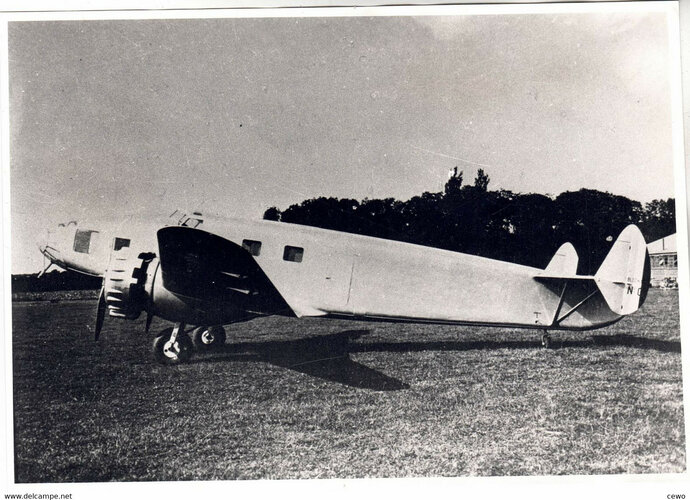
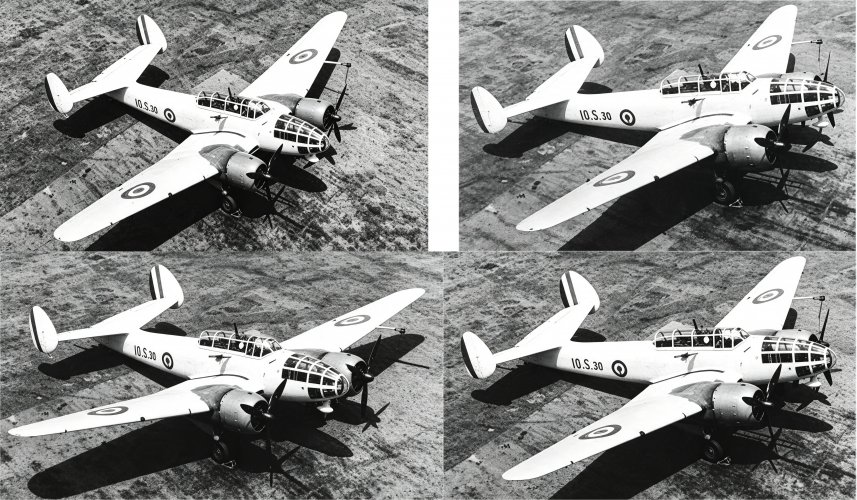
Bloch unbuilt designs and prototypes

so if I want to do a heller bloch 210 with the 20/21, I'll have to modify the cowling? (still have to in the original, the cowling ring diameter is wrong). Antone has a pc of n°2 before its modification? I want to know what th etial look like
 
I have found a drawing

This drawing is very interesting, but it is not a Bloch Aircraft, this is a Caudron-Renault. You can find information and drawings from Harry Robinson in Docavia "Les avion Caudron Renault" p.286/287.
 
Last edited:
Anyone have the real flight performance data of the mb-157? The rumors that it had a top speed of 700 km/h have been proven wrong and I wondered if anyone here have its real papers?
Proven wrong? By who?
 
Please folks! No hyphens on old French designations! Standard practice was [ prefix in block letters / space / number ].
 
For a long time, I've been trying to find the designations of the airfoils used in the design of the wing of Bloch aircraft, but have never found anything. Has anyone ever come across this information?
 
Hi all,

Just received the new Lela book on Bloch, great reference!
A question, does anybody have any 3view or drawing of the Bloch 90 series and Bloch 100? Failing this, more technical dimensional info?

Regards,
Rlucas
 
Hi,


there is two Bloch MB.190 Projects,the first MB.190 was a tourist aircraft project version
of MB.80,but the second or re-allocated project is unknown to me ?,can anybody help ?.

In my files,

the Bloch MB.190 was a twin engined postal aircraft project,that's
second use of designation,need confirm of course ?,I am not sure,
also I don't remember the source.
 
As in my list,the second use of the designation MB.140,was appeared
in four variants.
 
Of course from Gallica,but it's not one source,I can't declare more,
because that's in my book.
 
Of course from Gallica,but it's not one source,I can't declare more,
because that's in my book.
Certainly wrong: on Gallica, there is nothing about Bloch 140 bomber, that was developed under great secret. No publication was allowed and the press was under censorship control.
It seems that you just do not have reliable source.

In addition, the only publication speaking about the Bloch 140 was a Docavia from Jean Cuny, repeated by Charles Claveau in TU magazine. Unfortunately, Cuny he was wrong on this particular aircraft, he misinterpreted some information from its designer. I have clarified this in my first volume about Marcel Bloch: https://www.secretprojects.co.uk/threads/les-avions-marcel-bloch.42831/#post-666975
 
Last edited:
Are you sure about Gallica?, unfortunately I lost 80 % from my files in this journey,but as I said,there is another source,could be a book or a magazine,until back home.

One of them was a B3, not B4.
 
As I know,

B3 , B4 , AB3 Recce Bomber & High Altitude versions
 
As I know,

B3 , B4 , AB3 Recce Bomber & High Altitude versions
High altitude is in the base design. The body is designed for a minimum crew of 3 for B3 or A3 missions, with capability for a 4th one (AB3 and B4 are just conjectures, not projects).
The equipment can change from a flight to the next one, to adapt to a dedicated mission.

This is only ONE version, with multirole capability.
 
Last edited:
So the Bloch 140 (4 engines 170) was very secret ?
This is one of the errors from Cuny: the Bloch 140 was a twin-engine, not a four-engine bomber. This error was repeated several times as he was the first to publish its history.

The initial project was started as Bloch 163. The chief engineer in charge was Jean-Charles Parot (the future father of the "Vautour"). This project was developed under very high secrecy. When the Bloch 163 was renamed Bloch 140 and manufacturing started, it was powered by two Gnome-Rhône 14R engines.
 
Ok thank you. I may eventually correct or delete my posts from 2007, here and at the What if modellers forum. I don't want to spread false narratives about that plane.

I can see why the plane would have had pretty good performances. Compared to a Potez 63 with 700 hp, the MB-174 with 1030 hp 14M radials was a quantum leap in performance. An "upgrade" with 14R would have 1600 hp, hence another leap in performance. Very much like the MB-150 fighter evolution, from MB-152 to 155 to 157.

@PhR I've nuked or corrected my posts in this forum, related to the MB-140. Then I did the same for What if modellers, I nuked a couple threads.
 
Last edited:
From old site on Net,

The second project was the MB-135B4 , an aircraft similar in design to the MB-134, but powered by four lower-power Gnôme-Rhône 14M-6/M-7 engines. The M-6 engines were clockwise and mounted on the left wing, while the M-7 engines were counterclockwise and placed on the right wing – this design eliminated the influence of propeller torque. The MB-135 was a cantilever, low-wing monoplane, with an all-metal structure covered with duralumin sheet metal. The twin vertical stabilizers were positioned so that most of their surface area was beneath the horizontal stabilizer. This provided a large, clear field of fire for the upper gunner, who was to operate a single 20 mm cannon in a retractable, rotating gun turret on the fuselage's dorsal surface. This turret was planned for the production version of the bomber, and the prototype was not yet equipped with it.

Construction of the first MB-135-01 prototype (MB-135B4 No. 01) began at the Bloch factory in Courbevoie. At the end of 1938, the aircraft's individual components were transported to the SNCASO factory in Villacoublay, where final assembly took place. On January 12, 1939, SNCASO's chief test pilot, René Le Bail, and co-pilot Jean Lapeyre, flew prototype No. 01. Subsequent flight tests revealed the need for several minor changes to the aircraft's design, particularly in the tail and aileron areas. The aircraft was otherwise highly successful, boasting high performance and good flight characteristics. Prototype refinement took several months in the spring of 1939, and during the summer, the MB-135B4 awaited the Air Force's decision on whether to begin series production.

Unfortunately, World War II broke out on September 1, 1939, with France and England formally joining two days later. Meanwhile, the French aviation industry—disorganized by the nationalization of 1936-37 and grappling with numerous problems—was already struggling to keep up with the growing demand for air force aircraft. Many parts and components for newly built aircraft were in short supply, while the aircraft flying at the front were mostly obsolete. Therefore, the Air Ministry decided to limit the number of types produced and not introduce new aircraft—even highly successful ones—into series production, as the increased demand for modern engines and other equipment could not be met. Consequently, only a single MB-135 remained in production.

 
Should we distinguish what are unbuilt projects, what are cancelled projects?
 

Attachments

  • Bloch MB174_complete.jpg
    Bloch MB174_complete.jpg
    8.3 MB · Views: 56

Similar threads

Back
Top Bottom