Was it the lack of hangar / armored deck intricated relationship ? Seems to have been a colossal PITA. Harmonizing the hangar height and dimensions across the six ran straight into the armored deck - so the ships had to be razed to a certain level, then rebuilt around a specific hangar shape and size... hopefully common to the six at the end of all these rebuilds !
And of course during the ship lives naval aviation went from F4F Wildcat to... F-4 Phantom, no less.
The fundamental problem with the Iliustrious / Implacable modernisation was getting additional hangar height, but that is an issue with its origins in the 1930s if not the 1920s.
The USN had been building its carriers since the Yorktown class with a clear hangar height under the beams of roughly 17ft 6in (the Yorktowns were 17ft 3in, Wasp 17ft 2in), a height it then standardised on until the USS United States design of 1949 when they went higher. Forrestal was 25ft.
In the RN hangar heights settled at 16ft (Furious as reconstructed was 15ft). That included Hermes, C & G, Ark Royal and the Illustrious class. But to get extra aircraft capacity into an Illustrious treaty limited tonnage & hull, sacrifices were made in redesigning Indomitable and in the Implacables. So hangar height dropped to 14ft (upper hangar only in Indomitable) out of necessity.
Not a problem if you are designing your own aircraft. But once WW2 came along the FAA was becoming reliant of US aircraft and recognised its carriers had to match the hangar height of US ships. So the switch was made in the Colossus and Audacious classes in the 1942 Programme to 17ft 6in.
The effect can be seen with the Vought F4U Corsair. RN aircraft had 4in cut from each wingtip to that they could be stowed in the hangars of of the three Illustrious class, something that wasn't recognised until about autumn 1943. Indomitable got F6F Hellcats instead. Lack of the latter being available through Lend Lease meant the Implacables got Seafires with a folded height of 13ft 6in.
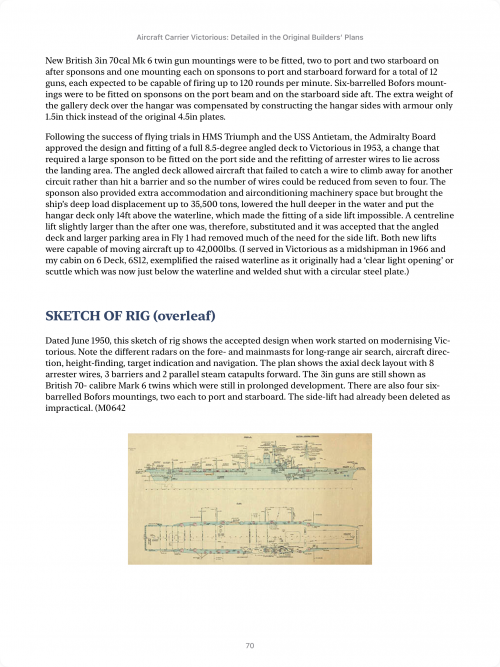
In designing the reconstruction of the armoured carriers, the Admiralty recognised that in a future war they might again be dependent on a supply of naval aircraft from the USA so better make the reconstructions compatible. So whatever happens that extra hangar height has to be bought somehow.
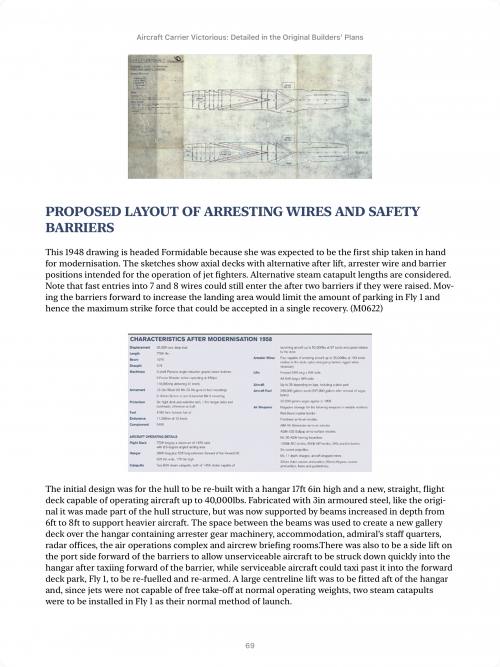
Then there was the problem of crew accomodation. Like many pre-war and wartime designs the carriers were seriously overcrowded by the end of WW2. More accomodation was to be met by incorporating an extra gallery deck under the flight deck. More depth from keel to flight deck required!
So Victorious was reduced to the level of the hangar deck floor (level with the quarterdeck). Immediately below that level amidships were machinery compartments with the cross ship funnel uptakes, so it couldn't go any lower. It was also so low as to make a side lift impossible. So overall her hull depth increased by a few feet from keel to flight deck (not sure exactly how much as the figures I have don't make sense on a quick read)
Trouble is that when you look at an Implacable (or Indomitable) you can't go down to the floor of the lower hangar as it is a deck lower than in Victorious and was only half length because it ran into machinery compartments at its forward end. So the description of the proposed modernisation of Implacable was to start at the floor of the upper hangar (but that is still about one deck higher than in Victorious. The hangar deck was roughly the equivalent of two normal decks.) With that slightly greater hull depth it was hoped that they might have enough freeboard to fit a side lift.
The original design of the two classes is so far apart that you were never going to get a homogeneous group of 6 ships.
But even the Essex class were not a homogeneous group when you delve into their design layout. Wartime experience meant differences between early & later ships. The one that has caught my eye in the past is the provision for aviation fuel stowage, comparing plans of Lexington CV-16 ordered in Sept 1940 with Shangri-La CV-38 ordered in Aug 1942. In later ships (probably those ordered in 1942 & 1943 but maybe retrospectively applied to vessels still in build depending on stage of construction) the forward avgas tank was moved aft to a point where the hull was beamier, with an extra layer of protection between them and the ship's outer hull. The tanks themselves were changed to a saddle design for greater protection but at a cost of about 10% of their capacity. This all came from lessons learned in the loss of Lexington CV-2 and Wasp CV-7 in 1942. How that was then changed again in the SCB-27A/C conversions I've never delved into.