Source was Moore " Building For Victory" p128.
Some queries about the above.
- Does your source say how much was saved by:
- cancelling Hawke outright?
No. But he notes on p137 that her boilers and machinery were complete and the main armament virtually ready. She had been laid down at Portsmouth RN Dockyard on 1 July 1943 and cancelled on 15th October 1945, with the cancellation "promulgated" on 23rd Oct (per Waters "British Fiji Class Cruisers and Their Deriviatives"). Some of that material had come from Vickers-Armstrong (Tyne) where it had been gathered for the original Tiger, the third cruiser of the 1941 Supplementary Programme, ordered on 18 Dec 1941. She was renamed Bellepheron and reordered as the sixth Neptune class vessel to be cancelled on 28th Feb 1947.
- And stopping work on Blake, Lion and Tiger?
As for these three
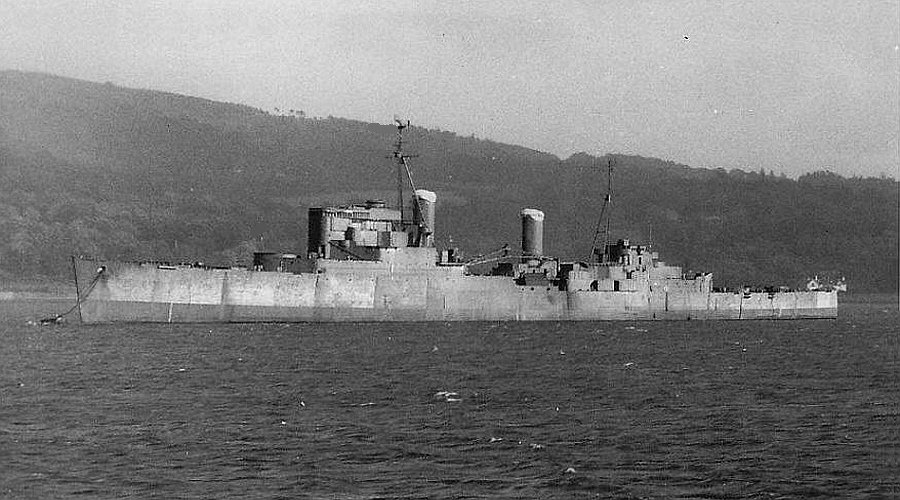
Defence (renamed Lion in 1957) launched 2nd Sept 1944 at Scotts.
Tiger (ex Bellerophon) launched 25th Oct 1945 at John Brown
Blake launched 20th Dec 1945 at Fairfield
Work was allowed to continue according to Waters, with discussions about revised requirements lasting through until March 1946. Work on these ships slowly ground to a halt. But it wasn't until May 1946 that it was ordered that Defence, the most advanced, should be laid up. The plan then was for her to go to Devonport for completion once the light carrier Terrible was completed for the RAN as HMAS Sydney.
Fairfield were told to suspend work on Blake in late 1946. John Brown received similar instructions in Sept 1947 but sought a stay of execution to April 1948. Exactly when work on her stopped is not clear according to Waters, but may have been around Jan 1948.
- Are the 4 cruisers upon which nothing had been spent the Neptune class?
- Because AFAIK 6 Neptune class were on order.
- That is 5 ordered in 1944 plus one ordered as a Swiftsure/Tiger and re-ordered as a Neptune.
No explanation given, but it has to be Neptune class ships.
- Which were the 4 Weapon class that were cancelled? Because AFAIK:
- 16 were on order at VJ Day of which 12 had been laid down and none had been launched.
- 12 were cancelled between October 1945 and January 1946.
- None of the 12 that were cancelled had been launched before they were cancelled.
- However, 2 were launched after they were cancelled to clear their slipways.
- That left 4 that were completed 1947-48.
19 originally ordered. Three ships from Scotts cancelled on 23rd Dec 1944.
8 were cancelled on 15th Oct 1945. Only 5 of these had already been laid down (4 by VJ Day + Sword)
Another 4 were cancelled on 23rd Dec 1945. It was these ships that I was referring to in my previous post. All 4 had been laid down.
Rifle had been suspended at Denny on 25th Sept 1945 before cancellation on 23rd Dec 1945 and was broken up on the slip. Denny received approx £94k in cancellation charges for hull & machinery work done on her & Spear (cancelled 15th Oct).
Work continued on Culverin (at Thornycroft), Cutlass (at Yarrow) & Carronade (at Scotts) to bring them to a condition whereby they could be safely launched to clear the slips. They were then scrapped. Cancellation message for Carronade reached the yard on 5th Jan 1946.
So 16 on order at VJ Day. 12 laid down by VJ Day + Sword laid down on 17th Sept1945 for a total of 13.
8 cancelled on 15th Oct 1945 (4 laid down by VJ Day + Sword)
4 cancelled on 23rd Dec 1945 (all of which had been laid down in 1944)
4 completed 1947/48 (all of which had been laid down in 1944)
Additional information from "Obdurate to Daring" by John English.
- Does it say how much money was saved by cancelling 16 out of 40 Battle class? AFAIK:
- All 40 were laid down before VJ Day of which 25 had been launched and 5 completed.
- Another 19 would be completed from VJ Day to May 48 bringing the total to 24.
- 22 of the 24 had been launched before VJ Day.
- The 2 launched after VJ Day were Vigo launched on 27.09.45 and Jultand launched on 20.02.46.
- The other 16 were cancelled in October 1945.
- But as I've already written all 16 were laid down before VJ Day of which 3 had been launched.
- Another 2 were launched between VJ Day and their cancellation.
- And 4 were launched after they were cancelled to clear their slipways.
- So a total of 9 out of 16 cancelled Battle class destroyers were launched.
- Which should come to a total of 33 because 33 out of 40 Battle class were launched.
No mention of savings on Battles. I think we agree on most of the numbers.
There were 16 x 1942 Battles and 26 (not 24) x 1943 Battles ordered. Two of the 1943 ships, Ypres (at Fairfield) & Vimiera (at Cammell Laird), ordered on 5th June 1943 were reordered as Daring class in 1944/45 and renamed Disdain & Danae respectively. The former was laid down on 5th Sept 1946 and the latter was cancelled on 13th Dec 1945.
Completion of the 1942 Battles was delayed due to late delivery of the Mk.VI directors. Barfleur, the lead ship ran trials without it before being laid up for a short period until it became available. Then 4 were diverted to Anson.
So, 15 of the 16 launched by VJ Day (Vigo was launched on 27th Sept 1945), with 5 completed by VJ Day + another 3 by the end of 1945 and the remaining 8 between Jan & Dec 1946.
All remaining 24 1943 Battles in the Programme had been laid down by the end of June 1945, with 10 having been launched before VJ Day of which 7 went on to be completed. The final ship completed (Jutland ex Malplaquet) was launched on 20th Feb 1946.
16 were cancelled on 15th Oct 1945 with 6 being brought to a stage of completion sufficient to allow a safe launch (to add to the 3 already in the water by VJ Day but not completed). The rest were scrapped on the slip. Some of the incomplete hulls were used for trials before being scrapped.
The cancellation message for Talavera at John Brown, reached the yard on 4th Dec 1945. The Admiralty paid £300k for the work on her. They also paid £281k to John Brown in respect of Trincomalee. Auxiliary machinery for the pair was purchased by the Admiralty in 1948 for £34.7k for transfer to Australia for their Battles.
The Admiralty had obtained agreement from the USA to acquire Mark 37 directors for all 26 of the 1943 Battles originally planned. I don't know how many were delivered (The order included directors for the Vanguard & 3 Audacious class carriers as well).
It was hoped that the final flotilla of 1943 Battles would receive the new Mk.VI turrets as trialled on Saintes in 1946/47.
I'm counting VJ Day as 2nd September 1945, when the Instrument of Surrender was signed. According to the Unauthorised History of the Pacific War Pocast, Toshikazu Kase (1903-2004) who was one of the Japanese signatories was an uncle of Yoko Ono.