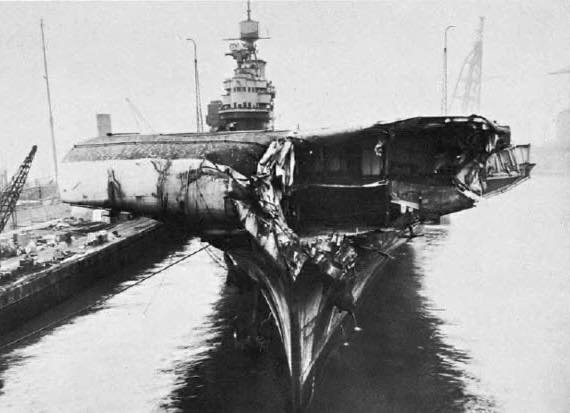
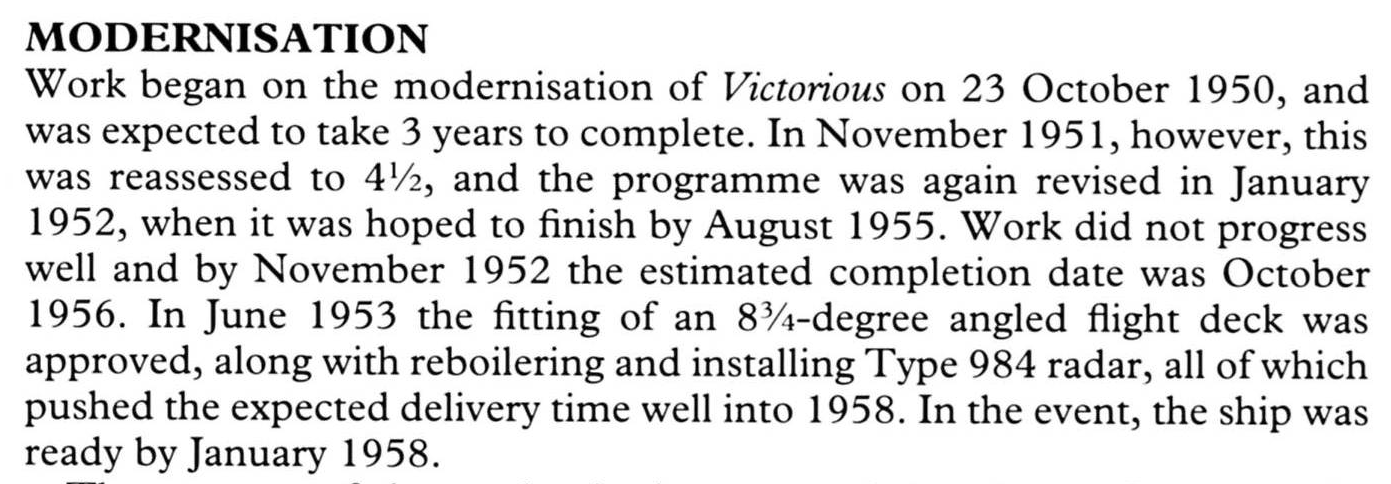
I was reading yesterday about hostile the early cold war was for the RN in general and the FAA in particular. Britain's appalling financial situation combined with a huge array of questions the nature of nuclear war and technology changes meant the RN and FAA faced constant attacks from the RAF and politicians like Sandys. This tracks with @JFC Fuller post about the almost impossible approval process to modernise the wartime carriers. It appears as if the early 50s was a bad time to do much with carriers.
I would say they would either convert it to a commando carrier or try to sell it another nation like Australia or India. How many Commando Carriers does the RN need?
Also if you upgraded the Implacables will be able to operate F4s?
They were originally intended to operate from Hermes and Victorious, but this didn't happen; whether viable or not, it would have been more likely from modernised Implacables than the smaller ships. These ships were of a size and similar in performance to the Essex.
They were originally intended to operate from Hermes and Victorious, but this didn't happen; whether viable or not, it would have been more likely from modernised Implacables than the smaller ships. These ships were of a size and similar in performance to the Essex.
Not really. Closer to an Essex in some respects like speed and tonnage, but dimensionally nearer Victorious.
Victorious -710ft on waterline. 28.6k tons full load. 30,5 knots
Implacable - 730ft on waterline. 32.1k tons full load. 32.5 knots
Essex - 820ft on waterline. 36.4k tons full load. 33knots
The whole premise of the Implacable design was to take the Illustrious design, increase its speed (for reasons unexplained) and increase the aircraft complement from 33 to 48, while still staying within the 23,000 ton standard Treaty limit. The fact that they came out much heavier in the end has much to do with wartime changes to the design, which were numerous and extended well beyond fitting a bigger forward lift.
Why was Illustrious never nominated for conversion?
It was planned that she would carry on as the training and trials carrier until 1957, when she would be replaced by a refitted Indomitable. Was she ever surveyed for conversion like Formidable was? It seems odd that they planned to run Victorious and Indomitable on into the 1960s and yet scrap Illustrious in 1957. Surely another carrier could have been swapped for the training/trials role? Warrior was the eventual replacement in 1953 but I think she was too small for the kinds of jet operational testing being carried out aboard Illustrious but either of the Indomitables could have fulfilled that role during the mid-50s.
And if we're getting into what-if scenarios (Victorious sunk) I've often wondered what would have happened to Ark Royal if she had survived the war.
Why was Illustrious never nominated for conversion?
It was planned that she would carry on as the training and trials carrier until 1957, when she would be replaced by a refitted Indomitable. Was she ever surveyed for conversion like Formidable was? It seems odd that they planned to run Victorious and Indomitable on into the 1960s and yet scrap Illustrious in 1957. Surely another carrier could have been swapped for the training/trials role? Warrior was the eventual replacement in 1953 but I think she was too small for the kinds of jet operational testing being carried out aboard Illustrious but either of the Indomitables could have fulfilled that role during the mid-50s.
And if we're getting into what-if scenarios (Victorious sunk) I've often wondered what would have happened to Ark Royal if she had survived the war.
I recall reading somewhere that the bomb explosion in her hangar had caused much greater structural damage than initially realised. Because it was a closed space, the overpressure introduced much higher stress to the structure that would have made the modernisation much more complex. I don't know the exact mechanism and would be just guessing, but it rings true.
While everyone knows about the Illustrious & Formidable being repaired in the USA in 1941 the repair & refit schedules of the Illustrious / Implacable classes later in the war are less well known. Those combined with their post-war service help to explain their material condition by the end of the 1940s. I'll start in late 1941.
Illustrious -
30/12/41 to mid-March 1942 Liverpool. Repairs to collision damage with Formidable.
This is what delayed her departure to the IO in 1942
26/2/43 - 7/6/43 Liverpool - incl prep for Barracudas
4/11/43 - 27/11/43 Liverpool - incl readying her for Corsairs
15/8/44 - 10/10/44 Durban
10/2/45 - 6/3/45 Sydney - first ship in Captain Cook dry dock. Removal of centre propellor & shaft and fitting replacement cap
6/4/45 Suffered fairly serious hull damage from a kamikaze near miss amidships. remained on station until relieved by Formidable on 14/4/45. https://www.armouredcarriers.com/hms-illustrious-kamikazehttps://www.armouredcarriers.com/adm26787/2014/10/16/illustrious-april-6-damage-report-bomb-shell
28/6/45 - arrived Rosyth for what was planned as a 4 month refit. It was turned into a 12 month refit. Forward & after ends of flight deck rebuilt, armament changes, complete new radar suite, repairs to hull and replacement of shaft and new 5 blade propellor to eliminate hull vibrations.
Jan-Aug 1948 - docked for "long overdue maintenance & repairs" (McCart)
Dec 1950 - April 1951
March - May 1952
9/12/52 - 24/4/53
Her final deck landings were carried out on 3 Dec 1954. Paid off 14 Feb 1955. 14 years service having steamed the equivalent of 18 times around the world (McCart)
Formidable:-
Dec 1941 to mid-Feb 1942 - repairs to stern after colliding with Illustrious. She came off the best from that incident.
21/9/42 to mid-Oct 1942 - Rosyth
19/11/44 to 9/6/44 - Belfast. Major refit. changes to armament and radars & re-equipped to operate Corsairs & Barracudas.
2/9/44 to 21/9/44 - Rosyth. Prep for Pacific. Changes to operate Avengers.
Late Sept 1944 - Jan 1945 - emergency docking at Gibraltar after a major machinery failure while en route to Pacific.
31/5/45 - 27/6/45 - refit at Sydney. It is at this point that questions arise as to how much of the damage suffered during the 3 incidents above was put right. The extent of the kamikaze damage can be seen in the above reports.
After that she had 9 days at Sydney in Sept and a couple of weeks at Portsmonth in early 1946 to equip her for repatriation and troop carrying duties. Those finished in Feb 1947. She then got a short refit that included cocooning armament & equipment to made her ready for maintained Reserve (McCart). By 1949 that seems to have become unmaintained Reserve according to most commentators at which point she was surveyed and condemned.
No one has yet produced that 1949 report to allow us to see what the problems really were. So rumours about twisted keels, bent hangar beams, unrepaired kamikaze damage circulate today.
Victorious:-
Jan 1943 - Norfolk, Virginia - aft end of flight deck modified. New fighter direction equipment fitted.
March 1943 - Pearl Harbor - extra AA added.
29/9/43 to 7 March 1944 - major refit incl radars, armament etc
Sept & Oct - short minor refits at Colombo & Bombay
Damage reports on her kamikaze damage can be found here. https://www.armouredcarriers.com/adm26787/2014/10/16/hms-victorious-may-9-damage-report-bomb-shell
5/6/45 - 26/6/45 - short refit at Sydney between operations. Light AA upgraded.
A more extensive planned refit in Sept 1945 at Sydney was cancelled with the end of WW2. That would have seen her fitted with a new rudder that had been manufactured and sent out to her. It was finally fitted in her next refit. She was plagued by rudder problems at different times in her life both before & after reconstruction. She had steamed about 268,000 miles in WW2.
31/10/45 to 13/12/45 - new rudder fitted. Conversion to troopship. That role lasted until Feb 1947.
7/6/46 - 3/7/46 - docked at Sydney to repair weather damage incl hole in stem.
Trooping duties ended in Jan 1947
25/6/47 to 19/9/47 - refit to prepare her to take over as a replacement for Nelson in the Home Fleet Training Squadron.
22/1/49 to 11/4/49 - refit at Rosyth incl weather damage to damaged forward lift.
On 20th Feb 1950 her training role ended and she was prepared for recconstruction.
Indomitable:-
After her brief repair at Norfolk in Nov 1941 after running aground she also had some repairs carried out to her machinery at Mombasa in June 1942. Then it was off to Operation Pedestal:-
25/8/42 to 20/2/43 Liverpool - Post Pedestal repairs to flight deck etc and refitting for Seafire operation.
16/7/43 to 17/4/44 Malta / Gibraltar / Norfolk & Rosyth. Repairs due to torpedoing and total refit to handle Hellcats, Barracudas, Avenger, update radar suite, armament etc.
She completed her last trooping run in December 1946. Then she received a two month refit to prepare her for Reserve.
??/50 to 25/10/50 Portsmouth - refitted as flagship of the Home Fleet in place of Implacable.
1951 Portsmouth - received a 5 week refit.
8/52 to Dec 1952 Portsmouth - refit
On 3rd Feb 1953 while off Malta, Indomitable suffered a fuel vapour explosion caused by a leaking fuel tank valve and a carelessly discarded cigarette. She suffered 8 killed and 28 seriously injured but the fire was quickly put out. McCart describes the fire as "serious" and only temporary repairs were made. She returned home to participate in the Coronation Review and was then laid up.
Indefatigable:-
She left the shipyard on Christmas Eve 1943 but machinery problems delayed her acceptance into the RN until 3 May 1944. She then received a refit at JOhn Brown on the Clyde and Portmouth DY 28 Sept 1944 to 18 Nov 1944 before departing for the Pacific. She was kamizied on 1 April 1945 with temporary repairs at Leyte Gulf at the end of the month courtesy of the Fleet train repair ships. https://www.armouredcarriers.com/adm26787/2014/10/16/indefatigable-april-4-damage-report-bomb-shell
Full repairs were made at Sydney 5 June to 7 July along with other works. She had a further small refit at Sydney 18 Sept to 15 Nov 1945, returning to Britain in March 1946.
She was then fitted out as a troopship, a role she fulfilled until Dec 1946. She was then prepared for the Reserve Fleet. From July 1949 to May 1950 she was refitted to serve in the Home Fleet Training Squadron, in which role she served until Oct 1954 receiving annual refits.
Implacable:-
Delays with machinery problems meant she wasn't accepted for RN service until 14 Aug 1944. She was refitted 10 Dec 1944 to 10 March 1945 before sailing for the Pacific. She suffered no damage in WW2. Another refit at Sydney Aug /Sept 1945 equipped her as a troopship. Dec 1945 / Jan 1946 this work was reversed and she was a carrier once again, finally arriving home again in June 1946.
She remained an operational carrier until Sept 1950 with periodic refits. She was replaced in the Fleet by a refitted Indomitable and became a training ship alongside Indefatigable, until 1954.
Summary
Both Illustrious & Victorious were kept in use postwar virtually constantly between refits and were being well maintained so there was probably no need for the kind of survey that was carried out on Formidable.
Formidable was the most hurt of the armoured carriers by the two kamikaze attacts and the hangar fire in May 1945. BUT that damage was minimal below the level of the hangar floor (the level to which Victorious was reduced during her reconstruction.). So talk of bent hangar beams and blast damage are all irrelevant to the reconstruction work required. So the problems must have lain deeper in the ship. Maybe her damage off Crete had something to do with it? Maybe he machinery issue in 1944/45 left matters unresolved? Maybe just the fact that she had been largely left to rust from early 1947?
In addition the repairs made to her at Sydney in June 1945 were sufficient for Adm Vian to choose her as his flagship for operations in July / Aug 1945 as the replacement for Indomitable, during which she performed just as well as the Victorious, Implacable & Indefatigable. Would he really have chosen a ship at less than its peak performance? He could have chosen one of the others. But the Implacables were already overcrowded. But why not Victorious?
Edit
As a final note on conversion for use in the training squadron the carriers had at least part of their hangars converted to classrooms and all of the equipment needed to operate aircraft removed. Indefatigable even acquired a small deck house on the flight deck.
So is it safe to say that WW2 carrier rebuilds aren't a good way (or better than other ways) to boost the RN and maintain Britain's position as a world power?
This thread has been an eye opener on the reasons for the Victorious' double rebuild and the other things Britain did in this period. I'm a lot more comfortable with the Victorious rebuild now, whereas previously I found it baffling, and if it cost £19m instead of £30m then that's even better. This thread has further reinforced my already firm belief that the 1957 DWP was an inflection point for Britain as a great power, a point where so many factors converged to hinge on the decisions of a handful of men.
The RN needed an interim upgrade for some or all of the ships rather than a complete rebuild. Even better, transfer them to Commonwealth and allied navies, with or without interim upgrades, freeing up personnel and money for newer ships (Audacious and Centaurs) and eventually new designs.
Then cascade the Centaurs to the Commonwealth navies as replacements for the older ships.
What interests me is what sort of upgrades would have been viable for the Armoured Fleets to get them into the jet age, i.e. to get them flying jets off Korea, supporting Operation Musketeer, through until they could be replaced with modern ships.
What interests me is what sort of upgrades would have been viable for the Armoured Fleets to get them into the jet age, i.e. to get them flying jets off Korea, supporting Operation Musketeer, through until they could be replaced with modern ships.
Probably not much more than Mk.6* arrester gear (rated at 20,000lb at 62kt) or the Mk.6** (20,000lb at 68kt), both of which were already trialled and ready during 1950.
One snag though - a lack of jets!
Attacker only began to enter frontline service in August 1951 and only built in small numbers and the FB.1 and FB.2 fighter-bombers did not follow until 1952; the Sea Hawk entered frontline use in March 1953 (while the initial service release was obtained on 1 January 1953 the armament was still not cleared for use at that time). The fighter-bomber FB.4 did not enter service until July 1954.
In combat trials it was found that the Sea Hawk could out-manoeuvre the Meteor with ease at 30,000ft, but the Meteor was superior below 20,000ft. So over Korea it should have given a decent account of itself against the MiG-15. But for the bread-and-butter ground support missions the FAA usually flew, the Sea Fury and Sea Hornet were more than adequate and were fighter-bombers.
The RN needed an interim upgrade for some or all of the ships rather than a complete rebuild. Even better, transfer them to Commonwealth and allied navies, with or without interim upgrades, freeing up personnel and money for newer ships (Audacious and Centaurs) and eventually new designs.
Then cascade the Centaurs to the Commonwealth navies as replacements for the older ships.
What interests me is what sort of upgrades would have been viable for the Armoured Fleets to get them into the jet age, i.e. to get them flying jets off Korea, supporting Operation Musketeer, through until they could be replaced with modern ships.
Ideally : three Audacious instead of two, and better management of the ten other carriers - the six Illustrious and the four Centaurs. I had a serie of threads about this a few years ago.
Summary
Both Illustrious & Victorious were kept in use postwar virtually constantly between refits and were being well maintained so there was probably no need for the kind of survey that was carried out on Formidable.
Formidable was the most hurt of the armoured carriers by the two kamikaze attacts and the hangar fire in May 1945. BUT that damage was minimal below the level of the hangar floor (the level to which Victorious was reduced during her reconstruction.). So talk of bent hangar beams and blast damage are all irrelevant to the reconstruction work required. So the problems must have lain deeper in the ship. Maybe her damage off Crete had something to do with it? Maybe he machinery issue in 1944/45 left matters unresolved? Maybe just the fact that she had been largely left to rust from early 1947?
In addition the repairs made to her at Sydney in June 1945 were sufficient for Adm Vian to choose her as his flagship for operations in July / Aug 1945 as the replacement for Indomitable, during which she performed just as well as the Victorious, Implacable & Indefatigable. Would he really have chosen a ship at less than its peak performance? He could have chosen one of the others. But the Implacables were already overcrowded. But why not Victorious?
The regularly repeated Formidable story gets the decisions the wrong way round. The carrier programme stabilised, as I described previously, in 1949. At that point the programme had space for three fleet carrier reconstructions and a smaller modernisation of a fourth ship as a deck landing training carrier. The remaining two ships would be scrapped when Eagle and Ark royal commissioned respectively but would otherwise remain in service or reserve as mobilisation assets.
Illustrious was the most recently modernised of the carriers and could operate 20,000lb aircraft, she was also the oldest, it made sense to keep her in service and not take her out of the fleet for modernisation. Indomitable had just entered a large refit that would allow her to operate 20,000lb aircraft too, after which she would become "the fleet carrier in reserve". She was effectively put in the same category as Illustrious in that when Ark Royal was commissioned it would be decided which of the two would be modernised as the deck landing training ship and which would be scrapped.
Implacable and Indefatigable could both operate 20,000lb aircraft too, they were faster, their machinery layout was considered superior and they were younger ships. They were obvious candidates for modernisation later in the programme.
That left Victorious and Formidable. Both ships were limited to 14,000lb (possibly 18,000lb at overload) aircraft so were most in need of modernisation. Formidable was in reserve whilst Victorious was active as a training carrier. It was therefore initially assumed that Formidable would be the ship modernised and Victorious would be scrapped when Eagle commissioned. However, in the space of just 3 days it was determined that the electrical and machinery condition in Victorious was better so she was chosen instead. Rather than war damage, the real culprit for the material state of Formidable seems to have been a lack of maintenance post-war. As best I can discern she received no major refit following the end of hostilities but did extensive trooping work before being placed in un-maintained reserve in March 1947. From there she deteriorated rapidly, in 1948 it was concluded she would need a 6 month refit just to make her serviceable and by 1949 there were reports of a flooded compartment.
In summary, there were three slots for major modernisation, Implacable and Indefatigable got two of them and Indomitable and Illustrious were modernised/ing already. That left one slot of either of Victorious of Formidable and the Navy chose the former as she had been better maintained.
Probably not much more than Mk.6* arrester gear (rated at 20,000lb at 62kt) or the Mk.6** (20,000lb at 68kt), both of which were already trialled and ready during 1950.
One snag though - a lack of jets!
Attacker only began to enter frontline service in August 1951 and only built in small numbers and the FB.1 and FB.2 fighter-bombers did not follow until 1952; the Sea Hawk entered frontline use in March 1953 (while the initial service release was obtained on 1 January 1953 the armament was still not cleared for use at that time). The fighter-bomber FB.4 did not enter service until July 1954.
In combat trials it was found that the Sea Hawk could out-manoeuvre the Meteor with ease at 30,000ft, but the Meteor was superior below 20,000ft. So over Korea it should have given a decent account of itself against the MiG-15. But for the bread-and-butter ground support missions the FAA usually flew, the Sea Fury and Sea Hornet were more than adequate and were fighter-bombers.
A more serious Sea Vampire could have been interesting, and an accelerated Seahawk. Then either a Sea Hunter or a Commonwealth FJ Fury family to serve out the 50s, maybe into the early 60s.
In my Alt History, I need to write up properly one day, I envisage Implacable and Indefatigable are crewed by the RAN in WWII and transferred post war. They serve in Korea using a mix of Hellcats, Bearcats, Sea Vampires and Fireflies. They receive interim angled decks, upgraded arrester gear and steam catapults during modernisations in the mid and late 50s. This enables them to operate FJ-4B (with Avon and Aden), and possibly Grumman Tigers and Gannets.
Ideally : three Audacious instead of two, and better management of the ten other carriers - the six Illustrious and the four Centaurs. I had a serie of threads about this a few years ago.
If the RN transferred the Implacables to the RAN then this could justify the completion of all three Audacious, plus, with these ships no longer being factored into the modernisation program, the order for two new carriers in the early 50s.
What interests me is what sort of upgrades would have been viable for the Armoured Fleets to get them into the jet age, i.e. to get them flying jets off Korea, supporting Operation Musketeer, through until they could be replaced with modern ships.
But the two greatest constraints to operating any aircraft in the post war years are lift size and hangar height. And those two constraints are the ones that cost the most to overcome, requiring major structural works to the ships.
Hood has already noted the British jet aircraft types that were not ready in time. Dimensionally we have:-
Attacker - with a folded width of 28ft 11in it won't fit down the lifts on an Illustrious, or the after lifts on the other three. So while possible on the later three ships it would involve a lot of juggling to have all aircraft movements via the forward lift.
Sea Hawk - folded it is too tall for any of the hangars. Folded height 16ft 9in
I can offer the Sea Vampire. First deck landed on 3 Dec 1945 by Eric "Winkle" Brown. Although without folding wings, it could be manoeuvered into the hangar on Theseus loaded sideway on her lifts, so should be able to be struck down into the upper hangars of Indomitable & the Implacables. But again it creates some difficulties. A lot of the development work in 1946/47 was really directed towards getting the Attacker aboard a carrier. 18 (excluding the F.21 for rubber deck trials) carrier capable F.20 were acquired by the RN in 1948 as conversions from FB.5 airframes. These were only ever intended to provide jet experience to FAA pilots and not as operational front line aircraft.
A Meteor III was lifted aboard the escort carrier Pretoria Castle in Aug 1945 for deck handling trials. In 1948 a trials airframe was cobbled up and deck landed on 8 June 1948 by Winkle Brown on Implacable. But it was never intended to be anything more than a trials exercise.
Looking to the USN the only two jet fighters available for Korea were the Grumman F9F Panther and the McDonnell F2H Banshee. The North American FJ-2 only began to roll off the production line in Autumn 1952 with only 25 in service by the end of 1953. The F-86 for the USAF took precedence.
F9F-2/3 Panther had a height of 16ft 9in with wings folded. I can't immediately find a figure for the F2H but it has to be in the same ballpark. So again they don't fit.
Even better, transfer them to Commonwealth and allied navies, with or without interim upgrades, freeing up personnel and money for newer ships (Audacious and Centaurs) and eventually new designs.
As far as transfer to the Commonwealth navies (Canada & Australia are the only candidates) the issue to be addressed is one of crew complement.
The Illustrious class were designed around a complement of about 1,250 (including an air group of 36 aircraft). All through WW2 crew numbers mushroomed with more aircraft, more light AA, more radar. Exact figures are hard to come by but in 1945 Hobbs quotes 2,000 for an Illustrious, 2,100 for Indomitable (as designed 1,392; 1941 on completion 1,592 per Friedman) and 2,300 for the Implacables.
Further Friedman gives 1,090 for Illustrious as a trials carrier postwar but that would be without an air group and a reduced crew. From 1951 whwn she took part in exercises she was only carrying 1 or 2 squadrons.
By way of comparision a Colossus had a crew, including the air group of around 1,300 in 1945 with an air group of 40 aircraft.
One of the attractions of the light carriers was that they were cheap to run in the financially constrained post war years due to the smaller crew requirement.
If that's correct fitting the angled flight deck, reboilering and installing the Type 984 radar added about 15 months to the length of her modernisation and produced a much better ship.
Ideally : three Audacious instead of two, and better management of the ten other carriers - the six Illustrious and the four Centaurs. I had a serie of threads about this a few years ago.
This would require a far better political environment for the RN than the very hostile one that actually existed. IIUC the RN selected a strategy of convoy defence with escorts as the main Cold War strategy, in light of the Soviet submarine threat. While this strategy had space for carriers they weren't front and centre of strategy and policy in this period, which alongside other factors like nuclear weapons and jets left them vulnerable to all sorts of external pressure until about 1955. However by then dreams of 9 carriers had shrunk to 6 and were soon to shrink even more to 4.
As I noted previously the RN accepted in 1942 that it had to match the 17ft 6in hangar height of USN to make sure we would be able to use US sourced aircraft. There was even a change to the Audacious class design in late 1942 to allow that. But look at the estimated completion dates of the various new classes at that point.
Colossus / Majestic - from mid 1944 into early 1946 (first 3 completed Dec 1944/Jan 1945)
Audacious - from March 1946 to 1947/48 (Audacious / Eagle only launched in March 1946.)
Centaur - 1947/48. (The first pair didn't launch until April / May 1947)
Now those estimated completion dates in 1942 might have been on the optimistic side and changing wartime priorities didn't help, nor did post war suspensions of work, but it shows that had the original plan been stuck to there would have been no need to retain the Illustrious / Implacables in the fleet in the first place, beyond the 1947/48 period.
Lift size shouldn't be ignored.
Of the aircraft being designed for the FAA in 1943 / 44 many were designed with dimensions for the new carriers in mind, not the old.
Look at the intended Barracuda replacement, the Fairey Spearfish. Spec O.5/43 dated 23/12/44 and issued to Fairey on 8/1/44 set the max dimensions as being not to exceed
Height (stowed) - 17ft
Length - 45ft 6in
Wingspan - 60ft (20ft folded)
AUW - 19,000lb max.
The length and height exceed the limits imposed by lifts and hangars on Illustrious/Implacable classes. Fairey brought the length in at 44ft 7in, still a bit tight for positioning on the 45ft long lifts on the Illustrious / Implacable class lifts.
Also Short Sturgeon to S.11/43 height & wingspan as above, length 45ft and weight 24,000lb.
Sea Fury spec called for a height limit of 15ft 9in. Sea Hornet 13ft 6in but a folded width limit of 27ft 6in meaning forward lifts on Indomitable & Implacables only. Which were of course the only two ships to be able to operate the Mosquito. Naval versions of the Spitfire XXI (Seafire 45 series) were to have a max height of 15ft, ruling out use on the Implacables.
Interestingly Spec N.7/46 issued in Oct 1946 which produced the Sea Hawk, called for a max height of 15ft 9in, which would have allowed its use on the Illustrious class but not the Implacables, but it came out at 16ft 9in in the end.
Incidentally, if WW2 had gone on into 1946, the RN was expecting F6F Hellcat production to cease at the end of 1945 after which Lend Lease supplies would dry up. The plan was that Indomitable would switch to operating Seafires (presumably Mk.XV/XVII at that stage).
There do not appear to have been plans to acquire the F8F Bearcat, apparently the Seafire 47 being deemed superior.
Easier? I think you are thinking too much about US carriers.
In the Essex the forward and after lifts were within the hangar space. Each was raised or lowered by two hydraulic rams from beneath that ran almost all the way to the bottom of the ship. The forward lift was in an alcove surrounded on three sides at hangar & gallery deck levels by accomodation compartments. All this was superstructure. The after lift was open on three sides, the fourth to starboard being close to the hanagr wall.
In British carriers the lifts were in a separate compartments fore and aft of the hangar space itself. The hangar ends were protected by 4.5in / 1.5in armoured bulkheads that were an integral part of the ships's structure. Within that bulkhead were sliding armoured doors giving access from the hangar to the lift compartments. Hangar was 62ft wide. Lift was 22ft wide (33ft forward in Indomitable & the Implacables).
British lifts were raised and lowered by chains (8 in number) contained in the solid side walls of the lift space with counterweights on the outer side of the lift wall. These ran deep into the ship two decks below the hangar deck. The motors to power those chains and counterweights were in compartments on the upper gallery deck (one deck down from the flight deck ) and on the outside of the solid hangar wall. Immediately outboard of the lift motor rooms were the gun bays for the 4.5in guns with the turrets themselves outboard of that. One deck down from that lower gallery deck were spaces for pumps, hoists, stowage of empty cartridge cases etc, all related to the operation of the main armament. Only when you get to the next deck down, the hangar deck level itself, were there accomodation and office spaces abreast the lift compartment.
Some changes were made in the following Indomitable & Implacables to accomodate the larger forward lift but in essence the general layout remained unchanged. In the Implacables the whole forward part of the hull was widened above the waterliine to create more volume around the lift, as well as more flight deck space around it. It also helps explain why the after lift wasn't increased in size in these ships (the hull volume aft just didn't exist).
Indomitable upper gallery deck https://www.armouredcarriers.com/adm26784/2014/10/16/indomitable-august-12-damage-report-bomb-shell
When Victorious was reconstructed, the method of raising / lowering the lifts remained the same. Extra space was made available by virtue of stripping her to hangar deck level and the removal of the 4.5in armament with all its attendant space requirements between the hangar deck & the flight deck. Thus there was more space to fit the larger lifts. It also helped that the forward lift was moved aft relative to the original to a point where the hull was wider and their was additional space in the sponson for the angled deck.
So creating larger lifts is no where near as easy as you seem to believe. If thet were not designed in to begin with it became very difficult to enlarge them except as part of a general reconstruction.
Illustrious class one hangar. The proposal for Implacable was to raze it to the floor of the UPPER hangar, not the lower.
Now you only have to raze both ends to increase the lift size alone. In the process weakening the hull girder (the flight deck being the strength deck and connected to what went on below). Replace all that strength in the rebuild. Remove / relocate the main armament being the major elements. After that doing the reconstruction of the bit in the middle (the big empty box that is the hangar itself) doesn't seem so much of a task.
If enlarging the lifts was such a simple process, I'm sure it would have been carried out sooner!
As I noted previously the RN accepted in 1942 that it had to match the 17ft 6in hangar height of USN to make sure we would be able to use US sourced aircraft. There was even a change to the Audacious class design in late 1942 to allow that. But look at the estimated completion dates of the various new classes at that point.
Colossus / Majestic - from mid 1944 into early 1946 (first 3 completed Dec 1944/Jan 1945)
Audacious - from March 1946 to 1947/48 (Audacious / Eagle only launched in March 1946.)
Centaur - 1947/48. (The first pair didn't launch until April / May 1947)
Now those estimated completion dates in 1942 might have been on the optimistic side and changing wartime priorities didn't help, nor did post war suspensions of work, but it shows that had the original plan been stuck to there would have been no need to retain the Illustrious / Implacables in the fleet in the first place, beyond the 1947/48 period.
I've read that 1 year wartime service is like 2 years (? it might be 1:3) of peacetime service, or something along those lines. Presumably the RN would have thought that first 3 Illustrious class would have been flogged to death by 1947/48 if the war continued, so likely not worth hanging onto in the longer term.
The UK cancelled 9 carriers at the end of the war. 4 Maltas, 1 Audacious and four Centaur. It's interesting to imagine how it could have been justified to complete some or most of them.
The first thought that comes to mind is that all Armoured Fleet carriers are retired or transferred as the Audacious class enters service, then the 1942 fleets are retired or converted to other roles as the first Centaurs arrive.
No modernisations, the Maltas and second for Centaurs are completed to modernised designs and the Audacious class and first four Centaurs are retired as the new ships enter service from the late 50s.
I've read that 1 year wartime service is like 2 years (? it might be 1:3) of peacetime service, or something along those lines. Presumably the RN would have thought that first 3 Illustrious class would have been flogged to death by 1947/48 if the war continued, so likely not worth hanging onto in the longer term.
Oh, don't even get me started on deferred maintenance!
When the first 4 Ohios were getting disarmed and SSGN conversions, there was a whole shuffling of ships from east coast to west coast. The Nebraska, Pennsylvania, and Kentucky all got sent over to the west coast, and all had significant amounts of maintenance deferred until they arrived. It took years and years before all that deferred maintenance got caught up, and until it was caught up they were always screwing up the schedules of West Coast boats.
When the war ends you've got a huge number of ships that have had the guts flogged out if them, often heavily fatigued with cracks etc and a huge list of deferred maintenance items that it's simply not good value for money to bring them back up to peacetime standards.
The UK cancelled 9 carriers at the end of the war. 4 Maltas, 1 Audacious and four Centaur. It's interesting to imagine how it could have been justified to complete some or most of them.
The first thought that comes to mind is that all Armoured Fleet carriers are retired or transferred as the Audacious class enters service, then the 1942 fleets are retired or converted to other roles as the first Centaurs arrive.
No modernisations, the Maltas and second for Centaurs are completed to modernised designs and the Audacious class and first four Centaurs are retired as the new ships enter service from the late 50s.
Let us not get carried away. Only one of those nine existed in real terms.
You can forget the Maltas. The second design iteration (Design X1 with an unarmoured flight deck and open hangar) had not been approved by the Admiralty at the end of WW2. The "orders" placed can really only be described as placeholders for the long slips required for their construction in the yards. The one given to Fairfield in 1943 referred to "an aircraft carrier" with no further detail, not even a class.
On top of that, there was the prospect in mid-1945 of another redesign. There was a new Fifth Sea Lord responsible for Naval Aviation (Admiral Sir Tom Troubridge) in post who favoured an armoured carrier design. It was his predecessor, Sir Denis Boyd appointed in 1943 who had pressed for the move away from an armoured carrier design. Mid-1945 coincided with the arrival back in Britain of the Illustrious for refit and her captain providing first hand briefings on the kamikaze threat and effect on USN and RN carriers. The then former DNC, Sir Stanley Goodall, recorded such conversations in his diary at the time.
So a Malta was unlikely to be a "modernised" X1 design but an entirely new design, so even less liklihood it would ever happen.
As for the additional 4 Centaurs, their orders had been suspended immediately after being placed. So no work was ever done on them beyond (perhaps?) gathering small quantities of materials for one or two.
Only the third Audacious, the original Eagle, existed in terms of steel on a slip. IIRC she was about 25% complete. Her cancellation represented a significant cost saving.
So of the 9 only the Eagle represents a realistic opportunity given Britain's financial position.
Oh, don't even get me started on deferred maintenance!
When the first 4 Ohios were getting disarmed and SSGN conversions, there was a whole shuffling of ships from east coast to west coast. The Nebraska, Pennsylvania, and Kentucky all got sent over to the west coast, and all had significant amounts of maintenance deferred until they arrived. It took years and years before all that deferred maintenance got caught up, and until it was caught up they were always screwing up the schedules of West Coast boats.
You can defer maintenance, but then you need to accelerate replacement.
I know I'm telling what you already know, but it frustrates me when politicians skimp on maintenance and cut back personnel and infrastructure to save money, then are surprised when life extensions become non-viable and poor value for money and the ships wear out sooner.
I attended a Rizzo Review session years ago, and one thing I recall is that they identified the assumption from force planners (bean counting consultants) that sustainment costs reduce in the initial service, then plateau and don't increase for the remaining life, as a key cause of the sustainment and availability issues the Navy were facing. There was no understanding of the increased costs and greater work required by aging platforms.
Therefore, the projected length of the refit and projected completion date of completion in:
October 1950 was 36 months and October 1953;
November 1951 was 54 months and April 1955;
January 1952 was 58 months and August 1955;
November 1952 was 72 months and October 1956;
June 1953 was "well into"1958, say, 90 months and April 1958;
But;
In the event, the refit took 87 months and ship was ready by January 1958.
If that's correct, fitting the angled flight deck, reboilering and installing the Type 984 radar (along with the associated CDS & DPT) delayed the completion of her modernisation from October 1956 to January 1958 (15 months) but produced a much better ship.
According to Freidman (P.309) reboilering was necessary because the existing boilers were worn out and because more electrical power was needed. Presumably, the extra electrical power was needed for the Type 984/CDS/DPT. Interestingly, he wrote that the reason why the new flight deck was completed just in time to be ripped up again so that the new boilers could be fitted was due to poor liaison between the construction and engineering departments of Portsmouth Dockyard resulting in a general reorganisation.
Marriott (P.71) wrote.
The actual rebuilding was a major engineering task which involved literally cutting the ship in two so that the hull could be lengthened by 30ft and the beam increased by 8ft. The hull was stripped to the hangar deck and rebuilding was already under way when it was decided that an angled deck would be incorporated; this was achieved by building a sponson structure 120ft long projecting 35ft out from the port side. Work on this was proceeding when it was retrospectively decided that new boilers were to be installed to replace the old Admiralty pattern units, some of which had been damaged in an accidental fire. This involved undoing some of the world already carried out and meant further delay.
He's the only source I've read that says the existing boilers were damaged in an accidental fire. If that's true the reason why they were replaced rather than being repaired may have been that it would have taken nearly as long to repair them, cost nearly as much to repair them and replacing the boilers rather than repairing them increased the service life of the ship.
On the other hand, I don't believe his claim that the hull was cut in two so the hull could be lengthened by 30ft and the beam increased by 8ft. That's for three reasons. The first is that he's the only person I've read that says that. The second is that the other sources say that, yes the flight deck was lengthened, but the waterline and pp lengths of her hull were unchanged. The third reason is that the other sources say that her beam was increased by fitting bulges. If I remember correctly @EwenS put me right about the lengthening of her hull in another thread, which led to me doing an extensive examination of the reference books (including contemporary editions of Jane's) and the short answer is that most sources said that her waterline and pp lengths didn't change.
Although, I wish it was true, because ITTL we could have had her hull lengthened even more to allow the installation of longer steam catapults, that is, at least the standard 151ft stroke BS.4 rather than the 145ft stroke versions that she actually received.
Marriott continued.
Below decks, virtually every compartment outside the machinery spaces was rebuilt, all wiring and piping was renewed, and new auxiliary machinery was installed. A remote machinery control room was provided and electrical generating capacity rose to 4,200kW. On 19th March 1956 the ship was floated out of dray dock, but fitting out still took almost another two years.
My guess is that the renewed wiring involved replacing the originally lead insulated wiring with PVC insulated wiring. What neither Friedman or Marriott say is that the electrical system was changed from 220V DC to 440V AC, 3-phase at 60Hz, which meant she had a more modern electrical system than Ark Royal, Eagle and the first 3 Centaur class. Does anyone know of the renewed wiring and change from DC to AC was part of the original plan or was a consequence of the June 1953 decision to install the Type 984, CDS and DPT?
Although I don't recall any of the reference books saying so, I presume that her accommodation was updated from 1930s to 1950s standards. As far as I know that was part of the plan from the beginning and is another things that contributed to the length and cost of the refit. However, it's another change that produced a better ship, because the better accommodation should have produced a more effective crew.
Friedman says (on Page 306) that fitting steam catapults was part of the original plan, which was . . .
. . . to bring the ship up to Ark Royal or better standards, as far as possible, so that she could launch 40,000lb jets and recover them at a landing weight of 30,000lbs, This required a much stronger flight deck, a smaller island (with improved radars), a deck-edge lift, much improved aviation fuel stowage and a modern anti-aircraft battery.
Friedman also wrote that the modern anti-aircraft battery was to consist of six twin 3in guns and new fire control gear was part of the original plan. However, the British version fitted to the Tiger class cruisers and some Canadian frigates was (as usual) taking longer than intended to develop, so the American version was fitted instead. If this change hadn't been made the refit would have taken even longer.
***** ***** ***** ***** ***** *****
Sometimes, I call the modernisation of Victorious a "great rebuild" because replacing so much of the original ship makes it feel like a 20th century version of an age of sail great rebuild, when the RN would take an existing, older vessel, declare it in need of repair, and "rebuild" it, often entirely replacing the old timber with new, larger structures, so it was a completely new ship in all but name.
This is because:
Everything above her hangar deck was completely new;
Virtually every compartment outside the machinery spaces was rebuilt;
The boilers were replaced.
All wiring and piping was renewed, and new auxiliary machinery was installed;
The bulges were completely new.
All that seems to have been left of the ship in her 1950 condition was the machinery (less the new boilers), the hull plating below the hangar deck and the hangar deck plating.
Which is why I think the Admiralty should have scrapped its aircraft carrier modernisation plans in favour of new ships, which I think would have taken no longer to build, cost no more to build and because they were new ships they could have things like a modern torpedo defence system. Furthermore, they would haven't been constrained by the existing hull, which would provide a measure of future proofing because it would be easier to make them capable of operating Phantoms class fighters and/or the OTL Phantom wouldn't need the extensive (and expensive) modifications required to make them capable of operating from Victorious (and Hermes), because space could have been made for longer and more powerful steam catapults.
My cynical side makes me think that's what the Admiralty wanted in the first place, but HM Government wouldn't provide money for new ships, but it would provide money for rebuilds. To be fair to HM Government this was post-war austerity era and HM Treasury needed all the foreign currency British industry could earn (export or die) so the shipyards had to concentrate on ships for the Merchant Navy (to increase invisible exports) and export contracts to the exclusion of everything else. I don't know for sure, but I strongly suspect, that ships like Ark Royal, Eagle, the Centaur class and the Daring class destroyers because the shipyards had to concentrate on building ships that would help the export drive rather than a shortage of money.
***** ***** ***** ***** ***** *****
Returning to Marriott (Page 71) he also wrote . . .
The original plan had been merely to modernise the ship along the lines so that she would be able to operate up to 54 post-war jet aircraft, and the work was to have been completed by 1954. However, the development of the angled flight deck and steam catapults meant that the design had to be recast to include these, and this added considerably to the cost and length of the programme. Another factor which acted to delay [in] completion was a chronic shortage of skilled manpower at Portsmouth dockyard in the mid-1950s.
However, my guess is that the shortage of skilled manpower was the overriding reason why the modernisation took so long.
The modernisation of the ship was originally planned was more extensive as Marriott initially claims, e.g. steam catapults were part of the plan from the beginning along with rearming the ship, rebuilding the ship from the hangar deck upwards.
The projected length of the modernisation had doubled from 36 months to 72 months before the decision to to fit the angled flight deck.
Adding the angled flight deck (and the Type 984/CDS/DPT) delayed the completion of the refit by another 15 months.
Furthermore, I suspect that the modernisation would have taken more than 72 months even if Victorious hadn't been fitted with an angled flight deck (and the Type 984/CDS/DPT) because of the labour shortage and the result would be a ship that could launch modern jet aircraft, but the absence of the angled flight deck meant she wouldn't be able to land them as easily and not having the Type 984/CDS/DPT meant she couldn't coordinate her fighters as effectively or coordinate the AA defences of her escorts as effectively either. This shortage of skilled manpower could also be why the ship arrived at Portsmouth in March 1950 and the refit didn't begin until October 1950.
I suspect that the chronic shortage of skilled manpower at Portsmouth dockyard lasted beyond the mid-1950s and was the main reason why other large-scale refits, modernisations and conversions took so long. E.g. the conversion to Triumph to a heavy repair ship and Blake's conversion to a helicopter cruiser. It also makes me wonder if there was a shortage of skilled manpower at the other dockyards and that was a major reason why many of them (such as Eagle's 1959-64 refit and Tiger's conversion to a helicopter cruiser) took much longer than originally planned.
So I watched Dr Alex Clarke video on the implacable class where he states that they would have been a much better option to rebuild than HMS Victorious.
Did he say why? They had exactly the same hull dimensions as Victorious, so there's no space for a larger hangar, larger flight deck or longer catapults. The more powerful machinery produced more steam. Maybe that would allow the catapults to be more powerful so it could launch heavier aircraft. That's the only advantage that I can think of.
If that's correct (and @EwenS usually is) there is space for a longer hangar, longer flight deck and longer catapults. FWIW I'd rather have longer catapults than a longer hangar.
For comparison, Ark Royal & Eagle were 750ft long at the waterline, the Centaur class (including Hermes) was 686ft 9in long at the waterline and the Colossus/Majestic class was 650ft long at the waterline.
Did he say why? They had exactly the same hull dimensions as Victorious, so there's no space for a larger hangar, larger flight deck or longer catapults. The more powerful machinery produced more steam. Maybe that would allow the catapults to be more powerful so it could launch heavier aircraft. That's the only advantage that I can think of.
If that's correct (and @EwenS usually is) there is space for a longer hangar, longer flight deck and longer catapults. FWIW I'd rather have longer catapults than a longer hangar.
For comparison, Ark Royal & Eagle were 750ft long at the waterline, the Centaur class (including Hermes) was 686ft 9in long at the waterline and the Colossus/Majestic class was 650ft long at the waterline.
Illustrious hangar length - 456ft width 62ft
Indomitable upper hangar length - 416ft; lower 208ft width of both 62ft
Implacable upper hangar length - 456ft (the same as an Illustrious); lower 208ft; width of both 62ft.
Those figures fit with their designed aircraft complements in terms of 40ft long Albacore sized aircraft i.e. 33/45/48.
The UK is the only postwar navy to use more than a couple of frontline carriers (France perhaps sensibly only managed two) apart from the USN until the Soviets get three Kievs.
Both the USN and the RN faced demands for carriers to be both strike and ASW platforms able to defend themselves and a task force.
The US were fortunate to have both the Midway and Essex classes and then the Forrestal supercarriers.
Operating in the shadow of this force produced a range of responses in the UK ranging from focussing on ASW (,Seamews to Seakings) to trying to get its own Forrestal (CVA01).
Whereas France moves from Dixmunde and Arromanche to the Clem/Foch pair with clear roles and airgroups the UK is all over the place. Compare the Sea Vixen with Etendard and F8.
Had Egyptian Migs hacked Wyverns and Seahawks from the skies over Port Said it would have been left to a sole squadron of RAF Hunters from Cyprus to rescue them.
The RN frontline only looked comparable with the US when the Buccaneer S2 joined up in the mid 60s. But by then it was too late.
Did he say why? They had exactly the same hull dimensions as Victorious, so there's no space for a larger hangar, larger flight deck or longer catapults. The more powerful machinery produced more steam. Maybe that would allow the catapults to be more powerful so it could launch heavier aircraft. That's the only advantage that I can think of.
The UK is the only postwar navy to use more than a couple of frontline carriers (France perhaps sensibly only managed two) apart from the USN until the Soviets get three Kievs.
Both the USN and the RN faced demands for carriers to be both strike and ASW platforms able to defend themselves and a task force.
The US were fortunate to have both the Midway and Essex classes and then the Forrestal supercarriers.
Operating in the shadow of this force produced a range of responses in the UK ranging from focussing on ASW (,Seamews to Seakings) to trying to get its own Forrestal (CVA01).
Whereas France moves from Dixmunde and Arromanche to the Clem/Foch pair with clear roles and airgroups the UK is all over the place. Compare the Sea Vixen with Etendard and F8.
Had Egyptian Migs hacked Wyverns and Seahawks from the skies over Port Said it would have been left to a sole squadron of RAF Hunters from Cyprus to rescue them.
The RN frontline only looked comparable with the US when the Buccaneer S2 joined up in the mid 60s. But by then it was too late.
The RN and USN Airgroups were Basiccaly the same expect the RN took a longer time to get a supersonic fighter into service, Failure to ge DH,110 into service (Which i think the should have gone for a FAW Scimitar in my mind). In 1956 the USN was only just introducing the F-11 Tiger so thats when things start to diverge between USN & RN. I dont think Egytian Migs pose a threat to Seahawks and Wyverns do to RN bettwer training.
Realistically if the 3rd Audacious was built as well i would liked to see the RN adopt the 3x Audacious and 2x Implacable as Fleet/Attack Carriers, the 4x Centaurs as AS Carriers and the 5x Colossus Class as Helicopter Carriers
This site uses cookies to help personalise content, tailor your experience and to keep you logged in if you register.
By continuing to use this site, you are consenting to our use of cookies.