
You are using an out of date browser. It may not display this or other websites correctly.
You should upgrade or use an alternative browser.
You should upgrade or use an alternative browser.
Alternate Post War Royal Navy Carrier Rebuilds
- Thread starter Caryina2642
- Start date


- Joined
- 6 September 2006
- Messages
- 5,316
- Reaction score
- 11,544
Flight deck lengths:
Illustrious: 753 x 95ft (229.5 x 29m); 740ft (225.6m) usable length in 1944
Victorious as reconstructed: 775 x 145ft 9in (236.2 x 44.42m)
Indomitable: 750 x 95ft (228.6 x 29m); 745ft (227m) usable length in 1943
Implacable: 760 x 102ft (231.6 x 31.1m)
So the Implacable's 20ft additional additional waterline length only allowed 10ft additional flight deck length.
Victrorious' new flight deck was 22ft longer. If we stuck a Victorious-style reconstruction on top of an Implacable hull it would probably come out around 780ft (237.7m).
Let's compare:
Eagle (1951): 795 x 115ft (242.3 x 35m)
Ark Royal (1955): 800 x 112ft (243.8m x 34.1m)
1952 Carrier: 1,000 x 160ft (304.8 x 48.7m)
So it would still be an intermediate - 20ft longer than Vic but 15-20ft shorter than EagleArk. In terms of scale those differences are each around half the length of a Scimitar fuselage!
Illustrious: 753 x 95ft (229.5 x 29m); 740ft (225.6m) usable length in 1944
Victorious as reconstructed: 775 x 145ft 9in (236.2 x 44.42m)
Indomitable: 750 x 95ft (228.6 x 29m); 745ft (227m) usable length in 1943
Implacable: 760 x 102ft (231.6 x 31.1m)
So the Implacable's 20ft additional additional waterline length only allowed 10ft additional flight deck length.
Victrorious' new flight deck was 22ft longer. If we stuck a Victorious-style reconstruction on top of an Implacable hull it would probably come out around 780ft (237.7m).
Let's compare:
Eagle (1951): 795 x 115ft (242.3 x 35m)
Ark Royal (1955): 800 x 112ft (243.8m x 34.1m)
1952 Carrier: 1,000 x 160ft (304.8 x 48.7m)
So it would still be an intermediate - 20ft longer than Vic but 15-20ft shorter than EagleArk. In terms of scale those differences are each around half the length of a Scimitar fuselage!
- Joined
- 15 July 2007
- Messages
- 5,731
- Reaction score
- 6,312
Wrong.
1952 CV quickly got limited by drydock to a flight deck of 870ft length. Essentially the practical limit of military drydocks then available.
Even though Gladstone in Liverpool was 1,000ft long. The docking of HMS Hood at 860ft in tue waterline was felt to be close to the limit.
Devonport No.10 was just 855ft length and the Rosyth docks 850ft.
One of my contentions is that the Medium Fleet Carrier might even have been limited to the two Portsmouth locks of 850ft and about 100ft width at their gates.
1952 CV quickly got limited by drydock to a flight deck of 870ft length. Essentially the practical limit of military drydocks then available.
Even though Gladstone in Liverpool was 1,000ft long. The docking of HMS Hood at 860ft in tue waterline was felt to be close to the limit.
Devonport No.10 was just 855ft length and the Rosyth docks 850ft.
One of my contentions is that the Medium Fleet Carrier might even have been limited to the two Portsmouth locks of 850ft and about 100ft width at their gates.
Volkodav
I really should change my personal text
- Joined
- 28 March 2014
- Messages
- 990
- Reaction score
- 1,668
If I recall, Friedman mentions in the Post War Naval Revolution that the original intent was for a 1000' flight deck on the 1952 carrier so it could operate a Canberra-sized strike aircraft, and hence also be sized to operate US types should they be required in a future conflict.Wrong.
1952 CV quickly got limited by drydock to a flight deck of 870ft length. Essentially the practical limit of military drydocks then available.
Even though Gladstone in Liverpool was 1,000ft long. The docking of HMS Hood at 860ft in tue waterline was felt to be close to the limit.
Devonport No.10 was just 855ft length and the Rosyth docks 850ft.
One of my contentions is that the Medium Fleet Carrier might even have been limited to the two Portsmouth locks of 850ft and about 100ft width at their gates.
NOMISYRRUC
ACCESS: Top Secret
- Joined
- 28 September 2008
- Messages
- 2,719
- Reaction score
- 4,468
According to the Conway's anatomy of the ship book the rebuilt Victorious had a main hangar that was 360ft long, 63ft wide and had a clear height of 17ft 6in. The forward was situated 36ft of its original position and its dimensions were 58ft x 40ft. Ahead of it was the hangar extension that according to the book was 52ft by 62ft with clear height of 17ft 6in. The new aft lift was in the same position as the original and measured 54ft x 34ft.
AFIAK the forward lift was moved back 36ft to allow the installation of the 145ft stroke BS.4 steam catapults.
As the Implacable and Indefatigable were 20ft longer than Victorious at the waterline it looks like they could have had hangars and lifts of the same dimensions as the rebuilt Victorious, plus catapults that were up to 20ft longer.
AFIAK the forward lift was moved back 36ft to allow the installation of the 145ft stroke BS.4 steam catapults.
As the Implacable and Indefatigable were 20ft longer than Victorious at the waterline it looks like they could have had hangars and lifts of the same dimensions as the rebuilt Victorious, plus catapults that were up to 20ft longer.
Last edited:
Rule of cool
ACCESS: Top Secret
- Joined
- 16 January 2024
- Messages
- 3,567
- Reaction score
- 4,520
145ft stroke BS.4 steam catapults.
I thought the Victorious ended up with 151' BS.5 catapults, same as Eagle and Ark Royal bow cats after their rebuilds.
NOMISYRRUC
ACCESS: Top Secret
- Joined
- 28 September 2008
- Messages
- 2,719
- Reaction score
- 4,468
I know they do. I read them first.Definitely 145ft stroke. Multiple sources confirm this.
Volkodav
I really should change my personal text
- Joined
- 28 March 2014
- Messages
- 990
- Reaction score
- 1,668
Reading the paper on Shangri-la a couple of thoughts come to mind.
1. Phantom and Buccaneer are what required CVA-01 and eventually made carrier aviation unaffordable for the UK (in light of other budget pressures). Had smaller, good enough aircraft been available, the existing carriers would have been viable for much longer.
2. SSBN and BAOR were two new budget pressures that made other traditional capabilities unaffordable.
3. The withdrawal from East of Suez undermined security and the status quo in those regions.
4. Something had to give, and it was carrier airpower; national prestige was tied to an independent nuclear deterrent, and treaty wise the UK couldn't be seen to be skimping on armoured formations or tactical airpower. Irrespective of how important the carriers were, they were out of sight, out of mind.
1. Phantom and Buccaneer are what required CVA-01 and eventually made carrier aviation unaffordable for the UK (in light of other budget pressures). Had smaller, good enough aircraft been available, the existing carriers would have been viable for much longer.
2. SSBN and BAOR were two new budget pressures that made other traditional capabilities unaffordable.
3. The withdrawal from East of Suez undermined security and the status quo in those regions.
4. Something had to give, and it was carrier airpower; national prestige was tied to an independent nuclear deterrent, and treaty wise the UK couldn't be seen to be skimping on armoured formations or tactical airpower. Irrespective of how important the carriers were, they were out of sight, out of mind.

Pirate Pete
ACCESS: Secret
- Joined
- 25 July 2007
- Messages
- 408
- Reaction score
- 736
'Flight deck lengths:
Illustrious: 753 x 95ft (229.5 x 29m); 740ft (225.6m) usable length in 1944
Victorious as reconstructed: 775 x 145ft 9in (236.2 x 44.42m)
Indomitable: 750 x 95ft (228.6 x 29m); 745ft (227m) usable length in 1943
Implacable: 760 x 102ft (231.6 x 31.1m)
So the Implacable's 20ft additional additional waterline length only allowed 10ft additional flight deck length.
Victrorious' new flight deck was 22ft longer. If we stuck a Victorious-style reconstruction on top of an Implacable hull it would probably come out around 780ft (237.7m).
Let's compare:
Eagle (1951): 795 x 115ft (242.3 x 35m)
Ark Royal (1955): 800 x 112ft (243.8m x 34.1m)
1952 Carrier: 1,000 x 160ft (304.8 x 48.7m)
So it would still be an intermediate - 20ft longer than Vic but 15-20ft shorter than EagleArk. In terms of scale those differences are each around half the length of a Scimitar fuselage'!
Hood made the above comment about the length/potential length of the flight deck a reconstructed Implacable/Indefatigable class in comparison with the Ark Royal and Eagle...
On that basis, presuming the lower 'half' hangar is re-purposed for accommodation/electrical requirements, then, IN RETROSPECT, they would seem to have been a better option for modernisation than the Illustrious group ships, also bearing in mind their much lower 'mileage' and utilisation during the war due to their much later completion dates.
The problem we have is that we are looking back with the benefit of the dreaded hindsight...
The Angled Flight Deck, etc, etc, were not on the cards when the ORIGINAL modernisation of the 'Illustrious' class ships was being proposed..
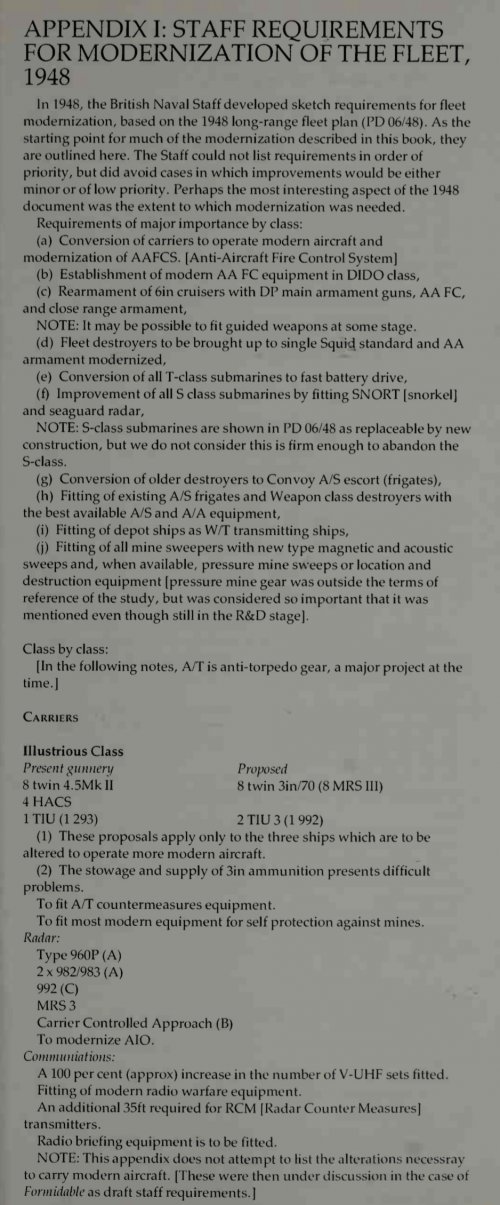
The attached is a screen grab from an Appendix in Friedman's 'The Postwar Naval Revolution'. It shows, or at least indicates, what the Admiralty were thinking of doing to the 'Illustrious' class ships way back in the late 1940's.
Also, don't forget that, despite their somewhat strenuous War Service, the whole Illustrious 'Class' were relatively new ships and, between the Wars, (and yes I know it was forced upon the Admiralty by the various Naval Treaties), there had been an acceptance that a ships useful life could be extended by modernisations and reconstructions...
The appendix also goes on to list the suggested changes to various Cruiser, Destroyer, Frigate, Submarine and Minesweeper classes....
As has previously been mentioned….
Eagle, Ark Royal and the two Indefatigable’s (all updated, at least in some interim way) along with the four Centaur class, all with ‘interim’ angled decks would have made for a good combination throughout the 1950’s/early 1960’s.
Bear in mind that when the original modernisation plan for the Wartime Carriers was formulated, although jet aircraft were on the scene, they were nowhere near the size that, even by the late 1950’s anyone seemed to expect them to be.
Looking back at it with that perspective means….
4 ‘Fleet’ and 4 Centaur ‘Lighter’ Fleet Carriers will need to be replaced by the early 1960’s.
As has already been mentioned, in Friedman’s reference to the fact that when the ‘1952’ Fleet Carrier was being sketched out, thoughts were for a ‘Canberra sized’ aircraft.
Illustrious: 753 x 95ft (229.5 x 29m); 740ft (225.6m) usable length in 1944
Victorious as reconstructed: 775 x 145ft 9in (236.2 x 44.42m)
Indomitable: 750 x 95ft (228.6 x 29m); 745ft (227m) usable length in 1943
Implacable: 760 x 102ft (231.6 x 31.1m)
So the Implacable's 20ft additional additional waterline length only allowed 10ft additional flight deck length.
Victrorious' new flight deck was 22ft longer. If we stuck a Victorious-style reconstruction on top of an Implacable hull it would probably come out around 780ft (237.7m).
Let's compare:
Eagle (1951): 795 x 115ft (242.3 x 35m)
Ark Royal (1955): 800 x 112ft (243.8m x 34.1m)
1952 Carrier: 1,000 x 160ft (304.8 x 48.7m)
So it would still be an intermediate - 20ft longer than Vic but 15-20ft shorter than EagleArk. In terms of scale those differences are each around half the length of a Scimitar fuselage'!
Hood made the above comment about the length/potential length of the flight deck a reconstructed Implacable/Indefatigable class in comparison with the Ark Royal and Eagle...
On that basis, presuming the lower 'half' hangar is re-purposed for accommodation/electrical requirements, then, IN RETROSPECT, they would seem to have been a better option for modernisation than the Illustrious group ships, also bearing in mind their much lower 'mileage' and utilisation during the war due to their much later completion dates.
The problem we have is that we are looking back with the benefit of the dreaded hindsight...
The Angled Flight Deck, etc, etc, were not on the cards when the ORIGINAL modernisation of the 'Illustrious' class ships was being proposed..
The attached is a screen grab from an Appendix in Friedman's 'The Postwar Naval Revolution'. It shows, or at least indicates, what the Admiralty were thinking of doing to the 'Illustrious' class ships way back in the late 1940's.
Also, don't forget that, despite their somewhat strenuous War Service, the whole Illustrious 'Class' were relatively new ships and, between the Wars, (and yes I know it was forced upon the Admiralty by the various Naval Treaties), there had been an acceptance that a ships useful life could be extended by modernisations and reconstructions...
The appendix also goes on to list the suggested changes to various Cruiser, Destroyer, Frigate, Submarine and Minesweeper classes....
As has previously been mentioned….
Eagle, Ark Royal and the two Indefatigable’s (all updated, at least in some interim way) along with the four Centaur class, all with ‘interim’ angled decks would have made for a good combination throughout the 1950’s/early 1960’s.
Bear in mind that when the original modernisation plan for the Wartime Carriers was formulated, although jet aircraft were on the scene, they were nowhere near the size that, even by the late 1950’s anyone seemed to expect them to be.
Looking back at it with that perspective means….
4 ‘Fleet’ and 4 Centaur ‘Lighter’ Fleet Carriers will need to be replaced by the early 1960’s.
As has already been mentioned, in Friedman’s reference to the fact that when the ‘1952’ Fleet Carrier was being sketched out, thoughts were for a ‘Canberra sized’ aircraft.
Attachments
Last edited:
NOMISYRRUC
ACCESS: Top Secret
- Joined
- 28 September 2008
- Messages
- 2,719
- Reaction score
- 4,468
Friedman wrote on P.306 of “British Carrier Aviation”.
Centaur received a pair of 139ft stroke BS.4 steam catapults in her 1956-58 refit. However, half-sister Hermes (whose hull had the same length and beam) was completed with a pair of 151ft stroke BS.4s and one of them was extended to 175ft in her 1964-66 refit. I suspect that Hermes had longer catapults than Centaur because her forward lift was on the deck-edge instead of the centreline.
This makes me think that if a deck-edge lift could be incorporated into a rebuilt Implacable there'd me more than enough room for a pair of 151ft stroke BS.4s. Furthermore, because Implacable was about 45ft longer than Hermes (between perpendiculars and at the waterline) they could have been replaced by a pair of 199ft stroke BS.5s. Failing that, they could at the very least have been replaced by a pair of 151ft stroke BS.5s. Implacable's machinery was nearly as powerful as the machinery on Ark Royal and Eagle so there should have been plenty of steam for catapults that powerful.
A deck-edge lift would interfere with the angled flight deck. However, the centreline lift on Victorious interfered with the steam catapults. So it’s a six-and-two-threes. Also the forward catapult on Hermes could feed the catapults, so the deck-edge lift on the the hypothetical rebuilt Implacable may be able to feed the catapults as well.
Moving the forward lift to the deck edge may also mean that instead of a main hangar 360ft long and a forward extension 52ft long (like the rebuilt Victorious) she could have a 470ft long hangar. The extra 58 feet is enough to stow two Phantoms, or two Sea Vixens or two Scimitars or two Buccaneers.
Which feels too good to be true to me and I think that when something feels too good to be true it usually is.
The staff called for at least two lifts, one at the deck edge forward and the other aft. There was some hope of moving the after lift right aft to the stern, abaft the aircraft recovery area. It could have lifted aircraft to the deck for the longest possible free take-off runs, presumably for special heavy aircraft with rocket assistance. The Staff also wanted the hangar extended beyond the lifts (unless the stern lift could be placed right aft.
And Footnote 22 said.In fact it proved impossible to provide either the deck-edge lift or the lift right aft. The hangar deck had too little freeboard for the former.
He wrote on Page 309 that the Staff Requirement for Implacable mentioned no side lift, but DAW hoped that her deeper hull could accommodate one as he estimated that the freeboard at the hangar deck would be 23ft 6in compared to only 14ft in Victorious.The stern lift had to be abandoned because the hull form aft was too fine.
Centaur received a pair of 139ft stroke BS.4 steam catapults in her 1956-58 refit. However, half-sister Hermes (whose hull had the same length and beam) was completed with a pair of 151ft stroke BS.4s and one of them was extended to 175ft in her 1964-66 refit. I suspect that Hermes had longer catapults than Centaur because her forward lift was on the deck-edge instead of the centreline.
This makes me think that if a deck-edge lift could be incorporated into a rebuilt Implacable there'd me more than enough room for a pair of 151ft stroke BS.4s. Furthermore, because Implacable was about 45ft longer than Hermes (between perpendiculars and at the waterline) they could have been replaced by a pair of 199ft stroke BS.5s. Failing that, they could at the very least have been replaced by a pair of 151ft stroke BS.5s. Implacable's machinery was nearly as powerful as the machinery on Ark Royal and Eagle so there should have been plenty of steam for catapults that powerful.
A deck-edge lift would interfere with the angled flight deck. However, the centreline lift on Victorious interfered with the steam catapults. So it’s a six-and-two-threes. Also the forward catapult on Hermes could feed the catapults, so the deck-edge lift on the the hypothetical rebuilt Implacable may be able to feed the catapults as well.
Moving the forward lift to the deck edge may also mean that instead of a main hangar 360ft long and a forward extension 52ft long (like the rebuilt Victorious) she could have a 470ft long hangar. The extra 58 feet is enough to stow two Phantoms, or two Sea Vixens or two Scimitars or two Buccaneers.
Which feels too good to be true to me and I think that when something feels too good to be true it usually is.
1. Phantom and Buccaneer are what required CVA-01 and eventually made carrier aviation unaffordable for the UK (in light of other budget pressures). Had smaller, good enough aircraft been available, the existing carriers would have been viable for much longer.
This. France philosophy with the Clemenceau class and two generations of Etendards. We couldn't afford more or bigger carriers. PA58 Verdun with F1M and A-7E and E-2 would have been cool but unaffordable.
And same story with the nuclear deterrent. Classic weaponry had to pay for it. The three armies however each got nuclear weaponry - Pluton and AN-52 tac nukes were one and the same.
Adt : Pluton
AdA : AN-52 on Jaguar and IIIE
Aeronavale : AN-52 then ASMP on Super Etendard (from 1978 the two carriers were upgraded to safely handle half a dozen tac nukes, later replace by ASMPs).
Last edited:
Caryina2642
ACCESS: Top Secret
- Joined
- 17 September 2022
- Messages
- 593
- Reaction score
- 316
How much extra deck parking would be added to a rebuilf implacable with this rebuildMoving the forward lift to the deck edge may also mean that instead of a main hangar 360ft long and a forward extension 52ft long (like the rebuilt Victorious) she could have a 470ft long hangar. The extra 58 feet is enough to stow two Phantoms, or two Sea Vixens or two Scimitars or two Buccaneers.
NOMISYRRUC
ACCESS: Top Secret
- Joined
- 28 September 2008
- Messages
- 2,719
- Reaction score
- 4,468
I haven't the foggiest.How much extra deck parking would be added to a rebuilt Implacable with this rebuild?
Or have I?
Hermes was sort of Centaur with a deck edge lift and hopefully a rebuilt Implacable is the rebuilt Victorious with a deck edge lift.
Therefore, divide the air group of Hermes by the air group of Centaur.
Then multiply the answer by the air group of Victorious.
That may give you a clue to how many aircraft a rebuilt Implacable with a deck-edge lift could carry.
NOMISYRRUC
ACCESS: Top Secret
- Joined
- 28 September 2008
- Messages
- 2,719
- Reaction score
- 4,468
The short answer is that she'd probably carry no more aircraft than Ark Royal and Eagle did in the 1960s and 1970s regardless of the theoretical capacity of the ship. They usually carried 12 Phantoms or Sea Vixens, 14 Buccaneers, a squadron of ASW helicopters, a flight of SAR helicopters and a flight of Gannets for SAR & COD.How much extra deck parking would be added to a rebuilt Implacable with this rebuild?
NOMISYRRUC
ACCESS: Top Secret
- Joined
- 28 September 2008
- Messages
- 2,719
- Reaction score
- 4,468
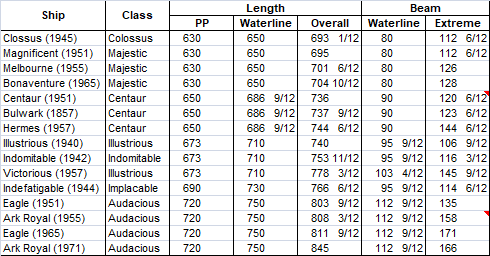
This is according to Pages 366 to 368 in Appendix A of "British Carrier Aviation" by Norman Friedman.

Notes
Notes
- The extreme beam of Centaur increased to 123ft 6in when her angled flight deck was fitted.
- The extreme beam of Ark Royal had increased to 164ft 6in by 1966.
- The overall length of Ark Royal in 1971 includes the bow bridle-catcher. I suspect that her length without it was around 811ft 9in like the rebuilt Eagle.
NOMISYRRUC
ACCESS: Top Secret
- Joined
- 28 September 2008
- Messages
- 2,719
- Reaction score
- 4,468
Based on what I think so far.So I watched Dr Alex Clarke video on the implacable class where he states that they would have been a much better option to rebuild than HMS Victorious. If I remember correctly he stated that Victorious was meant proof of concept before rebuilding the other war time carriers, of course we know what happened with the Victorious Rebuild. So what if instead of Victorious getting rebuilt either Implacable or Indefatigable are rebuild as a proof of concept?
- Would this be cheaper and take less time then the Victorious rebuild? If So would the 2nd Implacable also get rebuild along with HMS Eagle?
- If all 3 get rebuilt, plus with Ark Royal, what would the RN do with Hermes? Would they keep her as the 5th Carrier when one of the big 4 are in Refit? Or would Hermes get sold once completed to say Australia?
- Obviously Eagle and Ark Royal can get Phantomised, but would the Implacables be able to be Phantomoised or are they still too small?
- What would happen to Centaur? Converted to a Commando Carrier or Sold on?
- Finally how would this effect the Royal Navy going forward.
Question 1 - Would this be cheaper and take less time then the Victorious rebuild? If so, would the 2nd Implacable also get rebuild along with HMS Eagle?
No it wouldn't be cheaper. No it wouldn't take less time and no the 2nd Implacable wouldn't be rebuilt along with HMS Eagle.
Question 2 - If all 3 get rebuilt, plus with Ark Royal, what would the RN do with Hermes? Would they keep her as the 5th Carrier when one of the big 4 are in refit? Or would Hermes get sold once completed to say Australia?
The plan in 1951 was for a first-line force of 6 fleet carriers and 6 light fleet carriers in 1957. They were to consist of Ark Royal, Eagle, 3 modernised armoured carriers, a fourth armoured carrier for deck landing training 4 Centaur class and 2 modernised Colossus/Majestic class. The remaining light fleet carriers would be in reserve or in commission in second-line rolls, e.g. IOTL Triumph was the officer cadet training ship 1953-55 when she was relieved by Centaur, Ocean and Theseus became part of the Home Fleet Training Squadron when they were relived by Albion and Bulwark.
By 1954 the plan was for a first-line force of 3 fleet carriers and 3 light fleet carriers. Initially, they were to be Ark Royal, Eagle, Victorious, Albion, Bulwark and Centaur. Hermes would replace (IIRC) Albion when she completed while Centaur and (IIRC) Bulwark would be fitted with steam catapults. Again some of the other light fleet carriers would be in commission in second line-rolls and I suspect that Albion would have become the cadet training ship or replaced one of the ships in the Home Fleet Training Squadron when Hermes was completed instead of going into reserve or being sold.
There was a further reduction in the 1957 Defence Review from a first-line force of 5 ships (Ark Royal, Centaur, Eagle, Hermes & Victorious) all of which were now called strike carriers, plus 2 commando carriers (Albion & Bulwark) which effectively took the place of the 2 ships in the Home Fleet Training Squadron. However, Friedman wrote that the RN wanted 6 strike carriers (which may have been to make it easier to keep 2 East-of-Suez at all times) and I think Brown wrote that the RN wanted 3 commando carriers (which again may have been to make it easier to keep one East-of-Suez at all times).
If all 3 did get rebuilt, which I presume means Implacable, Indefatigable and Victorious, that either means no Radical Defence Review of 1954 or the cut from 12 aircraft carriers to 6 aircraft carriers is brought forward from 1954 to 1957.
- If it's the former.
- Then the 3 fleet and 3 light fleet carriers would effectively be changed to 6 strike carriers consisting of Ark Royal, Eagle, Hermes, Implacable, Indefatigable & Victorious.
- While.
- Albion, Bulwark & Centaur replaced 3 of the Colossus/Majestic class ships serving in second-line roles.
- Then the 3 fleet and 3 light fleet carriers would effectively be changed to 6 strike carriers consisting of Ark Royal, Eagle, Hermes, Implacable, Indefatigable & Victorious.
- If it's the latter, then the 1951 Plan remains in force until 1957 instead of 1954.
- In either case Hermes is still completed in 1959 to the same standard as IOTL.
On the other hand, ITTL having the rebuilt Implacable and Indefatigable in commission in 1957 or nearing the completion of their rebuilds strengthens the RN's case for having a fleet of 6 strike carriers because they've been bought and paid for. In which case Hermes (which was nearing completion as a Standard A-Star strike carrier) would be the sixth ship.
Therefore, Hermes effectively takes the place of Centaur and Centaur takes the place of Albion. In reverse order,
- Albion can be converted to a commando carrier a few years earlier than 1961. She remains in service until 1973, when she's relieved by Hermes and scrapped in the same year.
- Centaur remains in service as a strike carrier until 1961 to cover refits.
- Then she pays off and in common with OTL is an accommodation ship for the remainder of the 1960s and also in common with OTL is scrapped in 1972.
- However, what I want to happen rather than, rather than what I think will happen, is that she's converted to a commando carrier in 1961 and serves alongside Albion and Bulwark in that role until 1976 when she'd paid off and cannibalised for spares for Bulwark and Hermes.
- Hermes remains in service as a strike carrier until at least the end of 1965 when she's paid off. That's when Centaur was paid off IOTL. Or she stays in service as a strike carrier until paying off in 1970. In either case she's still converted to a commando carrier 1971-73 to replace Albion. Her subsequent career was as IOTL.
- Meanwhile, Bulwark's career was exactly the same as OTL.
Except, you meant Eagle, Implacable and Indefatigable. However, you still get the same result with a 5 strike carriers consisting of Ark Royal, Eagle, Hermes, Implacable and Indefatigable rather than them plus the OTL rebuilt Victorious.
Question 3 - Obviously Eagle and Ark Royal can get Phantomised, but would the Implacables be able to be Phantomoised or are they still too small?
If they have enough freeboard at hangar deck level to have a deck-edge lift (à la Hermes) then I think they can be Phantomised because there's space for two 199ft stroke BS.5 steam catapults.
In which case they'll be better than the rebuilt Ark Royal and Eagle which had one 199ft stroke BS.5 and one 151ft stroke BS.5. As written before the Implacable class had machinery that was nearly as powerful as Ark Royal and Eagle so there should be enough steam for the more powerful catapults.
They'd also be better than the rebuilt Ark Royal because they had the Type 984/CDS/DPT and an AC electrical system, which Ark Royal didn't. A fourth advantage they'd probably have over Ark Royal is that they were in better material condition than her despite having being completed 9 years earlier and seen action in World War II.
If they didn't have enough freeboard at hangar deck level to have a deck-edge lift the short answer is possibly. The extra 20 feet of length at the waterline means there's probably space for a pair of full-length BS.4 steam catapults (151ft stroke instead of 145ft) that could be replaced by a pair of 151ft stroke BS.5s in the 1960s. As written above the Implacable's machinery produced nearly as much steam as Ark Royal and Eagle so there should be no problem in that regard. The 20ft longer hull may make it possible to increase the stroke of the BS.5s to 165ft (that is the 145ft of the BS.4s in the rebuilt Victorious plus 20ft for the longer hull of Implacable equals 165ft) which is an improvement on 151ft but still not close to being as good as 199ft.
Question 4. What would happen to Centaur? Converted to a Commando Carrier or Sold on?
See Question 2.
5. Finally how would this effect the Royal Navy going forward.
Is this the timeline where one Implacable is rebuilt in the 1950s instead of Victorious? Or the Question 2 scenario, where Implacable and Indefatigable are rebuilt in the 1950s?
If it's the former, she may be Phantomised instead of Ark Royal and the refit may be faster and cheaper.
- She was in better condition than Ark Royal.
- She already has a fully-angled flight deck.
- She has Type 984/CDS/DPT and an AC electrical system. Ark Royal had neither before the refit and didn't get them in the refit.
- Plus you're not removing one of the bow catapults and installing a waist catapult.
- Although you are removing the existing 151ft stroke BS.4s and installing 199ft stroke BS.5s in their place.
- However, there's nothing to stop them having BS.4s with a stroke of 199ft installed as part of their original rebuilds.
- In common with Ark Royal she'd probably have all her guns removed and be fitted for but not with 4 Sea Cat launchers.
If it's the latter the RN still has 5 strike carriers in 1961, but they're Ark Royal, Eagle, Hermes, Implacable and Indefatigable instead of Ark Royal, Centaur, Eagle, Hermes and Victorious. That's:
- 2 Standard A ships (Implacable & Indefatigable), one Standard A-Star ship (Hermes) and one Standard C ship (Centaur) plus one Standard D ship (Eagle) being rebuilt to Standard A ITTL
- Instead of:
- One Standard A ship (Victorious), one Standard A-Star ship (Hermes) and one Standard C ship (Ark Royal) plus one Standard D ship (Eagle) being rebuilt to Standard A ITTL.
- Implacable was a bit better than Victorious.
- Her BS.4 steam catapults were a a bit longer than those on Victorious (151ft v 145ft).
- She could carry as many Scimitars, Sea Vixens and Buccaneers as Ark Royal and Eagle.
- Indefatigable was a lot better than Centaur.
- Her BS.4 steam catapults were somewhat longer than those on Centaur (151ft v 139ft).
- She had a fully-angled flight deck. Centaur had an interim angled flight deck.
- Centaur had an air group that included 8 Sea Vixens and 9 Scimitars, which was reduced to 12 Sea Vixens and no Scimitars in 1962 because she couldn't operate the Buccaneer.
- Indefatigable on the other hand had an air group that included 12 Sea Vixens and 12 Scimitars. The latter was replaced by a squadron of 14 Buccaneer S.1s in 1963 and a squadron of 14 Buccaneer S.2s later.
- Indefatigable had an AC electrical system. Centaur used DC.
- Indefatigable had Type 984/CDS/DPT. Centaur didn't.
- Although this extra capability was at the expense of a larger crew.
My guess is that in the early 1960s the long-term plan will be to complete at least 3 CVA.01s during the course of the 1970s and preferably 5 for a one-for-one replacement of the existing strike carrier force. However, the short-term plan (following the cancellation of the P.1154RN would be to Phantomise Implacable, Indefatigable and Eagle in that order.
Therefore:
- Implacable was Phantomised 1964-66. This refit took the place of the 1964-66 refit if Hermes IOTL.
- Indefatigable was Phantomised 1966-68.
- Hermes was paid off at the end of 1965 instead of Centaur IOTL. She spent several years as an accommodation ship, but was converted to a commando carrier 1971-73 and her subsequent history was as IOTL.
- Ark Royal wasn't Phantomised. Instead she remained in commission until she was damaged by a fire in November 1967, which led to her premature decommissioning and she was scrapped in 1969.
- Eagle was unlucky. She was to have been Phantomised after Indefatigable completed her refit and like the 2 Implacable class aircraft carriers was to have remained in service until 1975. However, yet another economic crisis led to the East of Suez withdrawal being brought forward from 1975 to the end of 1971. Therefore, she only operate Phantoms for 3 years instead of 6 which wasn't cost effective. So she wasn't Phantomised and paid off in 1970 which is when Hermes was paid off IOTL and was sold for scrapping straight away.
ITTL enough F-4Ks were ordered to equip 3 squadrons. That doesn't necessarily mean about 90 were ordered of which 78 were built. Also it doesn't necessarily mean that the total number of British Phantoms was increased from 170 to 196. The number of F-4Ms might be reduced from 118 to 92. My guess is that more may be ordered, but the number built was still 52 F-4Ks and 118 F-4Ms, but all the F-4Ks went to the FAA initially to equip 2 front-line squadrons and training units like No. 767 NAS which had 10 Phantoms instead of 5. The survivors would be transferred to the RAF in 1978. Half would be used to form No. 43 squadron in 1979 (instead of 1969) and the rest would (like IOTL) replace the F-4Ms in No. 111 squadron.
All other things being equal one of the Implacables would have paid off in 1972 instead of Eagle IOTL and the other would have remained in service until 1978 instead of Ark Royal IOTL. However, the Heath Government gave both ships a reprieve so both served until 1978 instead of the previous government's plan which was to pay both of them off in 1972.
Last edited:
What a fantastic post. Brilliant.
https://en.wikipedia.org/wiki/Implacable-class_aircraft_carrier
It makes one very important point: the Implacables in raw potential were much closer from Audacious - than their Illustrious ancestors. Definitively just capable enough, with the right rebuilt they could almost get a promotion to Audacious level - that is the holly grail of Phantomization.
Which really maxes out any WWII carrier, just ask the Essex and even the Midways.
In the end, in raw capability
-Audacious class (2 ships, could have been 3)
-Implacable class (2 ships)
..........
-Illustrious class (4 ships, but smaller than Implacables and pretty battered by WWII)
-Centaur class (4 ships, but considered as "super light fleet" rather than heavies but forced upward, kinda)
.........
-Colossus / Majestic (the other light fleet)
And now, with perfect hindsight, let's split them according to the "ultimate naval planes" coming after 1960
... (Phantoms ?)
-Audacious class
-Implacable class
... (Buccaneers but not Phantoms)
-Illustrious class (Victorious rebuilt)
-Centaur class (Hermes rebuilt)
...
-Colossus / Majestic
Bottom line: with 100% Phantomization hindsight, not only the Audacious were valuable - but the Implacables too, albeit they would need quite a rebuilt.
The line in the sand (Phantomization) is no longer "Audacious and nothing else" but "Audacious and correctly rebuilt Implacables."
The hopless ones - that can do Buccaneers but not Phantoms, so screw them - are not only the 4 Centaurs, but also the 4 Illustrious.
Congrats Implacables, you just got a promotion LMAO !
https://en.wikipedia.org/wiki/Implacable-class_aircraft_carrier
It makes one very important point: the Implacables in raw potential were much closer from Audacious - than their Illustrious ancestors. Definitively just capable enough, with the right rebuilt they could almost get a promotion to Audacious level - that is the holly grail of Phantomization.
Which really maxes out any WWII carrier, just ask the Essex and even the Midways.
In the end, in raw capability
-Audacious class (2 ships, could have been 3)
-Implacable class (2 ships)
..........
-Illustrious class (4 ships, but smaller than Implacables and pretty battered by WWII)
-Centaur class (4 ships, but considered as "super light fleet" rather than heavies but forced upward, kinda)
.........
-Colossus / Majestic (the other light fleet)
And now, with perfect hindsight, let's split them according to the "ultimate naval planes" coming after 1960
... (Phantoms ?)
-Audacious class
-Implacable class
... (Buccaneers but not Phantoms)
-Illustrious class (Victorious rebuilt)
-Centaur class (Hermes rebuilt)
...
-Colossus / Majestic
Bottom line: with 100% Phantomization hindsight, not only the Audacious were valuable - but the Implacables too, albeit they would need quite a rebuilt.
The line in the sand (Phantomization) is no longer "Audacious and nothing else" but "Audacious and correctly rebuilt Implacables."
The hopless ones - that can do Buccaneers but not Phantoms, so screw them - are not only the 4 Centaurs, but also the 4 Illustrious.
Congrats Implacables, you just got a promotion LMAO !
Last edited:
- Joined
- 6 September 2006
- Messages
- 5,316
- Reaction score
- 11,544
It's perhaps worth noting that Victorious' original hangar size was 456 x 62ft.As the Implacable and Indefatigable were 20ft longer than Victorious at the waterline it looks like they could have had hangars and lifts of the same dimensions as the rebuilt Victorious, plus catapults that were up to 20ft longer.
The Implacables' upper hangar was merely 2ft longer at 458ft. So there is no additional wriggle room to move the forward centreline lift any further aft without ending up with a smaller hangar than 360ft (Victorious having sacrificed 96ft in real terms even if the lift was only moved 36ft).
NOMISYRRUC
ACCESS: Top Secret
- Joined
- 28 September 2008
- Messages
- 2,719
- Reaction score
- 4,468
Like I wrote earlier on. When something feels too good to be true it usually is.What a fantastic post. Brilliant.
https://en.wikipedia.org/wiki/Implacable-class_aircraft_carrier
Rule of cool
ACCESS: Top Secret
- Joined
- 16 January 2024
- Messages
- 3,567
- Reaction score
- 4,520
This is an interesting thread, but its annoying that there's no neat trick to solve the problems.
NOMISYRRUC
ACCESS: Top Secret
- Joined
- 28 September 2008
- Messages
- 2,719
- Reaction score
- 4,468
It is perhaps worth noting that Implacable was 20 feet longer than Victorious at the waterline and overall. So, it is perhaps worth noting that there was about 10ft of extra length between the forward lift on an Implacable and the bow plus about 10ft of extra length between the aft lift and the stern on an Implacable due to both designs having hangars of virtually the same length.It's perhaps worth noting that Victorious' original hangar size was 456 x 62ft.
The Implacables' upper hangar was merely 2ft longer at 458ft. So there is no additional wriggle room to move the forward centreline lift any further aft without ending up with a smaller hangar than 360ft (Victorious having sacrificed 96ft in real terms even if the lift was only moved 36ft).
Therefore, it is perhaps worth noting that there was enough space between the forward lift and the bow on a rebuilt Implacable for a pair of 151ft stroke steam catapults (BS.4 or BS.5) without moving the lift back more than 36ft.
The RN also wanted the aft lift of Victorious moved further aft, but it wasn't possible due to the aft hull form being too fine. The RN will want the aft lift of a rebuilt Implacable moved further aft too. Therefore, it is perhaps worth noting that the extra 10 feet of length in the aft half of the hull will make it possible to move the aft lift back, although not as far as they wanted due to the aft hull form being too fine. (If anything it may be finer than the aft hull form of Victorious due to the Implacable's having the same beam as Victorious.) Nevertheless, it is perhaps worth noting that moving the the aft lift back 10ft would allow the designers to bring the forward lift back another 10ft (from 36ft to 46ft) without reducing the length of the hangar because the increase of 10 feet aft would have made up for the 10ft reduction forward.
Finally, it is perhaps worth noting that due to the above I stand by what I wrote in Message 85. That is.
As the Implacable and Indefatigable were 20ft longer than Victorious at the waterline it looks like they could have had hangars and lifts of the same dimensions as the rebuilt Victorious, plus catapults that were up to 20ft longer.
You nailed it !This is an interesting thread, but its annoying that there's no neat trick to solve the problems.
I would say, the RN dire situation looked like the USN if after CVA-58 USS United States cancellation in 1950, Forrestal and beyond never happened. Ever. Which means: the USN would be trapped with only WWII carriers that is 24 Essex plus the three Midways.
Now, imagine the USN desperately milking the Essex and Midways to the last drop, hopping they could last until 1980 so 30 more years. Meanwhile their atempts to get "fresh" carriers - let's call them Forrestal and CVV - are thwarted by politics and of course, the freakkin' USAF and its SAC bombers. Hello, "1952 carrier" and "CVA-01" !
...
- 24 Essex and 3 midways, that's 27 hulls.
- The RN had 2 Audacious, 6 Illustrious and 4 Centaurs so 12 major carriers plus the 16 light fleet, Colossus & Majestic , total 28 hulls.
- So the numbers are comparable albeit TBH the light fleet are closer from the 9 Independance and 2 Saipans, so CVL. Back to 12 hulls.
- Also Midways are far more capable than Audacious, only Maltas came close but they never existed.
NOMISYRRUC
ACCESS: Top Secret
- Joined
- 28 September 2008
- Messages
- 2,719
- Reaction score
- 4,468
FWIW Coral Sea, Lexington and Midway lasted into the 1990s. Admittedly, Coral Sea only by 4 months (decommissioned 26.04.90) and Lexington had been the training carrier since 1962.Now, imagine the USN desperately milking the Essex and Midways to the last drop, hopping they could last until 1980 so 30 more years.
NOMISYRRUC
ACCESS: Top Secret
- Joined
- 28 September 2008
- Messages
- 2,719
- Reaction score
- 4,468
It's perhaps worth noting that Implacable had more freeboard at the hangar deck than Victorious, which may make it possible to move the forward lift to the deck edge. If it turned out to be true, then it's perhaps worth noting that the DNC could "have his cake and eat it" because moving the forward lift to the deck edge makes it feasible to have longer catapults and a longer main hangar.It's perhaps worth noting that Victorious' original hangar size was 456 x 62ft.
The Implacables' upper hangar was merely 2ft longer at 458ft. So there is no additional wriggle room to move the forward centreline lift any further aft without ending up with a smaller hangar than 360ft (Victorious having sacrificed 96ft in real terms even if the lift was only moved 36ft).
I would personally not have the forward lift moved to the port deck edge. The arrangement on Hermes was found rather unsatisfactory, as the forward lift both interfered with landings and was very susceptible to bad weather, in addition to preventing the installation of a catapult on the angled deck. I would rather keep the forward lift as a closed lift but move it to port so that its port edge would coinside with the port side hangar wall. This would allow at least a 151' BS-5 on the starboard bow, if not even longer. The space vacated on the starboard side of the old lift well would be transformed into accomodation spaces and worlshops. This would also avoid having to move the hangar aftwards.
Instead of a port bow catapult, I would instal a 199' BS-5A on the angled deck and move the rear lift to either deck edge where it would be protected from the worst of the weather either by the island or the angled deck. Additionally, this would allow the extensions of the hangar rearwards to the space formerly taken by the liftwell, providing a hangar about 40' longer than the pre-reconstruction upper hangar. The former lower hangar and the lower part of the former rear lift well would be trasformed into accomodation and workshop spaces.
I would reboiler the ships with new 600 psi boilers. Not only would this increase power output (probably to a ballpark between 170 000 and 180 000 shp, if the turbines can utilise all the steam), allowing them to hopefully retain their top speed of 32,5 kts (2 kts faster than the Audacious-class!) despite the bulging required by the increased topweight caused by raising the flight deck by 3,5" (slightly offset by reducing the hangar roof plating from 3" NC plate to 1,2" NC plate), adding an angled deck, enlarging the island (necessitated by an increased need for accomodation and electronics spaces and command facilities) and a significantly increased electronics suite (including a Type 984), but also allowing the catapults to have a higher performance than those on the Audacious class thanks to about 50 % greater steam pressure.
Overall, the resulting modernised Implacables ought to be able to operate all the same aircraft as the Audacious class (thanks to their slightly higher speed, greater catapult performance thanks to increased steam pressure and possibly slightly longer bow catapults, they might even be capable of launching slightly heavier aircraft than the Audacious class ships), although due to being single-hangar ships, their aircraft capacity would be lower. Technologically, they would be superior to HMS Eagle after her OTL reconstruction thanks to AC electronics, better air conditioning, higher power generation capability and more modern machinery.
Instead of a port bow catapult, I would instal a 199' BS-5A on the angled deck and move the rear lift to either deck edge where it would be protected from the worst of the weather either by the island or the angled deck. Additionally, this would allow the extensions of the hangar rearwards to the space formerly taken by the liftwell, providing a hangar about 40' longer than the pre-reconstruction upper hangar. The former lower hangar and the lower part of the former rear lift well would be trasformed into accomodation and workshop spaces.
I would reboiler the ships with new 600 psi boilers. Not only would this increase power output (probably to a ballpark between 170 000 and 180 000 shp, if the turbines can utilise all the steam), allowing them to hopefully retain their top speed of 32,5 kts (2 kts faster than the Audacious-class!) despite the bulging required by the increased topweight caused by raising the flight deck by 3,5" (slightly offset by reducing the hangar roof plating from 3" NC plate to 1,2" NC plate), adding an angled deck, enlarging the island (necessitated by an increased need for accomodation and electronics spaces and command facilities) and a significantly increased electronics suite (including a Type 984), but also allowing the catapults to have a higher performance than those on the Audacious class thanks to about 50 % greater steam pressure.
Overall, the resulting modernised Implacables ought to be able to operate all the same aircraft as the Audacious class (thanks to their slightly higher speed, greater catapult performance thanks to increased steam pressure and possibly slightly longer bow catapults, they might even be capable of launching slightly heavier aircraft than the Audacious class ships), although due to being single-hangar ships, their aircraft capacity would be lower. Technologically, they would be superior to HMS Eagle after her OTL reconstruction thanks to AC electronics, better air conditioning, higher power generation capability and more modern machinery.
- Joined
- 6 September 2006
- Messages
- 5,316
- Reaction score
- 11,544
To save myself going mad I've looked at WW2 plans of both ships.It is perhaps worth noting that Implacable was 20 feet longer than Victorious at the waterline and overall. So, it is perhaps worth noting that there was about 10ft of extra length between the forward lift on an Implacable and the bow plus about 10ft of extra length between the aft lift and the stern on an Implacable due to both designs having hangars of virtually the same length.
Therefore, it is perhaps worth noting that there was enough space between the forward lift and the bow on a rebuilt Implacable for a pair of 151ft stroke steam catapults (BS.4 or BS.5) without moving the lift back more than 36ft.
The RN also wanted the aft lift of Victorious moved further aft, but it wasn't possible due to the aft hull form being too fine. The RN will want the aft lift of a rebuilt Implacable moved further aft too. Therefore, it is perhaps worth noting that the extra 10 feet of length in the aft half of the hull will make it possible to move the aft lift back, although not as far as they wanted due to the aft hull form being too fine. (If anything it may be finer than the aft hull form of Victorious due to the Implacable's having the same beam as Victorious.) Nevertheless, it is perhaps worth noting that moving the the aft lift back 10ft would allow the designers to bring the forward lift back another 10ft (from 36ft to 46ft) without reducing the length of the hangar because the increase of 10 feet aft would have made up for the 10ft reduction forward.
Finally, it is perhaps worth noting that due to the above I stand by what I wrote in Message 85. That is.
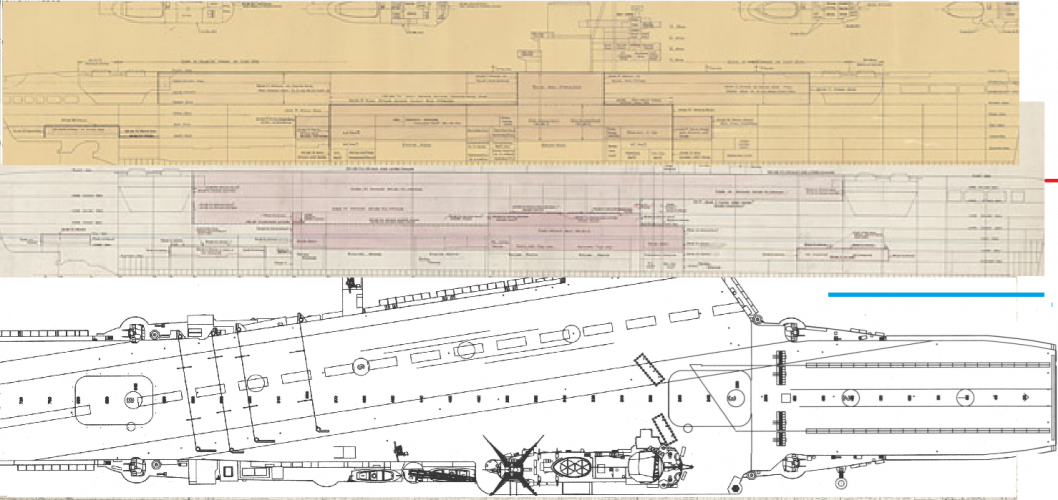
I've scaled both ships wl length with the rudder post as the datum mark.
From the datum point on the rudder post the hangar length is unchanged but essentially was moved forwards by ~25ft, along with the lifts. The fore end of the lift on Illustrious is around 115ft from the forward deck edge, on Implacable its 100ft. Likewise the deck between the aft end and the aft lift is 70ft on Illustrious and 100ft on Implacable.
This is low-rezs but you get the idea.
Top - Illustrious/Victorious WW2 standard as built
Middle - Implacable as built
Victorious - flight deck as rebuilt - just the portion corresponding to the wl length plus the entire forward end of the flight deck
The blue line is a scaled 151ft BS.5 - CAVEAT TIME - the Victorious rebuild plan is not an official plan and as you can see the catapults indicated here would be 171ft long, which we know is bollocks, but everything else seems to line up ok.
Pirate Pete
ACCESS: Secret
- Joined
- 25 July 2007
- Messages
- 408
- Reaction score
- 736
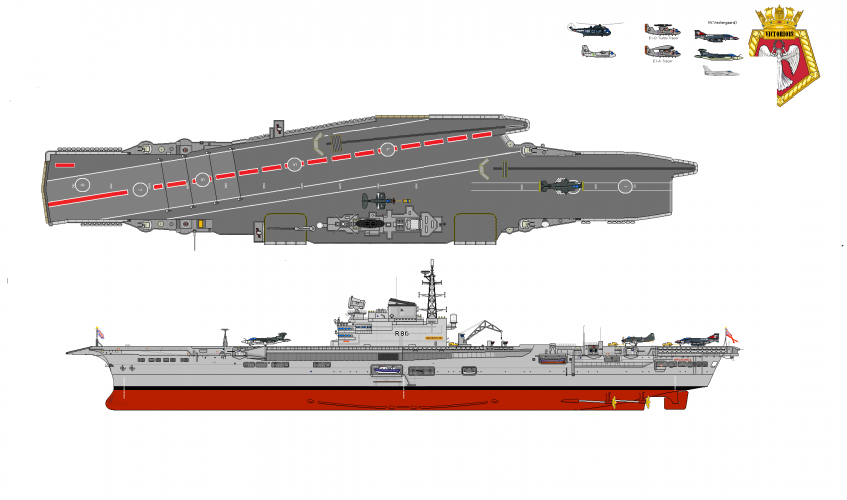
Complete 'Tangent' I accept, but stumbled across this Shipbucket image that I saved early last year. It's OBVIOUSLY Fan Art and the ship is named as Indomitable, but, given an 'ideal world', could Implacable/Indefatigable been something like this?
Attachments
During the design phase of the Audacious class, it was found out that the structural beams of the hangar roof could be reduced in depth by six inches without unduly affecting the structural strength or rigidity of the hull girder, as can be seen at the article describing the Audacious class at the excellent Armoured Carriers site.Didn't someone uncover that DNC re-estimated that Implacable and Indomitable had over deep beams for the Flighdeck by 6 inches?
https://www.armouredcarriers.com/hms-audacious-class-armoured-flight-deck
Beat me to it! I was about to spend my afternoon on this task, but starting from the forward perpendicular rather than that at the stern. But I wanted to try and identify the frame numbers for the location of the forward lift in both ships as a starting point for a detailed examination. I have a concern about how the shape of the bow above the waterline and the differing forward round downs might affect the measurements. But like you I only have those small scale drawings of Indefatigable to play with.To save myself going mad I've looked at WW2 plans of both ships.
I've scaled both ships wl length with the rudder post as the datum mark.
From the datum point on the rudder post the hangar length is unchanged but essentially was moved forwards by ~25ft, along with the lifts. The fore end of the lift on Illustrious is around 115ft from the forward deck edge, on Implacable its 100ft. Likewise the deck between the aft end and the aft lift is 70ft on Illustrious and 100ft on Implacable.
This is low-rezs but you get the idea.
Top - Illustrious/Victorious WW2 standard as built
Middle - Implacable as built
Victorious - flight deck as rebuilt - just the portion corresponding to the wl length plus the entire forward end of the flight deck
The blue line is a scaled 151ft BS.5 - CAVEAT TIME - the Victorious rebuild plan is not an official plan and as you can see the catapults indicated here would be 171ft long, which we know is bollocks, but everything else seems to line up ok.
View attachment 800405
When I read NOMISYRRUC's post I immediately felt there was something wrong. His assumption seemed to be that the extra 20ft of waterline length was added in the middle of the ship, causing a 10ft increase at either end.
I look at it differently. From the various descriptions of the development of the Implacables, the starting point was an Illustrious with new four shaft machinery. It was the extra space needed for those spaces that drove the increase in length. So the extra 20ft should, in theory, all be from around the after part of the island and rearward. So if the hangar length stayed the same and started from around the same point, any extra flight deck length was going to be aft of the after lift spaces
So more of a case of stretching the lower parts of the hull under the hangar. (I've found this very difficult to explain clearly). So your comments about the forward end continue to puzzle me.
The other issue to consider is that their were numerous changes made to these ships between 1940 and 1942 when they were launched. That includes the whole forward end of the ship above the waterline being widened. Compare the amount of flight deck space between the sides of the forward lift and the gun bays, and then compare with Indomitable to understand what I mean.
Something else to bear in mind is that Implacable and Indefatigable were not exact copies. Most notably Indefatigable carried her boats a deck higher than Implacable. I don't know how that might have affected her internal layout.
The real problem we have understanding the Implacables is that no one has so far produced a detailed study tracking the various changes to the design, starting from Illustrious all the way through to their completion in 1944 and beyond to Implacable's 1945 refit before she went to the Pacific (increased AA and changes to the aft end of the flight deck to increase its area)
Slightly aside, in Post-War Naval Revolution was a mention that in case of rearmament of the Majestics as missile cruisers, they would have to be reengined, doubling the HP and increasing speed towards 30 knots.
However, if they kept their hangars and flight decks, reengined Majestics could've made rather neat ASW/Harrier carriers a decade or so before the Invincibles.
However, if they kept their hangars and flight decks, reengined Majestics could've made rather neat ASW/Harrier carriers a decade or so before the Invincibles.
- Joined
- 6 September 2006
- Messages
- 5,316
- Reaction score
- 11,544
My comment "the hangar length is unchanged but essentially was moved forwards by ~25ft" is in relation to the rudder post datum line. But from the plans it does seem that the forward lift was slightly closer (~15ft) (and by implication the forward end of the hangar) to the bow edge of the flight deck than the Illustrious/Victorious/Indomitable. This is probably why the forward end of the ship above the waterline was widened.So more of a case of stretching the lower parts of the hull under the hangar. (I've found this very difficult to explain clearly). So your comments about the forward end continue to puzzle me.
I think from examining the plans its clear that the Illustrious and Implacable should be considered to be separate classes. I think the fact that they look so similar has led to folks assuming they are simply Illustriouses with a 20ft section bunged in the middle. As you say it is much more nuanced than that and essentially everything internally has been rejigged - plus the mods during construction you mention.
I've not looked at Indomitable, I suspect it would throw more interesting spanners into the works!
I've been poring over the plans I have available and looking, or at least trying to look, at the ship frame numbers.
So starting with Watton's Anatomy of the ship Victorious, the ship frame numbers run bow to stern, with the forward perpendicular being frame "1" and running to frame "180" running upwards at the aftmost end of the quarterdeck, The aft perpendicular (through the rudder mount) is at frame 168.
The doors dividing the hangar from the forward lift well are at frame 37. The doors dividing the hangar from the aft lift well are at frame 151.
The frame numbers are too small to discern on any plans downloaded from the Greenwich Museum site and I can't afford the £141 they want for a full sized copy. That is where the plans on the armoured carriers site seem to come from and which are no clearer.
What I have found are diagrams in one of Hobbs books that have flight and both hangar deck plans for Implacable. These have the frame numbers printed down the centrelines. (A Century of Carrier Aviation page 165). A bit of careful measuring suggests the divide between the forward lift and the hangar is at frame 37. At the aft end the divide between the hangar and after lift well falls around frame 151.
So it would appear that the forward lift is in the same place as it is on Victorious. However the slight flattening out of the forward round down may well have secured an additional few feet of useable flight deck. Compare Formidable & Implacable in 1945/46.


Hobbs has a similar diagram in his "British Aircraft Carriers" book for Indomitable (page 101). The forward end of her hangar is about frame 42 and runs aft to about frame 145 where it meets the after lift. This makes sense as her forward lift was moved 16ft aft compared to Victorious while her aft lift was moved forward by 24ft, thus shortening the upper hangar to 416ft instead of 456ft in both Victorious and Implacable.
As for the widening of the ship forward, I think that the reason becomes very apparent when you consider the room around the lift for moving aircraft around it. This 1944 photo take at Rosyth in May 1944 of Indomitable when she had Avengers of deck, I think highlights the problem nicely. But again it is a modification without a timeline, However reading Friedman I get the impression that this was a wartime modification, but how late in the build process was it able to be made? The catapult track does however seeem to have been left in the same place.

Compared to Implacable at Vancouver in Oct 1945

So starting with Watton's Anatomy of the ship Victorious, the ship frame numbers run bow to stern, with the forward perpendicular being frame "1" and running to frame "180" running upwards at the aftmost end of the quarterdeck, The aft perpendicular (through the rudder mount) is at frame 168.
The doors dividing the hangar from the forward lift well are at frame 37. The doors dividing the hangar from the aft lift well are at frame 151.
The frame numbers are too small to discern on any plans downloaded from the Greenwich Museum site and I can't afford the £141 they want for a full sized copy. That is where the plans on the armoured carriers site seem to come from and which are no clearer.
What I have found are diagrams in one of Hobbs books that have flight and both hangar deck plans for Implacable. These have the frame numbers printed down the centrelines. (A Century of Carrier Aviation page 165). A bit of careful measuring suggests the divide between the forward lift and the hangar is at frame 37. At the aft end the divide between the hangar and after lift well falls around frame 151.
So it would appear that the forward lift is in the same place as it is on Victorious. However the slight flattening out of the forward round down may well have secured an additional few feet of useable flight deck. Compare Formidable & Implacable in 1945/46.
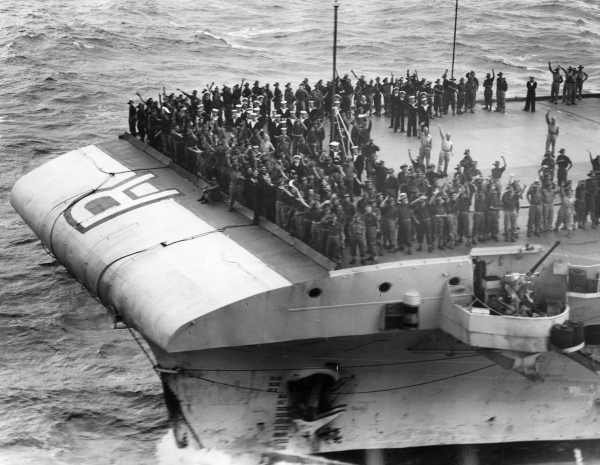
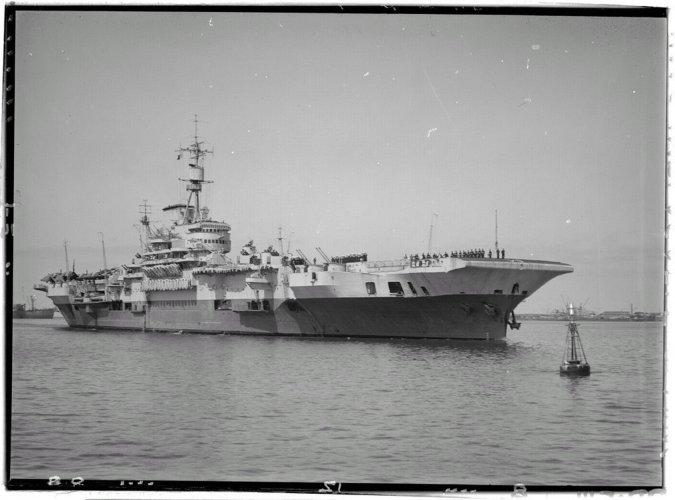
Hobbs has a similar diagram in his "British Aircraft Carriers" book for Indomitable (page 101). The forward end of her hangar is about frame 42 and runs aft to about frame 145 where it meets the after lift. This makes sense as her forward lift was moved 16ft aft compared to Victorious while her aft lift was moved forward by 24ft, thus shortening the upper hangar to 416ft instead of 456ft in both Victorious and Implacable.
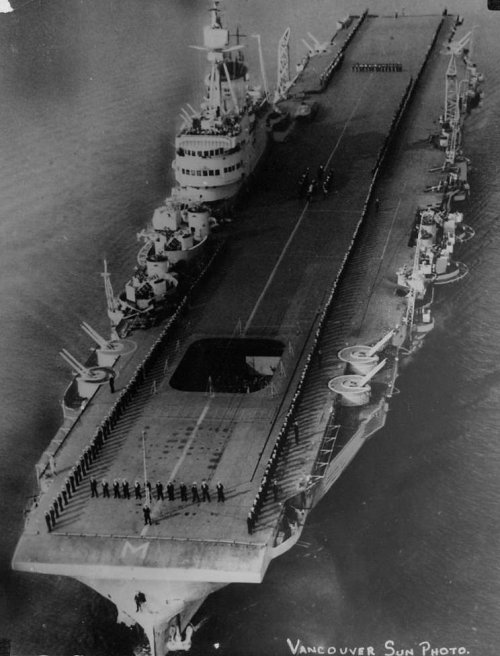
As for the widening of the ship forward, I think that the reason becomes very apparent when you consider the room around the lift for moving aircraft around it. This 1944 photo take at Rosyth in May 1944 of Indomitable when she had Avengers of deck, I think highlights the problem nicely. But again it is a modification without a timeline, However reading Friedman I get the impression that this was a wartime modification, but how late in the build process was it able to be made? The catapult track does however seeem to have been left in the same place.
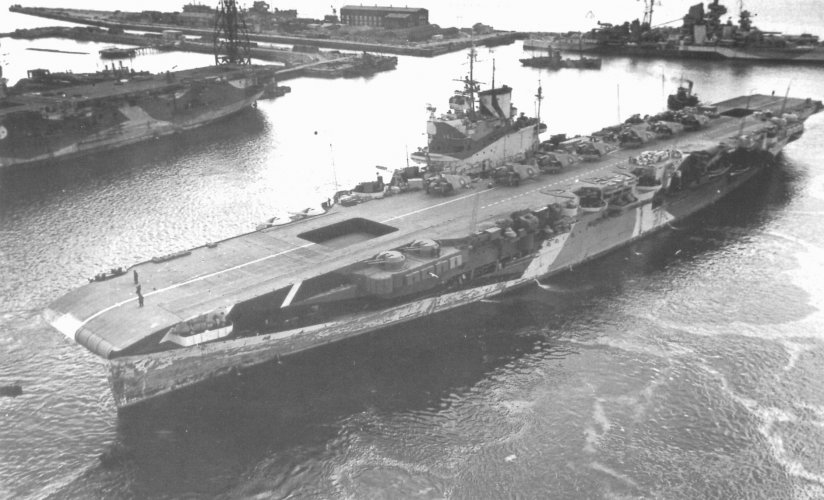
Compared to Implacable at Vancouver in Oct 1945
- Joined
- 6 September 2006
- Messages
- 5,316
- Reaction score
- 11,544
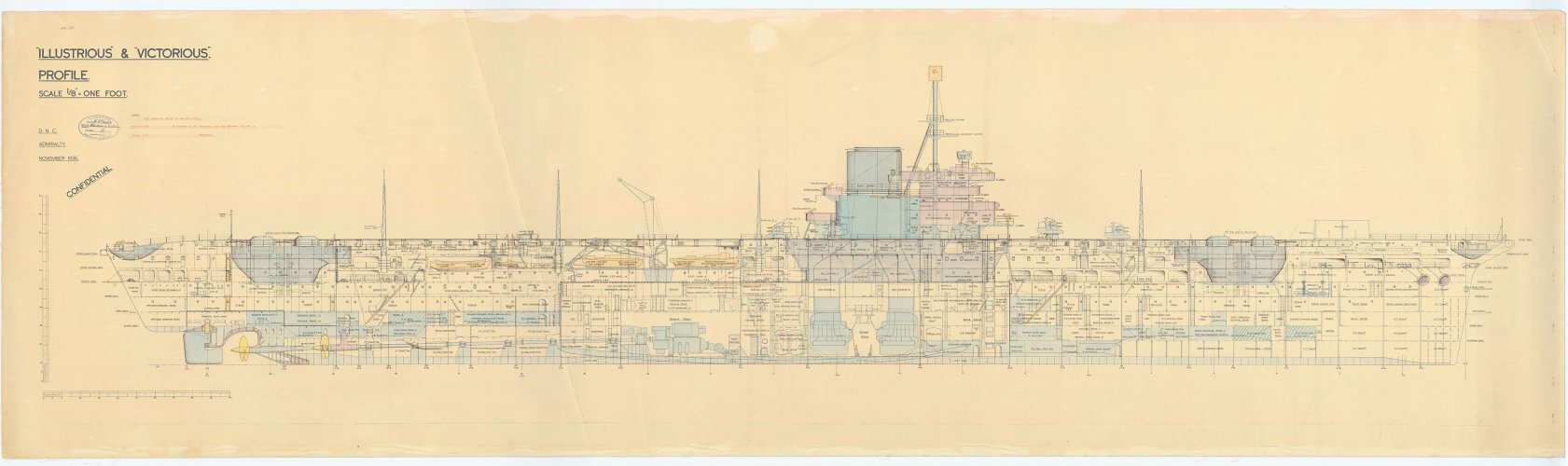
If it helps I found that in my files I do have a high-rez copy of the Illustrious profile plan (no names, no packdrill).
The lifts can be seen in their lowered positions beneath the 4.5in sponsons.
Sadly without an higher-rez Implacable/Indefatigable plan its not easy to settle the matter. I tried overlaying a lower-rez Implacable over this, I lined up the bow/double-bottom compartments pretty well and it suggested the forward lift (and 4.5in guns) were ~8ft further forward. But I now remain sceptical until something more concrete comes up.

The lifts can be seen in their lowered positions beneath the 4.5in sponsons.
Sadly without an higher-rez Implacable/Indefatigable plan its not easy to settle the matter. I tried overlaying a lower-rez Implacable over this, I lined up the bow/double-bottom compartments pretty well and it suggested the forward lift (and 4.5in guns) were ~8ft further forward. But I now remain sceptical until something more concrete comes up.
Thinking of the whole situation with carriers in the post-war era, I would change things beginning in 1945. I would not cancel the third Audacious-class ship Eagle. Instead, I would either cancel or transfer to another navy (RAN, RCN, MN, Indian Navy) the fourth Centaur-class light fleet carrier Elephant (completed OTL as HMS Hermes). I would order a switch to PVC-insulated AC electrical systems in all the new ships under construction (primarily the Audacious and Centaur classes, possibly also the first batch of Daring-class which was completed with lead-insulated DC electrical systems OTL).
I would rename the HMS Audacious HMS Hermes and have her completed as IOTL in 1951 with an axial flight deck and hydraulic catapults. I would make sure that HMS Irresestible (renamed Ark Royal) be properly protected from the elements while awaiting launching on the slipway, but she would finish otherwise as IOTL in 1954 with an intermediate angled deck, a deck-edge lift serving the upper hangar and two BS-4 steam catapults in the bow. I would have the Eagle fitted with new high-pressure boilers while building and have her finished in 1959 with a fully angled deck, a BS-5 in bow and a BS-5A on the waist, a Type 984 radar and a 48-track CDS. The first three Centaur-class ships would be finished as IOTL but possibly with high-pressure boilers, steam catapults and an interim angled deck, if possible.
While the new ships are being built, I would make sure that the six armoured-box-hangar carriers be all properly maintained either in active service or in maintained reserve. I would also give Formidable a refit to keep her in shape before her going into maintained reserve. This could possibly be funded by getting rid of all the corvettes and possibly even the frigates in reserve (with new submarine types the old corvettes would be all neigh useless and even the frigates of doubtful utility). Before starting the reconstruction programme of the legacy carriers, I would have the condition of all of them thoroughly surveyed. Any one of them with only very limited hull life left would be marked for disposal and be used as training ships or held in reserve until their disposal. I would also query friendly navies if they would be interested in acquiring any of the three Illustrious-class ships or their half-sister HMS Indomitable after a thorough reconstruction. I would push to get money budgeted for the reconstruction of at least the two Implacables (to a configuration I described in my previous post) and possibly of one of the older four carriers as a prototype. The slots for reconstruction would be 1950–1954, 1954–1958 and 1958–1962. The first ship reconstructed would probably finish in a more intermediate configuration with BS-4 catapults, no Type 984 and no CDS. I would also convert HMS Unicorn into a prototype commando carrier, as her double-hangar configuration, ability to lower material directly from the rear of her upper hangar to a lighter floating under the deck overhang and heavier gun armament would likely make her ideal for the role.
After the last of the Implacables finishes her reconstruction, I would have HMS Hermes (OTL Eagle) reconstructed to the OTL standard of HMS Eagle after 1964 between 1962–66 and Ark Royal to a similar standard 1966-1970. In the meantime, the Centaurs would gradually leave their roles as front-line carriers and either be converted to commando carriers, be sold to foreign navies or be scrapped.
With the two reconstructed Implacables and three Audaciouses, the RN would have a capable force, which could be gradually reduced in size and which would remain relevant and in reasonable material shape at least until the 1980's. Thus, the acquisition of replacement carriers would be pushed back by at least a decade and possibly up to 15 years. All this may seem to contain a lot of hindsight, but IMO, had the admiralty better understood Britain's perilous economic situation after the war, they would have most likely realised that new construction of aircraft carriers beyond finishing the ships already under construction and keels laid would be highly unlikely for a very long time. With his in mind, they would likely have decided to concentrate on retaining and improving the best of the legacy assets instead of relying on quick and cheap stop-gap solutions until fully new ships could be built. Thus, they would likely have proceded with the third Audacious instead of the fourth Centaur, as they would certainly have ubderstood, that the far larger and faster ships would better be able to accomodate ever larger and faster aircraft. Similarly, with new construction in the 1950's and likely in the 1960's ruled out, the admiralty would likely have fought harder for the reconstruction of the best of the legace assets (the Implacables and the Audaciouses).
I would rename the HMS Audacious HMS Hermes and have her completed as IOTL in 1951 with an axial flight deck and hydraulic catapults. I would make sure that HMS Irresestible (renamed Ark Royal) be properly protected from the elements while awaiting launching on the slipway, but she would finish otherwise as IOTL in 1954 with an intermediate angled deck, a deck-edge lift serving the upper hangar and two BS-4 steam catapults in the bow. I would have the Eagle fitted with new high-pressure boilers while building and have her finished in 1959 with a fully angled deck, a BS-5 in bow and a BS-5A on the waist, a Type 984 radar and a 48-track CDS. The first three Centaur-class ships would be finished as IOTL but possibly with high-pressure boilers, steam catapults and an interim angled deck, if possible.
While the new ships are being built, I would make sure that the six armoured-box-hangar carriers be all properly maintained either in active service or in maintained reserve. I would also give Formidable a refit to keep her in shape before her going into maintained reserve. This could possibly be funded by getting rid of all the corvettes and possibly even the frigates in reserve (with new submarine types the old corvettes would be all neigh useless and even the frigates of doubtful utility). Before starting the reconstruction programme of the legacy carriers, I would have the condition of all of them thoroughly surveyed. Any one of them with only very limited hull life left would be marked for disposal and be used as training ships or held in reserve until their disposal. I would also query friendly navies if they would be interested in acquiring any of the three Illustrious-class ships or their half-sister HMS Indomitable after a thorough reconstruction. I would push to get money budgeted for the reconstruction of at least the two Implacables (to a configuration I described in my previous post) and possibly of one of the older four carriers as a prototype. The slots for reconstruction would be 1950–1954, 1954–1958 and 1958–1962. The first ship reconstructed would probably finish in a more intermediate configuration with BS-4 catapults, no Type 984 and no CDS. I would also convert HMS Unicorn into a prototype commando carrier, as her double-hangar configuration, ability to lower material directly from the rear of her upper hangar to a lighter floating under the deck overhang and heavier gun armament would likely make her ideal for the role.
After the last of the Implacables finishes her reconstruction, I would have HMS Hermes (OTL Eagle) reconstructed to the OTL standard of HMS Eagle after 1964 between 1962–66 and Ark Royal to a similar standard 1966-1970. In the meantime, the Centaurs would gradually leave their roles as front-line carriers and either be converted to commando carriers, be sold to foreign navies or be scrapped.
With the two reconstructed Implacables and three Audaciouses, the RN would have a capable force, which could be gradually reduced in size and which would remain relevant and in reasonable material shape at least until the 1980's. Thus, the acquisition of replacement carriers would be pushed back by at least a decade and possibly up to 15 years. All this may seem to contain a lot of hindsight, but IMO, had the admiralty better understood Britain's perilous economic situation after the war, they would have most likely realised that new construction of aircraft carriers beyond finishing the ships already under construction and keels laid would be highly unlikely for a very long time. With his in mind, they would likely have decided to concentrate on retaining and improving the best of the legacy assets instead of relying on quick and cheap stop-gap solutions until fully new ships could be built. Thus, they would likely have proceded with the third Audacious instead of the fourth Centaur, as they would certainly have ubderstood, that the far larger and faster ships would better be able to accomodate ever larger and faster aircraft. Similarly, with new construction in the 1950's and likely in the 1960's ruled out, the admiralty would likely have fought harder for the reconstruction of the best of the legace assets (the Implacables and the Audaciouses).
You ignore Britain' dire financial state.Thinking of the whole situation with carriers in the post-war era, I would change things beginning in 1945. I would not cancel the third Audacious-class ship Eagle.
In 1945 the original Eagle was about 23% complete. Money spent £1.95m. Money saved by scrapping £5.5m (about £308m today) + whatever extra you need to spend to get her to your proposed standard.
Other savings in Dec 1945 achieved included
Majestic, Leviathan, Powerful & Terrible (all 60-80% complete) - £7.33m spent & £3.18m saved
4 cruisers - £0 spent £17.8m saved
4 Weapon class destroyers (50-60% complete)- £1.65m spent £ 1.15m saved.
Then figure in that many yards were keen to clear their slips as soon as possible to allow construction of profitable merchant ships. So Centaur, Albion & Bulwark were allowed to continue to the launch stage in 1947/48 to then be laid up incomplete.
The Admiralty were paying to keep Ark Royal & Hermes (ex Elephant) on the slips with some degree of preservation.
Who is going to pay for it?Instead, I would either cancel or transfer to another navy (RAN, RCN, MN, Indian Navy) the fourth Centaur-class light fleet carrier Elephant (completed OTL as HMS Hermes).
I doubt anyone could afford it. The Canadians turned Hermes down in 1952 as too expensive, preferring Bonaventure instead.
The French bought Arromanches (ex Colossus) in 1951 after a 5 year loan. And they got two Independence class CVL under MDAP from the USA.
Switch to AC, OK. But the late 1940s is too early for PVC cabling I believe. And anyway, the latter didn't prove to be a very good idea in warships from a damage control perspective. Too much in the way of toxic fumes in the event of fire.I would order a switch to PVC-insulated AC electrical systems in all the new ships under construction (primarily the Audacious and Centaur classes, possibly also the first batch of Daring-class which was completed with lead-insulated DC electrical systems OTL).
Waiting for the development of steam cats for the Centaurs would delay their completion by 1-2 years. It might also affect Ark Royal & HMAS Melbourne completing in 1955 depending on the industrial capacity to produce them.I would rename the HMS Audacious HMS Hermes and have her completed as IOTL in 1951 with an axial flight deck and hydraulic catapults. I would make sure that HMS Irresestible (renamed Ark Royal) be properly protected from the elements while awaiting launching on the slipway, but she would finish otherwise as IOTL in 1954 with an intermediate angled deck, a deck-edge lift serving the upper hangar and two BS-4 steam catapults in the bow. I would have the Eagle fitted with new high-pressure boilers while building and have her finished in 1959 with a fully angled deck, a BS-5 in bow and a BS-5A on the waist, a Type 984 radar and a 48-track CDS. The first three Centaur-class ships would be finished as IOTL but possibly with high-pressure boilers, steam catapults and an interim angled deck, if possible.
The first operational steam cats went to sea in 1954 on the first 3 Essex SCB-27C modernisations with 4 of the 6 C-11 cats for them built in Britain.
They were, except for Formidable. Contrary to the popular view, the other five were fairly active between 1946 & 1954. Illustrious as trials & training carrier, Victorious, Indefatigable & Implacable as training ships, Indomitable & Implacable as Home Fleet flagships with operational air groups at different times. This has been discussed before on various threads.While the new ships are being built, I would make sure that the six armoured-box-hangar carriers be all properly maintained either in active service or in maintained reserve.
I would also give Formidable a refit to keep her in shape before her going into maintained reserve.
Most of the pre-WW2 destroyers, escorts and Flower class corvettes were disposed of roughly 1946-49 (along with old battleships, carriers & cruisers) after relatively short periods in Reserve, either by scrapping or sale to the civilian market. The scrap yards couldn't have swallowed all the old ships at once, nor industry absorb the surplus steel generated in a shorter period.This could possibly be funded by getting rid of all the corvettes and possibly even the frigates in reserve (with new submarine types the old corvettes would be all neigh useless and even the frigates of doubtful utility).
The Black Swans, Loch & Bay class frigates were all active in the post war fleet at different times usually in some of the more distant parts of the diminishing Empire (Amethyst up the Yangtze River in 1949 or off Korea for example), as were some of the Hunts in training squadrons. What went to Reserve more or less immediately were the Castle class corvettes (young but with Squid so still seen as effective) and River class frigates as well as many of the wartime built destroyers as they returned home from Far Eastern waters. The latter came in handy when fast escorts were needed in the 1950s with Type 15 & 16 conversions as well as plans for Type 18 & 19.
See above about their post war use.Before starting the reconstruction programme of the legacy carriers, I would have the condition of all of them thoroughly surveyed. Any one of them with only very limited hull life left would be marked for disposal and be used as training ships or held in reserve until their disposal.
See above about navies with money to spend. These were expensive ships to run for any navy, including the RN. Hence the popularity of the Colossus / Majestic classes.I would also query friendly navies if they would be interested in acquiring any of the three Illustrious-class ships or their half-sister HMS Indomitable after a thorough reconstruction.
I would push to get money budgeted for the reconstruction of at least the two Implacables (to a configuration I described in my previous post) and possibly of one of the older four carriers as a prototype. The slots for reconstruction would be 1950–1954, 1954–1958 and 1958–1962. The first ship reconstructed would probably finish in a more intermediate configuration with BS-4 catapults, no Type 984 and no CDS.
Plans for modernising Unicorn to handle jets got cancelled in 1952 with the funds diverted to more urgent things, like angled flight decks.I would also convert HMS Unicorn into a prototype commando carrier, as her double-hangar configuration, ability to lower material directly from the rear of her upper hangar to a lighter floating under the deck overhang and heavier gun armament would likely make her ideal for the role.
Early 1950s is still a bit early for commando carriers. The helicopter still lacked lifting capacity with the first decent one being the Sikorsky S-55 and its Westland Whirlwind derivative. British service entry in 1952 and used from land in Malaya from 1953 with shipboard use from 1955, initially in the ASW role. Suez in Nov 1956 was the first helicopter assault from a carrier. Ocean & Theseus proved the concept, despite not being fitted out properly for it, but it was Bulwark (converted 1958-60) then Albion, larger and with better command facilities (something lacking in O & T), that carried it through.
In the USN the first helicopter assault ship was the Thetis Bay converted from an escort carrier in mid-1955. Two Essex conversions joined her in 1959 and the first Iwo Jima class was laid down the same year (the same year Unicorn was sold for scrap)
After the last of the Implacables finishes her reconstruction, I would have HMS Hermes (OTL Eagle) reconstructed to the OTL standard of HMS Eagle after 1964 between 1962–66 and Ark Royal to a similar standard 1966-1970. In the meantime, the Centaurs would gradually leave their roles as front-line carriers and either be converted to commando carriers, be sold to foreign navies or be scrapped.
With the two reconstructed Implacables and three Audaciouses, the RN would have a capable force, which could be gradually reduced in size and which would remain relevant and in reasonable material shape at least until the 1980's. Thus, the acquisition of replacement carriers would be pushed back by at least a decade and possibly up to 15 years. All this may seem to contain a lot of hindsight, but IMO, had the admiralty better understood Britain's perilous economic situation after the war, they would have most likely realised that new construction of aircraft carriers beyond finishing the ships already under construction and keels laid would be highly unlikely for a very long time. With his in mind, they would likely have decided to concentrate on retaining and improving the best of the legacy assets instead of relying on quick and cheap stop-gap solutions until fully new ships could be built. Thus, they would likely have proceded with the third Audacious instead of the fourth Centaur, as they would certainly have ubderstood, that the far larger and faster ships would better be able to accomodate ever larger and faster aircraft. Similarly, with new construction in the 1950's and likely in the 1960's ruled out, the admiralty would likely have fought harder for the reconstruction of the best of the legace assets (the Implacables and the Audaciouses).
Last edited:
Pirate Pete
ACCESS: Secret
- Joined
- 25 July 2007
- Messages
- 408
- Reaction score
- 736
I can’t help but feel that this discussion has taken a turn towards ‘best case scenario’ and has become influenced by hindsight.
The attached drawings give an indication of what were the original plans/thoughts for modernisation of the ‘Illustrious’ class ships….
Plus, a picture (dated 1952 I believe) of a model of an Illustrious class ship with an ‘angled’ fight deck.
The attached drawings give an indication of what were the original plans/thoughts for modernisation of the ‘Illustrious’ class ships….
Plus, a picture (dated 1952 I believe) of a model of an Illustrious class ship with an ‘angled’ fight deck.
Attachments
-
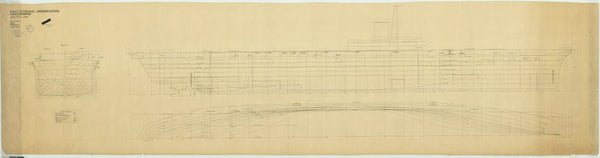 HMS Victorious Sheer and body plan for proposed reconstruction.jpg13.2 KB · Views: 48
 -
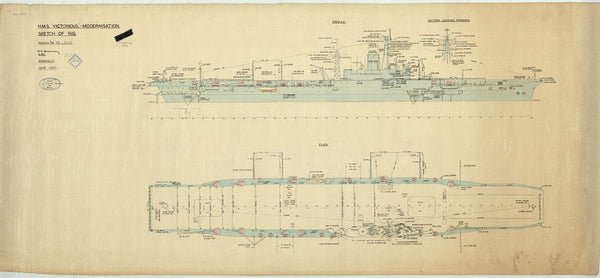 HMS Victorious Sketch of rig plan proposed reconstruction.jpg29.4 KB · Views: 44
 -
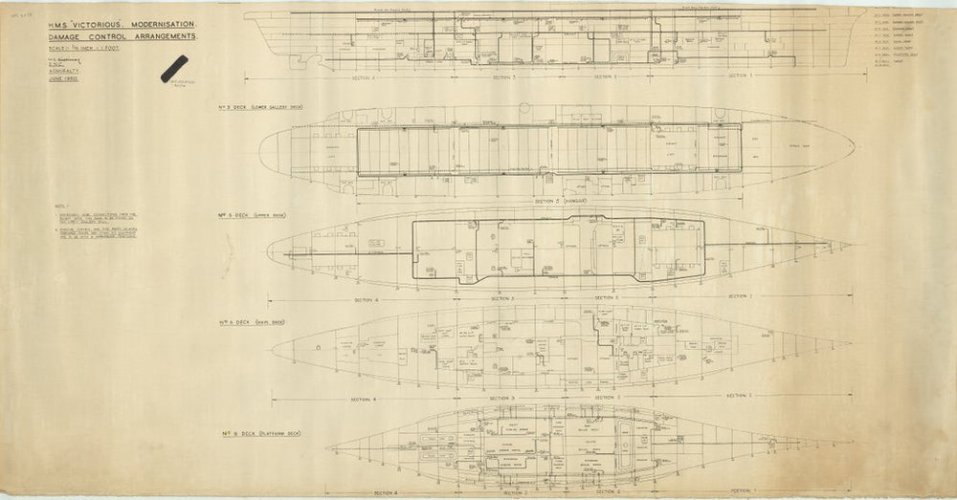 Damage control HMS Victorious arrangement plan proposed reconstruction.jpg77.3 KB · Views: 40
 -
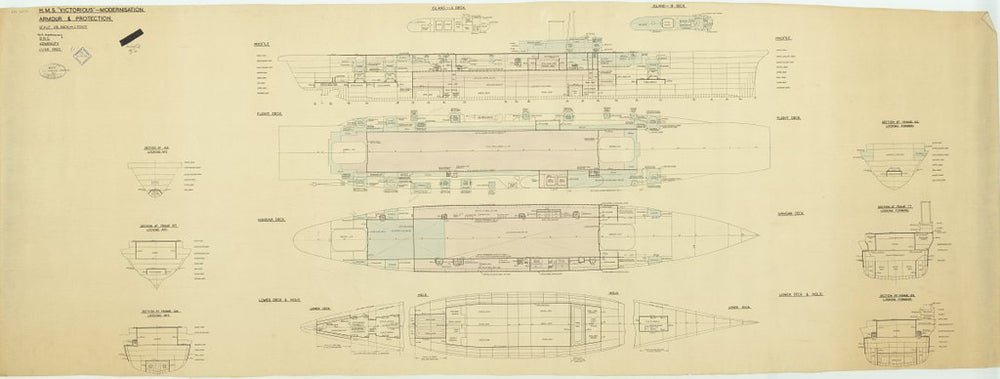 HMS Victorious Armour Plan for proposed Reconstruction.jpg49.2 KB · Views: 42
 -
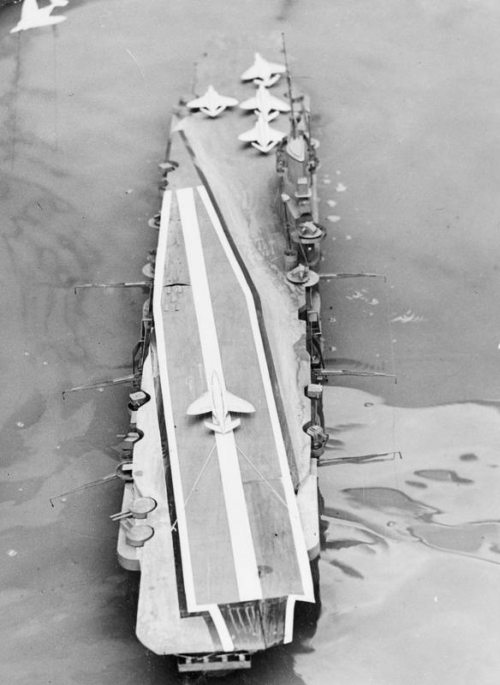 IMG_0664.png399.5 KB · Views: 46
Similar threads
-
-
 CVA-01 - What was the RN carrier plan 1966-1976
- Started by Thorvic
- Replies: 138
-
Royal Navy got Essex carriers - with a twist.
- Started by Archibald
- Replies: 60
-
The Centaur carrier fleet - a better fate...
- Started by Archibald
- Replies: 549
-
 Royal Navy 60s Carrier options: I should know the answers to these
- Started by uk 75
- Replies: 8