
You are using an out of date browser. It may not display this or other websites correctly.
You should upgrade or use an alternative browser.
You should upgrade or use an alternative browser.
Airbus A400M - Atlas C1

Titus K
ACCESS: Top Secret
- Joined
- 6 September 2025
- Messages
- 817
- Reaction score
- 2,777
So good news coming from Poland, they want 10x A400M.
https://www.opex360.com/2025/12/27/...uatre-avions-ravitailleurs-a330-800-mrtt-neo/
https://www.opex360.com/2025/12/27/...uatre-avions-ravitailleurs-a330-800-mrtt-neo/
However, according to Colonel Paluch, the two aircraft are not competitors.
“The press tends to generalize on this subject, and certain indications suggest that the C-390 Millennium is competing with the A400M in Poland. For us, they are not rivals. We are developing capabilities in three different operational segments:
According to Colonel Paluch, the rapid acquisition of a “heavy airlifter” is an “absolute priority” because it can be used for both tactical and strategic missions and can maintain “logistics chains […] even when roads and railways are cut.” Moreover, he added, “it can also fulfill the role of a medium-range transport aircraft.” The goal, he concluded, is to have “10 heavy aircraft” and “8 medium aircraft” so that these two types “complement each other.”
- light with the C-295,
- medium with the C-390 or the C-130J-30,
- heavy with the A400M Atlas, the latter currently having no competitor following the end of C-17 Globemaster production in 2016,” he said.
Furthermore, the A400M is not just a transport aircraft: it can also refuel other aircraft in flight [including helicopters], and it has sufficient potential to be equipped with capabilities in the fields of electronic warfare and intelligence. It is even being considered that it could take on an offensive role.
Interesting details:
(extracted from the link above)« Nous avons examiné la possibilité de réintégrer le programme MMF. Nous avons évalué différentes options et je suis convaincu que nous devons disposer de capacités nationales indépendantes. En cas de conflit, on ne sait jamais si l’accès aux aéronefs ne sera pas restreint pour des raisons politiques », a ainsi expliqué le général Nowak.
De son côté, le colonel Paluch s’est montré plus sévère à l’égard du programme MMF. « Nous savons qu’il est très peu efficient, malgré son élargissement à d’autres pays. La moitié des vols sont affrétés pour des missions de transport uniquement et les heures de ravitaillement en vol disponibles sont insuffisantes.
[...]
En outre, a-t-il ajouté, les avions ravitailleurs polonais pourraient, en temps de paix, être « mis à la disposition des forces aériennes ukrainiennes, bulgares, roumaines, slovaques, tchèques, et peut-être même scandinaves »… Mais à titre commercial. « Nous savons pertinemment combien coûte la location d’un avion ravitailleur et la réservation d’heures de vol. Pourquoi la Pologne ne ferait-elle pas de même ? C’est une dépense tout à fait abordable », a-t-il estimé.
-------------///********///----------------------------------
“We have examined the possibility of rejoining the MMF program. We evaluated different options, and I am convinced that we must have independent national capabilities. In the event of a conflict, you never know if access to aircraft might be restricted for political reasons,” explained General Nowak.
For his part, Colonel Paluch was more critical of the MMF program. “We know it is very inefficient, despite its expansion to other countries. Half of the flights are chartered for transport missions only, and the available in-flight refueling hours are insufficient.”
[...]
Furthermore, he added, the Polish tanker aircraft could, in peacetime, be “made available to the air forces of Ukraine, Bulgaria, Romania, Slovakia, the Czech Republic, and perhaps even the Scandinavian nations”… but on a commercial basis. “We know perfectly well how much it costs to lease a tanker aircraft and book flight hours. Why shouldn’t Poland do the same? It’s a perfectly affordable expense,” he concluded.
Titus K
ACCESS: Top Secret
- Joined
- 6 September 2025
- Messages
- 817
- Reaction score
- 2,777
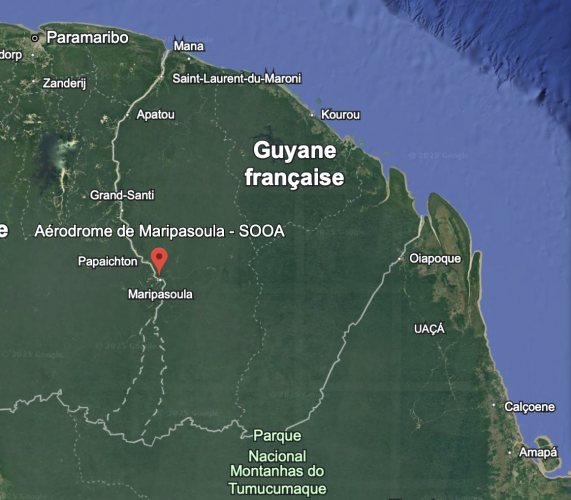
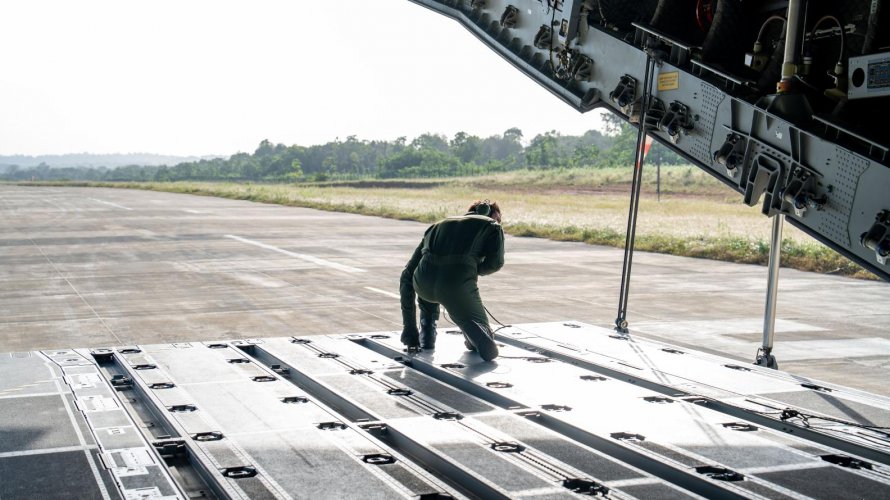
Missed this one in early 2025 ... first (empty) landing deep inside the French Guyana rain forest for an A400M, on a 1200m strip.
https://www.defense.gouv.fr/en/node/17251
https://www.defense.gouv.fr/en/node/17251
BUBO 25: First Successful Landing of an A400M in Equatorial Forest
On Monday, 24 February 2025, an A400M Atlas transport aircraft carried out its first empty landing at Maripasoula airfield, a landlocked municipality located in western French Guiana. This landing marks a major milestone by opening access for a wide-body aircraft to this area and once again demonstrates the commitment of the French Air and Space Force (AAE) to supporting and protecting overseas populations.
Just one month after its first landing on an austere airstrip in cold weather conditions in Canada, it was Maripasoula airfield’s turn—following several months of refurbishment work—to welcome the A400M Atlas, a strategic and tactical transport aircraft. On Monday, 24 February, the 83-tonne aircraft completed its first empty landing on a paved runway at the very edge of the French department.
A Remote Area in the Heart of the Amazon
Deep within the Guiana Amazonian Park, the municipality of Maripasoula—a true green haven surrounded by dense equatorial rainforest—is accessible only via the Maroni River or by air. Deployed to French Guiana as part of Operation BUBO 25 in a logistical support role, the A400M is taking advantage of its presence in the territory to carry out missions in support of overseas populations, particularly in the context of humanitarian assistance and disaster relief operations.
Pilot on the A400M with Squadron 1/61 “Touraine” at Air Base 123 in Orléans and mission aircraft commander, Captain Yann explains:
“Today, we carried out the first empty flight of the A400M in order to conduct a test, with the aim of later transporting cargo if needed to the local population.”
A true technical feat, this operation made it possible to validate the aircraft’s accessibility, ultimately allowing the transport of up to 30 tonnes of payload if required. Beyond the technical preparation, rigorous administrative coordination was also necessary, involving the French Armed Forces in French Guiana (FAG) and the local authorities responsible for managing the airfield. Securing approval for this landing marks a key milestone, now making it possible for the A400M to operate from Maripasoula airfield.
Testing the capabilities of the A400M
Cleared to accommodate light aircraft, such as the Casa tactical aircraft based at Air Base 367 in Cayenne, the airfield did receive the A400M—but not without constraints on this hard-to-access site.
“With a width of only 24 meters, this particularly narrow runway represents a challenge for the A400M’s maneuverability. It required a high level of skill and technical expertise to perform a runway turn-around,” explains Warrant Officer Loïc, an A400M flight engineer.
With an empty weight of 83 tonnes, the aircraft was lightened as much as possible for this initial trial. However, the aircraft still had to overcome another major constraint: runway strength, which until now had not allowed the A400M to land.
Working on the creation, restoration, and maintenance of French Air and Space Force (AAE) air platforms, the expertise section of the 25th Air Engineer Regiment intervened on the Maripasoula runway in September 2024. On site, the personnel carried out reverse-engineering work to assess the runway’s suitability for accommodating the aircraft.
“We studied and analyzed the construction archives of the runway as well as the various soil studies that had been conducted. We were able to conclude that the A400M could land safely. The trial of this first landing is excellent news,” said Lieutenant Colonel Édouard, head of the Operations and Training Office (BOI) of the 25th RGA.
Ensuring the Protection of Overseas Populations
This empty landing is of particular significance, as it demonstrates the A400M’s ability to access the most remote airfields within French territory in order to provide logistical and humanitarian support when needed. Following cyclones Irma, Belal, and Chido, the A400M’s power and long-range projection capability from mainland France ensure a rapid and effective response to support local populations and guarantee their safety.
“This is excellent news, because the A400M will make it possible to deliver a substantial logistical flow into this landlocked area, which until now was accessible only by pirogue,” Lieutenant Colonel Édouard said enthusiastically.
Last October, French Guiana experienced an unprecedented drought, causing historically low river levels and leading to the suspension of river transport to the most isolated towns and villages. In the face of these challenges, the French Air and Space Force (AAE) plays a key role in safeguarding populations thanks to its rapid deployment capability and the resilience of its Airmen, who are always ready to respond to today’s and tomorrow’s security and environmental crises.
“This was a first, and this success demonstrated the full capabilities of the A400M, which was able to land on the Maripasoula runway with perfect control, reflecting exemplary organization and management. The ORSEC ‘water’ emergency plan in French Guiana, triggered in October 2024 in response to a historic drought that isolated several municipalities, mobilized the armed forces to transport water, food, and fuel. The Casa aircraft carried out more than 100 sorties and transported 300 tonnes of cargo. The A400M, for its part, offers far greater capacity, capable of carrying between 25 and 30 tonnes in a single sortie. In light of the extreme climatic events that may occur in the coming years, this aircraft constitutes an essential strategic asset for relief and logistics operations.”
Attachments
Titus K
ACCESS: Top Secret
- Joined
- 6 September 2025
- Messages
- 817
- Reaction score
- 2,777
We know poland want 10 A400M (airbus offered 10-14 aircraft) ... now several european countries have shown interest, of which Greece and Italy
Also Danemark is an obvious candidate given the growing importance of Greenland and it's limited fleet 4 C-130J.
https://aviationweek.com/defense/ai...us-breathes-easier-a400m-given-demand-signals
Also Danemark is an obvious candidate given the growing importance of Greenland and it's limited fleet 4 C-130J.
https://aviationweek.com/defense/ai...us-breathes-easier-a400m-given-demand-signals
Last edited:
Titus K
ACCESS: Top Secret
- Joined
- 6 September 2025
- Messages
- 817
- Reaction score
- 2,777
https://www.flightglobal.com/defenc...le-to-saudi-arabia-airbus-says/166263.article
The 40t payload improvement (from 37t), called "super logistic high weight", should be operational in 2028-2029.
It will be achieved via software updates, with no hardware changes required.
On the mothership version :
Airbus Defence & Space is confident that it is a matter of when and not if it will make a marquee sale of its A400M Atlas to the Royal Saudi Air Force (RSAF).
Also Japan is mentioned as a potentiel new customer ...
The fleet has now accumulated 250.000 flight hours.
The 40t payload improvement (from 37t), called "super logistic high weight", should be operational in 2028-2029.
It will be achieved via software updates, with no hardware changes required.
On the mothership version :
A so-called “warehousing” installation is already in ground testing, with the roll-on, roll-off design able to house up to 50 UAS or a reduced number of remote carriers or deep strike weapons. That could include between 9 and 12 Taurus air-launched cruise missiles, the company says.
“We have a ground demonstrator for the magazine, and aim to fly with it in 2029,” Weber says.
Airbus Defence & Space is confident that it is a matter of when and not if it will make a marquee sale of its A400M Atlas to the Royal Saudi Air Force (RSAF).
Also Japan is mentioned as a potentiel new customer ...
The fleet has now accumulated 250.000 flight hours.
Titus K
ACCESS: Top Secret
- Joined
- 6 September 2025
- Messages
- 817
- Reaction score
- 2,777
As annonced during the Le Bourget, Spain will grow it's A400M fleet from 14 currently to 20 by 2029
Still, 7 are to be resold from the 27 originally planned
https://www.infodefensa.com/texto-d...s-ano-elevara-flota-aviones-hasta-20-unidades
Still, 7 are to be resold from the 27 originally planned
https://www.infodefensa.com/texto-d...s-ano-elevara-flota-aviones-hasta-20-unidades

- Joined
- 29 November 2010
- Messages
- 2,275
- Reaction score
- 5,186
I would be surprised if Japan goes for the A400M, as far as transport payload goes, its the plane most similar to their C-2s.
not unless Japan is dying for turboprop capabilities that cant be provided by their C-2.
not unless Japan is dying for turboprop capabilities that cant be provided by their C-2.

EmoBirb
ACCESS: Top Secret
- Joined
- 18 January 2025
- Messages
- 2,693
- Reaction score
- 6,919
Even so, it would ultimately be cheaper to procure such engines for their existing design, than adopting an entirely different aircraft.I would be surprised if Japan goes for the A400M, as far as transport payload goes, its the plane most similar to their C-2s.
not unless Japan is dying for turboprop capabilities that cant be provided by their C-2.
Titus K
ACCESS: Top Secret
- Joined
- 6 September 2025
- Messages
- 817
- Reaction score
- 2,777
Scott Kenny
ACCESS: USAP
- Joined
- 15 May 2023
- Messages
- 19,516
- Reaction score
- 27,964
Turboprop less likely than a propfan, IMO.Turboprop C2 would be niiiice. Also a twin turboprop version of the C390 would be nice!
- Joined
- 29 November 2010
- Messages
- 2,275
- Reaction score
- 5,186
there is no incentive for Japan to re-engine from 2 large turbo fans to 4 smaller turboprops, which would require a significant redesign of the wings and fuselageEven so, it would ultimately be cheaper to procure such engines for their existing design, than adopting an entirely different aircraft.
Scott Kenny
ACCESS: USAP
- Joined
- 15 May 2023
- Messages
- 19,516
- Reaction score
- 27,964
I thought that the C-2 used the same wing as the 4-engined P-1?there is no incentive for Japan to re-engine from 2 large turbo fans to 4 smaller turboprops, which would require a significant redesign of the wings and fuselage
- Joined
- 29 November 2010
- Messages
- 2,275
- Reaction score
- 5,186
it doesn't seem so. wingspans are different and the location of the wings are opposite (bottom vs top mounted)I thought that the C-2 used the same wing as the 4-engined P-1?
Scott Kenny
ACCESS: USAP
- Joined
- 15 May 2023
- Messages
- 19,516
- Reaction score
- 27,964
Missed this a while back.
None, because the KC-130s don't have a refueling boom.Well, the object of the proposal is to have a faster tanker with bigger wet bags.
I have never intended to doubt about the KC-130 excelling there*. Just that KC-Z being dead, a mission involving large offloads of fuel closer to IADS, a bigger, faster aircraft than the KC-130 but with comparable vaunted dirt strip landing might offer an increase in Tactical capability, pushing the balance closer to what KC-Z could have offered.
How many KC-130 do you need to refuel a B-21 500nm from China coastline? How many Hercules to support identically a flight of NGAD?
There is not so many things you can realistically do with a spoon when it comes to vase transfer.
* For example, French Special Force just got their helo refueled by an A400 for the first time last month, relying on KC-130J until now.
WatcherZero
ACCESS: Top Secret
- Joined
- 22 May 2023
- Messages
- 1,146
- Reaction score
- 2,974
France has certified A400M for landings on unprepared ice. They then proceeded to pickup 7 snowmobiles and 11 troops as a demonstration of capability to recover long range arctic patrols.
https://www.aerotime.aero/articles/french-a400m-first-arctic-sea-ice-landing-greenland
https://www.aerotime.aero/articles/french-a400m-first-arctic-sea-ice-landing-greenland
Titus K
ACCESS: Top Secret
- Joined
- 6 September 2025
- Messages
- 817
- Reaction score
- 2,777

Forest Green
ACCESS: USAP
- Joined
- 11 June 2019
- Messages
- 14,501
- Reaction score
- 31,532
Germany Is Now Airdropping Its Tiny Wiesel ‘Tankettes’
https://www.twz.com/land/germany-is-now-airdropping-its-tiny-wiesel-tankettes
- Joined
- 21 January 2015
- Messages
- 14,989
- Reaction score
- 24,203
Airbus Sees Eurodrone Surviving, Drops A400M Risk Language
Airbus expects the Eurodrone uncrewed aircraft program to survive even absent French participation, and is so confident about the prospects for the A400M military transport that it has dropped long-standing language warning about the production program’s future.
“The Eurodrone program is not dead,” Airbus CEO Guillaume Faury told reporters. France this month said it was exiting the program as part of a military spending plan update. The program is “very likely” to progress with a different setup, Faury said April 28.
Spectacular long range airdrop mission:
https://www.bbc.com/news/articles/cvgzv77ldpdo
A team of six paratroopers and two medical clinicians from 16 Air Assault Brigade parachuted on to Tristan da Cunha - an archipelago in the South Atlantic Ocean considered to be one of the world's most remote inhabited islands.
An RAF A400M transport aircraft, supported by an RAF Voyager, flew from RAF Brize Norton in Oxfordshire to Ascension Island, in the South Atlantic Ocean, before heading to Tristan da Cunha.
Two of the paratroopers jumped in tandem with an intensive care nurse and intensive care doctor, who will provide help to the island, which usually has a two-person medical team.
[...]
the parachutists faced a "really challenging, technical jump" due to high winds and the island being small. Average wind speeds over the island are often over 25mph (40km/h), the MoD said.
https://www.bbc.com/news/articles/cvgzv77ldpdo
Titus K
ACCESS: Top Secret
- Joined
- 6 September 2025
- Messages
- 817
- Reaction score
- 2,777
The Luftwaffe might order 10-20 additionnal A400M
https://www.hartpunkt.de/neue-a400m-transportflugzeuge-fuer-die-luftwaffe-im-gespraech/
https://www.hartpunkt.de/neue-a400m-transportflugzeuge-fuer-die-luftwaffe-im-gespraech/
According to reports, talks are taking place between the manufacturer Airbus Defence and Space and the official side. This should be between 10 and 20 aircraft
Not so much additional as they apparently plan to divest their earlier models to trade them with a really (and at last) militarized transport aircraft.
The Arsenal aircraft effort is also interesting (50 CM capacity would be nothing to shy about!).
The Arsenal aircraft effort is also interesting (50 CM capacity would be nothing to shy about!).
Titus K
ACCESS: Top Secret
- Joined
- 6 September 2025
- Messages
- 817
- Reaction score
- 2,777
https://fr.linkedin.com/pulse/a400m-dans-larctique-première-opération-réussie-sur-ceam-mw4gf

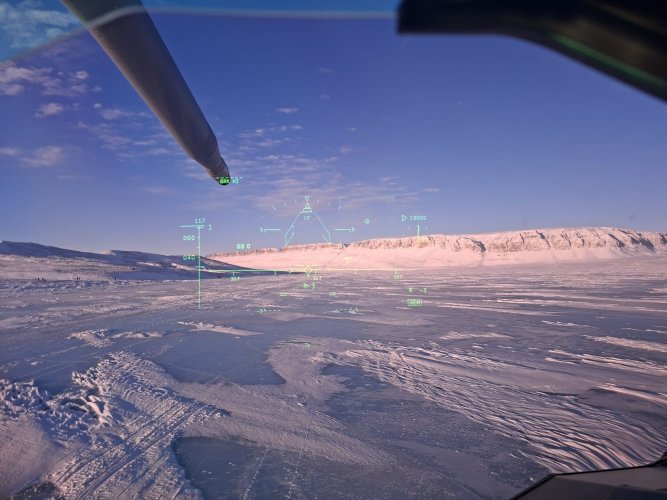
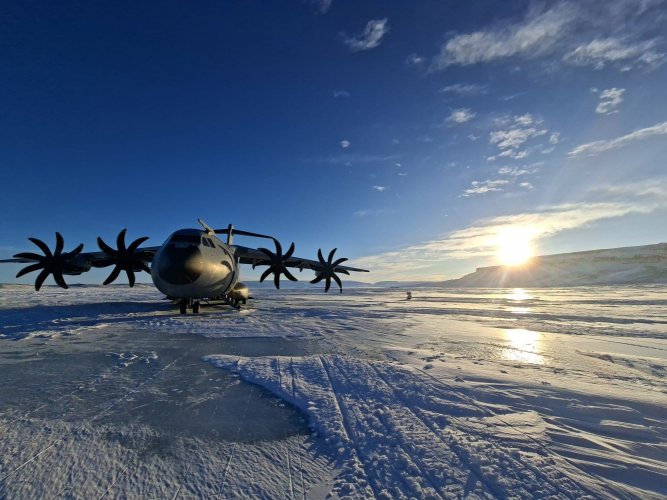
The landing took place in the Kap Harald Moltke Fjord, in northern Greenland at 82° North latitude, where temperatures hovered around –25°C. The A400M Atlas, an aircraft weighing more than 100 tonnes, successfully landed on an ice runway less than 1,400 meters long, located just 150 meters from the shoreline.
Unlike a prepared airstrip, the landing zone consisted entirely of natural terrain: bare ice partially covered with snow, with no prior preparation using heavy engineering equipment.
As part of the withdrawal of mountain commandos participating in Exercise Uppick 2026, the A400M carried out a complete recovery operation. The aircraft loaded 7 snowmobiles with their sleds as well as 11 personnel.
Titus K
ACCESS: Top Secret
- Joined
- 6 September 2025
- Messages
- 817
- Reaction score
- 2,777
Ressuply glider for A400
https://www.forcesoperations.com/le-planeur-logistique-redecolle-dans-les-armees-francaises/
https://www.forcesoperations.com/le-planeur-logistique-redecolle-dans-les-armees-francaises/
Unpowered and unmanned, this PRL will have to be capable of carrying a payload of several hundred kilograms over a distance of several tens of kilometers.
Air-transported and air-dropped from the cargo hold of an A400M, this glider must be able to enter flight automatically, follow a pre-programmed flight path, and, once it has landed, preserve the integrity of its payload. Although the payload it carries must be fully recoverable, the PRL itself is considered expendable. This is the brief definition of the requirement.
As the PRL is regarded as a low-cost system, its unit cost may not exceed €50,000.
Last edited:
Titus K
ACCESS: Top Secret
- Joined
- 6 September 2025
- Messages
- 817
- Reaction score
- 2,777
Airbus is developing the new A400M for France as launch customer.
https://www.airbus.com/en/newsroom/...development-of-new-capabilities-for-the-a400m

https://www.airbus.com/en/newsroom/...development-of-new-capabilities-for-the-a400m
France launches the development of new capabilities for the A400M
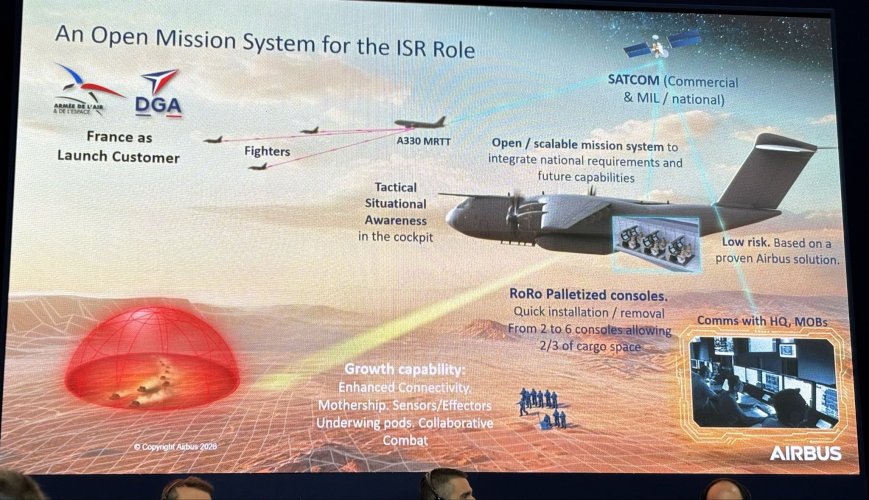
Airbus will develop through OCCAR and for DGA new capabilities for the A400M to equip the French A400M with multi-mission capabilities in the fields of intelligence, surveillance and reconnaissance
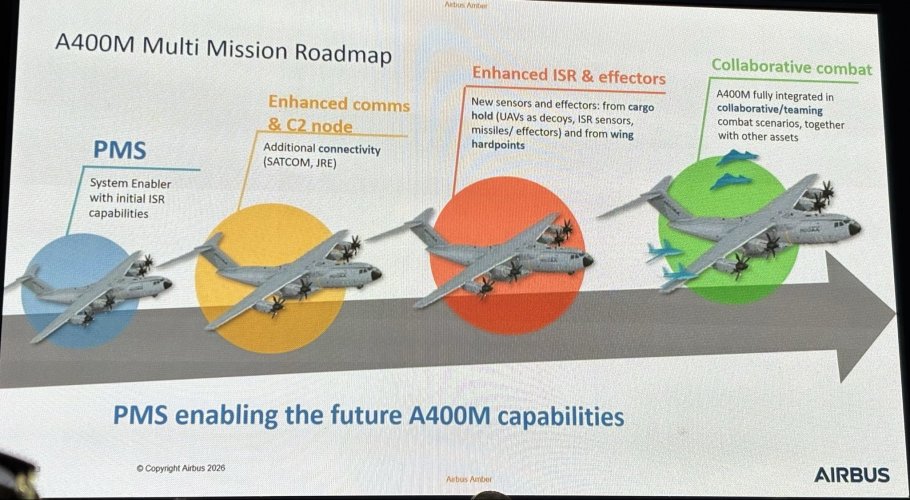
Paris, France – 16 June 2026 – Airbus Defence and Space has signed a contract with OCCAR (Organisation for Joint Armament Cooperation), acting on behalf of the French Directorate General of Armaments (DGA), for the development of new capabilities for the A400M. These upgrades, known as the “Parallel Mission System” (PMS), aim to equip French A400M with multi-mission capabilities in the fields of intelligence, surveillance and reconnaissance (ISR).
“The A400M is a true Swiss Army knife for the armed forces that use it. It has the capabilities and potential to continue expanding the scope of its missions,” said Jean-Brice Dumont, Executive Vice President Air Power at Airbus Defence and Space. “With this development, the French Air and Space Force is acquiring an aircraft capable of becoming a tactical command and control (C2) tool in the air.”
The PMS developments focus on the integration of a new mission system on board, as well as tactical situational awareness consoles installed in the cargo hold to monitor various sensors and coordinate missions. They also aim to integrate an optronic sensor onto the aircraft.
This new mission system is designed to integrate additional sensors and communication systems, as well as to manage drones and missiles launched from the aircraft’s cargo hold. Ultimately, the aircraft crew will be able to coordinate missions involving ground troops, helicopters – notably the Tiger and Caracal H225M – and fighter jets in a collaborative combat mode.
Following a development phase, the new equipment will be installed on board the first French A400M in 2027 and tested in flight in 2028. A number of aircraft in the Air and Space Force fleet will then be retrofitted to accommodate a PMS kit.
Furthermore, Airbus Defence and Space is already exploring the development of other capabilities for the A400M, such as long-range jamming, a mother-ship function for the in-flight release of drones and missiles, an increase in payload capacity to 40 tonnes, and finally firefighting capabilities. All these developments will further expand the capabilities and missions of the A400M, which are essential to meeting the current and future global needs of armed forces.
Attachments
Titus K
ACCESS: Top Secret
- Joined
- 6 September 2025
- Messages
- 817
- Reaction score
- 2,777
France order 6 of those PMS kits and will modify 20 A400M to be PMS-compatible.
https://www.defense.gouv.fr/sites/default/files/ministere-armees/Communiqué_A_La DGA poursuit activement le développement de futures capacités opérationnelles des A400M français.pdf
https://www.defense.gouv.fr/sites/default/files/ministere-armees/Communiqué_A_La DGA poursuit activement le développement de futures capacités opérationnelles des A400M français.pdf
Forest Green
ACCESS: USAP
- Joined
- 11 June 2019
- Messages
- 14,501
- Reaction score
- 31,532
WatcherZero
ACCESS: Top Secret
- Joined
- 22 May 2023
- Messages
- 1,146
- Reaction score
- 2,974
Some procurement announcements at the NATO summit in Turkey. I wont repost on multiple threads as I think the A400M procurement is the headline announcement.
Belgium, Croatia, France, Poland, Spain, Türkiye and the United Kingdom will fund a NATO A400M transport pool, no mention on numbers but will be additional dedicated air frames not pulled from existing national inventories.
https://www.nato.int/en/news-and-ev...nato-allies-expand-strategic-airlift-capacity
Belgium, Canada, Denmark, Germany, Latvia, Lithuania, Luxembourg, the Netherlands, Norway, Romania, and Sweden will jointly procure a pool of 10 SAAB GlobalEye. (Replacing the pool of 14 E3's in Germany) though contract hasnt been finalised yet.
https://www.nato.int/en/news-and-ev...borne-warning-and-control-system-is-announced
Finland has joined the A330MRTT tanker consortium alongside Belgium, Czechia, Denmark, Germany, Luxembourg, the Netherlands, Norway, Sweden. Delivery of the 10th of 12 planned aircraft is imminent.
Denmark, Finland, Germany and Norway will fund a shared pool of 5 Triton MQ-4C ISR drones.
https://www.nato.int/en/news-and-ev...ce-fleet-with-the-purchase-of-triton-aircraft
Canada, Czechia, Denmark, Finland, Greece, Norway, Slovakia, Sweden and Türkiye will fund development of a new NATO standard extended range 155mm round called (GENIFR) multinational High Visibility Project (HVP).
Denmark, France, Italy, Norway, Türkiye and the United Kingdom will fund concept work on a ground launched precision strike missile and launch platforms called Ground-Based Precision Strike Capabilities High Visibility Project.
https://www.nato.int/en/news-and-ev...y-requirements-with-multinational-initiatives
Finland, France and Sweden joined the 17 existing members of the multinational Flight Training Europe drone operator school.
Also announcements on European NATO spending a combined 40bn on satellite intelligence and anti-drone over the next five years.
We are also expecting an announcement today of a joint British-Netherlands procurement programme on amphibious warfare ships.
Belgium, Croatia, France, Poland, Spain, Türkiye and the United Kingdom will fund a NATO A400M transport pool, no mention on numbers but will be additional dedicated air frames not pulled from existing national inventories.
https://www.nato.int/en/news-and-ev...nato-allies-expand-strategic-airlift-capacity
Belgium, Canada, Denmark, Germany, Latvia, Lithuania, Luxembourg, the Netherlands, Norway, Romania, and Sweden will jointly procure a pool of 10 SAAB GlobalEye. (Replacing the pool of 14 E3's in Germany) though contract hasnt been finalised yet.
https://www.nato.int/en/news-and-ev...borne-warning-and-control-system-is-announced
Finland has joined the A330MRTT tanker consortium alongside Belgium, Czechia, Denmark, Germany, Luxembourg, the Netherlands, Norway, Sweden. Delivery of the 10th of 12 planned aircraft is imminent.
Denmark, Finland, Germany and Norway will fund a shared pool of 5 Triton MQ-4C ISR drones.
https://www.nato.int/en/news-and-ev...ce-fleet-with-the-purchase-of-triton-aircraft
Canada, Czechia, Denmark, Finland, Greece, Norway, Slovakia, Sweden and Türkiye will fund development of a new NATO standard extended range 155mm round called (GENIFR) multinational High Visibility Project (HVP).
Denmark, France, Italy, Norway, Türkiye and the United Kingdom will fund concept work on a ground launched precision strike missile and launch platforms called Ground-Based Precision Strike Capabilities High Visibility Project.
https://www.nato.int/en/news-and-ev...y-requirements-with-multinational-initiatives
Finland, France and Sweden joined the 17 existing members of the multinational Flight Training Europe drone operator school.
Also announcements on European NATO spending a combined 40bn on satellite intelligence and anti-drone over the next five years.
We are also expecting an announcement today of a joint British-Netherlands procurement programme on amphibious warfare ships.
Last edited:
Titus K
ACCESS: Top Secret
- Joined
- 6 September 2025
- Messages
- 817
- Reaction score
- 2,777
So Croatia and Poland join the A400M userbase.Belgium, Croatia, France, Poland, Spain, Türkiye and the United Kingdom
I was expecting Norway and Denmark to also join given their needs … maybe they'll order their own airframes
On Italy —> https://www.latribune.fr/article/de...400m-en-italie-reste-encore-en-salle-dattente
The Italian Air Force has a genuine interest in the A400M. However, the Franco-Italian summit scheduled for Thursday is not expected to formalize either an order or an official expression of interest from Rome.
Despite Airbus's lobbying efforts, the A400M is likely to remain on the sidelines during the 36th Franco-Italian Summit in Antibes. Italy's interest in the aircraft is not expected to appear in the final declaration to be issued at the conclusion of the summit. Nevertheless, the Italian Air Force intends to acquire up to 14 aircraft—more likely between 8 and 10—to replace its aging fleet of C-130Js.
For now, as is also the case in France, the purchase is being held back primarily by budget constraints. Italy, which withdrew from the A400M program in 2003 in favor of American alternatives, must now find the financial resources needed to meet its Air Force's capability requirements for tactical transport aircraft.
Last edited:
Scott Kenny
ACCESS: USAP
- Joined
- 15 May 2023
- Messages
- 19,516
- Reaction score
- 27,964
I understand there's some challenges with the prop blades interacting with the radar beams, as well as some very specific vibration limits in play.Any plans to make a A400M based AWACs? It Should have a good loiter time as well as pretty good electrical output no?
Those vibration limits are why the E-2Ds have 8-bladed props instead of the 6-bladed props like a C-130J.
WatcherZero
ACCESS: Top Secret
- Joined
- 22 May 2023
- Messages
- 1,146
- Reaction score
- 2,974
Didn't the E-2A and E-2B have four blades until the C version? The E-1's had three blades. I think the principle motivation was air displacement and the C blades being lighter due to being carbon fibre allowed you to add extra without affecting rotation speed.
Titus K
ACCESS: Top Secret
- Joined
- 6 September 2025
- Messages
- 817
- Reaction score
- 2,777
https://www.infodefensa.com/texto-d...ntas-12-a400m-airbus-entrega-decimo-a330-mrtt
Three possible options for the A400M fleet
For the moment, a specific number of A400M aircraft has not been established, Airbus highlights, and three strategic options are being evaluated:
- that the participating countries provide aircraft that they already have in service;
- that aircraft that are currently in production are delivered directly;
- that the countries that are part of the joint fleet make new purchase orders.
WatcherZero
ACCESS: Top Secret
- Joined
- 22 May 2023
- Messages
- 1,146
- Reaction score
- 2,974
From other interviews seems that similar to the other multinational programs there will be various membership levels, from just using the pooled services, to maintenance and training participation in the A400m between the multinational fleet and existing sovereign fleets, up to owning a share in the pooled aircraft themselves.
Titus K
ACCESS: Top Secret
- Joined
- 6 September 2025
- Messages
- 817
- Reaction score
- 2,777
+16 A400M in Germany ?
Germnay is (for now) not part of the NATO A400M transport pool.
https://www.hartpunkt.de/bundeswehr...-fuer-einzelne-beschaffungsvorhaben-bekommen/
Germnay is (for now) not part of the NATO A400M transport pool.
https://www.hartpunkt.de/bundeswehr...-fuer-einzelne-beschaffungsvorhaben-bekommen/
According to the draft budget, more money is also to be allocated to the procurement of the Airbus A400M transport aircraft. Commitment appropriations of approximately 3.6 billion euros have been set aside for this purpose for the period from 2028 to 2032. The 2026 budget had previously allocated only 1.45 billion euros for this purpose. This suggests that the Federal Ministry of Defense intends to order additional aircraft of this type. Experts speculate that the order could involve about 16 aircraft.

snne
ACCESS: Top Secret
- Joined
- 3 July 2022
- Messages
- 2,408
- Reaction score
- 8,848
Us, expecting Turkey to order additional aircraft for its primary workhorse fleet now that its modernized C-130s have been grounded for over a year, be like...:+16 A400M in Germany ?
Germnay is (for now) not part of the NATO A400M transport pool.
https://www.hartpunkt.de/bundeswehr...-fuer-einzelne-beschaffungsvorhaben-bekommen/

While this is certainly a positive development, multinational transport pools probably won't be enough on their own, nor will they cover the Turkish military's overseas transport requirements...Belgium, Croatia, France, Poland, Spain, Türkiye and the United Kingdom will fund a NATO A400M transport pool, no mention on numbers but will be additional dedicated air frames not pulled from existing national inventories.

- Joined
- 3 June 2006
- Messages
- 3,538
- Reaction score
- 6,212
Yes, the 16 extra A400M aircraft are for the NATO MMF pool, as mentioned during the NATO summit in Ankara this week.
Source (German):
https://suv.report/nato-staaten-bauen-strategische-lufttransport-und-tankerkapazitaeten-aus/
Source (German):
https://suv.report/nato-staaten-bauen-strategische-lufttransport-und-tankerkapazitaeten-aus/
Titus K
ACCESS: Top Secret
- Joined
- 6 September 2025
- Messages
- 817
- Reaction score
- 2,777
They don't mention the extra 16 in this article, wrong link ?Yes, the 16 extra A400M aircraft are for the NATO MMF pool, as mentioned during the NATO summit in Ankara this week.
Source (German):
- Joined
- 3 June 2006
- Messages
- 3,538
- Reaction score
- 6,212
Yes and no, it is a developing story.They don't mention the extra 16 in this article, wrong link ?
The German DoD might finance or order the 16 A400M for the NATO MMF pool.
A sightly older source in German:(...) Mehr Geld soll laut dem Haushaltsentwurf auch in die Beschaffung des Transportflugzeugs Airbus A400M fließen. So sind hier Verpflichtungsermächtigungen von rund 3,6 Milliarden Euro für den Zeitraum 2028 bis 2032 ausgebracht. Im Haushalt 2026 waren bislang lediglich 1,45 Milliarden Euro dafür hinterlegt. Das deutet darauf hin, dass das BMVg weitere Maschinen dieses Typs ordern möchte. In Fachkreisen wird darüber spekuliert, dass es sich um etwa 16 Exemplare handeln könnte. (...)
https://www.hartpunkt.de/bundeswehr...-fuer-einzelne-beschaffungsvorhaben-bekommen/
Similar threads
-

-
 McDonnell Douglas / Boeing C-17 Proposed Variants
- Started by hesham
- Replies: 40
-
RAAF Wedgetail AEW&C proposals and early designs
- Started by Triton
- Replies: 2
-