
You are using an out of date browser. It may not display this or other websites correctly.
You should upgrade or use an alternative browser.
You should upgrade or use an alternative browser.
AH-64 Apache Projects
Scott Kenny
ACCESS: USAP
- Joined
- 15 May 2023
- Messages
- 19,676
- Reaction score
- 28,162
I'd much rather borrow the MQ8 drone software for this one, thanks.Well if someone will go put a few hundred hours on the printed rotor head I might be more inclined to accept it. That is what we pay test pilots for right?

aonestudio
I really should change my personal text
- Joined
- 11 March 2018
- Messages
- 3,381
- Reaction score
- 9,228

- Joined
- 18 October 2006
- Messages
- 4,782
- Reaction score
- 6,847
https://www.boeing.com/features/2024/04/modernized-ah-64-apache?s=03
New! and improved!
New! and improved!
Scott Kenny
ACCESS: USAP
- Joined
- 15 May 2023
- Messages
- 19,676
- Reaction score
- 28,162
New (to me) IR suppression directing the exhaust up into the rotor, maybe new engines, longer stub wings with 3x heavy stations per side, MOSA.
Edit: really too bad that the compound Apache isn't happening yet...
- Joined
- 18 October 2006
- Messages
- 4,782
- Reaction score
- 6,847
Apache is not getting a lot of love these days. In fairness a lot of updates were being done while the United States were focused on Central Asia. With the pivot to the Pacific and the huge distances, there are few with an appitite for further investment in a short(er) range attack helicopter. Short sighted perhaps, but with senior leaders in the US trying to invest in updating the U.S. Navy, and the U.S. Air Force as the primary branches in that region, and FLRAA just starting, there is very little funds available at the moment.

isayyo2
Lurker alert
- Joined
- 24 November 2011
- Messages
- 1,240
- Reaction score
- 2,837

Scott Kenny
ACCESS: USAP
- Joined
- 15 May 2023
- Messages
- 19,676
- Reaction score
- 28,162
Longer wings I expected, shame about not getting the pusher prop.
jsport
what do you know about surfing Major? you're from-
- Joined
- 27 July 2011
- Messages
- 8,628
- Reaction score
- 6,930

- Joined
- 27 December 2005
- Messages
- 19,230
- Reaction score
- 35,694
Why is this topic full of non-project posts?
MovedWhy is this topic full of non-project posts

RavenOne
ACCESS: Top Secret
- Joined
- 18 June 2008
- Messages
- 1,197
- Reaction score
- 3,844
Our last and 50th AH-64E Apache AH2 has been handed over
https://www.boeing.co.uk/news-relea...OJxmXjH6tqiIh7VxXk_aem_MQfUvmNpTvzaZYLZwJ0z-w


Cheers
https://www.boeing.co.uk/news-relea...OJxmXjH6tqiIh7VxXk_aem_MQfUvmNpTvzaZYLZwJ0z-w


Cheers
Scott Kenny
ACCESS: USAP
- Joined
- 15 May 2023
- Messages
- 19,676
- Reaction score
- 28,162
Is that like "new Porshe smell"?Shiney! Still has that new helicopter smell I bet.
Firefinder
ACCESS: Top Secret
- Joined
- 5 October 2019
- Messages
- 1,261
- Reaction score
- 2,387
If I recall correctly it was a combo of weight space issues.G’day guys, with regards to the naval Apache, why cut the chain gun? Could it not be integrated differently? It seems like a fairly useful capability in LIC and peacetime patrols
Basically big radar need the room of the ammo to fit its stuff.
And a side of the Navys, AT THE TIME, not liking electrical powered weapons like that.
Thanks for your reply, very interesting. I suppose gun pods could be made and fitted on the stub wings when needed in any caseIf I recall correctly it was a combo of weight space issues.
Basically big radar need the room of the ammo to fit its stuff.
And a side of the Navys, AT THE TIME, not liking electrical powered weapons like that.
aonestudio
I really should change my personal text
- Joined
- 11 March 2018
- Messages
- 3,381
- Reaction score
- 9,228
isayyo2
Lurker alert
- Joined
- 24 November 2011
- Messages
- 1,240
- Reaction score
- 2,837
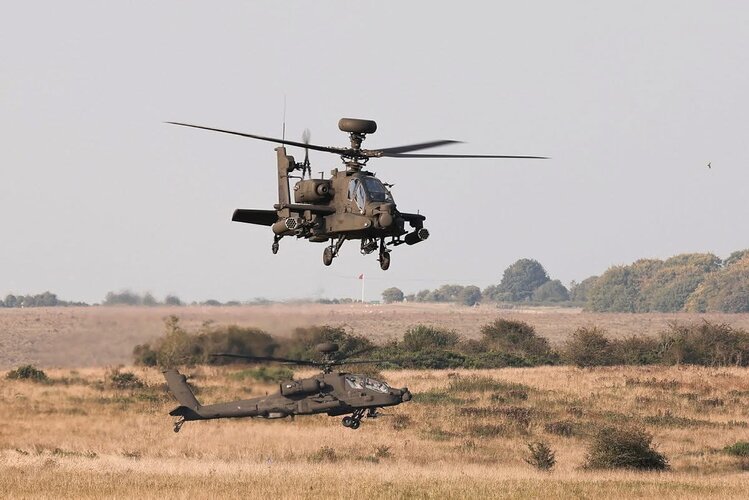
Alright I’m a bit lost on the caption…
I see the Hellfire and NLOS antenna on the port stub and a Spike box hung on the starboard stub wing. So the clearly the Spike NLOS is operational for EUCOM based Apaches?The AH-64 Apache visible in the photo is armed 'only' with the Hellfire missile. The integration of American AH-64s with Spike-NLOS began few years ago, but Spike-NLOS missiles have not been introduced into European military exercises to date.

Scott Kenny
ACCESS: USAP
- Joined
- 15 May 2023
- Messages
- 19,676
- Reaction score
- 28,162
Not sure I like giving up one pylon, 1/4 of the weapons capacity for the datalink antenna. How long before Army agrees to the 6-station wings, able to carry 24x Hellfires or 20x Spike NLOS (assuming that one pylon is still lost to the datalink antenna)
- Joined
- 18 October 2006
- Messages
- 4,782
- Reaction score
- 6,847
No one thinks you are going to make it anywhere within ~10-20Km of the forward line of troops. Longer range weapons like Spike and some of the new longer range missiles are what keeps the attack helicopter in business. I would not be surprised in the coming years to see fiber optic missiles as part of the outfit. Also the U.S. Army is finally recognizing that the AH-64 is the fastest CUAS system on the battlefield. If you can succeed with an Mi-17 with a 14.5mm MG, a air to air radar, APKWS, and proximity fused 30mm ought to be able to do the job as well. In an era of tank killing FPV, there is no need for a $$ attack helicopter for that. It will do (close in) BAI on high priority targets and try to do the counter recon fight against enemy UAS.Not sure I like giving up one pylon, 1/4 of the weapons capacity for the datalink antenna. How long before Army agrees to the 6-station wings, able to carry 24x Hellfires or 20x Spike NLOS (assuming that one pylon is still lost to the datalink antenna)
Scott Kenny
ACCESS: USAP
- Joined
- 15 May 2023
- Messages
- 19,676
- Reaction score
- 28,162
Right, but that also comes with a side order of your helo FARPs being displaced that much further back from the front lines so you still have the same flight time from FARP to patrol/shooting area to work with. And since your longer ranged munitions aren't any faster than Hellfires (and ALEs are slower!), you end up with less time per helo shooting. Which is addressed by adding more weapons.No one thinks you are going to make it anywhere within ~10-20Km of the forward line of troops. Longer range weapons like Spike and some of the new longer range missiles are what keeps the attack helicopter in business. I would not be surprised in the coming years to see fiber optic missiles as part of the outfit.
Seems a very odd mission shift, but likely for the moment. I expect the Army to end up with a CUAS drone "fighter" in inventory as part of replacing the Apache. https://www.secretprojects.co.uk/threads/designs-systems-of-drone-air-superiority.45877/Also the U.S. Army is finally recognizing that the AH-64 is the fastest CUAS system on the battlefield. If you can succeed with an Mi-17 with a 14.5mm MG, a air to air radar, APKWS, and proximity fused 30mm ought to be able to do the job as well. In an era of tank killing FPV, there is no need for a $$ attack helicopter for that. It will do (close in) BAI on high priority targets and try to do the counter recon fight against enemy UAS.
- Joined
- 18 October 2006
- Messages
- 4,782
- Reaction score
- 6,847
Any helicopter would be the fastest CUAS system on the battlefield (witness UKR Mi8/17, Israeli AH-64, and RUS Ka-52) chasing down drones, because they are not terrain restricted and faster than any truck. The big difference I know of is that the AH-64D/E has an air radar mode that means they can scan for the incoming small targets. I don't know if the Ka-52 has a similar capability, but I think we all have seen the videos of UKR Mi-8, RUS Ka-52, and Israeli AH-64 downing drones. It should not be too long before they have non-kinetic means to render the drone incapable of operations.Seems a very odd mission shift, but likely for the moment. I expect the Army to end up with a CUAS drone "fighter" in inventory as part of replacing the Apache. https://www.secretprojects.co.uk/threads/designs-systems-of-drone-air-superiority.45877/
The gun bunnies will embrace the mission because they are without mission (in general warfare) until longer range high speed missiles are acquired. Even then I do not see ~$200K(+) missiles with 45-100KM being used to plink tanks, when we now have ~$200 ATGUAV (with re-attack capability) in the hands of every platoon of ground forces. Of course if the ATGUAV and artillery can't take care of it the attack helicopters can alway revert with long range shots.
While the FARP(s) will certainly be further back than they were, 120 knots cross country beats 6 knots cross country of high speed ground vehicles. Likely if they are standing air guard for a division there will be a flight of two on patrol who are replaced by another pair at the end of their fuel endurance.
You are inadvertently calling for a compound Apache. And that brought me the biggest smile of the day. Yes, let's revive this!
https://gallery.vtol.org/image/P8woD
https://gallery.vtol.org/image/P8woD
Last edited:

- Joined
- 19 July 2016
- Messages
- 4,816
- Reaction score
- 4,276
Actually, might be a reasonable forward lookling gambol.
- Joined
- 18 October 2006
- Messages
- 4,782
- Reaction score
- 6,847
I recall when I saw this briefed at a symposium, I was one of many who thought this a brilliant idea. I still like the concept. Unfortunately despite the best efforts of the business development efforts the engineering reality was that it would be a new aircraft that looked like an Apache (think CH-53K). It would require the full effort of a new start. The U.S. Army already had two new rotorcraft programs, FLRAA and FARA, and a shrinking budget. There was no interest in even more of the dwindling budget going into another Army Aviation program. Ironically the efforts of Boeing to market it as an Improved Apache, was one of the things that killed it. The FLRAA and FARA were being touted to the Congress as the first "New Start" rotorcraft in fifty years. Senior leaders did not want to ask to upgrade a ~40 year old aircraft when they were asking for scare dollars for brand new ones.You are inadvertently calling for a compound Apache. And that brought me the biggest smile of the day. Yes, let's revive this!
https://gallery.vtol.org/image/P8woD
The old adage: "Better to be lucky than good." rings true.
Scott Kenny
ACCESS: USAP
- Joined
- 15 May 2023
- Messages
- 19,676
- Reaction score
- 28,162
I think Boeing was trying to appear as a cheaper/simpler option, like how the Cobra was a dodge around regular procurement bidding requirements to get something RIGHT NOW.I recall when I saw this briefed at a symposium, I was one of many who thought this a brilliant idea. I still like the concept. Unfortunately despite the best efforts of the business development efforts the engineering reality was that it would be a new aircraft that looked like an Apache (think CH-53K). It would require the full effort of a new start. The U.S. Army already had two new rotorcraft programs, FLRAA and FARA, and a shrinking budget. There was no interest in even more of the dwindling budget going into another Army Aviation program. Ironically the efforts of Boeing to market it as an Improved Apache, was one of the things that killed it. The FLRAA and FARA were being touted to the Congress as the first "New Start" rotorcraft in fifty years. Senior leaders did not want to ask to upgrade a ~40 year old aircraft when they were asking for scare dollars for brand new ones.
The old adage: "Better to be lucky than good." rings true.
This does make me wonder, though. Could you build a compound tail onto a standard Cobra? Didn't Piasecki do that with a ducted pusher?
aonestudio
I really should change my personal text
- Joined
- 11 March 2018
- Messages
- 3,381
- Reaction score
- 9,228
https://defence-industry.eu/ah-64-a...s-against-evolving-unmanned-aircraft-systems/
https://www.jpost.com/defense-and-tech/article-866737Apache aircrews executed engagements using the Joint Air-to-Ground Missile, HELLFIRE variants, the Hydra-70 Guided Rocket with an Advanced Precision Kill Weapon System guidance section, and 30mm rounds. All missile systems destroyed their targets, the Hydra-70 Guided Rocket with APKWS achieved three of four target kills, and 30mm rounds neutralised designated aerial threats.
These results confirmed that Apache can provide persistent, flexible, and cost-effective options to defeat UAS threats. Each munition demonstrated offers trade-offs in range, collateral risk, and engagement tempo, giving commanders scalable solutions suited to mission requirements.
RavenOne
ACCESS: Top Secret
- Joined
- 18 June 2008
- Messages
- 1,197
- Reaction score
- 3,844
Happy 50th birthday to the legendary Apache as on this day, 50 years ago,the then Hughes YAH-64 Apache flew .
So in honor here are my photos from over the last 3 decades including my Scans of my old 35mm (please excuse the not so stellar images!)


Cheers
So in honor here are my photos from over the last 3 decades including my Scans of my old 35mm (please excuse the not so stellar images!)


Cheers

FighterJock
ACCESS: Above Top Secret
- Joined
- 29 October 2007
- Messages
- 7,260
- Reaction score
- 8,572
50 Years? time does fly past quickly. Happy birthday Apache. THE best attack helicopter in the world.

Forest Green
ACCESS: USAP
- Joined
- 11 June 2019
- Messages
- 14,600
- Reaction score
- 31,710
View: https://x.com/AirPowerNEW1/status/1972792712383562027
Maximum Impact: Apache 30mm Gunnery with the 10th Mountain Division
https://www.army.mil/article/288702..._30mm_gunnery_with_the_10th_mountain_division
Forest Green
ACCESS: USAP
- Joined
- 11 June 2019
- Messages
- 14,600
- Reaction score
- 31,710
AH-64 Apache Is Getting Proximity Fuzed 30mm Cannon Ammo For Swatting Down Drones
https://www.twz.com/air/ah-64-apach...zed-30mm-cannon-ammo-for-swatting-down-drones
- Joined
- 18 October 2006
- Messages
- 4,782
- Reaction score
- 6,847
https://www.armyrecognition.com/new...ems-for-extended-sensing-and-effects-delivery
Apache has found renew interest by the U.S.Army; with its' demonstrated ability to help deal with the vexing problem of drones, and now also the ability to launch drones. With the demonstration of the "Red Wolf" missile by the USMC, I would not be surprised to see a demonstration from an Apache soon. Theoretically we could see AH-64 Anti-ship Helicopter in the coming years.
If I were the type to bet money I would do so on the U.S. Army getting around to validating APKWS on the platform soon enough.
Apache has found renew interest by the U.S.Army; with its' demonstrated ability to help deal with the vexing problem of drones, and now also the ability to launch drones. With the demonstration of the "Red Wolf" missile by the USMC, I would not be surprised to see a demonstration from an Apache soon. Theoretically we could see AH-64 Anti-ship Helicopter in the coming years.
If I were the type to bet money I would do so on the U.S. Army getting around to validating APKWS on the platform soon enough.
Last edited:
Similar threads
-
 Vought V-529 & V-531 Twin engined Corsair II projects
- Started by Deino
- Replies: 22
-

-
The best Western Cold War Attack Helicopter project
- Started by uk 75
- Replies: 6
-

-
