
I think 8 A6s attacking the runways and taxiways for those RAAF base examples is reasonable. However, you haven't touched the aircraft parked on the hardstands, any in dispersal areas, any ammo dumps and fuel storage all of which will likely require more aircraft.
Sure, but my priority would be breaking the runways. Doesn't matter how many planes are still operational there, how much fuel is there, or even how many weapons are left there if the planes cannot take off or land!

The only time it might be worth hitting the hardstands before breaking the runways is when an airbase has a lot of aircraft out in the open.


In addition the A6 is a serious bomber, with a big payload and highly advanced avionics. If you swap A6s for a more common type the numbers to attack the same airfield go up.
I dunno, an F-4 could carry the same bombload, IIRC. Or at least 9x1000lb bombs, which is still plenty to smash a runway per plane. I think even A-7s could do the job with 6x1000lbs bombs each.

But otherwise you're looking at something at least the size of a Canberra B(I).6 for the attack. The USAF B-57 doesn't have the payload to do the job.

I did have an idea to reduce the number of planes needed for an attack slightly, by having the two pairs assigned to break the runway and parallel taxiway cross over in the middle of the angled taxiways, so that the angled taxiways would get caught in the stick and split that way. It may require adding an additional aircraft to the flights so that it's two vics of 3 birds instead of two pairs.
 
Sure, but my priority would be breaking the runways. Doesn't matter how many planes are still operational there, how much fuel is there, or even how many weapons are left there if the planes cannot take off or land!

The only time it might be worth hitting the hardstands before breaking the runways is when an airbase has a lot of aircraft out in the open.


I dunno, an F-4 could carry the same bombload, IIRC. Or at least 9x1000lb bombs, which is still plenty to smash a runway per plane. I think even A-7s could do the job with 6x1000lbs bombs each.

But otherwise you're looking at something at least the size of a Canberra B(I).6 for the attack. The USAF B-57 doesn't have the payload to do the job.

I did have an idea to reduce the number of planes needed for an attack slightly, by having the two pairs assigned to break the runway and parallel taxiway cross over in the middle of the angled taxiways, so that the angled taxiways would get caught in the stick and split that way. It may require adding an additional aircraft to the flights so that it's two vics of 3 birds instead of two pairs.

I don't disagree with attacking the runways etc, that's what Israel did in 1967 and the RAF and RSAF did in 1991, what'd I'd argue is with the weight and persistence of the attacks. In 1967 Israel sent the vast majority of it's ~260 combat aircraft including armed trainers against Egyptian airbases in 3 waves in the first morning, so most bases got attacked at least twice within a few hours. In 1991 the ~100 Tornados attacked Iraqi air bases for 6 consecutive nights, until the IAF stopped flying. Both of these campaigns used specialist munitions specifically designed to damage runways, rather than regular dumb bombs which aren't ideal.

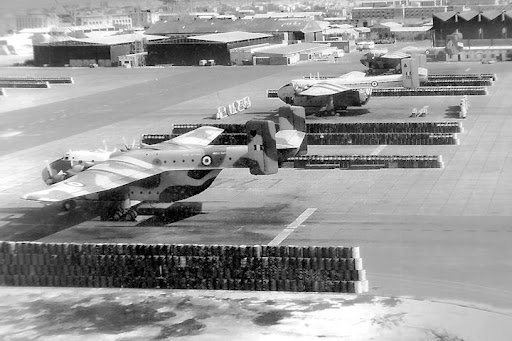
To be fair the Egyptians in 1967 did make the job easy for the Israelis, who once they'd dropped their rocket powered anti-runway bombs (not Durandals) strafed the Egyptians aircraft lined up neatly on hardstands. Even an irregular parking pattern would have made Israels job more difficult, their 4 strafing runs might be against individual aircraft, let alone if Egypt had erected even the most primitive revetments.
 

Attachments

  • RAF Beverleys in Revetments Aden.jpg
    RAF Beverleys in Revetments Aden.jpg
    51.1 KB · Views: 20
  • RAF Hunters in revetments Aden.jpg
    RAF Hunters in revetments Aden.jpg
    64.3 KB · Views: 19
FWIW I'm not anti STOL/VTOL, rather it needs to fit within the technological state of the art and should be an adjunct to the performance of the aircraft in the air. In the 60s VTOL made a good light, subsonic attack aircraft, trying for more was a disaster. In a similar vein a Mach 2 fighter or long range strike aircraft needed 4-5000' of tarmac, trying to get it to operate from less than that ruined the aircraft in the air and blew the cost way out.

A force structured around such aircraft, complimented by well built airbases and a decent amount of dispersal to civil airfields etc would likely give good results in terms of survivability.
 
Many nations were trying to make the take-off and landing distances shorter in the jet age, while still not relinquishing performance and/or payload. Some were better 'baked', like the swing-wing (with shortcoming being that allowed G load was not as good as on the fixed wings, even if titanium was used; maintenance was also much increased; wing pylons were usually either avoided or were just for the light load, with F-111 being a notable exception), or the wings with full-span high-lift devices, but the required runaways still remained sizable. Same for the fully-blown flaps & slats.

So here is my suggestion: a high-wing aircraft, that has the movable nozzles in the front (or whatever is the alternative feasible system that can push down the compressed air down when required) while the rear nozzle is fixed as one can see on a MiG-21 or on a Mirage. Afterburner is standard part of the engine - talk alt-Pegasus that does ~90 kN dry, and ~140 kn on reheat. About one half of the dry thrust can be used to help out during taking off and landing, ie 45 kN = ~10000 lbf = aircraft is 'lighter' by some 4.5 tons as far as wings are concerned. That is with initial engine of the 1960s.

Wing is of normal size, not that small like on the 1st Harriers, but also thin so the drag is not outrageously high at high speeds.
It is not only about what the British can do with this system (make this aircraft instead of Jaguar in case the partnership is not made?), but also the other aircraft-making countries.
The counter argument is just using well designed 'blow' over leading and trailing edges of the wing results in good STOL or low TO&L speeds.
 
Back
Top Bottom