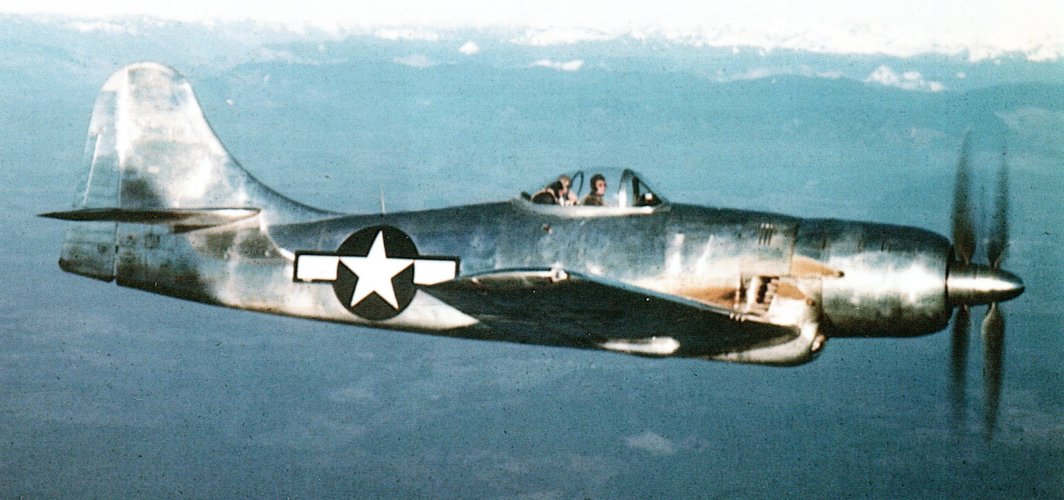
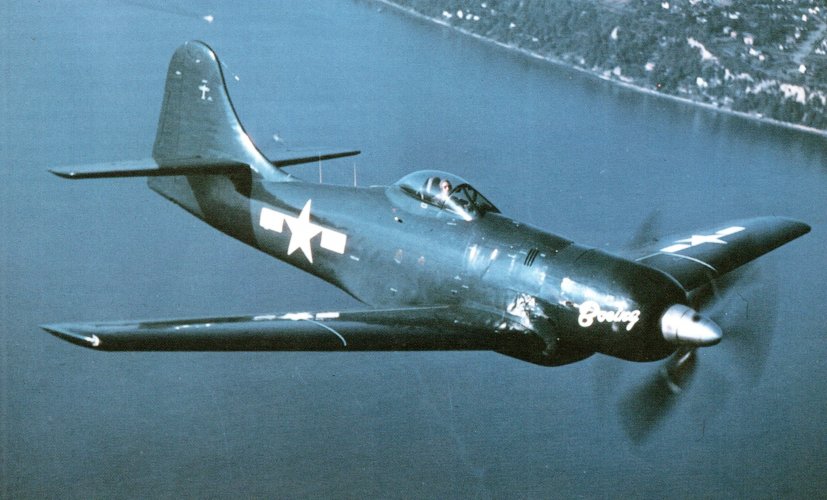
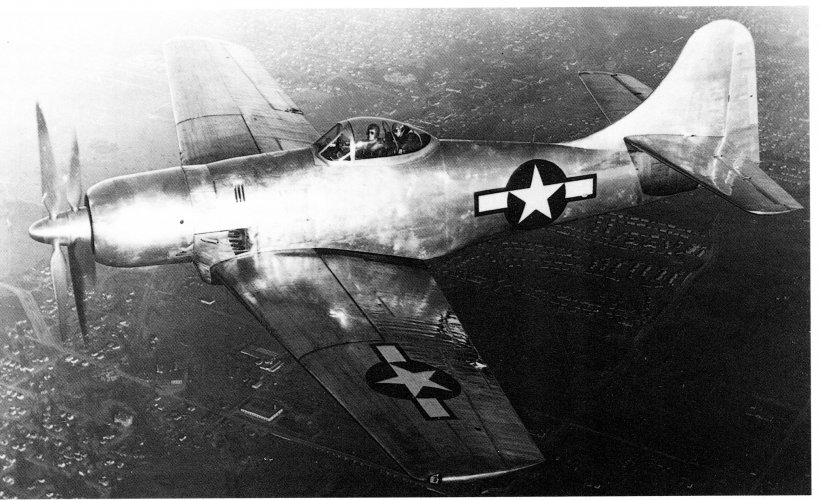
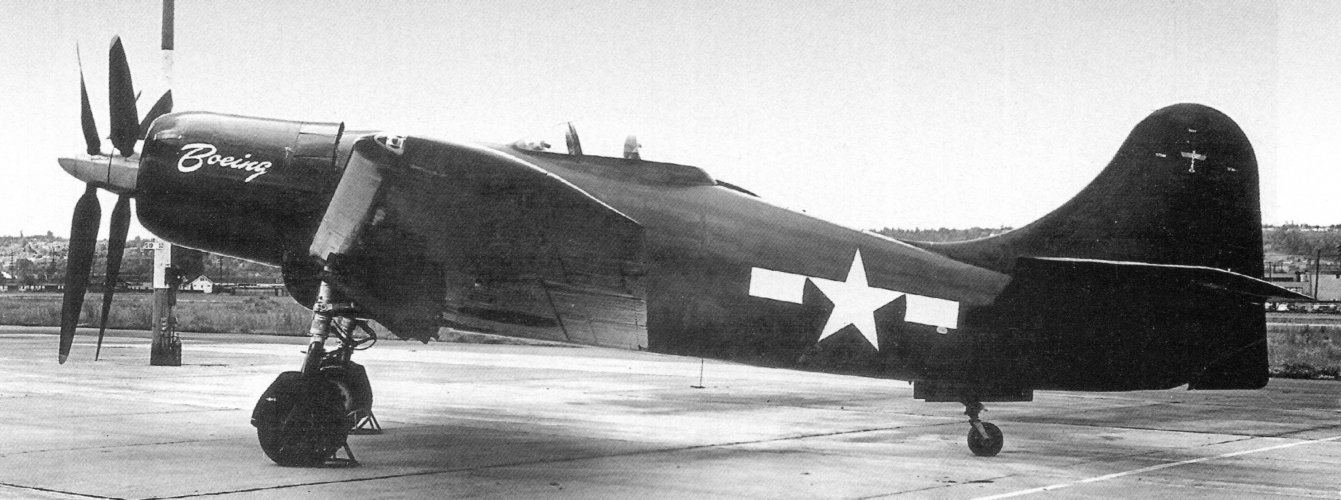
Boeing XF8B-1 Five-in One
On June 30, 1941, the U.S. Navy Bureau of Aeronautics decided to support the development of the F7F
Tigercat, a twin engine, single seat multirole heavy aircraft, to serve in the
Midway class carriers.
The project was doomed to failure because with the technology available at the time, it was not possible to solve the problem of landing on the deck of an aircraft carrier with an engine stopped.
Early in 1943, the Bu Aer issued the specification SD-349, calling for a long-range shipboard escort fighter with 342 mph top speed, 79 mph landing speed, deck takeoff in 262 feet with 25 knot wind, 30,000 feet ceiling and 3,760 ft/min rate of climb.
To avoid the symmetry problems suffered by the
Tigercat, Boeing proposed to use a single engine aircraft designed to be used as long-range escort fighter, shorth range shipboard interceptor, high speed level bomber, medium range dive bomber or low level, medium range torpedo bomber.
To be able to perform such different roles, it was necessary to design a large airframe, 130 per cent heavier than a
Hellcat and 116 per cent heavier than an
Avenger to accommodate a large amount of fuel, fitted with vertically folding wings for carrier storage.
Tigercat designers calculated that its multirole missions required the power of two P&W R-2800-22W engines each rated at 2,200 hp, but the American industry had not been able to develop an operating engine of 4,400 hp and Boeing had to use the P&W R-4360 of only 3,000 hp. an experimental third-generation engine of which only a few prototypes had been built.
Boeing engineers took a big risk mixing an airframe with multiple innovative systems with a little-tested engine, and the predictable result was the construction of only three prototypes, no production contract and a program cost twice the estimate.
On April 10, 1943, the U.S. Navy awarded a contract for three prototypes (Bu Aer Nos. 57984, 57985 and 57986), one static test airframe, four engines, spares and design drawings.
The mockup of Boeing Model 400 was inspected in early October 1943.
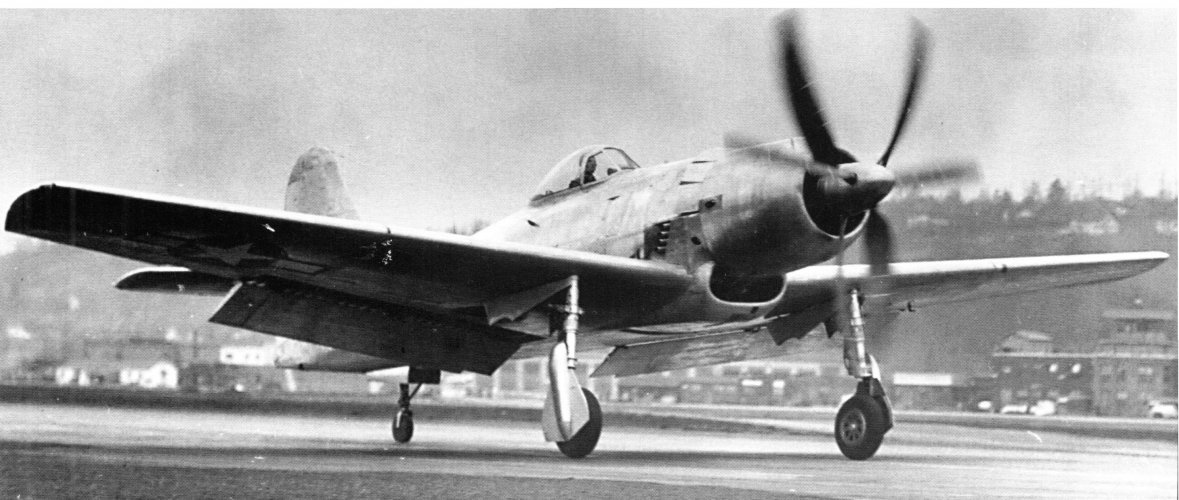
The first prototype was flown on November 27, 1944, powered by one Pratt and Whitney R-4360-8a, air cooled radial engine driving a six-bladed, contra-rotating airscrew Aeroproducts propeller.
This engine suffered from over speeding, overheating and it proved extremely hard to start, due carburetor malfunction.
On February 13, 1945, during a 120-mph taxi run test, the undercarriage retracted without warning. As a result, the engine, the propeller, the chin air intake the landing gear doors and the bomb bay doors were damaged.
The aircraft was repaired, a new R-4360-10 engine (c/n 23) was installed, and a flight engineer's seat was located behind the pilot to reduce development time.
Between March 5 and April 9, 1945, the prototype was tested at Patuxent River naval air station, but the wing folding system proved not to work properly in moderate wind.
The U.S. Navy evaluation program included mockup combats against twin engine fighters Grumman F7F
Tigercat and Bell P-59
Airacomet.
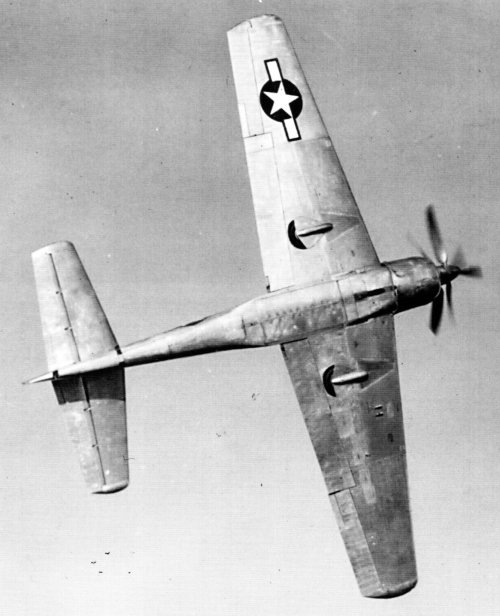
At this time the aircraft was not yet painted, except for a large Olive Drab anti-glare panel and four star and bars national insignia.
During the summer of 1946, the painting scheme was changed to overall Glossy Sea Blue (FS 15042, ANA 623).
First prototype technical data
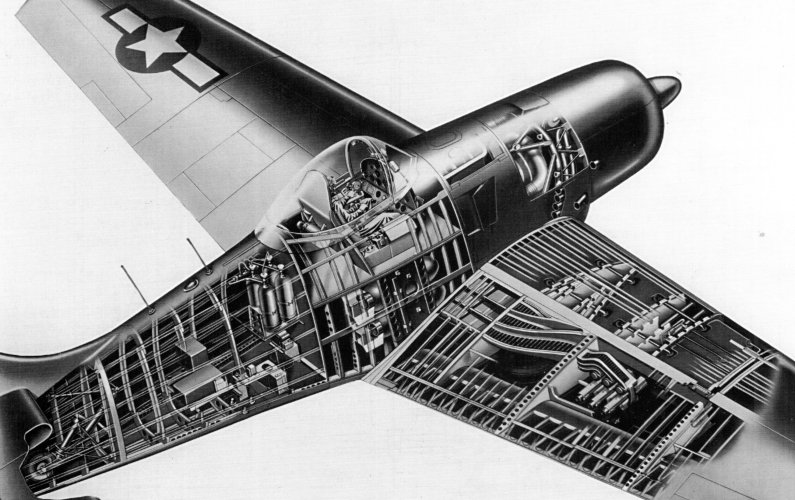
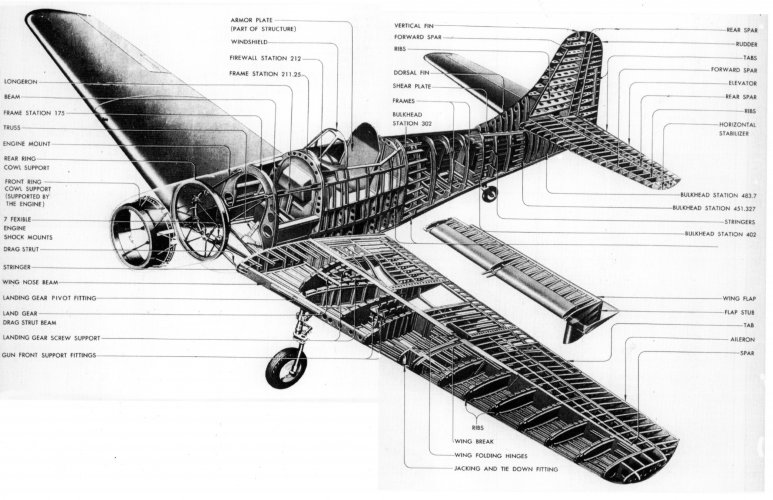
Wings: single spar, 16.46 m span, 45.43 sq. m area, electrically operated folding system and Fowler flaps, hydraulically boosted ailerons, 384 U.S. gallons of fuel housed in internal cells, 600 gallons in four underwing drop tanks and two underwing racks for 1,000 lb. bombs or two AD-1/AM-1 torpedoes, six 0.5-in machine guns with 400 rpg or six T-31 20-mm cannons with 200 rpg and main carriage members. In night fighter configuration, the plane could carry under the starboard wing one pod housing the AN/APS-4 airborne radar.
Fuselage: housing the engine mount, firewall, 40 U.S. gallon oil tank, chin air intake with the gun camera, cockpit with armor plates and bulletproof windshield, Mk 23 computing gunsight, bomb bay with four racks or one fuel cell containing 270 U.S. gallon, radio telephone, IFF radio, battery, landing lights, electrically operated tail wheel and tail hook, B-17 style tailfin and horizontal stabilizer with tabs, overall length: 13.21 m, height: 4.98 m.
Power plant: one Pratt and Whitney R-4360-10, 28 four row 28 cylinders, air cooled radial engine with two-stage engine-driven supercharger and intercooler, driving a six-bladed, contra-rotating Aeroproducts airscrew with 4.27 meters of diameter. The engine was rated at 3,000 hp, restricted to five minutes of max power.
Max weight: 10,414 kg, max speed: 695 km/h, service ceiling: 11,430 m, climb rate: 3,660 ft/min, range: 5,000 km.
The second prototype was flown on November 27, powered by the R-4360-10 (c/n 23) rebuilt after the accident of the first prototype.
On December 26, 1945, the aircraft suffered engine failure during a high-altitude flight test and the pilot was forced to make an emergency landing damaging the propeller.
It was also necessary to replace the engine with the R-4360-10 (c/n 31).
The second prototype was delivered to the USAF-Wright Field for an evaluation program conducted between February and August 1946.
Several changes were incorporated at the request of the Air Materiel Command to increase the critical Mach number:
-Redesigned cockpit and canopy.
-Modified radio equipment.
-Revised exhaust tubes.
-Modified the carburetor air intake.
-Modified wheel covers.
-Faired tailhook.
-Installation of compressibility dive-recovery flaps.
As a result of all these modifications, the aircraft was 680 kg overweight.
The test program was terminated by a new engine failure and the prototype was returned to the Navy.
Painting scheme: Overall Glossy Sea Blue (FS 15042, ANA 623).
Proposed configurations to accomplish the various roles:
-Shipboard interceptor: with 384 U.S. gallons of fuel housed in the wing cells and six 0.5-in machine guns.
-Long-range escort fighter: with 384 U.S. gallons of fuel housed in the wing cells, 270 gallons in the bomb bay cell, 600 gallons in four underwing drop tanks and six 0.5-in machine guns.
-Medium range dive bomber: with 384 U.S. gallons of fuel housed in the wing cells, 270 gallons in the bomb bay cell, two 1,000 lb. bombs in underwing bomb racks and six 0.5-in machine guns.
-Long-range level bomber: with 384 U.S. gallons of fuel housed in the wing cells, 600 gallons in four underwing drop tanks, 3,200 lb. of internal bombs and six 0.5-in machine guns.
-Torpedo-bomber: with 384 U.S. gallons of fuel housed in the wing cells, 270 gallons in the bomb bay cell, three torpedoes AD-1 or AM-1 and six 0.5-in machine guns.
Tests showed that the aircraft did not excel at any of these roles.
Proposed production engines:
-P&W R-4360-B-2 with two-stage supercharger, rated at 3,250 hp.
-P&W R-4360-C with two-stage supercharger, rated at 3,500 hp.
The third prototype made its maiden flight in March 1946 powered by the engine c/n 31 and was used by the USAF for weapons tests at Eglin Field between July and December 1946.
When the machine guns were tested in flight, they were found to jam during maneuvers at high G and it was necessary to install anti-surge devices and ammunition drive boosters.
It was also shown that the poor design of the weapons housing caused inadequate cooling and led to frequent stoppages.
The 20-mm guns were not used during the tests.
The bomb bay doors were designed to open and close quickly after each bomb was launched and during testing of the system showed a tendency to open during tight turns, but they could not be bridled at more than 130 mph because of the negative air pressure. The launch system was never tested, only the external bomb racks were used for dive bombing tests.
During the tests, 1,000 lb. bombs were launched at 400 mph with diving angles between 40 and 60-degrees and 4-to-5 G pull outs.
The USAF evaluation concluded that the Model 400 was unsuitable for high-speed level bombing, because the deficient design of the bomb bay door system, also was unsuitable for diving due to its longitudinal instability diving at 60-degrees. The type proved inferior in dogfight against conventional fighters P-51 and P-47, due to their large size, overweight and slower maneuverability.
The U.S. Navy had considered a production contract for torpedo bombers, but the type was no better than the existing specialized torpedo bomber already available: Douglas BTD, Martin BTM and Curtiss BTC.
The Model 400 was too large compared to the
Hellcat and
Corsair naval fighters and took up too much space in the carrier's hangars, decreasing the number of aircraft available.
It was also unsuitable as a night fighter and the Navy preferred to use the
Tigercat which could carry a larger, more advanced nose-mounted radar.
During the post war, the need for propeller fighters had disappeared and the last prototype was scrapped on March 16, 1950.