overscan (PaulMM)

Administrator
Staff member
Joined
27 December 2005
Messages
18,728
Reaction score
33,173
June 26 1972 issue of Aviation Week & Space Technology is dedicated to ASD and its work.

SLIM.png
Surface-launched interceptor missile (SLIM), above. is under study for the late 1970s. It would be stored and launched from hardened sites and controlled by an AWACS aircraft.
Surface-launched interceptor missile (SLIM). ASD concepts envision SLIM as a second-generation Boeing Bomarc-type missile. It would be compatible with an airborne warning and control system (AWACS) and would be emplaced in hardened sites. Its speed and range capabilities would be greatly advanced over those of the Bomarc.
 
Last edited:
Proposed advanced manned interceptor, below, has been studied in depth at ASD. It would
have a speed of about Mach 4.
Advanced Manned Interceptor.png
Advanced Manned Interceptor (AMI). The AMI would have essentially the same speed, range and payload capacity as the FI-X. but it would be optimized as an interceptor only and would not have any other capability. If the Soviet bomber threat should grow, it probably would have a better chance of being developed than the FI-X. Powerplants for the AMI would be two advanced turbojet or turbofan engines. with a wrap-around ramjet for additional speed. The AMI has been studied in considerable depth. A report detailing the technology needed for its development has been forwarded from the deputate of development planning to ASD headquarters.
 
Last edited:
QRI.png
Quick reaction interceptor (QRI) under study by ASD would be an automated self—contained intercept system with a Mach 3-plus speed and high acceleration.
Quick-reaction interceptor (QRI). This would be a follow-on to the IMI with a Mach 3—plus speed capability. It would be an automated, self-contained intercept system. largely independent of ground control systems. As the name implies. quick reaction and extremely high acceleration are envisioned.
 
Fighter-interceptor-X (Fl-X). This concept envisions a somewhat faster aircraft than the QRI, with a speed capability of about Mach 4 and a greater armament capacity. This aircraft would not be Aviation Week & Space Technology. June 26, 1972 devoted entirely to the intercept mission. It also would have an air-superiority role and possibly a tactical strike capability.
Air-launched interceptor (ALI). Despite its designation, this system is an airbreathing missile that could be carried in large numbers by a C-5-sized aircraft and launched at approaching targets. It could be carried by an AWACS aircraft or by a companion aircraft to an AWACS.
Super AWACS. Again, a C-5-sized aircraft is envisioned as the basis for an advanced AWACS. This concept is based at least partly on a recent study by
Hughes. Under the concept, the AWACS would have the capability of detecting and possibly attacking land- and submarine-launched ballistic and cruise missiles, as well as aircraft threats.
 
Last edited:
Relatively low priority given to the start of development of a new manned interceptor aircraft for defense of the continental U. S. has focused immediate USAF attention on deriving an improved manned interceptor (IMI) from among aircraft already in existence or under development. Along with existing aircraft, this could provide the mainstay of U. S. air defense until the early 1980s, when both new aircraft and new missiles are contemplated. Aircraft now being considered at USAF’s Aeronautical Systems Div. for the IMI role include:
  • McDonnell Douglas F-15
  • Grumman F-14
  • General Dynamics F-111-X-7
    This is a stretched version of the F-111, with a 100-in. longer fuselage. The expanded area would permit the aircraft to carry additional fuel and interceptor-type avionics systems. Powerplants would be Pratt & Whitney P-100s.
  • North American Rockwell NR-349.
    This would be a heavily modified version of the North American Rockwell A-5 Vigilante. It would be powered by three General Electric J79 engines and would have a saddle fuel tank for extended range. Armament would include six Hughes Phoenix missiles. Prime consideration in choosing an eventual IMI will be rapid reaction time, reflecting Air Force concern over the threat of the new Soviet Backfire supersonic bomber (AW&ST Oct. 4, p, 12). For the period beginning in the mid-1970s. ASD is considering at least six possible alternatives. The master shopping list currently lists possible procurement of only one air-defense weapon system for the 1975—1985 period.
 
Related to that, from 1973 (though the report is apparently dated January 1st, 1975):
Parametric Analysis of an Advanced Manned Interceptor Utilization

Abstract:​

This report parametrically reviews the interceptor and patrol aircraft requirements to adequately defend the CONUS against penetrating aircraft with a stand off missile and subsequently reviews the interceptor and patrol aircraft requirements to assure patrol aircraft survivability against the same penetrating aircraft with an air-to-air missile. In the first situation, the only consideration is CONUS defense without regard for patrol aircraft survivability, while the latter considered both CONUS defense and patrol aircraft survivability.
Unfortunately the report itself seems to be currently offline despite being supposedly available to the public.
 
Last edited:
June 26 1972 issue of Aviation Week & Space Technology is dedicated to ASD and its work.
View attachment 776613

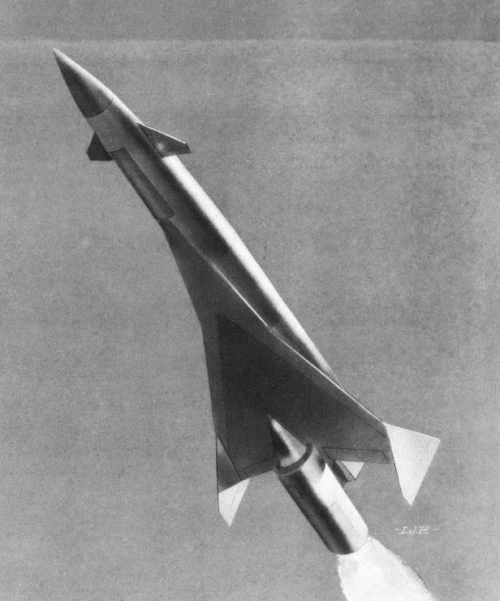
Rockwell SLIM.png
Surface-launched interceptor missile (SLIM) is depicted in a Rockwell International artist’s concept with a hypersonic engine for Mach 4 to 6 speeds. The Boeing CQM-100A Bomarc missile derivative would use dual-mode infrared/ radar guidance system. SLIM would have a potential air-launch application and could be controlled by USAF’s AWACS.
Surface—launched interceptor missile (SLIM), a Rockwell International study using the Boeing CQM-10A missile with a hypersonic engine for Mach 4—6 speeds with an infrared/radar dual-mode guidance system. Garrett AiResearch has completed initial studies with a liquid oxygen-fueled hypersonic engine that could be adapted for SLIM.
SLIM also has a potential for airlaunch application, and Air Force interest in the missile has been renewed with the cancellation of the AGM-86 subsonic cruise armed decoy (SCAD) missile by the Pentagon.
The supersonic Bomarc with a rocket booster and hypersonic engine would weigh about 10,000 lb. with solid-state avionics improvements, compared with the earlier 16,000 lb. missile. SLIM has been designed for surface launch and guidance by the U. S. AWACS aircraft. It also could be launched and later turned over to an AWACS for terminal guidance to the target, a method dubbed “forward pass.” Air Force has completed studies providing for a weapons mix of SLIMs and manned interceptors. The missile would use an inertial platform and have a semiactive guidance system.
AWST 17 September 1973
 
Last edited:
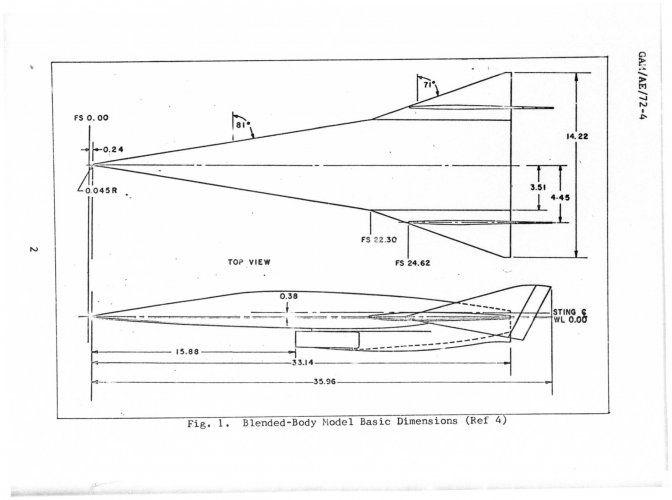
McDD-AMI 1972.jpg
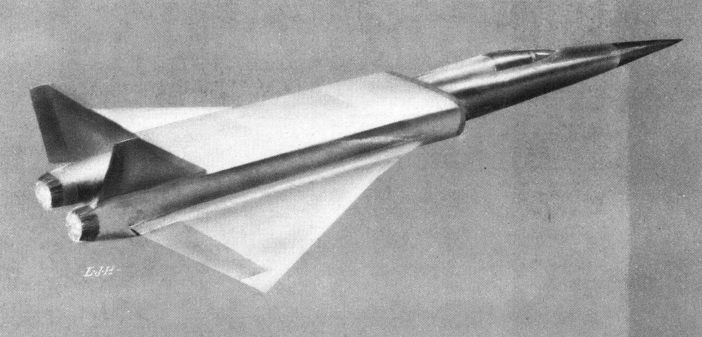
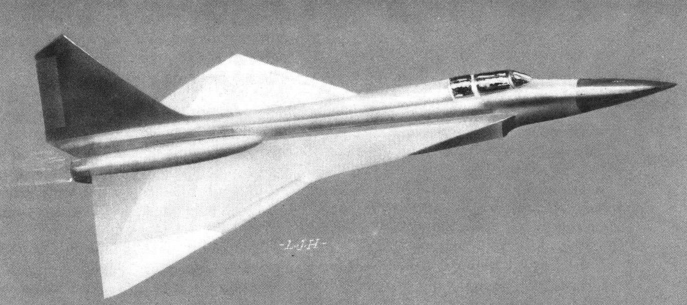
McDonnell-Douglas Advanced Manned Interceptor design from 1972 report Low Mach Number Wind-Tunnel Study of an Advanced Manned Interceptor


Looks just like:

cimg2512-jpg.733560

 
Last edited:
Advanced Interceptor

Vought Aeronautics Division heard of interest in hypersonic interceptor aircraft in March 1968. The team went to work on an Advanced Interceptor (AI) study. Driven by Required Operational Capability (ROC) for Advanced Manned Interceptor, (LAO-3119 10 July 1968) from the USAF and a composite cycle engine evaluation study (Request for Proposal No. F33625-69-12-1453, Exhibit “A”. Statement of Work 4 October 1968) the team went to work.

 
View attachment 776987
McDonnell-Douglas Advanced Manned Interceptor design from 1972 report Low Mach Number Wind-Tunnel Study of an Advanced Manned Interceptor
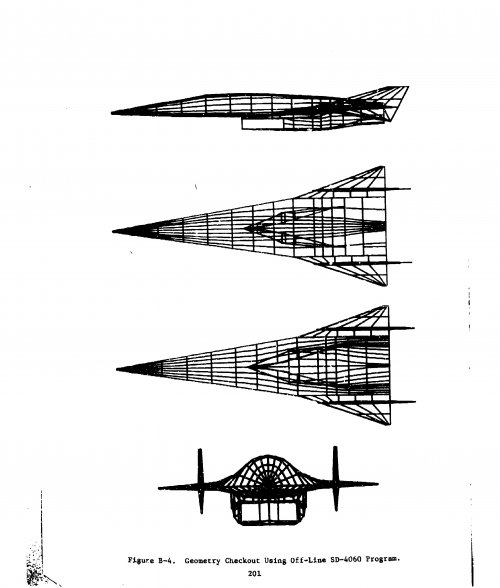
There's also a three-view (and some nice 1973 CGI) in The Mark IV Supersonic-Hypersonic Arbitrary-Body Program Volume I - Users's Manual.

threeview.jpg

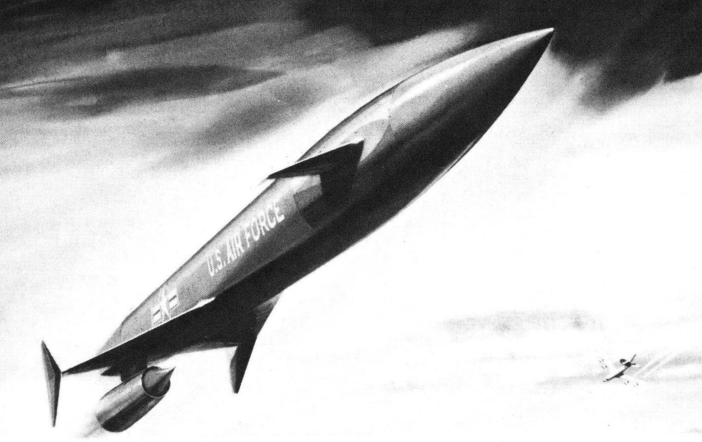
Air-launched interceptor (ALI). Despite its designation, this system is an airbreathing missile that could be carried in large numbers by a C-5-sized aircraft and launched at approaching targets. It could be carried by an AWACS aircraft or by a companion aircraft to an AWACS.
I wonder if the USAF Mach 6 rocket accelerated SLBM interceptor launched from a C-5 circa 1974 is related to the above, though it looks like it could be larger and manned?
xd4c-71276-apr-70-jpg.73977

cimg2292-jpg.733556
 
Back
Top Bottom