In general, it does seem the SR maxed out at almost M3.5.
IIRC the F-12 interceptor design had a top speed of M3.5 (I don't know if the YF-12A reached M3.5 during flight-tests though).

In general, it does seem the SR maxed out at almost M3.5.
That's what I thought but wasn't sure, thanks for that.IIRC the F-12 interceptor design had a top speed of M3.5 (I don't know if the YF-12A reached M3.5 during flight-tests though).

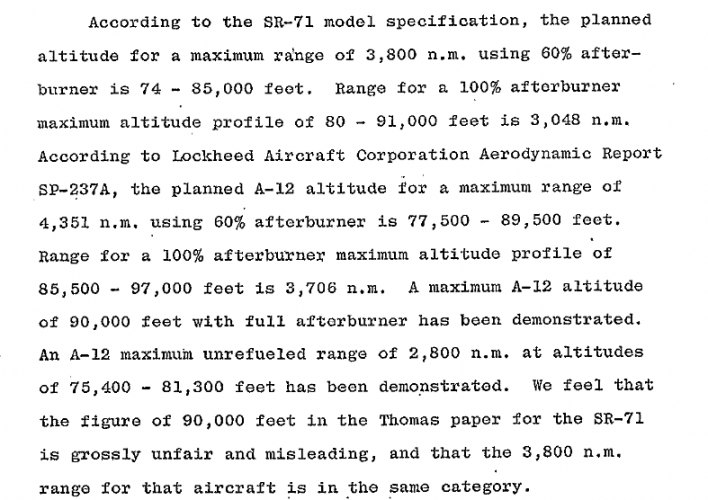
According to an issue of "Wings of Fame" The A-12 was able to reach Mach 3.6 and 97,000 feet in early testing. I'm aware of the limits frequently mentioned for suspecting that's impossible (TET, shock angle, etc.) but thought I'd pass it along. Mary Shaefer, who was the head of the flight dynamics portion of the NASA Blackbird effort, didn't dismiss it but said the two figures might not have been on the same flight. (On USENET back in the day.)I briefly worked with the late and very nice Joe Vida at the B-2 CTF in the 90s and who was apparently the high-time RSO in the SR community. He did tell me a few great stories regarding North Korea missions. In general, it does seem the SR maxed out at almost M3.5.
He did tell me a story about returning from a mission and they were to land at McGuire AFB, they contacted the tower related to landing, the young tower Sgt asked their position and Joe stated they were just coming across the west coast of Africa at 90kft, M3.35. I thought I would share this, the Sgt had a moment of silence as well then responded.
I'd think that very unlikely.Could it be that the SR-72 is needed to test new 6th generation fighter engines? Since it can fly faster and higher than anything in the inventory?
Thanks for the info, I knew the A-12 had much higher performance than the SR.According to an issue of "Wings of Fame" The A-12 was able to reach Mach 3.6 and 97,000 feet in early testing. I'm aware of the limits frequently mentioned for suspecting that's impossible (TET, shock angle, etc.) but thought I'd pass it along. Mary Shaefer, who was the head of the flight dynamics portion of the NASA Blackbird effort, didn't dismiss it but said the two figures might not have been on the same flight. (On USENET back in the day.)
The Blackbird achieved its maximum speed in 1976, when it set a speed record. The coldest day was chosen, and the aircraft had minimal fuel. This speed was 3,529.56 km/h or Mach 3.3 or 2,194 mph. They wanted to reach 2,200 mph, but they fell short by 6 mph. The SR‑71 pilot himself said so. In various dubious sources, we read about Mach 3.5, Mach 3.6, Mach 4, Mach 4.5 and so on. But there is no evidence to support this. The A‑12 is lighter than the SR‑71 and therefore can fly 3000 feet higher, but it practically cannot fly faster. They have the same thrust, dimensions, and aerodynamic shape. I saw a page from a NASA document where the difference in maximum speed between the A‑12 and the SR‑71 was stated as “up to 20 (twenty, not two hundred! ) mph.”According to an issue of "Wings of Fame" The A-12 was able to reach Mach 3.6 and 97,000 feet in early testing. I'm aware of the limits frequently mentioned for suspecting that's impossible (TET, shock angle, etc.) but thought I'd pass it along. Mary Shaefer, who was the head of the flight dynamics portion of the NASA Blackbird effort, didn't dismiss it but said the two figures might not have been on the same flight. (On USENET back in the day.)
As I said, this was in testing, not an official record-setting flight. Also, there was a stretch in the last record-setting flight where they did reach 2,242 mph.The Blackbird achieved its maximum speed in 1976, when it set a speed record. The coldest day was chosen, and the aircraft had minimal fuel. This speed was 3,529.56 km/h or Mach 3.3 or 2,194 mph. They wanted to reach 2,200 mph, but they fell short by 6 mph. The SR‑71 pilot himself said so. In various dubious sources, we read about Mach 3.5, Mach 3.6, Mach 4, Mach 4.5 and so on. But there is no evidence to support this. The A‑12 is lighter than the SR‑71 and therefore can fly 3000 feet higher, but it practically cannot fly faster. They have the same thrust, dimensions, and aerodynamic shape. I saw a page from a NASA document where the difference in maximum speed between the A‑12 and the SR‑71 was stated as “up to 20 (twenty, not two hundred! ) mph.”
I think that saying “in fact, the SR‑71 or the A‑12 sometimes flew faster than that SR‑71, which set the record in 1976, but this is still classified” is the same as saying “in fact, the F‑15 can accelerate and climb faster than the F-15 Streak Eagle, but this is classified.”
Thanks for the info, I knew the A-12 had much higher performance than the SR.