Saturn vs N1 shows the advantage not just of Von Braun's absolute authority
Just
The failure of the N1 is in marked contrast to the success of the Soyuz, which has become the most used manned system.
Rather like the Titan and Gemini, Soyuz could have been an alternative, if risky, way to the Moon.
Saturn vs N1 shows the advantage not just of Von Braun's absolute authority but the lavish amounts of money and industrial resource available to the USA.
It had nothing to do with Von Braun's "absolute authority", which never existed. Von Braun did not design the Saturn V. His organization did (Koelle). It was another center (Silverstein) that told him to use hydrogen in the upperstages. Also, all up testing was a Headquarters mandate (Mueller).

Also, it wasn't the "lavish amounts of money and industrial resource", it was just doing ground tests.
Replying to my own post because just thought of something.
The Saturn V's success was due to Von Braun's lack of "absolute authority" (others made significant decisions, which included LOR) and the N1 failed because of Korolev's "absolute authority". His decisions on propellant types and engine supplier also aided in the demise of vehicle.
 
With all these mentions of arcane, exotic, 'BeNOTthere' propellants, I feel I must reference a truly tall tale...

Tangential: After Uni, the first job interview I attended coincided with 'New Scientist' breaking news of PVC stabilisers' prompt carcinogenicity. My would-be employers made that stuff in bulk. IIRC, even the manager who spoke to me had been hastily up-dating his CV while scouring the 'vacancies' in that NS issue. We made small talk, then I fled.

During my second interview, at a smaller and rather ramshackle site that looked like a pyro factory --Thick-walled bunkers with corrugated roofs, wide doors and multiple foam inlets-- the 'interview board' showed me a molecular formula, asked how I'd make the stuff. My first glance found three (3) ways the molecule would come apart unpleasantly with scant encouragement, or even spontaneously.
( Think 'sweating' dynamite in High Summer, nitroglycerin oil in old, glass-stoppered bottle on sun-lit shelf, nitrogen tri-iodide on meth... )
Very, very politely, I replied that I wouldn't dare, given its extreme exothermic instability.
The board members smiled, explained that they had a reliable work-flow.
A few seconds later, alarms began to sound, bleepers bleeped, the site fire-team ran past the window and I was hastily ordered off the site before city fire-crews arrived and took names...
 
The Saturn V's success was due to Von Braun's lack of "absolute authority" (others made significant decisions, which included LOR) and the N1 failed because of Korolev's "absolute authority". His decisions on propellant types and engine supplier also aided in the demise of vehicle.
Two strong personalities, Glushko and Korolev could not agree
Korolev was the lead and Glushko was a supplier. Korolev decided not to use him.
 
The Saturn V's success was due to Von Braun's lack of "absolute authority" (others made significant decisions, which included LOR) and the N1 failed because of Korolev's "absolute authority". His decisions on propellant types and engine supplier also aided in the demise of vehicle.
Two strong personalities, Glushko and Korolev could not agree
Korolev was the lead and Glushko was a supplier. Korolev decided not to use him.
The conflict was deep: Glushko urged on hypergolics looking for few engines with higher performances while Korolev didn't like them because nasty and dangerous and so he always wanted kerolox engines, more and more of them with lower performances but more reliability.
 
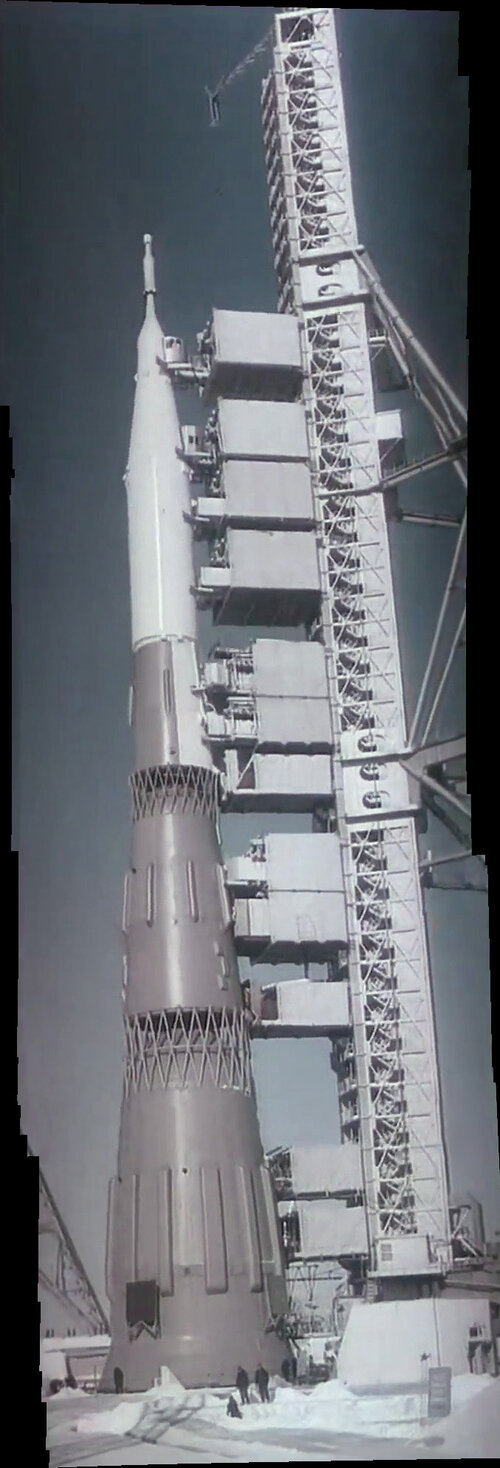
The launch tower leads one to believe that even taller LVs were looked at.

Even though I respect Glushko and Energiya (the RLA series was what he really wanted)--I do wish Korolev had lived and N-1 perfected.
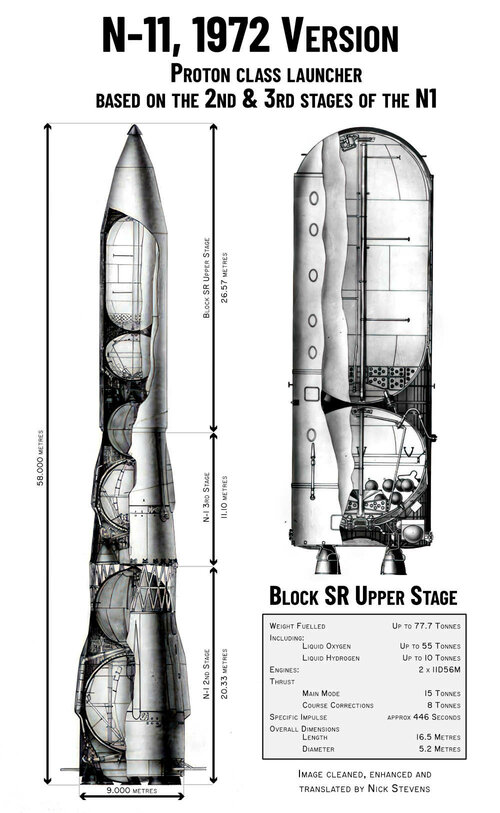
Yes, many versions with hydrogen upper stages and uprated NK-33 were studied that would have been taller; from basic Blok SR for the reworked early 70s lunar program View: https://x.com/RussianSpaceWeb/status/1759985183099359564
to much, much taller ones that would be more comparable to starship in size. Astronautix has some drawings but I'm not sure how accurate they are.
 
I stumbled across this five year video that's a supercut of all four failed N-1 launch attempts:


The N1 rocket was the Soviet counterpart to the US Saturn V. Development started in 1959.
Its first stage is the most powerful rocket stage ever built. Because of its technical difficulties and lack of funding for full-up testing the N1 never completed a test flight.
All four uncrewed launches out of 12 planned tests ended in failure, each before first-stage separation.
The first test launch took place in February 21, 1969. The launch started well, the rocket cleared the pad and began ascending. But then there was a fire in the rocket, followed by an explosion. Metallic debris had caught inside an engine. About 1 minute into the flight, the rocket exploded 40km from the launch site.
The second launch took place in July 3, 1969. Learning from the first failure, the engines control system was improved for this flight. Seconds after takeoff, the rocket fell back onto the pad. Exploding with a force of a small nuclear bomb. It was the largest rocket explosion in history being visible that evening up to 35 kilometres away. While the debris were still being scraped up from the floor of the Kazakh desert, the race was over: the US launched Apollo 11. But the Soviets didn't give up.
The third launch took place in June 26, 1971. Soon after lift-off the N1 experienced an uncontrolled roll beyond the capability of the control system to compensate. At T+39 seconds the vehicle disintegrated from structural loads.
The fourth and last launch took place in November 23, 1972. At about T+90 seconds into flight, a fire started in the boattail of the booster and engine #4 exploded. The first stage broke up at T=107 seconds.
After the series of catastrophic failures, the Soviet program were eventually brought to an end.
 
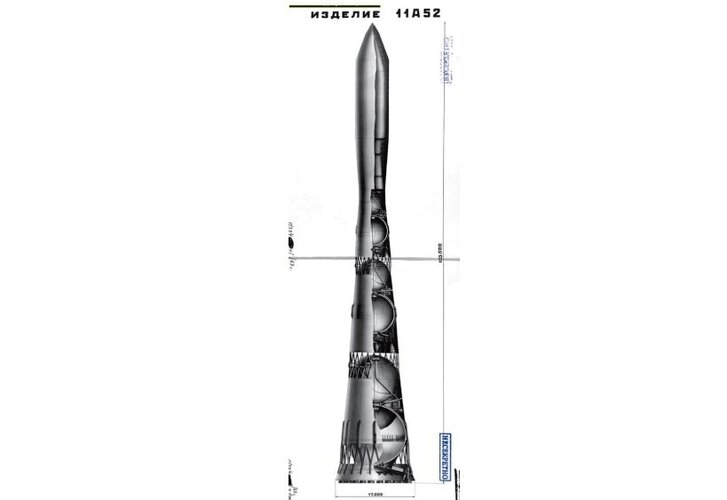
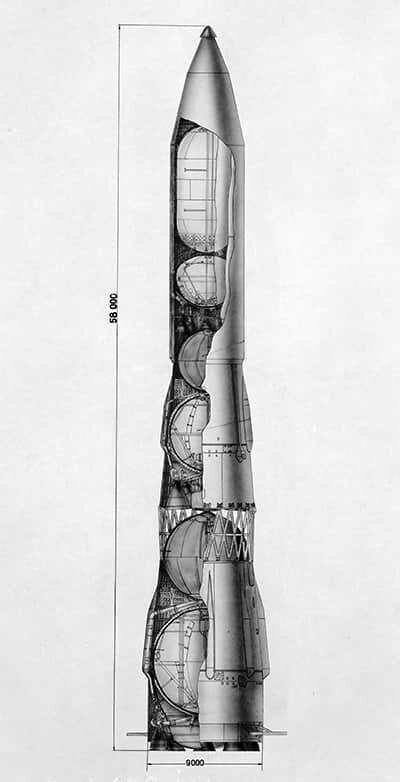
Just looking at the cutaway diagrams of the N-1 shows just how structurally inefficient its' design was.
 

View: https://twitter.com/nick_stevens_gr/status/1322856728074092547


View: https://twitter.com/nick_stevens_gr/status/1322862746992562177


View: https://twitter.com/nick_stevens_gr/status/1322868092280688641

Ok so Nick Stevens has a wonderful substack where he posts amazing, rare Soviet space program documents.
Best off his substack right here.
 
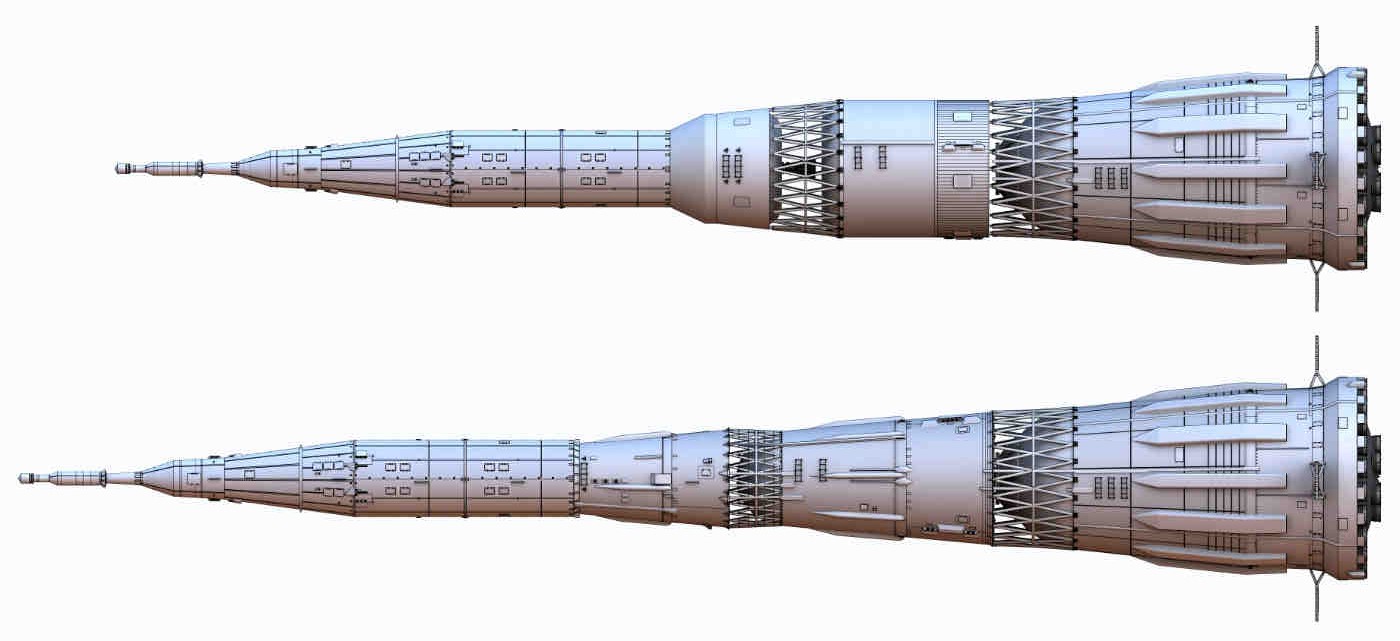
i notice something on two N1M pictures
So far known had the N1M block A, 30 Engine thrust increased from 175 metric tons thrust to 250 metric tons
How ever i see six extension on block A with each 4 engines
mean has this version of N1M has 54 NK-33 engines ?
 
i notice something on two N1M pictures
So far known had the N1M block A, 30 Engine thrust increased from 175 metric tons thrust to 250 metric tons
How ever i see six extension on block A with each 4 engines
mean has this version of N1M has 54 NK-33 engines ?
Thrust of 250 tf was assumed for the NK-15 option in 1965. In 1969, the idea of forcing NK-15 was abandoned, and on the N-1M they decided to install 36 engines with a standard thrust of 154 tf
 
I think that the Soviet bureaucrats responsible for scrapping the remaining unused N-1s were very short-sighted, they should kept launching them till they ran out. One would've no doubt made it into orbit also just imagine the size of the space-stations the Soviets could've launched with an N-1.
 
I think that the Soviet bureaucrats responsible for scrapping the remaining unused N-1s were very short-sighted, they should kept launching them till they ran out. One would've no doubt made it into orbit also just imagine the size of the space-stations the Soviets could've launched with an N-1.
In part at least the usual political infighting and CYA in effect there, I would imagine.
 
If they had gone with Glushko's rocket instead of the N-1 then things would have been rather different in history books the space race instead would have been very much closer than it was. I wonder what made them go with the N-1 in the first place money?
 
NASA took many years to solve the combustion instability problems that plagued the F-1. The RD-270 was of similar size, and it was a staged combustion engine, i.e. more complex than the F-1. I don't think the UR-700 would have been ready any sooner than the N-1.
 
NASA took many years to solve the combustion instability problems that plagued the F-1. The RD-270 was of similar size, and it was a staged combustion engine, i.e. more complex than the F-1. I don't think the UR-700 would have been ready any sooner than the N-1.
Yep, at some point Rocketdyne and Marshall SFC grew so desperate, they threw dynamite at F-1 combustion chambers. As for the RD-270, when ground tested circa 1969 it had combustion instabilities too which were never solved.
 
NASA took many years to solve the combustion instability problems that plagued the F-1. The RD-270 was of similar size, and it was a staged combustion engine, i.e. more complex than the F-1. I don't think the UR-700 would have been ready any sooner than the N-1.
AIUI, the nitrogen tetroxide/hydrazine fuel combination has much better behaviour than oxygen/kerosene - which was why Glushko preferred the stuff despite the handling difficulties and toxicity. It was, and still is, a widely used propellant combination for a very good reason.

That doesn't mean there weren't problems, but it does suggest that they'd have been easier to solve than on a comparably sized oxygen/kerosene engine. If there'd been a serious effort to do so, which there wasn't.
 
AIUI, the nitrogen tetroxide/hydrazine fuel combination has much better behaviour than oxygen/kerosene - which was why Glushko preferred the stuff despite the handling difficulties and toxicity. It was, and still is, a widely used propellant combination for a very good reason.
F-1's fix was baffles on the injector plate--Glushko's fix for his later RD-170 series engines was multiple combustion chambers.

Did anyone combine those two fixes? Why did Glushko keep one nozzle for RD-270? I would have imagined baffles would have straightened that out after the F-1 fix was made public.

Had the Nedelin disaster not happened--who knows?
 
Did anyone combine those two fixes?
What would be the point of doing that? If a single nozzle can be made to work, why bother with two for the same thrust?
Had the Nedelin disaster not happened--who knows?
How does that have any bearing on anything? The Soviets/Russians continued to keep using similar propellant combinations.
 
What would be the point of doing that? If a single nozzle can be made to work, why bother with two for the same thrust?
So more powerful engines can be scaled up...each nozzle F-1 size. Smaller engines for boostback.

The largest engines outside a "milk-stool" angled away a tad. The milk-stool itself can surround landing engines that gimble more freely. Different size engines might perhaps better for an airframe that all the same size like N-1.
 
So more powerful engines can be scaled up...each nozzle F-1 size. Smaller engines for boostback.

The largest engines outside a "milk-stool" angled away a tad. The milk-stool itself can surround landing engines that gimble more freely. Different size engines might perhaps better for an airframe that all the same size like N-1.
It's all about engineering tradeoffs - e.g. different engine size overall performance vs. single engine size overall cost. Design optimization rules.
 
So more powerful engines can be scaled up...each nozzle F-1 size. Smaller engines for boostback.

The largest engines outside a "milk-stool" angled away a tad. The milk-stool itself can surround landing engines that gimble more freely. Different size engines might perhaps better for an airframe that all the same size like N-1.
just no. boost back is off topic for N1
 

Similar threads

Back
Top Bottom