
although the flight profile for that 800km range would be interesting to know.
Supersonic to high supersonic flight for the entire distance suggests mostly a high flight path, not sea-skimming.

The only low altitude supersonic AShCM I'm aware of is the Kalibr variant with the rocket terminal stage, M2.5-M2.9 for ~50km. You'd have immense drag and airframe heating if sea-skimming, and IIRC roughly Mach 1.2 is the aluminum heat soak speed limit so the airframe would have to go to titanium or thermal composites.
 
Now, Exocet was interesting because the fuzing was not impact, it was pseudo-proximity. The radar seeker would give a time-to-go estimate just before impact, and the fuze would set that plus a few milliseconds as the actuation time. Other designs use actual impact-plus-delay fuzing or void-counting fuzes to get a detonation properly inside the hull.

This is interesting information .... wouldn't this be susceptible to the accuracy of the radar wave form used?
 
That almost certainly means that Stratus LO will have a range above 1000km reading between the lines, although the flight profile for that 800km range would be interesting to know.

To be honest I'd be disappointed if it didn't hit 1200km+ if its got a turbofan onboard.
 
Supersonic to high supersonic flight for the entire distance suggests mostly a high flight path, not sea-skimming.

The only low altitude supersonic AShCM I'm aware of is the Kalibr variant with the rocket terminal stage, M2.5-M2.9 for ~50km. You'd have immense drag and airframe heating if sea-skimming, and IIRC roughly Mach 1.2 is the aluminum heat soak speed limit so the airframe would have to go to titanium or thermal composites.
ASMP-A does M2+ at sea level.
 
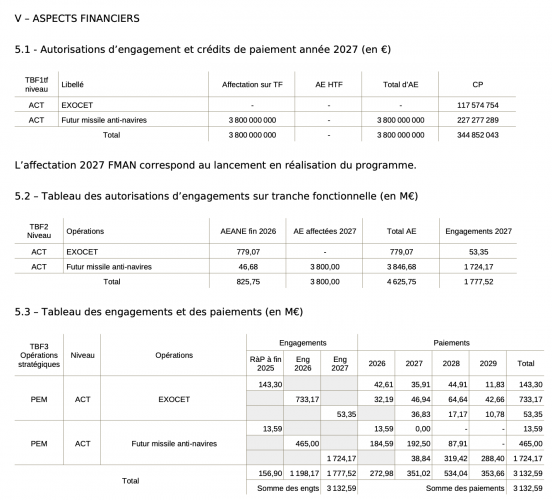
€3.8 billion in commitment authorisations for the Stratus RS programme in 2027, of which €1.7 billion will be committed that year.
€927 million in payments are scheduled over the 2027–2029 period.
 

Attachments

  • Capture d’écran 2026-10-03 à 09.54.06.png
    Capture d’écran 2026-10-03 à 09.54.06.png
    209.7 KB · Views: 19
Last edited:
The only low altitude supersonic AShCM I'm aware of is the Kalibr variant with the rocket terminal stage, M2.5-M2.9 for ~50km. You'd have immense drag and airframe heating if sea-skimming, and IIRC roughly Mach 1.2 is the aluminum heat soak speed limit so the airframe would have to go to titanium or thermal composites.
All supersonic sea skimmers are still /high/ supersonic at low level; that's their point. Low supersonic missiles are frankly worse at getting past defenses than LO high subsonic sea skimmers.

And yes, they use special electronics, titanium and heat-resistant fairings because of that.
 
Some information from a French journalist who visited MBDA today:

  • The UK retains some involvement in STRATUS-RS, just as France retains some involvement in STRATUS-LO. So MBDA France and MBDA UK are involved in both programmes.

  • Italy is only involved in STRATUS-LO: at one point, there had been talk of Italy (Leonardo) supplying part of the STRATUS-RS seeker, but that is now completely off the table, and it is therefore very likely that Thales France will be responsible for it.

  • Both missiles are reportedly capable of being launched from ship VLS and Ramps, as well as from aircraft
  • The VLS and Ramp versions would require an additional booster, and MBDA is trying to use the same booster for both missiles and both launch methods.

  • The Assessment phase for both missiles is now complete.
  • The STRATUS RS development contract is expected at Euronaval 2026
  • The STRATUS LO should follow by late 2026 or early 2027.
  • First deliveries are planned around 2030, with entry into service in the early 2030s.
  • MBDA’s goal is a common architecture allowing the two missiles to cover multiple platforms, flight profiles and target types while minimizing the number of hardware variants.


STRATUS-RS:
  • Same missile, same seeker and same warhead for all four missions.
  • Primary missions: anti-ship and SEAD.
  • Secondary missions: deep strike and anti-HVAA.
  • For the anti-HVAA role, there will still be some software work required for target designation, so it seems likely that this capability will not be implemented from the outset.
  • The STRATUS-RS seeker will be an active AESA seeker, with SAR functionality. It is this SAR capability (combined with advanced INS/GNSS navigation and a secondary IIR imaging sensor), that will allow it to perform SEAD/DEAD through target recognition, without having to rely on a passive sensor detecting radar emissions.
  • STRATUS-RS's propulsion will be a liquid-fueled ramjet
  • STRATUS-RS will have a range "well over 3 times that of Exocet". (which matches the 800km range claim on the chart i posted)
STRATUS-LO
  • Same missile, same warhead(tandem) and same seeker for both missions
  • Primary mission : deep-strike
  • Secondary missions : anti-ship
  • Passive sensors (IR+RF)
  • STRATUS-LO's propulsion will use a new turbofan (RR/Safran), allowing the missile's range to be increased considerably.
  • STRATUS-LO's range is said to be "more than doubled compared with Storm Shadow"
 
Last edited:
Italy is only involved in STRATUS-LO: at one point, there had been talk of Italy (Leonardo) supplying part of the STRATUS-RS seeker, but that is now completely off the table, and it is therefore very likely that Thales France will be responsible for it.

Quite surprised about that as MBDA Italia is the centre of excellence within MBDA for RF seekers....seems the Centre of Excellence idea is optional....at least when France is involved...

TRATUS-RS will have a range "well over 3 times that of Exocet". (which matches the 800km range claim on the chart i posted)

Presumably Block IIIc which gets to c250km.

The STRATUS-RS seeker will be an active AESA seeker, with SAR functionality. It is this SAR capability (combined with advanced INS/GNSS navigation and a secondary IIR imaging sensor)

Wonder if that IIR has scene matching as well, seems pretty cheap and helps in GNSS denied environments.
 
Quite surprised about that as MBDA Italia is the centre of excellence within MBDA for RF seekers....seems the Centre of Excellence idea is optional....at least when France is involved...
If Italy isn't interested in / doesn't want to fund Stratus-RS there is no reason to simply give them one of the most important elements of the missile. They have their new Teseo Mk2 and LO for AShM
Also, maybe Italy's center of excellence offers a less excellent solution than Thales France.
 
One minor correction - unless this is coming from another source - but the article does not claim a secondary IIR seeker for Stratus-RS, that I can see? It speaks only of the AESA seeker with a SAR function for imaging.

Stratus-LO, rather, is the one with an IIR seeker, in combination with a passive RF sensor.
 
One minor correction - unless this is coming from another source - but the article does not claim a secondary IIR seeker for Stratus-RS, that I can see? It speaks only of the AESA seeker with a SAR function for imaging.
It's coming from the same author on a forum, but he didn't feel confident enough to put in his actual article, he's not 100% sure.
 
so rough range
(double SS - 550km) over 683 miles (1100km) for S Lo
(Triple Ex (block 3c) - 250km class?) over 466 miles (750km) for S Rs
 

Similar threads

Back
Top Bottom