In many simulations, stealth fighter canopies are often modeled as PEC (Perfect Electric Conductor).
As far as I know, this is mainly done to prevent radar waves from penetrating into the cockpit and producing additional scattering from the internal structures. In actual aircraft, transparent conductive coatings such as ITO (Indium Tin Oxide) are known to be used on canopies for this purpose, so many simulations seem to simplify the electromagnetic behavior of the canopy by treating it as a PEC surface.
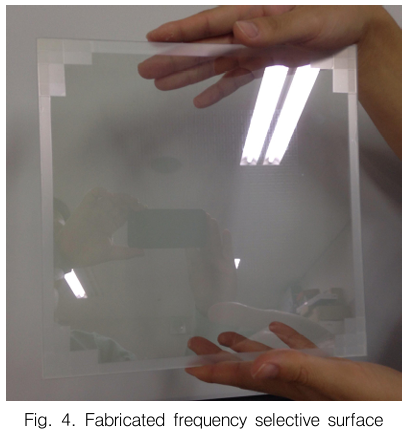
However, I came across a 2015 paper from South Korea that goes one step further: it investigates a
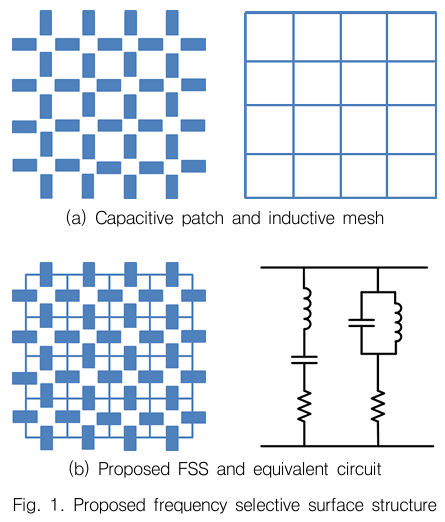
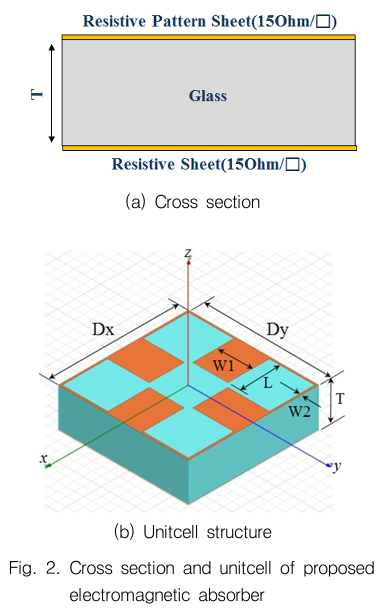
transparent electromagnetic absorbing structure (Transparent RAM) designed to reduce the radar reflection of the canopy itself.
In other words, instead of simply preventing electromagnetic waves from penetrating the canopy, the idea is to design the canopy so that it
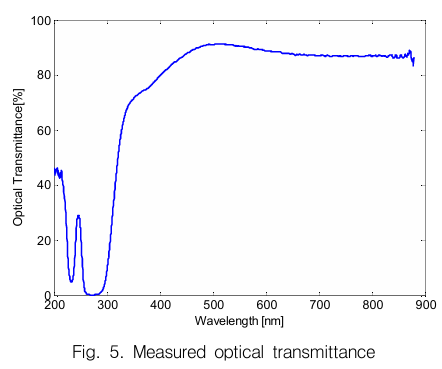
remains transparent in the visible-light spectrum while functioning as an electromagnetic absorber in the X-band.
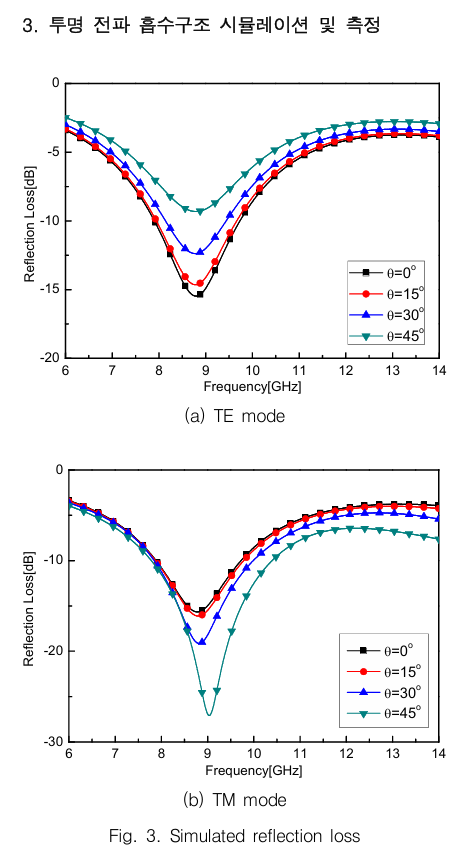
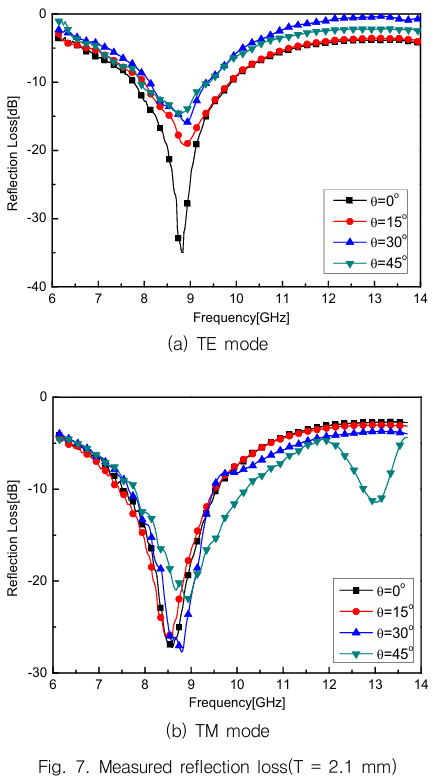
The measured performance of the fabricated sample is quite impressive. In the TE mode, under normal incidence, the structure achieved a
minimum reflection loss of as much as -35 dB at 8.8 GHz. Using -10 dB as the absorption criterion, it achieved a bandwidth of
7.50–9.58 GHz, or about 2.08 GHz (23.6%). Even at the more stringent -20 dB criterion, the measured bandwidth was
8.50–9.10 GHz, or 600 MHz (6.8%).
What is even more interesting is the angular stability. Even when the incidence angle was increased to 45°, the resonant frequency was maintained, while a
-10 dB absorption bandwidth of 7.92–9.44 GHz, or 1.52 GHz (17.3%), was still measured. The TM mode showed a slight frequency shift at normal incidence, but otherwise exhibited similar characteristics, with a
-10 dB bandwidth of 2.08 GHz and a
-20 dB bandwidth of 620 MHz.
In other words, this research was not simply about
“coating the canopy with a transparent conductive film and treating it as a metallic surface.” It investigated the possibility of
designing the canopy itself as a transparent RAM structure capable of substantially reducing radar reflection within a specific frequency band.
The
-35 dB minimum reflection loss is particularly striking. It corresponds to only about
0.03% of the incident power being reflected at the resonance frequency, meaning that, at least at the sample level, the structure achieved very strong reflection suppression rather than merely providing electrical conductivity while remaining optically transparent.
Of course, this paper only experimentally validates the electromagnetic characteristics of a fabricated transparent absorbing structure. It does not demonstrate that applying the same structure to an actual fighter canopy would reduce the aircraft's overall RCS by a specific number of decibels. A real canopy is curved and involves additional factors such as its frame, multilayer construction, and interaction with the surrounding airframe.
Nevertheless, it does raise an interesting question:
is it really appropriate to model the canopy of a stealth aircraft as a PEC in all RCS simulations?
If a structure such as this were incorporated into an actual stealth aircraft model, it would be interesting to compare it with a conventional PEC canopy and determine
how much the radar cross section of the canopy itself could actually be reduced.
And this makes me wonder whether
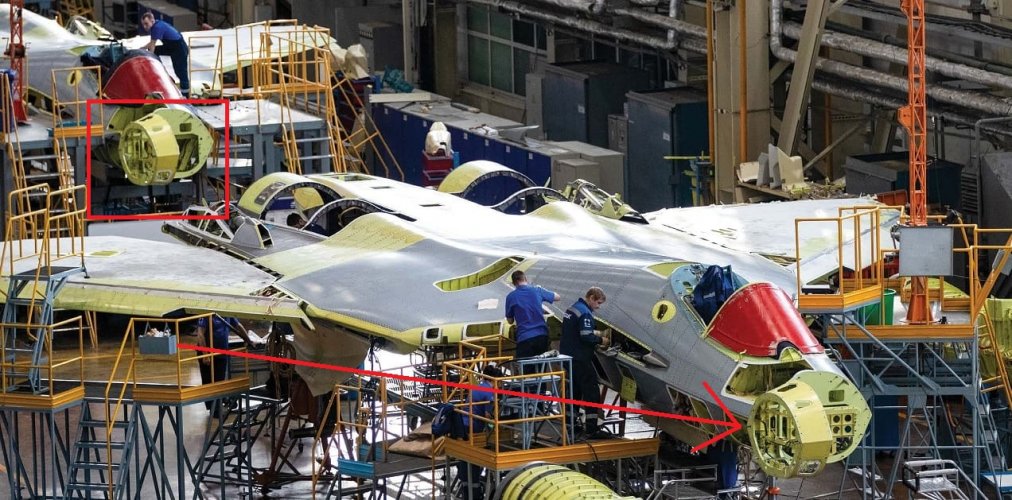
exposed optical windows such as the Su-57's IRST window should also be modeled not simply as PEC or conventional dielectric surfaces, but potentially as frequency-selective transparent RAM structures.
source
https://scienceon.kisti.re.kr/srch/selectPORSrchArticle.do?cn=JAKO201534165173958