You would think so, but there's a number of countries that are operating Flankers, including later variants such as the Su-30SM.. despite either having small geographic size, a small economy or both. Countries such as Belarus, Armenia, Myanmar, etc.
Logically, MiG-29 variants would be better suited for those markets, but the reality is that countries relying on Russian aircraft might be forced to choose Sukhoi due to the issues surrounding the MiG-29M/35 program and limited userbase.

that being said, I agree with your last part, that's where China comes in. Their companies now offer a range of alternatives for countries that can't or don't want "western" jets, but also want something smaller (and cheaper) to operate than the Flankers. From armed trainers like the L-15, to the larger J-10, and the JF-17 that sits in between. Those who have more money to spend and a more modern design, may look hard at the J-35 alongside the Su-57.

Yes, but still I think the number of countries getting these huge & heavy birds like Flankers and F-15EX are limited even more so for 5th generation types where the J-20 is not for sale and the Su-57E is almost the sole contender on the market. However I'm pretty sure, the market mostly consolidates on types one weight-class below aka within either the established 4th/4.5th generation fighters - even if I don't like these generation classifications - and soon around the J-35 as the sole Eastern block type in that segment.
 
J-35 is however closer to something like Su-57 than it is to something like a next gen J-10.

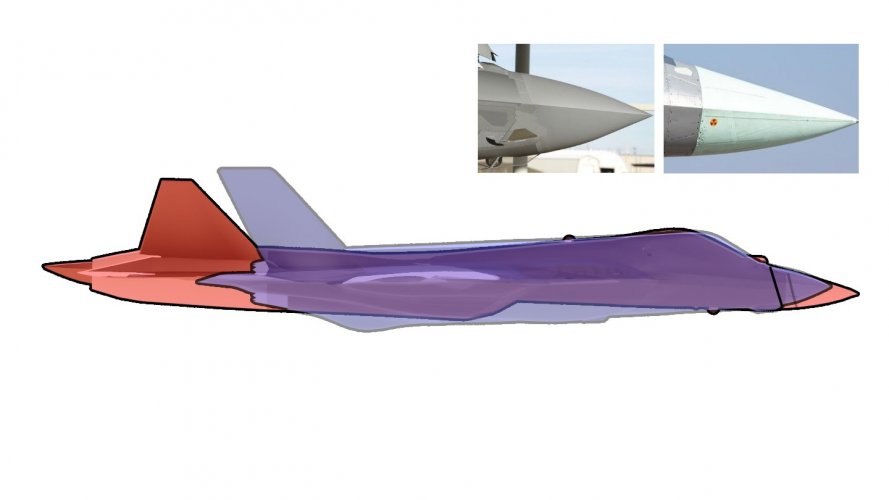
Meaning it's a not particularly light, large, twin engine jet. These are the same limiting factors that constrain the Su-57. As in, they're both expensive to procure and operate due to their inherent layout. Possibly why JSC Sukhoi decided to go single engine with T-75, even though the VKS itself is adverse to single engine aircraft, it's more suitable for export and serves an entirely different segment and user base. In that sense only the F-35 does something similar, however that's off limits to anyone outside NATO + ROK/JP/IL.

The most successful Chinese offerings so far were single engine fighters of the last generation, the most successful Russian offerings in recent history were heavy twin engine, tandem seat fighters.

Quite frankly, I believe the non-aligned and eastern bloc market is extremely hard to predict based on such trends. I don't think we can accurately predict potential sales in any meaningful way right know, something @Deino should be familiar with given the gazillion rumors of sales of J-10s and J-35s to everyone and nobody. The same applies to the Su-57 which in theory has a lot of potential customers but so far only secured one foreign customer through Algeria. If Su-57D becomes a similar success as Su-30, that's to be seen. All we can do is wait.
 
I think taking several airframe losses speaks for itself, but that's not for this thread and has been a topic on this forum within it's dedicated thread since the same day when they first hit the ground. They have, based on all the evidence that's available, proven to be vulnerable to the combination of J-10CE, JF-17, PL-15E and Saab AEW&C. Meaning that the only data point available is that, during the combat deployment against contemporary aircraft flown by a comparable or perhaps better trained force, neither Rafale nor Su-30MKI could provide a technological advantage big enough to overcome the operational and tactical shortcomings of the fighting force that deployed them.

And in the context of my post, I was specifically referring to that lesson being learned the hard way, yet the IAF still tried to play hardball. Which resulted in them missing the chance to procure an aircraft that could provide them with such a technological advantage that it could genuinely compensate for minor operational errors simply because the capability gap to the Pakistani Fleet would be that large. Currently however it seems like the opposite is the case and that India missed their chance, while Pakistan appears eager to grap the J-35 as soon as the opportunity arises.
 
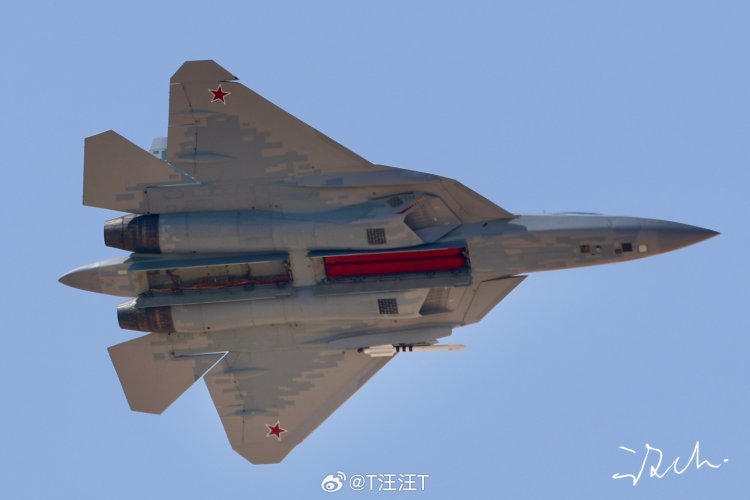
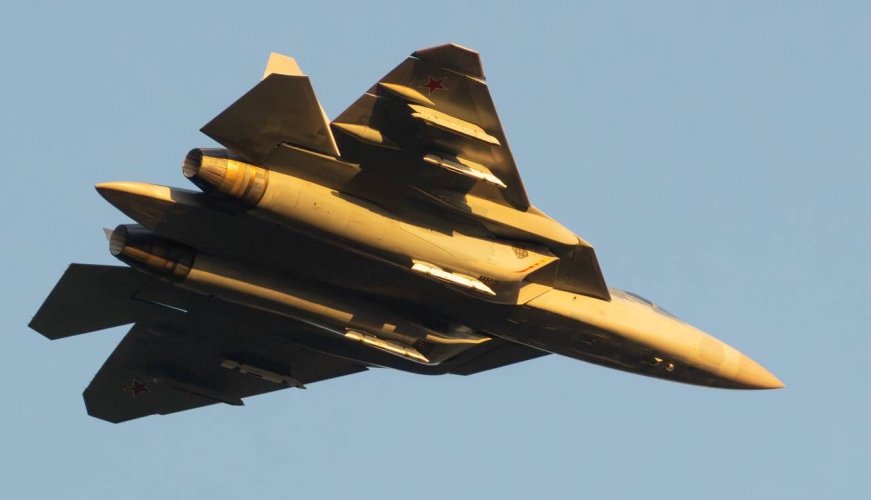
These dummy Kh-69s up front emphasize why the Su-57 has such cavernous IWBs. Only jet of it's generation to carry genuine ALCMs internally.

In fact anything with the overall dimensions : 4.2m x 0.4m x 0.4m .

PS

6 min video can be seen here :

Flight of the T-50-9 prototype, serving as the export version of the Su-57E, at an airshow in Egypt.

''During the presentation, the internal weapon bays were showcased, which contained Kh-69 cruise missiles and R-73 short-range air-to-air missiles.''

https://t.me/warhistoryalconafter
 
Last edited:
new FOD grate design


''В связи с этим заявленное защитное устройство осуществляет своюработу на скоростях самолета от 0 км/ч до ~60 км/ч, после чего вероятность попаданияпостороннего предмета в воздушный канал сводится кминимуму и защитное устройствоможно убирать.''

''Accordingly, the claimed protective device operates at aircraft speeds ranging from 0 km/h to approximately 60 km/h, after which the probability of a foreign object entering the air duct is minimized and the device can be retracted.''

It will be used only during roll on tarmac and taxiways but not during take off/landing roll.
 
Okay, but it's still a decade old pre-serial airframe, and serial Su-57Es have already been delivered to Algeria.
It's more than good enough to serve as a flying solo display and can show off other features like the IWBs at air shows. I don't expect serials to fly at air shows as long as the prototypes remain air worthy.
 
Okay, but it's still a decade old pre-serial airframe, and serial Su-57Es have already been delivered to Algeria.

I suppose that time-line TBO of the T-50/Su-57 is about 10 years. Prototype T-50-9 flew its first test flight on April 2017. Very possible that this prototype hasn't gone first general overhaul at all, so there is plenty of time for '509 blue' to fly on international air shows for years to come.
 
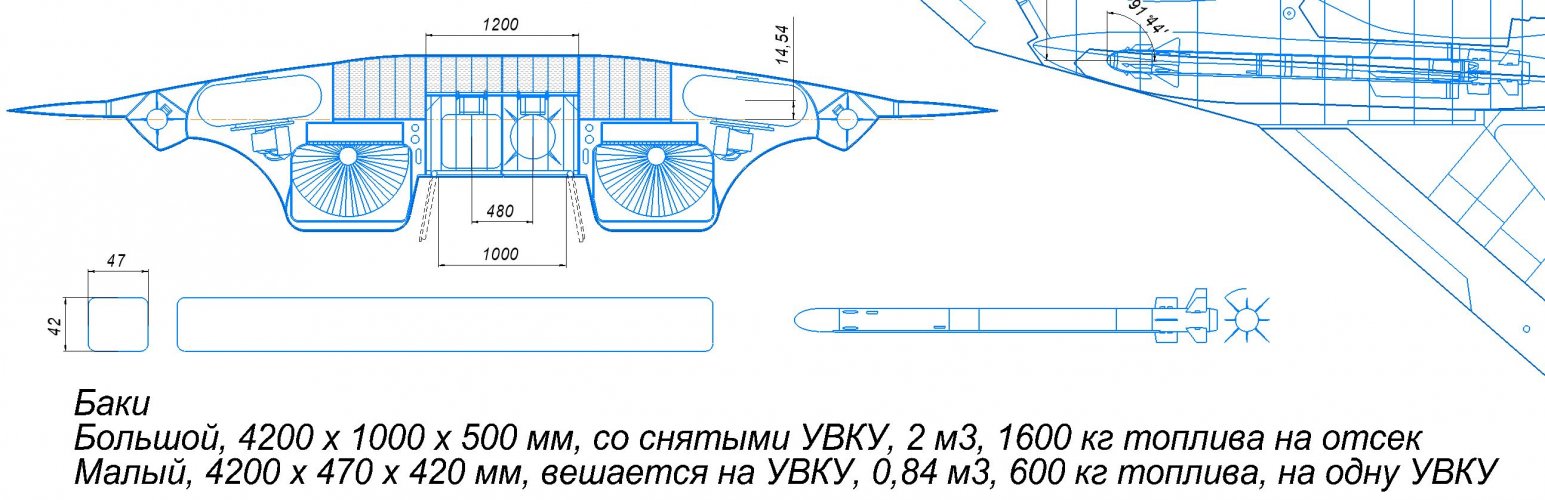
Apparently, IWB drop tanks were developed for the Su-57 at one point...

Do we have data what is the volume of the VTB-M and VTB-B ?

ВТБ-М и ВТБ-Б для истребителя пятого поколения Су-57 — это вкладные топливные баки (ВТБ) разной емкости.

ВТБ-М — Вкладной Топливный Бак Малый.
ВТБ-Б — Вкладной Топливный Бак Большой.

The VTB-M and VTB-B for the fifth-generation Su-57 fighter are conformal fuel tanks of varying capacities.

VTB-M — Small Insertable Fuel Tank.
VTB-B — Large Insertable Fuel Tank.
 
Tanks

VTB-B
4200 x 1000 x 500 mm, with removed UVKU, 2 m³, 1600 kg of fuel per compartment

VTB-M (on the picture)
4200 x 470 x 420 mm, mounted on UVKU, 0.84 m³, 600 kg of fuel, per UVKU

presumably
 

Attachments

  • tank.JPG
    tank.JPG
    314 KB · Views: 17

Similar threads

Back
Top Bottom