Thanks Ainen, so it is only 12 F-35As that the RAF are getting, let's wait and see if they order more because the main Lockheed F-35 website still has the UK total down as 138 F-35s that would be okay to have that total split two ways between the F-35A and F-35B. I can dream Ainen.
 
As the weapons integration work winds down you may see some more B's ordered for regular use replacing the instrumented ones based in America. In the short term though I don't think we will see any more, they may have come down in price but their poor availability wont motivate a rush to phase out Typhoons in their favour.
 
Three articles from UKDJ.

https://ukdefencejournal.org.uk/uk-seeks-naval-missile-silos-that-fire-without-crews-aboard/

A silo able to hold weapons at readiness for a month unattended is the enabling technology for the missile-carrying uncrewed platforms envisaged in the Defence Investment Plan

https://ukdefencejournal.org.uk/british-drone-warships-could-boost-shipbuilding-industry/

Measured by tonnage and man-hours, six command ships and a swarm of drones would likely not match the programme they replace, though the sum looks different once the measure is hull count and the number of yards able to take part. [...] a fleet of uncrewed platforms could spread work to the commercial and second-tier yards that rarely see a warship order, sustaining a broader industrial base and a steadier drumbeat of construction than a handful of complex hulls ever could.

https://ukdefencejournal.org.uk/britain-to-start-building-new-nuclear-attack-subs-next-year/

The last of the Astutes, Achilles (formerly Agincourt), is not due to be commissioned until 2028 at the earliest! 'Up to' 12 AUKUS or SSN-A subs are planned. 'Alongside the boats themselves, the document lists investment in weapons systems and sensors for underwater drones as the signature project under AUKUS Pillar 2, the strand of the partnership covering advanced technologies rather than the submarines.'
 
What little has been said about FASE leads me to believe it's a family of systems. Possibly several missiles of different sizes, different roles and, naturally, different reach. Benchmarking against PL17 would be unwise, though, as that entered service around 2022 or so, while any plausible long range FASE product might see service only in mid 2030s, at best, given the current situation and shown development timelines in Europe. By then, Chinese are likely to have something else, other than PL17.
 
https://www.gov.uk/government/news/...t-to-strengthen-nato-and-back-uk-shipbuilding

Britain and Holland will each purchase four 15,000t, 160m amphibious transport ships, for a joint fleet of eight vessels.

This is a major cut from previous Multi-Role Strike Ship plans, which envisioned the British RN as operating six large, well-armed amphibious assault ships, potentially with VLS.

As currently specified, the British ships will be smaller than the current Bay-class auxiliaries.
 
As currently specified, the British ships will be smaller than the current Bay-class auxiliaries.
Since the UK doesn't have a full Marine Corps anymore, only Commandoes/Special Forces, is there any mission where you'd need more than ~350 Commandoes?

If not, there's no real reason to have a larger Amphib.
 
A Dutch-British naval program … this has the potential to set new records for delivery delays

Overall, 4 ships of this size would be an excellent outcome for the KM ... but it is remarkable to see the RN end up with the same amount of identical ships as the KM. Troubling.
 
Ships will be built at Harland and Wolff in Belfast with some Dutch components.
The four ships would be 10% shorter and 7% smaller displacement than the Bay class going by the description in the press release.

The Enforcer is the same ship family as the previous Bay Class and they will obviously be highly customised, the closest matching recent reference design is the Damen Landing Platform Dock Enforcer 15628;

156m and 15,000 ton displacement
Max speed 18 knots, cruising speed 12 knots, range 8,000nm
Room for three medium helicopters on deck and three in hangars (or 2 Chinook)
UAV Deck 6x medium drones, UAV Hanger 8x medium drones
1x 76mm gun, 1x RAM, 4 Decoy launchers 2x30mm.
Crew 147, embarked troops 430-560 depending on accommodation size/deployment length
1,530 sqm vehicle space (Bays are 1,150 sqm), 680 sqm stores, 50 sqm ammunition store
2x large landing craft and 4x Fast Landing craft davit
Optional extras: Dock extension to 4x large landing craft (which I think they might take), acoustic noise reduction, side ramp 25 tons, Icebreaking

Dutch put their spend at between €1.1bn and €2.5bn, UK puts its spend at £2.4bn.
 
Last edited:
What little has been said about FASE leads me to believe it's a family of systems. Possibly several missiles of different sizes, different roles and, naturally, different reach. Benchmarking against PL17 would be unwise, though, as that entered service around 2022 or so, while any plausible long range FASE product might see service only in mid 2030s, at best, given the current situation and shown development timelines in Europe. By then, Chinese are likely to have something else, other than PL17.
Perhaps the range can reach that level
 
So same ship just having the Drone flight deck and helicopter flight decks merged, Superstructure possibly moved to an island.
 
At least the RN will be getting some new ships. And they cannot come fast enough.
 
As the weapons integration work winds down you may see some more B's ordered for regular use replacing the instrumented ones based in America. In the short term though I don't think we will see any more, they may have come down in price but their poor availability wont motivate a rush to phase out Typhoons in their favour.

Last we heard on the 3 instrumented aircraft was that MoD was seeking a price to upgrade them to full combat capability, the 3 older airframes would join the normal fleet....and then be replaced by new, instrumented, aircraft from the 27 Tranche 2 aircraft.

Quite how that plays out now is another thing....was a price that made sense received? Is it possible to upgrade the 3 original aircraft in a reasonable timeframe (they're not getting younger)? Do we now need 3 instrumented aircraft or can we make do with fewer? Do they all need to be B variants or do we require at least 1 A variant as a result of the split buy?

Suspect its all stuck in the upgrade morass for all of the Tranche 1 fleet....of which there has been little to no news on timeframes or costs in an age. Even if a contract was signed tomorrow I now think it would be impossible to get the entire fleet to the same standard (something like Block IV Lot 19 as the baseline) before 2033/34. Perhaps longer....

In other words....GCAP may arrive at the same time as the F-35 fleet actually reaches an acceptable standard....(you never know availability might have improved by then as well...).

Thanks Ainen, so it is only 12 F-35As that the RAF are getting, let's wait and see if they order more because the main Lockheed F-35 website still has the UK total down as 138 F-35s that would be okay to have that total split two ways between the F-35A and F-35B. I can dream Ainen.

See above for why its exceptionally doubtful that we will see more than 75 F-35 being purchased for UK use.....GCAP will swallow up all the combat air budget post 2030..and if it goes to plan and delivers, then buying more F-35 would be madness. But this also brings into further question the purchase of 12 x F-35A. Because its likely that F-35B and C will exit production in the early 2030's, with LM concentrating on F-35A. We'll then have 59 x F-35B to maintain the carrier air wing capability until F-35's OSD. Which doesn't give us much margin for losses/attrition.
 
Let's wait and see timmymagic even if they get less than 75 F-35As say 50 at most then I would still be happy at that number, it would still be significantly more than the 12 that were originally specified for.
 
There are Dutch naval officers on Twitter confirming that Damen's Enforcer is not the chosen design. Instead, they're at an expanded version of the NRP D. João II, meaning the RN might end up with four pocket LHDs.
Not much point having an LHD with the island hangar, even on the fatter KM concept image it doesn't look wide enough for 2 Merlin hence limiting to 1 where a wider hangar could take 4 helicopters. Drones that can be operated from the side alcoves won't be large enough to work alongside Merlin at its range limit as something like Proteus is likely to need a conventional hangar.

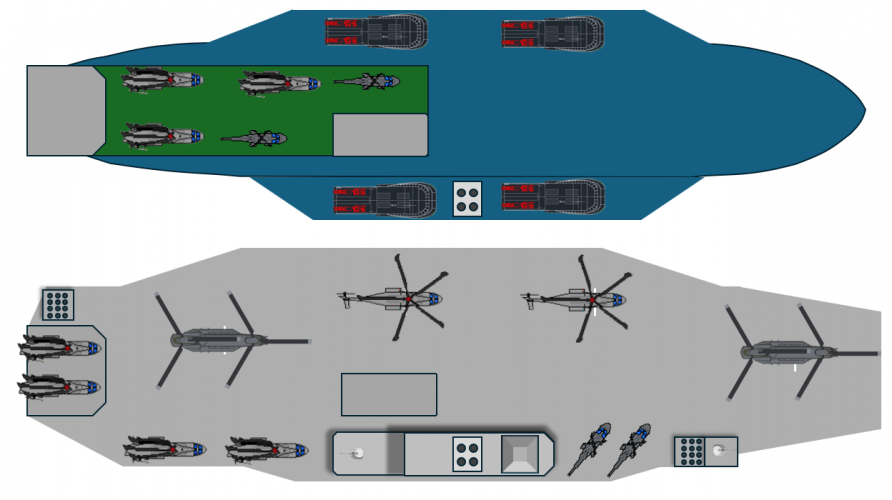
I'm hoping for either a San Giorgio or Ocean style flexible hangar/vehicle deck with lifts down to well dock beach level or something like the MRSS concept I worked through with no well dock and abandoning LCUs for a dedicated hangar.
1783533221613.png
Through Deck MRSS ver.3.png
 
Not much point having an LHD with the island hangar, even on the fatter KM concept image it doesn't look wide enough for 2 Merlin hence limiting to 1 where a wider hangar could take 4 helicopters. Drones that can be operated from the side alcoves won't be large enough to work alongside Merlin at its range limit as something like Proteus is likely to need a conventional hangar.
Quite. Especially when Merlin is entering its final decade of life and we don't yet know the footprint of the eventual NGRC replacement, which is quite likely to be larger if they do procure a tiltrotor - although of course the QEs do have a Commando airlift capability.
 
Thanks Ainen, so it is only 12 F-35As that the RAF are getting, let's wait and see if they order more because the main Lockheed F-35 website still has the UK total down as 138 F-35s that would be okay to have that total split two ways between the F-35A and F-35B. I can dream Ainen.
I'll take a tenner of anyone's money, if we buy more than the 72 already contracted for including the 12 A's.

Its a joke aircraft, which simple doesn't work. Just read the public Accounts committee report.
 
Don't get me started on the public accounts committee. They are like the General Accounting Office in the US.
 
I'll take a tenner of anyone's money, if we buy more than the 72 already contracted for including the 12 A's.

Its a joke aircraft, which simple doesn't work. Just read the public Accounts committee report.
Someone should probably tell the Israelis, then, given they've made decent use of the platform.
 
Not much point having an LHD with the island hangar, even on the fatter KM concept image it doesn't look wide enough for 2 Merlin hence limiting to 1 where a wider hangar could take 4 helicopters. Drones that can be operated from the side alcoves won't be large enough to work alongside Merlin at its range limit as something like Proteus is likely to need a conventional hangar.

I'm hoping for either a San Giorgio or Ocean style flexible hangar/vehicle deck with lifts down to well dock beach level or something like the MRSS concept I worked through with no well dock and abandoning LCUs for a dedicated hangar.
View attachment 817323
View attachment 817324
Yeah, something along those lines would be useful. Fitting them with NS110 would give them a decent sensor picture, as well.
 
Someone should probably tell the Israelis, then, given they've made decent use of the platform.
If you read it, limited capability is available 44% of the time or roughly (44, 46 I forget the precise number) so. Which means for certain 'dumb' tasks in a benign environment, good enough will do.
 
I'm hoping for either a San Giorgio or Ocean style flexible hangar/vehicle deck with lifts down to well dock beach level or something like the MRSS concept I worked through with no well dock and abandoning LCUs for a dedicated hangar.
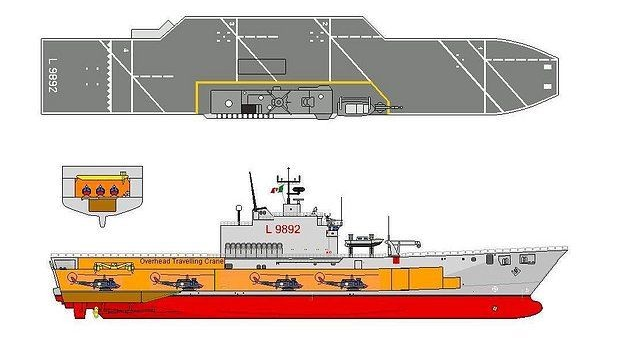
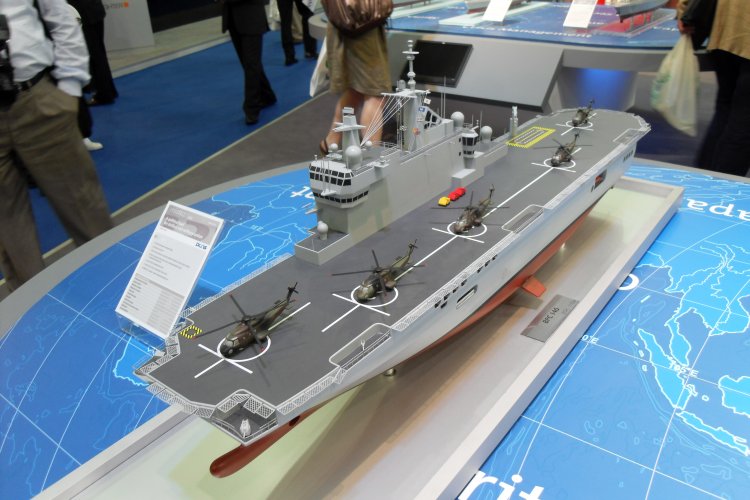
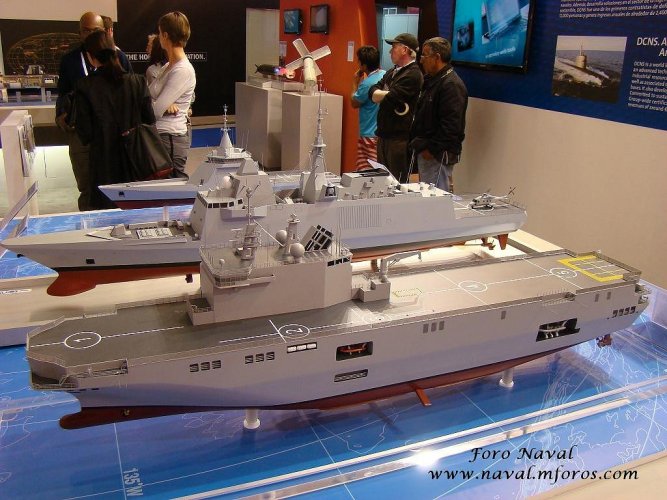
Looks like this will be closer in size to the 14,000t BPC 140 design (i.e. shrunk Mistral), which existed in 2 versions.

The initial aviation-optimized variant had a skinny island and 5 full helo spots. The later logistics-optimized variant adopted a fat island to increase internal volume but at the expense of limiting 2 helo spots to light 5t helicopters. Personally I prefer a skinny island as that potentially allows for axial deck launch & recovery of fixed-wing UAVs.

There were various internal arrangement options for 2 to 4 LCMs, a hangar for 6-10 helicopters (with either a skinny lateral elevator or full size stern elevator - the later is better for fixed wing UAVs), a vehicle deck for 30-50 vehicles, command and hospital areas, and the usual flex spaces (e.g. ability to carry containers and vehicles on deck, vehicles or containerized hospital modules in the helicopter hangar, main battle tanks in the dock etc). These days you could also carry USVs in the lateral boat bays, and artillery / loitering munition launchers on the flight deck...

See pics and description below.
The MISTRAL 140 is 160 Meters long and have a full displacement of 13.460 Tonnes, a top speed of 19.2 kt, a range of 10.000nm at a speed of 12 kt, five helicopter spots, a hangar for six helicopters, a 1200m2 vehicle hangar for wheeled and tracked vehicles, 400m2 space for a command post and 680m2 for a Level 3 hospital. 4 LCMs can operate from the dock. The vessel is manned by a crew of 160 and can transport 130 Tonnes of ammunition and 500 fully equipped troops. Defensive systems include two MBDA SIMBAD SAMs and 30mm and 12.7mm guns.
 

Attachments

  • BPC 140 v1.jpg
    BPC 140 v1.jpg
    2.8 MB · Views: 34
  • BPC 140 v2.jpg
    BPC 140 v2.jpg
    151.2 KB · Views: 32
Last edited:
Looks like this will be closer in size to the 14,000t BPC 140 design (i.e. shrunk Mistral), which existed in 2 versions.

The initial aviation-optimized variant had a skinny island and 5 full helo spots. The later logistics-optimized variant adopted a fat island to increase internal volume but at the expense of limiting 2 helo spots to light 5t helicopters. Personally I prefer a skinny island as that potentially allows for axial deck launch & recovery of fixed-wing UAVs.

There were various internal arrangement options for 2 to 4 LCMs, a hangar for 6-10 helicopters (with either a skinny lateral elevator or full size stern elevator - the later is better for fixed wing UAVs), a vehicle deck for 30-50 vehicles, command and hospital areas, and the usual flex spaces (e.g. ability to carry containers and vehicles on deck, vehicles or containerized hospital modules in the helicopter hangar, main battle tanks in the dock etc). These days you could also carry USVs in the lateral boat bays, and artillery / loitering munition launchers on the flight deck...

See pics and description below.
That looks pretty good- I assume all combinations of island and lift were possible?

One thing I don't like about the smaller LHDs like the Mistral and its variants is that the requirement to have the hangar above the well dock causes a disproportionately tall and narrow hull. Therefore I think for ATS there would be great utility in having a single large space within the ship able to store both aircraft and vehicles and with access to both the flight deck and the well dock. This would allow the ship to be entirely given over to vehicles and stores for HADR, with UAVs perhaps still stored in the island; it would also allow a full commando raiding configuration with the maximum number of helicopters and trailered USVs.
Helicopter access would need to be by an internal lift due to the small size but ideally this would be quite large to, as you say, facilitate fixed-wing drones being carried in future and have the capacity for heavy vehicles. If possible this flexible deck would be slightly higher than is usual for vehicle decks to allow level transfer to boats and USVs in davits too. Artillery like MLRS or containerised AShMs could be moved by rails, lift and crane to the forwards upper deck for fire support.
 
One thing I don't like about the smaller LHDs like the Mistral and its variants is that the requirement to have the hangar above the well dock causes a disproportionately tall and narrow hull. Therefore I think for ATS there would be great utility in having a single large space within the ship able to store both aircraft and vehicles and with access to both the flight deck and the well dock.
There are pros and cons to each arrangement. Putting the hangar in front of the well deck creates a very large floodable space not far above the waterline... not ideal from a survivability perspective. Also clear segregation of operations and accommodations spaces on different levels and fore/aft is helpful... e.g. easier to handle aviation in a separate hangar above your vehicles and landing craft, easier to accommodate all personnel forward etc.

There's still plenty of flex in a stacked arrangement... vehicles and containers can be stored on any of 4 levels (well dock, vehicle deck, hangar deck, flight deck), hospital or extra accommodation can extend into the helicopter hangar, additional helicopters and UAVs can be stored in a deck park (or even in the vehicle hangar if they fit the lower ceiling height) etc.
 
1783624971282.png

That comes from this tweet. Major details are as follows:
  • Pollard heavily implies that the Common Combat Vessel will be built by Babcock in Rosyth. However, he does not outright confirm that the hull is derived from AH140, stating instead that it would simply be able to make use of the existing build facilities.
  • He states that T26 production on the Clyde is safe for an additional 15 years, or until the 2045-2050 period. With deliveries starting in 2028-2029, that's roughly a ship every 1.1-1.5 years.
  • All eight of the British-Dutch Amphibious Transport Ships will be built in the UK, with Pollard mentioning them alongside the Fleet Solid Support Ships. This suggests that they will be built in Belfast, but there's no confirmation as of yet.
  • The Commando Insertion Craft and Standardised Vessels (mine countermeasures motherships) will be purchased from Norway.
 
All eight of the British-Dutch Amphibious Transport Ships will be built in the UK, with Pollard mentioning them alongside the Fleet Solid Support Ships. This suggests that they will be built in Belfast, but there's no confirmation as of yet.
That's really great news, Belfast will have their work cut out as no other yard can hope to build 8 15kt ships by the end of the 2030s. Hopefully in a few years' time we get a view of 4 ATS in build at once in the big dry dock!
The Commando Insertion Craft and Standardised Vessels (mine countermeasures motherships) will be purchased from Norway.
Not Pollard calling them CIC (and not knowing the acronym) after renaming them JCC in the release of the joint plan with Norway...
CIC being part of the Norway offset all but guarantees that the ESNA design will be chosen, which is a good flexible option but a little on the bulky side.
 
CIC being part of the Norway offset all but guarantees that the ESNA design will be chosen, which is a good flexible option but a little on the bulky side.
They're fast buggers as well, their website says 67 knots.
 
They're fast buggers as well, their website says 67 knots.
They are indeed, would edge out the Skjold class as the fastest operational military surface vessels, though the SES-100B would still hold the crown for fastest SES at 96 (!) knots.
Might also if armed beat the fastest surface missile launch which SES-100B set with an SM-1 at 60 knots.
 
Putting the hangar in front of the well deck creates a very large floodable space not far above the waterline... not ideal from a survivability perspective.
That's why the flexible deck would be higher than is usual for a vehicle deck, as a hybrid between a hangar deck and vehicle deck with a longer and higher ramp up from the well dock. The space would be no longer than the lower vehicle decks of most amphibious ships; the Wasp class have nearly half of their length taken up by the well deck alone, well over 2/3 with the vehicle deck.
There's still plenty of flex in a stacked arrangement... vehicles and containers can be stored on any of 4 levels (well dock, vehicle deck, hangar deck, flight deck), hospital or extra accommodation can extend into the helicopter hangar, additional helicopters and UAVs can be stored in a deck park (or even in the vehicle hangar if they fit the lower ceiling height) etc.
As they are smaller than most other vessels I think the priority for ATS should be to be able to commit the entire vessel to its current role and be optimised for the ability to reconfigure. A single flexible deck is the best way of doing that as it maximises the space available for any one capability while still allowing a split between several, with the flight deck interface at one end and the water at the other.
 
In some good, if not quite sexy, reamament news.

https://ukdefencejournal.org.uk/mod-buys-finnart-oil-terminal-to-boost-navy-fuel-reserves/ said:
The deep-water terminal, on the eastern shore of Loch Long a few miles from HMNB Clyde, was built by the US Navy during the Second World War and spent decades handling crude oil for the Grangemouth refinery, first under BP and later Ineos, with a berth capable of taking tankers of up to 324,000 tonnes. Its future had been in doubt since September 2024, when operator Petroineos announced the site would close following the end of refining at Grangemouth, and the MoD’s interest in the site had surfaced in reporting over the past year, including its appearance on a leaked list of potential locations for new munitions production.

...

The acquisition was confirmed as Defence Minister Luke Pollard visited HMNB Clyde to announce £26 billion of investment over ten years to modernise the Royal Navy’s three main bases at Clyde, Devonport and Portsmouth, funding the MoD describes as the largest programme of naval infrastructure investment since the end of the Cold War.

...

Alongside the naval funding, the Minister confirmed more than £240 million in RAF sustainment contracts benefiting Scotland. Boeing Defence UK has been awarded a £115.2 million two-year extension to sustain the RAF’s nine P-8 Poseidon maritime patrol aircraft at Lossiemouth, safeguarding over 200 skilled jobs and more than 20 apprenticeships, while a separate £127.5 million E-7 Wedgetail sustainment contract will support around 180 jobs with a further 60 to 80 new roles projected. A £20 million investment in Inchgreen Marine Park on the lower Clyde will revitalise one of the UK’s largest operational dry docks, supporting 350 direct jobs and a new skills centre.

 
Current RAF obsession...prefacing things with 'Storm'....suppose its better than Warfighter....

Storm Shadow...the missile, of which we're not buying any more...
StormShroud...Takever AR3 with Britestorm EW package
StormFighter....the BAE CCA
StormChrome....a new EW drone
StormFire....a 1,000nm OWE...owned by the RAF Regt....

Obviously the last 3 are the new ones...StormChrome? Greater range or speed than StormShroud? Capable of accompanying manned aircraft (one of the glaring issues with StormShroud)?

Is the RAF trying to get in the Army's way with StormFire? Shouldn't the RAF Regt really focus on protecting air bases and AD???
If they're developing something new, rather than just buying the Rotron SkyLance developed for Brakestop it will be some seriously not joined up thinking...or...are they looking for something cheaper and Shahed like....

View: https://x.com/Rotorfocus/status/2077709021507674434

View: https://x.com/GarethJennings3/status/2077667022830227532
 
Last edited:
Are there any hard details out for when these are planned to go into testing/service, or (the eternal UK question) how they're being paid for?
 
UK Exploring Requirements For Nuclear F-35A Mission

When London said it would commit to the dozen F-35As to augment its fleet of F-35Bs, it suggested the conventional takeoff and landing version would be used for training and for the nuclear mission.

But Air Vice-Marshal Jim Beck, RAF director of capability and programs says “the two are separate.” The dozen aircraft are to serve for operational conversion training.

How the UK will pursue the nuclear mission, including the ability to deliver U.S. B61-12 bombs, remains a work in progress. “We're doing the analysis to understand the size and posture of force that we will need to undertake this,” he said at the Global Air & Space Chiefs’ Conference.


Among the issues up for discussion is how big a fleet of F-35As the UK might need as it takes on the nuclear mission, but other issues are also under study. Among those is the need to introduce a refueling boom capability the UK currently does not have with its tanker fleet.

RAF Air Chief Marshal Harvey Smyth told Aviation Week that the service is exploring options with Airtanker, the operator of the service’s Airbus A330 Multi-Role Tanker Transports, to install an aerial refueling boom.
 
Whilst getting a separate set of F-35A is more sensible than trying to make one do two roles that kinda break the other (in terms of reliability and avalability) it is, in the wider context, just doubling stupidity (we will get the first planes when we get GCAP, at the earliest, and we don't give our carriers more of the only kind of extant fixwing that they'll be able to fly outside of bullying SAAB into making the STOL Gripen or a time consuming and costly rebuild which will necissitate buying more unique planes anyways).
 
We will have to do something quick in regards to the refueling boom issue with the tanker fleet, retrofiting the boom onto the existing tanker fleet would be the best method as buying new tankers fitted out with the boom would probably be too expensive for the UK to do right now.
 
My un-expert thoughts:

1. why not buy the F-35C instead? has the longer range than the B, but already had the probe.

2. as the whole things in theory modular, could they take the front off a C or B, which has the probe and swap? i get there's lots of plumbing to change etc but doable?
 

Similar threads

Back
Top Bottom