FighterJock
ACCESS: Above Top Secret
- Joined
- 29 October 2007
- Messages
- 7,227
- Reaction score
- 8,538
My thoughts too Sferrin, with the two main weapon bays you can forget about a centre line hardpoint for external ordinance/fuel tanks.


You could always do it like the F-105 and have the centerline pylon be ON the weapons bay door.My thoughts too Sferrin, with the two main weapon bays you can forget about a centre line hardpoint for external ordinance/fuel tanks.

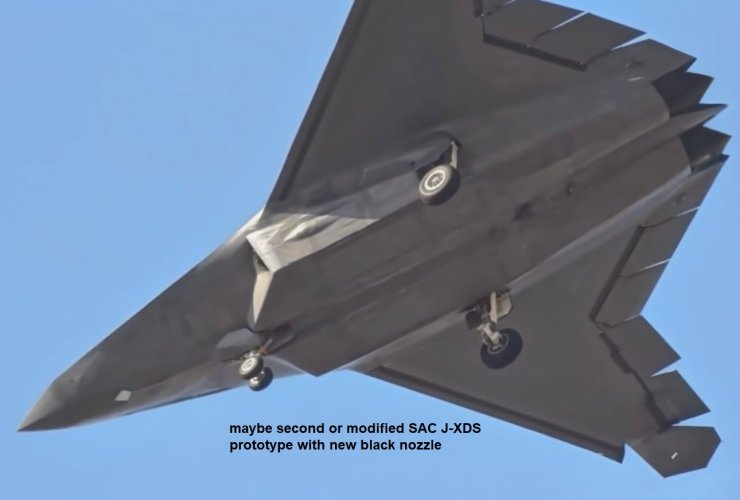
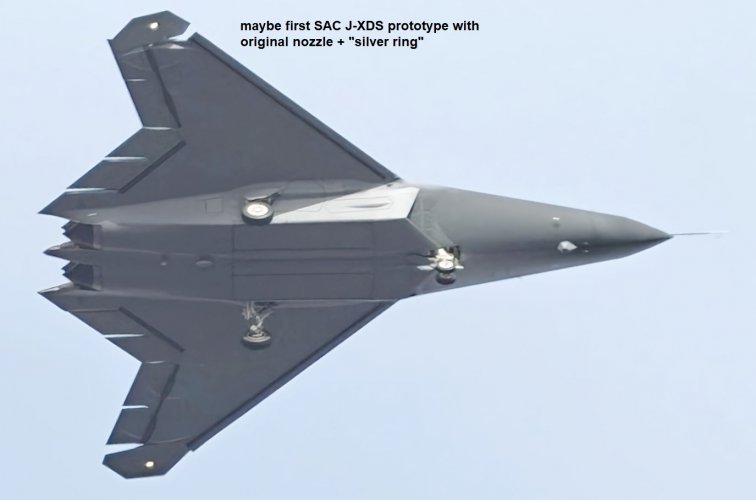
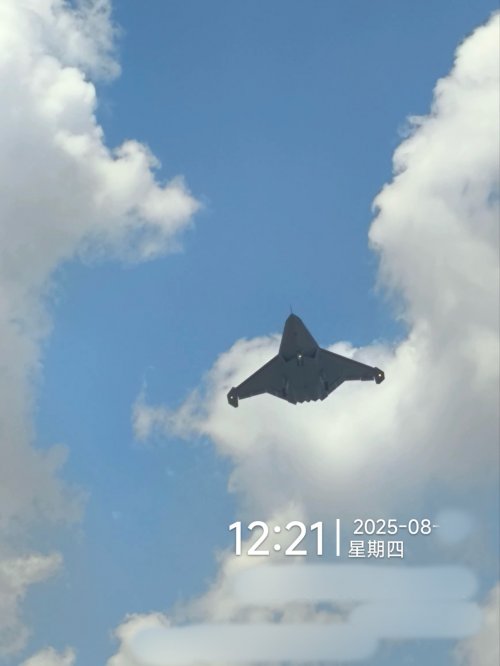
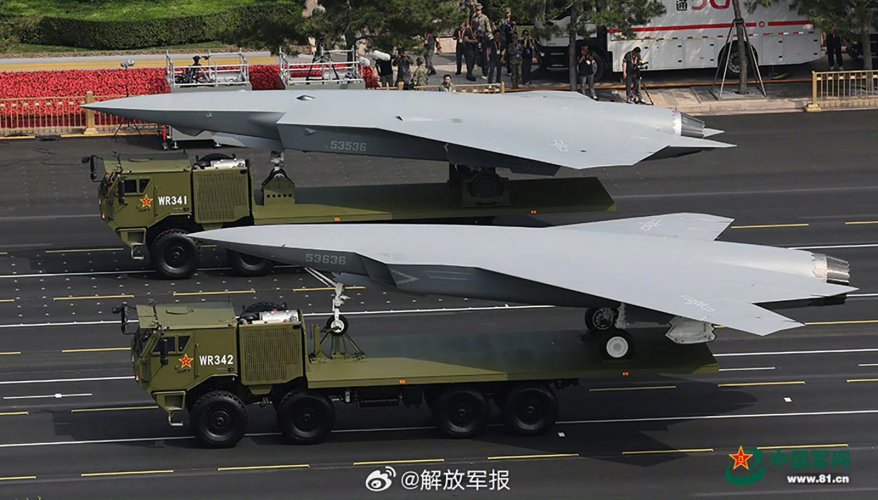
Those inlets look really weird from that angle. Doesn't look right for a DSI, doesn't have the spacing needed for a caret, ...New look at the underside of the J-XDS/SAC 6th gen (although some detail has been lost due to AI enhancement!).
Via ACuriousPLAFan/SDF:
Combined response:Two bays... but I do wonder - centreline external hardpoint?
It may, but picture a buddy-fueling tank on the centerline. So your side bays are likely filled with fuel tanks anyways.Wouldn't it create clearance issues for the stores in the bays?

OR.... it's just AI screwing up the details

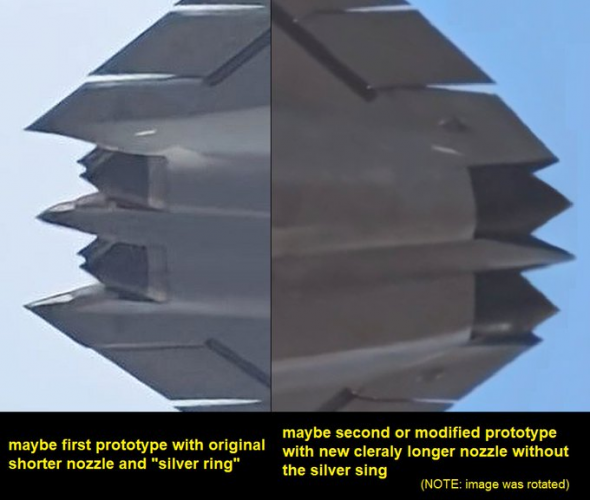
However, would an automatic AI-enhancement result in such larger longer nozzles even if not intentionally manipulated?
imo the idea makes sense to some degree, but the specific geometry of that trough (or at least from what we can currently see from post 2997) doesn't really lend itself all that well to conformal storage, as it seems a bit too wide and shallow. If we're talking about something with a non-circular cross-section (say something akin to JSM/LRASM/Kh59MK2/AKF98, something with a rounded rectangular or trapezoidal cross-section) then it may well be suited for the trough geometry but for round munitions not so much I think.With regard to a hypothetical centre-line hardpoint, I do honestly suspect that you may all be right to discount it.

Really wish they'd gotten a picture with the underside of the aircraft more exposed to the sun. Just a slightly bigger bank angle is all I'm asking!

| 
|
Thank you but I specifically wanted the light at the angle in that photograph I had quoted to check for any odd shadows on the side of the nose.

I would say the lack of edge alignment is suspect.Or it is an 100% AI ?? ... I think we nowadays have to keep this option in mind whenever we see something new.
However, would an automatic AI-enhancement result in such larger longer nozzles even if not intentionally manipulated?
AI is currently holding us hostage—in more ways than one!
I got these on X last year, might help.Those inlets look really weird from that angle. Doesn't look right for a DSI, doesn't have the spacing needed for a caret, ...
Really wish they'd gotten a picture with the underside of the aircraft more exposed to the sun. Just a slightly bigger bank angle is all I'm asking!
So we'd be able to see any contours on the underside of the nose.
Thank you!I got these on X last year, might help.

Sorry for the late reply. I just saw this post.Not sure how I missed this earlier:
3x 30-35klb engines would give the J-36 a TWR of about 1.27:1 at 50% fuel. (~105klb MTOW, ~82,500lbs at combat maneuvering weight. ~55k empty, 25k fuel, 2500lbs AAMs)
An F-16C-50/52 is looking at a TWR of about 1.18 in the same situation of 50% fuel and 4x AMRAAM+2x AIM9
The F-22 has a TWR of about 1.25 with 50% fuel and 6x AMRAAMs+2x AIM9
I don't think the J-36 is going to have any trouble at all regaining energy after a turn in a dogfight.
If I had access to thrust-at-altitude charts or tables I'd have used those.Sorry for the late reply. I just saw this post.
This analysis is flawed. You must be assuming the dog fighting is going to be at sea level. The available thrust is directly related to altitude and free stream velocity. Hence, all of your thrust to weight ratios are incorrect. Moreover, the drag loses are far greater on a large delta (J-36) than on a 16c or 22. The 36 may recover, but what is the delta T during recovery. I suspect the 22 will waste it in a turning fight if it does not blow its tail off BVR.

I suspect the 22 will waste it in a turning fight if it does not blow its tail off BVR.
)
Sorry for the late reply. I just saw this post.
This analysis is flawed. You must be assuming the dog fighting is going to be at sea level. The available thrust is directly related to altitude and free stream velocity. Hence, all of your thrust to weight ratios are incorrect. Moreover, the drag loses are far greater on a large delta (J-36) than on a 16c or 22. The 36 may recover, but what is the delta T during recovery. I suspect the 22 will waste it in a turning fight if it does not blow its tail off BVR.

I suspect you’re worrying about the wrong tailless aircraft here if we’re talking WVR or just kinematics in general.I suspect the 22 will waste it in a turning fight if it does not blow its tail off BVR.
let's not go down the unhinged debate of 6th gen somehow outmaneuver a conventional tail design of 4th or 5th gen given all things equal entering the visual range (ruling out energy, electronic, and geometric advantages).I suspect you’re worrying about the wrong tailless aircraft here if we’re talking WVR or just kinematics in general.
F-35 doesn't even carry a heatseeker inside, and it's close in weapon is its gun.the f-35's DAS basically usher in the new era of dogfight that no longer requires turn and burn. 2 platforms with DAS like capability will most likely ensure mutual destructions.
It would be rather amusing should F-47 end up maneuverable, and will beat digested food out of designs, born at the dawn of fbw.6th gen (rightfully) gives up on the traditional dogfighting maneuverability in the same way 4th gen gave up pure top speed of previous gen.
huh? why would DAS like system need a heat seeking type of missile to work? and we're talking 6th gen aircraft in the context of DAS similar or superior equivalence. Why would the f-35's internal weapon carriage be relevant?F-35 doesn't even carry a heatseeker inside, and it's close in weapon is its gun.
I.e. no, it's turn or burn.
Well, the irrelevance of WVR - even if true, as there are multiple caveats - is applicable only to specialized WVR weapons.huh? why would DAS like system need a heat seeking type of missile to work?
If the argument is completely broken in it's very first example ("F-35's DAS usher in a new era of dogfight that no longer requires turn and burn") - applying the wrong lesson further won't make it right.and we're talking 6th gen aircraft in the context of DAS similar or superior equivalence. Why would the f-35's internal weapon carriage be relevant?
why do you assume that the missile can only engage with a seeker lock from the missile's own radar?Well, the irrelevance of WVR - even if true, as there are multiple caveats - is applicable only to specialized WVR weapons.
For offbore ARH weapon shots, for starters, you really want to feed a 3rd coordinate(which DAS does not provide), and overall, their close-in performance is comparatively limited.
Which is why WVR weapons still exist.
If the argument is completely broken in it's very first example ("F-35's DAS usher in a new era of dogfight that no longer requires turn and burn") - applying the wrong lesson further won't make it right.
For example, if F-35 gets off-bore DAS AMRAAM shot at F-47, but the latter's RCS alone prevents seeker lock, engagement doesn't seem to be off to a good start.
You're kidding, right? Tailless fighters can absolutely be as (if not even more) maneuverable than traditional tailed designs. This was already demonstrated by the X-36 and ICE. Your premise doesn't make sense in the way that 6th gens will inherently utilise much more advantageous aerodynamic geometries.let's not go down the unhinged debate of 6th gen somehow outmaneuver a conventional tail design of 4th or 5th gen given all things equal entering the visual range (ruling out energy, electronic, and geometric advantages).
You're misunderstanding this. One of the core capabilities that 6th gens are pursuing are even more robust sustained turn rates at high speed and high altitudes compared to 5th gens in order to secure the best firing position for BVR engagements. This ironically encourages very low wing loading/highly blended wing-body designs, which ultimately yields to exceptional lift coefficients. Add the inherent ultra-relaxed stability nature of tailless designs, and voila. A "natural" dogfighter with an exceptional instantaneous turn rate and kinematic profile.6th gen (rightfully) gives up on the traditional dogfighting maneuverability in the same way 4th gen gave up pure top speed of previous gen.
I think that's the case for all modern aa weapons; the only exception I can think of is starstreak/martlet, but those are only for helicopters, and in any case they're super directional...why do you assume that the missile can only engage with a seeker lock from the missile's own radar?
did the x-36 and ICE demonstrate maneuverability superior to that of traditional tail design? (the aspect of maneuverability strictly relevant to close in dogfight)You're kidding, right? Tailless fighters can absolutely be as (if not even more) maneuverable than traditional tailed designs. This was already demonstrated by the X-36 and ICE. Your premise doesn't make sense in the way that 6th gens will inherently utilise much more advantageous aerodynamic geometries.
Any actual research paper to demonstrate that these features yield a platform superior in maneuverability to traditional wing tail platform or these features are there to provide fighter like performance for a tailless fighter at supersonic speed?But let's look at the "J-50" as an example. Tailless, massive LERX-integrated nose, lambda wings with AMWs and 8 other individually controllable trailing edge control surfaces (not to mention leading edge slats), thrust vectoring, and who knows what else (active flow control?). In terms of relaxed stability it's already head and shoulders above conventional designs. There's absolutely no reason that it wouldn't be as maneuverable as conventional fighters.
You're misunderstanding this. One of the core capabilities that 6th gens are pursuing are even more robust sustained turn rates at high speed and high altitudes compared to 5th gens in order to secure the best firing position for BVR engagements. This ironically encourages very low wing loading/highly blended wing-body designs, which ultimately yields to exceptional lift coefficients. Add the inherent ultra-relaxed stability nature of tailless designs, and voila. A "natural" dogfighter with an exceptional instantaneous turn rate and kinematic profile.
you don't think future platform can cue a missile with a 360 degree tracking/targeting system the entire engagement envelope while maintaining positional and energy advantage?I think that's the case for all modern aa weapons; the only exception I can think of is starstreak/martlet, but those are only for helicopters, and in any case they're super directional...
P.s. my understanding is that verticals problem is not so much maneuverability(it affects certain maneuvers, but there are workarounds), but rather stability, especially supersonic.
It is the opposite to the direction they move in, and it's in any cas is beyond the event horizon.you don't think future platform can cue a missile with a 360 degree tracking/targeting system the entire engagement envelope while maintaining positional and energy advantage?
we're talking WVR, not at the edge of sensor effective detection range. the launching platform can also climb (if they don't already come in with positional advantage already being stealthier with better sensors and electronic warfare suit) to extend the event horizon will provide tracking off boresightIt is the opposite to the direction they move in, and it's in any cas is beyond the event horizon.
On currently known platforms, it's likely possible on su-57/j-36/b-21, but to my knowledge, it wasn't even considered; why? Onboard guidance and autopilot is all round superior.
In the end, F-35 example is telling; it's often used as example, yet it's in fact a very maneuverable 9g jet, which is built for anything but for exploiting high offbore WVR missile combat.
And if there's any such aircraft remaining in modern world, it's the rafale... which isn't particularly new, and is unique, rather than representative of the general trend.
What does?This looks mean!
The plane on the picture the post just before mine.What does?
Ah. The hazards of the ignore list.The plane on the picture the post just before mine.
Ah, seems like someone just can't handle different opinions. A hazardous trait.Ah. The hazards of the ignore list.