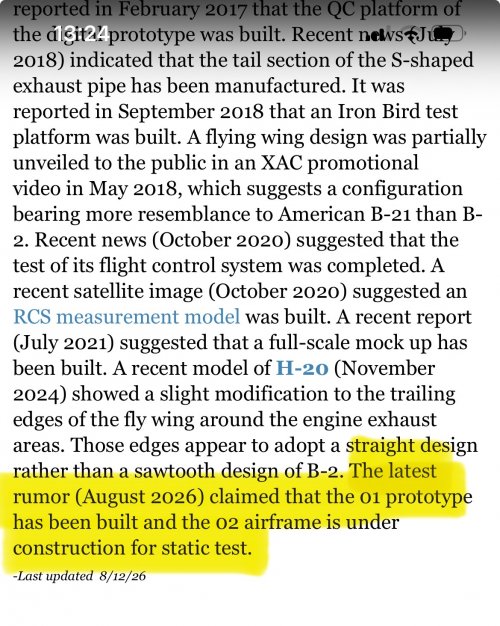
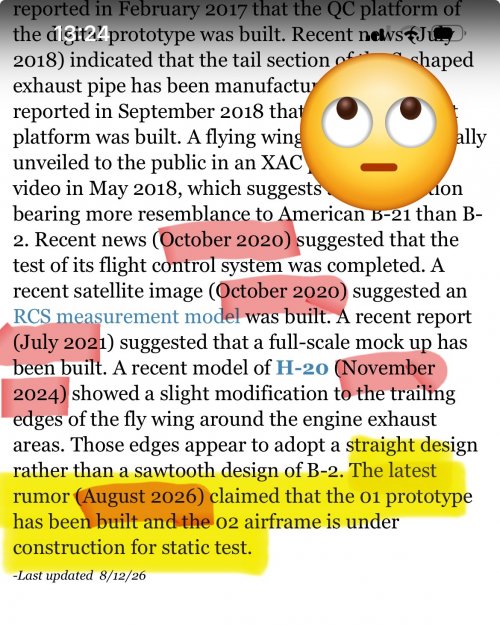
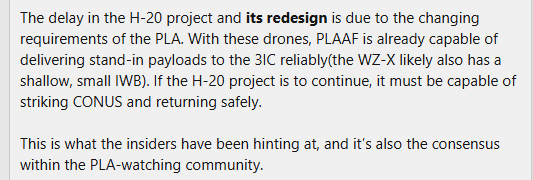
Obviously the redesign of the H-20 is a result of design testing?
No idea. I think the rumor was that the requirements changed, but I have not really paid attention to. I assume there are posts up thread that discuss this far better than I have.

Obviously the redesign of the H-20 is a result of design testing?

That's certainly the only reason I'd want to scrap everything and start over on the redesign.Eh, it probably didn't fly yet. i would guess development simply lasted so long that both chinese design capabilities and goalposts changed. Maybe they realized they could achieve order of magnitude better stealth and longer range with a redesign.

It doesn't have to be a total redesign. Maybe the outward dimensions and shape remains the same, who knows? But if one applied new engine tech, new construction methods and materials, new radar absorbing materials - then internal detailed engineering could've changed. Enough so for several more years of this so-called increment 2 bomber design. Resulting in both a bit more room for fuel, smaller fuel consumption, potentially lower empty weight - all possibly contributing to longer range. We'll see. If there's no manned bomber in the next few years I'd say it becomes more likely China decided to cancel the project and rely solely on unmanned large platforms.

|
|
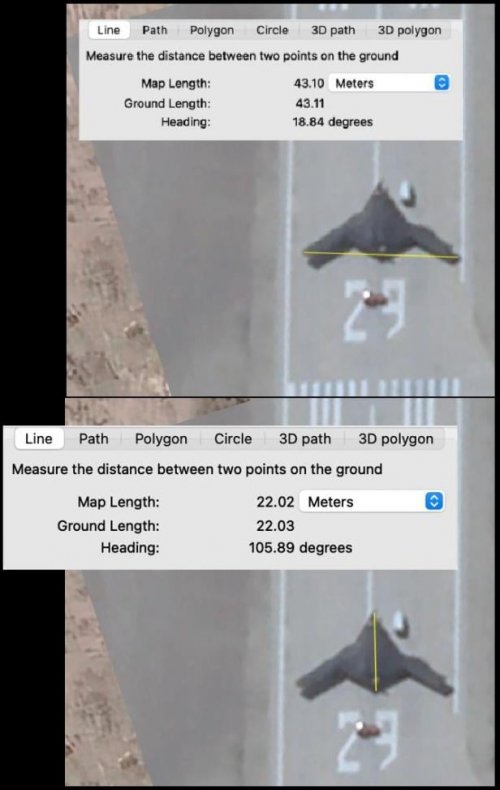
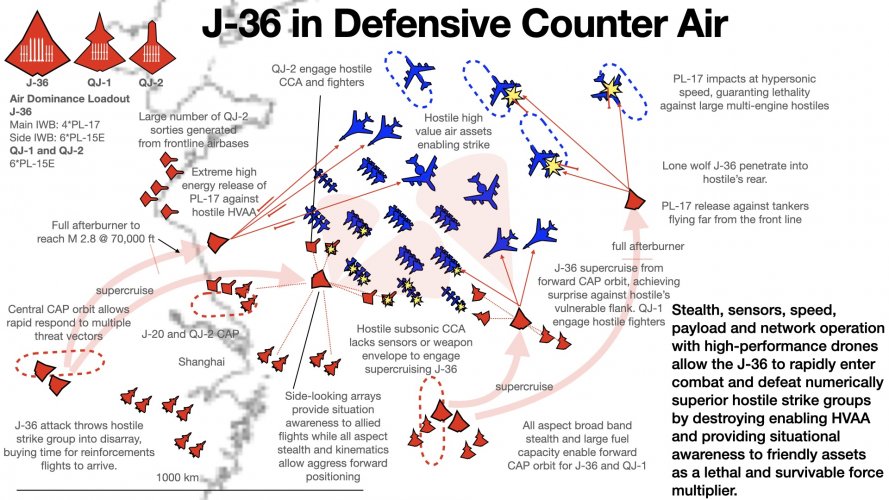
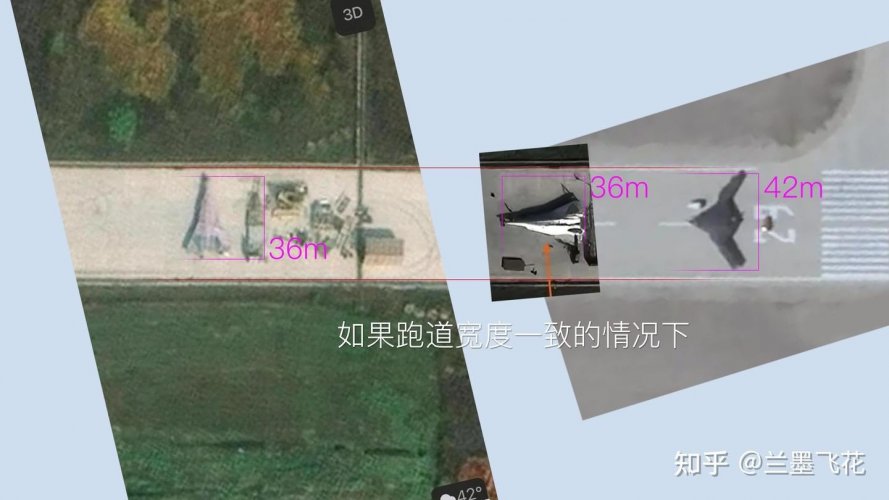
FYI guys, this bad boi is B-21 sized; something of this capability is not imagined when someone hears the word "UCAV"...
Think about that, think about its consequences in the Pacific Theatre, and how it influenced the H-20’s redesign into a CONUS bomber.
China currently lacks the means to strike in volume beyond the West Pacific, hence why this aircraft's as significant as the 6th gens...
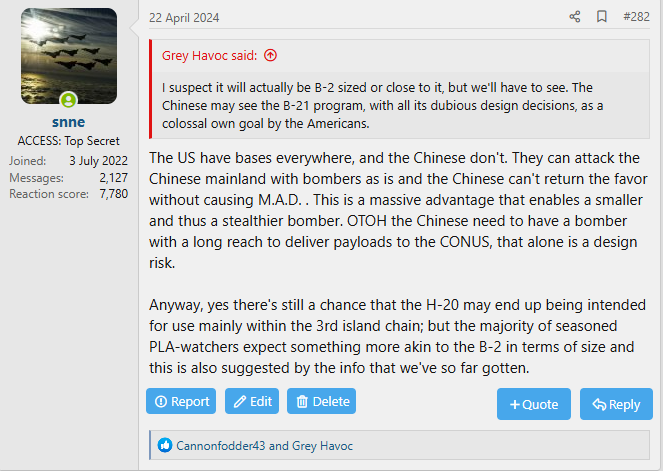
The US have bases everywhere, and the Chinese don't. They can attack the Chinese mainland with bombers as is and the Chinese can't return the favor without causing M.A.D. . This is a massive advantage that enables a smaller and thus a stealthier bomber. OTOH the Chinese need to have a bomber with a long reach to deliver payloads to the CONUS, that alone is a design risk.
Anyway, yes there's still a chance that the H-20 may end up being intended for use mainly within the 3rd island chain; but the majority of seasoned PLA-watchers expect something more akin to the B-2 in terms of size and this is also suggested by the info that we've so far gotten.
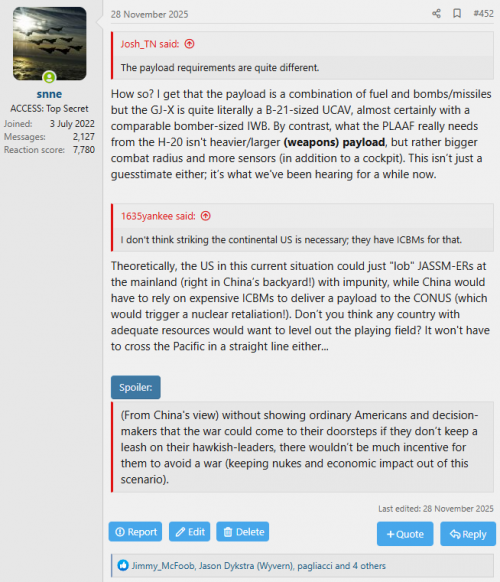
How so? I get that the payload is a combination of fuel and bombs/missiles but the GJ-X is quite literally a B-21-sized UCAV, almost certainly with a comparable bomber-sized IWB. By contrast, what the PLAAF really needs from the H-20 isn't heavier/larger (weapons) payload, but rather bigger combat radius and more sensors (in addition to a cockpit). This isn’t just a guesstimate either; it’s what we've been hearing for a while now.
Theoretically, the US in this current situation could just "lob" JASSM-ERs at the mainland (right in China’s backyard!) with impunity, while China would have to rely on expensive ICBMs to deliver a payload to the CONUS (which would trigger a nuclear retaliation!). Don’t you think any country with adequate resources would want to level out the playing field? It won't have to cross the Pacific in a straight line either...
(From China's view) without showing ordinary Americans and decision-makers that the war could come to their doorsteps if they don’t keep a leash on their hawkish-leaders, there wouldn’t be much incentive for them to avoid a war (keeping nukes and economic impact out of this scenario).

Well, there are two ways to come to big VLO strike platform.So how did the H-20 come into being then if China already has a large UAV in the B-21 size, this simply does not make any sense.

Not to go OT but that's got me wondering if we'll see unmanned versions of the B-21.Well, there are two ways to come to big VLO strike platform.
One is to ask existing heavy aircraft manufacturer to come up with a modern heavy VLO bomber from their experience. It's H-20, and the starting point is H-6.
Another is to progressively up the drone game - big VLO drone is ultimately the same thing as medium VLO drone, just...bigger.
Two paths can be related, they can be not; they can reinforce each other, they can exist in parallel.
Because it won't be B-21-sized, it will serve a different purpose and have an almost entirely different CONOPS, that's why...So how did the H-20 come into being then if China already has a large UAV in the B-21 size, this simply does not make any sense.
|
|
|

|
Unlikely, there's not a lot of cost savings or performance gain by dropping all the life support stuff out of an aircraft that big.Not to go OT but that's got me wondering if we'll see unmanned versions of the B-21.
Or it might be the same reason that everyone else says B-21 has to be manned. Too much risk putting nukes on a UCAV. So that would make H-20 the nuclear bomber. Adds the same dimension to nuclear triad that USA has with air launched/dropped nukes.Because it won't be B-21-sized, it will serve a different purpose and have an almost entirely different CONOPS, that's why...
But how many of these new Chinese platforms may only be demonstrators, I can't see China going into production involving all of these new platforms, I think there is some smoke and mirrors going on hear. Germany during WW2 as an example, had all kinds of new types of aircraft but at the end of the day most were just one or two-off prototypes.Exactly. People always overlook the fact that China already has a B-21-sized bomber UAV in testing (alongside a larger RQ-180 analogue with a possible small IWB)…
But how many of these new Chinese platforms may only be demonstrators, I can't see China going into production involving all of these new platforms, I think there is some smoke and mirrors going on hear. Germany during WW2 as an example, had all kinds of new types of aircraft but at the end of the day most were just one or two-off prototypes.
But how many of these new Chinese platforms may only be demonstrators, I can't see China going into production involving all of these new platforms
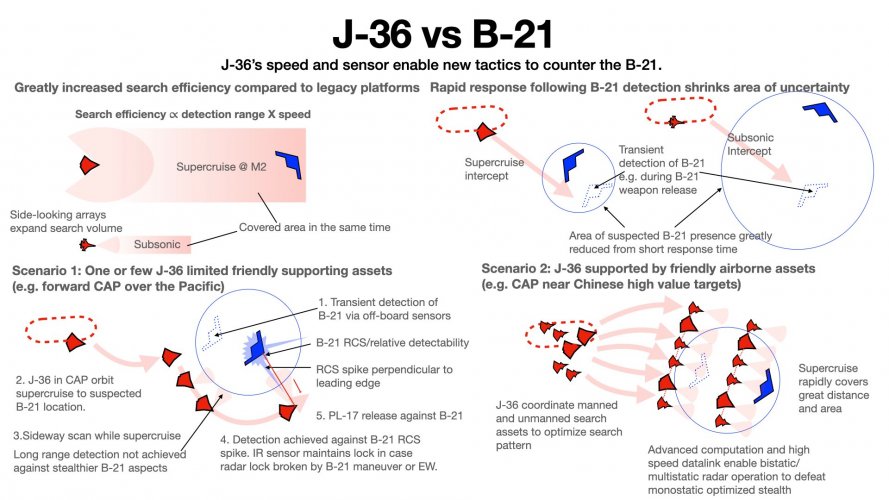
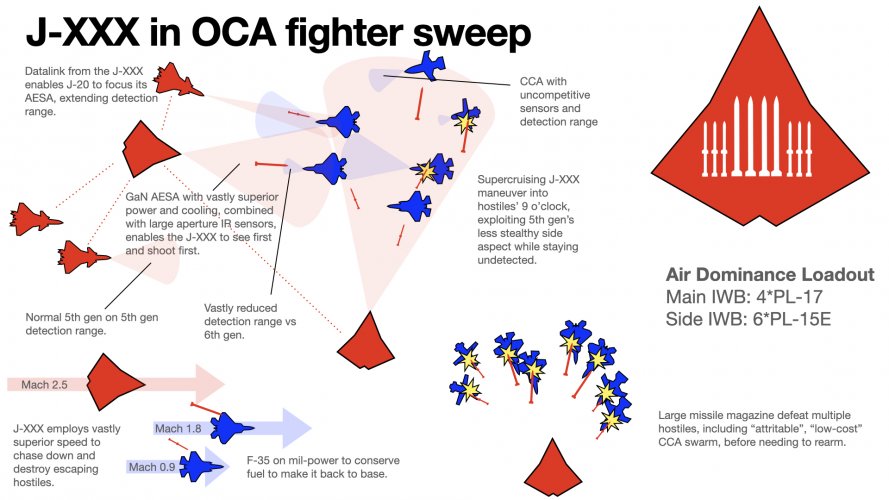
|
|
)
PLA has extremely strict requirements for cost control. Even now, actual aircraft bidding competitions like the FY-23 and YF-22 remain unimaginable for them. When you spot a full-scale prototype or demonstrator at the test site, it must have gone through repeated deliberations and is almost certain to enter service.But how many of these new Chinese platforms may only be demonstrators, I can't see China going into production involving all of these new platforms, I think there is some smoke and mirrors going on hear. Germany during WW2 as an example, had all kinds of new types of aircraft but at the end of the day most were just one or two-off prototypes.


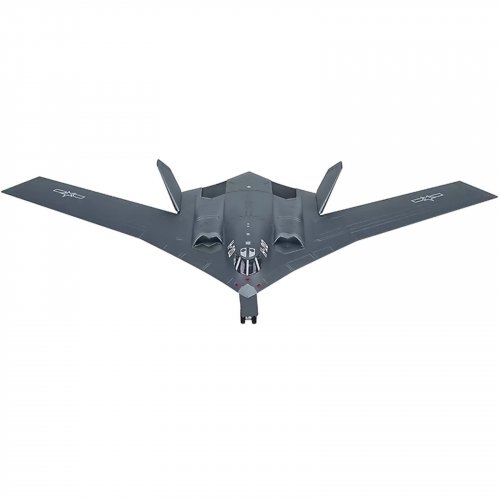
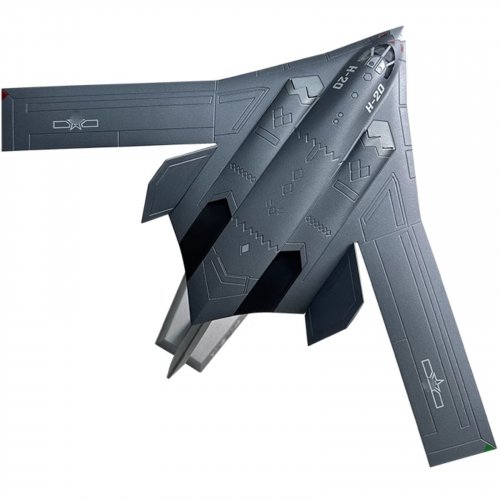
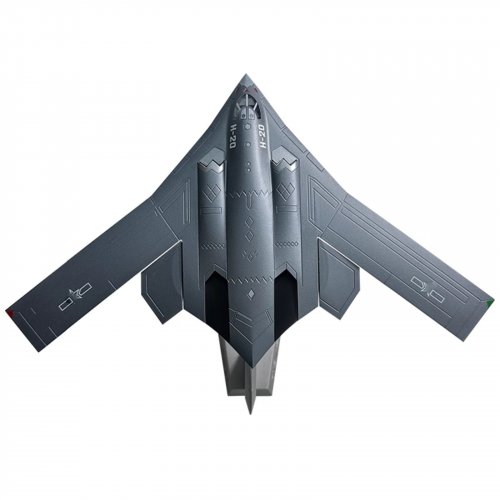
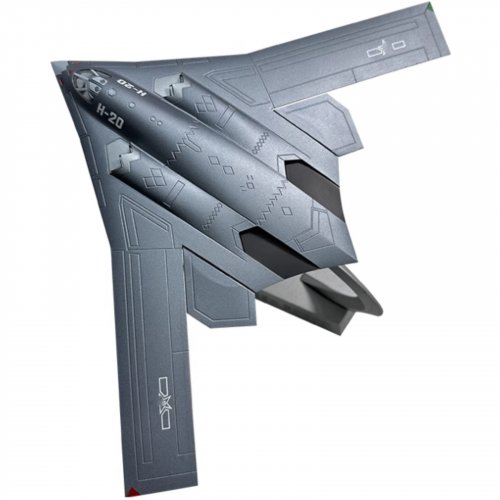
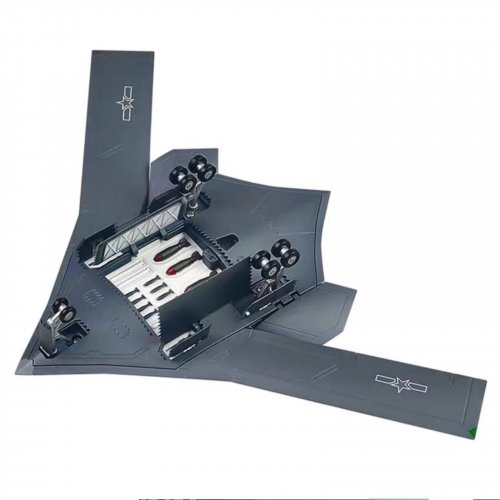
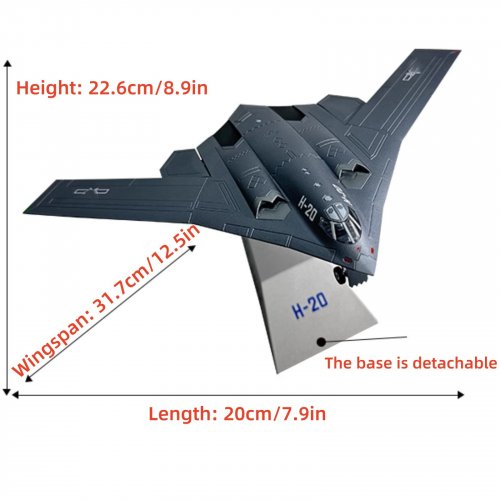
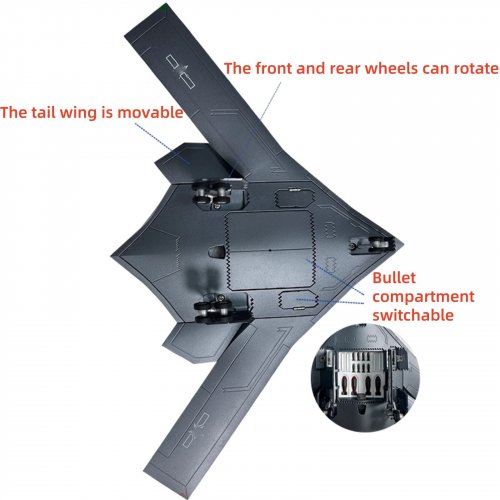
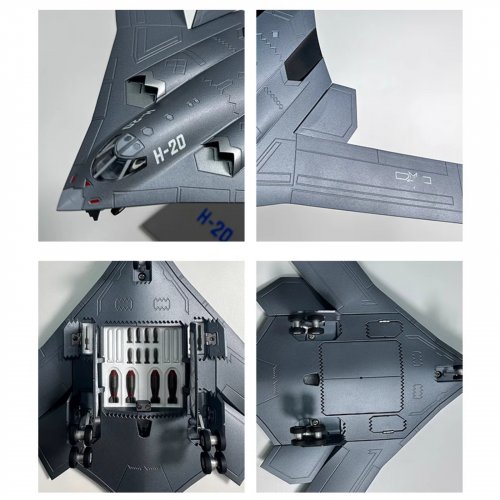
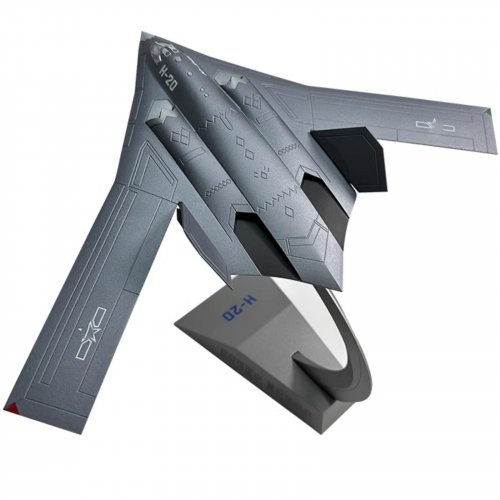
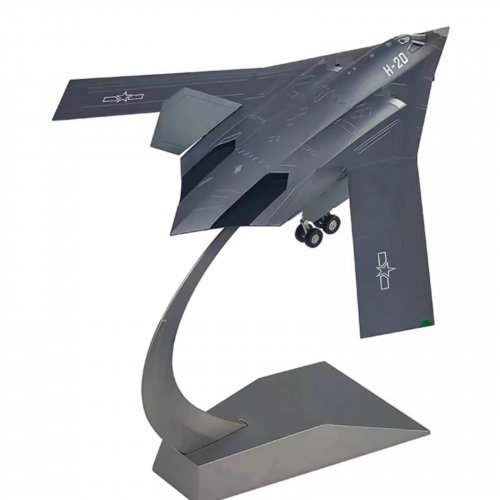
Not like the US had a lot of RQ180s, either (at least 10). Or U-2s before it (102 built, ~45 currently in service). Or even a lot of SR-71s (32) or A-12s (13).WZ-X is probably never going to be made in large quantities anyways, maybe a dozen or two.
Depends entirely on how trusting the Chinese are of their autonomy programs and control datalinks.GJ-X is the interesting one here, if it's the PLAAF's answer to the conventional strike portion of B-21's role than it could foreseeably be made in the hundreds and partially replace H-6K/Js in high risk missions.
You do know that the planned production of B-2s was 132, right? It was the collapse of the Soviet Union in the 1990s that saw production strangled.H-20 would then basically be relegated to mostly strategic bombing like nuclear missions to replace the current H-6Ns which also limits H-20's numbers, IMO likely only a few dozen will be produced at best, similar to planned B-2 numbers at the end of the 80s.
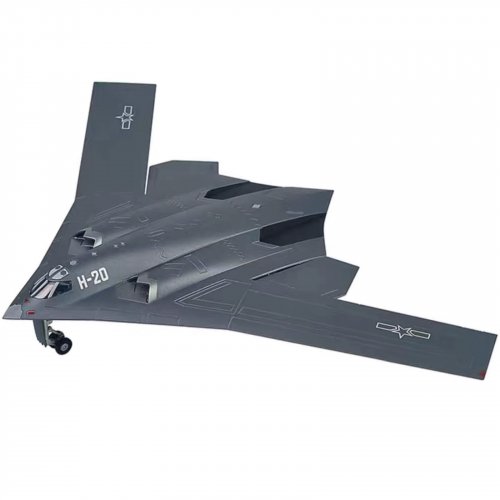
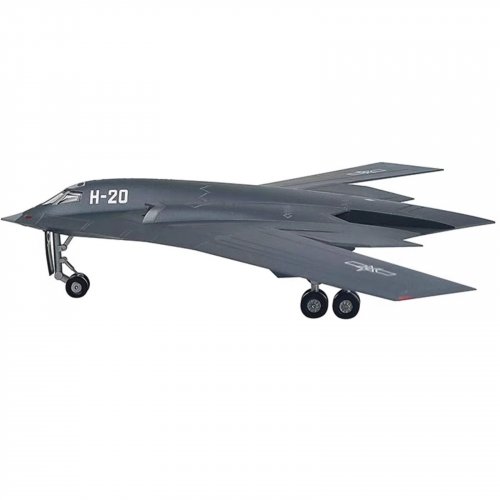
Yeah if this is real it wouldn’t be able to take off. The CG to where the landing gears are have way too much moment arm. Flying wings doesn’t have a lot of pitching moment authority and already have a hard time rotating to take off; this thing with its landing gear and tail placement wouldn’t be able to rotate at all.1/160 China H-20 Strategic Stealth Bomber Fighter Prototype Military Plane Model
That's not necessarily a problem, see Grandpa BUFF for an example of a plane that does not rotate on takeoff.Yeah if this is real it wouldn’t be able to take off. The CG to where the landing gears are have way too much moment arm. Flying wings doesn’t have a lot of pitching moment authority and already have a hard time rotating to take off; this thing with its landing gear and tail placement wouldn’t be able to rotate at all.
Besides you clearly being new to PLA watching, another part of your argument that does not make sense is the comparison to Germany. Frankly, if we were to make a more fitting and widely accepted analogy; modern China would be the US, whereas the modern US would be Imperial Japan.

Would have gone nicely with the 241 B-1As they'd planned to produce.Not like the US had a lot of RQ180s, either (at least 10). Or U-2s before it (102 built, ~45 currently in service). Or even a lot of SR-71s (32) or A-12s (13).
Depends entirely on how trusting the Chinese are of their autonomy programs and control datalinks.
You do know that the planned production of B-2s was 132, right? It was the collapse of the Soviet Union in the 1990s that saw production strangled.
If any airplane sitting on it's gear has its wing at a positive angle of attack, it does not need to rotate to take off. You leave the elevator at neutral and throttle up to takeoff speed and the airplane will lift off on its own. I fly takeoffs with tailless models this way all the time.Yeah if this is real it wouldn’t be able to take off. The CG to where the landing gears are have way too much moment arm. Flying wings doesn’t have a lot of pitching moment authority and already have a hard time rotating to take off; this thing with its landing gear and tail placement wouldn’t be able to rotate at all.
We don't have any good way to know.When do you all think this kind of stealth bomber will appear?
Yeah, I know, I expect PLA to eventually fully develop it's nuclear triad which involves massively expanding the stragetic bomber fleet from effectively zero right now to the high tens if not low hundreds along with replacing all the 09IVs with 09VIs as soon as possible given those are effectively moving target practice with missiles too short legged to hit most of CONUS from relatively safe seas.You do know that the planned production of B-2s was 132, right? It was the collapse of the Soviet Union in the 1990s that saw production strangled.
April First, 20XX...When do you all think this kind of stealth bomber will appear?
Yeah, then you need long ass runways to take off. This limits the number of bases from where you can take off. It’s not as much of a problem in the 50s when you didn’t have a constant stream of satellites looking over a handful of strategic bases. I would argue that being limited to runways with very long runways these days is very much an issue.That's not necessarily a problem, see Grandpa BUFF for an example of a plane that does not rotate on takeoff.

This model is absolute BSI think we are probably reading a little too much into this model.

So the exhaust isn't serrated, that's how I'm reading it. Rather than a straight trailing edge like the A-12
Hui Tong doesn't edit out the earlier bits; he leaves everything in chronologically.So the exhaust isn't serrated, that's how I'm reading it. Rather than a straight trailing edge like the A-12
That is a terrible design for reducing RCS.So the exhaust isn't serrated, that's how I'm reading it. Rather than a straight trailing edge like the A-12
It's China, giving practically every single base those very long runways is not an issue.Yeah, then you need long ass runways to take off. This limits the number of bases from where you can take off. It’s not as much of a problem in the 50s when you didn’t have a constant stream of satellites looking over a handful of strategic bases. I would argue that being limited to runways with very long runways these days is very much an issue.
Okay, that's a much better argument for that not being a likely representative model.There are other reasons why this isn’t real as well (unless whomever design this is an idiot or have unreasonable design requirements imposed upon them). By putting your main landing gears that far aft and that far outboard, you create huge load path issues. On any airplane your primary structural member is going to be your main wing spar. This will be near the C/4 of the wing. You want the shortest load path from the landing gears to the main spar while being as close to the aft most CG as possible. This is because when you land, all the load taken up by the wings will have to be transferred to the main landing gears. The further apart the main gears are from the wing spar, the heavier your structure will need to be in order to take that load. If you don’t then you’d have to make other sacrifices like reduce bring back weight (which defeats the purpose of a cavernous weapons bay depicted). Finally the trailing edge is relatively thin, this makes it much harder to put in a sufficiently thick structural member to take up the landing gear loads. So if this is real then the only explanation is they didn’t know what they are doing or they are faced with moronic design requirements. Neither of these are likely IMO; thus the conclusion that this is no way representative of what a H-20 would look like.
You do realize Hui Tong’s texts are basically a chronological compilation of every semi-trustworthy rumor we’ve heard about the H-20, right? Just because two words happen to appear close to each other in a paragraph doesn’t necessarily mean much, especially since we’ve been hearing all kinds of stuff about the H-20 for a very long time.That is a terrible design for reducing RCS.