My theory was the "redesign" was them pivoting the R&D into HALE bomber/ISR drones like the WZ-X and the GJ-X.

It is unclear what kind of mission and payload these aircraft will have, and moreover I wonder if they will have sufficient automation/communication to fulfill strategic bomber roles. At a minimum I doubt such platforms would be trusted with nuclear weapons.

IMO, these are efforts largely unrelated to the strategic bomber role (or else efforts that are supportive like ISR).
 
Forgive me if im misunderstanding what ur saying. But I feel like flying a high end bomber over the ocean- requiring multiple refueling- then over the CONUS is a massive logistical undertaking and intelligence risk as opposed to strike via submarine or something like that. the one thing i could see is it provides flexibility for negotiation/diplomacy in the event of a flashpoint- but i still dont really see the H-20 leaving asia.
 
If B-21 can have combat ranges up to 10k km, no doubt H-20 which is much larger and newer having the range to directly overfly coasts of CONUS without refueling should be expected.

I stated that figure off the top of my head and it may well be inaccurate; I was deliberately using a generous estimate to point out the huge ranges involved in the Pacific even for an aircraft with one of the most aerodynamically optimal shapes and very high engine efficiency.

Size is not the factor. All engine related things equal, fuel fraction probably is what you want to look at - the B-2 has a fuel fraction approaching 0.5 which is on the high side already. You can trade payload for fuel to some extent, but I do not see H-20 flying over the CONUS with anything like a strategic bomber sized payload. I would presume cruise missiles are available and likely new types designed specifically for the aircraft and mission, and other posters Indicate ballistic missiles are an option.
 
Last edited:
"For now that would be JingLei-1 which has a range of 8000Km as stated by official media"

Already explained the Primary role of H20, It will replace H6 as air leg of triad so we have to assume H20 will carry the only air launched nuke vehicle in service right now aka JL1.

I am not aware of any LRSO counterpart being in development for now and given the place of ALBMs in PLA doctrine I don't see one being developed anytime soon either so JL1 is our only option for the time being.

I cannot imagine H-6K/J/N being taken out of service anytime soon; they are all relatively new aircraft. And anything carrying a >10 meter long bomb bay is going to be a monstrous aircraft. I think it more likely JL-1 continues to equip H-6 and that weapons much more compact are in development for H-20.
 
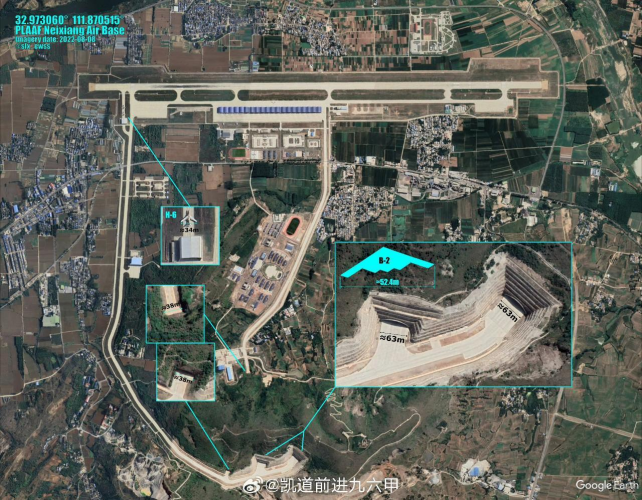
It's never been posted here so ill post this here, since this was discussed already on SDF in august.

Neixiang air base which is only known to host bombers of the PLAAF added new underground shelters that are 63m wide sometime before 2022.

You can see that underground shelters for the H-6 are roughly 38m wide in comparison. (I didn't create the graphic btw)

I'm not entirely convinced this is some kind of new shelter for the H-20? These were built in the very early 2020s, and H-20 is still not known to exist. So they could be very well for other things.

View: https://twitter.com/sfx_ewss/status/1945720370897768829?s=20

1764448853938.png
 
I would think that the H-20 was probably based on the size of the B-2 especially for the PLAAF's long term strategic goals of targeting beyond the second island chain as they currently see it, so anything being the size of the B-21 would just not be good enough.
Remember that the B-21 has better range than the B-2.

Let's talk expected payloads for a second.

B-2 has 2 bays, each roughly the size of the B-52's bay. B-21 has 1 bay at least the size of a B-2 bay, due to the need to carry MOP.

IMO B-21 traded half the B-2's bombload for more fuel. (grossly over-simplifying)

The Chinese could certainly do that as well, building a roughly B-2-sized airframe with just one bomb bay to leave more room for fuel. Use 4x CFM56-efficiency-class engines to lift all the fuel.
 
As for the bypass stuff it should go into its own thread so the experts can properly weigh-in but just think through how different BPR turbofans work and then scale it to the mass of these aircraft and the altitudes and air density they would typically fly.
 
New MOP replacement is smaller, though...

B-21 design freeze was something like 2018 and MOP production was to increase by 4x; hard to imagine the USAF intends to retire the type post B-2.

We know that LRSO is going into B-21 and we can guess that it is roughly AGM-86 in size and weight, with any new efficiency probably dedicated to range not size reduction. If we assume that B-21 will use an 8 round rotary launcher like every other active US bomber, that gives us a payload of roughly 25,000. It is hard to imagine 30,000 is unworkable, particularly as the B-2s nominal warload is 45,000 lbs, which means that to carry two it must be deleting ~15,000 lbs of its 167,000 lbs of max fuel load.
 
Seems like all you'd need to do is collapse the entrance and crater the taxiway.
I suspect, depending on internal arrangement of the shelter, both can be cleared out very fast with appropriate mechanization.
I honestly didn't think such large arcs make sense from fortification point of view, but Chinese, yet again, just build things.
 
B-21 design freeze was something like 2018 and MOP production was to increase by 4x; hard to imagine the USAF intends to retire the type post B-2.

We know that LRSO is going into B-21 and we can guess that it is roughly AGM-86 in size and weight, with any new efficiency probably dedicated to range not size reduction. If we assume that B-21 will use an 8 round rotary launcher like every other active US bomber, that gives us a payload of roughly 25,000. It is hard to imagine 30,000 is unworkable, particularly as the B-2s nominal warload is 45,000 lbs, which means that to carry two it must be deleting ~15,000 lbs of its 167,000 lbs of max fuel load.
There's a trick in there, when a B-2 carries a MOP.

The normal bombload is rated with either the rotary launcher or the BRA installed. Something that holds a good 25,000lbs isn't going to be light, I think @mkellytx said the rotary launcher was around 6000lbs. So when the rotary launcher gets removed, that opens up a little more weight that the plane can carry.
 
There's a trick in there, when a B-2 carries a MOP.

The normal bombload is rated with either the rotary launcher or the BRA installed. Something that holds a good 25,000lbs isn't going to be light, I think @mkellytx said the rotary launcher was around 6000lbs. So when the rotary launcher gets removed, that opens up a little more weight that the plane can carry.
@Scott Kenny I don't recall posting that. However, 6,000 lbs feels a bit high. The CSRL carries 8 up to 4,000 lb weapons, but it's weight was never as impactful as HSAB's.
 
B-2 AARL weights much less. Less than one tonn AFAIR
 
https://www.twz.com/air/china-just-...lth-bomber-global-strike-commands-top-general
"I can certainly understand their [the Chinese] desire to have a long-range strike capability like the United States, and I know that they’re pursuing it aggressively"

"What I can tell you is they’re just not there yet. I think our adversaries look at our long-range strike capabilities, and … want to mimic them, but they can’t."
 
I know China has been known to pull a rabbit out of its hat all the time across many areas of technology, but they have never built a bomber from scratch. And building a stealth bomber from no previous full development experience must be a little challenging. If nothing else, I think engine development of the kind of efficiency they would need to reach their stated goals would be problematic. It is worth noting that J-36 uses three existing engine types, and all the extra weight, volume, complexity, and maintenance that involves. That indicates to me new engines are still somewhat of a stumbling block. And more efficient , higher bypass engines if anything are something their industry has less experience with.

But in any case, short story, we haven’t seen anything H-20 like flying around. There is a large drone of that size, but it’s unclear what the role or capabilities are, and it is clearly unmanned. So I think it is fair to say H-20 is still months or years from first flight.

On the bright side, I have no doubt it exists and will fly, unlike PAK-DA.

 
I know China has been known to pull a rabbit out of its hat all the time across many areas of technology, but they have never built a bomber from scratch. And building a stealth bomber from no previous full development experience must be a little challenging. If nothing else, I think engine development of the kind of efficiency they would need to reach their stated goals would be problematic. It is worth noting that J-36 uses three existing engine types, and all the extra weight, volume, complexity, and maintenance that involves. That indicates to me new engines are still somewhat of a stumbling block. And more efficient , higher bypass engines if anything are something their industry has less experience with.

But in any case, short story, we haven’t seen anything H-20 like flying around. There is a large drone of that size, but it’s unclear what the role or capabilities are, and it is clearly unmanned. So I think it is fair to say H-20 is still months or years from first flight.

On the bright side, I have no doubt it exists and will fly, unlike PAK-DA.

China does care a lot about its image and currently they are publicly posturing towards regional supremacy. Given that, I imagine they are fine keeping the H-20 under wraps for now. The reveal of such an aircraft might escalate geopolitical tensions due to a perceived shift in posture (regional to global).
 
Oh those are some famous last words. Maybe they'll roll out their H-20 the next time he's in that part of the world.
Tbf, rolling out something isn't capability.

Capability is trained unit, or at least a production representative prototype with crew, which can be used to deliver token missions in extreme circumstances. This is many years away.
 
China does care a lot about its image and currently they are publicly posturing towards regional supremacy. Given that, I imagine they are fine keeping the H-20 under wraps for now. The reveal of such an aircraft might escalate geopolitical tensions due to a perceived shift in posture (regional to global).

It seems super unlikely China does not care about its image when it spend vast amounts of political clout forcing other countries to accept its image.

We will see H-20 when the Chinese are capable of making H-20; they have hardly been shy about new technology. If anything there current activities seem far more calibrated to “hey! Look at me!”

We will see H-20 when China is capable of flying H-20.
 
China seems to be building experience on large composite airframes. Maybe after they got air data on GJ-X then they'll proceed with H-20. If H-20 is a B-21 and not a supersonic airframe (far less likely). They can assemble their own high bypass engines and fiddling with the parts from there is a good start.
 
China seems to be building experience on large composite airframes. Maybe after they got air data on GJ-X then they'll proceed with H-20. If H-20 is a B-21 and not a supersonic airframe (far less likely). They can assemble their own high bypass engines and fiddling with the parts from there is a good start.
I don't believe that the H-20 will be supersonic.

Not even the US has gone for a supersonic stealth bomber.
 
I don't believe that the H-20 will be supersonic.

Not even the US has gone for a supersonic stealth bomber.
Depends on whether they want to drop JDAMs or uber long range missiles on CVNs.

Something like an ultra VLO LAMPS (high subsonic cruise and M2 dash at high alt) would be fairly manageable, as they already have supercruise capable TPS on the latest J-20 lot.
 
I'm surprised anyone would think that the PRC aerospace industry of 2026 would be particularly challenged to develop a modern strategic stealth bomber.

There's been far too many of these "they have no prior experience with XYZ" that end up getting shown up in recent history, you'd think people would learn to actually track their industry and R&D instead.
 
I'm surprised anyone would think that the PRC aerospace industry of 2026 would be particularly challenged to develop a modern strategic stealth bomber.
Well, developing strategic bombers is challenging task for everyone. If you look carefully into their development programs, straighfotward developments without controversies is rarest of exceptions.
Tbh only B-52 sort of counts, if you consider throwing out entire first batch as uncontroversial. Maybe b-21 will, but this is maybe in the future.

PRC, as of today, hasn't developed all that many heavy aircraft completely by itself in the first place.
There's been far too many of these "they have no prior experience with XYZ" that end up getting shown up in recent history, you'd think people would learn to actually track their industry and R&D instead.
Building something doesn't mean it isn't challenging. It means higher development risks, which may (likely, risk isn't absolute by definition) take money and time to solve.
China running H-20 program shouldn't have prohibitive risks. While we don't have much insight into H-20 program, it has been around the corner for enough time. Some controversies under the table are rather likely - and we may have heard rumors about them ("revised more ambitious specifications").
 
Well, developing strategic bombers is challenging task for everyone. If you look carefully into their development programs, straighfotward developments without controversies is rarest of exceptions.
Tbh only B-52 sort of counts, if you consider throwing out entire first batch as uncontroversial. Maybe b-21 will, but this is maybe in the future.

PRC, as of today, hasn't developed all that many heavy aircraft completely by itself in the first place.

Building something doesn't mean it isn't challenging. It means higher development risks, which may (likely, risk isn't absolute by definition) take money and time to solve.
China running H-20 program shouldn't have prohibitive risks. While we don't have much insight into H-20 program, it has been around the corner for enough time. Some controversies under the table are rather likely - and we may have heard rumors about them ("revised more ambitious specifications").

There is a difference between something being "challenging" or "being challenged by" as part of general project development efforts for a new type of product, versus being "challenging" in the sense that a project's pursuit or prosecution is considered "pulling a rabbit out of a hat".

The reason I make that distinction, is that almost every new generation project that the PRC has developed since the 1990s (if not earlier) has been "challenging" -- J-8 upgrades, J-10, J-11B, J-15, J-20, Y-20, J-35/A -- so many of them were carried out without prior precedence or industry experience or equivalent. And this is ignoring more recent efforts like J-36, J-XDS, and the huge (strategic bomber sized) GJ-X and WZ-X UAVs.
I would hazard to say that with the industry experience, resourcing and funding they have now, that developing a modern VLO bomber today will probably be less of a relative challenge for them than say, developing J-10 or J-20 was for them back in the day.


Putting it another way, there is a difference between "having never done something before" and "within means of doing something based on assessment of present experience, industry competency, resources, and funding". And some of the comments are just going with the former rather than having a look at the actual latter.
That doesn't mean the strategic bomber project may not have delays or funding overruns or hiccups -- but what it does mean is objectively as of 2026 the question of "is it within their means to develop a modern strategic bomber" the answer should be "obviously yes".
 
Putting it another way, there is a difference between "having never done something before" and "within means of doing something based on assessment of present experience, industry competency, resources, and funding". And some of the comments are just going with the former rather than having a look at the actual latter.
That doesn't mean the strategic bomber project may not have delays or funding overruns or hiccups -- but what it does mean is objectively as of 2026 the question of "is it within their means to develop a modern strategic bomber" the answer should be "obviously yes".
Correct.

The question is not "will the Chinese develop a strategic bomber" but "when will they deploy one".

But that seems to be taking a bit of time.
 
Correct.

The question is not "will the Chinese develop a strategic bomber" but "when will they deploy one".

But that seems to be taking a bit of time.

I remember back in mid 2023 there was some noise from the PRC language grapevine that their next gen fighter projects would emerge earlier than H-20, which was a slight surprise in the sense that it both conveyed their 6th gen projects were a bit more ahead than the community expected, and that the H-20 may have been revised even more than expected.

Now as of early 2026 of course, that statement has borne out entirely true, but H-20 (or whatever its name will be) is very much still on the cards, though we don't fully know what it'll look like.
Given they have a near B-21 sized flying wing UCAV in the "GJ-X" it's somewhat less likely that H-20 will be "only" a flying wing of the same planform, but at the same time going for a large airframe which is both stealthy and supersonic is probably a bit much. So we are somewhat still in the dark.
 
Then the next question is combined platform/armament range and payload mass.
I would expect something between 100 and 150 tons MTOW, with a payload mass on the order of 12 tons. Range of a good 10,000km, maybe more, depends more on engine efficiency than fuel weight. Armament range of 500-1500km, depending on just what gets loaded.

Xiao-Raider, in other words.
 
Oh those are some famous last words. Maybe they'll roll out their H-20 the next time he's in that part of the world.
Maybe, but I think what he said has some merit to it. Long range aviation is a difficult thing to master, although the mission looks simple on paper. Let's not forget that right now only two countries operate true strategic bombers, the US and Russia. With the US being the only one that can fully leverage the intercontinental portion thanks to a more robust aerial refueling fleet.

I have no doubt that the H-20 will succeed, but I do think that it's development has proven more difficult to XAC than many would have anticipated. We should keep in mind that the evolving landscape of threats and countermeasures doesn't apply unilaterally to the US, it also does for China. So I imagine that some of the earliest and I mean the very earliest concepts for H-20 had to be either discarded or heavily revised. Simply because of how the world changed over the years, the PLAAF might have wanted something more future proof or something more ambitious than initially planned. It's certainly a very different task than their H-6 was.

I also think it's noteworthy that as we speak all three of the major nuclear powers, being the US, China and Russia, have an ongoing program for a new strategic bomber. It's certainly quite the time to be alive if one likes bombers and the first time in decades this is happening. Truly "Second Cold War" vibes.
 
but at the same time going for a large airframe which is both stealthy and supersonic is probably a bit much.
Is it though? The 'J-36' is already a fairly large, tri engine aircraft with two people inside. To me it seems like quite the task but not Impossible to scale up the design to a large quad engine jet, albeit with all intakes on the top side. Especially the first configuration of the CAC design, with it's exhaust configuration, might be very promising for a bomber.

Could you imagine that the first prototype may have carried out sub-scale real world validation for XAC in that regard? It could explain why the subsequent aircraft had a different exhaust configuration. But I'm not aware how much the individual design houses under AVIC cooperate. So maybe you can offer some insight there.
 
Is it though? The 'J-36' is already a fairly large, tri engine aircraft with two people inside. To me it seems like quite the task but not Impossible to scale up the design to a large quad engine jet, albeit with all intakes on the top side. Especially the first configuration of the CAC design, with it's exhaust configuration, might be very promising for a bomber.

Could you imagine that the first prototype may have carried out sub-scale real world validation for XAC in that regard? It could explain why the subsequent aircraft had a different exhaust configuration. But I'm not aware how much the individual design houses under AVIC cooperate. So maybe you can offer some insight there.
There's nothing magical about supersonic heavy aircraft since 1950s.
It'll just cost more, and will perform worse at some of important considerations, one way or another.

Let's be frank, all too many people wanting to see a supersonic aircraft are looking for bragging rights. Air force looks for a tool.
 
Aside from cost I don't really see the drawbacks of a supersonic strategic bomber over a conventional one. Maybe payload? But subsonic stealth bombers aren't exactly payload wonders either.
 
Aside from cost I don't really see the drawbacks of a supersonic strategic bomber over a conventional one. Maybe payload? But subsonic stealth bombers aren't exactly payload wonders either.
Substantially less stealthy configuration, all things considered; far lesser loiter (don't even try swing wings, Anakin; not like they'll help to offest this much anyway), substantially more service (as if stealth bombers don't have enough).

Ultimately, strategic bomber is deterrent first, transport system second.
 
Substantially less stealthy configuration, all things considered; far lesser loiter (don't even try swing wings, Anakin; not like they'll help to offest this much anyway), substantially more service (as if stealth bombers don't have enough).

Ultimately, strategic bomber is deterrent first, transport system second.
But it makes up for that with sheer speed, i.e. getting in and out quicker, faster reaction time. Thus loiter time is less important, do bombers even loiter much these days? While maintenance falls under the cost category.
 
Aside from cost I don't really see the drawbacks of a supersonic strategic bomber over a conventional one. Maybe payload? But subsonic stealth bombers aren't exactly payload wonders either.

If cost and little to no stealth weren't an issue I suspect that there are some airforces that would love to have a B-58 Hustler with a 21st century update.
 

Similar threads

Back
Top Bottom