I'd put some Blighter A400 panels (or the circular ones on the Paladin S3, believe they're Polish) on the mast rather than the Giraffe 1X on the mount. Keep it simple and as cheap as possible. Such panels offer more than enough range for such an application, without adding huge cost.
The Polish ones are rectangular, they're part of the FieldCTRL family of radars from Advanced Protection Systems.

For a notional CAMM-SR I think the route to take would be the seeker on existing unguided rocket route (like APKWS). Essentially you'd be using the CAMM name as a 'brand name' like Spike. The real trick then would be if you could make a cheap enough turnover pack to make SVL really viable for it, that way you could maximise range and minimum engagement distances, obviously for trainable launch you could ditch the turnover pack. As for seeker stick to SAL, unless a really cheap seeker option is available.
Not sure if such a missile would be able to counter any of the more capable threats tbh, and as far as I understand, @zen 's idea is a more general-purpose surface to air missile, not necessarily focused on C-UAS like the APKWS and similar missiles, but short enough so that it can be stored on a vehicle vertically, kinda like on the Tor system. I don't think that SAL is the optimal guidance method here though, as it limits the number of targets that can be engaged at once.

I would suspect that any canister for an IR missile or other relatively fragile seeker would have an opening lid of some sort. MML had a hinged flap on its AIM-9X and Hellfire canisters, for example.
Fair, especially if the canisters would be field-reloadable like in the NASAMS.
 
Last edited:
Not sure if such a missile would be able to counter any of the more capable threats tbh, and as far as I understand, @zen 's idea is a more general-purpose surface to air missile, not necessarily focused on C-UAS like the APKWS and similar missiles, but short enough so that it can be stored on a vehicle vertically, kinda like on the Tor system. I don't think that SAL is the optimal guidance method here though, as it limits the number of targets that can be engaged at once.

The idea behind a 'CAMM-SR' would primarily as a C-UAS round, its main role would be self defence for the SAM battery itself (or naval platform). Sure it could deal with a cruise missile as well, but only with a degree of luck (the missile flying very close to it). As for SAL guidance, the point would be to keep the cost down as low as possible. IF a suitable lo-cost seeker could be developed and deployed it could use that instead.
 
I can see two paths for CAMM-SR.
The Hi cost option is essentially a shorter range CAMM able to be fired vertically even from a moving vehicle. Vaguely like Tor.

This would allow IR and AR options and potentially provide a more densely packable WVRAAM on aircraft as well.

The Lo cost option could use SAL or even offboard guidance by datalink....modern ACLOS Essentially.

Arguably both could have a place.
 
I can see two paths for CAMM-SR.
The Hi cost option is essentially a shorter range CAMM able to be fired vertically even from a moving vehicle. Vaguely like Tor.

This would allow IR and AR options and potentially provide a more densely packable WVRAAM on aircraft as well.

The Lo cost option could use SAL or even offboard guidance by datalink....modern ACLOS Essentially.

Arguably both could have a place.
I agree, there are two problems to be solved.
The first is that CAMM as it stands is slightly too big for the sensor, C&C and a sensible number of missiles all to fit in e.g. a Boxer module or container. That requires a missile that can be stored vertically or when horizontal minimise the length required. CAMM is also too heavy to be reloaded at sea into angled launchers as RAM is. So there is a requirement for a slightly cheaper missile but where the main need is for compactness.
The second is that CAMM is too expensive for many of the targets it would be facing in a future conflict. The benchmark CAMM was designed for was defending warships against attacks by supersonic anti-ship missiles, but OWEs and smaller drones are the main enemies on land even at the high value targets Sky Sabre defends. Here, too, compactness is a key requirement but the key is to stay roughly cost competitive with low-cost attacks.

For the Hi requirement I don't think much change is necessary from base CAMM. An IR seeker might give better performance against stealthy targets like anti-ship missiles and a shorter body is needed but the current wider booster gives better acceleration than competing systems like RAM. Perhaps swapping the turnover pack for thrust vectoring would save length too, and add manoeuvrability?

For the Lo requirement the best way IMO would be to effectively recreate IR APKWS from the ground up as a dedicated missile. SAL and other semi-active systems limit rate of fire and impose extra requirements on launch vehicles, but if Cambridge Aerospace can build AR seekers competitively with Shahed cost I don't see why MBDA couldn't do the same. LMM making use of its supposed modularity with an IR seeker would have a similar effect, but vertical launch would be better.
 
I think it's quite plausible for CAMM itself to maybe reverse leverage CAMM-MR's larger diameter rocket motor back down to produce a missile effectively of CAMM range or CAMM-ER range.
Ideally producing a shorter length missile that fits VL onboard a vehicle like Boxer or whatever other vehicle we might be exploring for that role. But VL similar to Tor.
If this mates with a 'big bore' ASRAAM, challenging MICA and results in more production of various elements. Then all to the good.
Though I suspect JTAM is changing this......

My theory on CAMM-SR options is having a common back end and motor results in larger production runs of said elements. Which should bring down costs.
By all means if a low cost radar seeker is possible.....lets add that into the options list for this.

I do like the idea of keeping soft VL for this and arguably I'd explore a Martlet LMM and Starstreak HVM successor that removes to need for soldiers to point the missile at the target.
Just keep the missile tube vertical and let the technology do the work.

I'd go further on the optical system the soldier uses and if we can feed the target over to nearby CAMM-SR as well.....we've got layered and appropriate selection of response effectors to the target type.

The big thing I haven't seem is a land or ship equivalent of JSF's DAS Distributed Appature Sensor system.
That stitches in real time multiple EO/IR images together for a 360 view.
Because with modern recognition software, it may be possible to feed something like CAMM a target from such completely passive sensors.

Though maybe that needs additional sterioscopic ranging optics?
 
I think it's quite plausible for CAMM itself to maybe reverse leverage CAMM-MR's larger diameter rocket motor back down to produce a missile effectively of CAMM range or CAMM-ER range.
Ideally producing a shorter length missile that fits VL onboard a vehicle like Boxer or whatever other vehicle we might be exploring for that role. But VL similar to Tor.
If this mates with a 'big bore' ASRAAM, challenging MICA and results in more production of various elements. Then all to the good.
Though I suspect JTAM is changing this......
I assume you mean a more or less beer-can shaped missile?

The Macross Missile Massacre/Itami Missile Massacre may live yet! :D

That said, a missile with those proportions is pretty draggy so it'll cost you range.


I do like the idea of keeping soft VL for this and arguably I'd explore a Martlet LMM and Starstreak HVM successor that removes to need for soldiers to point the missile at the target.
Just keep the missile tube vertical and let the technology do the work.
It's easier for the soldier to point a tube more or less at the target just in terms of balancing the load on your shoulder.


I'd go further on the optical system the soldier uses and if we can feed the target over to nearby CAMM-SR as well.....we've got layered and appropriate selection of response effectors to the target type.
That would require the individual soldier to radiate a datalink, and with a (heavy) computerized optic on their weapon.

I think it'd be more viable for vehicle sensors to tie in.


The big thing I haven't seem is a land or ship equivalent of JSF's DAS Distributed Appature Sensor system.
That stitches in real time multiple EO/IR images together for a 360 view.
Because with modern recognition software, it may be possible to feed something like CAMM a target from such completely passive sensors.

Though maybe that needs additional sterioscopic ranging optics?
I've seen proposals for ship to have such a setup.

It'd be relatively easy to do that on vehicles, but would need some fancy anti-static/anti-dust coating on the lenses.
 
It's easier for the soldier to point a tube more or less at the target just in terms of balancing the load on your shoulder.
It's easier to point an optics package without the weight of the missile on your shoulder.
That would require the individual soldier to radiate a datalink, and with a (heavy) computerized optic on their weapon.
Depends. Fibre optic cable when the missile is just behind you with a fellow holding it upright on the ground. No emissions until missile motor start.

Not that heavy really.

Sky Sabre already uses datalinks, of LPI technology and fiber is viable.
 
I’m thinking back to the days when ships were still equipped with a variety of weapon systems. The right, cost-effective weapon for every type of target. It will come.
 
For the Hi requirement I don't think much change is necessary from base CAMM. An IR seeker might give better performance against stealthy targets like anti-ship missiles and a shorter body is needed but the current wider booster gives better acceleration than competing systems like RAM. Perhaps swapping the turnover pack for thrust vectoring would save length too, and add manoeuvrability?

For the Lo requirement the best way IMO would be to effectively recreate IR APKWS from the ground up as a dedicated missile. SAL and other semi-active systems limit rate of fire and impose extra requirements on launch vehicles, but if Cambridge Aerospace can build AR seekers competitively with Shahed cost I don't see why MBDA couldn't do the same. LMM making use of its supposed modularity with an IR seeker would have a similar effect, but vertical launch would be better.
That sounds somewhat familiar tbh. Not sure how relevant it is to this discussion, but I guess it can at least serve as a comparison of sorts, since there are some similar development works here in Poland.
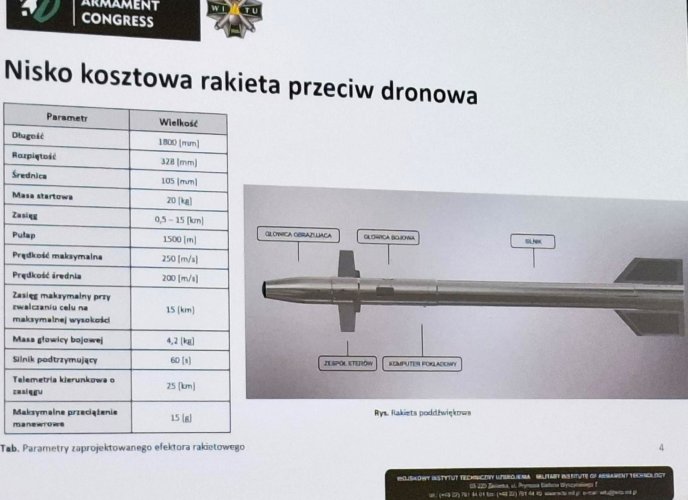
First is the 105 mm C-UAS missile, with a two way data link (which I assume means that command guidance is possible) as well as an IIR seeker (just on renders as of now though) and a maximum range of 15 km, though a rather slow Vmax of just 250 m/s. The missile itself is just 1,8 meters long, which would make it perfect for frontline systems, even ones using vertical launch.
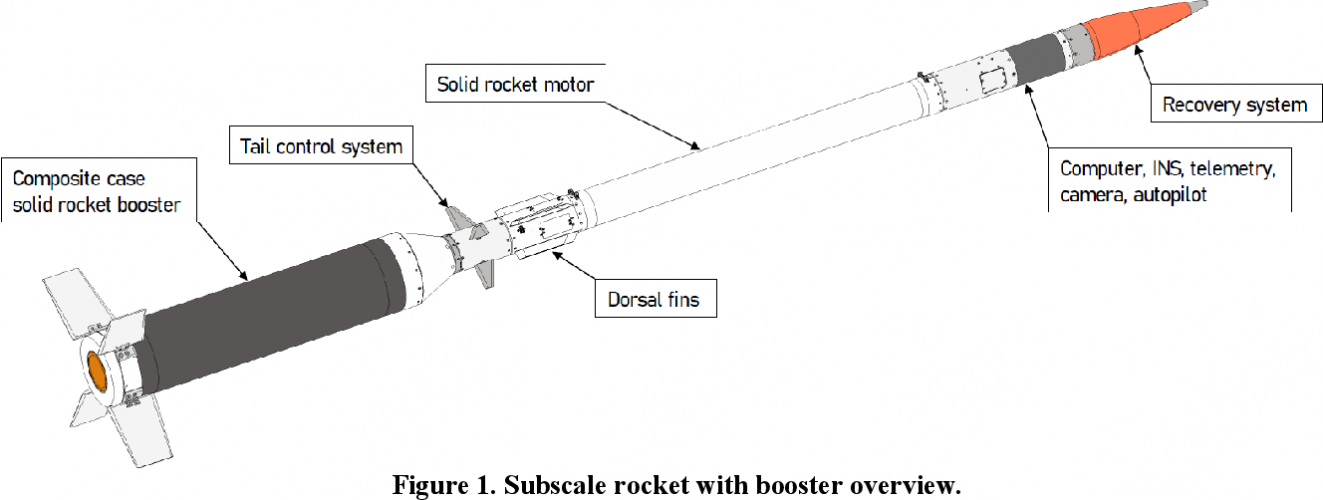
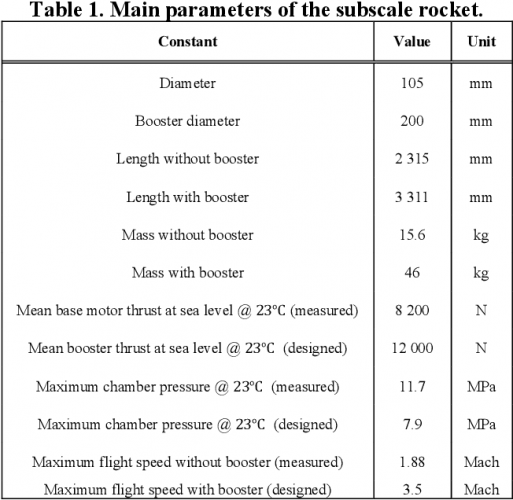
The second development is the "Object 105", a scale model of a 300 mm suborbital rocket*. It comes in two flavors, a single stage one, 2,3 meters long, and a two stage one, 3,3 meters long with a 200 mm booster. These lengths match the length of the Strela-10 (single stage) and the Osa (boosted) missiles, which might be the sign as to what these were meant to be developed into. That project unfortunately went nowhere as our MoD wasn't (and still isn't) interested in developing domestic VSHORAD and SHORAD SAMs, but there is quite a bit of performance data in some research papers (including the table below), so maybe someone could calculate some performance estimates here.
And both of these 105 mm missiles seem kinda similar to the concepts you're describing here, so I thought they're relevant enough to describe here.


*that whole project itself just screams dual use btw - the consortium is led by two military research institutes, the engine calibers (105, 200, 300 and 610 mm) enable usage in military projects, and the whole rocket is designed with maneuverability in mind, unusual for a civilian rocket.

P.S. I'm also pretty sure these could be soft launched, as Mesko did some experiments with soft launching missiles of similar size, specifically with the turnover pack design.
 

Attachments

  • 3-Figure1-1.png
    3-Figure1-1.png
    64.5 KB · Views: 92
  • 2-Table1-1.png
    2-Table1-1.png
    40.3 KB · Views: 76
  • dbNniWhDplvKsAYCs4igzvPgURnfQAjmseg6GwiI.jpg
    dbNniWhDplvKsAYCs4igzvPgURnfQAjmseg6GwiI.jpg
    265.7 KB · Views: 73
  • GahNl0SXUAARrw9.jpg
    GahNl0SXUAARrw9.jpg
    202.9 KB · Views: 72
Last edited:
The big thing I haven't seem is a land or ship equivalent of JSF's DAS Distributed Appature Sensor system.
That stitches in real time multiple EO/IR images together for a 360 view.
Because with modern recognition software, it may be possible to feed something like CAMM a target from such completely passive sensors.

See ADAD...in use for decades by the UK....now likely to be replaced by Spynel-X (which has far greater resolution, but doesn't rotate anywhere like as fast as ADAD).

EO/IR staring arrays are pretty standard on warships these days, alongside the EO/IR turrets, usually mast mounted.
 
Last edited:
The big thing I haven't seem is a land or ship equivalent of JSF's DAS Distributed Appature Sensor system.
That stitches in real time multiple EO/IR images together for a 360 view.
Because with modern recognition software, it may be possible to feed something like CAMM a target from such completely passive sensors.
CAMM TELs already come equipped with optronic masts(unique among EU SAM options, though IRIS can have it as a add on package).

DAS with passive AI ranging(fancy way of saying counting pixels) is a bit later tech stack than these systems though.
 
CAMM TELs already come equipped with optronic masts(unique among EU SAM options, though IRIS can have it as a add on package).

Thats one of the reasons why I think a 'CAMM-SR' should be an APKWS type rocket with SAL.
 
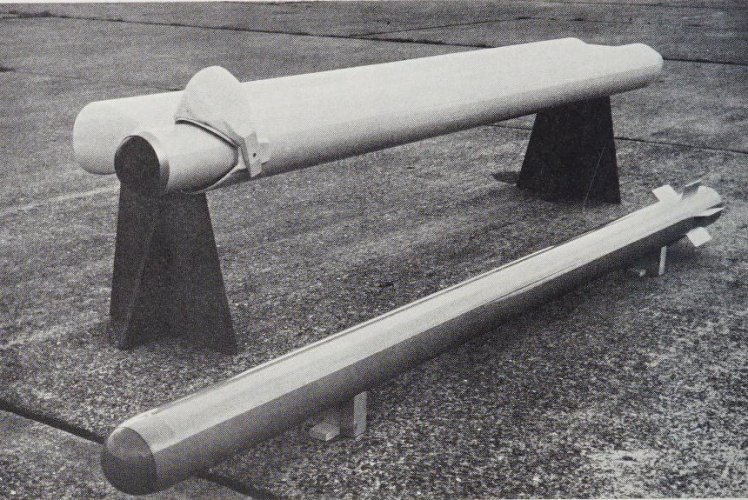
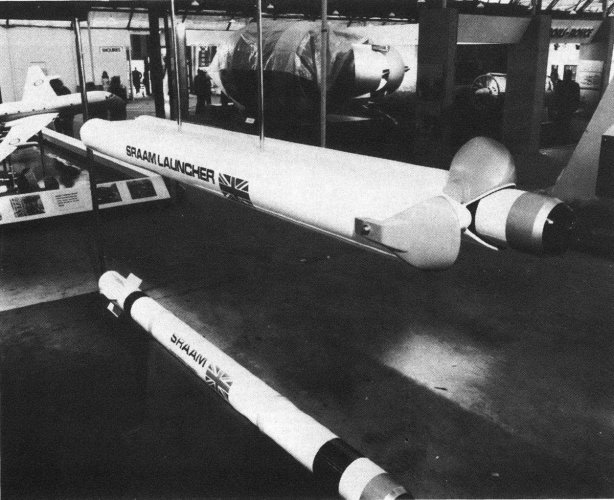
Hawker Siddeley Dynamics lightweight, short-range air-to-air missile (SRAAM) being devel-
oped tor the British Ministry of Defense. is mounted above side by side on single |aunch
beam that can be slung from strong points under wings, or from belly points. Solid fuel mis-
sile is 2.73 meters long and 0.168 meters in diameter.
AWST 11 Sep 1973
 

Attachments

  • SRAAM2.jpg
    SRAAM2.jpg
    452.7 KB · Views: 53
SRaAM-75 Contract

London—Hawker Siddeley Dynamics was
awarded a project definition study con-
tract last week for its Sraam-75 (short—
range air-to-air missile) for Royal Air
Force McDonnell Douglas Phantom F-4
fighters and eventually for the multi-role
combat aircraft (MRCA).
The weapon is a follow-on to the Hawker
Siddeley Taildog infrared air
combat missile, which has not gone into
production. Another version, the longer-
range Sraam 100, has been dropped for
the time being,
Since development of Sraam-75 will
delay arming Phantoms, the Ministry of
Defense has ordered a batch of Ray—
theon Sparrows to keep the inventory to
combat strength, In the meantime,
Hawker Siddeley Dynamics also has
been awarded a feasibility contract on
fitting Sparrows with components devel—
oped by Marconi Space and Defense,
Ltd., and EMI, Ltd., to reduce dollar costs.
AWST 6 March 1972
 
SRAAM instead of Sparrows?!?

Say what now?

I could see Taildog/SRAAM as gun replacements. 8x SRAAMs is about the same weight as either a pair of ADEN 30mm or the GAU12+ammo pod on Harriers. Load that onto your P1216 in place of the BK27.

But SRAAM is not a replacement for Sparrow. Wrong range, wrong engagement modeling.
 
SRAAM 100....?

Ok forgot this.
It's on this thread around page 1.
 
Last edited:
SRAAM instead of Sparrows?!?

Say what now?

I could see Taildog/SRAAM as gun replacements. 8x SRAAMs is about the same weight as either a pair of ADEN 30mm or the GAU12+ammo pod on Harriers. Load that onto your P1216 in place of the BK27.

But SRAAM is not a replacement for Sparrow. Wrong range, wrong engagement modeling.

In 1972, Sparrow was looking decidedly crap. At this same time, Germany was buying the F-4F without Sparrow specifically as an interceptor, because the Sparrow capability was deemed not worth the money.

Edit: Some later thoughts. I don't think the RAF even had Sidewinder in 1972. The RN did, but the RAF may not have gotten it yet. The first tranche of F-4M (FGR.2) were primarily used as strike aircraft, and the Sparrow (counter-intuitively) might have been preferred. It had an all-aspect capability, so you could shoot it in the face of interceptors without getting into a turning fight (and dumping A2G ordnance) like the tail-aspect Sidewinders of the time demanded.
 
Last edited:
SRAAM instead of Sparrows?!?

Say what now?

I could see Taildog/SRAAM as gun replacements. 8x SRAAMs is about the same weight as either a pair of ADEN 30mm or the GAU12+ammo pod on Harriers. Load that onto your P1216 in place of the BK27.

But SRAAM is not a replacement for Sparrow. Wrong range, wrong engagement modeling.
The actual plan was to fit AIM-7E2 Sparrow with a new seeker, which became Skyflash, in addition to SRAAM-75 - the article frames this as for purely financial reasons but the Marconi seeker was very much an upgrade. It was even considered for US Sparrow at one point.

Then of course SRAAM-75 was canned to save money.
 
In 1972, Sparrow was looking decidedly crap. At this same time, Germany was buying the F-4F without Sparrow specifically as an interceptor, because the Sparrow capability was deemed not worth the money.
The Germans, however, tell the story differently. According to them, Sparrow was not selected because the F-4 was procured only as a stopgap measure and primarily for air-to-ground missions. The radar also lacked the module required to use Sparrow.
 
The Germans, however, tell the story differently. According to them, Sparrow was not selected because the F-4 was procured only as a stopgap measure and primarily for air-to-ground missions. The radar also lacked the module required to use Sparrow.

That was what I thought, the F-4F just didn't have the systems (although I guess they procured it for a reason like that).
 
Edit: Some later thoughts. I don't think the RAF even had Sidewinder in 1972. The RN did, but the RAF may not have gotten it yet. The first tranche of F-4M (FGR.2) were primarily used as strike aircraft, and the Sparrow (counter-intuitively) might have been preferred. It had an all-aspect capability, so you could shoot it in the face of interceptors without getting into a turning fight (and dumping A2G ordnance) like the tail-aspect Sidewinders of the time demanded.
You're right, that is very counter-intuitive. But we did have that same conversation around AIM-9Cs on F-104s.
 
That was what I thought, the F-4F just didn't have the systems (although I guess they procured it for a reason like that).

They chose to modify the F that way. Exactly why gets confusing. I think they were saving manpower, mostly.

I believe they even considered removing the rear seat completely but that was too much work so the Fs had a simplified rear cockpit that was mostly left empty operationally.

There was a company proposal for a single-seat F-4 with enhanced radar.

Post in thread 'McDonnell Douglas F-4 Phantom II' https://www.secretprojects.co.uk/threads/mcdonnell-douglas-f-4-phantom-ii.17615/post-547387
 
Apparently ASRAAM and CAMM production is to restart.
 
I suppose that reopening ASRAAM production means that a lot more Block 6 ITAR-free versions will be made enabling the MoD get rid of its' remaining pre-Block 6 ASRAAMs (No doubt donating them to Ukraine).
 
The potential exists for further developments.

One might see an Air-Ceptor option for example.
And considering how well ASRAAM has performed as a SAM....

A longer body and motor might step into AMRAAM capabilities.

And it does occure that under FASE, the application of different motors and other elements might allow an almost JTAM capability as a development.

As could a change of motor open up higher speed developments.
 
Why did CAMM production stop ?!

I don't think it did?

In 2024, MBDA announced a major expansion of CAMM production.

https://www.defensenews.com/global/...record-orders-amid-european-air-defense-rush/

MBDA plans to triple monthly production rate for the CAMM family of missiles between 2022 and 2026...


MBDA is doubling production capacity at its site in Bolton, U.K., is creating a second final assembly line for CAMM-ER in Italy, and is doubling the site of its final assembly line in France
 
Defense Dept. has expressed interest in the Hawker Siddeley Dynamics
Sraam-75 short-range air-to-air missile as a possible joint venture with the
British (AW&ST Mar. 6. p. 14). However, British Ministry of Defense and the
manufacturer do not share the view. apparently believing the weapon has a
high export potential that could offset development and production costs.
AWST 20 March 1972
 
Apparently ASRAAM and CAMM production is to restart.

Never stopped, press release is wrong...Asraam Blk VI and CAMM have been in high volume production for years now...with a big backlog.

A longer body and motor might step into AMRAAM capabilities.

Have a look at how long a CAMM-ER is without the turnover pack...and compare to an AIM-120C.....
 

Similar threads

Back
Top Bottom