In the future,given what we r seeing on the Euro front, if the tank can't counter drone launcher/ control sites it will be hit and eventually destroyed minus very good APS. Ranges for tanks being hit are approaching beyond 20km. Tanks defense capabilities must now reach these distances or one is fighting the "last war".
Why tank?
Why not anything else? Must infantry also conform to this?
How can infantry fire out to 20km?

On the distributed battlefield the tank/IFV sub- component unit is very far from being guaranteed support assets such arty & aviation.
The current front clearly specifies the need to engage control stations, + ie all drone related nodes on every tank raid.
Air power is the premier way of delivering firepower in 2026.
If you fail to deliver firepower to an area, maneuvering into it is stupid.
Better figure out how to still deliver those relevant fires than to waste important assets on a pointless mission.
Not missing the if at all. ..am defining the new norm to survive.
You seem to be doing that from the notion that Ukraine is indicative of the future battlefield, when in reality it indicates very few things.
Every current Euro-front logistics & and fire support chain is heavily disrupted exerytime. One needs to pay attention. We in the West believe we r above all this disruption and so much more organized. That is far from being proven. Under heavy EW, cyber attack the Western Army's organizational fragility may well be multipled.
That is a reality for most European armies. But the M1 is an American project, so it must be considered from the American perspective.
..have never even hinted at the replacement of howitzers or any Direct or General Artillery Support.
Then how do you make a tank an indirect fire vehicle without killing the howitzers?
That's their role. If an MBT becomes the howitzer, then no army would budget a dedicated howitzer.

have heard the third shot on the latest Merkava is completely automated to assure hits & thus survival.
What does this sentence mean? What shot?

..have never argued for above 140mm from the CAATB project. Obviously, the technology needs to further updated. Nexter claims to still be on 140mm, 120mm research appears to be nostalgic. Again, feeling a spurious distraction is being tossed to distract from serious debate.
If you keep the smoothbore gun how exactly do you plan on maintaining reasonable accuracy out to 20-40km?
And if you keep it 120-140mm how do you expect to achieve lethality?

An SPH has a rifled 155mm L/52. It is physically optimized for this job.
An MRL has longer range guided munitions.
If a fire mission can be fully automated, then why not let the SPH/MRL take it?
 
Germany developed a double trunnion design for higher elevations (+30 degrees) on MBTs. I suspect in the long run the difference between howitzer and mortar will vanish and the difference between tank and field gun will vanish. There will just be high and low-medium velocity cannon platforms. Both will be equally capable of direct, or indirect, fire.
Higher elevations are necessary for more things than just indirect fire. The threat is increasingly shifting to the above ground layer.
Higher floors in a building, intercepting munitions and hovering platforms, as well as overcoming terrain limitations.
 
Higher elevations are necessary for more things than just indirect fire. The threat is increasingly shifting to the above ground layer.
Higher floors in a building, intercepting munitions and hovering platforms, as well as overcoming terrain limitations.

In context of the only mechanized war with 21st century weapons it is for indirect fire.

2nd Fallujah and Baghdad are not likely to be realistic tactical situations in the future.

But yeah, the point is that higher elevation is a necessity now, even in absence of high rises.
 
Germany developed a double trunnion design for higher elevations (+30 degrees) on MBTs.
Yes, I expect that tanks will get a higher elevation, as a function of being able to shoot out upper floors in the city.


I suspect in the long run the difference between howitzer and mortar will vanish and the difference between tank and field gun will vanish. There will just be high and low-medium velocity cannon platforms. Both will be equally capable of direct, or indirect, fire.
Disagree. Mortars have a completely different firing system than artillery or tank guns. (Ignoring the <120mm mortars)
 
Disagree. Mortars have a completely different firing system than artillery or tank guns. (Ignoring the <120mm mortars)

Muzzle loaded mortars have gone extinct in Ukraine due to widespread saturation of the grey zone by low level (company-battalion) attack aviation. It isn't clear if they will come back but many ground commanders in the grey zone miss them and their responsiveness. When I say "mortar", I really mean subsonic high angle projector with large payload fraction shells, but it would probably just be a howitzer with a really scuffed muzzle velocity and some sort of thin wall high explosive casing I guess.

This will continue into the future, but NATO is too busy getting hung up on 2023-2024, instead of looking at 2025-2026. The French put a mortar on a truck that can emplace, fire six rounds, and displace inside 140 seconds. That's probably about 30-40 seconds too long.

You want a mortar that can fire on the move and then it has to be able to move without being seen. Something like, it comes out of a hide or underground tunnel that lets it do a little racetrack, before scurrying back inside its camouflaged zone. And it displaces either during bad weather, dawn/dusk, or by underground connection to other hides to avoid being killed.

That's what T-64 and Leopard 1 have been doing incidentally. Not the tunnel part. Not yet. They also don't fire indirect on the move.

A lot of 20th century, ultimately WW1 or Cold War, weapons seem to be going extinct in Ukraine as they can't find proper places. Tanks aren't going extinct, but they will need to change a lot, and be less recognizable as having a distinction between an artillery piece and a tank, and having less of an emphasis on frontal arc protection.
 
Last edited:
Why tank?
Why not anything else? Must infantry also conform to this?
How can infantry fire out to 20km?
Never said anything about Ifvs, infantry. this conversation has went off the thread/rails.
Air power is the premier way of delivering firepower in 2026.
This is off thread.
If you fail to deliver firepower to an area, maneuvering into it is stupid.
Off thread & not necessarily valid in future engagements.
Better figure out how to still deliver those relevant fires than to waste important assets on a pointless mission.
This is just random off thread.
You seem to be doing that from the notion that Ukraine is indicative of the future battlefield, when in reality it indicates very few things.
Maybe it isn't. Hopefully and probably it isn't but yet one might, as such expansive battlefields must be planned for.
That is a reality for most European armies. But the M1 is an American project, so it must be considered from the American perspective.
Not sure how this relevant. We are discussing a replacement called DLP.
Then how do you make a tank an indirect fire vehicle without killing the howitzers?
Repeatedly stated SPHs or their roles are not in question.
That's their role. If an MBT becomes the howitzer, then no army would budget a dedicated howitzer.
Just obviously false.
What does this sentence mean? What shot?
Understand the latest Merkva has a completely automated engagement sequence once a target/threat is loaded into the FC system ie autload, aim + fire. Maybe it doesn't but the near term automation conceived as part of M1 developments highlighted on this forum but not on this thread describe a fully autonomous firing sequence, although no autoloader is presented. The technology is there.
Likewise, uas automation will continue to advance rendering FPV manpower requirements obsolete.
If you keep the smoothbore gun how exactly do you plan on maintaining reasonable accuracy out to 20-40km?
It remains an issue folks have not forgotten.
And if you keep it 120-140mm how do you expect to achieve lethality?
Not a relevant question. Capabilities must always be kept mind, but that is not part of this thread.
An SPH has a rifled 155mm L/52. It is physically optimized for this job.
An MRL has longer range guided munitions.
If a fire mission can be fully automated, then why not let the SPH/MRL take it?
As stated, the DS & especially GS can not be guartenteed therefore a raid cell may well have to depend only on itself.
 
Never said anything about Ifvs, infantry. this conversation has went off the thread/rails.
Precisely. You think a tank should do everything, but you're missing the context in which it operates, which is the multi-domain force and that includes many other elements that are stand-in with it, stand-off, and so on.
And the point of having multiple types of systems and platforms and weapons is to fulfill the mission while avoiding overburdening any element.
Not sure how this relevant. We are discussing a replacement called DLP.
Semantics. The M1E3 is an E3 on the M1.
Understand the latest Merkva has a completely automated engagement sequence once a target/threat is loaded into the FC system ie autload, aim + fire.
That's false.
The Merkava 4 Barak has additional tools to locate, identify, inform and cue the crew on targets. But it does not perform the engagement automatically. It is semi automatic.

A person loads a shell. And no, there is no autoload. It's manual.
The computers insert the data they gather into the BMS.
And the gunner and TC can, with the press of a button, slew the gun on cue and engage.
Maybe it doesn't but the near term automation conceived as part of M1 developments highlighted on this forum but not on this thread describe a fully autonomous firing sequence, although no autoloader is presented. The technology is there.
Likewise, uas automation will continue to advance rendering FPV manpower requirements obsolete.
Feasibility of automation far preceded decision. Autonomous weapons, that you fire and forget, existed for a long time. But consistently armies prefer to keep a person in the loop, even if it's just optional, because it creates many advantages and prevents mishaps.

Case in point is the Merkava Barak that you mentioned, and Carmel.

As stated, the DS & especially GS can not be guartenteed therefore a raid cell may well have to depend only on itself.
This is off thread.
 
As stated, the DS & especially GS can not be guartenteed therefore a raid cell may well have to depend only on itself.
And die. Rinse and repeat.
It remains an issue folks have not forgotten.
Fins are draggy. On small arms ammo they are generally, expressedly design to be draggy, and so hypervelocity, fin stabilized rounds from smoothbore barrels, powered from a single, initial impulse, well I can only politely put it t, not something artillery would need, or even ask for.
 
DLP is a separate entity and program AFAIK. It might have died on the vine to M1E3, or is simply being pushed back.
You can't really have firm programs without a solid grasp on the technologies or CONOPS involved.
The M1E3 isn't the first prototype. A lot of these technologies and concepts were demonstrated years ago, and are evolving and consolidating into more complete products. They morphed into the M1E3, which is just a comfortable way of doing it. And M1E3 will morph into something else. Until the time comes and all the engineering around it is done and it's time to decide on a final product to develop and manufacture.
For the time being, the M1E3, DLP, and other names - can be considered one effort.
 
You can't really have firm programs without a solid grasp on the technologies or CONOPS involved.
The M1E3 isn't the first prototype. A lot of these technologies and concepts were demonstrated years ago, and are evolving and consolidating into more complete products. They morphed into the M1E3, which is just a comfortable way of doing it. And M1E3 will morph into something else. Until the time comes and all the engineering around it is done and it's time to decide on a final product to develop and manufacture.
For the time being, the M1E3, DLP, and other names - can be considered one effort.
How are we supposed to believe you know that DLP and M1E3 are largely the same program. As posted earlier on this thread, available information says they are not the same. Need some proof there is not BSing going on here.
 
Precisely. You think a tank should do everything, but you're missing the context in which it operates, which is the multi-domain force and that includes many other elements that are stand-in with it, stand-off, and so on.
We are about a Descive Lethality Platform. (DLP) nothing more.
And the point of having multiple types of systems and platforms and weapons is to fulfill the mission while avoiding overburdening any element.
Technologies & new higher /advanced capabilities are the goal.

Humans in the loop are great & necessary and was only mentioned in the context of manpower intensive is over.
 
Then that logic must be imposed not only on tanks but also on infantry, and artillery, and APCs, and anything that maneuvers and supports a maneuver.
But if you do that, everything you have is a massive bloat that's no longer capable of doing its job.
View: https://www.youtube.com/watch?v=lLNi4bLc2h4


In a century, the destroyer have evolved from thousand ton ship with a bunch of 4" QF into whatever the DDG-1000 and likes. In a century, the fighter have evolved from a fast airplane with a gun to whatever F-35 is suppose to do.

The MBT is a tank that combines the mobility of a cruiser tank, armor of a heavy, high explosive capability of an assault gun, armor penetration of a tank destroyer and packed with as much sensors as a scout would get. At 60+ tons each it is also very bloated compared to good old 25ton pre-ww2 vehicles.

And that is not considering something like the Merkava that gets an organic mortar and infantry carrying room at expense of ease of maintenance. Clearly the IDF doesn't know how to operate APCs or simple mortars?

Not saying the role merging and multirole is always successful and a good idea, but it works reasonably well in a lot of cases.

Why tank?
Why not anything else? Must infantry also conform to this?
How can infantry fire out to 20km?
The Russo-ukrainian war infantry is quickly equipping FPVs with 20+ km range. The foot-borne forces having such long range recon and firepower is what is driving all the range escalation because the safest option in the survivability onion is "don't be there" with 100% defeat of opponent weapon.

Why not tank, because tank can already conduct indirect fire and just FCS tweaks and purchase of smart munitions like KSTAM-II can increase its capability significantly.

As for whether it makes sense, it feels like the classic, whether scout vehicles should get ATGMs or not debate.

You want a mortar that can fire on the move and then it has to be able to move without being seen.
Maybe just buy Nemo/Amos (duck tape a RWS with CKEM and Counter drone on top to boot)
View: https://www.youtube.com/watch?v=oO2m2Pu5eOA


But its a mortar and don't shoot SABOT and thus is NOT a TANK (regardless of armor and other characteristics) and ONLY A TANK can TANK-THINGs thus proof by semantics it doesn't work!
 
Last edited:
The MBT is a tank that combines the mobility of a cruiser tank, armor of a heavy, high explosive capability of an assault gun, armor penetration of a tank destroyer and packed with as much sensors as a scout would get. At 60+ tons each it is also very bloated compared to good old 25ton pre-ww2 vehicles.
That is a consolidation of technology, not roles.
And that is not considering something like the Merkava that gets an organic mortar and infantry carrying room at expense of ease of maintenance. Clearly the IDF doesn't know how to operate APCs or simple mortars?
Why is every mention of the Merkava followed by the repeat of empty slogans?
Yes, it has a mortar. And yes there is a corridor in the back.
But it is not a mortar vehicle. It doesn't take fire missions and throw HE. It's for illumination, signal, smoke etc.
And it is not an APC. Best case you can get 2 guys in there if they need some CASEVAC but that's it.
For APCs they have actual APCs like the Eitan and Namer and Achzarit and Nagmashot and so on.
The Russo-ukrainian war infantry is quickly equipping FPVs with 20+ km range. The foot-borne forces having such long range recon and firepower is what is driving all the range escalation because the safest option in the survivability onion is "don't be there" with 100% defeat of opponent weapon.
The "Don't be there" doesn't mean not existing. It means to not be where you are most easily observed, which coincides with where is most defended.
That is also a fundamental aspect of maneuver. You don't go head on into the most well built defenses. You either go through vulnerable areas, or you create them and then go through.
Why not tank, because tank can already conduct indirect fire and just FCS tweaks and purchase of smart munitions like KSTAM-II can increase its capability significantly.
KSTAM 2's older brothers the 155mm SMART and BONUS were used in Ukraine. Not so stellar performance due to very limited use case.
Which brings me to the question - if you have the SMART - why also put it on a tank?
And if I break up a battalion to give their MBTs to the local artillery unit - where do I get more tanks? Or alternatively, what reason does local artillery have to stay instead of redeploy to other high demand areas?

Why not just remove that KSTAM, take a basic APC and convert it to carry ATGMs/LMs, and pack it with 20 Spikes or Brimstones or SkyStrikers or whatever?
As for whether it makes sense, it feels like the classic, whether scout vehicles should get ATGMs or not debate.
The rationale for giving ATGMs to scout vehicles is to improve their retreat potential and survivability if they stumble on a mechanized force. They by themselves are not strike assets.
 
Eh, not against swarms. Automated swarm of large enough size can close in fast enough to cross the engagement distance of a laser before the laser manages to take out all of its members, as a few seconds might elapse between laser shots (dwell time plus reposition time between shots) As small lasers that can plausibly be used on turrets, such as the one shown, have effective ranges of maybe a few miles (if that) - an automated swarm will have, say, a minute or two (2-4 miles) to cross through the lethal zone of the turret. If the laser can manage 30-40 shots per minute that's 80 to 120 drones downed before remaining drones start impacting. And while that may seem like many drones, it really isn't. Ukraine is saying it is using 9000 drones per day. That's with mostly human operated FPV drones. Automated swarms might increase that by an order of magnitude. China has showcased 100 to 200 drone large attack drone swarms. Those might grow bigger in the future. And drones themselves will remain fairly cheap. Exchanging 100 or so drones for one high end vehicle with laser protection will be done regularly. Even at $5000 per drone (like 10 times more expensive than current FPV drones in Ukraine) using up 100 drones still costs half a million dollars. Still 10 to 20 times less than a high end laser protected vehicle.
 
Eh, not against swarms. Automated swarm of large enough size can close in fast enough to cross the engagement distance of a laser before the laser manages to take out all of its members, as a few seconds might elapse between laser shots (dwell time plus reposition time between shots) As small lasers that can plausibly be used on turrets, such as the one shown, have effective ranges of maybe a few miles (if that) - an automated swarm will have, say, a minute or two (2-4 miles) to cross through the lethal zone of the turret. If the laser can manage 30-40 shots per minute that's 80 to 120 drones downed before remaining drones start impacting. And while that may seem like many drones, it really isn't. Ukraine is saying it is using 9000 drones per day. That's with mostly human operated FPV drones. Automated swarms might increase that by an order of magnitude. China has showcased 100 to 200 drone large attack drone swarms. Those might grow bigger in the future. And drones themselves will remain fairly cheap. Exchanging 100 or so drones for one high end vehicle with laser protection will be done regularly. Even at $5000 per drone (like 10 times more expensive than current FPV drones in Ukraine) using up 100 drones still costs half a million dollars. Still 10 to 20 times less than a high end laser protected vehicle.
Need microwave weapons that take down all drones in a volume rather than one at a time. (Or up the power of your laser significantly to reduce dwell time. )
 
Yeah, microwave weapons can be better against swarms. Though they have their own set off issues. They require dedicated vehicles - so they're more like escort platforms that protect a larger vehicle formation. Their MW emitters, though they cover a whole area, still can't do 360 degrees. US Army Leonidas for example covers 60 degrees. And needs a few seconds of dwell time. Multiple emitters would make the vehicle either way too big, too cumbersome or too expensive. And MW weapons right now enjoy even worse ranges than lasers. Like literally just a mile or so. Even though we're talking about huge arrays with lots of powers that require a whole vehicle. All that to protect a vehicle formation is not really good. It forces quite tight spacing.

Much more powerful lasers are no go for individual vehicles - too bulky (even if their price somehow drops down some day). Powerful lasers would again have to be placed on escort vehicles protecting the whole formation. Which puts a big crosshair on it for other systems and threats and introduces a single point failure threat for the whole formation.
 
Need microwave weapons that take down all drones in a volume rather than one at a time. (Or up the power of your laser significantly to reduce dwell time. )
Yes. Up ing laser pwr is a solution as actuation can meet swarms.

Microwaves maybe as back up for short range.
We r back into an expensive vehicles whose primary laser is against i e ds & mines.

Possibly a DE vehicle w a primary armament like PIKL (non traditional lasr) which can be used against armored vehicles (multiple effects not just burn) as well or @ lower power for AP(non-lethal pressure).

tanks will need these escorts, but overall cost is going to demand these tanks engage in indirect fire as primary task.
 
Last edited:
Eh, not against swarms. Automated swarm of large enough size can close in fast enough to cross the engagement distance of a laser before the laser manages to take out all of its members, as a few seconds might elapse between laser shots (dwell time plus reposition time between shots) As small lasers that can plausibly be used on turrets, such as the one shown, have effective ranges of maybe a few miles (if that) - an automated swarm will have, say, a minute or two (2-4 miles) to cross through the lethal zone of the turret. If the laser can manage 30-40 shots per minute that's 80 to 120 drones downed before remaining drones start impacting. And while that may seem like many drones, it really isn't. Ukraine is saying it is using 9000 drones per day. That's with mostly human operated FPV drones. Automated swarms might increase that by an order of magnitude. China has showcased 100 to 200 drone large attack drone swarms. Those might grow bigger in the future. And drones themselves will remain fairly cheap. Exchanging 100 or so drones for one high end vehicle with laser protection will be done regularly. Even at $5000 per drone (like 10 times more expensive than current FPV drones in Ukraine) using up 100 drones still costs half a million dollars. Still 10 to 20 times less than a high end laser protected vehicle.
Either a more powerful laser or a microwave zapper are needed for dealing with swarms. Also, the APS radars could strobe through the swarm if they're powerful enough.
 
Thus far we're not seeing 100 drones attacking tanks simultaneously so I think such a laser would be generally very effective.

If it's a large enough collection of drones a 120mm AMP round set to detonate in the middle of them ought to have a nice effect.

For the M1A3 I still think a RWS using the M230LW similar to the one on the Abrams X tech demonstrator would be a good idea and would also play an important role against drones.
 
Powerful DEW weapon-ed vehicle is not escort, it is a main combat vehicles and the vehicles with ancient shell shooting weapons are the escorts. This is the logical case as DEW is more expensive and fragile than a big steel tube, and also more critical.

Consider a laser vehicle capable of hardkilling a significant fraction of a drone swarm. Point it on the ground and it can kill/suppress just about all EO/IR sensor out to the horizon in no time, and maintain fire for long period of time. No human with direct fire weapon is going to fight that (getting warcrimes claims aside). It can also impact the greater air war with both no fly zone and a larger zone of disruption/suppression.

A lot of effort will be spent optimize the battlefield effect of a powerful DEW vehicle, and stuff like entire formations of gun-armed tanks would be sacrificed to protect one or take down an opponent's DEW vehicle if push comes to shove.

Automated swarms might increase that by an order of magnitude. China has showcased 100 to 200 drone large attack drone swarms. Those might grow bigger in the future. And drones themselves will remain fairly cheap. Exchanging 100 or so drones for one high end vehicle with laser protection will be done regularly. Even at $5000 per drone (like 10 times more expensive than current FPV drones in Ukraine) using up 100 drones still costs half a million dollars. Still 10 to 20 times less than a high end laser protected vehicle.
Such automated swarms will face other automated swarms in attrition, and swarms will be attacking launch points if interception is not reliable.

You can bring DEW vehicles not because it can kill a drone swarm by itself, but it can protect your own drone carriers and other long range systems from low volume sneak attacks. A formation that takes hundreds of munitions to kill is superior to one that'd die to a dozen.
The "Don't be there" doesn't mean not existing. It means to not be where you are most easily observed, which coincides with where is most defended.
That is also a fundamental aspect of maneuver. You don't go head on into the most well built defenses. You either go through vulnerable areas, or you create them and then go through.
Yes, the need to find weak flanks result in the race to the sea. The ww1 generals had military training and knows the theory of maneuver, but theory don't work in all situations, otherwise just apply the theory of victory and be done.

With long range weapons, the entire front can be covered with defensive fire. To maneuver, one need to neutralize the fire and outranging is a valid option. The tank uses the cannon and not swords like cavalry or the chariot and even the effective flamethrower is rare, as out ranging explosive charges and simple rocket projectors greatly improves tank survivability.

---

Ukrainian front is low density with long boarders with limited hard terrain obstacles and low population density nations fighting it out without full mobilization and under the condition of deep equipment attrition. If vulnerable areas can't be found there, it can't be found in a lot of conflicts. (sure there is fighting in the african desert and likes, but do people really care?)

Which brings me to the question - if you have the SMART - why also put it on a tank?
In war against strong opponents, they get the initiative half the time and sometimes it is your side that is screwed up. Read about being on the defending side of a maneuver operation. Stuff like artillery parks rolled up, supply lines cut, airfield overrun with tanks, and all kinds of other FUBAR. In those situations, standard doctrine is out the window and physics is what matters as tasks needs to be done to save the situation regardless of asset available. There are cases of anti-aircraft guns blocks an armor attack and stopped a breakthrough, tank destroyers conducting indirect fire, unarmored jeeps conducting assaults, air force logistics personnel conducting rear guard action, heavy bombers conducting CAS, and everything in between. Consider all the battles fought by depleted units at 30% strength with entire category of equipment wrecked, they still need to figure something to complete basic battlefield tasks.

It is better to get every capability if it doesn't cost very much, you never know when you'd need it. Anyone in the force structure could find a use in a unplanned situation.

Why not just remove that KSTAM, take a basic APC and convert it to carry ATGMs/LMs, and pack it with 20 Spikes or Brimstones or SkyStrikers or whatever?
Ammo is cheap (especially if only distributed on a needed basis), extra vehicle with crews is expensive. Just have both.

The rationale for giving ATGMs to scout vehicles is to improve their retreat potential and survivability if they stumble on a mechanized force. They by themselves are not strike assets.
Bradleys killed a lot of Iraqi armor with low losses under aggressive deployment. Assumption about the battlefield do not hold and multi-role capability is useful when reality don't match predictions.
 
Last edited:
Why not just remove that KSTAM, take a basic APC and convert it to carry ATGMs/LMs, and pack it with 20 Spikes or Brimstones or SkyStrikers or whatever?
Because I can put a couple of KSTAMs into every tank as needed. If you don't need KSTAMs you load something akin to STAFF or the Mid-range Munition developed for FCS. KSTAMs are for vertical terrain, MRMs (a fast GL-ATGM) are for flat terrain.

Your average tank engagement range in western Europe is about 1500m, though you can usually see some hilltops at about 3km and 5km.

The rationale for giving ATGMs to scout vehicles is to improve their retreat potential and survivability if they stumble on a mechanized force. They by themselves are not strike assets.
The US Army absolutely does use cav scouts as strike assets.
 
In the new transparent battlefield, everybody must shoot @ scoot, and at maximum range as everyone within 50km is targetable. Thus the emphasis on indirect fire.
Using 15-70 drones a target is not a long term technical or tactical strategy.
 
In the new transparent battlefield, everybody must shoot @ scoot, and at maximum range as everyone within 50km is targetable. Thus the emphasis on indirect fire.
Using 15-70 drones a target is not a long term technical or tactical strategy.
The battlefield doesn't become transparent on its own, and information is both hard to acquire and even harder to maintain.
 
Thus far we're not seeing 100 drones attacking tanks simultaneously so I think such a laser would be generally very effective.

If it's a large enough collection of drones a 120mm AMP round set to detonate in the middle of them ought to have a nice effect.

For the M1A3 I still think a RWS using the M230LW similar to the one on the Abrams X tech demonstrator would be a good idea and would also play an important role against drones.
The thing is that, with Ukraine, what we're seeing with drones is that they're surprisingly easily countered with EWar and IADS assets. What has been shown across various media is the equivalent of a TF2 Frag Montage, conveniently editing out all the failed attempts. The most consistent drone capability is increasing sensor density, which both sides have exploited for artillery.
The battlefield doesn't become transparent on its own, and information is both hard to acquire and even harder to maintain.
... and given the fact that the memetic warfare genie has been let out of the bottle, it's going to get worse for the information front. Especially since the McCollough Effect exists (which means you can 'hack' the senses, making it even harder to gather information... if not outright cause people to die because they saw the wrong image).
 
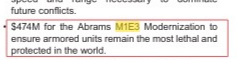
The $474 million (approximately $471 million) budget for the modernization of the M1E3 Abrams tank is an official figure from the fiscal year 2027 R&D assessment budget. This is not a small amount, but rather an effort to accelerate investment in specific phases. IMG_20260518_025036.png
 
Powerful DEW weapon-ed vehicle is not escort, it is a main combat vehicles and the vehicles with ancient shell shooting weapons are the escorts. This is the logical case as DEW is more expensive and fragile than a big steel tube, and also more critical.

Consider a laser vehicle capable of hardkilling a significant fraction of a drone swarm. Point it on the ground and it can kill/suppress just about all EO/IR sensor out to the horizon in no time, and maintain fire for long period of time. No human with direct fire weapon is going to fight that (getting warcrimes claims aside). It can also impact the greater air war with both no fly zone and a larger zone of disruption/suppression.

A lot of effort will be spent optimize the battlefield effect of a powerful DEW vehicle, and stuff like entire formations of gun-armed tanks would be sacrificed to protect one or take down an opponent's DEW vehicle if push comes to shove.
Disagree somewhat here.

Yes, you can point an AA weapon at ground targets and warcrime your way to victory. See the effects of pointing the Quad 50 turrets or Flakvierlings at ground targets during WW2.

But I expect that the vehicle of the future is going to pack an AA laser pintle like the old Shermans mounted their .50cal. And then it will also have a couple of RWS doubling as independent thermal viewers ("commander's" RWS and "loader's" RWS, even though the turret won't be manned).

The AA laser can be pointed at the ground, but then it's not looking for air threats.
 
Yes, you can point an AA weapon at ground targets and warcrime your way to victory. See the effects of pointing the Quad 50 turrets or Flakvierlings at ground targets during WW2.

But I expect that the vehicle of the future is going to pack an AA laser pintle like the old Shermans mounted their .50cal. And then it will also have a couple of RWS doubling as independent thermal viewers ("commander's" RWS and "loader's" RWS, even though the turret won't be manned).

The AA laser can be pointed at the ground, but then it's not looking for air threats.
Lasers with sufficient performance are currently too big to fit a tank, and future improvements would only make it barely being able to fit a tank chassis. That will be generation 1 of the DEW vehicle.

Now, what about future generations where laser performance increases while sizes are smaller? The thing with lasers is that it can target far more things than 50cals and have utility when you scale up the performance. The upper limit is horizon to horizon death rays that no fly zone everything within LOS and simply wipes out saturation artillery barrage out of the air if not kill space assets on top.

At the time you can fit effective lasers as RWS, a full laser vehicle would be considered a S400/patriot class asset. Now both laser RWS and full laser vehicles would be used, but by then warfare is likely utterly transformed by DEW everywhere, think lasers on ships, planes, satellites, if not disposable munitions! (think disposable anti-laser laser to snipe mirrors) We don't even have the context for that environment.

As for shooting at land targets, the biggest advantage of solid state lasers is low cost per shot, cheaper than bullets and also with small logistic requirement making it the favored weapon to be used whenever possible for tasks like suppression. Also for air defense vehicles designed for anti-saturation work must have extremely agile targeting and powerful sensing that works while engaging. If we are talking about serious drone volumes, engaging dozens of target per minute with lag time of under a second should be on the table. Allocating such weapons to ground fire is no problem when it naturally can switch to AA in under a second.

The battlefield doesn't become transparent on its own, and information is both hard to acquire and even harder to maintain.
... and given the fact that the memetic warfare genie has been let out of the bottle, it's going to get worse for the information front. Especially since the McCollough Effect exists (which means you can 'hack' the senses, making it even harder to gather information... if not outright cause people to die because they saw the wrong image).
So, you'd support my proposal for the ramming battleship in the BBX thread because stealth, cloaking, defenses and EWAR right?

We all know that prediction of the future ultimately converge on people fighting with power swords because range is a lie.
 
Lasers with sufficient performance are currently too big to fit a tank, and future improvements would only make it barely being able to fit a tank chassis. That will be generation 1 of the DEW vehicle.

Now, what about future generations where laser performance increases while sizes are smaller? The thing with lasers is that it can target far more things than 50cals and have utility when you scale up the performance. The upper limit is horizon to horizon death rays that no fly zone everything within LOS and simply wipes out saturation artillery barrage out of the air if not kill space assets on top.
I think every soldier that has read the Hammer's Slammers books has desperately wanted to operate under that kind of AA/CRAM cover.


At the time you can fit effective lasers as RWS, a full laser vehicle would be considered a S400/patriot class asset. Now both laser RWS and full laser vehicles would be used, but by then warfare is likely utterly transformed by DEW everywhere, think lasers on ships, planes, satellites, if not disposable munitions! (think disposable anti-laser laser to snipe mirrors) We don't even have the context for that environment.
Right now I'm talking a ~50kw laser on the AA pintle. ODIN to HELIOS class power, but in a smaller mount.


As for shooting at land targets, the biggest advantage of solid state lasers is low cost per shot, cheaper than bullets and also with small logistic requirement making it the favored weapon to be used whenever possible for tasks like suppression. Also for air defense vehicles designed for anti-saturation work must have extremely agile targeting and powerful sensing that works while engaging. If we are talking about serious drone volumes, engaging dozens of target per minute with lag time of under a second should be on the table. Allocating such weapons to ground fire is no problem when it naturally can switch to AA in under a second.
Depends on how the laser is searching for the air threats it's supposed to be looking for. If the laser has to use itself as the AA sensor, then it will take longer to revert to AA work from surface-search. If the AA laser is also tied into the APS radars, then it can respond faster.

Also, IIRC the HELIOS actually has 3 separate beam modes and has a camera on the inside of the laser optic which the Navy has discovered to be incredibly useful. (It is something like a 60x zoom thermal/near IR imager with a huge objective lens)

So, ground-side I could see installing a bigger laser emitter onto a scout vehicle for the secondary uses, plus the standard laser capabilities.
 
So, you'd support my proposal for the ramming battleship in the BBX thread because stealth, cloaking, defenses and EWAR right?

We all know that prediction of the future ultimately converge on people fighting with power swords because range is a lie.
The thing is that why WH40k has melee weapons is due to a combination of material science and the sort of soldiers that tend to show up. For example, you'll inevitably get to melee range with Orks because they're durable enough and come in such large numbers that you'll be running out of ammo sooner than later.

With cloaking, it's going to be bad as being a hole is just as obvious as screaming as loud as possible. The Ohios had the problem that their sound baffling was too effective, making them easier to detect via sonar (just look for the blotches of silence, so to speak).
 
The thing is that why WH40k has melee weapons is due to a combination of material science and the sort of soldiers that tend to show up. For example, you'll inevitably get to melee range with Orks because they're durable enough and come in such large numbers that you'll be running out of ammo sooner than later.
Isn’t that a thread about M1 replacement or I’m missing something?
 
An issue when talking about systems ON the one vehicle or IN the environment it operates is that some folk want to divorce the two. It is not sensible to discuss the one without the other.
Far too many programs have been developed without adequate reference to the threat environment it is to operate in and the development of counters to it.
 
An issue when talking about systems ON the one vehicle or IN the environment it operates is that some folk want to divorce the two. It is not sensible to discuss the one without the other.
Far too many programs have been developed without adequate reference to the threat environment it is to operate in and the development of counters to it.
Quite true.

Sensors
I expect there to be a TACIT BLUE type radar-recon drone overhead, providing GMTI data to everyone, air and ground forces alike. A stealthy little bastard instead of the big E-8 JSTARS. A small number of them will be part of every Combat Aviation Battalion, maybe as much as a full Gray Eagle system of 12 airframes and 5 control consoles. If we can also pack in an EOTS eyeball without losing stealth, we add that as well. Note that I am talking about something the size of a Gray Eagle or Predator here, not even as big as a Reaper. Primary mission is to ID the S400 C&C units to prioritize their destruction, but also any other force concentration.

The tank proper will likely have a tethered drone for popping up over the hill or house to see what is on the other side.

I've mentioned before how the AA laser may also be usable as a high-magnification optical sensor, at the expense of it not being available for AA use when you're using it as a giant telescope. So have a friend nearby when you're using the Looking Glass.

I also expect two RWS mounts, both able to act as hunter-killer sights for the gunner. That means stabilized thermal sights and laser rangefinders, tied into the tank fire control computer.

The APS suite is going to have to have laser detectors plus fighter-level MAWS if not DIRCM. The MAWS can be tied into the standard smoke launchers, but it can also have chaff, flares, jammers, and even just flat directed frag or buchshot charges tied in as well. The AA laser pintle would be the DIRCM. There's likely an automatic "point the turret at the laser" system built into the laser detectors.

Defenses
As to the APS suite itself, we're probably looking at we'd call 3 separate systems today, maybe 4. Starting right next to the hull, we're talking a system like Iron Curtain or AMAP/Strikeshield for point defense (In the naval analogy this is the CIWS system). The next layer out is the smoke-etc launchers with their directed frag and/or buckshot loads, more or less equivalent to the Arena system (in the naval analogy, this is guns and RAM). The third system is something like Trophy or the short ranged part of Quick Kill (in the naval analogy this is ESSM). The optional fourth system would be the long ranged part of Quick Kill (in the naval analogy this is SM2).

~50kw AA laser for smoking drones and incoming ATGMs.

The two RWS likely have different weapons on them. One has a 30mm with programmable airburst rounds. The other one is likely an MG, but I am reminded of the proposed 70mm grenade launcher because 40mm wasn't enough boom for the bunkers boats were encountering in the Mekong Delta. It was literally a scaled-up Mk19 in design. So the other RWS could be 70mm AutoGL plus an MG of some flavor, .50cal to .338.
An Urban Survival Kit will add some serious shenanigans to both RWS:​
Laser dazzler​
LRAD loudspeaker to shout "hey, stupid" among other phrases in the local language.​
ADS "microwave pain ray" to shout "leave, stupid!"​
white-light searchlight to say "we see you" (main gun would also get a white-light searchlight in this case)​
 
The thing is that why WH40k has melee weapons is due to a combination of material science and the sort of soldiers that tend to show up. For example, you'll inevitably get to melee range with Orks because they're durable enough and come in such large numbers that you'll be running out of ammo sooner than later.
Numbers are the issue and indeed a sword cannot run out of ammo. You can run out of stamina though.
But is that really the direction we're going right now?

If we give every squad a shotgun, you lose 1/9th of your rifle caliber ammo.
But if you give every squad a rifle mounted C-UAS sight, you could spare someone else from using their ammo.
Both solutions exist in some way. The latter is considered for more longer term organized efforts.

More things that are each able to shoot at more types of things.
Like air and missile defense partially fulfilled also by artillery assets, and armored fighting vehicles.

The overall effect is that ammo consumption is spread out over more sources of fire, putting less strain on individual assets.

So we are not moving in a direction of ammunition scarcity, but rather an abundance.
 
Isn’t that a thread about M1 replacement or I’m missing something?
I was pointing out the kind of environment that makes melee a thing again.
Numbers are the issue and indeed a sword cannot run out of ammo. You can run out of stamina though.
But is that really the direction we're going right now?

If we give every squad a shotgun, you lose 1/9th of your rifle caliber ammo.
But if you give every squad a rifle mounted C-UAS sight, you could spare someone else from using their ammo.
Both solutions exist in some way. The latter is considered for more longer term organized efforts.

More things that are each able to shoot at more types of things.
Like air and missile defense partially fulfilled also by artillery assets, and armored fighting vehicles.

The overall effect is that ammo consumption is spread out over more sources of fire, putting less strain on individual assets.

So we are not moving in a direction of ammunition scarcity, but rather an abundance.
That depends heavily on other factors, especially technology (which people love to ignore).

If someone develops something akin to Project Itoh's Genocidal Organ's 'masking', then ammo either becomes stupidly powerful to insta-gib any soldier, or everyone is essentially running around with weapons with the RoF of high-end MG-42s (you know, the ones with the rollers that allow 25 rounds/sec) with moderately improved ammo and gib people that way because the drug makes anything less than that impossible (as the drug bascially turns off pain receptors entirely for the duration, meaning you can have someone literally blown in half and still fight until s/he bleeds out). Just to give an example.
 
Back
Top Bottom