Well.....SAAB did offer up a large A26 SSK with three short length Trident sized silos.......
Supposedly for TLAM like cruise missiles.
But.......they were Trident silo diameter size.........
The D5 is roughly 44 ft tall.
If you cut off the first stage (variant 1), it would be roughly 21 ft tall.
If you cut off the second stage (variant 2), it would be roughly 35 ft tall.
Based on the size of the A26, it could probably only fit the variant 1 configuration.
Based on the size of the Virginia class (specifically the block V+ variant equipped with the VPM), it is likely to only be able to fit the variant 1 configuration without substantial redesign work, but there is a possibility of it fitting the variant 2 configuration if sufficiently extensive modifications were made to the submarine's design.
According to my current model for the Trident II D5 (which is slightly flawed in that it insists that max loading with W88s results in only 3677 nmi of range on a MET instead of the claimed 4000–4100 nmi), these variants would have the following performance:
Variant 1 (delete stage 1; approx 21 ft tall):
895 nmi (1658 km) range at MET
Variant 2 (delete stage 2; approx 35 ft tall):
2667 nmi (4939 km) range at MET
These variants did not have their stage-specific Isp parameters adjusted/corrected.
As a result, I believe that the results calculated for variant 1 are likely a significant over representation of the actual performance attainable due to it using the stage 2 Isp for stage 1, which assumes vacuum levels of performance at sea level, which would be highly unrealistic. Therefore the actual results for variant 1 would probably be significantly lower than this.
Both variants likely also have inaccurate Isp for the upper stage as well, which I suspect means that both variants 1 and variants 2 have significantly overrepresented performance relative to actual real world performance. Therefore the actual results for both variants 1 and variants 2 would probably be significantly lower than this.
The flaws in my model mean that any estimate produced is possibly underestimated by up to 10%. I suspect multiple factors account for this discrepancy, but unfortunately most of them cannot be addressed at this time. For the time being, this is the best estimate I can produce for this particular missile.
Now, with all that being said, I'm quite doubtful as to the practical usefulness of a 895 nmi range ballistic missile. Even the very first primitive naval ballistic missiles had 57% more range than this (1400 nmi for Polaris A-1), and 2500 nmi rapidly became the bare minimum range for US SLBMs with the Polaris A-3 and Poseidon C-3. It's also notable that there was a major effort to increase this to 4000 nmi with the Trident I C-4 and Trident II D-5. I think introducing even just a 2500 nmi SLBM today would be a major challenge, and introducing a 895 nmi SLBM today would be outright absurd and unlikely to succeed.
Variant 2 would have much more practical utility thanks to its 2667 nmi range, but I'm not sure that you could cram it into the VA-class without a major redesign. At minimum, it would only fit into the VA-class block V+ variants equipped with a VPM. The VPM has only four tubes, and it's unclear what the exact dimensions of said tubes are beyond width.
HI Sutton claims that VPM tubes require a minimum boat height of 32 feet to accommodate, which implies the maximum size of a missile that can be loaded into a VPM would be less than 32 feet tall. If this is true, then there is no possible chance of fitting a variant 2 missile into a VPM-equipped VA class submarine without a complete redesign of the VPM segment to add significant extra vertical height.
I'm not sure that such a major redesign would be worth doing in order to accommodate carrying only four missiles. It certainly wouldn't be cheap. Not sure what it would do to the performance or acoustics of the submarine either – likely nothing good.
Just a nice video by the CEA on the trajectory of a TNO warhead
Lots of cool CGI
View: https://www.youtube.com/watch?v=G20onYpEISo
Does it really wobble like that? Is it really shaped like that and not like a cone?
The wobbling is probably intentionally being exaggerated there to help demonstrate how spin stabilization helps correct for external sources of errors during reentry (such as high altitude winds) that would otherwise cause major loss of accuracy if spin stabilization was not being used.
With regards to the RB shape, it looks like an ancient ultra-low-beta RB design. It is somewhat realistic because RBs with that shape were actually deployed in the past (albeit like 70 years ago). However it is highly unlikely to be an accurate depiction of what the currently deployed French RBs look like.
(It is
possible that they clung onto a RV design straight out of the 1960s? Sure. But is it
likely? Not at all.)
I expect they use something much closer to the Mk3/W68 or Mk4/W76 RB designs. There's no good reason not to, and plenty of great reasons to use these newer RB designs. They aren't exactly ground-breaking either – the Mk4 only has a beta of 1800, which is far from bleeding edge, even for naval RBs. The Mk3's beta has never been disclosed, but I expect it to probably be somewhere in the 1400–1700 range. Both of these are quite old designs now.
There's not a ton of information available about the French naval warheads online unfortunately, unlike US naval warheads. So all we really have is informed speculation based on mirror-imaging and behavioral cues (e.g. the French blurring out all of their nuclear power plants in public satellite imagery out of paranoia, the lack of publicly available information and imagery regarding the French nuclear arsenal, etc). Mirror-imaging suggests that they would use a Mk3/Mk4-like RB design. Behavioral cues suggest that they would not disclose realistic depictions of their RBs in public media.
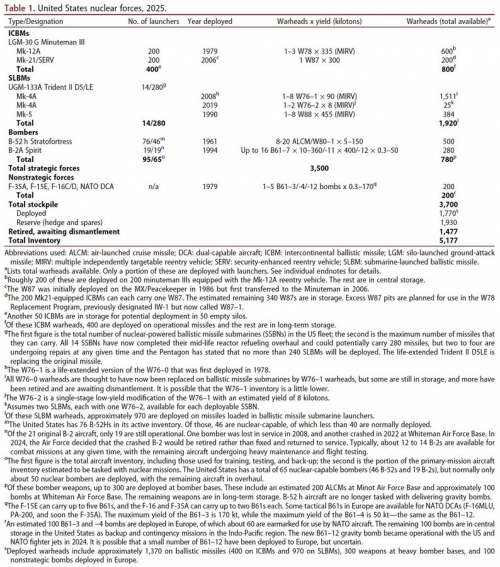
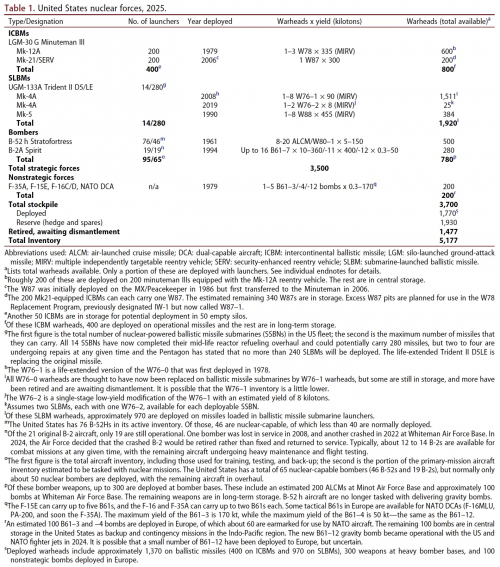
Sentinel’s delays do not alter the fact that the US has far more warheads in storage than it has deployed, and that its current fleet of ICBMs and SLBMs could roughly double their current load of ~1400 warheads. Additionally the number of deployed AGM-86s (~250) could be roughly doubled as well.
For SLBMs, there are enough warheads available that you could double current warhead loadings with a little bit left over.
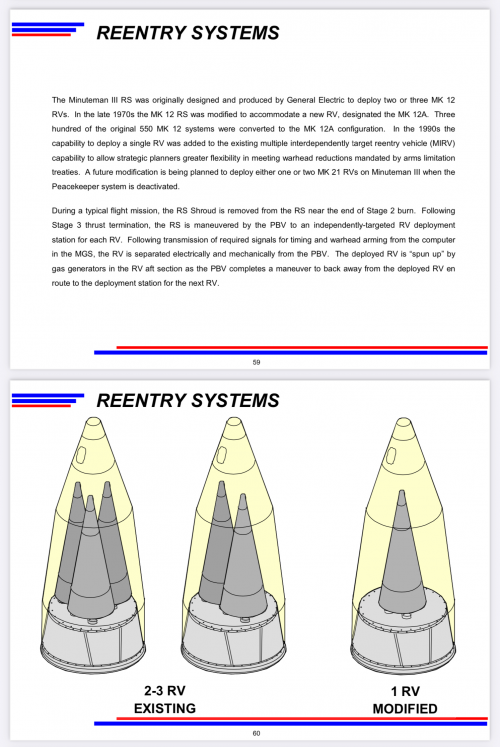
For ICBMs, that's trickier. The existing ICBMs have single-RV clear decks. New clear decks would need to be manufactured before we could upload any ICBMs. You would need to manufacture two different variants of clear decks, as the W78-equipped and W87-equipped ICBMs require different clear deck designs. If new clear decks were manufactured, then the W87-equipped ICBMs would become capable of carrying up to two W87s, while the W78-equipped ICBMs would become capable of carrying up to three W78s.
With regards to available inventory, that's a different matter.
We only have 600 W78s available. Although that is technically enough to load all 200 of the W78-carrying ICBMs with a 3-1 MIRV loading, it would leave zero warheads left over for maintenance activities. Realistically, we probably could not load all 200 with 3-1 MIRV. Still, if we did, that'd allow for tripling the warhead loading on these 200 ICBMs.
For the W87, we have tons of these in inventory, more than enough to load all 200 of the W87-carrying ICBMs with a 2-1 MIRV loading. In fact, we'd be able to load all 200 W87-carrying IBCMs with 2-1 MIRV, then if enough MM III missiles are available to fill the 50 empty silos, we could also fill every one of those silos with a 2-1 MIRV equipped W87-carrying MM III, and still have a modest amount of W87s left over for a (somewhat thin) maintenance pool afterwards.
So for ICBMs, if we stuck to the existing 400 missiles, we could increase total warhead loadings from 400 warheads to up to roughly 1000 warheads, although realistically probably a little lower than this due to the shortage of W78s.
If we added 50 extra missiles in the empty hot silos (which may or may not actuall be possible depending on how much MM III inventory is actually left at this point), then we could increase total warhead loadings from 400 warheads up to roughly 1100 warheads, although realistically probably a little lower than this due to the shortage of W78s.
In a crisis, there are extra W78 pits (and various other components) in central storage that could theoretically be remanufactured into new W78s (although a number of critical components would still need to be newly manufactured), however doing so would be an immensely expensive and slow project, so it probably isn't practical to consider. It's also unclear if certain critical components were preserved or discarded. For example, it's likely that many of the components were preserved, but it's unclear if the RV aeroshells were preserved. If those were lost, then that'd add a tremendous amount of additional difficulty and delay to remanufacturing additional W78s. And regardless of how much is preserved, you'd definitely need to produce new build primary explosives, interstages, radiation cases, and gas transfer systems, all of which would be quite difficult to do in a hurry without compromising the warhead's reliability.