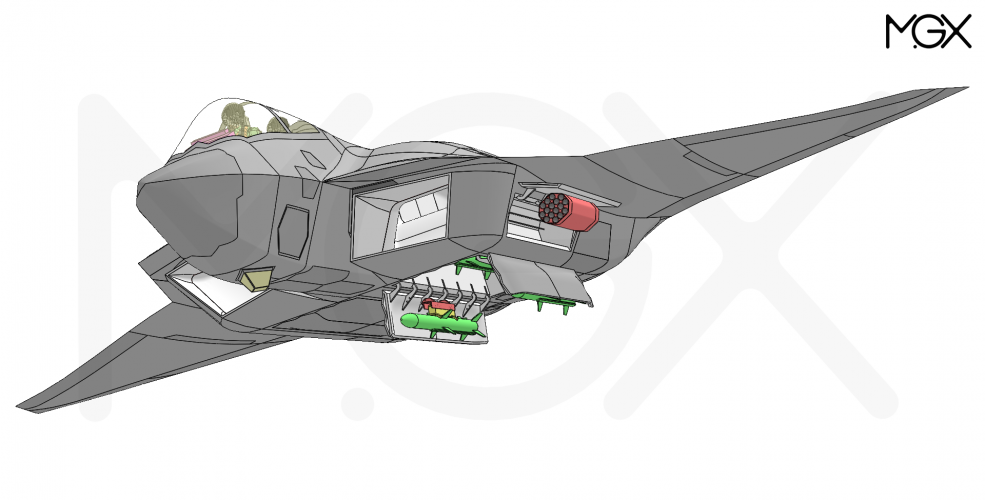
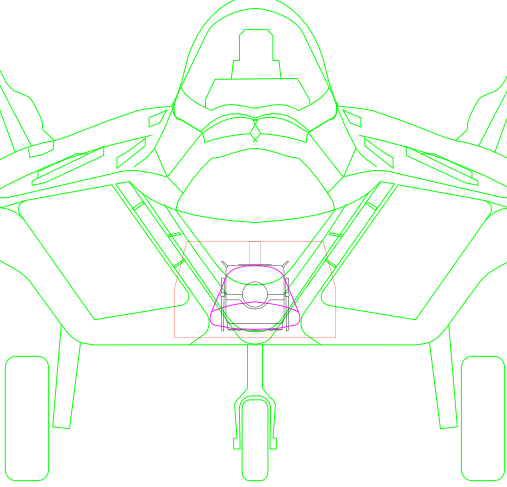
Possible configuration of the Boeing F/A-XX

The weapon load is pretty optimistic when you factor in additional real engineering constraints like actuator sizing, real thicknesses, adequate space for loaders, adapters for different mounting locations etc. Which all add up to be a good 10-20% extra in my experience. But it's unrealistic for @VTOLicious to do this by himself.

I'd just bear in mind that a real aircraft designed around this is likely to be quite a bit larger, or carry less.

I try to keep it as realistic as possible. This is also evident in the fact that I first consider the dimensions of the weapons bay, the size of the engines, intake ducts etc. and then design the fuselage around it, rather than simply focusing on an appealing appearance.

However, it is good to remind people that the this of course not a real aircraft design and solely based on the limited capabilities of a private person doing this as a hobby :)
 
Last edited:
Great work VTOLicious! Very inspiring. I hope the GCAP weapon bays match this. Do you think you could possibly mount 4 round APKWS rocket pods on the bay door mounts?
By the time APKWS gets used stealth probably won't matter anymore. Or it's close to the fleet & defense.
Besides DEW is a thing for both manned and unmanned aircrafts, too.
So I think bay mounted probably won't be a thing.

Anyhow, is there any news about a stealthy buddy tanking pod in the works yet?
There should be a large scale effort for new stealth pylons, racks, pods etc. for all these 6th generation fighters.
For my part I'll just assume them being based on what's been shown so far.
 
I try to keep it as realistic as possible. This is also evident in the fact that I first consider the dimensions of the weapons bay, the size of the engines, intake ducts etc. and then design the fuselage around it, rather than simply focusing on an appealing appearance.
It's definitely a good attempt but there's only so far that you can go. It'll change some of the details and performance rather than the overall configuration.
 
By the time APKWS gets used stealth probably won't matter anymore. Or it's close to the fleet & defense.
Besides DEW is a thing for both manned and unmanned aircrafts, too.
So I think bay mounted probably won't be a thing.
I think stealthy carriage of APKWS would be a nice capability to have for taking out targets of opportunity on the way to or back from your main mission. It’s a gun like capability without having to line up the aircraft on the target.

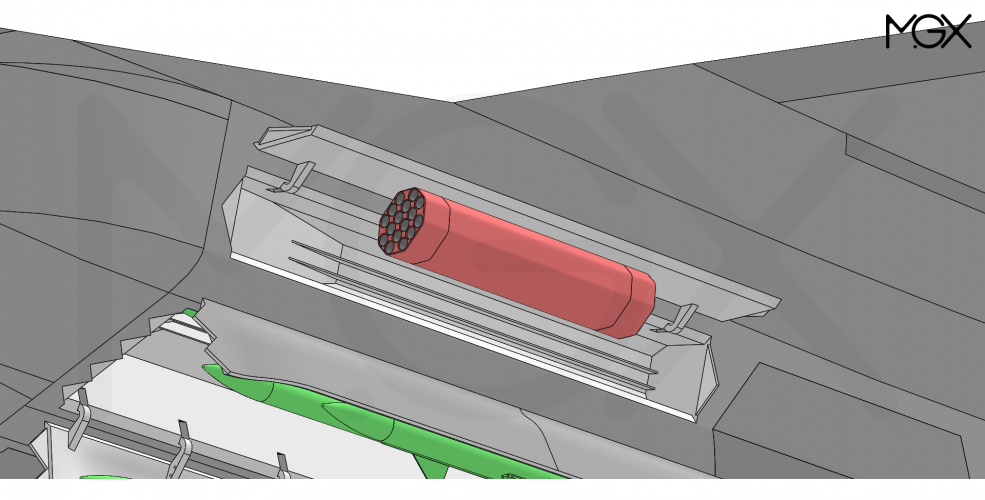
Maybe integrating 4 tubes into each side bay door would be possible?
 
See your old F-86D/L

iu
 
Am I too late to get in on the "dorsal inlets" discussion? That idea goes back way farther than 14 years at Boeing/MDC. It first surfaced at least as far back as the infamous A-X that evolved into A/F-X back in the 1990s. It was one of the few non-STOVL things I worked on. The program itself deserves more attention than it's gotten, as a brilliant example of how screwed up things can get when there are too many companies scrambling for scarce procurement dollars. MDC people were on 2 competing teams, firewalled off from each other. The one I was on had been given dorsal inlets as a result of the program manager doing MBWA, "Management By Walking Around," which was a trendy management fad of the day, to get leaders out of their corner offices and let them see what their people were doing. Our top boss was going past the configurators' section one day when he noticed that one of the new hires had moved the inlets away from the wing roots and up over the aft fuselage. He grabbed the idea instantly because, as he put it to us, it was a visual distinguishing feature for our design over what any of the other teams was likely to be working on.

As time went on, we (the rank and file) realized that with the inlet literally right behind the cockpit, it would be impossible to safely do ground run-ups with the canopy (canopies, actually) open due to the risk of the flow field pulling "things" out of the cockpit and straight into the engines. That wasn't all: There was nowhere to put the air refueling probe (for the USN/ROW version) or UARRSI port (for USAF) that was outside of that flow field. During air refueling there's always a little puff of vaporized fuel on separation from the tanker, coming from the short section between the shutoff valves on the tanker and receiving aircraft. The amount of fuel vapor needed to cause ignition and detonation in the bypass ducts of the engines - well, tests at China Lake had already produced data on that for a wide variety of high-bypass turbofan engines, and so we knew that the vapor puff was something that our engines couldn't tolerate. So clearly the "overhead inlets" as we called them were just not going to work. Luckily (for this and a couple of other embarrassing reasons) the whole program collapsed before the world saw just what we were going to propose, and as far as I know that design has been kept under wraps ever since. (Actually, for a while the large display model of it stood in the lobby of one of our buildings where every visitor had to walk past it. But it eventually disappeared.)

Anyway that's the Boeing (via MDC) baptism with dorsal inlets. It looks like (on the pix here, at any rate) the overhead inlets may now have been slid off of centerline far enough to solve the refueling problem after all. But for whatever reason, we didn't do that on A/F-X.
 
You seem extremely knowledgeable on this topic with very apparent industry experience, you think top mounted intakes are going to show up on the F/A-XX?
 
I think stealthy carriage of APKWS would be a nice capability to have for taking out targets of opportunity on the way to or back from your main mission. It’s a gun like capability without having to line up the aircraft on the target.

Maybe integrating 4 tubes into each side bay door would be possible?
Like the F-102?
 

Attachments

  • f-102 weapons bay.jpg
    f-102 weapons bay.jpg
    7.7 KB · Views: 118
Am I too late to get in on the "dorsal inlets" discussion? That idea goes back way farther than 14 years at Boeing/MDC...

As time went on, we (the rank and file) realized that with the inlet literally right behind the cockpit, it would be impossible to safely do ground run-ups with the canopy (canopies, actually) open due to the risk of the flow field pulling "things" out of the cockpit and straight into the engines. That wasn't all: There was nowhere to put the air refueling probe (for the USN/ROW version) or UARRSI port (for USAF) that was outside of that flow field. During air refueling there's always a little puff of vaporized fuel on separation from the tanker, coming from the short section between the shutoff valves on the tanker and receiving aircraft. The amount of fuel vapor needed to cause ignition and detonation in the bypass ducts of the engines - well, tests at China Lake had already produced data on that for a wide variety of high-bypass turbofan engines, and so we knew that the vapor puff was something that our engines couldn't tolerate. So clearly the "overhead inlets" as we called them were just not going to work...

Anyway that's the Boeing (via MDC) baptism with dorsal inlets. It looks like (on the pix here, at any rate) the overhead inlets may now have been slid off of centerline far enough to solve the refueling problem after all. But for whatever reason, we didn't do that on A/F-X.

Interesting! Thx for the insight.

Dorsal inlets do have some advantages, especially when it comes to stealth-aircraft, which usually feature long serpentine ducts routed through the fuselage. Consequently a lot of valuable fuselage volume is consumed by those ducts that could otherwise be used for fuel, etc.

On the other hand, as you just mentioned, there is also a lot of constraints that come with intakes located above the wing. For instance, it is repeatedly pointed out that ingestion of vortices, that occur at higher AoA, is an issue. This is especially true for stealth-fighters which typically feature sharp edges on the sides of the nose fuselage.

Of course, there are examples of aircraft which feature dorsal intakes. But these are either subsonic-aircraft (e.g. B-21), or supersonic-aircraft without high requirements in terms of manoeuvrability or stealth (e.g. X-59).
 
You seem extremely knowledgeable on this topic with very apparent industry experience, you think top mounted intakes are going to show up on the F/A-XX?
I've been retired for 10 years now so I only know what I read. I noticed some illustrations floating around that might or might not have any bearing on what's being done these days, that's all. I thought people might be interested on a little-known factoid from the distant past, when I was young - well, youngish anyway! :)
 
I've been retired for 10 years now so I only know what I read. I noticed some illustrations floating around that might or might not have any bearing on what's being done these days, that's all. I thought people might be interested on a little-known factoid from the distant past, when I was young - well, youngish anyway! :)
Which ones?!?!?!
 
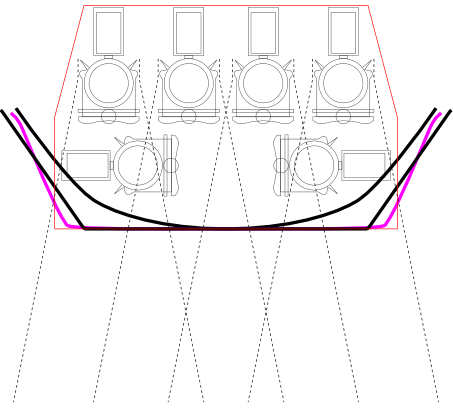
MGX F/A-XX M200, Weapons Bay Loadout Options:
  • Side bays are equipped with 2 AMRAAM as standard (323 kg)
8x AMRAAM - Total payload weight: 1292 kg
4x AARGM-ER - Total payload weight: 2191 kg
4x JSOW - Total payload weight: 2311 kg
2x JASSM - Total payload weight: 2365 kg
24x SDB II - Total payload weight: 2555 kg
12x JDAM / 500 lb - Total payload weight: 3359 kg
4x JDAM / 2000 lb - Total payload weight: 4247 kg
Like I said earlier, I’m not sure there’s much benefit to the 5m long bay except for the 12x JDAM load out.

Since most US weapons fit within a ~4.4m long box, you could shorten by 50-60cm, saving 10-12% volume (~400L per side), without impacting any of the other loads.

This would still allow for 6x 500lb JDAMs + 12x SDB II, which makes for a great bomb truck (~6,000lbs of ordnance), with the additional fuel volume being a useful benefit.
 
Last edited:
Like I said earlier, I’m not sure there’s much benefit to the 5m long bay except for the 12x JDAM load out.

Since most US weapons fit within a ~4.4m long box, you could shorten by 50-60cm, saving 10-12% volume (~400L per side), without impacting any of the other loads.

This would still allow for 6x 500lb JDAMs + 12x SDB II, which makes for a great bomb truck (~6,000lbs of ordnance), with the additional fuel volume being a useful benefit.

Nope, unfortunately it's not that simple.

Currently, I'm using the entire length of the bay for the 2000 lb JDAMs as well. The bay is too narrow to fit them side by side (without longitudinal offset).
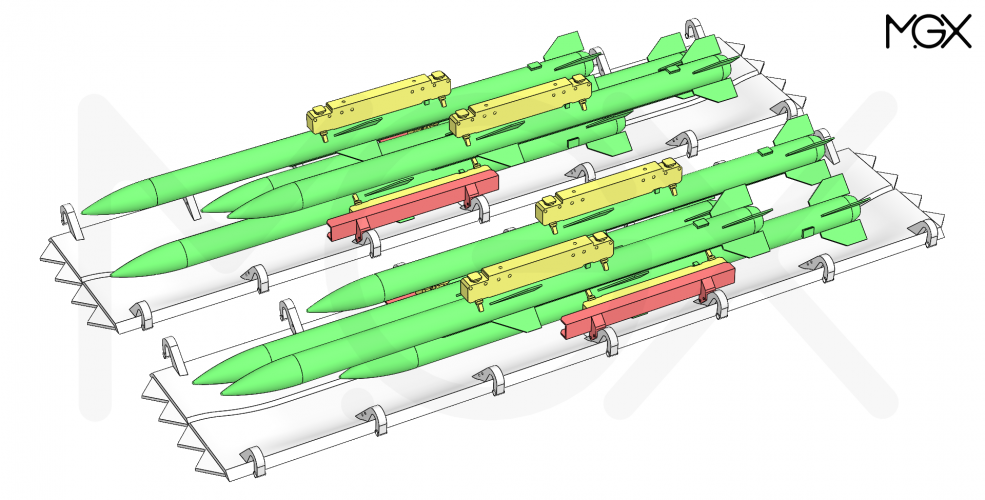
Same is true for the AIM-120 setup... Just look at that, it's like a 3D puzzle! If you adjust something to fit weapon A better, you realize you got an issue with weapon B. Then you are satisfied with A & B and find out you got an issue with C... and so on :D

MGX FA-XX_IWB+AIM120_001.PNG

The current setup is the best I could figure and I'm quite happy with the result. The only thing that bothers me is that only one JASSM fits in each bay and the wasted space that comes with it.

Last but not least, ~6000 lb internal load is F-35 level - Not enough!
 
Last edited:
I think stealthy carriage of APKWS would be a nice capability to have for taking out targets of opportunity on the way to or back from your main mission. It’s a gun like capability without having to line up the aircraft on the target.

Maybe integrating 4 tubes into each side bay door would be possible?
They actually have programs underway to get this capability.

"Gun like capability without having to line up the aircraft on the target."

The programs all have "munitions" between 40mm and 70mm diameter. All the plans I have seen mount the tubes/barrels on the upper side of the aircraft similar to the cannon. The seeker then has a clear view into the upper hemisphere. A dozen small short range mini rockets effectively makes the cannon redundant.

200lb M61 cannon and 200lb of ammunition. That space and weight allows for many of micro missiles. They will most likely want something half the size of APKWS with 20+ rounds.
 
Currently, I'm using the entire length of the bay for the 2000 lb JDAMs as well. The bay is too narrow to fit them side by side (without longitudinal offset).
Same is true for the AIM-120 setup

I understand the need for stagger… the question is how much stagger is necessary?

Boeing’s EWP for example has a ~55cm stagger between AIM-120s, for a total length of ~4.2m… much less than what you’re showing here. Likewise MK-84 fins are only ~10 inches long, so ~40cm stagger should leave plenty of clearance, allowing a total length <4.30cm. Both of which line up well with other weapons such as LRASM, JSOW etc, without requiring a 5m long bay.

Last but not least, ~6000 lb internal load is F-35 level - Not enough!
The 4.4m long bay would still carry 2x more MK-84s and JSOWs, and 3x more SDBs than an F-35… hardly in the same class!
 
I understand the need for stagger… the question is how much stagger is necessary?

Boeing’s EWP for example has a ~55cm stagger between AIM-120s, for a total length of ~4.2m… much less than what you’re showing here. Likewise MK-84 fins are only ~10 inches long, so ~40cm stagger should leave plenty of clearance, allowing a total length <4.30cm. Both of which line up well with other weapons such as LRASM, JSOW etc, without requiring a 5m long bay.

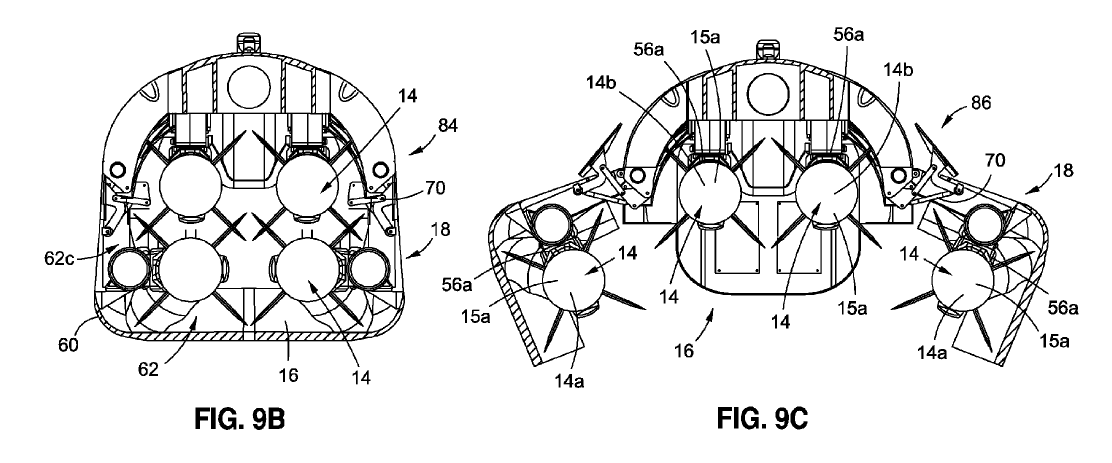
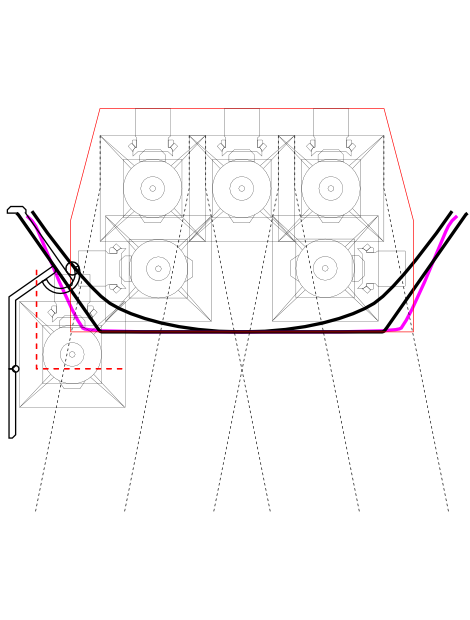
I know Boeing's EWP very well - There's a significant difference between my bay design and Boeing’s pod design:
Boeing EWP_5.PNG

The EWP has the door hinge located well above the bottom of the pod. As a result, the side walls swing to the outside and the fin closest to the center does not swing across the centerline when opening.

But the fin does swing across the centerline on my bay
. It must have the hinge much closer to the bottom, due to its flat-bottom-door design. There is no option to have doors like on the EWP.
Consequently, a longitudinal offset between all four AIM-120s is necessary - Believe me, I have it in 3D, with moving doors ;)

In a twin-engine design with side-by-side IWBs, the problem is not so much the length but rather the width and depth of the bay.
 
Last edited:
I think stealthy carriage of APKWS would be a nice capability to have for taking out targets of opportunity on the way to or back from your main mission. It’s a gun like capability without having to line up the aircraft on the target.

Maybe integrating 4 tubes into each side bay door would be possible?

That's the maximum size of a door mounted rocket launcher that would fit the side bays. It can accommodate 16 laser-guided 70mm APKWS. 8x AMRAAM + 32 APKWS all together...
MGX FA-XX_IWB+APKWS_002.PNG
 

Attachments

  • MGX FA-XX_IWB+APKWS_003.PNG
    MGX FA-XX_IWB+APKWS_003.PNG
    294.3 KB · Views: 155
Last edited:
Nice, ideal for low cost drone plinking while the AMRAAM type weapons take out the high end threats.

Lots of ideas out there for small missiles at the moment. An infrared seeker is in the works for the APKWS if I remember correctly.

I still like the idea of F-102 style permanent launch tubes in the bay doors :)
 
Can't shake the impression this looks like super-optimized Su-57, because of the LERX probably, but in overall layout as well. :)
 
But the fin does swing across the centerline on my bay. It must have the hinge much closer to the bottom, due to its flat-bottom-door design. There is no option to have doors like on the EWP.
Consequently, a longitudinal offset between all four AIM-120s is necessary - Believe me, I have it in 3D, with moving doors ;)

Thanks, I think I understand, though your drawing doesn’t seem to show the fin swinging across the centerline?

ag-iwb_020-png.801214


What happens if you have the top 2 AMRAAMs in the same longitudinal location (no offset) and then the 2 AMRAAMs on the doors offset a little forward, either both in the same longitudinal location or just slightly offset from each other to increase clearance?
 
Thanks, I think I understand, though your drawing doesn’t seem to show the fin swinging across the centerline?
What happens if you have the top 2 AMRAAMs in the same longitudinal location (no offset) and then the 2 AMRAAMs on the doors offset a little forward, either both in the same longitudinal location or just slightly offset from each other to increase clearance?

It may look simple from the front. But I can assure you that it's significantly more complex in the 3D model. There are many aspects to consider, not just the position of the fins relative to each other. It took many attempts to find the current arrangement - I'm confident the current layout is the best compromise to allow for the most versatile loading possible and to make the best possible use of the volume, not only for the AIM-120, but also for all the other loading options.
 
Nice, ideal for low cost drone plinking while the AMRAAM type weapons take out the high end threats.

Lots of ideas out there for small missiles at the moment. An infrared seeker is in the works for the APKWS if I remember correctly.

I still like the idea of F-102 style permanent launch tubes in the bay doors :)
The IR seeker is already operational and flying on the F-15E.

The primary goal for the planned "micro missiles" is to take out incoming air-to-air missiles. Not only does it replace the Sidewinder and the cannon but it will also do the job of chaff and flare.

The MSDM was announced all the way back in 2015. There are multiple programs underway.

https://en.wikipedia.org/wiki/Miniature_Self-Defense_Missile
50 years ago we had 10 aircraft types to cover all the missions. Now the F-35 can perform all of these missions. We have the same thing happening with the munitions with tri-mode seekers becoming common. For example it is really just software/programming stopping an AMRAAM missile from becoming an air-to-surface anti radiation missile.

It is common sense to have multi-role weapons. The aircraft doesn't need to carry one of each weapon type for emergency situations. The long range air-to-air missile can then become an emergency SEAD weapon. The cheap micro-missiles can hit low cost drones, but it can also hit enemy vehicles or infantry units.

The most logical package in 2050 would be:
1) AMRAAM sized multi-role missile for high end threats.
2) Micro multi-role missile for close in threats and low cost threats.
3) Low powered laser to fry IR sensors.

All this weapon bay talk to fit these stop gap weapons fielded on 4th gen platforms is just ridiculous. Andural has sized its cruise missiles to be AMRAAM sized and quarter AMRAAM sized. The 6th gen aircraft will be in service for 50 years. It would be foolish to design around outdated weapons and compromise the performance of the design.
 
That's the maximum size of a door mounted rocket launcher that would fit the side bays. It can accommodate 16 laser-guided 70mm APKWS. 8x AMRAAM + 32 APKWS all together...
View attachment 801381
The classic 17-shot won't fit?

I'm just trying to avoid custom racks as much as possible.


Can't shake the impression this looks like super-optimized Su-57, because of the LERX probably, but in overall layout as well. :)
There's a huge difference in bay layout, Su-57 has two bays in tandem while the FAXX has the bays in parallel.
 
There's a huge difference in bay layout, Su-57 has two bays in tandem while the FAXX has the bays in parallel.
I said optimized :)

IIRC that Chinese RCS analysis attributed much of Su-57 reflections to the gap between the engines, so it's only logical to change that.

But I mean the general configuration of the airframe and control surfaces, mostly, allowing for removed rudders.
 
Last edited:
The most logical package in 2050 would be:
1) AMRAAM sized multi-role missile for high end threats.
2) Micro multi-role missile for close in threats and low cost threats.
3) Low powered laser to fry IR sensors.
Yes, multi-role is ideal. It took JAGM a long time to get here and is still struggling. We now have much better and more compact chip technology to get it all done but cost will likely get in the way of procurement. For war some million of munitions are needed.
All this weapon bay talk to fit these stop gap weapons fielded on 4th gen platforms is just ridiculous. Andural has sized its cruise missiles to be AMRAAM sized and quarter AMRAAM sized. The 6th gen aircraft will be in service for 50 years. It would be foolish to design around outdated weapons and compromise the performance of the design.
Inventory is one reason why M117 is still in service. Besides as far as packing goes the difference is just an exchange ratio. You only get a better outcome with geometric solids. The smaller they are the more you could pack but the efficiency will go down due to the size of racks. Naturally total stored mass will be less. The more important question from a military point of view is how much stored kill or more precisely mission killl you can get out of it. Today, standoff range has become somewhat more important, too. So it's a trade-off between those two depending on the mission.
None the less I'm curious what you would get with Andural specific loadouts.
 
Yes, multi-role is ideal. It took JAGM a long time to get here and is still struggling. We now have much better and more compact chip technology to get it all done but cost will likely get in the way of procurement. For war some million of munitions are needed.
The 6th gen platforms won't be in service in large numbers for another 10 years. The chips and sensors tech will then be cheap to make most munitions multi-role. JAGM gives a good idea of what is coming. Once the software is developed it is simple copy and paste onto each munitions. The production run can then be larger which reduces the unit cost.

The type of war is unknown. A micro-missile developed to counter Chinese air-to-air missiles can also be used against a large drone swarm. There is no need to stock pile weapons for both roles. The total stockpile can then be smaller.

It will also be easier to consume older versions of a munition. For instance when a newer micro-missile comes out with a higher accuracy against incoming air-to-air missiles then the older missiles can be used up in the air-to ground role.

None the less I'm curious what you would get with Andural specific loadouts.
Increased accuracy helps offset the smaller warhead size. Also multiple smaller weapons can be used for one target which makes it harder for the enemy to defend against.

There is an obsession here about warhead size leading to endless discussion about weapon bay size trying to fit JASSM/LRASM internally. The two common sizes for the new weapons appear to be 360cm long 40cm wide larger weapons and 180cm long 20cm wide smaller weapons. Basically AMRAAM size and quarter AMRAAM size. I assume there will be a third even smaller size for the micro munitions.
 
Increased accuracy helps offset the smaller warhead size. Also multiple smaller weapons can be used for one target which makes it harder for the enemy to defend against.
As long as the warhead is big enough to actually punch through the armor of the single target, yes. Else you need a single big boom.


There is an obsession here about warhead size leading to endless discussion about weapon bay size trying to fit JASSM/LRASM internally. The two common sizes for the new weapons appear to be 360cm long 40cm wide larger weapons and 180cm long 20cm wide smaller weapons. Basically AMRAAM size and quarter AMRAAM size.
Despite the actual volume, we're calling the smaller of those two "halfRAAM" because they take half the length of the AMRAAM/Meteor.


I assume there will be a third even smaller size for the micro munitions.
Maybe even two micro munition sizes: one that is roughly APKWS sized and an aircraft self defense missile that is closer to the size of a chaff/flare/active decoy expendable. Because APKWS is too big to carry enough to use for self defense.
 
I think it's safe to assume that future weapons systems will be based on the form factor of current weapons in service. AIM-120 => AIM-260 is good example of this.
However, this doesn't mean that there couldn't be new A/A or A/G weapons that are smaller or larger. For instance, 1/2-RAAM would certainly be a reasonable size to consider as a replacement for the AIM-9, and/or a suitable size to equip CCA with it. But I also believe that the form factor of the widespread JDAM-family cannot be ignored.
On the other hand, I consider it highly questionable to design a weapons bay solely to the needs of oversized weapon systems such as JASSM, LRASM or AIM-174B. However, ultimately it all depends on the customer requirements.
 
Last edited:
As long as the warhead is big enough to actually punch through the armor of the single target, yes. Else you need a single big boom.
If we take a ship for example an AMRAAM sized warhead hitting the bridge or primary radar means the ship is disabled and blind. You can then sink it with a dumb bomb. A saturation attack is definitely the biggest threat. Multiple AMRAAM sized missiles pulling 30g in the end game will be hard for the ship to defend against. If the seeker can get a clear image of the ship it can then hit the exact spot.

Despite the actual volume, we're calling the smaller of those two "halfRAAM" because they take half the length of the AMRAAM/Meteor.
They are quarter AMRAAM. The Small diameter bomb is 17cm wide. Half the width of the AMRAAM with fins. Four can fit in the space of an AMRAAM. Barracuda 100 is the 15cm in diameter and 1.8m long. Four fit in the space of an AMRAAM. Barracuda 500 is AMRAAM size.

Maybe even two micro munition sizes: one that is roughly APKWS sized and an aircraft self defense missile that is closer to the size of a chaff/flare/active decoy expendable. Because APKWS is too big to carry enough to use for self defense.

Two munition sizes is fairly likely. Maybe a different solution for the F-35 and another for the 6th gen platforms. A logical solution is unpowered guided hit-to-kill munitions that drop out of the rear of the aircraft like traditional chaff/flare. They can hit enemy SAMs and missiles coming from the rear. The larger rocket powered missiles then shoot forward which would be required for head to head air-to-air engagements.
 
If we take a ship for example an AMRAAM sized warhead hitting the bridge or primary radar means the ship is disabled and blind. You can then sink it with a dumb bomb. A saturation attack is definitely the biggest threat. Multiple AMRAAM sized missiles pulling 30g in the end game will be hard for the ship to defend against. If the seeker can get a clear image of the ship it can then hit the exact spot.
These might be good for saturation but won't necessarily disable a ship enough. And to get sufficient mass imho you might need more than 20 shots to get hits in; so at least 1-2 aircraft in full stealth. By naval destruction metric you need ~2000 lb worth of warhead to kill a ship. In terms of mass and volume and aircrafts needed the smaller ammo certainly offers the best hit result. It would still come short in term of destruction. Whether it's enough to risk a simple bomb run is another question. Probably, stand-off will remain the choice with something like PJDAM or similar bombs.

They are quarter AMRAAM. The Small diameter bomb is 17cm wide. Half the width of the AMRAAM with fins. Four can fit in the space of an AMRAAM. Barracuda 100 is the 15cm in diameter and 1.8m long. Four fit in the space of an AMRAAM. Barracuda 500 is AMRAAM size.
Barracuda 100 & Barracuda 250 are SDB size but Barracuda 100 is still rail launched. And as they've said somewhere it's limited to 3g (good for helicopters) which limits an A2G fighter's 4.5 (to 5.5) requirement.
You can't simply based on size. Many wing sizes have to adjust to a "box container" format, hence, rotated 45° which reduces their width by square root of 2. You won't get a clear exhange based on stated sizes.
F47-center-IWB1040mm-5AIM.png
F47-center-IWB1040mm-SDB-six-pack.png
As you can see in my F47's 1040 mm wide IWB I could pack up to 5 AIM120 or 2x 6 SDBs. But as you can see with the dashed lines the problem with both is drop clearance. The conservative choice would be to go with 4 AIM120 or 2x 5 SDBs.

Barracuda 500 is actually JASSM size with more volume and lighter structure for more range.
Anduril-Barracuda-500-F22.png
Two munition sizes is fairly likely. Maybe a different solution for the F-35 and another for the 6th gen platforms. A logical solution is unpowered guided hit-to-kill munitions that drop out of the rear of the aircraft like traditional chaff/flare. They can hit enemy SAMs and missiles coming from the rear. The larger rocket powered missiles then shoot forward which would be required for head to head air-to-air engagements.
Yes, but even with latest rocket science and current fuel grain will limit range to 4 nm or less. That's slightly less than APKWS at best. And that's about a 5-7 seconds window. Intercept and closing speed has to be carefully managed by the pilot. Ofc it won't matter for slow drones. If a pilot is distracted or dazed he will miss the timing. These two need to have an option for computer automated-triggering.
 
Yes, but even with latest rocket science and current fuel grain will limit range to 4 nm or less. That's slightly less than APKWS at best. And that's about a 5-7 seconds window. Intercept and closing speed has to be carefully managed by the pilot.
That is not how you estimate range. A lighter warhead and seeker will give a longer range at any given size. The stinger missile is smaller yet outranges APKWS. This is how the AMRAAM had longer range than the larger Sparrow as the warhead halved in weight and the seeker was much smaller/lighter.

Look at the Lockheed hit-to-kill missile. It is only 5lb and it has very impressive range. It is similar in weight to a 40mm bofor gun round or only 15% of the weight of APKWS. The range is 3km range from a ground launched configuration. Range more than doubles if/when air launched. The AMRAAM range halves when surface launched.

6km range for the Lockheed 5lb missile is impressive and it only costs $16,000 each. The Raytheon MSDM is similar size. We have two highly classified programs. These are the weapons that will replace the cannon in the 6th gen fighters. Most people would agree if you have 20+ of these micro missiles it would be fine to remove the cannon.

https://en.wikipedia.org/wiki/Miniature_Hit-to-Kill_Missile
https://en.wikipedia.org/wiki/Miniature_Self-Defense_Missile
I assume these micro-missiles would launch from a tube on the upper surface of the aircraft. Like a 40mm belt fed grenade launcher.
 
All this weapon bay talk to fit these stop gap weapons fielded on 4th gen platforms is just ridiculous. Andural has sized its cruise missiles to be AMRAAM sized and quarter AMRAAM sized. The 6th gen aircraft will be in service for 50 years. It would be foolish to design around outdated weapons and compromise the performance of the design.

Increased accuracy helps offset the smaller warhead size. Also multiple smaller weapons can be used for one target which makes it harder for the enemy to defend against.

There is an obsession here about warhead size leading to endless discussion about weapon bay size trying to fit JASSM/LRASM internally. The two common sizes for the new weapons appear to be 360cm long 40cm wide larger weapons and 180cm long 20cm wide smaller weapons. Basically AMRAAM size and quarter AMRAAM size. I assume there will be a third even smaller size for the micro munitions.
I have to disagree and say that a large weapons bay and the ability to carry weapons with a large warhead should be a very important capability on a 6th generation fighter.

All the micro missiles and future air defence systems will also make it harder for your weapons to reach their targets. If half or more of your weapons are suppressed by EW or shot down you are going to need to carry and launch more of them per mission. The bays could also be filled with fuel tanks if you want to swap weapons for range and endurance.

As for warhead size you have to remember that small warheads may only cause survivable and repairable damage while large warheads can destroy targets completely. Also, it’s easier to build a trench and bunker system to survive 250lb and 500lb bombs than it is for 1000lb and 2000lb bombs.

It’s all going to be very unpleasant!

To me, VTOLicious’s design makes a lot of sense.
 
I have to disagree and say that a large weapons bay and the ability to carry weapons with a large warhead should be a very important capability on a 6th generation fighter.
I disagree. The vast majority of targets can now be taken out with a warhead under 500lb. The bombs are becoming increasingly more accurate. It is not the Gulf War where the bombs missed by 200 feet so they put 2,000lb of explosives to compensate. People then assume a 2,000lb bomb is needed based on the Gulf War inaccuracy.

The GBU-28 bunker buster is a 5,000lb bomb yet it is similar volume to a 2,000lb JDAM. The reason for it being so heavy is because it has a very thick steel casing. An AMRAAM sized bunker buster bomb with a similar thick steel casing could easily be made. I estimate a 10inch diameter and 12 feet long long bomb would come in at 2,000lb. This is better than compromising the aircraft design. It would be easier to just give the bunker busting jobs to other assets.

By naval destruction metric you need ~2000 lb worth of warhead to kill a ship.
The radar on the ship has no armor. A direct hit with only 20lb of explosives would destroy the entire radar. The ship is now totally blind.

Your plan of attack makes no sense. Launching a couple slow subsonic cruise missiles with large warheads at an enemy ship with all its systems running will simply result in the enemy ship shooting down your missiles.

The obvious solution is to send a large number of high speed and highly manoeuvrable missiles that have just enough destructive power to disable the ships sensors. Once disabled that is when you attack it with the large warheads.

An AMRAAM size missile has the speed, manoeuvrability and warhead size to take out the ships radar.

Penetrating the ships defensive bubble and disabling it is the job of a strike fighter. Sinking a disabled ship sounds like a job for another asset.
 

Similar threads

Back
Top Bottom