Stargazer

ACCESS: USAP
Top Contributor
Senior Member
Joined
25 June 2009
Messages
15,515
Reaction score
9,447
I still have to finish my detailed Cierva list, but here is a rough version:

SPAIN

BCD-1* 'El Cangrejo' two-seat biplane (* Barcala, Cierva & Diaz)
BCD-2* small racing tractor monoplane (* Barcala, Cierva & Diaz)
C-3 (large biplane)

BRITAIN

C.1 Autogiro N°1
C.2 Autogiro N°2
C.3 Autogiro N°3
C.4 Autogiro N°4
C.5 —
C.6 —
C.6A (C.6bis)
C.6B —
C.6C (Avro Type 574)
C.6D (Avro Type 575)
C.7 (Loring C.VII)
C.8V (Avro Type 586)
C.8R (Avro Type 587)
C.8L-I (Avro Type 611)
C.8L-II (Avro Type 617)
C.8L-III (Avro Type 617)
C.8W (C.8 Mark IV)
C.9 (Avro Type 576)
C.10 (Parnall 4/26)
C.11 (Parnall 'Gyroplane')
C.12 (Loring C.XII)
C.13 (Short 31/26)
C.14 project of which no detail has survived
C.15 project of which no detail has survived
C.16 project of which no detail has survived
C.17 Mk. I (Avro Type 612)
C.17 Mk. II (Avro Type 620)
C.17 Hydr. (Avro Type 620)
C.18 (Weymann-Lepère CTW.200)
C.19 Mk. I C.19 Mk. II C.19 Mk. IIA C.19 Mk. III C.19 Mk. IVP C.19 Mk. IV C.19 Mk. V
C.20 (Focke-Wulf C.19 'Don Quichote')
C.21 (Lioré et Olivier C.21)
C.22 project, no details (1934)
C.23 design study, no details
C.24 (De Havilland C.24)
C.25 (Comper G.31/1)
C.26 (1) twin-engine autogiro-helicopter design study
C.26 (2) (De Havilland C.24 modified)
C.27 (Cierva-Lepère C.L. 10)
C.28 (Weir W.1)
C.29 (Westland C.29)
C.30
C.30P
C.30A
C.30A (Avro Type 671 'Rota I') (A.39/34?; ordered under Spec. 16/35 and 2/36)
C.30A (Avro Type 671 'Rota II')
C.30A (Avro Type 671 'Rota seaplane')
C.30 (Focke-Wulf C.30 'Heuschrecke')
C.30 (Lioré-et-Olivier LeO C.30)
C.30 (SNCASE C.301)
C.30 (SNCASE C.302)
C.30 Mk. II
C.30 Mk. III
C.30 Mk. IV
C.30 Mk. V
C.30J
C.31 (1) (Cierva-Lepère C.L. 20)
C.31 (2) project for a two-seat coupe autogyro
C.32 design study similar to C.31
C.33 (Avro Type 665)
C.34 (Lioré-et-Olivier > SNCASE C.34)
C.35 design study
C.36 design study
C.37 (Avro Type 668)
C.38 design study
C.39 design study for 2/3 seat fleet spotter autogyro to Spec. S.22/38
C.40 (Bradbury & Cull/British Aircraft Mfg. Co.) (43/36)
C.41 (1) second design study to Spec. S.22/38
C.41 (2) Fairey-Bennett FB.1 Gyrodyne developed to Spec. 4/46


After the war, Cierva takes over the Weir company and continues the W.* series (more on that later).
 
Also;


C.14 was a flying boat Autogyro for the 31/26
Spec.,and the Shorts Brother who was developed it.
C.31 was a project of 1934 for a two-seat coupe autogyro with
retractable landing gear and powered by one 385hp Napier Rapier
IV engine.
C.32 was similar to C.31 but powered by one 200 hp De Havilland
DH Gipsy Six engine.
C.33 (Avro-665) was an Avro project ,envisaged the combination
of a four-seat Commodore biplane with a three-blade rotor,powered
by one 240 hp Armstrong Siddeley Lynx IVC engine.
C.37 was a twin-engined cabin autogyro,proposed by Avro as the
Type-668.
C.39 was a project for 2/3 seat fleet spotter autogyro to Spec.
22/38,this would have had a three-blade rotor and 600 hp Rolls-
Royce kestrel engine.
 
hesham, do I need to get cross for you to understand what I say? In a similar topic on another forum, you already posted these and I told you that C.14 was A MISTAKE. I have reliable sources to prove it! And yet you persist, just because you saw it mentioned once in a magazine... If I had made a list of all the mistakes I found in magazines, or even in supposedly reliable books, I'd have pages of them!

So unless you prefer to trust a magazine, the authoritative source should be the book The Cierva Autogiro, which states clearly that C.14 to C.16 correspond to projects of which nothing has survived, while the Shorts hydroaeroplane for Spec. 31/26 is the C.13.
 
Hi all,

from my archive:

C-5 - f/f 07.1923
C-15 - project only
C-16 - project only
 
Found a new designation today; the W.10.

From what I've read, W.10 was a designation assigned to a 4- to 5-seat single-engine helicopter project, but a member of my forum has found material regarding an early design for the W.11 "Air Horse", in which it is described in one source to be the "W.10". Which is right or wrong? And wouldn't a "W" in the designation mean it was a development of Weir, even in collaboration with Cierva?

http://stingraysrotorforum.activeboard.com/t38340705/cierva/
 
Stingray™ said:
And wouldn't a "W" in the designation mean it was a development of Weir, even in collaboration with Cierva?

No, Travis. Cierva and Weir became only one company and retained just the name Cierva, with "W." designations.
 
Sting, see here :-


http://www.secretprojects.co.uk/forum/index.php/topic,3109.msg110311.html#msg110311


for more info on the Air Horse...


cheers,
Robin.
 
The "C." list in the first post is now complete (except for C.14 to C.16, of which nothing has survived).

I will add more details to each entry soon so as to flesh it out a bit.

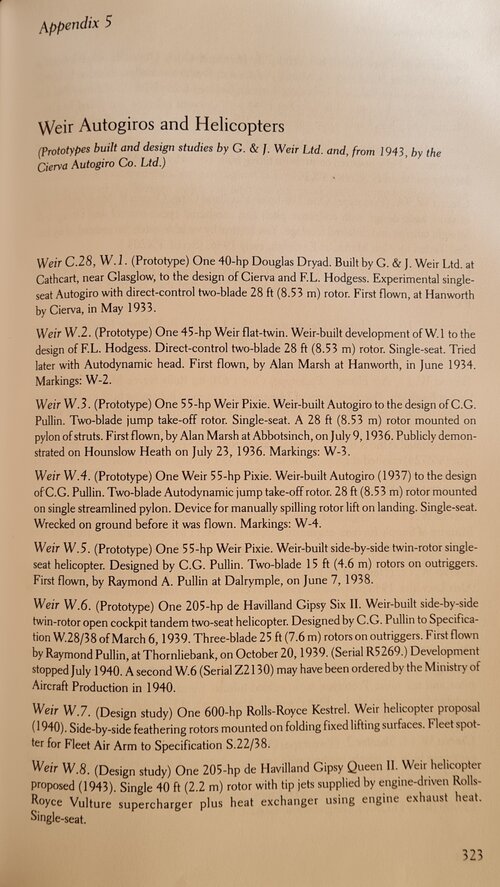
Here is the "W." list. Designations W.1 to W.5 pertain to autogiros built by G. & J. Weir in Glasgow, and from W.6 onwards, Weir is taken over by Cierva and the projects carry that name.

W.1 Cierva C.28 with custom-manufactured Douglas-Dryad engine (1933)
W.2 Cierva C.28 with Weir O-92 Dryad II flat two-cylinder, horizontally-opposed, air-cooled engine, and drive to spin rotor before take-off (1934)
W.3 single-seater powered by an inverted 4-cylinder in-line engine and fitted with a two-bladed 'auto-dynamic' rotor (1936)
W.4 single-rotor autogiro, a more elegantly finished version of the earlier W.3 design with a 50 hp engine (1937)
W.5 single-seat helicopter powered by an air-cooled engine; two two-bladed rotors each had cyclic and collective pitch control and turned at 430 r.p.m (1938)
W.6 two-seater helicopter built under 28/38 and powered by a more powerful fan-cooled engine located in the nose (1939)
W.7 helicopter project to S.22/38 specification in which the offset airscrew gives propulsion and a very "cushy" clutch effect for starting the rotor
W.8 helicopter project with folding rotor and two propellers in pusher position, one permanently coupled to the transmission and one having a clutch
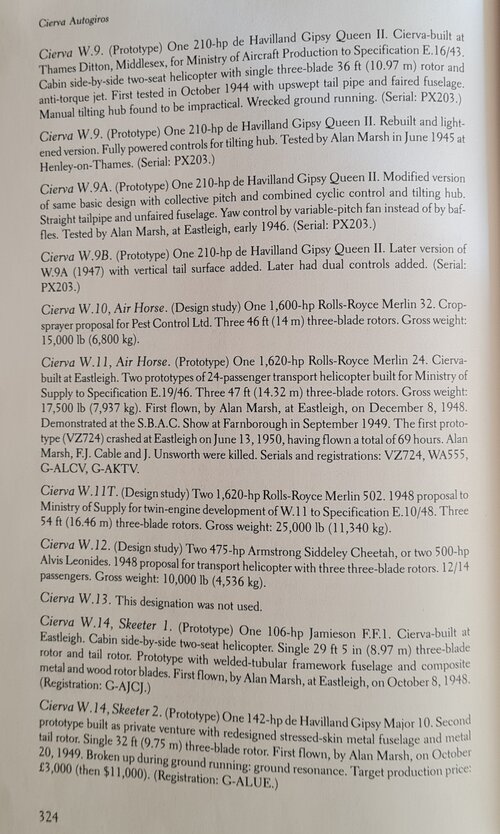
W.9 experimental helicopter to E.16/43 specification with a three-blade main rotor (1944)
W.10 project for a 4/5-seat single-engine helicopter
W.11 Air Horse, very large helicopter with single Rolls-Royce Merlin 24 engine driving three large three-blade rotors; second example ordered to E.19/46 (1948)
W.11 Spraying Mantis, agricultural spraying version developed with Pest Control, Ltd., project only
W.11T project for an enlarged W.11 with two 1208kW Rolls-Royce Merlin 502 engines (1948)
W.12 projected smaller freighter development of W.11 with Rolls-Royce Dart turboprops and a payload of 1½ tons or 12 passengers
W.13 not assigned
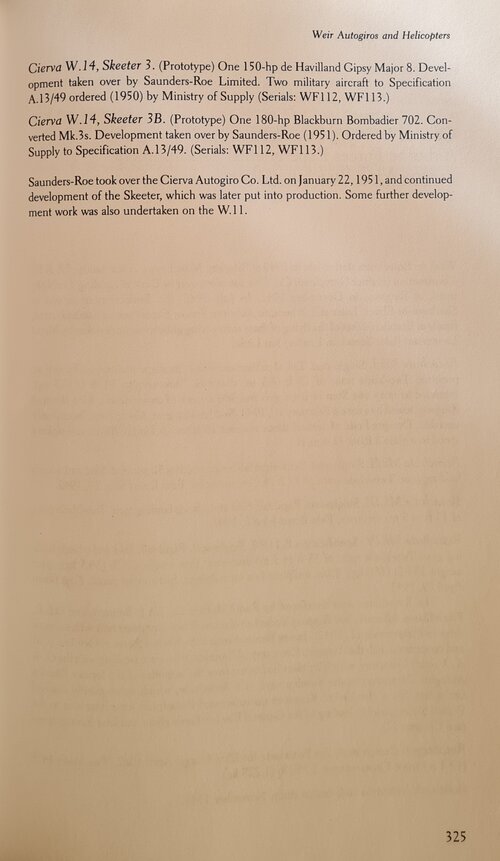
W.14 Skeeter, became the Saro Skeeter, built by Saunders-Roe Ltd. (1948)
 
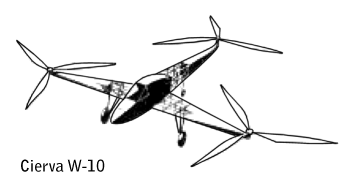
Here is what the Cierva W-10 was supposed to look like:
 

Attachments

  • Cierva W.10 enhanced.gif
    Cierva W.10 enhanced.gif
    12.8 KB · Views: 178
Stargazer2006 said:
C.22 (Avro Type 665)
...
C.33 (Avro Type 665)


"Type 665" was used twice for unrelated designs? Or is this a mistake? I'm fairly certain on the accuracy of it applying to the C.33, but due to lack of available info I'm not sure about the C.22. I'm working on the Cierva list at my site (finally) so any clarification on this would be much appreciated.
 
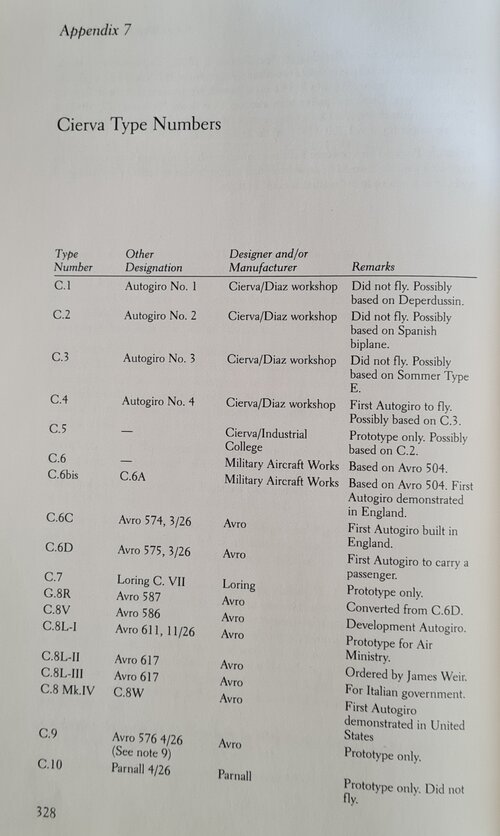
To the best of my knowledge, the Avro designations that were used for Cierva autogiros are as follows:

574 Cierva C.6C Autogiro
575 Cierva C.6D/C.8L* Gyroplane
576 Cierva C.9 Autogiro
586 Cierva C.8V
587 Cierva C.8R
611 Cierva C.8L Mk I
612 Cierva C.17 Mk I
617 Cierva C.8L Mk II
617 Cierva C.8L Mk III
620 Cierva C.17 Mk II
620 Cierva C.17 Hydrogiro
665 Cierva C.33
668 Cierva C.37

The designation "Avro Type 665" for the Cierva C.22 is most probably a mistake on my part.
I also notice I listed some versions of the C.19 as "Avro Type 620" but that is probably a mistake too.

Sorry for the inconvenience.
 
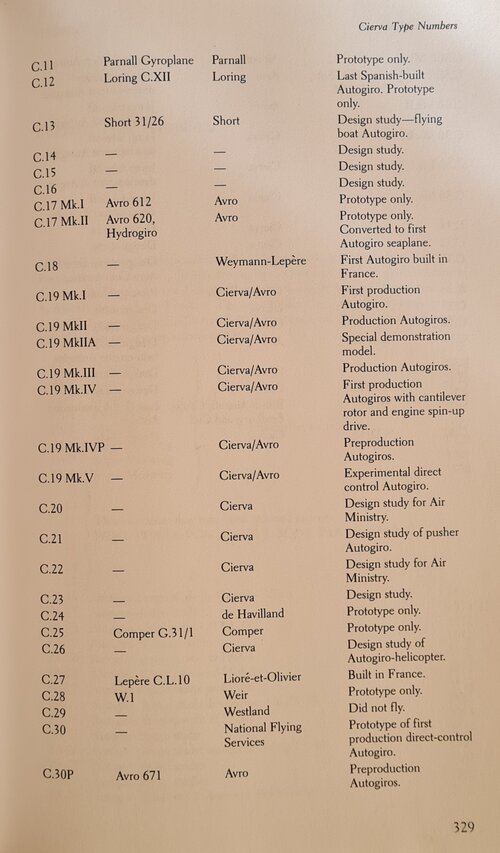
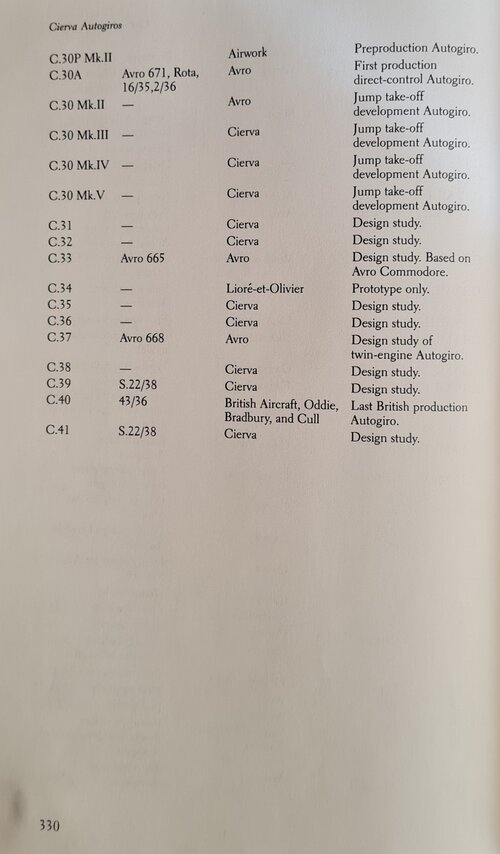
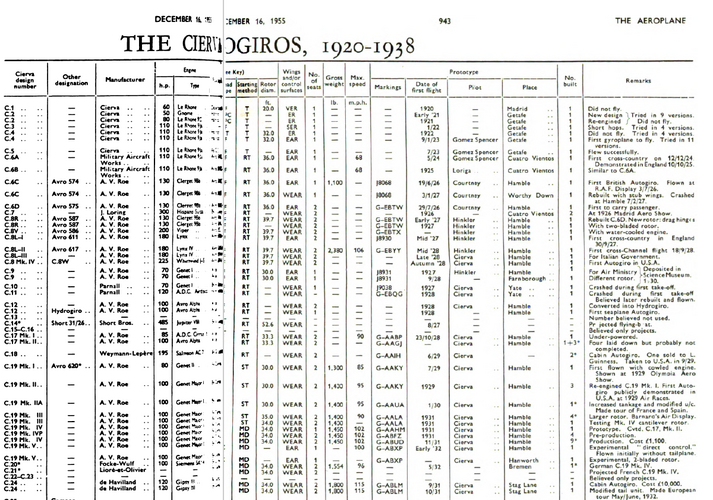
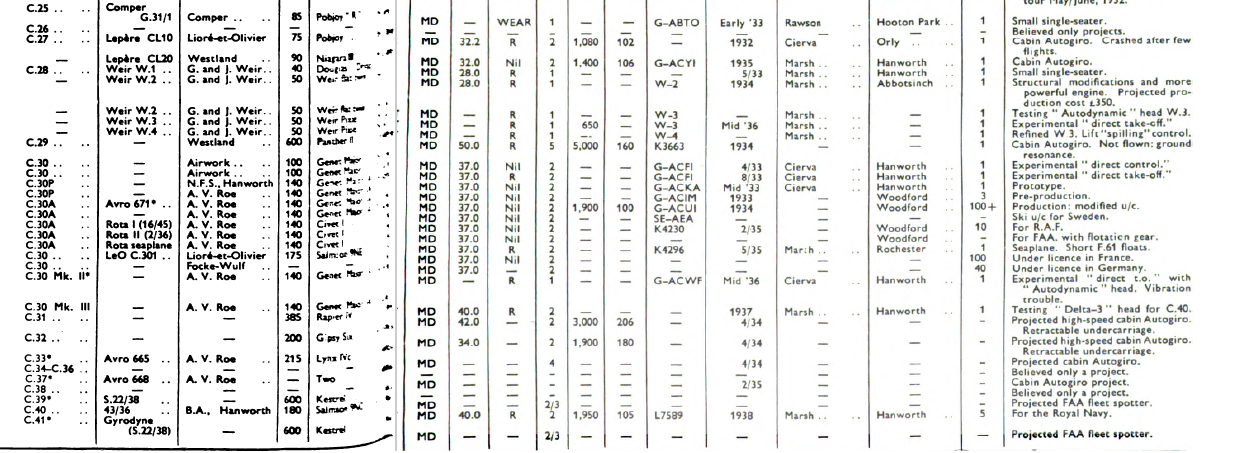
From the Book . . . . .
 

Attachments

  • Cierva & Weir designations (1).jpg
    Cierva & Weir designations (1).jpg
    1.1 MB · Views: 39
  • Cierva & Weir designations (2).jpg
    Cierva & Weir designations (2).jpg
    1.3 MB · Views: 39
  • Cierva & Weir designations (3).jpg
    Cierva & Weir designations (3).jpg
    1.1 MB · Views: 33
  • Cierva & Weir designations (4).jpg
    Cierva & Weir designations (4).jpg
    884.6 KB · Views: 50
  • Cierva & Weir designations (5).jpg
    Cierva & Weir designations (5).jpg
    890.9 KB · Views: 49
  • Cierva & Weir designations (6).jpg
    Cierva & Weir designations (6).jpg
    802.9 KB · Views: 50
  • Cierva & Weir designations (7).jpg
    Cierva & Weir designations (7).jpg
    843 KB · Views: 55
My Cierva research compiled in one Excel file (note second thumbnail for key to abbreviations).
 

Attachments

  • CIERVA (version 2025-11-20 by Stéphane Beaumort © 2025).xlsx
    42.7 KB · Views: 21
Stephane, the Specification File is not too clear on some details so here are the titles, dates and key requirements from four AM Specs.

AM Specification 3/26 - Rotaplane with Clerget Engine. Issued 11th March 1926
“This Specification is intended to cover the construction of a rotaplane substantially similar to the aircraft demonstrated under Specification No.14/25 as defined by Drawings No.A.799 and A.8OO.”


AM Specification 4/26 - Light Rotaplane with Armstrong Siddeley Genet Engine. Issued 13th May 1926


AM Specification 11/26 - Two Seater Gyroplane with Lynx Engine. Issued 10th June 1926
"The design is to be agreed between the contractor and the inventor, and is to be to the satisfaction of the Director of Scientific Research. Three interchangeable sets of blades are to be provided for the rotor, having ratios of blade area to disc area of 0.18, 0.14 and 0.1 respectively.


AM Specification 31/26 - Gyroplane Boat Seaplane (Jupiter Engine). Issued 11th July 1927
“The final design is to be based on the information covered by Contractors Drawing No.C.R.1775 and is to be agreed between the contractor and the inventor to the satisfaction of the Director of Scientific Research.”
 
C.21 (Lioré et Olivier C.21)
Hi Stargazer,
do you have any evidence of this? Is it just coming from mention in Hartman site or copy of this in TU by Charles Claveau?
1763644293677.png
I never found any trace in Lioré et Olivier archives, and Brooks does not confirm this in his book.
 
Regarding the C13 v C14 discussion it is quite plausible that they are both 'correct'. There was a continuing superstitious reluctance to use 13 for designations or type numbers in the 20s and 30s so it may well have been changed or both used. Shorts were one company that appear to have avoided 13, their designations went directly from S.12 to S.14, so the change may have been theirs.
 
If I understand what you wrote, my list contained some errors or ambiguities. The info on the first two Specs. seemed correct, so I suppose what you're saying here is that the C.8L-I (Avro Type 611) was the answer to Specs. 11/26 and 31/26. Am I right?
No, I was just providing you with the actual titles, dates etc. taken from the documents themselves, as I thought it might be useful. For example you have a Short drawing number there which may help track down a copy
 
Hi Stargazer,
do you have any evidence of this? Is it just coming from mention in Hartman site or copy of this in TU by Charles Claveau?
View attachment 792290
I never found any trace in Lioré et Olivier archives, and Brooks does not confirm this in his book.

No, as I said in the key, the asterisk (*) indicates rumored but unconfirmed allocations. And you're right, Brooke doesn't really believe this allocation existed:
Although it has been reported that the French C.19 Mk.IV was to be designated C.21, this seems unlikely.
As a matter of fact, if my theory of C.20 and C.21 being reallocated to Weymann's CTW.200/201 and CTW.210 is correct (which I don't have proof for right now), it would have made no sense to allocate C.21 a third time to LeO the following year.
 
Regarding the C13 v C14 discussion it is quite plausible that they are both 'correct'. There was a continuing superstitious reluctance to use 13 for designations or type numbers in the 20s and 30s so it may well have been changed or both used. Shorts were one company that appear to have avoided 13, their designations went directly from S.12 to S.14, so the change may have been theirs.
I'm glad you wrote that because Shorts asking for a change in designation because of superstition was exactly my supposition!
 
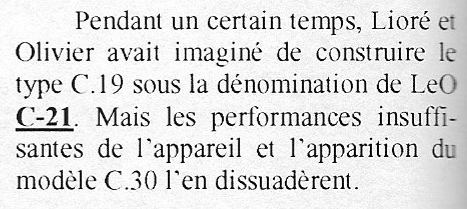
From TU 243.
Oh, yes, I remember this one now. The way it's written ("Lioré et Olivier had imagined building the type under the designation LeO C-21") suggests that if the designation did exist, it might have been company-given and not an actual Cierva one.
 
Oh, yes, I remember this one now. The way it's written ("Lioré et Olivier had imagined building the type under the designation LeO C-21") suggests that if the designation did exist, it might have been company-given and not an actual Cierva one.
I remember it too and, as I said above, Charles just took the information from Hartman's site, which I consider not reliable enough. Fortunately, as you mention, Charles was careful enough not to be too assertive and reported this as a hypothesis and not as a fact.
 
Last edited:

Similar threads

Back
Top Bottom