the US has done a tremendous amount of work in missile technologies from shaping, aero, flight profiles, propulsion of all sorts, seekers, smart fusing and target detection etc etc. The issue is AMRAAM, like Sidewinder, is such a good platform with such an extensive base of knowledge, and importantly seems amenable to clever tweaks to consistently deliver enough performance improvements that absent a pacing threat like China recently, the cost effectiveness and budget arguments have crushed any hope of a clean sheet design making it far. But things have changed and now there are things like JATM and apparently others.

To extend and simplify, both Sidewinder and AMRAAM evolutionary variants have always been “good enough for the money” for the CONOPs of the platforms that carried them, be they F-16s or F-22s, until recently. Hence AIM-174b (and this thread) and AIM-260 and hopefully cheap, bulk Costo Kirkland AMRAAMs.
 
So, how a potential client nation can reject Chinese AAM offers now ? seeing that they have :

-Phased array seekers
-Some long range no less than any EU or US competitors
-The weapon systems already in service with the PLAAF and having good industrial baseline to support it
-Recently prove itself in battle

Especially that common folks often praise phased arrays and now look there is ITAR free and non US and allies aligned advanced weapons available for export. I noticed that comparison between US-Allies design with its competitors often neglect export potentials, like seeing currently available AMRAAM's and even Meteors are still slotted planar array seeker, what does it offer against PL-15E ?
 
So, how a potential client nation can reject Chinese AAM offers now ? seeing that they have :

-Phased array seekers
-Some long range no less than any EU or US competitors
-The weapon systems already in service with the PLAAF and having good industrial baseline to support it
-Recently prove itself in battle

Especially that common folks often praise phased arrays and now look there is ITAR free and non US and allies aligned advanced weapons available for export. I noticed that comparison between US-Allies design with its competitors often neglect export potentials, like seeing currently available AMRAAM's and even Meteors are still slotted planar array seeker, what does it offer against PL-15E ?

If they have established system (EU or U.S.) it may not be compatible with Chinese fighter aircraft. That said, if China could get data linking to work between J-10C and Eyrie Eye, the sky is the limit.

So, potentially US sanctions?
 
So, how a potential client nation can reject Chinese AAM offers now ? seeing that they have :

-Phased array seekers
-Some long range no less than any EU or US competitors
-The weapon systems already in service with the PLAAF and having good industrial baseline to support it
-Recently prove itself in battle

Especially that common folks often praise phased arrays and now look there is ITAR free and non US and allies aligned advanced weapons available for export. I noticed that comparison between US-Allies design with its competitors often neglect export potentials, like seeing currently available AMRAAM's and even Meteors are still slotted planar array seeker, what does it offer against PL-15E ?

The lack of Chinese aircraft exports, of which AFAIK Pakistan is the singular exception. I think that is about to change, especially with the current U.S. administration, but probably not in a huge way - like 1-2 new clients.

But yes, an export PL-15 is almost certainly a superior product compared to export AMRAAM, and likely even the latest and greatest AIM-120. AIM-260 seems designed to offset that, though we do not know the details.
 
the US has done a tremendous amount of work in missile technologies from shaping, aero, flight profiles, propulsion of all sorts, seekers, smart fusing and target detection etc etc. The issue is AMRAAM, like Sidewinder, is such a good platform with such an extensive base of knowledge, and importantly seems amenable to clever tweaks to consistently deliver enough performance improvements that absent a pacing threat like China recently, the cost effectiveness and budget arguments have crushed any hope of a clean sheet design making it far. But things have changed and now there are things like JATM and apparently others.

To extend and simplify, both Sidewinder and AMRAAM evolutionary variants have always been “good enough for the money” for the CONOPs of the platforms that carried them, be they F-16s or F-22s, until recently. Hence AIM-174b (and this thread) and AIM-260 and hopefully cheap, bulk Costo Kirkland AMRAAMs.
Yep. Consider we could have had a HOBS short range AAM half a century ago in the form of the AIM-95.

aim-95a.jpg
 

Attachments

  • aim-95a.jpg
    aim-95a.jpg
    18.2 KB · Views: 29
Last edited:
What are the technical differences between the PLA's PL15 used for domestic purposes and the export version PL15E?
It's either they have no physical booster difference like how @siegecrossbow said but have different electronic configs like worse ECCM and inefficient guidance logic thus the shorter range and maybe even a worse seeker. Or it's possible that the booster doesn't use a dual pulse motor like the normal PL-15 and just have a conventional booster-sustainer config
 
If they have established system (EU or U.S.) it may not be compatible with Chinese fighter aircraft. That said, if China could get data linking to work between J-10C and Eyrie Eye, the sky is the limit.

So, potentially US sanctions?

Sanctions or some economic-political restrictions and alienation is the quickest way.

On the datalinking tho, possible but that would still need the OEM to cooperate. The other way is the Country actually designed their own datalink standard that act as "middleman" between EU and CN system. Might be politically less risky as there wont be any contact between CN and EU personnel.

What are the technical differences between the PLA's PL15 used for domestic purposes and the export version PL15E?

Perhaps the exclusions of some ECCM modes while the seekers and propulsions remain standard. It is easier to downgrade the software sides than hardware as one can still make use of the established industrial lines. Trying to downgrade hardware e.g smaller rocket motor will necessitates not only new actual motor to be developed but also flight control law need to be devised around that new motor, and if the client country only buy little amount, the missile will end up being impractical economically as each of them have to bear the cost of RnD.

Changes in range however can perhaps be implemented by limiting the battery capacity, as it should be cheaper to implement. The domestic use missile perhaps have 2.5 minutes duration while export one 1-1.5 minutes. Those could limit the range for say example for AIM-120B by 28-46%
 
Perhaps the exclusions of some ECCM modes while the seekers and propulsions remain standard. It is easier to downgrade the software sides than hardware as one can still make use of the established industrial lines. Trying to downgrade hardware e.g smaller rocket motor will necessitates not only new actual motor to be developed but also flight control law need to be devised around that new motor, and if the client country only buy little amount, the missile will end up being impractical economically as each of them have to bear the cost of RnD.

Changes in range however can perhaps be implemented by limiting the battery capacity, as it should be cheaper to implement. The domestic use missile perhaps have 2.5 minutes duration while export one 1-1.5 minutes. Those could limit the range for say example for AIM-120B by 28-46%
1746869535721.png
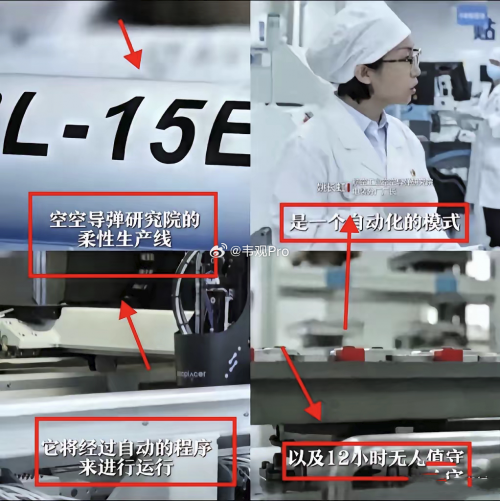
The flexible production line at the Air Missile Research Institute(中国空空导弹研究院) is a motorized model.
It will run through an automated program and be unmanned for 12 hours.
cctv posted the video, you guys should be able to find it on tubing and tiktok,
ps: this screenshot is incomplete. It refers to 24-hour unmanned production and 12-hour unattended operation. Additionally, 'flexible' here means supporting small-batch customization.
 
Defense Updates has just put out a video concerning India's recently obtaining of several examples of relatively intact PL-15Es:


As witnessed in the Ukraine-Russia conflict, critical weapons fell into the adversary's hands.For example, Russia caught hold of the U.S. Javelin anti-tank missile, M2 Browning machine gun, and FIM-92 Stinger MANPAD, to name a few.Ukraine managed to recover the T-90M Main Battle Tank, BTR-80 armored personnel carriers, Pantsir-S1 SAM, and Krasukha-4 EW system.A similar situation is repeating in the Indian subcontinent.
During the latest India-Pakistan conflict, several Chinese PL-15 air-to-air missiles fired by the Pakistani Air Force slipped into Indian hands. Viewers may note that reports indicated that China urgently delivered this missile to Pakistan as tensions escalated after the Pahalgam terror attack.
In this video, Defense Updates analyzes why the capture of PL-15 is a big blow for Pakistan & China?
#defenseupdates #operationsindoor #indiapakistanwar
Chapters:
0:00 TITLE
00:11 INTRODUCTION
01:14 SPONSORSHIP - NordVPN
01:47 RECOVERY
03:11 PL-15 OVERVIEW
04:44 THREAT from PL-15 IS GENUINE
07:40 ANALYSIS
 
Defense Updates has just put out a video concerning India's recently obtaining of several examples of relatively intact PL-15Es:

I think people believe it's a big deal because people think the PL-15 is the best BVRAAM in the PLAAF arsenal. Not only is the PL-15E a tuned down PL-15. But there's no way a missile of this caliber would've been sold abroad if the risk of it being examined by an enemy was detrimental to China's national security. Due to the existence of the PL-16 not being widely known to the public, I think this is as overblown as the Russian's capturing some old NATO armor in Ukraine. India is already working on a missile with an AESA seeker and it's already undergoing trials. I'm not sure if the general public would bat an eye if it was a PL-12.
 
I think people believe it's a big deal because people think the PL-15 is the best BVRAAM in the PLAAF arsenal. Not only is the PL-15E a tuned down PL-15. But there's no way a missile of this caliber would've been sold abroad if the risk of it being examined by an enemy was detrimental to China's national security. Due to the existence of the PL-16 not being widely known to the public, I think this is as overblown as the Russian's capturing some old NATO armor in Ukraine. India is already working on a missile with an AESA seeker and it's already undergoing trials. I'm not sure if the general public would bat an eye if it was a PL-12.
If the PL-16 is as potent as it is described, i.e a smaller form factor. Greater range, and similar maneuverability, barring electronics and seeker improvements. Even the true PL-15 in the PLAAF has already become outdated.
 
"M2 Browning machine gun"

Pretty sure they grabbed a few of those back in WWII. :D

The Soviet Union no doubt got a shit-load of M2s way back during WWII for shredding Nazis on the Eastern Front;):D.
 
Last edited:
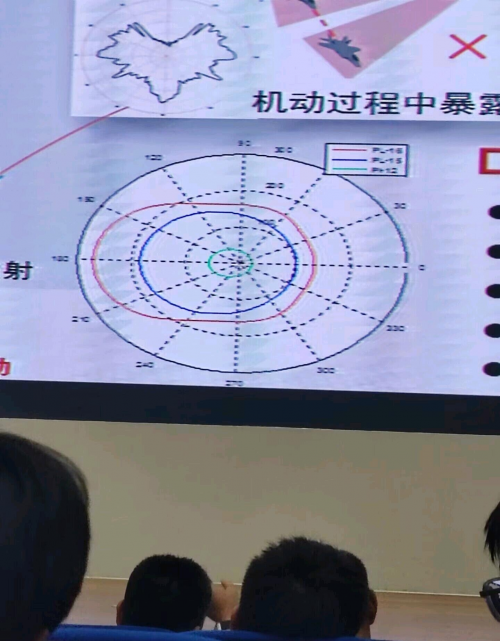
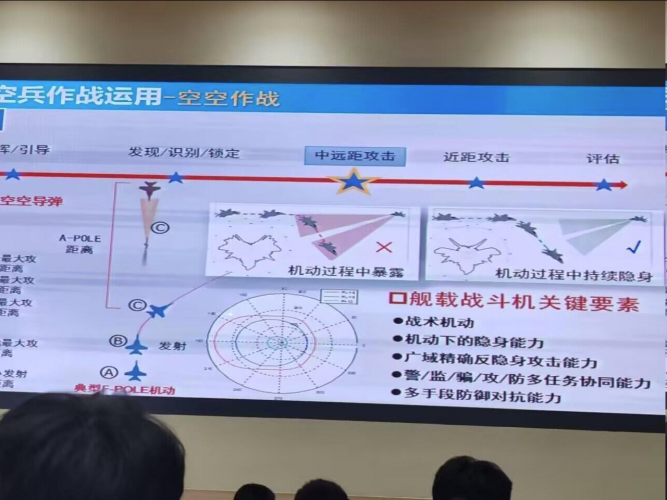
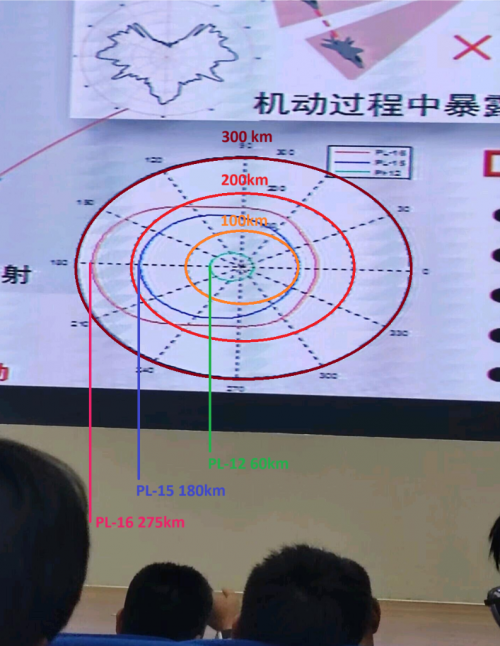
Very nice chart, but I’m confused, where did he got the range number from?
I believe this is how some are reading this chart.
1753579603062.png
The problem is we don't know what envelope the launch parameters were for these supposed range calculations. And given that the range for the PL-12 seems quite underestimated and the PL-15 seems a bit lower than expected. The launch parameters or other variables may differ from standard conditions.

Although this may indeed show what kind of ranges the PL-16 is capable of. I'm more interested in the official recognition of the existence of the PL-16. As I believe most people that don't follow PLA developments even know of the PL-16 missile, and believe the PL-15 is the PLAAF's best weapons bay capable BVRAAM.
 
I believe this is how some are reading this chart.
View attachment 779269
The problem is we don't know what envelope the launch parameters were for these supposed range calculations. And given that the range for the PL-12 seems quite underestimated and the PL-15 seems a bit lower than expected. The launch parameters or other variables may differ from standard conditions.

Although this may indeed show what kind of ranges the PL-16 is capable of. I'm more interested in the official recognition of the existence of the PL-16. As I believe most people that don't follow PLA developments even know of the PL-16 missile, and believe the PL-15 is the PLAAF's best weapons bay capable BVRAAM.
So the 100-200-300 km rings are prediction?
 
I believe this is how some are reading this chart.
View attachment 779269
The problem is we don't know what envelope the launch parameters were for these supposed range calculations. And given that the range for the PL-12 seems quite underestimated and the PL-15 seems a bit lower than expected. The launch parameters or other variables may differ from standard conditions.

Although this may indeed show what kind of ranges the PL-16 is capable of. I'm more interested in the official recognition of the existence of the PL-16. As I believe most people that don't follow PLA developments even know of the PL-16 missile, and believe the PL-15 is the PLAAF's best weapons bay capable BVRAAM.
Someone just abritrarily assigned a 60km range to the PL-12, there is no stated numbers on the graph.
 
Someone just abritrarily assigned a 60km range to the PL-12, there is no stated numbers on the graph.
Launch altitude and speeds of target or launch vehicle are not known, it very well could be 60km for the given scenario. What we do know now is that, if true, the PL-15 can do 180km in the same conditions.
 
Hi all, new member.

Wanted to add the FT article that PL15 range was enhanced due to unspecified software updates derived from G42 AI tech in 2022


Question, what sort of tech could this be? Mid course guidance from LEO sats?

Wishful thinking, this whole story sounds like a bunch of baloney. It's quite obvious why no one decided to post it in this thread beforehand.
 
It is the FT, they have high sourcing standards before they run a story, not sure how it is baloney immediately?

The timing of the leak and even the placement is definately "motivated" (cui bono etc) but this is such a specific piece of info that it may have something to it?
 
It is the FT, they have high sourcing standards before they run a story, not sure how it is baloney immediately?

The timing of the leak and even the placement is definately "motivated" (cui bono etc) but this is such a specific piece of info that it may have something to it?

The PL-15 entered service in 2011, with the already expected 200km+ range figures. G42 was founded in 2018 and unspecified AI tech was supposedly transferred to China via Huawei, (of course another article targeting Huawei) by 2022. The PL-15 was never indicated to have any range extensions by 2022, nor via recent leaks showing the A-poles of the PL-15 and PL-16. The PL-16 has been rumored to have entered service around this time, yet this article that speaks of the secret US spies have no knowledge of the PL-16? Lastly the air to air variants of the PL-15 have had their productions run end. Just 3 years after the ground breaking software update that enabled it to extend it's range> why would they do that. How did these unspecified US spies know that the software transfer to Huawei was for air to air missiles? Huawei is famously not an air to air missile producing company. There just seems to be a lot of holes in this specific story.

These spies seem to specifically know that the tech was transferred to Huawei and to upgrade the PL-15 and the PL-17. It's funny these US spies only know about the mainstream PLAAF BVRAAMs. I would've given more thought on it, if the discussed missile was the mysterious PL-16. However this just sounds made the hell up and they chose to talk about PL-15 and PL-17 because they didn't know about the PL-16 nor did enough research on the matter, and that most western audiences have no clue what the PL-16 is, but the PL-15 and PL-17 are a widely discussed and known threat. Talk about high sourcing standards.
 
Last edited:
Something that always irks me about sourcing on China's military by mainstream western media is that it's always the unnamed sources, or the unnamed spies who have no skin in the game and can say whatever they want, with no reputation to defend. People will soon forget stories like these. The information that we can get from the Chinese insiders however, who have to transmit information through riddles and hoops have proven to be more reliable over many years of discussions. They have a credibility that needs to be maintained, this is why they are often trusted sources for us on matters of the PLA, yet if you don't follow closely enough you will never believe what they say.
 
Thanks for the reply. It would be shocked if there wasn't wide scale industrial espionage ongoing everywhere, so it is not to point out China or UAE particularly. The FT article is blatatantly aimed at sending a warning shot to those cooperating with Chinese BigTech and thus light on detail. Its a motivated plant.

I was more curious about what this cryptic phrase could mean

"Two people said the technology involved software that would optimise the flight of the missiles."

To your question, even if PL15s were made in 2011 (or 2014 as per the ones fired by PAF and recovered in India), that means there are significant software updates that happen during the life of the missile, and what does "optimize the flight" mean in the context of an LR AAM? (Perhaps the curiosity is more aerodynamics driven. What would change between 2011 and 2022 that suddenly some new insight was derived, that results in a huge increase in effective range? (250 km+ according to Indian reports)

My (very layman) guess basis of tech that G42 has was that it may have been LEO sat based mid course guidance.. but that sounds too outlandish for, as you said, a missile made in 2011.
 
Thanks for the reply. It would be shocked if there wasn't wide scale industrial espionage ongoing everywhere, so it is not to point out China or UAE particularly. The FT article is blatatantly aimed at sending a warning shot to those cooperating with Chinese BigTech and thus light on detail. Its a motivated plant.

I was more curious about what this cryptic phrase could mean

"Two people said the technology involved software that would optimise the flight of the missiles."

To your question, even if PL15s were made in 2011 (or 2014 as per the ones fired by PAF and recovered in India), that means there are significant software updates that happen during the life of the missile, and what does "optimize the flight" mean in the context of an LR AAM? (Perhaps the curiosity is more aerodynamics driven. What would change between 2011 and 2022 that suddenly some new insight was derived, that results in a huge increase in effective range? (250 km+ according to Indian reports)

My (very layman) guess basis of tech that G42 has was that it may have been LEO sat based mid course guidance.. but that sounds too outlandish for, as you said, a missile made in 2011.

Flight path optimization I'm guessing has to do with how high the missile lofts or with how the missile pulses are fired. Something like the PL-15 would loft extremely high, while a ramjet powered missile like the meteor has a relatively flat trajectory. I'm quite sure that the PL-15 has always been a 200+ class missile, since it's introduction. It was that many did not believe it to be true, because think about how much prejudice talking about Chinese advancements faced back then, and how much they still do now. It's only after being combat proven are, especially Indian commentators, coming to terms with how advanced the PL-15 is. Range is not a static figure, it depends on the launch parameters determined by the fighter carrying it, and the direction and profile of the target. In absolutely ideal conditions, it wouldn't surprise me that the PL-15 is capable of hitting targets up to 300km away. But as further a target may be, the probability of kill on a 300km solution should drop significantly.
 
Software changes might also alter how the missile leads the target, particularly if it has multiple pulses. It might minimize turns once it commits to going down range to maximize range and minimize flight time in the general direction of the target, then execute a very hard turn towards the targets predicted path and fire its second pulse to achieve a high energy intercept.
 
Given G42 (and I guess Space42) is not into lauching, it is surprising they would have any software for optimizing flight profiles at all.

BTW leaks/reports in Indian Press are praising PL15 features gained from the anslysis of the recovered examples:


While DRDO remains tight-lipped about its analysis report submitted to the defence ministry, the examination has identified several superior features in the Chinese weapon, one of the people cited above said. These include a miniature active electronically scanned array (AESA) radar with advanced propellant capable of maintaining speeds exceeding Mach 5, and sophisticated anti-jamming capabilities
 
Thanks for the reply. It would be shocked if there wasn't wide scale industrial espionage ongoing everywhere, so it is not to point out China or UAE particularly. The FT article is blatatantly aimed at sending a warning shot to those cooperating with Chinese BigTech and thus light on detail. Its a motivated plant.

I was more curious about what this cryptic phrase could mean

"Two people said the technology involved software that would optimise the flight of the missiles."
Raytheon did something very similar years ago for the AIM-120. I was implying China might have got a peek. Or figured it out from what they could glean.
 
Raytheon did something very similar years ago for the AIM-120. I was implying China might have got a peek. Or figured it out from what they could glean.


Raytheon Software Upgrade Extends AIM-120 AMRAAM Range, Increases Lethality
by mmElodie Collins
September 18, 2025, 11:32 am

Raytheon has made software upgrades to the AIM-120 Advanced Medium-Range Air-to-Air Missile, or AMRAAM, to enhance the weapon system’s reach and lethality, Air and Space Forces Magazine reported Tuesday.


The upgrades have already been implemented in AMRAAM rounds coming off the production line, the company said at a press event.


AMRAAM Software Upgrade Tested on F-22​

Raytheon revealed that the software updates underwent experimental tests in the second half of 2024, but the company only received permission from the Air Force to discuss the matter.

During the test, RTX launched AIM-120D missiles from an F-22 at Eglin Air Force Base in Florida. The exact range of the AMRAAM is unknown, and Raytheon did not characterize how much farther the missiles can fly. However, a Raytheon spokesperson shared that the tests represent the “longest known shot of an AMRAAM by a fifth-generation fighter.”

Improved Propulsion, Threat Response​

Jon Norman, vice president of requirements and capabilities at Raytheon, also revealed that the missile has “a little bit bigger engine from the propulsion side,” which was made possible through the use of modern electronics. The executive added that the AMRAAM has a more efficient battery and software that takes advantage of the higher altitudes and speeds at which F-22 and F-35 fighters operate.

He also said the software strengthens the capability of the AMRAAM to counter a wider variety of threats and enables pilots to fly the missile from “further than they ever imagined before.”

The upgrade is part of the U.S. Air Force’s form, fit, function refresh, or F3R, effort to continuously enhance AMRAAM’s performance.
 
Yeah, I was thinking about this as well:

AIM-120D is an upgraded version of the AMRAAM with improvements in almost all areas, including 50% greater range (than the already-extended range AIM-120C-7) and better guidance over its entire flight envelope yielding an improved kill probability (Pk). Initial production began in 2006 under the Engineering and Manufacturing Development phase of program testing and ceased in September 2009.[45] Raytheon began testing the D model on August 5, 2008, the company reported that an AIM-120D launched from an F/A-18F Super Hornet passed within lethal distance of a QF-4 target drone at the White Sands Missile Range.[46] The range of the AIM-120D is classified, but is thought to extend to about 100 miles (160 km) or potentially up to 112 miles (180 km).[47] The AIM120D after F3R (Form, Fit, Function, Refresh) has a slightly bigger motor section. As Well as a more efficient battery and coding leads to the AIM120D getting increased range according to vice president of Raytheon, Jon Norman.[48]

I know they got software-driven range bumps before last year.
 
non-export PL-15s are said to be no longer in production. If there has been a recent software update that greatly enhances the PL-15, why end production so soon?
 
Yeah, I was thinking about this as well:

AIM-120D is an upgraded version of the AMRAAM with improvements in almost all areas, including 50% greater range (than the already-extended range AIM-120C-7) and better guidance over its entire flight envelope yielding an improved kill probability (Pk). Initial production began in 2006 under the Engineering and Manufacturing Development phase of program testing and ceased in September 2009.[45] Raytheon began testing the D model on August 5, 2008, the company reported that an AIM-120D launched from an F/A-18F Super Hornet passed within lethal distance of a QF-4 target drone at the White Sands Missile Range.[46] The range of the AIM-120D is classified, but is thought to extend to about 100 miles (160 km) or potentially up to 112 miles (180 km).[47] The AIM120D after F3R (Form, Fit, Function, Refresh) has a slightly bigger motor section. As Well as a more efficient battery and coding leads to the AIM120D getting increased range according to vice president of Raytheon, Jon Norman.[48]

I know they got software-driven range bumps before last year.
Getting an (unspecified but significant) bump due to fresh software is mind-boggling. It points to some breakthrough just understood amd discovered in the last couple of years.

Are there open source reports in AIAA or other trade journals that has discovered this new flight envelope for LR AAMs??

And what at an amazing coincidence that both PL15 and AIM120s got this and was reported at the same time!!! (Sept Oct 2025).

The implications for air power deployment and tactics also follow.

Added later: Could it also be as simple as newer gen power packs? Better battery tech (as we see in our phones.. and on EVs and drones) would allow for much more powerdul seeker and comms deployment
 
Last edited:
I asked ChatGPT to search AIAA and other academic journals and yes there are several papers on optimization of flight profiles of dual pulse AAMs using latest gen computational techniques:

Pseudospectral optimal control (linear Gauss pseudospectral) + sequential convex programming or direct transcription is used to compute near-optimal launch → boost → coast → terminal trajectories for dual-pulse missiles. This directly targets ignition timing for the second pulse and control history (angle of attack) to maximise range/time-of-flight or minimize final time.


Model-Predictive Control (MPC) frameworks are applied to run constrained optimisation onboard or in near-real time, enabling adaptation to target maneuvers and updated sensor inputs. EuroGNC 2024 and AIAA surveys show how MPC can be made tractable for missile control by convexification and fast solvers.


Deep Reinforcement Learning (DRL) / computational guidance is proposed and demonstrated in simulation as a way to discover non-intuitive guidance policies that trade energy vs interception probability. These works show RL policies can outperform classical guidance in some simulated scenarios.
 
Last edited:
For the experienced PLA watchers: I frequently see 300km mentioned as a range figure for the PL-15 in western media. Surely this is unrealistically high, yes?
 

Similar threads

Back
Top Bottom