It could be simply a way to reduce design risk. For instance, let's say you have a more advanced inlet - but you are only 90% sure it will be as desirable as you think. To speed development you build prototypes with both the experimental solution and a proven solution... that way you aren't delayed if you decided to go with the conservative approach, and you also have good data on whether the more ideal alternative actually is more ideal.

If anything, it is a sign that (1) prototypes are still needed for validation and (2) they want this aircraft in mass production as soon as possible.

That latter conclusion is a reasonable take-away if they are building parallel prototypes with different features.
Trying to think of the last time anybody did something like this. This isn't like two different aircraft, from different manufacturers. Maybe the STOL and VG versions of the MiG-23? Or the S-6 / Su-24?
 
Is there any actual evidence for this? Almost every ATF concept shown, before the YF-22/23 were rolled out, had a canard. And we saw how that worked out. (None of the 7 ATF entries had a canard.)
I mean if we disregard the renderings for XA103 we've still got some GE and PW patents to go off. Could possibly all be smokescreen but it seems like the best solution for signature reduction improvement over current conventional 3D and 2D exhausts.
 
Trying to think of the last time anybody did something like this. This isn't like two different aircraft, from different manufacturers. Maybe the STOL and VG versions of the MiG-23? Or the S-6 / Su-24?

It was a really common practice until the 1940s. There are probably a couple of examples from the 1970s (alternative engines or especially avionics fits?) - but yes, it would be pretty uncommon after that.
 
Could it be that they've changed the engine?

I have to admit I was also thinking about them trialing two engines alongside two fighters, ATF style.


If they have changed the engine I doubt it would be done so in a "sidegrade" manner because they don't really have two engines of the same thrust class available to have an ATF style competition for their engines.

If they have changed the engines, chances are it would be an upgrade instead.
 
@snne : As enormous as it is, it seems logical to understand it to be an attack/bomber. Just like there was Maurauder and Fortress.

The most concerning aspect of this new iteration is the displayed agility in design. Many countries have (temporarily?) lost such to say the least. Agree that we don´t know the true date of the first flight of the earlier model, but still, we have major changes implemented on an airframe that had been pushed to test flight as a production representative model. That´s not something every country can (still) do.
 
@snne : As enormous as it is, it seems logical to understand it to be an attack/bomber. Just like there was Maurauder and Fortress.

The most concerning aspect of this new iteration is the displayed agility in design. Many countries have (temporarily?) lost such to say the least. Agree that we don´t know the true first flight of the earlier model, but still, we have major changes implemented on an airframe that had its first flight. That´s not something every country can (still) do.
It's more likely they were designed in parallel.
 
@Sferrin : I would understand that if the modification were limited to acute technological choices like the inlets that would take longer to be fully designed. But the landing gear? Why do they have to come from Diabolo to twin wheel bogies?
 
@Sferrin : I would understand that if the modification were limited to acute technological choices like the inlets that would take longer to be fully designed. But the landing gear? Why do they have to come from Diabolo to twin wheel bogies?
Could be the landing gear configurations were driven by the interior layout.
 
They certainly have a good reason. The point I wanted to raise is that those design changes have major impacts on the airframe and require a lot of design time, validation, production resources and... taxpayer money. That´s not something you iterate today as easily as they apparently do...
 
They certainly have a good reason. The point I wanted to raise is that those design changes have major impacts on the airframe and require a lot of design time, validation, production resources and... taxpayer money. That´s not something you iterate today as easily as they apparently do...
Which is why I suggested they were done in parallel. They didn't fly the one with the upper intakes and then go back to the drawing board and design the second configuration. I would think the one with the upper intake was the preferred design with the other being a backup. Would be interesting to know for sure though.
 
@Blitzo do you think these two iterations of the J-36 could be competing philosophies? One prioritizing all out signature reduction while the other improves flight characteristics and stability? As in, CAC came up with two viable paths to go forward with and found it necessary to validate data with two genuine prototypes to compare under real world conditions?

Otherwise I have a difficult time to rationalize such radical changes, especially in the rear of the aircraft, which looks very much out of place and mismatched with the overall aircraft compared to the initial exhaust layout.

I'm interested to hear your thoughts about this.
 
Trying to think of the last time anybody did something like this. This isn't like two different aircraft, from different manufacturers. Maybe the STOL and VG versions of the MiG-23? Or the S-6 / Su-24?

Chengdu previously had made a rather major change in intake design between prototype 3 and 4 for JF-17, going from splitter intake to DSI.

And that wasn't too long ago, about 2 decades ago, and from the same manufacturer and design institute.
 
@Blitzo do you think these two iterations of the J-36 could be competing philosophies? One prioritizing all out signature reduction while the other improves flight characteristics and stability? As in, CAC came up with two viable paths to go forward with and found it necessary to validate data with two genuine prototypes to compare under real world conditions?

Otherwise I have a difficult time to rationalize such radical changes, especially in the rear of the aircraft, which looks very much out of place and mismatched with the overall aircraft compared to the initial exhaust layout.

I'm interested to hear your thoughts about this.

I don't think they're competing philosophies, but rather successive prototypes in most domains, with one exception possibly being the engine exhaust.

My view is similar to what Avimimus wrote on the last page -- it's a way to reduce risk and speed up development by having the initial prototype fly with a more conservative set of various elements, and that lets you risk reduce by implementing more sophisticated elements on a subsequent prototype or as those sophisticated elements have a bit more time to be verified.

The JF-17 experience of integrating DSIs halfway through their prototype run is instructive.

(Mods, feel free to merge this post with my one above)
 
Chengdu previously had made a rather major change in intake design between prototype 3 and 4 for JF-17, going from splitter intake to DSI.

And that wasn't too long ago, about 2 decades ago, and from the same manufacturer and design institute.
That's relatively tame by comparison. Lockheed did the same on an F-16 when they invented the thing.
 
They certainly have a good reason. The point I wanted to raise is that those design changes have major impacts on the airframe and require a lot of design time, validation, production resources and... taxpayer money. That´s not something you iterate today as easily as they apparently do...

I think China's aero and industrial might has been and still is underestimated. Perhaps it really is much easier for China to iterate at this pace, whereas the American Industry might find overly expensive and wasteful.

China at present is sort of in a renaissance period, I think many here are surprised at how many new, complex, and absolutely massive projects China is currently developing all at the same time.
 
That's relatively tame by comparison. Lockheed did the same on an F-16 when they invented the thing.

They were also smaller and simpler aircraft, but the changes were significant and localized.

For J-36, the changes we see are also what I would call significant, but localized. The overall airframe planform and geometry and other parts of it seem largely consistent with the first airframe, while the changes we see are somewhat well circumscribed (intake, exhaust, main landing gear)
 
To add to what @Nx4eu said, I think we cannot appreciate enough in what kind of era we're currently in with regards to military aviation. China, US, Russia, France, UK, South Korea, Turkey, Japan, Italy, Germany and many others developing an incredible amount of advanced jets, drones, munitions, missiles, sensor packages, radars, networking systems, AI etc. When was the last time that so many countries were competitive on the market and able to pull off sophisticated indigenous developments?

Stuff like the J-36, J-50 or B-21 are the absolute pinnacle of what we're granted to observe.

 
Trying to think of the last time anybody did something like this. This isn't like two different aircraft, from different manufacturers. Maybe the STOL and VG versions of the MiG-23? Or the S-6 / Su-24?
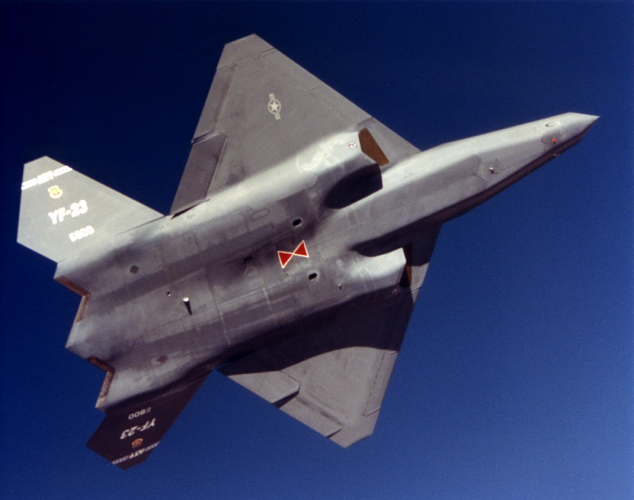
There's the different engines for ATF, and the OML was notably different between the two YF-23s.


@snne : As enormous as it is, it seems logical to understand it to be an attack/bomber. Just like there was Maurauder and Fortress.
No, it's a long range penetration fighter. As in a type that really hasn't been a thing since the P-51 Mustang (or maybe the F-101).

Penetrating Counter Air.

The J36 is exactly the size I was expecting F-47 to be. 100,000+lbs MTOW.

Due to bay size, it can carry large bombs and AGMs. But it's designed to primarily do air to air work on the US side of China's A2AD bubbles.
 
There's the different engines for ATF, and the OML was notably different between the two YF-23s.
Really? Apart from a few panels around the exhaust I recall no notable differences... F-23 had noticeable OML differences between the two engine choices.

Anyway, back on topic... Looking forward to seeing more pictures of this second prototype to better understand te extent if the changes!
 
It could be a risk distribution method. no 1 seems to have a riskier exhausts. Look at the separation between the nozzles lips of no 1 I believe they are some novel thurst vectoring. No 2 gets the more advanced air inlets and smaller/riskier landing gears doors (according chinese leakers the landing gear doors when opened played a vital in yaw stability in landing).

So what's the purpose beside just safety? It's also political. J-36 and J-50 operationally compliment each other, but politically they are rivals. I'm sure there are internal camps within the PLA that debate what is the right ratio between these 2 aircraft. Is it 4:1 or 5:1 etc? By distributing risky techs into 2 airframes, Chengdu ensures a smooth development/great optics, boosting for a higher buys in that ratio of mixed force debate.
 
It could be a risk distribution method. no 1 seems to have a riskier exhausts. Look at the separation between the nozzles lips of no 1 I believe they are some novel thurst vectoring. No 2 gets the more advanced air inlets and smaller/riskier landing gears doors (according chinese leakers the landing gear doors when opened played a vital in yaw stability in landing).

So what's the purpose beside just safety? It's also political. J-36 and J-50 operationally compliment each other, but politically they are rivals. I'm sure there are internal camps within the PLA that debate what is the right ratio between these 2 aircraft. Is it 4:1 or 5:1 etc? By distributing risky techs into 2 airframes, Chengdu ensures a smooth development/great optics, boosting for a higher buys in that ratio of mixed force debate.

I do agree it is related to distributing developmental risk between successive prototypes, but I don't think it's political, optics related, or a related to J-XDS.

It simply makes sense from an engineering and intra-program perspective to risk reduce in practical ways, to maximize development speed and to gather flight test data sooner rather than later in pursuit of developing a program of record to attain an operational capability sooner rather than later (weeks and months add up after all).
In PRC aerospace it's not uncommon for even EMD prototypes (or even initial production variants) to have initial lower risk components, sections or subsystems, which then get iterated or improved or added once sufficient testing or readiness of a given new component/subsystem/section is met.
 
To add to what @Nx4eu said, I think we cannot appreciate enough in what kind of era we're currently in with regards to military aviation. China, US, Russia, France, UK, South Korea, Turkey, Japan, Italy, Germany and many others developing an incredible amount of advanced jets, drones, munitions, missiles, sensor packages, radars, networking systems, AI etc. When was the last time that so many countries were competitive on the market and able to pull off sophisticated indigenous developments?

Stuff like the J-36, J-50 or B-21 are the absolute pinnacle of what we're granted to observe.
Though a slight digression, I still want to say: for aviation enthusiasts, the present may indeed be a golden age, yet it also subtly heralds an era of heightened competition and uncertainty. Looking back on today’s military aviation development in a future period of peace, the experience will likely be more comfortable than living through the current tide of the times (´; v ;`)
 
Really? Apart from a few panels around the exhaust I recall no notable differences... F-23 had noticeable OML differences between the two engine choices.
Yes, the engine humps for the YF120 variable-cycle engine are taller and wider than those for the YF119 engines.


Anyway, back on topic... Looking forward to seeing more pictures of this second prototype to better understand te extent if the changes!
Very much so!
 
Though a slight digression, I still want to say: for aviation enthusiasts, the present may indeed be a golden age, yet it also subtly heralds an era of heightened competition and uncertainty. Looking back on today’s military aviation development in a future period of peace, the experience will likely be more comfortable than living through the current tide of the times (´; v ;`)

Yes, I've felt that. I remember talking to my father about the B-58, Vulcan, and the Century Series - and his relationship to those aircraft is very different to mine for that reason. Lot's to admire aerodynamically and technically, but the 'prestige symbol' is gradually being replaced by the words 'that is a civilisation killer' in the back of my mind. It does change how you relate to it.

So what's the purpose beside just safety? It's also political. J-36 and J-50 operationally compliment each other, but politically they are rivals. I'm sure there are internal camps within the PLA that debate what is the right ratio between these 2 aircraft. Is it 4:1 or 5:1 etc? By distributing risky techs into 2 airframes, Chengdu ensures a smooth development/great optics, boosting for a higher buys in that ratio of mixed force debate.

We're pretty used to different groups of private corporations coalescing to make rival bids. But I'm not sure we can always assume this is the case elsewhere.

What if requirements are produced by the PLAAF - Chengdu does initial development and becomes confident regarding the planform, control scheme, and sensor layout which is optimal for the requirement. However, what if there are rival teams or design proposals within Chengdu?

Building two prototypes would allow a fly-off competition, giving the PLAAF a competitive process, but lowering the cost and creating certainty for Chengdu by having that competition take place within Chengdu itself (and retaining the fixed elements of the design which are unlikely to change)?

Meanwhile the J-XDS has a flyoff with two competing prototypes by different companies, and the same is the case for the various CCAs?

P.S. Either that or we're just seeing different powerplant options... and overthinking it.
 
On the so far intriguing issue of engines, i guess it's safe to say that one don't just changes the nozzle design willy nilly on an engine, it takes a lot of effort to get it just right. So it could be that J-50 flew with either the intended, or more powerful engines (WS-10 variant? WS-15? something else?) and now those engines are fitted to J-36 no. 2 as a sort of interim configuration until either a more appropriate nozzle design for J-36 is ready, or until the nozzle/exhaust area is better integrated with the J-36 airframe.

Another possibility is that J-36 engines/nozzles encountered some issues (heat, vibration etc.?) and they fitted the J-50 engines that presumably work better as an interim fix.

Of course, there is the elephant in the room that the 2D TVC engines perhaps are needed for enhanced controlability for the supersonic, supercruising, tailless J-36.

It is worth noting that J-20/J-35 engine variations and nozzle details were changed several times before/ over the course of production as well.
 
Yes, the engine humps for the YF120 variable-cycle engine are taller and wider than those for the YF119 engines.
Not according to my checks. The YF120 engine had a sligtly different panel on top by the exhaust, but the OML was of the bread loaves were identical. They were oversized anyway due to the dropped thrust reverser requirements so would not have required engine driven OML changes. Only on F-23 were notable engine driven OML differences present.

Which brings us a back to J-36. Hopefully we get better pictures of the top to better understand the engine related changes in this second prototype. I am not aware of large and differeing engine programs running so any variations must be around the engine exhaust only. But I am speculating there.
 
Last edited:
Yes, the engine humps for the YF120 variable-cycle engine are taller and wider than those for the YF119 engines.
The nacelles themselves were identical between the two engines, the GE model did however have slightly wider exhaust troughs to handle the higher mass flow of the YF120.
 
I don't understand the comments on risk reduction. CAC has plenty of experience designing DSI intakes to call upon, and plenty of flight test evidence to validate their models. I don't see this being anywhere near one of the major risks.

Changing intake, ducts, and main undercarriage bays means a complete re-do of the centre fuselage structure. I know CAC has plenty of manpower, but people spending time doing this means less time spent doing something that contributes to a more capable aircraft. Why?
 
I don't understand the comments on risk reduction. CAC has plenty of experience designing DSI intakes to call upon, and plenty of flight test evidence to validate their models. I don't see this being anywhere near one of the major risks.

Changing intake, ducts, and main undercarriage bays means a complete re-do of the centre fuselage structure. I know CAC has plenty of manpower, but people spending time doing this means less time spent doing something that contributes to a more capable aircraft. Why?

The risk reduction isn't in those individual sections, but rather having them present and integrated integrated on the first prototype of a rather ambitious, new large airframe design. It's possible they may have been able to integrate all the fees features onto the first airframe, but it might have resulted in a slower flight test program, or it may have resulted in the first airframe making its maiden flight much later.

Putting it another way, what we are seeing may be the most efficient, least resource and personnel intensive way of conducting its development and flight testing in context of the overall program.
 
Another thought would be that they are building two different variants on purpose, one more optimised for strike (No.1) and the other for the fighter/interceptor role (No.2). Or maybe No.1 has been around for much longer than its reported unveiling on 24th Dec 2024.
 
Another thought would be that they are building two different variants on purpose, one more optimised for strike (No.1) and the other for the fighter/interceptor role (No.2). Or maybe No.1 has been around for much longer than its reported unveiling on 24th Dec 2024.

Unlikely, given the changes we've seen wouldn't be the more significant determinant differences that you'd need for a strike variant. You'd want something larger with an actual more expansive weapons bay for it.

Nor is it like the first airframe is ill-suited for an air to air role.


The simplest answer, and one borne from past PRC and CAC airframe development, is that it's just risk reduction and iterative development as part of the EMD process.
 

Similar threads

Back
Top Bottom