The avgas tank(s) were built into the hull design of the ship. They were triple walled with a water jacket surrounding them on all sides. With all the other precautions built in, removing them or repurposing them would have entailed major shipyard time and disassembly of a big chunk of the hull to do. It was better just to leave them in place unused.

That sounds more extensive and space-consuming than the protection @Yellow Palace described above, is that the case? IIUC these big refits gave big increases in fuel capacity right when it was needed.
I cannot fathom where a third 'wall' would go (perhaps a double cofferdam?) but otherwise is pretty much as I described: water filled cofferdam surrounding a self-contained low-flashpoint tank. I believe there's also a requirement for the tank to be backfilled with water or an inert gas. The purpose of the water is to ensure that if you do get leaks, you at least just get water in your fuel. That makes whatever you were fuelling not work, but it's a lot better than explosive vapours making your ship not work in a very terminal fashion. It's seriously heavy, space consuming and a general pain in the backside unless you genuinely need the stuff.

There'd be no disadvantage to cutting into the inerted pipework and using the tank for high-flashpoint fuel (probably F-44 in practice) but on a big ship like ENTERPRISE with plenty of fuel it's perfectly likely that it was deemed not worth the effort for a minimal increase in tankage.

I'm saying 'low flashpoint' because while it could be F-18 (AVGAS) , in the case where I worked with it was (IIRC) F-67. Petrol/gasoline, as you prefer. Likewise, high-flashpoint fuel would probably be F-44, but could conceivably be F-54 or F-76. Or some other weird things, but mostly those. If you want to use F-77 for some reason, you'll need special tanks again.
 
I cannot fathom where a third 'wall' would go (perhaps a double cofferdam?) but otherwise is pretty much as I described: water filled cofferdam surrounding a self-contained low-flashpoint tank. I believe there's also a requirement for the tank to be backfilled with water or an inert gas. The purpose of the water is to ensure that if you do get leaks, you at least just get water in your fuel. That makes whatever you were fuelling not work, but it's a lot better than explosive vapours making your ship not work in a very terminal fashion. It's seriously heavy, space consuming and a general pain in the backside unless you genuinely need the stuff.
I'd guess an air volume around the water volume around the fuel tank.

The air volume would allow for the outer wall to buckle without sending force into the water/fuel tanks.
 
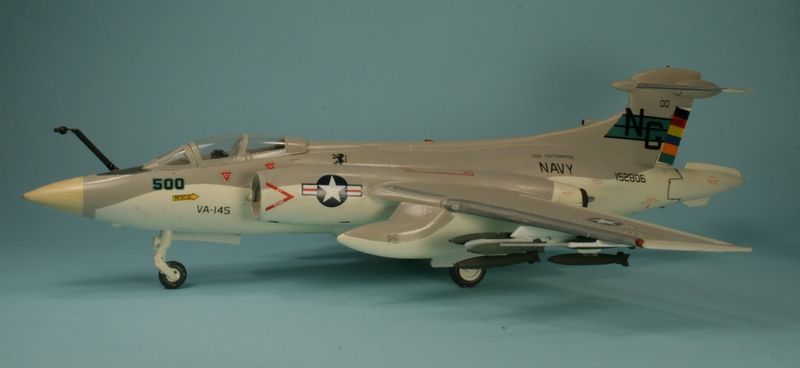
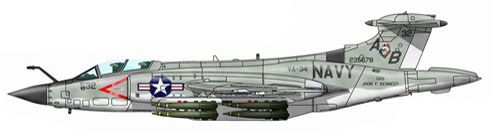
hipotetico-blackburn-buccaneer-de-la-us-navy-uss-j-f-kennedy.jpg

usnbucc.jpg
I can just see that parked next to an F-101 Voodoo.

Might we have seen T-tails persist--maybe those two influence a third design with commonality?
 
That was the F-101 not the Starfighter. The small wings with negative dihedral didn't blank the tail on the 104 like they did on the 101.
Ugh. I knew it was one of the Century series. Could have sworn that was an issue on the F-104 as well.
 
I remember footage of a Starflighter where the T-tail flexed a good bit--but did not break...rather sturdy. I'd like canards and T-tails both.
 
Buccaneer vs Intruder: I kind of like this. What were their respective strengths and weaknesses ?
Buccaneer always sounded faster and a bit more agile, the Intruder seems to have been more like a bomb truck: slower maybe, but moar bombs.

(damn, ninja'd by @kaiserd )
From what I read the Intruder had a clear edge on avionics. The DIANE system allowed the plane to conduct an air strike in zero visibility. e.g. a night with thunderstorms. Which is something Blue Parrot is not capable of
 
From what I read the Intruder had a clear edge on avionics. The DIANE system allowed the plane to conduct an air strike in zero visibility. e.g. a night with thunderstorms. Which is something Blue Parrot is not capable of

This is very true, the US was heavily involved in Vietnam just as A6 production began. The demands of this war and the acquisition budgets it fostered meant the basic A6 design received a lot of development in the area of its design most amenable to upgrades; avionics.

In contrast the cancellation of the TSR2, which used the same basic AIRPASS radar, robbed the Buccaneer (and Lightning) of a convenient source of avionics upgrades. The Buccaneer did have one interesting piece of avionics, radar warning relievers in its wingtips which could measure the different signal times to give the Buccaneer a bearing to head to.
 
The F-104 was notorious for the tail stalling. It's not just an airliner problem, it's a fundamental problem with T-tails at high AoA
I regularly fly my T-tail aeroplane, stall it for practice even spin it occasionally…. So far it’s behaved itself… I’m still here.

There’s a lot more to the deep stall than just the T-tail;- engine position, cg, elevator control authority, pitching inertia. Intake configuration … I’ve probably missed a few.

So a T-tail doesn’t equal a deep stall problem.
 

Similar threads

Back
Top Bottom