Ex Buccaneer navigator here. Had privilege to have exchange tour with RN, experienced two years flying with 809 Squadron from Ark Royal (47 night deck landings), Also had front line tours on Canberra (Germany) and Tornado (Honington). Buccaneer was easily the best strike/attack aircraft: better range, better speed, better weapons capabilities, better maneuverability at low level.

You are using an out of date browser. It may not display this or other websites correctly.
You should upgrade or use an alternative browser.
You should upgrade or use an alternative browser.
USN decides to buy The Blackburn Buccaneer....
- Thread starter bobtdwarf
- Start date
Rule of cool
ACCESS: Top Secret
- Joined
- 16 January 2024
- Messages
- 3,567
- Reaction score
- 4,520
Ex Buccaneer navigator here. Had privilege to have exchange tour with RN, experienced two years flying with 809 Squadron from Ark Royal (47 night deck landings), Also had front line tours on Canberra (Germany) and Tornado (Honington). Buccaneer was easily the best strike/attack aircraft: better range, better speed, better weapons capabilities, better maneuverability at low level.
Did you count those night landings on Ark Royal in your log book, or is each on seared into your memory?
Rule of cool
ACCESS: Top Secret
- Joined
- 16 January 2024
- Messages
- 3,567
- Reaction score
- 4,520
I don't know about the USN getting the Buccaneer, but apparently a potential customer was Israel in the few years just before the US became it's main supplier of military aircraft. Apparently the US was reluctant to sell combat aircraft to Israel, they'd prefer the Europeans did it, and Israel was looking at something to offset the Arab Il28s and Tu16s and the Buccaneer and A6 were on the menu although I don't know how closely the Buccaneer was looked at.

Do you have a reference source for Israel seeking the Buccaneer ? not one iv found in the files as yet
cheers, Joe
cheers, Joe

T. A. Gardner
ACCESS: Top Secret
- Joined
- 18 February 2021
- Messages
- 2,007
- Reaction score
- 3,558
I'd say it's unlikely that the Buccaneer would have been considered by Israel given they didn't purchase anything else in combat aircraft from the British and British military aircraft sales post WW 2 were always spotty.I don't know about the USN getting the Buccaneer, but apparently a potential customer was Israel in the few years just before the US became it's main supplier of military aircraft. Apparently the US was reluctant to sell combat aircraft to Israel, they'd prefer the Europeans did it, and Israel was looking at something to offset the Arab Il28s and Tu16s and the Buccaneer and A6 were on the menu although I don't know how closely the Buccaneer was looked at.
Rule of cool
ACCESS: Top Secret
- Joined
- 16 January 2024
- Messages
- 3,567
- Reaction score
- 4,520
Do you have a reference source for Israel seeking the Buccaneer ? not one iv found in the files as yet
cheers, Joe
Not really, apparently its mentioned in a book by Shlomo Aloni but I don't know. Apparently the Israelis wanted the F4 first and A6 second as their heavy attack aircraft , so my guess is the Buccaneer and Mirage IV were included to give a left and right of arc. A bit like how the RN looked at the Forrestal during the CVA01 process and the RAN looked at the CVA01 and Essex during the HMAS Melbourne replacement process.
I wouldn't have paid it any attention but for what I read from Robert Komer in early 1966 about the US attitude to their first combat aircraft sale to Israel. Apparently the US had delayed taking this step and was not keen at all, only doing it to balance the sale of F104s to Jordan.
Of course all of this happened when Britain had no confidence on the world stage and was a poor export partner, which likely saw Israel reject the Buccaneer in 5 minutes. However confidence and worthiness as a partner isn't set in stone, its the actions of the key people.
Rule of cool
ACCESS: Top Secret
- Joined
- 16 January 2024
- Messages
- 3,567
- Reaction score
- 4,520
I'd say it's unlikely that the Buccaneer would have been considered by Israel given they didn't purchase anything else in combat aircraft from the British and British military aircraft sales post WW 2 were always spotty.
Israel bought about 32 meteors in the early-mid 50s and was doing the joint thing with the Chieftain tank in the 60s, but other than that you're right. That said there's nothing inherently wrong with the Buccaneer given Israel wanted the A6, but British policy with regards to arms exports post 57 DWP wasn't condusive for widespread exports of the combat aircraft they were making.
Israel with Buccaneers (and consequentially Lightnings) would have probably indirectly deepen the relationship with the UK and South Africa. Israel was carved out of the British Palestine, so without their 1948 decree you never have a new state of Israel. That fantasy buy obviously radically changes not only future UK exports of their equipment but probably changes so much more than just arm sales because it requires major shifts in political power to happen. It probably means a shift that allows India and Australia to enthusiastically continue to acquire British equipment, too.
SA. and UK. relationship was always close, at the time the UK. decided to break off formal political relations we also scuppered ongoing potential export sales for eg. Nimrod MR.1, Thunderbird SAM., Basset CC.1 (as well as tenative enquiries into Jaguar)
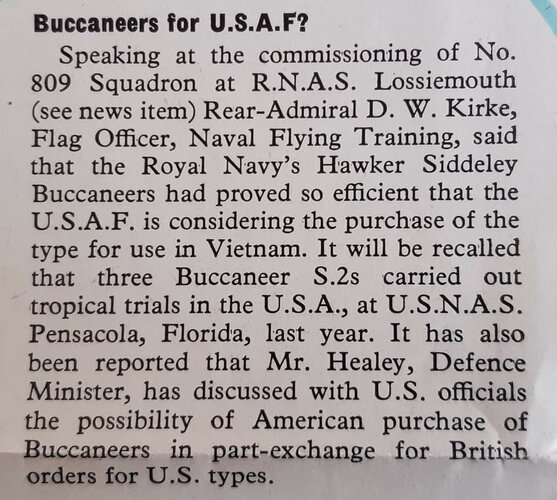
Dragging the thread back to topic ... Possible Export ?, USAF. Buccaneer S.2 (A-6 alternate), Air Pictorial, March 1966
Dragging the thread back to topic ... Possible Export ?, USAF. Buccaneer S.2 (A-6 alternate), Air Pictorial, March 1966
Attachments
Last edited:
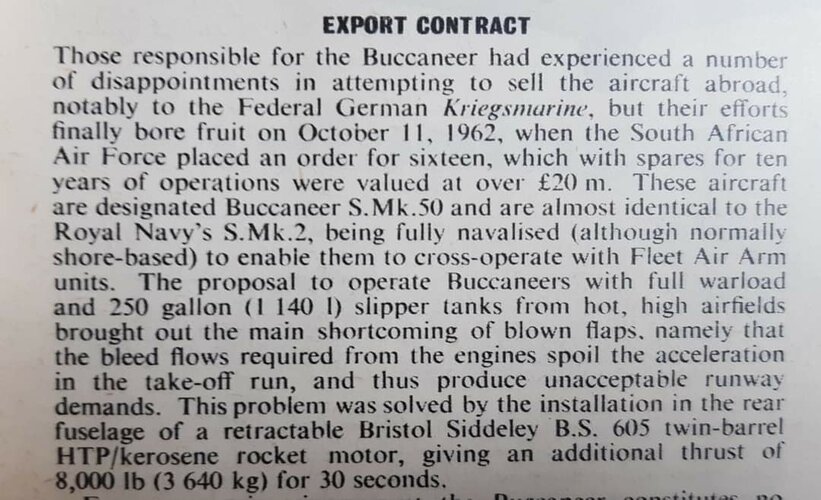
Possible Export ?, RAAF., Buccaneer S.2 offered as GD. F-111C stopgap, 1971
Possible Export ?, Buccaneer S.2 for Egypt (also Harrier, Jaguar & Hawk), June 1972
Possible Export ?, German Navy Buccaneer S.2, 1962, ref. Flying Review International, 21/1, September 1965
Possible Export ?, Buccaneer S.2 for Egypt (also Harrier, Jaguar & Hawk), June 1972
Possible Export ?, German Navy Buccaneer S.2, 1962, ref. Flying Review International, 21/1, September 1965
Attachments

BlackBat242
OK, I changed my personal text ;)
- Joined
- 10 April 2013
- Messages
- 1,620
- Reaction score
- 5,022
Ummm why would Israel have bought a single-purpose interceptor when they really needed a multirole fighter*... just because they bought a really good strike aircraft?Israel with Buccaneers (and consequentially Lightnings)
Mirage III fit their needs much better - and Israel never bought military hardware that didn't fit their operational needs.
* Sorry... all those sales brochures aside, a Lightning using those air-ground weapons really wasn't effective at all.
BlackBat242
OK, I changed my personal text ;)
- Joined
- 10 April 2013
- Messages
- 1,620
- Reaction score
- 5,022
Dragging the thread back to topic ... Possible Export ?, USAF. Buccaneer S.2 (A-6 alternate), Air Pictorial, March 1966
Ummm... the USAF never operated the A-6 - that was USN/USMC only.
The USAF would have been looking at Bucc as a F-105 supplement/replacement, and for the requirement that eventually saw them buy a modified A-7.
Rule of cool
ACCESS: Top Secret
- Joined
- 16 January 2024
- Messages
- 3,567
- Reaction score
- 4,520
What year/s was West Germany interested in the Buccaneer? I've read that they were but that's about it.
1960. NA.39 demonstrated to the West German Defence Minister, Franz-Josef Strauss, at Farnborough Air Show. The Germans were shopping for a new maritime strike aircraft for the Marineflieger. Eventually bought the F-104G to fulfill the role.What year/s was West Germany interested in the Buccaneer? I've read that they were but that's about it.
T. A. Gardner
ACCESS: Top Secret
- Joined
- 18 February 2021
- Messages
- 2,007
- Reaction score
- 3,558
I'd agree and go a bit further. For all intents, the Lightning was also a daylight only fighter with a very limited armament package. Israel needed a fighter with longer range radar guided missiles as an option, and that wasn't happening with the Lightning anytime soon.Ummm why would Israel have bought a single-purpose interceptor when they really needed a multirole fighter*... just because they bought a really good strike aircraft?
Mirage III fit their needs much better - and Israel never bought military hardware that didn't fit their operational needs.
* Sorry... all those sales brochures aside, a Lightning using those air-ground weapons really wasn't effective at all.
Rule of cool
ACCESS: Top Secret
- Joined
- 16 January 2024
- Messages
- 3,567
- Reaction score
- 4,520
Israel's interceptor needs were covered by the 1963 buy of 72 Mirage IIIC, armed with the Shafrir 1 missile as well as the 8 launchers for 15 Matra R530 missiles. If the Lightning was going to enter Israeli service it would be instead of this.
Their 1965-66 requirement was for a low level intruder aircraft as an offset to Arab Il28s and Tu16s., 30 heavy and 120 light attack Apparently the F4 was the top of their wishlist with the Mirage IV second (a bit like the RAAF's options in late 1963) but couldn't afford them so asked for 75 old B66s instead. By 1966 this requirement had morphed into the A6, if the Buccaneer was considered it would have been in this time-frame. in ther event the US refused to sell the A6 and Israel ordered the 50 Mirage V and it's first batch of 24 + 24 A4s.
These are all single role-aircraft, although the Mirage V would be pretty nifty in air to air if needed.
In Feb 1968 the F4E sale was authorised, finaly filling the 1965-66 heavy attack requirement, with about 90 being in service by 1973. The remaining Mirage IIIC were still used in the interceptor/air to air role but the F4E was truly multi-role and would take on air to air fighting to cover the Mirage losses. Maybe the Spey Buccaneer could meet the strike portion of this requirement, but the Lightning was past its prime export window by 1968.
The next time the Israelis needed a 'fighter', to replace the now very depleted and hard flown Mirage IIIs, they got the F15A in 1977.
Their 1965-66 requirement was for a low level intruder aircraft as an offset to Arab Il28s and Tu16s., 30 heavy and 120 light attack Apparently the F4 was the top of their wishlist with the Mirage IV second (a bit like the RAAF's options in late 1963) but couldn't afford them so asked for 75 old B66s instead. By 1966 this requirement had morphed into the A6, if the Buccaneer was considered it would have been in this time-frame. in ther event the US refused to sell the A6 and Israel ordered the 50 Mirage V and it's first batch of 24 + 24 A4s.
These are all single role-aircraft, although the Mirage V would be pretty nifty in air to air if needed.
In Feb 1968 the F4E sale was authorised, finaly filling the 1965-66 heavy attack requirement, with about 90 being in service by 1973. The remaining Mirage IIIC were still used in the interceptor/air to air role but the F4E was truly multi-role and would take on air to air fighting to cover the Mirage losses. Maybe the Spey Buccaneer could meet the strike portion of this requirement, but the Lightning was past its prime export window by 1968.
The next time the Israelis needed a 'fighter', to replace the now very depleted and hard flown Mirage IIIs, they got the F15A in 1977.
Rule of cool
ACCESS: Top Secret
- Joined
- 16 January 2024
- Messages
- 3,567
- Reaction score
- 4,520
1960. NA.39 demonstrated to the West German Defence Minister, Franz-Josef Strauss, at Farnborough Air Show. The Germans were shopping for a new maritime strike aircraft for the Marineflieger. Eventually bought the F-104G to fulfill the role.
I hadn't realised the Sea Hawk had lasted in German Navy service until the mid 60s. I presumed once the F104G entered German service from 1960 that was it, all other deals were off.
Did the Germans like the Buccaneer, did they give it real consideration or was it just a glance to reject it?

- Joined
- 3 January 2006
- Messages
- 1,405
- Reaction score
- 1,375
As I recollect, the German Navy requested detailed information on the Buccaneer, but with arcane British export regulations, all such material had to be physically passed through the British embassy in Bonn, where someone forgot about it for months on end.I hadn't realised the Sea Hawk had lasted in German Navy service until the mid 60s. I presumed once the F104G entered German service from 1960 that was it, all other deals were off.
Did the Germans like the Buccaneer, did they give it real consideration or was it just a glance to reject it?
Rule of cool
ACCESS: Top Secret
- Joined
- 16 January 2024
- Messages
- 3,567
- Reaction score
- 4,520
As I recollect, the German Navy requested detailed information on the Buccaneer, but with arcane British export regulations, all such material had to be physically passed through the British embassy in Bonn, where someone forgot about it for months on end.
That'd be right.
Apparently when EE was trying to sell Germany the Lightning in the wake of the cancellation of the SR177 British officials told them not to buy it.

- Joined
- 27 September 2006
- Messages
- 6,622
- Reaction score
- 7,443
Ironically the Luftwaffe did not patrol West Geman airspace in peacetime, this task was left to the British in the North and US in the South. So Lightnings did get to contribute to the air defence of the Federal Republic.
Rule of cool
ACCESS: Top Secret
- Joined
- 16 January 2024
- Messages
- 3,567
- Reaction score
- 4,520
Ironically the Luftwaffe did not patrol West Geman airspace in peacetime, this task was left to the British in the North and US in the South. So Lightnings did get to contribute to the air defence of the Federal Republic.
What timeframe was this? In late 1957 the 2ATF had 12 all-weather & day fighter sqns. I imagine this was sufficient to patrol West German northern airspace. However by 1964 RAFG was down to 2 all-weather fighter sqns, which seems inadequate to even defend its own 4 bases.
There must have been a transfer of responsibility at some point. Perhaps the British air defence sector becoming a NATO command under British control or something?
BlackBat242
OK, I changed my personal text ;)
- Joined
- 10 April 2013
- Messages
- 1,620
- Reaction score
- 5,022
It took a bit of time after the "final selection" to see delivered aircraft.I hadn't realised the Sea Hawk had lasted in German Navy service until the mid 60s. I presumed once the F104G entered German service from 1960 that was it, all other deals were off.
The F-104G was declared the winner of the contest on November 6, 1958, in an announcement made by German Federal Defense Minister Franz Josef Strauss in Bonn. An initial contract for 66 F-104Gs was awarded to Lockheed on February 6, 1959, which was later increased to 96.
Herr Strauss also indicated that the German aircraft industry would build 210 F-104Gs under license. On March 18, 1959, a consortium of German aircraft manufacturers acquired a license to manufacture the Starfighter. License production and associated technology transfers to expand the German national aircraft industry were key features of the program.
The first German Starfighters were the Lockheed-built two-seat F-104Fs which were initially used in the USA to train German instructors. At that time, the F-104Fs were painted with standard USAF insignia and carried USAF serial numbers. These machines were then handed over to Waffenschule 10, which was based at Norvenich in Germany. After handover, they were repainted in Luftwaffe insignia and assigned German serial numbers. They began converting pilots for JBG31 in July of 1960.
The first operational unit to be equipped with the F-104G was Jagdbombergeschwader 31 "Boelcke" (JBG31), also based at Norvenich. JBG31 became fully operational in 1963.
Rule of cool
ACCESS: Top Secret
- Joined
- 16 January 2024
- Messages
- 3,567
- Reaction score
- 4,520
4 years from decision to IOC isn't unusual, that's about what the RAAF did with the Mirage at the same time. I was surprised that the 1959 F104 decision didn't cover the Marineflieger requirement, that the door was still open for the Buccaneer in mid 1960.
- Joined
- 27 September 2006
- Messages
- 6,622
- Reaction score
- 7,443
2ATAF and 4ATAF were responsible for NATO air operations in West Germany. I do not know at what point the Luftwaffe would have joined the US and UK in patroling German airspace along its eastern borders.
Rule of cool
ACCESS: Top Secret
- Joined
- 16 January 2024
- Messages
- 3,567
- Reaction score
- 4,520
2ATAF and 4ATAF were responsible for NATO air operations in West Germany. I do not know at what point the Luftwaffe would have joined the US and UK in patroling German airspace along its eastern borders.
IIUC the RAF 2TAF became NATO 2ATAF, and the CO of RAFG was also the CO of 2ATAF.
Its useful to note the A-6 short field capability was only to meet a USMC requirement...until it didntThat "USN never issued the spec that became the A-6" is the only way this can flyas the A-6 spec could never be met in either the bombload or take-off realms by the Bucaneer.
The A-6 spec required short-field capability... which is why the first few YA-6s (YA2F-1 before the designation change) had a downward-tilting nozzle on each J52 exhaust!
These look familiar?
View attachment 673051
View attachment 673052
Note the slots in the lower outer fuselage for the tilting nozzles:
View attachment 673053
Scott Kenny
ACCESS: USAP
- Joined
- 15 May 2023
- Messages
- 19,536
- Reaction score
- 27,989
Pardon me, binged the thread.
Buccs would definitely be license-built after the first ~50 or so, see the B-57. Licensee would not be Grumman in this case**, and not Douglas, either since too much of the USN air fleet was Douglas made. Possibly Vought, though this would do interesting things with the A-7 production later on.
** In the event of no A-6 contest, I'd nominate Grumman for the licensee to build Buccaneers. "Grumman Iron Works" and the Buccs being milled from solid...
Tomcats with Speys/TF41s? I'm not sure that'd actually be an improvement over the TF30-P-412/414. 10,800lbs dry/20,800 wet thrust for the TF30, the Spey 202 is making 12,100lbs dry/20,500 wet. Only significant improvement would be the compressor stall issue, and I'm not enough of an engine nerd to know if compressor stalls were also a Spey issue.
S-3 Vikings (S-2s were the radial-engined Tracker) with Speys? No way. TF41 "Spey" is 3500lbs (don't have easy access to a weight for non-afterburning Spey except for TF41), while TF34 is only 1500lbs. So the Vikings would be down 4000lbs of load but would have about 10,000lbs more thrust and burn about twice as much fuel. IMO the much greater fuel consumption is the killer for an MPA.
But I don't think that the TF41 would be an improvement in the Tomcat unless the Spey 202 was less vulnerable to compressor stalls.
================
Obviously, the biggest advantage of this would be getting the A-6 electronics into the Buccaneer. If those can't be made to fit and the A-7s were still introduced (likely, since they were developed to replace A-4s), the A-7 D/E avionics would fit in the Buccaneer.
Snowball's chance in hell of that happening.Wright might realise after messing up the Sapphire, that Americanisation for Americanising sake isn't a good idea and talking more with AS is better.
I was leaning towards Buccs for the Essex-class and A-6s for the bigger carriers.You could wind up with both. The initial concept of the A-6 was for an all weather CAS aircraft*, a Skyraider replacement (based on Korean experience where weather and night limited the A-1s use), rather than a long range strike aircraft. Although the Buccaneer did fine as a CAS aircraft for South Africa, so there may be too much overlap in performance for both to be produced. Both aircraft wound up in roughly the same niche, but coming from different directions, the A-6 from CAS to strike and the Buc the other way around. With a bit more niche optimization there could be a role for both, in which case the A-6 (with a gun) would replace the A-4 (on the large carriers), and the A-7 would never happen, while the Buccaneer would take the role the A-6 had in naval and land attack once it gets TFR and other relevant avionics.
Buccs would definitely be license-built after the first ~50 or so, see the B-57. Licensee would not be Grumman in this case**, and not Douglas, either since too much of the USN air fleet was Douglas made. Possibly Vought, though this would do interesting things with the A-7 production later on.
** In the event of no A-6 contest, I'd nominate Grumman for the licensee to build Buccaneers. "Grumman Iron Works" and the Buccs being milled from solid...
Speysaders would be likely, IMO. Though they'd be rebuilds not new builds.More wishful thinking about the knock on effects of the USN buying the Buccaneer.
- The RF-8 Crusader remained in service with the USN until the 1980s and the F-8 Crusader remained in service with the NRF for as long.
- According to Norman Polmar in "World Combat Aircraft Directory" 1,261 Crusaders were produced 1954-65 of which 448 were remanufactured 1965-70.
- In this "Version of History" the remanufactured Crusaders may have received Spey engines and I think they would have if the USA buying the Buccaneer led to the USA buying the Spey-Phantom.
- France would have bought new 42 Crusaders with Spey engines if the USN had fitted Speys to the 448 remanufactured Crusaders.
- Could the F-14A Tomcat have a pair of Speys instead of a pair of TF30s? However, as far as I know that's something that could have been done in the "Real World" but wasn't.
- Might the S-2 Vikings have had Speys instead of TF34s in the interests of standardisation? However, that's something else that could have done in the "Real World" but wasn't.
Tomcats with Speys/TF41s? I'm not sure that'd actually be an improvement over the TF30-P-412/414. 10,800lbs dry/20,800 wet thrust for the TF30, the Spey 202 is making 12,100lbs dry/20,500 wet. Only significant improvement would be the compressor stall issue, and I'm not enough of an engine nerd to know if compressor stalls were also a Spey issue.
S-3 Vikings (S-2s were the radial-engined Tracker) with Speys? No way. TF41 "Spey" is 3500lbs (don't have easy access to a weight for non-afterburning Spey except for TF41), while TF34 is only 1500lbs. So the Vikings would be down 4000lbs of load but would have about 10,000lbs more thrust and burn about twice as much fuel. IMO the much greater fuel consumption is the killer for an MPA.
The USN didn't consider commonality an advantage until the Super Hornets and F-35s.The USN doesn't seem to view commonality as a universal benefit, though. If there's an issue with the Spey engine (say), then the entire carrier air wing is grounded. A mix of types and engines removes that single point of failure.
That said, the TF41 so greatly improved the A-7 that the USN bought their own version of the airframe (basically the USAF-spec A-7D but with USN radios).The TF41 was an Air Force engine, with the Navy preferring the TF30. The TF30 also had the advantage of being recycled from the F-111B project - the Tomcat was all about reusing systems developed for the F-111B.
But I don't think that the TF41 would be an improvement in the Tomcat unless the Spey 202 was less vulnerable to compressor stalls.
Acknowledging that it wasn't an experiment, but being able to pack 3 squadrons of attack planes instead of 2 on the big carriers is a selling point.One thing struck me about this post by H_K over on the Centaur class carrier thread: the Buccaneer was incredibly compact compared to the A-6 - folded, it's actually slightly smaller than an F-8.
When the USN experimented with the all-Grumman air wing in the 1980s, it wound up replacing two squadrons of A-7s with one of A-6s. With Buccaneers replacing both, it would probably be possible to do two squadrons of fighters and three of all-weather strike aircraft, replicating what had been done with F-8s and A-4s on the smaller ESSEX class.
That wouldn't be enough to get the USN to buy Buccaneers. But it's an interesting prospect all the same.
================
Obviously, the biggest advantage of this would be getting the A-6 electronics into the Buccaneer. If those can't be made to fit and the A-7s were still introduced (likely, since they were developed to replace A-4s), the A-7 D/E avionics would fit in the Buccaneer.

SSgtC
ACCESS: Top Secret
- Joined
- 13 July 2020
- Messages
- 1,303
- Reaction score
- 3,112
Size wasn't the issue for the Navy not operating the Intruder on the Essex class. The A-6 flew off of them just fine. The reason the Navy didn't want a heavy attack aircraft on the Essex class was because of the types prodigious appetite for fuel and ordinance. The Essex class had limited storage for both, and so the Navy made the decision not fly Intruders from them operationally. This really wouldn't change with the Buccaneer. They're still going to eat through fuel and ammo stocks at an unacceptably high rate compared to the Corsair and Skyhawk.I was leaning towards Buccs for the Essex-class and A-6s for the bigger carriers.
Scott Kenny
ACCESS: USAP
- Joined
- 15 May 2023
- Messages
- 19,536
- Reaction score
- 27,989
At reduced payloads. Don't think I caught it in this thread just how reduced they were, but nuclear-strike packages with full internal fuel would obviously be fine.Size wasn't the issue for the Navy not operating the Intruder on the Essex class. The A-6 flew off of them just fine.
You're just not launching an 18,000lb bombload strike off an Essex, which ironically was the primary attack load for Vietnam.
Similarly, you're probably not launching a Buccaneer with a 16,000lb load off an Essex, either.
Yes, the fuel consumption is an issue, Intruder or Buccaneer have twice the engines of the others. Corsair is still a 15,000lb payload aircraft, and Skyhawks are ~8,000lb. So the ordnance-consumption claims aren't as big a deal.The reason the Navy didn't want a heavy attack aircraft on the Essex class was because of the types prodigious appetite for fuel and ordinance. The Essex class had limited storage for both, and so the Navy made the decision not fly Intruders from them operationally. This really wouldn't change with the Buccaneer. They're still going to eat through fuel and ammo stocks at an unacceptably high rate compared to the Corsair and Skyhawk.
CV12Hornet
ACCESS: Top Secret
- Joined
- 8 January 2021
- Messages
- 661
- Reaction score
- 1,489
735 tons of ordnance, 300,000 gallons of avgas (and presumably somewhat more gas once the partial conversion to JP-5 was done). Note that this 300,000-gallon figure is lower than the rebuilt Victorious, redesigned Hermes, and HMS Eagle, and nobody would accuse British carriers on being heavy on aircraft stores.
However, American carriers also had more aircraft capacity than British, which compounds the problem.
For aircraft, the Intruder carried 2344 gallons of fuel internally, the Corsair 1476, and the Skyhawk 800. The Buccaneer is actually better in this regard than the Intruder - it carried 1871 gallons of fuel internally.
As far as bomb loads, in practice the Corsair and Skyhawk would almost never carry their maximum bombload, or even close to it, as that absolutely murders their range. The heaviest approved load for the Skyhawk was a 6600-lb loading presumably for close air support; the Corsair's standard load was 12 Mark 81 bombs for a total load of 3600 lbs, and the absolute heaviest bombload I can find is not only around 10,000 lbs, but also cut into internal fuel. And in practice even the Intruder didn't ever carry its maximum rated bombload due to pylon load limitations.
However, American carriers also had more aircraft capacity than British, which compounds the problem.
For aircraft, the Intruder carried 2344 gallons of fuel internally, the Corsair 1476, and the Skyhawk 800. The Buccaneer is actually better in this regard than the Intruder - it carried 1871 gallons of fuel internally.
As far as bomb loads, in practice the Corsair and Skyhawk would almost never carry their maximum bombload, or even close to it, as that absolutely murders their range. The heaviest approved load for the Skyhawk was a 6600-lb loading presumably for close air support; the Corsair's standard load was 12 Mark 81 bombs for a total load of 3600 lbs, and the absolute heaviest bombload I can find is not only around 10,000 lbs, but also cut into internal fuel. And in practice even the Intruder didn't ever carry its maximum rated bombload due to pylon load limitations.
Last edited:
T. A. Gardner
ACCESS: Top Secret
- Joined
- 18 February 2021
- Messages
- 2,007
- Reaction score
- 3,558
A couple of notes here: The Essex class always carried avgas as the S-2 Tracker, E-1 / WF-2 Tracer, A-1 Skyraider, and C-1. All of these were piston engine aircraft and served until the Essex class were being retired from service. The tank(s) for avgas would be far too difficult to modify for use with JP 5. Even the Enterprise retained her avgas tank throughout her entire career for that reason.735 tons of ordnance, 300,000 gallons of avgas (and presumably somewhat more gas once the full conversion to JP-5 was done). Note that this 300,000-gallon figure is lower than the rebuilt Victorious, redesigned Hermes, and HMS Eagle, and nobody would accuse British carriers on being heavy on aircraft stores.
However, American carriers also had more aircraft capacity than British, which compounds the problem.
For aircraft, the Intruder carried 2344 gallons of fuel internally, the Corsair 1476, and the Skyhawk 800. The Buccaneer is actually better in this regard than the Intruder - it carried 1871 gallons of fuel internally.
As far as bomb loads, in practice the Corsair and Skyhawk would almost never carry their maximum bombload, or even close to it, as that absolutely murders their range. The heaviest approved load for the Skyhawk was a 6600-lb loading presumably for close air support; the Corsair's standard load was 12 Mark 81 bombs for a total load of 3600 lbs, and the absolute heaviest bombload I can find is not only around 10,000 lbs, but also cut into internal fuel. And in practice even the Intruder didn't ever carry its maximum rated bombload due to pylon load limitations.
Rule of cool
ACCESS: Top Secret
- Joined
- 16 January 2024
- Messages
- 3,567
- Reaction score
- 4,520
A couple of notes here: The Essex class always carried avgas as the S-2 Tracker, E-1 / WF-2 Tracer, A-1 Skyraider, and C-1. All of these were piston engine aircraft and served until the Essex class were being retired from service. The tank(s) for avgas would be far too difficult to modify for use with JP 5. Even the Enterprise retained her avgas tank throughout her entire career for that reason.
I was under the impression that avgas tanks needed to be very special because the vapours are highly explosive. IIUC such tanks were enclosed within their own watertight spaces, isolated from main structure to protect from whip from explosions and special ventilation measures.
In contrast my belief was that JP5 vapour was not inherently explosive and therefore could be stored in pretty basic, watertight spaces without all the precautions of avgas tanks. In addition as the likes of the Essex class converted from avgas to JP5 they picked up fuel capacity because all the fancy avgas tanks took up a lot of space in the spaces allocated to fuel storage.
Am I deluded, or am I on the right track?
- Joined
- 5 May 2007
- Messages
- 2,016
- Reaction score
- 4,277
Current regulations require low-flashpoint fuel (i.e. petrol or avgas) to be in a tank surrounded with a water-filled cofferdam to prevent any buildup of fumes, and special pipework is needed which can be drained and filled with inert gas when not in use. As far as I'm aware, the requirement for a separate tank is driven by the cofferdam arrangements rather than shock loading.I was under the impression that avgas tanks needed to be very special because the vapours are highly explosive. IIUC such tanks were enclosed within their own watertight spaces, isolated from main structure to protect from whip from explosions and special ventilation measures.
There's no inherent reason, beyond the cost of modifying the pipework, why you couldn't put high-flashpoint fuel (i.e. F44) in such a tank if it was unnecessary for its intended purpose. But if you had plenty of other tanks, the modification might not be deemed worthwhile.
SSgtC
ACCESS: Top Secret
- Joined
- 13 July 2020
- Messages
- 1,303
- Reaction score
- 3,112
No, the Essex class could operate them at their full up weights. The max catapult assisted TO weight of an A-6E is 58,000 pounds. At that weight, their power on stall speed is 119 knots. The C11 cats on an Essex could get that up to about 120 knots. Plus a minimum of 19 knots ship speed. So 139 knots of airspeed. 20 knots of safety margin above stall speed is plenty.At reduced payloads. Don't think I caught it in this thread just how reduced they were, but nuclear-strike packages with full internal fuel would obviously be fine.
You're just not launching an 18,000lb bombload strike off an Essex, which ironically was the primary attack load for Vietnam.
Similarly, you're probably not launching a Buccaneer with a 16,000lb load off an Essex, either.
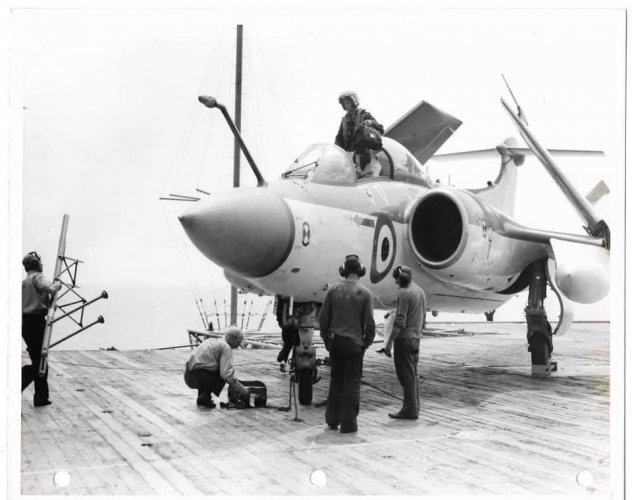
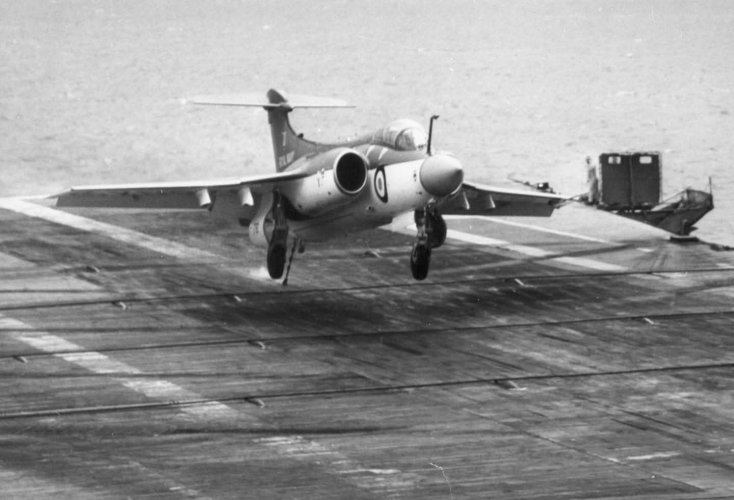
Looks like this has come full circle ! ... https://www.secretprojects.co.uk/threads/blackburn-buccaneer-developments.3110/post-457567
Attachments
Attachments
T. A. Gardner
ACCESS: Top Secret
- Joined
- 18 February 2021
- Messages
- 2,007
- Reaction score
- 3,558
I was under the impression that avgas tanks needed to be very special because the vapours are highly explosive. IIUC such tanks were enclosed within their own watertight spaces, isolated from main structure to protect from whip from explosions and special ventilation measures.
The avgas tank(s) were built into the hull design of the ship. They were triple walled with a water jacket surrounding them on all sides. With all the other precautions built in, removing them or repurposing them would have entailed major shipyard time and disassembly of a big chunk of the hull to do. It was better just to leave them in place unused.
JP 5 is hard to ignite. One time, to equal parts disgust and horror, I had to go to one of the JP 5 pump rooms on the Enterprise to do maintenance on a motor controller for one of the pumps. Arriving, I found two crew there in a buzz from the fumes that were visible in the space. The bilge below was awash with JP 5 floating in a layer over the water.In contrast my belief was that JP5 vapour was not inherently explosive and therefore could be stored in pretty basic, watertight spaces without all the precautions of avgas tanks. In addition as the likes of the Essex class converted from avgas to JP5 they picked up fuel capacity because all the fancy avgas tanks took up a lot of space in the spaces allocated to fuel storage.
Am I deluded, or am I on the right track?
One of these fools was smoking a cigarette--Yes, there were big "NO SMOKING!" signs on the bulkheads. He tells me when I point this out, that it's no big deal as the JP 5 won't ignite as he flicked the lit cigarette in the bilge...
In the Essex class some avgas storage was converted to JP 5 along with using some of the torpedo defense system voids for the same purpose. But those occurred during major conversions when the ship was razed to the hanger deck and rebuilt, that sort of thing.
Rule of cool
ACCESS: Top Secret
- Joined
- 16 January 2024
- Messages
- 3,567
- Reaction score
- 4,520
The avgas tank(s) were built into the hull design of the ship. They were triple walled with a water jacket surrounding them on all sides. With all the other precautions built in, removing them or repurposing them would have entailed major shipyard time and disassembly of a big chunk of the hull to do. It was better just to leave them in place unused.
................
In the Essex class some avgas storage was converted to JP 5 along with using some of the torpedo defense system voids for the same purpose. But those occurred during major conversions when the ship was razed to the hanger deck and rebuilt, that sort of thing.
That sounds more extensive and space-consuming than the protection @Yellow Palace described above, is that the case? IIUC these big refits gave big increases in fuel capacity right when it was needed.
Similar threads
-
-

-
 How to fix USN shipbuilding
- Started by Colonial-Marine
- Replies: 63
-
-
The RN buys the Kidds after the Iranian revolution
- Started by apparition13
- Replies: 110