Like the Germans provides the duck, the Spanish provides the corn, and we provide the feeding skills ? Please, shooting on Trappier is one thing, but shooting on gastronomy is worst.
So, now we know what the F in FCAS stands for: Forcefed

Like the Germans provides the duck, the Spanish provides the corn, and we provide the feeding skills ? Please, shooting on Trappier is one thing, but shooting on gastronomy is worst.
So, now we know what the F in FCAS stands for: Forcefed

Intention and what's actually needed are two different things.
NATO's collective defence doesn't care where the border is.I don't know if you missed it, but the Iron Curtain isn't in Germany anymore.
So Panzerbrigade 45 “Litauen” (based in Rudninkai, Lithuania) can be ignored?The defence of the "Western World" can be comfortably handed to the Baltics, Poland, Sweden and the likes,
That's an extraordinarily naïve thing to say. Consider the murder of Zelimkhan Khangoshvilli in Berlin by the FSB, the planned assassination of Armin Pappenberger of Rheinmetall, the explosion and fire at DHL Leipzig (also DHL Birmingham and DHL Warsaw), and the various other established Russian espionage and subversion efforts,Germany isn't threatened by anything external at the moment

So, now we know what the F in FCAS stands for: Forcefed
Sir, you are talking to someone mentioning of France's "colonial ambitions" and contesting the Arctic in another thread. Result of Russian disinformation at work I'd say.And only one of them determines procurement. However in this case the view of the Bundeswehr over what's actually needed, reinforced by the lessons from Ukraine, seems to more closely reflect reality than your idea of a defence just forward of the German border.
NATO's collective defence doesn't care where the border is.
So Panzerbrigade 45 “Litauen” (based in Rudninkai, Lithuania) can be ignored?
NATO Multinational Corps Northeast (HQ Szezcin, Poland), responsible for the defence of the Baltics, doesn't have a German commander for a third of the time? (The other two thirds it's a German deputy commander or chief of staff, rotating with the Poles and Danes).
Luftwaffe Jagdgeschwader don't take their part in the NATO air policing commitments in the Baltics?
Germany isn't subject to Article 5?
Germany didn't less than 10 days ago reaffirm the Trinity House Accord with the UK, committing it to "reinforcing the security of the Euro-Atlantic region, recognising that long-term European defence is key to the security of both Participants", with John Healey and Boris Pistorius meeting for the Trinity House Defence Ministerial Council in Berlin?
Your understanding of Germany's established treaty commitments beyond the borders of Germany seems rather lacking. Which means trying to apply your beliefs to the requirements for FCAS is going to come up rather short.
That's an extraordinarily naïve thing to say. Consider the murder of Zelimkhan Khangoshvilli in Berlin by the FSB, the planned assassination of Armin Pappenberger of Rheinmetall, the explosion and fire at DHL Leipzig (also DHL Birmingham and DHL Warsaw), and the various other established Russian espionage and subversion efforts,
"We are talking about a sharp increase in cases of espionage and hybrid measures,” Martina Rosenberg, head of Bundeswehr military counterintelligence, this week.
No, the main point of contention is the F-35. Trappier still cant get over it that Belgium went for the F-35 over the Rafale because he is a petty and vindictive man. It resurfaced again now that Belgium announced a F-35 follow-on order.Normally I'd be laughing along with the rest...
But Trappier is right. For the pittance that Belgium would contribute, with no needed tech or orders I just can't see the point. The complications and additional administrative burden would likely swallow up what little contribution Belgium would make....and why should they get industrial offsets for such a small contribution?
This is going to be he said / she said, but no we are not.I litteraly wrote a few posts ago that they were considering a mixed fleet in the post-2040 period.

Those two cooperations are quite different.The most European solutions would be the anduril/rheinmetall or kratos/airbus projects recently announced, so still very much American at large.

Nice job Belgium, arrogant industrialists indeed.
For sure other guys are going to share without orders.As regards Belgium I mean it’s not like anyone else in Europe is developing a sixth generation aircraft…hang on a minute!!!

That just happened. And good riddanceBelgium would be welcome into GCAP/Tempest I am sure if they get cold feet over SCAF at any point in the future.

Still not sure that Belgium really brings anything to GCAP as a partner, either.
2 more languages and some political instability !Still not sure that Belgium really brings anything to GCAP as a partner, either.

Does Belgium have any strengths or expertise when it comes to fighter jet development? For example, in areas like avionics development?Still not sure that Belgium really brings anything to GCAP as a partner, either.
None that I'm aware of, though I know that if/when I'm wrong this forum will correct me.Does Belgium have any strengths or expertise when it comes to fighter jet development? For example, in areas like avionics development?
I don't believe so.Is there reliable information on the basis of which it is possible to determine, at least roughly, the target thrust of the SCAF engine?
I don't believe so.
With PANG allowing an aircraft up to 45 tonnes MTOW, I would not be surprised if the takeoff weight with internal weapons only was ~35-36 tonnes (~80,000lbs). So, 10% bigger than Mirage IVA, or about the size of the Tomcat or A-5. And that suggests engines in the ~32-35klbs thrust class for a fighter airframe. But that is the upper limit on how big a plane they could build.
France has not built or operated fighters that big before. Rafale is only 24.5 tonnes MTOW, and 15 tonnes gross. If SCAF is designed around ~30 tonnes MTOW, then M88-4 would be a viable engine (~26,500lbs/120kN thrust) for something "off the shelf," IMO.
We can look at the German studies immediately preceeding FCAS (DLR Future Fighter Demonstrator, aka Project Diabolo).Is there reliable information on the basis of which it is possible to determine, at least roughly, the target thrust of the SCAF engine?
Is there reliable information on the basis of which it is possible to determine, at least roughly, the target thrust of the SCAF engine?
Looking at the F-22's and Su-57's reported characteristics as well as the data provided for the DLR Future Fighter Demonstator by @H_K, it seems about feasible to achive a sensible internal payload and fuel volume and weight in a design having about a 35,000-38,000kg MTOW and a gross weight of around 30,000kg. This gives some headroom for heavy duty landing gear and arrestor hook or possibly things like stealthy CFTs (to achive combat ranges more in line with was is planned for other sixth gen designs of around 1000nm). That seems to require at least about 160kN of wet thrust per engine, when looking at the F-22 in particular. With the right internal layout it should be possible to carry an ASMP internally with such a design. Anything less than that would require making uncomfortable compromises either in multirole flexibility or air-to-air capabilities.We can look at the German studies immediately preceeding FCAS (DLR Future Fighter Demonstrator, aka Project Diabolo).
https://www.secretprojects.co.uk/th...r-demonstrator-dlr-ffd-project-diabolo.43292/
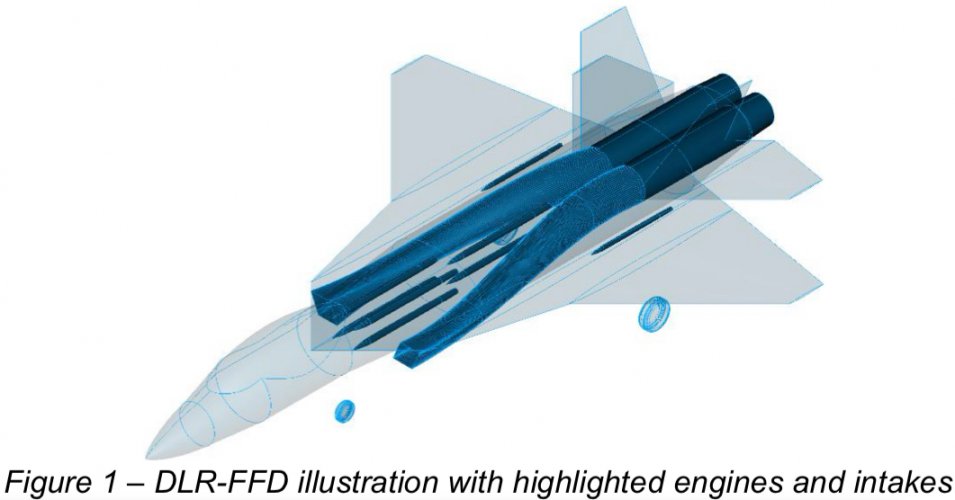
The FFD’s net thrust requirement was 112.7kN dry / 177.1kN wet (per engine). This required a 5m long engine with 1m inlet diameter, weighing 1875kg. Thrust also quoted elsewhere as 124kN dry / 183kN wet… possibly gross (uninstalled) engine rating.
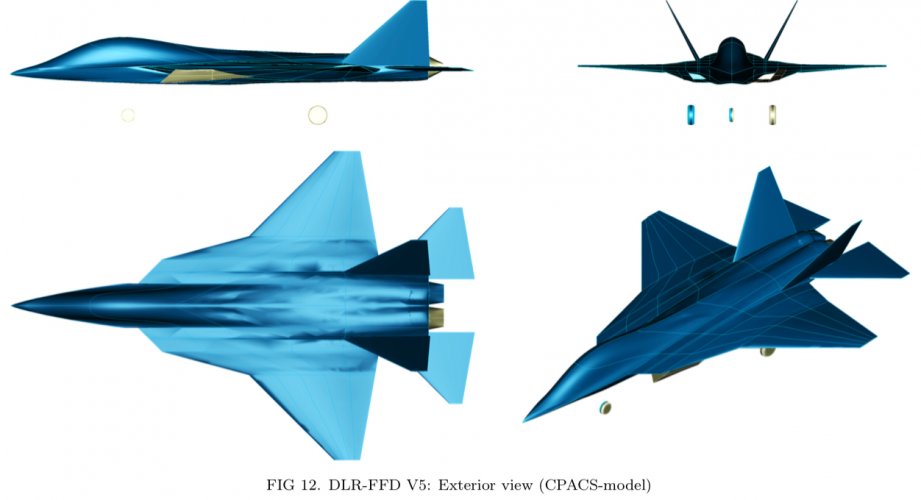
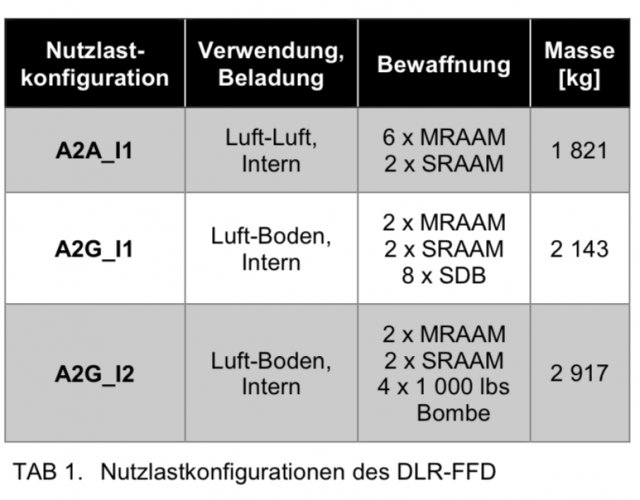
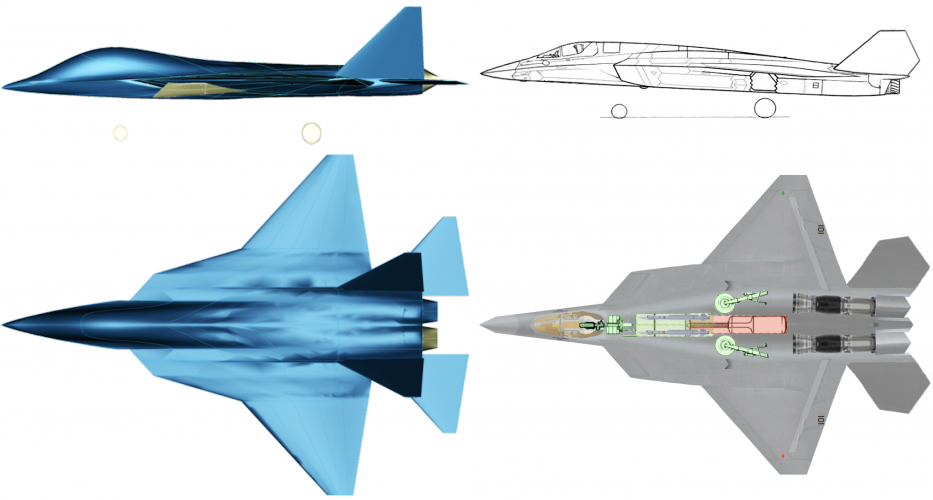
The FFD design is quite big… 20.3m long x 14.8m wide with a 100m2 wing. Empty weight is ~16.5t. Take off weight clean is 28.3t with 8x AAMs (1.8t) and 10t internal fuel, increasing to 29.4t in air to ground configuration with internal weapons (4x AAMs + 4x 1,000lb JDAMs). Max take off weight is ~35t with external load. Combat radius is 780nm hi-hi-hi with internal fuel and 2.5min combat, or 550nm with 1hr CAP loiter.
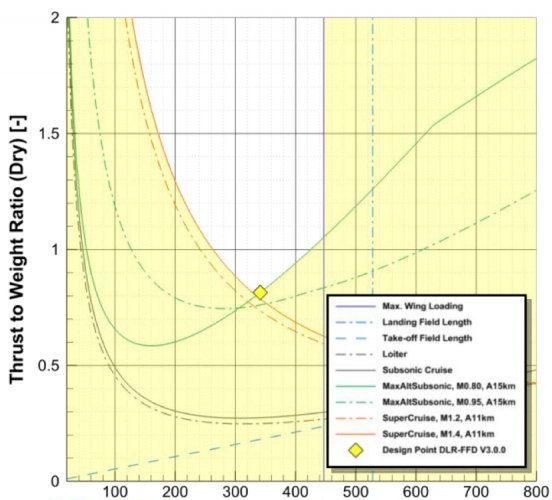
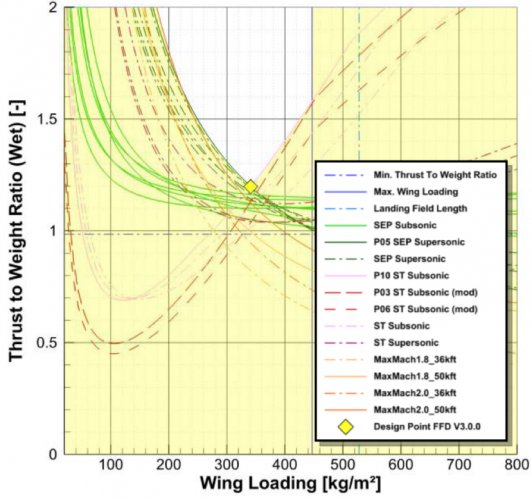
I find these thrust numbers rather high IMHO. Dry thrust is driven by the Mach 1.4 supercruise requirement and wet thrust by requirements for supersonic maneuverability and Mach 2.0 top speed… see charts below. In addition, the wing is oversized (100m2) in order to enable subsonic cruise at 50,000ft, which increases structural weight and thrust requirements.
So perhaps thrust requirements could be cut by 10-20% to ~100kN dry and ~150kN wet with a few performance compromises (eg. supercruise at Mach 1.2 vs 1.4, top speed Mach 1.8 vs 2.0, subsonic cruise at 45kft vs 50kft). Also I would expect Dassault to be able to optimize the design a fair bit (eg. FFD weapons bay volume seems quite oversized).
Looking at the F-22's and Su-57's reported characteristics as well as the data provided for the DLR Future Fighter Demonstator by @H_K, it seems about feasible to achive a sensible internal payload and fuel volume and weight in a design having about a 35,000-38,000kg MTOW and a gross weight of around 30,000kg. This gives some headroom for heavy duty landing gear and arrestor hook or possibly things like stealthy CFTs (to achive combat ranges more in line with was is planned for other sixth gen designs of around 1000nm). That seems to require at least about 160kN of wet thrust per engine, when looking at the F-22 in particular. With the right internal layout it should be possible to carry an ASMP internally with such a design. Anything less than that would require making uncomfortable compromises either in multirole flexibility or air-to-air capabilities.
I'm not sure the NGF would ever fly that heavy, it's just a reference value, as there are certain requirement for internal volume and weight capacity and certain kinematic characteristics that have to be met when flying at gross weight (estimated at around 30,000 kg). And you're probably not getting lower than that if you have to cram all the stuff currently carried by Rafales or Eurofighters externally into internal bays and larger internal fuel tanks to meet stealth requirements. Looking at how Safran believes it can push the M88 to 120 kN and considering the EJ200 has been originally designed with a growth potential to 120 kN and the respective size of these engines, I don't see why EUMET's engine couldn't reach ~160kN wet if it had i.e. similar external dimensions as the Snecma M53.If we're realistically talking about an aircraft with a 35,000–38,000 kg MTOW and new developed engines w/ +- 160 kN wet thrust, then all that remains is to wish France — with its economy — and the average French citizens a great deal of resolve. Especially in light of the new trade agreement with the overseas partner.
I think the DLR's FFD design represents the upper limit of the size range for FCAS/NGF, at 16.5t empty, 28-29t take off weight clean with internal weapons and ~35t MTOW with external stores, with 2x 180kN engines.it seems about feasible to achive a sensible internal payload and fuel volume and weight in a design having about a 35,000-38,000kg MTOW and a gross weight of around 30,000kg.
Air-to-air performance isn’t really the driver of weight and size here, it’s the necessity to carry things like the ASMP internally to meet stealth requirements. These requirements also preclude the use of drop tanks in combat missions. Unless the plan is to totally sacrifice high-altitude performance and speed, leading in effect to little more than a slightly better F-35. And if that were the final result, what’s the point of the whole exercise? The F-35 isn’t suitable to replace the Rafale or the Eurofighter in the air to air role, as exemplified by the US acquisition of the F-15EX, Germany’s, Italy‘s and the UK‘s continued reliance on the Eurofighter including additional purchases to the extent that production lines have to be expanded and Poland‘s interest in acquiring either the Eurofighter or the F-15EX as a dedicated air superiority platform. Sometimes you just need to be able to climb, accelerate and cover a distance in a timely manner.I think the DLR's FFD design represents the upper limit of the size range for FCAS/NGF, at 16.5t empty, 28-29t take off weight clean with internal weapons and ~35t MTOW with external stores, with 2x 180kN engines.
The initial target weights were 14.5t empty and 26-27t clean, with 2x 150kN engines, but FFD's size grew as they refined the structural weights and performance requirements. I expect French input will drive size back down, leveraging Dassault's experience and the French MoD's historical preference for more balanced requirements rather than all-out air-to-air performance.
To illustrate below... here's the German FFD study (left) compared with my hypothetical triple delta LEVCON fighter (right), which represents what might be achievable with a smaller ~13.5-14t empty fighter with 120kN engines and a more streamlined fuselage with high fineness ratio as on the A-5 Vigilante.
View attachment 779486
The German DLR studies found the opposite.Air-to-air performance isn’t really the driver of weight and size here, it’s the necessity to carry things like the ASMP internally to meet stealth requirements.
Sure, let’s spend a lot of money on a European F-35 equivalent, that can’t really replace the Eurofighter or the Rafale in air-to-air and has no means of self defense beyond being hard to see in case it needs to deliver a nuke. /sThe German DLR studies found the opposite.
First because carrying a full air to air load internally (6 Meteors + 2 IR SAMs) takes a lot of internal volume… 4 Meteors being about as much as an ASMP.
Second, and most importantly, because air to air maneuverability drives up thrust requirements and wing area to meet specific goals such as specific excess energy, Mach 2, supercruise, cruise at 50,000ft etc. And fuel requirements for long range CAP + several minutes combat at max AB thrust are also quite significant.
By contrast if A2G requirements were the only driver than 2x M88 ECO with 10t thrust and a fighter with a single internal bay for ASMP and CFTs might be sufficient.
To even remotely make sense, the NGF needs to have decent kinematics, sufficient internal payload capacity and enough internal fuel to get to where it needs to go. Make that work with a gross weight of 25,000kg - great! But looking at available data suggests this isn’t feasible.

Sounds a lot like a F-35 that's longer, (hence heavier), twin engine (hence heavier), and has a bunch more wetted area...You could take a KF-21 today as your starting point, scale it up +15% in length x width (i.e. a scale-up factor of +30%), install F414 growth engines with +30% thrust (128kN)... that would give you:
- KF-21 : 11.8t empty, 19t clean TO, 16.9x11.2m
-> Minimum sized FCAS (~30% scale up): ~14t empty, ~25t clean TO, 19.5x13m
Why would French input drive that design's size down?I think the DLR's FFD design represents the upper limit of the size range for FCAS/NGF, at 16.5t empty, 28-29t take off weight clean with internal weapons and ~35t MTOW with external stores, with 2x 180kN engines.
The initial target weights were 14.5t empty and 26-27t clean, with 2x 150kN engines, but FFD's size grew as they refined the structural weights and performance requirements. I expect French input will drive size back down, leveraging Dassault's experience and the French MoD's historical preference for more balanced requirements rather than all-out air-to-air performance.
F-35 is unusually short & fat and F135 is also unusually heavy for its thrust class, both linked to the STOVL requirements.Sounds a lot like a F-35 that's longer, (hence heavier), twin engine (hence heavier), and has a bunch more wetted area...
Maybe for GCAP and what Germany wants.So what I’m saying - merely as a conceptual starting point mind you - is you could take much of the KF-21 almost as is (nose section, avionics, engines (uprated +20% using the latest tech obviously), with lighter YF-23 style ruddervators and then scale up the center section and wing by 20-30%… and that should give you a pretty good design baseline for FCAS.
You're missing my point.It will BE AS multirole AS it gets as none of them can afford to have 2 large fleets split between air dominance and strike. If we need more of one them then we use an remote carrier / ucav for optimised that mission set
Or, like F/A-18 and Rafale, you can design it around both missions, no?You can design a plane primarily around strike, and you can design a plane primarily around air superiority.

Compared to F-15 or Eurofighter both (F/A-18E/F and Rafale) are very much leaning into the strike category, sacrificing performance metrics that are advantageous in air combat.Or, like F/A-18 and Rafale, you can design it around both missions, no?
I'm honestly expecting SCAF to be a striker, with air superiority primarily handled by drones.