
- Joined
- 3 June 2011
- Messages
- 20,030
- Reaction score
- 17,224
How did you arrive at that?3 to 6 depending on terrain.

How did you arrive at that?3 to 6 depending on terrain.
Standard rule of thumb for air burst explosive.How did you arrive at that?
Thought maybe you had something specific.Standard rule of thumb for air burst explosive.
Multiple spread out over a area in a pattern is more effective then a single massive one.
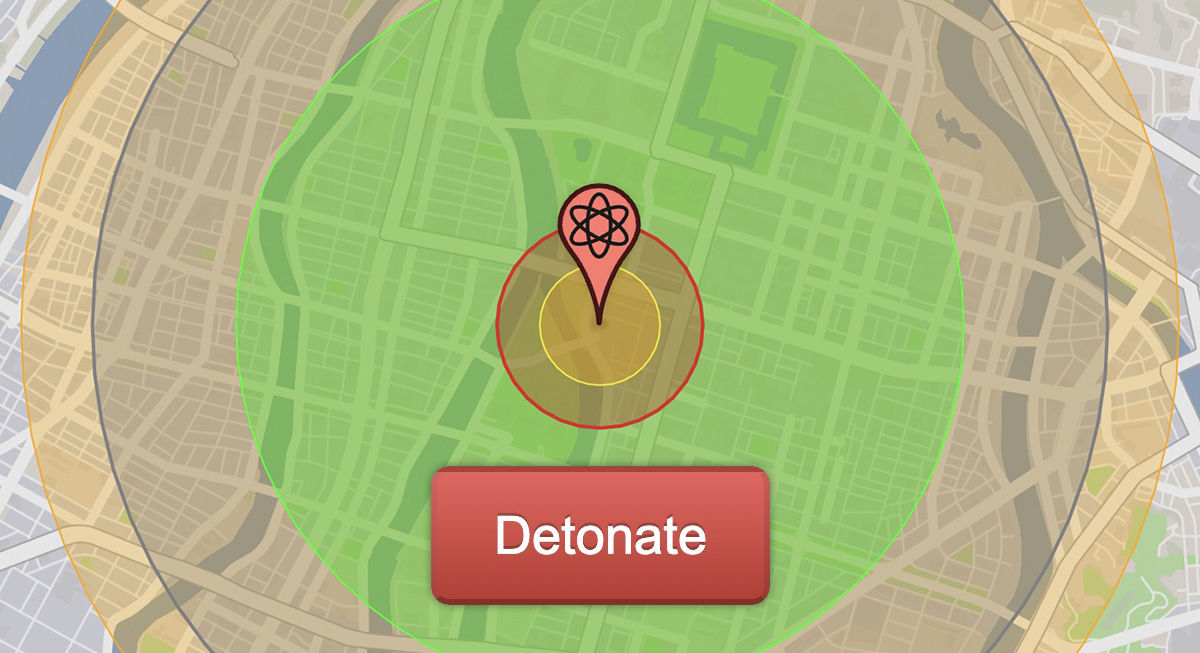
 nuclearsecrecy.com

^The prime argument.When do you need to destroy that big of an area outside of useless city terror bombing?
This one?Crud, didn't save it to my computer. Was part of a 1990s report on Trident missile safety, that happened to give range for missiles that had been downloaded. And I'm now apparently losing my mind trying to find it...
Well, I thought it was that one.


 www.telegraph.co.uk
I know the feeling!Where TF did they go?!?!?! AAAAAAAARGH!!!!!
So they haven't learned...
So they haven't learned...
They haven't learned that people are willing to go to war to prevent them specifically from having a bomb. That is the lesson I was referring to.Or they learned the alternative lesson: the only way to keep someone from fucking with you is to actually have a bomb.
Or they learned that they can survive a bombing and the only way to stop them is a ground invasion.They haven't learned that people are willing to go to war to prevent them specifically from having a bomb. That is the lesson I was referring to.
They haven't learned that people are willing to go to war to prevent them specifically from having a bomb. That is the lesson I was referring to.
Except that they don't have the HEU available. Which likely means that they don't have access to any Pu, either.I think that intent is pretty clear on Usrael’s part. Less clear if the U.S. administration actually has that conviction. The U.S. presence in Diego has emptied out.
If I were them I would develop a weapon as quickly as possible. It is the only way to forestall an open ended Israeli campaign that bombs Iran a couple times a year when a new threat is identified.
Except that they don't have the HEU available. Which likely means that they don't have access to any Pu, either.
60% is not weapons grade.They had no shortage of HEU pre war - hundreds of pounds of 60% pure. It is hard to imagine the strikes destroyed it all.
60% is not weapons grade.

Once you pass 20%, it gets pretty easy, and 60% is just a hop skip and a jump.
That is also my understanding.My understanding is that once 5% enrichment (The upper end of U-235 enrichment for making fuel-slugs for thermal nuclear-reactors) is reached a lot of the hard enrichment work has been done.
Wellerstein doesn't (IIRC) model the interactions of multiple shocks, which tend to strengthen blast effects.Thought maybe you had something specific.
According to this calculator:
NUKEMAP by Alex Wellerstein
NUKEMAP is a website for visualizing the effects of nuclear detonations.
I would take 24 200kt W80s to equal the "heavy blast" area to 1 B41. And even then it's not going to be equivalent. Peak pressure will be larger for the B41, thermal pulse will last longer, larger crater if ground burst, etc. Load a B-52 up and you get 20 W80s max. Or you get the equivalent of 48 just internally, the B-1B 72 and the B-2A 96.
Exactly, my point is that the whole thing is a mess to model so equivalence between low yield multiple and higher yield is not that easy to assess from the outside. That said, it seems like everyone has gone that wayWithout knowing the timing, separation, etc. it amounts to hand-waving.
Mostly because increased accuracy and lower weight is preferred for most applications. Really, the only thing giant nukes are good for are hitting sprawling soft targets or extremely hard point targets, when you need the target to be inside the crater. (Or, if you're numerically limited by treaty, being able to kill more targets.)Exactly, my point is that the whole thing is a mess to model so equivalence between low yield multiple and higher yield is not that easy to assess from the outside. That said, it seems like everyone has gone that way
Witness the small number of new B61-13s, high yield precision weapons.Really, the only thing giant nukes are good for are hitting sprawling soft targets or extremely hard point targets, when you need the target to be inside the crater. (Or, if you're numerically limited by treaty, being able to kill more targets.)
So you meant things like dropping a 10Mt onto an airfield, so that the entire airfield is engulfed in the crater?With a 340kt maximum yield setting the B61-13 is an intermediate warhead that is a sub-strategic weapon at best. The term 'high yield' should only really apply to megaton range weapons and above.
There is no such thing as overkill (especially when there are deep buried facilities under and around said airfield).So you meant things like dropping a 10Mt onto an airfield, so that the entire airfield is engulfed in the crater?
Pershing 1A, basically Iskander in function, had a 400kt warhead. Even the B83, our biggest nuke at a paltry 1.2 Mt, isn't "high yield". Those would be bombs like the Mk17/24, Mk36, and B41.With a 340kt maximum yield setting the B61-13 is an intermediate warhead that is a sub-strategic weapon at best. The term 'high yield' should only really apply to megaton range weapons and above.

NATO considered 200kt to be sufficient to knock out airfields during the Cold War.There is no such thing as overkill (especially when there are deep buried facilities under and around said airfield).
That assessment and similar ones are pretty much discredited these days.US Navy deemed W88 combined with Trident II's accuracy to be sufficient for hard targets, and even the higher yield MUNSTER topped out at 800kt.
Standard anti-airfield loadout on both sides was 600kt, I thought? 200kt was usually more associated with anti-carrier warheads.NATO considered 200kt to be sufficient to knock out airfields during the Cold War.
That assessment and similar ones are pretty much discredited these days.
Standard anti-airfield loadout on both sides was 600kt, I thought? 200kt was usually more associated with anti-carrier warheads.
It now seems likely that Russia only temporarily (at best) withdrew those warheads from service. And the assumption by some western analysts that most of the DF-5s had lower yield warheads may have been a classic case of mirror thinking, not least given recent reports that a 3-4Mt MIRV (not just the already known older single warhead) has been progressively introduced by China to it's DF-5 fleet since the early 2020s.Are they? I'm not aware of any recent projects to greatly increase warhead yields (if anything, the opposite), and this is something that every other nuclear power appears to agree with, given the fact that the Russians have withdrawn their 20mT ICBM warheads from service, and the majority of Chinese DF-5s in service are MIRVed with 200-300kT warheads.
If I am not mistaken, another major factor for that yield being picked for that variant was a shortage at the time of available nuclear material, as well as the usual Treasury shenanigans.It was the main driver in the development of the 190kT WE.177C.
FWIW the 60 megaton Class A that SAC wanted in the late 1950s was wanted for 'runway cratering'. The usual weapons effects calculations give a crater diameter of 3km, which equates to the normal length of a runway for strategic bombers.So you meant things like dropping a 10Mt onto an airfield, so that the entire airfield is engulfed in the crater?
Also the 170 kiloton maximum yield on the tactical versions of the B-61, and the derivatives thereof. NATO policy at the time was that 'tactical' nuclear weapons would be limited to 200 kilotons - the existence of a limit should of course alert us to the fact that the limit might otherwise be exceeded!It was the main driver in the development of the 190kT WE.177C.
Which arguably means that it is obsolete long before it hits the water.ll the discussion of extremely high yield warheads is of course irrelevant: the Columbia class will carry Trident D5, which by virtue of its design cannot carry a large unitary warhead of any yield.
That limit had apparently been dispensed with by the 1980s, ironically in part due to the Dual-Track (sometimes also referred to as Double-Track) policy I believe.Also the 170 kiloton maximum yield on the tactical versions of the B-61, and the derivatives thereof. NATO policy at the time was that 'tactical' nuclear weapons would be limited to 200 kilotons - the existence of a limit should of course alert us to the fact that the limit might otherwise be exceeded!
The Nuclear-Armed Sea-Launched Cruise Missile (SLCM-N) program, reintroduced in the 2018 Nuclear Posture Review to counter Russian and Chinese regional nuclear threats, gained legislative momentum with the Fiscal Year 2024 National Defense Authorization Act (NDAA), which mandated its development and initial operational capability by 2034 despite initial cancellation in 2022. Recent Congressional funding reflects bipartisan support.
60(a). Do you support the SLCM-N program as a necessary enhancement to U.S. theater deterrence?
Yes. I fully support the development of the SLCM-N program. SLCM-N will provide the President with enhanced flexible response options, which will support deterrence of limited nuclear use and high-consequence non-nuclear strategic attacks against U.S., allied, and partner vital interests.
60(b). Given Congressional backing and the deteriorating global security environment highlighted in 2024 testimony, what steps would you take to accelerate the SLCM-N’s timeline to meet the 2034 operational goal?
If confirmed, I am committed to seeking the necessary resources to develop SLCM-N to the Congressionally mandated IOC of 2034. Further, I am committed to working with select stakeholders, such as Strategic Systems Program, to accelerate facets of the SLCM-N program as applicable.
It's (no doubt intentionally) unclear how much of the original D5 will be in D5LE2 when that enters service in 2039. It's been described as not like the current missile, but also not completely new.Which arguably means that it is obsolete long before it hits the water.
There's shenanigans that can be done there. Up to and including cutting the third stage in half so it no longer sticks through the bus, or deleting the 3rd stage entirely.All the discussion of extremely high yield warheads is of course irrelevant: the Columbia class will carry Trident D5, which by virtue of its design cannot carry a large unitary warhead of any yield.
If it is a whole new missile, you have to compete the whole thing.Continuing to call the thing 'Trident II' and/or 'D5' seems to be poor politics, but doesn't look like D5LE2 is fully defined yet, much less funded.


