exclaimedleech8

ACCESS: Top Secret
Joined
30 September 2024
Messages
583
Reaction score
636
One of the most promising applications for ceramics is in gas turbine engines. They can handle much higher temperatures than the metals currently used and are far less expensive. Back in the 70s and 80s, ceramics were hailed as the killer app for automotive turbine engines.
 
One of the most promising applications for ceramics is in gas turbine engines. They can handle much higher temperatures than the metals currently used and are far less expensive. Back in the 70s and 80s, ceramics were hailed as the killer app for automotive turbine engines.
What killed turbine engines in cars was the constantly-varying engine RPMs. Turbines have a very narrow range where they are most efficient, so the best setup for turbine power of surface vehicles is series hybrid, aka turbine-electric. Turbine engines spin at best-economy speed driving a generator, and there's an electric motor powering the wheels (or screws, for a ship).

We're seeing some ceramic parts showing up in automotive engines, like turbocharger wheels (either compressor or turbine side), and @Nicknick mentioned engine valves.
 
Turbines have a very narrow range where they are most efficient
Engineers got around that problem with variable geometry and regenerators.

This 1980 NASA study calculated that a 2 shaft gas turbine with variable free turbine nozzle, an inlet temperature of 2500 degrees, and a 94% effective regenerator would offer 60% better fuel economy than a piston engine with the same power output (Page 38).
 
I do have a collection of all SAE papers from that time. Regenerative turbines can be halfway efficient if operated along a line. With a two shaft configuration, this easy to achrieve, but efficiency was only moderate, even when compared to a contemporary V8 engine...
 
Last edited:
I do have a collection of all SAE papers from that time. Regenerative turbines can be halfway efficient if operated along a line. With a two shaft configuration, this easy to achrieve, but efficiency was only.moderate, when compared to a contemporary V8 engine...n
The big limitation on turbine efficiency is how much heat the materials can handle. To keep everything cool, they need to run the engines very lean, which means you need a bigger compressor that takes a bigger parasitic load. 2500 degrees would've allowed efficiency comparable to a diesel
 
Engineers got around that problem with variable geometry and regenerators.

This 1980 NASA study calculated that a 2 shaft gas turbine with variable free turbine nozzle, an inlet temperature of 2500 degrees, and a 94% effective regenerator would offer 60% better fuel economy than a piston engine with the same power output (Page 38).
Calculated, not demonstrated.

And a 2500degF/1370degC TIT is way up there.
 
Engineers got around that problem with variable geometry and regenerators.

This 1980 NASA study calculated that a 2 shaft gas turbine with variable free turbine nozzle, an inlet temperature of 2500 degrees, and a 94% effective regenerator would offer 60% better fuel economy than a piston engine with the same power output (Page 38).

Note, the mentioned 13.8 km/L are 7.7 L/100 km which is the more common form to describe the fuel consumption. The contemporary quite large and heavy Mercedes E-Class Diesel consumes only 5.3 L/100 km in the demanding WLTP cycle.

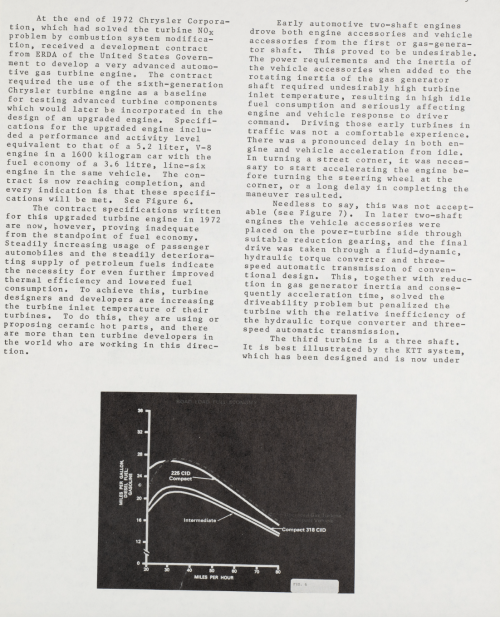
With higher temperatures, the NOx emissions are rising. this caused the latest Chrysler turbine developments in the early 70 th to have higher spfc than the older design. With the introduction of the first NOx limitations and the oil crises, the turbine cars were dead.

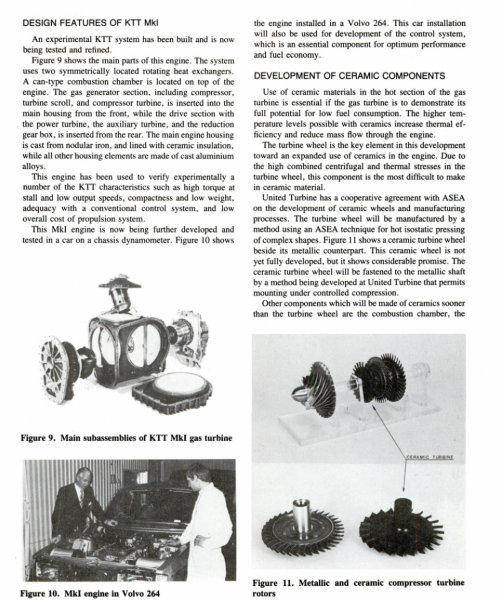
There have been some ceramic turbine wheels for turbo chargers in the 80 th, but thes fall out of fashion because the higher material thickness compared to metal wheels reduced their efficiency. This would have been a problem for small gas turbines as well.
 
Last edited:
Note, the mentioned 13.8 km/L are 7.7 L/100 km which is the more common form to describe the fuel consumption. The contemporary quite large and heavy Mercedes E-Class Diesel consumes only 5.3 L/100 km in the demanding WLTP cycle.

With higher temperatures, the NOx emissions are rising. this caused the latest Chrysler turbine developments in the early 70 th to have higher spfc than the older design. With the introduction of the first NOx limitations and the oil crises, the turbine cars were dead.

There have been some ceramic turbine wheels for turbo chargers in the 80 th, but thes fall out of fashion because the higher material thickness compared to metal wheels reuced the efficiency. This would have been a problem for small gas turbines as well.
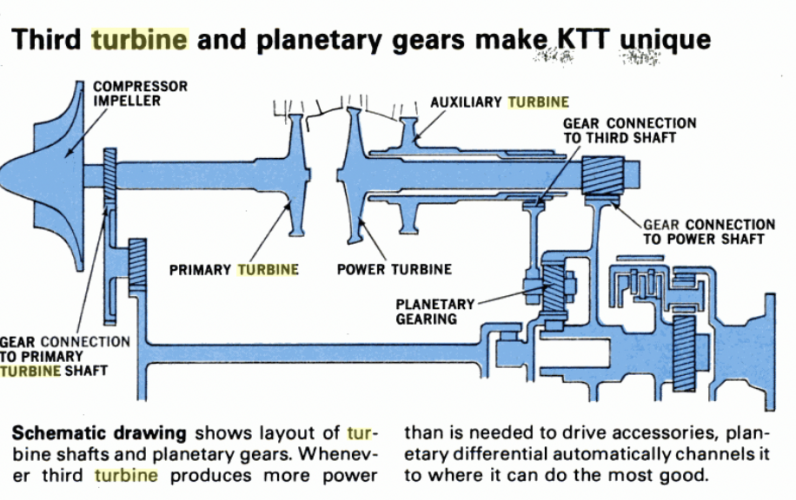
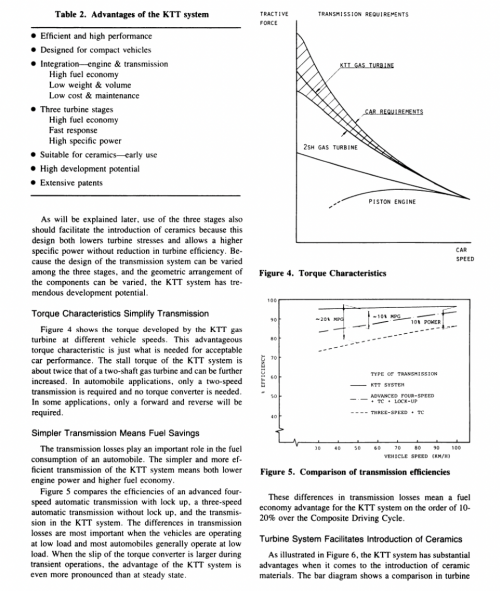
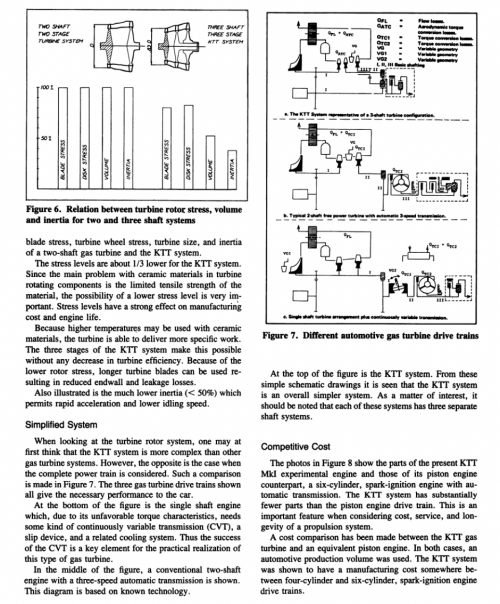
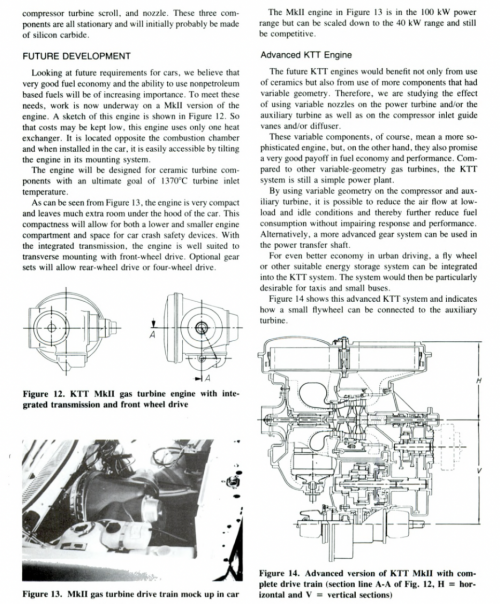
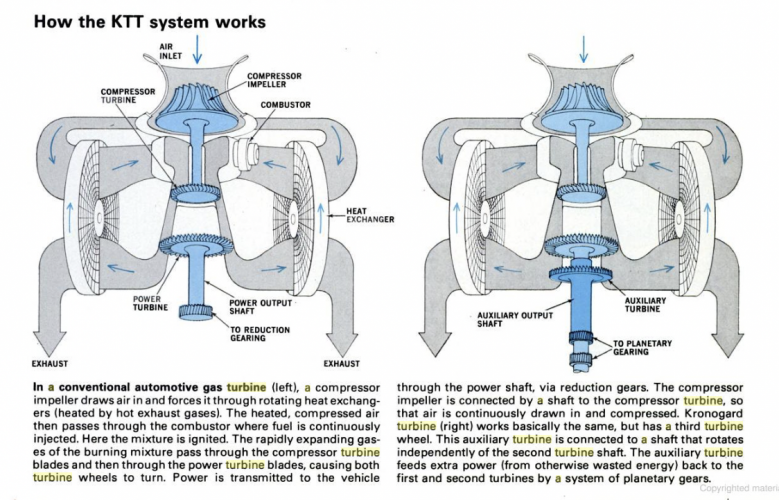
There are other ways to improve a turbine's efficiency. A Swedish engineer added a third turbine that would drive the auxiliaries even when the power turbine was stationary and to provide increased stall torque. This meant there was no need for a separate transmission. They could also add a stop start system. and then the improved understanding of combustion and air flows and better lubricants would further improve efficiency.
 
There are other ways to improve a turbine's efficiency. A Swedish engineer added a third turbine that would drive the auxiliaries even when the power turbine was stationary and to provide increased stall torque. This meant there was no need for a separate transmission. They could also add a stop start system. and then the improved understanding of combustion and air flows and better lubricants would further improve efficiency.

The most logical and common approach was a free turbine (compressor and highpressure turbine) with a low pressure turbine coupled to the gearing of a standart automatic gear box. The low pressure turbine acted the same way as torque converter and made the driving quite like in a automatic car (but more sluggish...).

Of course, improvments could have been made, but combustion engines made rapid improvments too. Like the Wankel engine, turbines offered no decicive advantages, but were more expensive and less efficient. Even for locomotives, they weren't able to replace the Diesels, despite the larger required power demands works in favour of the turbines.
 
The most logical and common approach was a free turbine (compressor and highpressure turbine) with a low pressure turbine coupled to the gearing of a standart automatic gear box. The low pressure turbine acted the same way as torque converter and made the driving quite like in a automatic car (but more sluggish...).
That's how the 1960s Chrysler Turbine cars worked. Separate power turbine connected to an automatic, no torque converter.
 
Indeed, despite that, there were other more exotic solutions, like single shaft turbines with air filled high speed air torque converters (using the losses for pre heating the combustion air) or multiclutch/gear transmissions.
 
That's how the 1960s Chrysler Turbine cars worked. Separate power turbine connected to an automatic, no torque converter.
Doing that means they would've had to drive auxiliaries from the compressor turbine, which means slow throttle response.
 
But this mini turbine would have had a terrible efficiency, this would become even worse, since it would have to run continiously with a vide variing power demand (airconditioning on/off) and variing pressure/temperature ratios which would have been totally unrelated to the power output. Quite a horrible unefficient solution!

In modern times, an electric power take off would be mor appropiate.
 
But this mini turbine would have had a terrible efficiency, this would become even worse, since it would have to run continiously with a vide variing power demand (airconditioning on/off) and variing pressure/temperature ratios which would have been totally unrelated to the power output. Quite a horrible unefficient solution!

In modern times, an electric power take off would be mor appropiate.
I'm not sure what you mean. When the car was idling, the auxiliary turbine would've only provided enough power for auxiliaries. when accelerating, it would've sent a jolt of power to the compressor, boosting acceleration, and then at speed, the power turbine would be absorbing most of the thermal energy while the auxiliary turbine would've done little
Like the Wankel engine, turbines offered no decicive advantages, but were more expensive and less efficient.
The lightweight, small size, low maintenance requirements, smoothness, simplicity, and the ability to run on a wide variety of fuels are all pretty big advantages. The only problem was they never found a ductile, inexpensive material able to handle 2500 to 3000 degree temperatures.
 
Please explain how the third turbine would power the compressor. Before you described it in a way, that suggests it was not mechanically connected to the free shaft turbine.

Combustion engines also run on a wide range of fuel, Diesel engines can consume Diesel, plant oils, Jet fuel and raw Fischer Tropsch fuels. Otto engines can also run on about every burnable gas, alcohol, ammonia etc.

Regenerative turbines werent light or simple and their sealing system surly needed some attention.
 
Please explain how the third turbine would power the compressor. Before you described it in a way, that suggests it was not mechanically connected to the free shaft turbine.

Combustion engines also run on a wide range of fuel, Diesel engines can consume Diesel, plant oils, Jet fuel and raw Fischer Tropsch fuels. Otto engines can also run on about every burnable gas, alcohol, ammonia etc.

Regenerative turbines werent light or simple and their sealing system surly needed some attention.


Screenshot 2025-06-22 at 8.34.36 AM.png

Screenshot 2025-06-22 at 8.35.28 AM.png

From Popular Science October 1979

Modern otto engines require high octane gasoline or they'll suffer from knock. Diesel engines can't run on gasoline.

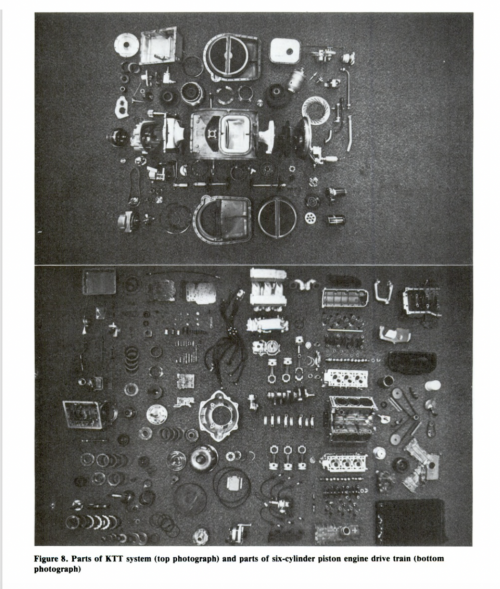
And yes, even with the regenerator, it is still much simpler than a piston engine. Chrysler's turbine engine had 80% fewer parts than a comparable V8 of the time.
 
Thanks for the picture, this makes it clearer, but still, I don’t fully understand the system. The third turbine is connected with a power split to the auxiliary drive (not visible) and the final drive. There is no free turbine section, the compressor/high pressure turbine shaft is somehow connected with gears to something not included in the picture. All I can see is a coaxial bearing in the ‘’gear connection to power shaft’’ without any possibility for torque transfer.

In a post nuclear war world (like water world), it might be a great advantage to have engines which can run on all type of fuels, but generally there is no need. MAN developed the MAN FM-Verfahren (aka ‘’Frau Meurer Verfahren’’ or ‘’fremdgezuendet Mittenkugelverfahren’’) for military purposes which could run on gasoline, Diesel fuel or jet fuel. Orbital (an Australian company) also developed a combustion system for multi fuel capability, but without any visible success on the market.

The number of parts doesn’t affect engine reliability. Valveless two stroke or Wankel engines are very simple indeed with a low number of parts, but they are well known for being troublesome and short lived. The reason is the difficult lubrication conditions in these engines. Harry Ricardo pointed out, that the Liberty engine in WW1 not only was the most complicated engine with the highest number of moving parts, but also the most reliable aero engine of its time. Even today, marine or locomotive four stroke engine usually have a very high number of parts (OHV valvetrain, up to 20 cylinders) but run very reliable with a long operational live.

Standard open cycle gas turbines don’t have any friction surfaces other than the shaft bearings. This makes the wear rate very low and it the reason for their reliability and long service life. When adding a regenerator with hot, unlubricated sealing surfaces plus shaft sealings, gears etc. this advantage gets lost.
 
Thanks for the picture, this makes it clearer, but still, I don’t fully understand the system. The third turbine is connected with a power split to the auxiliary drive (not visible) and the final drive. There is no free turbine section, the compressor/high pressure turbine shaft is somehow connected with gears to something not included in the picture. All I can see is a coaxial bearing in the ‘’gear connection to power shaft’’ without any possibility for torque transfer.
The 3rd turbine's shaft is not connected to the power turbine's shaft (and then to final drive), it's just concentric to the power turbine shaft like a multi-spool engine.


Standard open cycle gas turbines don’t have any friction surfaces other than the shaft bearings. This makes the wear rate very low and it the reason for their reliability and long service life. When adding a regenerator with hot, unlubricated sealing surfaces plus shaft sealings, gears etc. this advantage gets lost.
Ceramic seals work really well. But I'll admit I'd prefer a non-rotating regenerator.
 
Please take a second look, at the ''planetary drive'', the third turbine is clearly attached to the axis of the planetary gear drive (''gear connection to third shaft''). The power of third turbine is split (like in the Prius gear system) between the gearbox and the turbine shaft. Interestingly, this has no direct connection to anything with the auxillaries drives (generator, air conditioning etc.), it is just called auxiliary turbine.

The trick is, that the speed of the third turbine gets slower, when the output shaft rotates faster. Keep in mind, that we do have a conventional automatic transmission, which cannot always supply the perfect rpm for max. efficiency. This system takes this into account, by using more power with the third turbine when the speed of the power turbine is lower than ideal (remaining counterflow swirl downstream of the power turbine).

(Note, my posting before was wrong in that regard, now it all makes sense!)

 
Last edited:
Please take a second look, at the ''planetary drive'', the third turbine is clearly attached to the axis of the planetary gear drive (''gear connection to third shaft''). The power of third turbine is split (like in the Prius gear system) between the gearbox and the turbine shaft. Interestingly, this has no direct connection to anything with the auxillaries drives (generator, air conditioning etc.), it is just called auxiliary turbine.

The trick is, that the speed of the third turbine gets slower, when the output shaft rotates faster. Keep in mind, that we do have a conventional automatic transmission, which cannot always supply the perfect rpm for max. efficiency. This system takes this into account, by using more power with the third turbine when the speed of the power turbine is lower than ideal (remaining counterflow swirl downstream of the power turbine).

(Note, my posting before was wrong in that regard, now it all makes sense!)
Okay, I am seeing it now, but it's still really freaking weird. I feel like it may be better to have a controllable-pitch turbine attached to the driveshaft.
 
I know variable pitch guiding vanes, but no variabe pitch turbine vanes, I guess you ment that. This approach would help on the entrance side of the power turbine but wouldn't much on the swirl at the exhaust side.

II guess this system will also decrease the fuel consumption at idle considerably, since a standing power turbine is the biggest mismatch from the ideal operating line. The high fuel consumption at idle was a serious problem for turbine cars.

It's a clever approach but it increases the complexety and cost of an allready expensive system. At some speeds/loads the efficiency might be worse than without the third turbine.
 
It's a clever approach but it increases the complexety and cost of an allready expensive system. At some speeds/loads the efficiency might be worse than without the third turbine.
When you consider the fact that you don't need a separate transmission, this is cheaper and simpler, especially relative to today's transmissions that have 8, 9, or even 10 speeds.

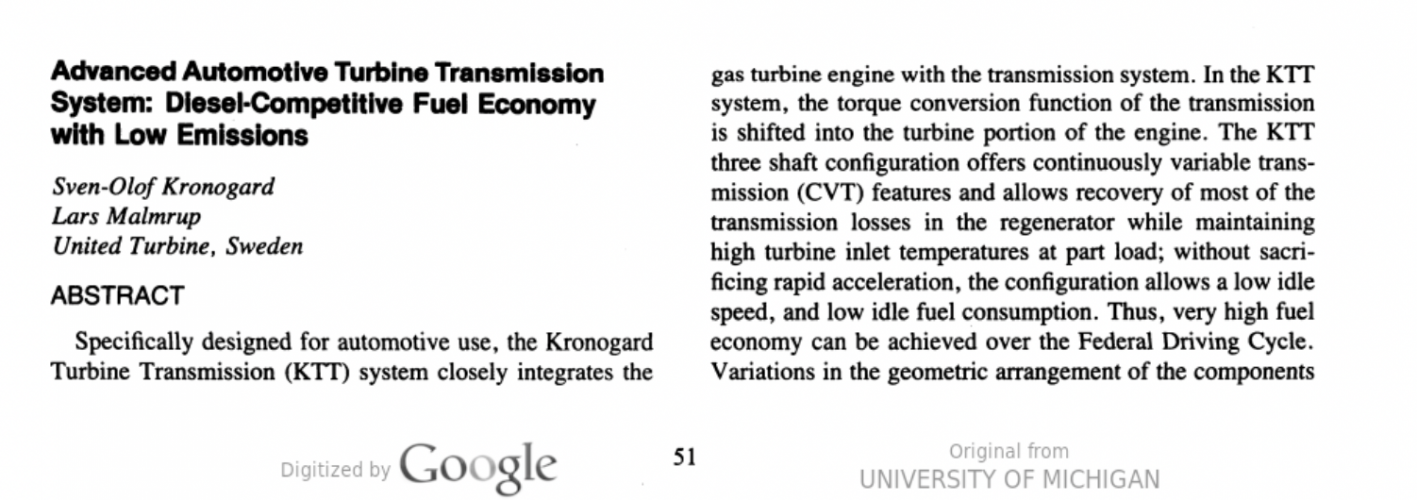
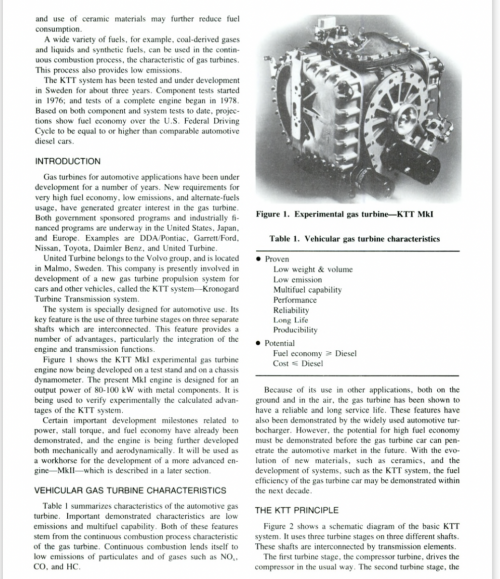
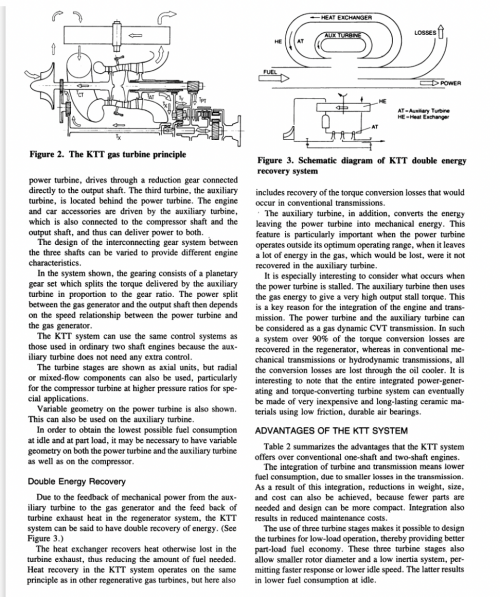
EDIT: For a more clear explanation, here's a paper Kronogard, the inventor, presented in 1979
Screenshot 2025-06-23 at 11.26.30 AM.png Screenshot 2025-06-23 at 11.26.42 AM.png Screenshot 2025-06-23 at 11.26.49 AM.png Screenshot 2025-06-23 at 11.27.31 AM.png Screenshot 2025-06-23 at 11.28.13 AM.png Screenshot 2025-06-23 at 11.28.43 AM.png Screenshot 2025-06-23 at 11.28.54 AM.png Screenshot 2025-06-23 at 11.28.59 AM.png Screenshot 2025-06-23 at 11.29.16 AM.png
 
Last edited:
Seems to me that third turbines, recuperation and similar complexity are dead in the water for automotive applications. Coupling a turbine to an electrical generator as a range extender for a battery EV solves all the driveability issues and you can run the turbine at its optimal RPM and maybe achieve pretty decent efficiency. Shrinking the battery down to 12-15kWh means you end up with a pretty lightweight package.
 
Nikola Tesla turbine on several disks it is good for small turbines Even though it's made of ceramic, there's still not much pressure on those discs. However, these industrial ceramics are still expensive because they do not use ordinary alumina clay. my idea was to use regular ceramic baked until there were lines on the surface to place mesh either made of steel or carbon and then all of it to be glued with epoxy resin.
 
Seems to me that third turbines, recuperation and similar complexity are dead in the water for automotive applications. Coupling a turbine to an electrical generator as a range extender for a battery EV solves all the driveability issues and you can run the turbine at its optimal RPM and maybe achieve pretty decent efficiency. Shrinking the battery down to 12-15kWh means you end up with a pretty lightweight package.
Screenshot 2025-06-23 at 11.28.43 AM.png

"complexity"
 
In a post nuclear war world (like water world), it might be a great advantage to have engines which can run on all type of fuels, but generally there is no need. MAN developed the MAN FM-Verfahren (aka ‘’Frau Meurer Verfahren’’ or ‘’fremdgezuendet Mittenkugelverfahren’’) for military purposes which could run on gasoline, Diesel fuel or jet fuel. Orbital (an Australian company) also developed a combustion system for multi fuel capability, but without any visible success on the market.
It would greatly simplify the process of oil refining. High octane gasoline is expensive to make.
 
That's how the 1960s Chrysler Turbine cars worked. Separate power turbine connected to an automatic, no torque converter.
Screenshot 2025-06-23 at 4.18.22 PM.png
According to George Huebner, the father of Chrysler's turbine program, the drivability issues with that configuration were so great that they were forced to use the power turbine to drive the accessories and incorporate a separate torque converter for later versions.
 
"complexity"
I mean, whatever range extender you use is somewhat complex. And FFS Mazda is talking about varying rotor RPM per face in their single-rotor range extender!!!

But running at best economy RPM while spinning a generator is exactly how all the other range extenders work. The turbine just has the hottest exhaust until you get recuperators/regenerators in there.
 
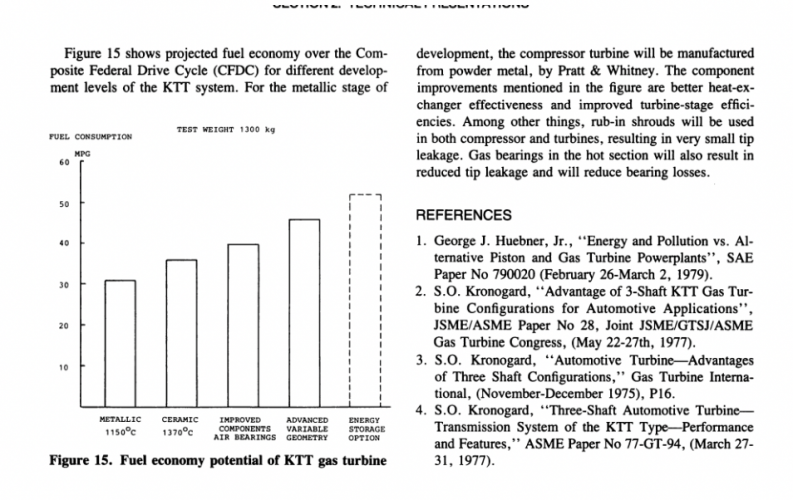
Comparing a hypothetical ceramic turbine (1375 deg Celsius!) with air bearings and advanced variability (whatever that means...) to a contemporary mass produced Otto engine with an automatic gear box is not representative. They should have made the comparison with an equal hypothetic lean burn (CVCC was already in production back than), variable compression direct injected engine with electrically coupled turbocharger.

Todays engines are more efficient than all the advanced turbine engines ever promised, with truck engines even exceeding the 50 % mark.

Again, the number of part says nothing about cost, reliability or longlivity. A 12 cylinder locomotive engine has 48 valves, 24 rocker arms, 24 push rods, 24 tappets, several turbo chargers, lots of gears pumps etc. but works absolutely reliable for decades.
 
Comparing a hypothetical ceramic turbine (1375 deg Celsius!) with air bearings and advanced variability (whatever that means...) to a contemporary mass produced Otto engine with an automatic gear box is not representative. They should have made the comparison with an equal hypothetic lean burn (CVCC was already in production back than), variable compression direct injected engine with electrically coupled turbocharger.

Todays engines are more efficient than all the advanced turbine engines ever promised, with truck engines even exceeding the 50 % mark.

Again, the number of part says nothing about cost, reliability or longlivity. A 12 cylinder locomotive engine has 48 valves, 24 rocker arms, 24 push rods, 24 tappets, several turbo chargers, lots of gears pumps etc. but works absolutely reliable for decades.
You're undermining your argument by admitting that today's state of the art "piston" engines are partially turbine engines.

"Advanced variability" means adding adjustable vanes to the compressor and auxiliary turbines.
 
You're undermining your argument by admitting that today's state of the art "piston" engines are partially turbine engines.
Some of them are not just using the electrically coupled turbo**, but a full on turbocompounding setup.

** most turbochargers still leave a pretty significant gas temperature and velocity after the turbine that can be exploited for power.
 
I'm pragmatic, I don't dislike turbomachinery and like to combine them with piston engines :)...
 
BTW an automatic stop start system is way easier to implement on a turbine engine, because starting the engine takes less torque. There's another boost for efficiency


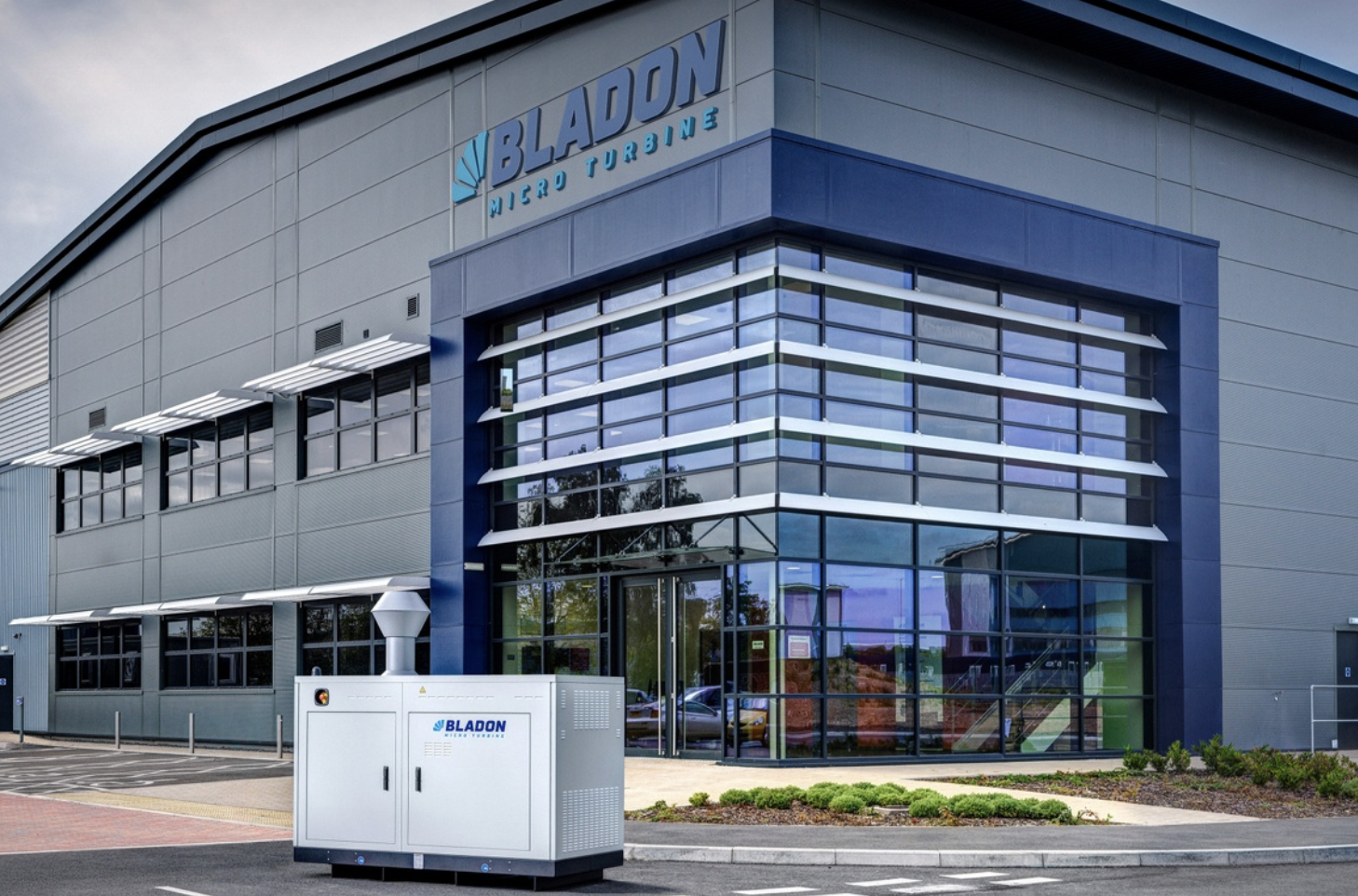
These guys were working for years on a range extender for Jaguar who threw in $$ to get if off the ground and it all ended up in tears.

Great little axial turbine yet went the wrong direction years ago, not ceramic yet now could be.

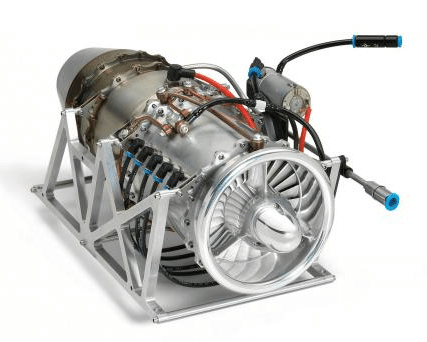
Micro-Gas-Turbine-by-Bladon-Jets-UK.png


Regards,
 
BTW an automatic stop start system is way easier to implement on a turbine engine, because starting the engine takes less torque. There's another boost for efficiency
I don,t think so, the rotational energy matters, not the torque. Piston engines can run on their own power from 300 rpm onwards, turbines need much more speed and time to spool up.
 
I don,t think so, the rotational energy matters, not the torque. Piston engines can run on their own power from 300 rpm onwards, turbines need much more speed and time to spool up.
Chrysler was able to combine the starter and alternator into one unit in their Turbine Car
 

Similar threads

Back
Top Bottom