I'll give you the J-50 for air superiority but the J-36, in my opinion looking at it's configuration and with the number of elevons plus the four (2 per side) split wingtip surfaces, not so much. The J-36 is a large platform and could function as an interceptor and medium strike but it's not designed for maneuverability. The number of elevons scream supersonic trim similar to the XB-70. Not unless you're tied to the program in some manner; systems of systems, power generation, EW, range and bleeding edge, maybe or maybe not.

Why do we think that high end air superiority of the future should emphasize maneuverability?

It's been pretty obvious for quite a few years now that the domains of highest yield gains that you want to prioritize for air superiority are signature reduction, sensing/processing, networking, EW, weapons, and once maneuverability reaches a sufficient minimum threshold, additional bleeding edge gains arguably yield less gains in relative capability than the other aforementioned domains.

Emerging high yield domains also include attribility/mass, automation of capability, and range (latter being theater/geography specific).

I would posit that an airframe with a retentive focus on traditional maneuverability is reflective of wanting to maintain a "lower risk/lower technology" backup capability for said aircraft.


====


I generally agree with you that it's air superiority but think it's more. I think it's meant to do carry out a modern day pearl harbor. There's no way that chinese transport ships can reach taiwan shores without suffering heavy heavy cost unless china can preemptively destroy runways surrounding it. The range, speed, stealth, sensor package and large payload are meant for it to be self sufficient without relying on traditional strike package (electronic and surveillance support assets etc) which could give away a preemptive strike.

Phrases like "modern day pearl harbour" are vague, and if you are referring to the ability of the PLA to conduct a bombardment campaign prior to carrying out a Taiwan invasion -- well you don't need J-36 for that. Heck, a bombardment campaign doesn't even need to be "given away" when the PLA has the PLARF and the PLAAF being so large to begin with.

If they want a more theater scale (4000km+ from mainland) aerial stealthy strike system you'll want something much bigger than J-36, and I suspect that is what H-20 will be for.


However, what the PLA does need is the ability to contest and achieve command of the air at distances of 3000-4000km from the PRC mainland, to both engage and defeat existing competitor tacair and future 6th gen tacair and their CCAs, to allow them to in turn credibly and comprehensively target aerial force multipliers (tankers, AEW&C etc) to achieve air control at the more "operational" level. That requires long range, stealthy, networked, EW-oriented high performance aircraft that can engage aerial targets itself and also direct their own CCAs and support their complementary manned tacair (6th, 5th gen alike) as a networking/command hub at the system of systems level. That will require a lot of onboard power generation, as well as a lot of fuel, and all in a package that is kinematically competitive enough to exploit those characteristics.

Control of the air is what will enable comprehensive re-attack of and suppression of air bases/ports/air defense sites in the western pacific and targeting mobile naval forces (air control enables aerial strike systems to operate much more safely, airborne EW and ELINT, as well as aerial BDA/ISR to cue theater range fires like IRBMs, hypersonics etc).


Also I'm not completely sold on J-36 being the more bleeding edge. There's no guarantee that J-36 3 engines are designed around the idea that a 3 stream adaptive engine with enough power generation from just 2 engines to accomplish x, y, z while the J-50 was built around the premise of the success of developing such engine and novel miniaturization of components.

I don't see why we should speculate by this point.

Everyone involved in following PLA aviation by now should already know the primacy of the PLA Chinese language grapevine and their track record, and until something changes, it would really be far easier just to accept the following pill that J-36 is a high end air superiority platform, emphasizing signature reduction, sensing/processing, networking/command, weapons, power generation, range and speed.
J-36 will have VCE/ACE solution in the future. Its three engine configuration is not reflection of a projected future engine limitations, but should be seen to reflect the capability the aircraft will be capable of once its intended engines are ready.


China has done this before with the j-20 where the overall layout is dictated by the premise that the engines it would receive were inferior to US counterparts.

Not really -- the J-20's engines were always intended to be WS-15, which was always conceived to be comparable to US counterparts of the equivalent generation (F119/F-22).
One could make the case that J-20's layout was designed such that it would have competitive kinematic performance even when using interim engines (WS-10s).
 
Phrases like "modern day pearl harbour" are vague, and if you are referring to the ability of the PLA to conduct a bombardment campaign prior to carrying out a Taiwan invasion -- well you don't need J-36 for that. Heck, a bombardment campaign doesn't even need to be "given away" when the PLA has the PLARF and the PLAAF being so large to begin with.
Because enemy can rush at least some of their aircraft into the air before their runways get hit. Element of surprise is relevant. Ballistic missile launch can give away to a variety of sensors.

Not really -- the J-20's engines were always intended to be WS-15, which was always conceived to be comparable to US counterparts of the equivalent generation (F119/F-22).
One could make the case that J-20's layout was designed such that it would have competitive kinematic performance even when using interim engines (WS-10s).
I can't find the direct source right now (so some other members might help out) but j-20 engineers on at least 2 occasions (one was a lecture, the other being at least 10 years ago in an article interview) spoke about making compromise to other facets of performance in order to compensate for speed, knowing that engine tech wouldn't catch up to the US, at least for a while.
 
Last edited:
Because enemy can rush at least some of their retaliatory aircraft into the air before their runways get hit. Element of surprise is relevant. Ballistic missile launch can give away to a variety of sensors.

And an aerial strike system (even a supersonic capable stealthy strike aircraft, as you propose for J-36) would be better? If anything the transit speed of a supersonic aircraft (even one optimized for RF signature reduction), considering modern sensing technology, for a long range strike would prove to offer less surprise than a ballistic missile or hypersonic system.

But even that is a red herring, because in a true large scale high intensity conflict, mere surprise is not enough -- it is the ability to achieve surprise and continuously attrit and conduct accurate re-attack which is important (unless one theoretically was able to conduct a first strike surprise attack of such gargantuan magnitude that the enemy had no materiel or forces remaining at all... and such a capability is not available to either side in a US-PRC conflict).

Anyway, this is all academic -- my sincere word of advice is just to view J-36 as a high end air superiority platform. See it as the true expression of what a next generation air superiority system looks like, and see the J-50/J-XDS as a more "conservative" platform. I believe that would make envisioning the future of air power easier.


I can't find the direct source right now (so some other members might help out) but j-20 engineers on at least 2 occasions (one was a lecture, the other being at least 10 years ago in an article interview) spoke about making compromise to other facets of performance in order to compensate for speed, knowing that engine tech wouldn't catch up to the US, at least for a while.

I'm pretty familiar with most J-20 literature, and I translated one of the most comprehensive original papers that led to the development of J-XX and in turn J-20, a few years back into English (https://thediplomat.com/2022/02/what-a-19-year-old-study-tells-us-about-chinas-j-20/) -- the fact that J-20 was always going to use interim engines initially was well accepted, but the design of the aircraft was still oriented around its target intended engines that would be comparable to that of its generational peer/target (F-22).
 
And an aerial strike system (even a supersonic capable stealthy strike aircraft, as you propose for J-36) would be better? If anything the transit speed of a supersonic aircraft (even one optimized for RF signature reduction), considering modern sensing technology, for a long range strike would prove to offer less surprise than a ballistic missile or hypersonic system.
If it's actually a VLO aircraft, ie basically undetectable to long-range radars?

Yes, stealthy aerial strike wins over ballistic or hypersonic missile strikes.


I'm pretty familiar with most J-20 literature, and I translated one of the most comprehensive original papers that led to the development of J-XX and in turn J-20, a few years back into English (https://thediplomat.com/2022/02/what-a-19-year-old-study-tells-us-about-chinas-j-20/) -- the fact that J-20 was always going to use interim engines initially was well accepted, but the design of the aircraft was still oriented around its target intended engines that would be comparable to that of its generational peer/target (F-22).
Just a reminder that in terms of static thrust numbers, the F119 is not significantly better than same-year F110s. Both make ~30+klbs in afterburner. The F119 advantage is that it's got a much higher exhaust velocity, so it's better for supercruise
 
If it's actually a VLO aircraft, ie basically undetectable to long-range radars?

Yes, stealthy aerial strike wins over ballistic or hypersonic missile strikes.
If that were true, and VLO designs are effectively invisible to radar then I wonder why both China and the US is investing so heavily on low band anti-stealth long range radars?
Just a reminder that in terms of static thrust numbers, the F119 is not significantly better than same-year F110s. Both make ~30+klbs in afterburner. The F119 advantage is that it's got a much higher exhaust velocity, so it's better for supercruise
Early prototypes used Al-31Fs which were quite a bit worse even on static thrust when compared to F-110s only later when they started mass producing J-20s did they switch to WS-10Cs.
 
Last edited:
It is WIDE though, you're forgetting that this thing has an extremely wide platypus nose. The nose array by some estimates could be as large as the V004 on the Su-34.

Lots of room for side arrays too.

I would assume this is an air superiority fighter where the J-36 seems to be a medium attack platform. To maintain LO, they would have to lock-out the wing tip surfaces for penetration, the SU-57 would have to lock-out the LEX surfaces to maintain LO as well if the Russian are planning to operate the -57 as an LO or semi-LO platform.

I'd caution about thinking in terms of existing categories:

The J-36 should have 50% more power, allowing for a larger radar array. It also should have excellent endurance, high speed dash, and an ability to carry very large air-to-air missiles (as well as moderately sized air-to-ground missiles).

The J-50 should be a bit more affordable and might fit on carriers, as a potential replacement for the J-20/J-35.

We should expect some type of drone missile carrier (in addition to sensor and jamming drones) for a high-med-low mix to provide bulk - especially as the J-50 should be expensive and the J-36 even more expensive.

We don't know if the J-50 is optimised for air-to-air work and/or limited to 250kg (PL-15 class) missiles. We also don't know if the J-36 has the structural strength or inlet optimisations required for it to pull 7+ gees while flying supersonic (allowing it to be competitive for medium range BVR jousting, rather than extreme BVR releases). It is possible that the J-36 is more manoeuvrable than we think in the supersonic regime and capable of going toe-to-toe in BVR fights with more ease than expected. It is also possible that the J-50 has small weapon bays to optimise its performance, but would use 'loyal wingman' type drones as a source of PL-17 class missiles or strike weapons (providing designation and control).

So we don't really know if the J-50 has any strike capacity or if the J-36 can be more than a scout and a linebacker... but we haven't rule out overlap yet.

But I don't think it makes sense to think in terms of 20th century aircraft categories.

The question I'd ask:
- What can the platform see?
- Where can the platform be, how quickly, and how long before it is seen?
- What weapons can it release?
- Once it is seen: Can it use kinematic defense, countermeasure/electronic warfare, until it is able to get out of the engagement envelope of enemy sensors/weapons?

Both of these types should have sensor performance better than most existing fighters (and possibly better than existing 5th generation types). Both of these types have potential for supercruise that is likely superior to existing fighters. Both of these types have broadband stealth that should be as good or better than existing fighters, as well as weapons that are competitive.

I suppose the only real area for debate is whether they can defend themselves as well as existing fighters.
 
Afterthought: Do AESA arrays need to be flat? How good would a giant wedge shaped array be?
 
Afterthought: Do AESA arrays need to be flat? How good would a giant wedge shaped array be?

It doesn't BUT such array, which termed as Conformal array will be much more difficult to :
-Control emmission wise, harder to control sidelobes and to maximize power aperture to the direction you are looking
-Cooling and provision of electrical power will be more difficult as there will be change in shape of the array and thus more difficult to allocate volumes.

Thus why we never seen or rather limited operation of conformal array.
 
And an aerial strike system (even a supersonic capable stealthy strike aircraft, as you propose for J-36) would be better? If anything the transit speed of a supersonic aircraft (even one optimized for RF signature reduction), considering modern sensing technology, for a long range strike would prove to offer less surprise than a ballistic missile or hypersonic system.
We don't know how far the level of rcs heat and visual suppression of these aircraft compared to current 5th gen. And why would a surprise attack dictate a supersonic flight from mainland here? And by also I feel the need to clarify, a surprise attack does not mean the aircraft fly undetected all the way til it's on top of US airbase to do a vertical bomb drop.

Considering modern sensing tech, there's no way a ballistic/hypersonic missile launch from land or naval ship is remotely surprising.

But even that is a red herring, because in a true large scale high intensity conflict, mere surprise is not enough -- it is the ability to achieve surprise and continuously attrit and conduct accurate re-attack which is important (unless one theoretically was able to conduct a first strike surprise attack of such gargantuan magnitude that the enemy had no materiel or forces remaining at all... and such a capability is not available to either side in a US-PRC conflict).
I think you misunderstood, what I suggest and yours are not mutually exclusive. As I've said, I do believe it's an air superiority fighter. The power generation and the possible capabilities that would need such power is, to me, the most intriguing aspect. And, I never suggested that a surprise attack would result in zero combat loss for PLA and decisively end the war before it begins. The point is to limit the amount of aircraft actually get up in the air as much as possible.

I'm pretty familiar with most J-20 literature, and I translated one of the most comprehensive original papers that led to the development of J-XX and in turn J-20, a few years back into English (https://thediplomat.com/2022/02/what-a-19-year-old-study-tells-us-about-chinas-j-20/) -- the fact that J-20 was always going to use interim engines initially was well accepted, but the design of the aircraft was still oriented around its target intended engines that would be comparable to that of its generational peer/target (F-22).
I appreciate your work in helping us understanding the enemy;} but I'm also surprised you're not familiar with the 2 interview/lecture I'm referring to. The lecture was recently posted within the last few months I believe over at sino. I'll try dig it up and DM you. Either in the 2 6th gen threads or the j-20 thread actually.
 
If it's actually a VLO aircraft, ie basically undetectable to long-range radars?

Yes, stealthy aerial strike wins over ballistic or hypersonic missile strikes.

Negative.

Whether one solution wins over another depends entirely on the disposition of each side's forces, local geography etc.


For the PRC, the challenge they have being posed is how to conduct a thorough, comprehensive first wave strike with the element of surprise against major regional US bases -- the most important one in the western pacific being Guam, which is nearly 4000km away from the Chinese mainland.
If Guam was the only US base or only location in the region that had any air defenses or sensors, then perhaps the idea of a VLO aircraft launching a large first wave raid against it would be superior to ballistic or hypersonic missiles.

The problem the PLA faces is that at the outset of a conflict, they are already ringed fairly closely by US bases or US-allied territories with ground and air based sensors and naval forces that encircle the Chinese coast beginning at a distance of 200km (Taiwan, South Korea) to slightly more distantly like Japan or Philippines, with various islands with their own air bases and naval forces.
In other words, for the PLA, there is a good chance that prior to conflict, the distance between its coastal airspace, and with Guam, will be fairly heavily populated by US or US-allied AEW&C, aircraft, UAVs, and AAW ships.

Sending a large fleet of VLO aircraft across nearly 4000km -- -- even if they were supersonic capable, that is still a 1.5 hour flight --- to hit Guam, without first significantly wearing down US and allied bases and aircraft and ships closer to the PRC mainland, is ludicrous.

Edit: if one wants to envision the VLO aircraft carrying a stand off range missile thus not requiring it to literally get on top of Guam, that's fine, we can shave 500-1000km from the range it needs to travel. But that's still some nearly 3000km to travel.


That is why, for the PLA, targeting longer distance US bases like Guam will likely be done with long range missiles/hypersonics initially. They are faster, and you won't risk losing valuable aircraft that have to secretly run a 1.5 hour gauntlet (or 3 hour gauntlet total if you include the return journey) of US et al's air defenses in the region that basically begin at the PRC's doorstep.
For US bases closer to the PRC mainland, sure, a combination of missiles, aircraft, would certainly be viable, but the PLA is so spoiled for choice for targeting bases within 1000km of its coast that an additional VLO asset won't change things that much.


Just a reminder that in terms of static thrust numbers, the F119 is not significantly better than same-year F110s. Both make ~30+klbs in afterburner. The F119 advantage is that it's got a much higher exhaust velocity, so it's better for supercruise

I am aware. Considering that supercruise was one of the requirements for the "next gen fighter" (at the time), I don't see how this requires clarification
 
Last edited:
J-36 and J-XDS should not be viewed with neat Western categories of aircraft type. It is probably unhelpful to even think of them as exemplifying“NGAD, with Chinese characteristics”.

But generally I see both, especially J-36 as pushing the see farther without being seen thinking to a new frontier, especially when it gets adaptive cycle engines that will drive massive power and cooling capacity. Coupling this with formidable on-board compute and you could have a very very sophisticated implementation of cognitive EW, sensing & control and communications. Extremely LPI awareness and more hardened communications capabilities are valuable for kill web resiliency and wartime function.
 
We don't know how far the level of rcs heat and visual suppression of these aircraft compared to current 5th gen. And why would a surprise attack dictate a supersonic flight from mainland here? And by also I feel the need to clarify, a surprise attack does not mean the aircraft fly undetected all the way til it's on top of US airbase to do a vertical bomb drop.

In that case, tbh i'm not sure what the conops or tactical/operational problem you're proposing is.

I assumed based on the description of the problem, one was thinking about doing first wave/surprise strikes against US regional bases, the most important and challenging of which for the PRC is Guam. See my reply to Scott Kenny where I describe why missiles/hypersonics would be more important for the PLA against the operational problem they face Vis a Vis the US.


Considering modern sensing tech, there's no way a ballistic/hypersonic missile launch from land or naval ship is remotely surprising.

Indeed, but the time to react is what's important. Compared to a VLO aircraft, for the PLA's operational setting, long range missiles/hypersonics are likely to offer less reaction time for US defenders at long range bases like at Guam, at the outset of a conflict.


I think you misunderstood, what I suggest and yours are not mutually exclusive. As I've said, I do believe it's an air superiority fighter. The power generation and the possible capabilities that would need such power is, to me, the most intriguing aspect. And, I never suggested that a surprise attack would result in zero combat loss for PLA and decisively end the war before it begins. The point is to limit the amount of aircraft actually get up in the air as much as possible.

If you're suggesting that J-36 may have a secondary strike role, sure I do agree with that. However considering the likely vital role of J-36 in future PLA air superiority concepts, I think it would be an odd situation if a J-36 was directly involved in deploying munitions (standoff or not)


I appreciate your work in helping us understanding the enemy;} but I'm also surprised you're not familiar with the 2 interview/lecture I'm referring to. The lecture was recently posted within the last few months I believe over at sino. I'll try dig it up and DM you. Either in the 2 6th gen threads or the j-20 thread actually.

I'm happy to read the articles if you have them.
In any case, terms like "enemy" is a bit emblematic of the problem of military watching. Ideally people should do this for the love of the game (I know you are kidding).
 
Last edited:
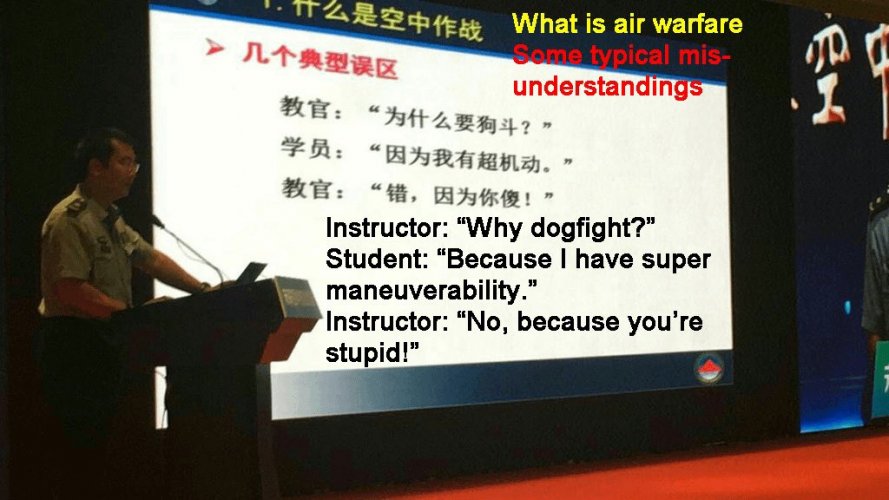
View attachment 771756

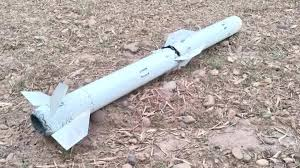
View attachment 771757
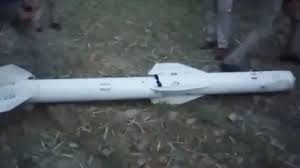
View attachment 771758


Saddly BVR weapons also fail, so agility is not out of Fashion, what do you need to make a BVR missile fail?

Student: '-Simple teacher, agility a BVR missile takes time, the faster you go and the better you turn you can make the BVR missile fail and good EW

"Dogfighting" (WVR combat) being low yield and less useful does not equate to kinematics being low yield and useless.


No one is debating the importance of kinematic performance in aerial combat or air superiority.
However what should be rather widely accepted is that that WVR combat and "dogfighting" is not preferable and it is low yield.


The fact that BVR weapons can be defeated is actually an excellent reason for why networking, sensors, EW, and weapon quality (range, acceleration, maneuvering, etc) are so important, as well as having quantity/mass of shooters and sensors. Because being able to outmass and out-network and out-range the enemy's system of systems in the BVR domain means you are able to defeat them before the WVR domain.

There is a reason why we differentiate 4.5th gen aircraft primarily based on their advances in sensing, networking, EW, and weapons (to an extent).

So actually the slide is still correct -- one would be stupid to actively choose to dogfight (WVR), supermaneuverability or not.
 
Last edited:
Student: '-Simple teacher, agility a BVR missile takes time, the faster you go and the better you turn you can make the BVR missile fail and good EW
Funny you mention EW, now that Rafale's supposedly top-of-the-line-can-replace-5th-gen ultra EW suite the SPECTRA failed to save it from PL-15's downgraded export model. Also, all of the things you mentioned don't need the aircraft to perform a cobra or a J-turn or whatever, it just has to be maneuverable enough and fast enough and there's nothing suggesting either of these aircrafts flies like a boat.
 
"Dogfighting" (WVR combat) being low yield and less useful does not equate to kinematics being low yield and useless.


No one is debating the importance of kinematic performance in aerial combat or air superiority.
However what should be rather widely accepted is that that WVR combat and "dogfighting" is not preferable and it is low yield.


The fact that BVR weapons can be defeated is actually an excellent reason for why networking, sensors, EW, and weapon quality (range, acceleration, maneuvering, etc) are so important, as well as having quantity/mass of shooters and sensors. Because being able to outmass and out-network and out-range the enemy's system of systems in the BVR domain means you are able to defeat them before the WVR domain.

There is a reason why we differentiate 4.5th gen aircraft primarily based on their advances in sensing, networking, EW, and weapons (to an extent).
heavier aircraft higher torsional forces, more fuel, heavier, the less control devices less control, the more aircraft use wing trailing edge controls the more compromised the wing becomes, single delta wing poor low speed performance.

why design an aircraft like that: stealth.

Rule of quantum mechanics quanta can be absorbed or emitted, stealth aircraft are not invisible to radar.
 
Last edited:
Funny you mention EW, now that Rafale's supposedly top-of-the-line-can-replace-5th-gen ultra EW suite the SPECTRA failed to save it from PL-15's downgraded export model. Also, all of the things you mentioned don't need the aircraft to perform a cobra or a J-turn or whatever, it just has to be maneuverable enough and fast enough and there's nothing suggesting either of these aircrafts flies like a boat.
humm funny I have not seen 3 rafales downed, beyond propaganda, loses do not mean anything if they are low, Israel lost Mirage IIIs too, so what? missiles fail you like it or not and BVR missiles fail too.
 
I'm curious to see what the actual fleet number of the J-36 will end up being. I doubt it will be a one-to-one replacement for the J-20. With three engines per airframe, a larger airframe, more and more sophisticated sensors the unit cost should be quite high, even for Chinese standards with lower labor and manufacturing cost.

But I assume that's why the concept of wingmen/CCAs get pushed so heavily, to provide numbers at a lower cost.

I could genuinely see the J-36 fleet not exceeding 200 airframes, depending on how many J-20s, J-35As and CCAs get introduced, which will act as the grunts under the guidance of the J-36.
 
heavier aircraft higher torsional forces, more fuel, heavier, the less control devices less control, the more aircraft use wing trailing edge controls the more compromised the wing becomes, single delta wing poor low speed performance.

I have doubt that we can be certain the J-36 doesn't have an exceptionally good supersonic sustained turn rate at half fuel load... I'm also not sure that we can be certain it wouldn't be better than the F-22.

P.S. Not quite sure what you mean with your trailing edge comment.
 
Negative.

Whether one solution wins over another depends entirely on the disposition of each side's forces, local geography etc.
Ballistic or hypersonic missiles are detected at launch of attack. Detected by entire constellations of satellites in orbit.

This means that the USA is alerted to the level of "wake up the President, we're under potential nuclear attack" because until the missile tracks start to shape up there's no easy way to tell where that ballistic missile is going. So the Football gets opened and the POTUS opens up his codewords. Get a president that is grumpy from lack of sleep and hurting, and you may be looking at a commanded Minuteman launch in response before the target of the attack is identified.

Whereas VLO aircraft seem to not be visible on OTH radars, but instead need to be within line of sight of the long-range radars. This means that you know where the attack target is and can scale your response a little more appropriately.
 
I have doubt that we can be certain the J-36 doesn't have an exceptionally good supersonic sustained turn rate at half fuel load... I'm also not sure that we can be certain it wouldn't be better than the F-22.

P.S. Not quite sure what you mean with your trailing edge comment.
A tailess delta like Mirage 2000 has to do the control an aft tail will do with elevons or tailerons, but still it has a vertical tail, a flying wing complicates this even further since it needs split flaps or adverse yaw controls like the J-50.

Is that the ideal configuration?

No, it is not, everything depends what needs the aircraft has, for an airliner, a tubular fuselage with moderate swept wings an aft tail and a vertical tail is the best compromised, for a delta wing the best is a canard ahead of it.

However people think J-36 is good for everything, J-50 rewrote the rules of Physics or F-47 has not compromises, the reality is every step in one direction a design takes drawbacks appear to counter balance it.

There is not the perfect configuration all have drawbacks, however tactics are what makes the difference in war, it means you exploit your enemies weaknesses and minimize the impact of your own weakness, while using your strengths to the fullest, if a single Rafale was down, it does not mean a thing, since it might have not exploited its strengths well and exploited the enemy`s weaknesses, the rest is pure nationalism and propaganda
 
Last edited:
I'm curious to see what the actual fleet number of the J-36 will end up being. I doubt it will be a one-to-one replacement for the J-20. With three engines per airframe, a larger airframe, more and more sophisticated sensors the unit cost should be quite high, even for Chinese standards with lower labor and manufacturing cost.

But I assume that's why the concept of wingmen/CCAs get pushed so heavily, to provide numbers at a lower cost.

I could genuinely see the J-36 fleet not exceeding 200 airframes, depending on how many J-20s, J-35As and CCAs get introduced, which will act as the grunts under the guidance of the J-36.

I could see a fleet of some 300ish J-36s, complemented by some 600-800 land based J-XDS, and 2-3 thousand CCAs of varying levels of sophistication.

Of course such a fleet will not emerge suddenly and be complemented during its service by 4.5th gen and 5th gen aircraft as well.


Edit:

Moderators, feel free to move the below discussion chain to a different thread (not sure which would be appropriate).

Ballistic or hypersonic missiles are detected at launch of attack. Detected by entire constellations of satellites in orbit.

This means that the USA is alerted to the level of "wake up the President, we're under potential nuclear attack" because until the missile tracks start to shape up there's no easy way to tell where that ballistic missile is going. So the Football gets opened and the POTUS opens up his codewords. Get a president that is grumpy from lack of sleep and hurting, and you may be looking at a commanded Minuteman launch in response before the target of the attack is identified.

Whereas VLO aircraft seem to not be visible on OTH radars, but instead need to be within line of sight of the long-range radars. This means that you know where the attack target is and can scale your response a little more appropriately.

It doesn't particularly matter where the POTUS is immediately made aware of an imminent attack or not, because if the PLA was wanting to carry out a large scale first strike with the element of surprise then chances are US forces in the region will already be high alert anyhow and the US would be on an elevated strategic alert level.

In other words, from the perspective of the PLA, if they want to achieve the element of surprise they won't be able to attain true strategic level surprise, but they can probably try to attain operational level and tactical level surprise.


For the purposes of defeating the linchpins of US basing in the western Pacific, they would be wanting to target the likes of Guam and other bases at similar distances, and that can only be done in a timely way by use of IRBMs and hypersonics at scale rather than manned aircraft.

If US sensors detect a large PLA volley of missiles and hypersonics and interpret that as a nuclear attack and launch their own nukes due to that, well that would be a risk that everyone will just accept.

It's pretty well accepted that conventional IRBMs and hypersonics are part of the inventory for both the PRC and US and will be involved in a Westpac war (US has LRHW, Opfires and others, the PLA has many IRBMS and hypersonics themselves as well), and it's quite easy to identify what is a likely nuclear attack versus conventional.
So no, there is probably not much fear that the US would interpret a large scale PLA conventional missile bombardment of its Westpac bases as a nuclear attack, because the US knows that the PRC aren't stupid and each side knows how quickly the use of nuclear warheads can escalate to strategic nuclear exchange.

I feel like we are in 2005 or something, this entire discussion about "conventional IRBMs being interpreted as nuclear" is something that's already been largely resolved over a decade ago in terms of strategic contingency planning as part of a Westpac conflict.
 
Last edited:
heavier aircraft higher torsional forces, more fuel, heavier, the less control devices less control, the more aircraft use wing trailing edge controls the more compromised the wing becomes, single delta wing poor low speed performance.

why design an aircraft like that: stealth.

Rule of quantum mechanics quanta can be absorbed or emitted, stealth aircraft are not invisible to radar.

I don't see how any of this contradicts what I wrote in my last post, which is that the slide displayed is correct -- choosing to engage in WVR is a poor decision in this day and age, and there is a reason why modern aircraft and upcoming aircraft are emphasizing signature reduction, EW, sensors, networking.

Kinematic performance is still important, but pursuing WVR engagements is not where it is at.

And we can see that with the new PLA jets and also with what we've seen and heard from the developmental trajectories and concepts of other global next gen projects as well.
 
I'm curious to see what the actual fleet number of the J-36 will end up being. I doubt it will be a one-to-one replacement for the J-20.
I'm not expecting it to replace J-20s at all.

I've been expecting the J-36 to replace the ~300 Flankers of various types flying air superiority missions (Su-27s, Su-35s, and J-11s). And yes, 1:1 replacement. Those Flankers then get cascaded down to replace the ~300x J-7/J-8s, and are then replaced by either J-20s, J-35s or CCAs once the Flankers are obsolete.

There's also another ~300 J-16s that will need to be replaced, eventually. Those are all pretty new airframes, though, so I suspect that they'd be replaced late in the production run of either J-35s or J-36s.

This makes for a potential run of ~300-600 J-36s.

Note: Multirole J-35s replace the ~600 J-10s and the ~100 Su-30s. This would make a run of ~700-1300x J-35s just for the PLAAF.

CCAs would provide most of the anticipated expansion of the PLAAF, with 1:1 replacement of current manned platforms.


I'm guessing that since the J-50 is a smaller airframe than the J-36 is, the J-50 is for carrier use and will replace all ~70 Flankers in the PLANAF. As the PLANAF gets more carriers, I suspect that some of the airframes will be J-35s in addition to the J-50s. Riffing off of USN carrier wings, I'm guessing ~24x J-50s and ~24x J-35s per carrier, plus any CCAs they develop.

I have no idea how many carriers the PLAN intends to get, I'd assume at least as many as the USN can field, once China's GDP is there to support it. In the short term, I'd anticipate at least 4 supercarriers and possibly 8.

4-8 supercarriers suggests ~150-250x J-50s (and an accompanying ~150-250x naval J-35s). Matching the USN carrier for carrier suggests ~350x J-50s (and another ~350x naval J-35s).
 
I don't see how any of this contradicts what I wrote in my last post, which is that the slide displayed is correct -- choosing to engage in WVR is a poor decision in this day and age, and there is a reason why modern aircraft and upcoming aircraft are emphasizing signature reduction, EW, sensors, networking.

Kinematic performance is still important, but pursuing WVR engagements is not where it is at.

And we can see that with the new PLA jets and also with what we've seen and heard from the developmental trajectories and concepts of other global next gen projects as well.
Opinions are opinions and that is why I do not like this type of threads full of opinions.

But I will tell you why I disagree, in 1982 there was a war in Lebanon, at least 70 Syrian fighters were downed and supposedly 4-8 Israeli aircraft , in 2025 it was similar but I do not see the same number, why? because it is known BVR missiles do fail, well all missiles can fail, and most air forces have short range AAMs.

of May 7th I only see kind of believable evidence 1 or 2 fighters downed of 130? come on.

So No I think WVR combat has not disappeared, the trend is for BVR but the reality is BVR missiles fail, and PL-15 is an example.

J-36 and J-50 are fighters that will control drones and do fighting as armed AWACS and F-47 has disclosed its loyal wing man. any way at the end of the day aircraft can be destroyed in their bases as the May 7th showed so no I do not believe that J-36 is a supper duper weapon, nor F-47.
 
Of course, the WVR will not disappear, but it is clear that the WVR did not occur in these 130 aircraft, and in the whole process, India may not even find a shadow of a J10JF17, which is the charm of the BVR (whether you can find it and get close to it is a question, you may be hunted by long-range air-to-air missiles before you find it) But I don't think these two air battles may be used as a reference for the development direction of China's next-generation fighters. An air battle of this magnitude even seems to the Chinese Air Force to be a petty fight. But to say that the Chinese J36 is perfect in all directions is clearly not true.
 
Idn expecting the J-36 to replace the ~300 Flankers of various types flying air superiority missions (Su-27s, Su-35s, and J-11s). And yes, 1:1 replacement. Those Flankers then get cascaded down to replace the ~300x J-7/J-8s, and are then replaced by either J-20s, J-35s or CCAs once the Flankers are obsolete.
Flankers are already obsolete, there are already no active unit of J-7s in the PLAAF all of them has been transfered to flight school or serve other training purposes, the only J-8s on active duty are the single brigade of JZ-8Fs which are the recon variants. Even all the Su-30s has been retired to aviation colleges and apparently all the J-11As, supposedly some batch 06 J-11Bs as well but can't be sure.


PS: J-50s are also definitely going to be land based as well so production would likely be far higher just due to PLAAF procurement as well
 
Last edited:
J-50 going to be land based as well Tomboy that is news to me, I would have thought that the J-50 would have been for the PLAN and the J-36 for the PLAAF? Unless the PLAAF are going to buy a small number of J-50 as well as the J-36.
 
J-50 going to be land based as well Tomboy that is news to me, I would have thought that the J-50 would have been for the PLAN and the J-36 for the PLAAF? Unless the PLAAF are going to buy a small number of J-50 as well as the J-36.

It is likely that J-50/J-XDS will be for both the PLAAF and PLAN.

As it currently stands, the J-XDS prototype does not have a catapult launch bar on its nosegear nor does it have requisite accommodation for a tail hook, nor fold lines for its wings.

Chances are what we see right now is an EMD equivalent prototype for the PLAAF land based version of the J-XDS, and at some point in the future we will see a carrierborne variant prototype of J-XDS, with the relevant modifications I mentioned above.


Based on the respective profiles of J-36 and J-XDS, I wouldn't be surprised if the PLAAF buys a larger number of land based J-XDS to J-36 (perhaps as large as a 2:1 ratio), while the PLAN will of course buy a large number of carrierborne J-XDS variants as well.
 
A tailess delta like Mirage 2000 has to do the control an aft tail will do with elevons or tailerons, but still it has a vertical tail, a flying wing complicates this even further since it needs split flaps or adverse yaw controls like the J-50.

Is that the ideal configuration?

No, it is not, everything depends what needs the aircraft has, for an airliner, a tubular fuselage with moderate swept wings an aft tail and a vertical tail is the best compromised, for a delta wing the best is a canard ahead of it.

However people think J-36 is good for everything, J-50 rewrote the rules of Physics or F-47 has not compromises, the reality is every step in one direction a design takes drawbacks appear to counter balance it.

There is not the perfect configuration all have drawbacks, however tactics are what makes the difference in war, it means you exploit your enemies weaknesses and minimize the impact of your own weakness, while using your strengths to the fullest, if a single Rafale was down, it does not mean a thing, since it might have not exploited its strengths well and exploited the enemy`s weaknesses, the rest is pure nationalism and propaganda

Just to be clear: "I have doubt that we can be certain the J-36 doesn't have an exceptionally good supersonic sustained turn rate at half fuel load... I'm also not sure that we can be certain it wouldn't be better than the F-22."

So that is just one flight regime - one requiring a high thrust-to-weight ratio and a high supersonic lift-to-drag ratio at relatively low angles of attack.

P.S.
I'm still not clear if you were talking about structural strength, pitch authority, the amount of drag produced by control surfaces for a degree of pitch authority or something else. Delta wings have high plenty of room for a high degree of structural strength and lots of chord inboard which makes it quite easy to fit control surfaces along their trailing edges.
 
Just to be clear: "I have doubt that we can be certain the J-36 doesn't have an exceptionally good supersonic sustained turn rate at half fuel load... I'm also not sure that we can be certain it wouldn't be better than the F-22."

So that is just one flight regime - one requiring a high thrust-to-weight ratio and a high supersonic lift-to-drag ratio at relatively low angles of attack.

P.S.
I'm still not clear if you were talking about structural strength, pitch authority, the amount of drag produced by control surfaces for a degree of pitch authority or something else. Delta wings have high plenty of room for a high degree of structural strength and lots of chord inboard which makes it quite easy to fit control surfaces along their trailing edges.
the question is what is the main purpose of wings?

Most aircraft use wings as lift generators with the fuselage for fuel, the landing gear and cockpit; aft tail or elevators for pitch and roll control, the vertical tails for yaw control.

tailless designs and flying wings they reduce drag at the expense of lift and overwhelm the wing with yaw, pitch and roll control basically overwhelming the wing, and making it less stable and controllable.

6th generation aircraft are pushing that direction for stealth.


BVR weapons need speed, but with high speeds come large turn rates.

Mach 5 means around 1700m/s or 1.7 km a second, the turn rate will be low and turn radius large thus it is easier to hide a stealth fighter at 200km away but the missile loses agility and at 200km away a Mach 5 missile takes around more than 2 minutes to go 200km that is ample warning time.

So a 6th generation fighter is a sniper that uses more agile drones.

in Mat 7th 2025 you are far from the aircraft downed in 1982 either in the Bekka Valley or Falklands, where shorter range and slower Python 3s or AIM-9L were used.
 
Last edited:
I could see a fleet of some 300ish J-36s, complemented by some 600-800 land based J-XDS, and 2-3 thousand CCAs of varying levels of sophistication.

Of course such a fleet will not emerge suddenly and be complemented during its service by 4.5th gen and 5th gen aircraft as well.

I'm unsure, I think the manned tactical portions of large air forces will become smaller in the future, with the unmanned portions becoming larger. So while there may be a slight overall growth, I don't think we'll see extremely large fleets of next generation fighters anywhere. With 300 being probably at the very upper limit of what's economical.

That's at least what I assume when the J-36 and F-47A are as sophisticated and capable as theorized, thus extremely expensive and resource intensive. Perhaps tactical fighters on the lower end of the capability curve are more likely to see larger fleet numbers. But every next generation fighter is still a theoretical at this point, I think it's too early to tell which one is which.

So I could see your 300 airframe estimate be a thing in the future, but I think that would be the absolute maximum that's reasonable to spend money on. Especially given that the J-36 with it's tri-engine layout will probably be maintenance intensive, even compared to it's peers. Simply because a third engine adds a lot of stuff that needs attention and man hours.
 
Flankers are already obsolete

I'd say it's one to two decades too early to make that statement. Especially looking at the J-16D and the J-15T/J-15D.

I wouldn't count the likes of the Flanker series and Eagle series out before the 2050s, there will be some role for them even then.

Vulnerability doesn't equate to obsolescence. Otherwise every military system would already be obsolete upon conception, let alone introduction. It's more so about at what point does the projected vulnerability overtake the potential usefulness and thus becomes a net negative to operate. And I definitely think that's not the case yet. Especially when any given next generation program is at least a decade away from service entry at best and even after that, most air forces in the world rely on 4th and 5th generation aircraft.
 
I'm unsure, I think the manned tactical portions of large air forces will become smaller in the future, with the unmanned portions becoming larger. So while there may be a slight overall growth, I don't think we'll see extremely large fleets of next generation fighters anywhere. With 300 being probably at the very upper limit of what's economical.

That's at least what I assume when the J-36 and F-47A are as sophisticated and capable as theorized, thus extremely expensive and resource intensive. Perhaps tactical fighters on the lower end of the capability curve are more likely to see larger fleet numbers. But every next generation fighter is still a theoretical at this point, I think it's too early to tell which one is which.

So I could see your 300 airframe estimate be a thing in the future, but I think that would be the absolute maximum that's reasonable to spend money on. Especially given that the J-36 with it's tri-engine layout will probably be maintenance intensive, even compared to it's peers. Simply because a third engine adds a lot of stuff that needs attention and man hours.

I agree that manned tactical portions of large air forces will become smaller -- 900 manned primary tactical aircraft for the PLAAF (divided between J-36 and J-XDS in a 1:2 ratio) as I described in my scenario, would be complemented by 2000-3000 CCAs/UCAVs, and very much fulfill that sort of fleet composition.
 
View attachment 771756

View attachment 771757
View attachment 771758


Saddly BVR weapons also fail, so agility is not out of Fashion, what do you need to make a BVR missile fail?

Student: '-Simple teacher, agility a BVR missile takes time, the faster you go and the better you turn you can make the BVR missile fail and good EW
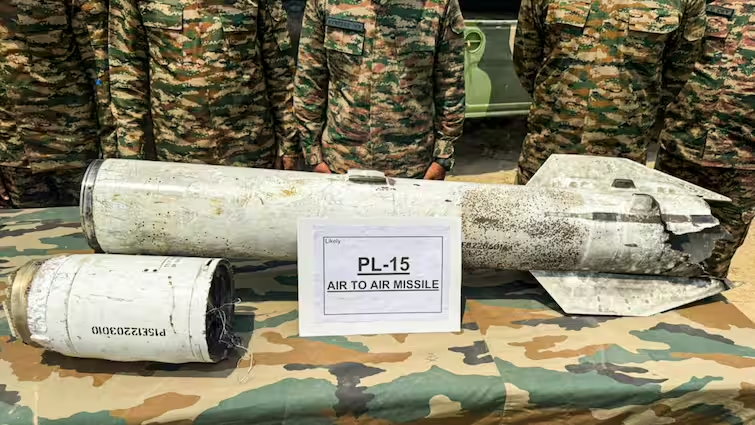
To me these pictures look like the warhead and seeker is missing. Do you think they just fell off randomly due to shoddy workmanship, or is the PL-15 maybe equipped with a continuous rod warhead which leaves the missile body relatively intact when it explodes?
 
To me these pictures look like the warhead and seeker is missing. Do you think they just fell off randomly due to shoddy workmanship, or is the PL-15 maybe equipped with a continuous rod warhead which leaves the missile body relatively intact when it explodes?
it could be, but to be honest that is topic for another thread, in my opinion for what I have seen the Americans want to do, is 6th generation fighters as the quarter backs.

I mean F-47 controlling cheaper drones to fight the WVR fights while the F-47 on BVR, supported by more powerful F-55s, F-22 upgraded as Super Raptor and F-35s.

BVR missiles fail but getting closer means higher risks so you use Drones supported by more agile F-55 and F-22s Super Raptors in the mid field since very likely they will be much more agile and survivable in closer combats where BVR missiles might reach their targets sooner due to fact these aircraft are more agile than F-47 and could fire their missiles closer to their targets..
 

Similar threads

Back
Top Bottom