I'll give you the J-50 for air superiority but the J-36, in my opinion looking at it's configuration and with the number of elevons plus the four (2 per side) split wingtip surfaces, not so much. The J-36 is a large platform and could function as an interceptor and medium strike but it's not designed for maneuverability. The number of elevons scream supersonic trim similar to the XB-70. Not unless you're tied to the program in some manner; systems of systems, power generation, EW, range and bleeding edge, maybe or maybe not.
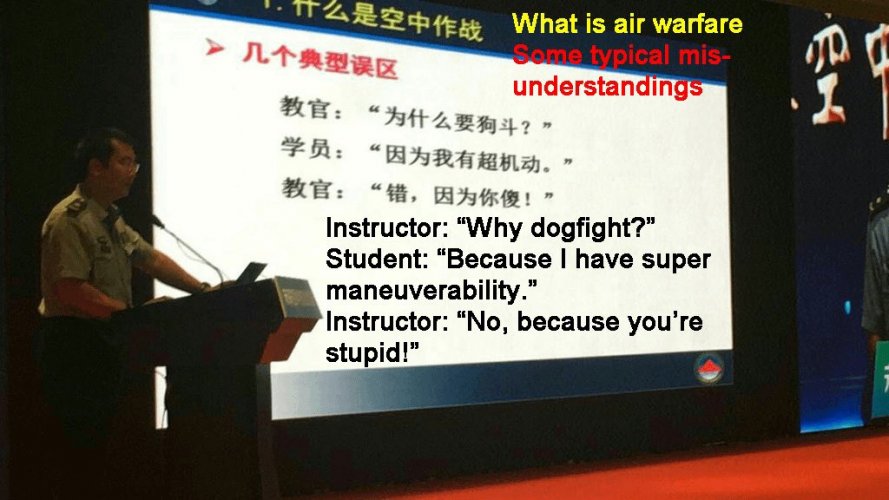
Why do we think that high end air superiority of the future should emphasize maneuverability?
It's been pretty obvious for quite a few years now that the domains of highest yield gains that you want to prioritize for air superiority are signature reduction, sensing/processing, networking, EW, weapons, and once maneuverability reaches a sufficient minimum threshold, additional bleeding edge gains arguably yield less gains in relative capability than the other aforementioned domains.
Emerging high yield domains also include attribility/mass, automation of capability, and range (latter being theater/geography specific).
I would posit that an airframe with a retentive focus on traditional maneuverability is reflective of wanting to maintain a "lower risk/lower technology" backup capability for said aircraft.
====
I generally agree with you that it's air superiority but think it's more. I think it's meant to do carry out a modern day pearl harbor. There's no way that chinese transport ships can reach taiwan shores without suffering heavy heavy cost unless china can preemptively destroy runways surrounding it. The range, speed, stealth, sensor package and large payload are meant for it to be self sufficient without relying on traditional strike package (electronic and surveillance support assets etc) which could give away a preemptive strike.
Phrases like "modern day pearl harbour" are vague, and if you are referring to the ability of the PLA to conduct a bombardment campaign prior to carrying out a Taiwan invasion -- well you don't need J-36 for that. Heck, a bombardment campaign doesn't even need to be "given away" when the PLA has the PLARF and the PLAAF being so large to begin with.
If they want a more theater scale (4000km+ from mainland) aerial stealthy strike system you'll want something much bigger than J-36, and I suspect that is what H-20 will be for.
However, what the PLA does need is the ability to contest and achieve command of the air at distances of 3000-4000km from the PRC mainland, to both engage and defeat existing competitor tacair and future 6th gen tacair and their CCAs, to allow them to in turn credibly and comprehensively target aerial force multipliers (tankers, AEW&C etc) to achieve air control at the more "operational" level. That requires long range, stealthy, networked, EW-oriented high performance aircraft that can engage aerial targets itself and also direct their own CCAs and support their complementary manned tacair (6th, 5th gen alike) as a networking/command hub at the system of systems level. That will require a lot of onboard power generation, as well as a lot of fuel, and all in a package that is kinematically competitive enough to exploit those characteristics.
Control of the air is what will enable comprehensive re-attack of and suppression of air bases/ports/air defense sites in the western pacific and targeting mobile naval forces (air control enables aerial strike systems to operate much more safely, airborne EW and ELINT, as well as aerial BDA/ISR to cue theater range fires like IRBMs, hypersonics etc).
Also I'm not completely sold on J-36 being the more bleeding edge. There's no guarantee that J-36 3 engines are designed around the idea that a 3 stream adaptive engine with enough power generation from just 2 engines to accomplish x, y, z while the J-50 was built around the premise of the success of developing such engine and novel miniaturization of components.
I don't see why we should speculate by this point.
Everyone involved in following PLA aviation by now should already know the primacy of the PLA Chinese language grapevine and their track record, and until something changes, it would really be far easier just to accept the following pill that J-36 is a high end air superiority platform, emphasizing signature reduction, sensing/processing, networking/command, weapons, power generation, range and speed.
J-36 will have VCE/ACE solution in the future. Its three engine configuration is not reflection of a projected future engine limitations, but should be seen to reflect the capability the aircraft will be capable of once its intended engines are ready.
China has done this before with the j-20 where the overall layout is dictated by the premise that the engines it would receive were inferior to US counterparts.
Not really -- the J-20's engines were always intended to be WS-15, which was always conceived to be comparable to US counterparts of the equivalent generation (F119/F-22).
One could make the case that J-20's layout was designed such that it would have competitive kinematic performance even when using interim engines (WS-10s).