nothing newThat's still Admiral Schröder. Check https://alnavco.com/content/modeling_historic_notes/pdfs/alnavco_the_fleet_that_never_was.pdf for Projeckt KW45 it's there.
Here is an excerpt from page 56: "More intriguing were projects KW45 and KW50 designed between June and September 1939. These plans were found by Capt (Ret) Ken Johnson and placed in the National Archives. Reports issued by the Director of Naval Intelligence on 8/29/45 contained capture documentation of submarines, cruisers, destroyers, battleships and carriers. Discussed by the “Neubauausschuss” during the 1939 time period, no other previous or subsequent mention of these ships have been found in the German archives. Immense, fast, under-armed and under-armored battlecruisers had advanced designs completed but were never approved. These would have suffered from the same design defects as the OPQs but remain intriguing ships."

You are using an out of date browser. It may not display this or other websites correctly.
You should upgrade or use an alternative browser.
You should upgrade or use an alternative browser.
WW1 and WW2 Never Built Warship Designs
- Thread starter Godzilla37
- Start date
-
- Tags
- world war i world war ii

Godzilla37
ACCESS: Restricted
- Joined
- 16 May 2024
- Messages
- 36
- Reaction score
- 21
Still, Projekt KW45 isn't Weimar Germany's 1928 cruiser killer also I didn't say that KW45 was new. I said I hadn't found a design like this before.nothing new
Last edited:
Godzilla37
ACCESS: Restricted
- Joined
- 16 May 2024
- Messages
- 36
- Reaction score
- 21
I have already gone through thatIf you haven't looked at the USN "Spring Styles" books, you can find Book 3 (the WW2 era designs) here:
Spring Styles Book # 3 (1939-1944), Lot S-511

- Joined
- 1 February 2011
- Messages
- 3,341
- Reaction score
- 5,029
Check:
https://www.secretprojects.co.uk/threads/kriegsmarine-central-km-ship-plans-discussion.37568/
To us all these designs are not new. To him it is new. But try google as well. And read naval forums more, gamef orums less.
https://www.secretprojects.co.uk/threads/kriegsmarine-central-km-ship-plans-discussion.37568/
To us all these designs are not new. To him it is new. But try google as well. And read naval forums more, gamef orums less.
1Big Rich
ACCESS: Confidential
Some very interesting designs I found from https://alnavco.com/content/modeling_historic_notes/pdfs/alnavco_the_fleet_that_never_was.pdf which I have never heard of before:
US Max Fast BB: Displacement: 72,500 tons Length: 975' Width: 107' Speed: 30 knots Armament: 8-20”(4x2) and 20-5”/38(10x2)
US CA Scheme M: Date: June 1940 Displacement: 17,300 tons Length: 735’ Width: 74’ 82 Speed: 33.2 knots Armament: 10-10” (2x2,2x3)
I have plenty of Alnavco's models, and many of their never-were capital ships, but some of them are not exactly historical.
CA-2D is an example; the historic concept from the Spring Styles book referenced above had a cruiser bridge like Baltimore, but the Alnavco model has more of an Alaska/Iowa look.
Another is their F3 battlecruiser, which has the layout of a Nelson with two funnels. The actual drawing of F3 (and F2 for that matter) had the Number 3 turret superfiring, not the middle turret. Those drawings can be seen here:
https://www.tapatalk.com/groups/alltheworldsbattlecruisers/f2-and-f3-battlecruisers-t8627.html
Regards,
Godzilla37
ACCESS: Restricted
- Joined
- 16 May 2024
- Messages
- 36
- Reaction score
- 21
Any drawings and stats for that design?Vickers offered a Nelson like design for Spain.
- Joined
- 1 February 2011
- Messages
- 3,341
- Reaction score
- 5,029
With a turning radius measures in leagues, a cruising range measures in meters, requiring the entire fleet's personnel.Well, we can always go full lunatic here:
https://warshipsresearch.blogspot.com/2021/08/japanese-500tons-battleship-design.html
Nothing quite like Japanese OCD to make things interesting!
- Joined
- 1 February 2011
- Messages
- 3,341
- Reaction score
- 5,029
Large ships had large fuel supply so plenty of range. As for the turn rate why turn fast when you have 100 16" barrels on each side? Against torpedoes only bulkheads and compemantation helps but to sink such a large ships a ton of torpedoes are needed. See Yamato and Musashi.

T. A. Gardner
ACCESS: Top Secret
- Joined
- 18 February 2021
- Messages
- 2,006
- Reaction score
- 3,558
Well, that Japanese mega ship has some serious design flaws that weren't really known fully in 1912-ish when it was proposed. These include:Large ships had large fuel supply so plenty of range. As for the turn rate why turn fast when you have 100 16" barrels on each side? Against torpedoes only bulkheads and compemantation helps but to sink such a large ships a ton of torpedoes are needed. See Yamato and Musashi.
Use of casemate guns in the hull, or what I assume are casemate guns in the hull (slots in hull sides). These lower freeboard in the case of flooding and as history proved, were worthless as ranges increased. They also often couldn't be used in a seaway.
Wing turrets. These are close to the outer hull meaning there's little depth to whatever torpedo defense system that might be installed.
Given the location of the engines and boiler rooms, the shafts on this ship are going to be very long making them torque limited, but worse, giving very long shaft alleys that could be a weak spot for progressive flooding.
Not sure if coal or oil firing was planned. If coal, complete nightmare and a huge risk of coal fires due simply to the mass of coal that would have to be carried.
With a proposed crew of 12,000, fitting all of them aboard and keeping them fed etc., is going to be a Herculean task.
The most ludicrous thing is the proposed speed is 42 knots! Yea, I think somebody's finger slipped on the typewriter there and they meant 12 knots.
Godzilla37
ACCESS: Restricted
- Joined
- 16 May 2024
- Messages
- 36
- Reaction score
- 21
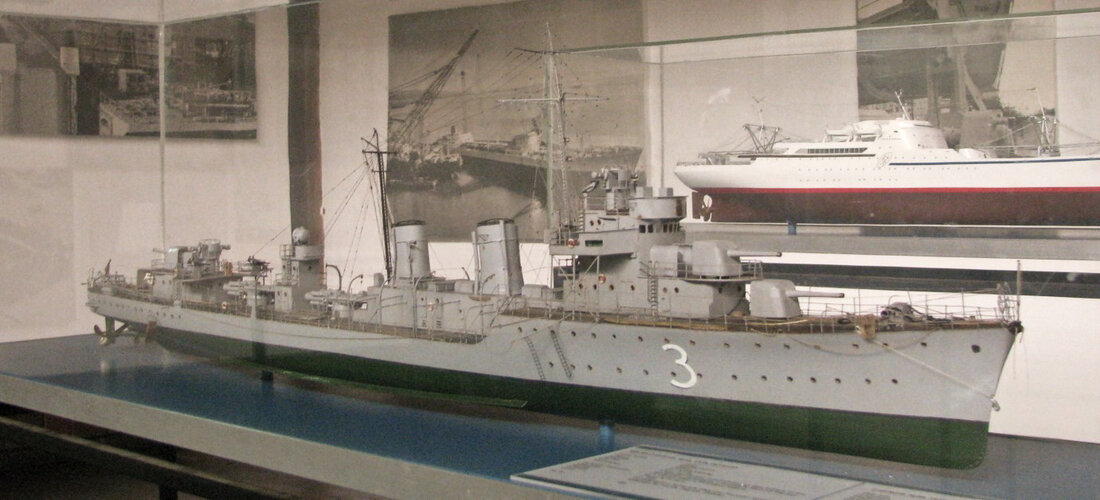
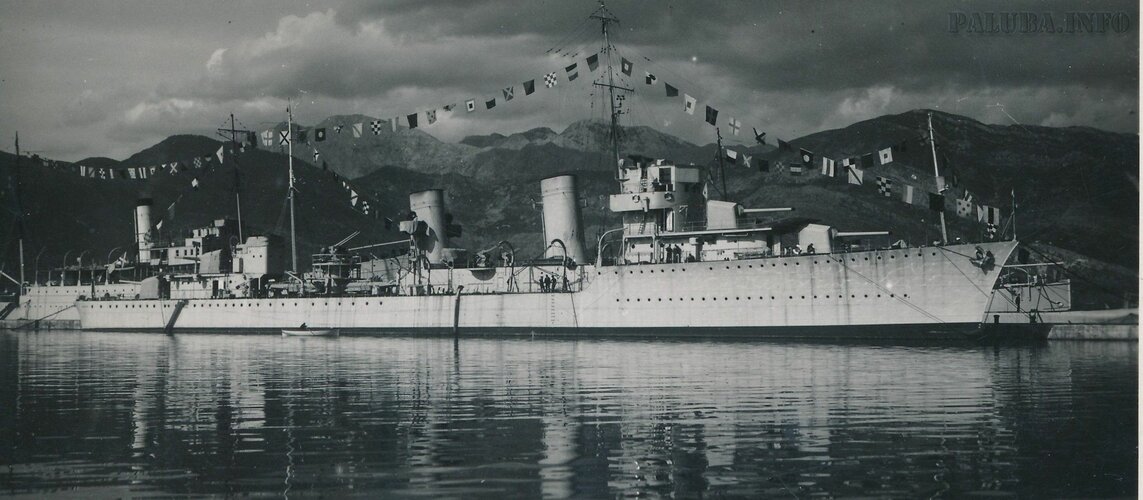
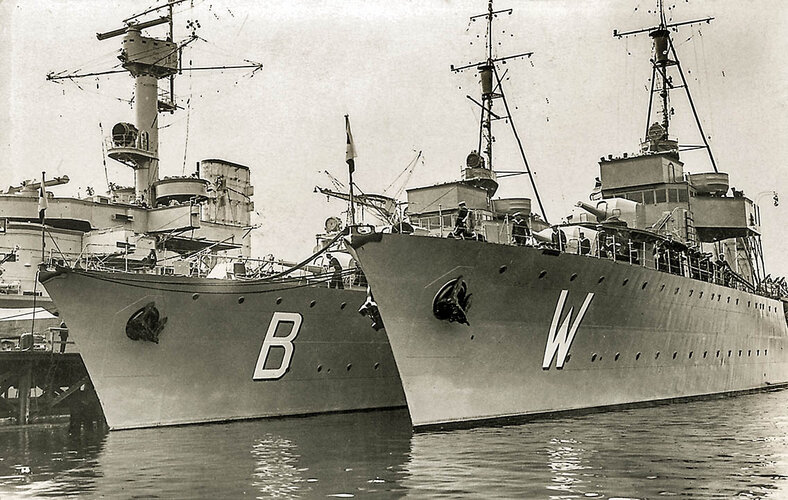
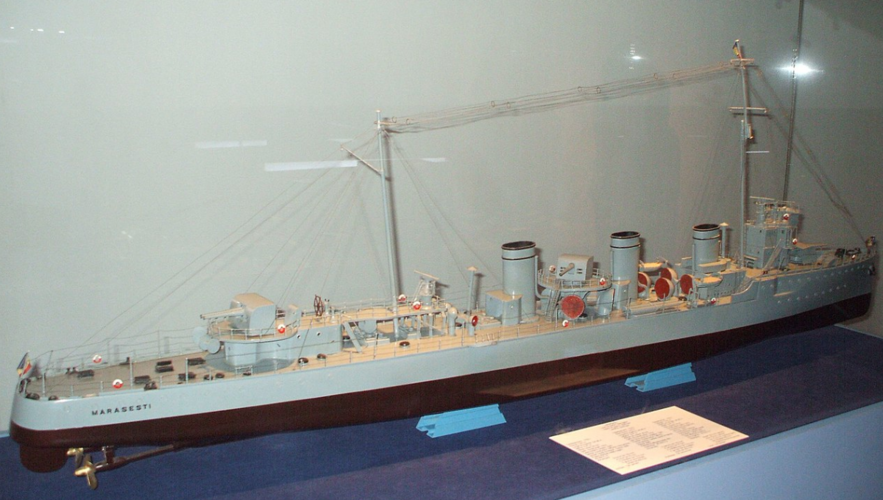
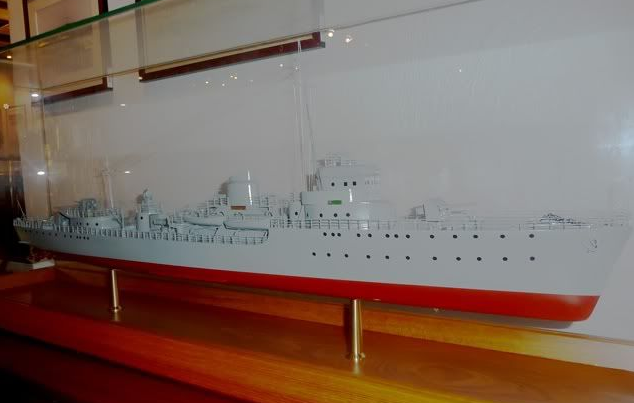
Any WW2 destroyer projects for European countries except for Spain, Netherlands and other major European countries during WW2?
- Joined
- 1 February 2011
- Messages
- 3,341
- Reaction score
- 5,029
France:
Le Fier class Destroyer Escort - 1937
Ateliers et Chantiers de la Loire Design for Poland - 1933
Chantiers et Ateliers Augustin Normand for Poland- 1933
Ateliers et Chantiers de Bretagne Design for Poland- 1933
L'Intrepide Class - 1938
Hoche Class - 1940
Germany:
T61 class or Flottentorpedoboote Type 1940 - 1940
T37 class or Flottentorpedoboote Type 1941 - 1941
T52 class or Flottentorpedoboote Type 1944 - 1944
IvS Design 1 for China- 1929
IvS Design 2 for China / Project 174 - 1929
Z31 class or Zerstörer Type 1938A - 1938
Z40 class or Zerstörer Type 1938B - 1939
Z46 class or Zerstörer Type 1936C - 1942
Z51 class or Zerstörer Type 1942 - 1942
Z52 class or Zerstörer Type 1944 - 1944
Z57 class or Zerstörer Type 1945 - 1945
Italy:
Tosi Design 1937 Destroyer Escort - 1937
Design 1939 - 1939
Commandanti Medagile d'Oro (Series I-III) 1942/43
OTO AS 450 Design Escort Destroyer - 1942
Japan:
Matsu (Preliminary) Escort Destroyer - 1942
Mutsuki Preliminary Design F-41C - 1921
Mutsuki Preliminary Design F-41D - 1922
Mutsuki Preliminary Design F-41D1 - 1922
Mutsuki Preliminary Design F-41D2 - 1922
Mutsuki Preliminary Design F-41D3 - 1922
Mutsuki Preliminary Design F-41E - 1923
Mutsuki Preliminary Design F-41E1 - 1923
Mutsuki Preliminary Design F-41E2 - 1923
2.000ton Design - 1923
Harima Shipyard Design 1007 for China - 1931
Shimakaze (Preliminary) - 1939
Super Shimakaze / V-6 - 1942
Super Akizuki / V-7 - 1942
The Netherlands/Hollandia:
Gerard Callenburgh Class (As laid down) - 1938
Norway:
Alesund Class - 1938
Poland:
Wicher Class Modernization Proposal 1) - 1935
Wicher Class (Modernization Proposal 2) - 1935
Wicher Class (Modernization Proposal 3) - 1935
Wicher Class (Modernization Proposal 4) - 1935
Wicher Class (Modernization Proposal 5) - 1935
Grom Class (Preliminary Design 1) - 1934
Grom Class (Preliminary Design 2) - 1934
Grom Class (Preliminary Design 3) - 1935
Grom Class (Preliminary Design 4) - 1935
Huragan Class - 1939
Soviet Union:
I'm sure my list is way incomplete but:
Project 24 - 1936
Kiev Class - 1939
Project 35 - 1941
Project 47 - 1941
Project 36 - 1944
Project 40 - 1944
Project 40L - 1944
Project 40A - 1944
Project 40B - 1944
Project 40IE - 1944
Project 40IL - 1944
Project 40H - 1944
Spain:
Project 148 - 1939
Sweden:
Design 1936 Destroyer Escort - 1936
Design 1945 Destroyer Escort - 1945
Götaverken Shipyard Design for Poland / Project 84375 - 1934
Götaverken Shipyard Design for Poland / Project 85318 - 1934
2.500ton Design - 1941
1.750ton Design - 1941
2.175ton Design Variant A - 1941
2.175ton Design Variant B - 1941
2.175ton Design Variant C - 1941
2.175ton Design Variant D - 1941
2.175ton Design Variant E - 1941
2.500ton Design Variant A - 1941
2.500ton Design Variant B - 1941
1.790ton Design - 1942
1.800ton Design - 1942
2.000ton Design Variant A - 1942
2.000ton Design Varaint B - 1942
2.000ton Design Varaint C - 1942
2.000ton Design Varaint D - 1942
2.090ton Design - 1942
Destroyer Leader Design 3 - 1947
Destroyer Leader Design 5 - 1947
United Kingdom:
Thornycroft Design A for Poland - 1933
Thornycroft Design B for Poland - 1933
Thornycroft Design C for Poland - 1933
Thornycroft Design for China - 1934
Swan Hunter Shipyard Design for Poland - 1934
Design V Leader - 1934
Design A - 1935
Design B - 1935
Design C - 1935
Design D - 1935
Design E - 1935
Design L.44 - 1937
Design L.56 - 1937
Design L.60 - 1937
Design L.70 - 1937
Design L.72 - 1937
Design L.90 - 1937
Vickers Design for Thailand/Siam - 1938
Thornycroft Design for Argentina - 1947
Vickers Design for Venezuela - 1947
USA:
John C. Butler Class (Shore Bombardment Conversion Proposal) - 1943
John C. Butler Class (AA Support Conversion Proposal) - 1943
Design 1927 1 - 1927
Design 1927 2 - 1927
Design 1928 Scheme 1 - 1928
Design 1928 Scheme 3 - 1928
Design 1928 Scheme 5 - 1928
Design 1928 Scheme 6 - 1928
Design 1928 Scheme 7 - 1928
Design 1928 Scheme 8 - 1928
Design 1932 Scheme 5 - 1932
Design 1932 Scheme 6 - 1932
Design 1932 Scheme 10 - 1932
Design 1932 Scheme 11 - 1932
Design VI - 1937
Gibbs & Cox Design E - 1940
Design 1939 Scheme 1 - 1939
Design 1939 Scheme 2 - 1939
Design 1939 Scheme 2-A - 1939
Design 1939 Scheme 3 - 1939
Design 1939 Scheme 4 - 1939
Design 1939 Scheme 5 - 1939
Design 1939 Scheme 6 - 1939
Design 1939 Scheme 7 - 1939
Design 1939 Scheme 8 - 1939
Design 1939 Scheme 9 - 1939
Design 1939 Scheme 10 - 1939
Design 1939 Scheme 10-B 1939
Design 1939 Scheme 10-C - 1940
Design 1939 Scheme 10-D - 1940
Design 1939 Scheme 10-E - 1940
Design 1941 Scheme A - 1941
Design 1941 Scheme A-I - 1941
Design 1941 Scheme B - 1941
Design 1941 Scheme B-I - 1941
Design 1941 Scheme B-II - 1941
Design 1941 Scheme B-III - 1941
Design 1941 Scheme B-IV - 1941
Design 1941 Scheme B-V - 1941
Design 1941 Scheme B-VI - 1941
Design 1941 Scheme B-VII - 1941
Fast Destroyer Design - 1944
Heavy Destroyer Design - 1945
Intermediate Destroyer Design - 1945
Light ASW Design - 1945
Heavy ASW Design - 1946
Scheme A - 1946
Scheme B - 1946
Scheme C - 1946
Scheme D - 1946
Scheme E - 1946
Scheme E-12 - 1947
Scheme F - 1946
Scheme G - 1946
Scheme H - 1946
Scheme I - 1947
Scheme J - 1947
Scheme J-5 - 1947
Scheme J-7 - 1947
Scheme J-8 - 1947
Scheme J-12 - 1947
Scheme J-13 - 1947
Scheme K - 1947
Scheme L-1 - 1947
Scheme L-3 - 1947
Yugoslavia:
Split Class as Designed - 1938
Le Fier class Destroyer Escort - 1937
Ateliers et Chantiers de la Loire Design for Poland - 1933
Chantiers et Ateliers Augustin Normand for Poland- 1933
Ateliers et Chantiers de Bretagne Design for Poland- 1933
L'Intrepide Class - 1938
Hoche Class - 1940
Germany:
T61 class or Flottentorpedoboote Type 1940 - 1940
T37 class or Flottentorpedoboote Type 1941 - 1941
T52 class or Flottentorpedoboote Type 1944 - 1944
IvS Design 1 for China- 1929
IvS Design 2 for China / Project 174 - 1929
Z31 class or Zerstörer Type 1938A - 1938
Z40 class or Zerstörer Type 1938B - 1939
Z46 class or Zerstörer Type 1936C - 1942
Z51 class or Zerstörer Type 1942 - 1942
Z52 class or Zerstörer Type 1944 - 1944
Z57 class or Zerstörer Type 1945 - 1945
Italy:
Tosi Design 1937 Destroyer Escort - 1937
Design 1939 - 1939
Commandanti Medagile d'Oro (Series I-III) 1942/43
OTO AS 450 Design Escort Destroyer - 1942
Japan:
Matsu (Preliminary) Escort Destroyer - 1942
Mutsuki Preliminary Design F-41C - 1921
Mutsuki Preliminary Design F-41D - 1922
Mutsuki Preliminary Design F-41D1 - 1922
Mutsuki Preliminary Design F-41D2 - 1922
Mutsuki Preliminary Design F-41D3 - 1922
Mutsuki Preliminary Design F-41E - 1923
Mutsuki Preliminary Design F-41E1 - 1923
Mutsuki Preliminary Design F-41E2 - 1923
2.000ton Design - 1923
Harima Shipyard Design 1007 for China - 1931
Shimakaze (Preliminary) - 1939
Super Shimakaze / V-6 - 1942
Super Akizuki / V-7 - 1942
The Netherlands/Hollandia:
Gerard Callenburgh Class (As laid down) - 1938
Norway:
Alesund Class - 1938
Poland:
Wicher Class Modernization Proposal 1) - 1935
Wicher Class (Modernization Proposal 2) - 1935
Wicher Class (Modernization Proposal 3) - 1935
Wicher Class (Modernization Proposal 4) - 1935
Wicher Class (Modernization Proposal 5) - 1935
Grom Class (Preliminary Design 1) - 1934
Grom Class (Preliminary Design 2) - 1934
Grom Class (Preliminary Design 3) - 1935
Grom Class (Preliminary Design 4) - 1935
Huragan Class - 1939
Soviet Union:
I'm sure my list is way incomplete but:
Project 24 - 1936
Kiev Class - 1939
Project 35 - 1941
Project 47 - 1941
Project 36 - 1944
Project 40 - 1944
Project 40L - 1944
Project 40A - 1944
Project 40B - 1944
Project 40IE - 1944
Project 40IL - 1944
Project 40H - 1944
Spain:
Project 148 - 1939
Sweden:
Design 1936 Destroyer Escort - 1936
Design 1945 Destroyer Escort - 1945
Götaverken Shipyard Design for Poland / Project 84375 - 1934
Götaverken Shipyard Design for Poland / Project 85318 - 1934
2.500ton Design - 1941
1.750ton Design - 1941
2.175ton Design Variant A - 1941
2.175ton Design Variant B - 1941
2.175ton Design Variant C - 1941
2.175ton Design Variant D - 1941
2.175ton Design Variant E - 1941
2.500ton Design Variant A - 1941
2.500ton Design Variant B - 1941
1.790ton Design - 1942
1.800ton Design - 1942
2.000ton Design Variant A - 1942
2.000ton Design Varaint B - 1942
2.000ton Design Varaint C - 1942
2.000ton Design Varaint D - 1942
2.090ton Design - 1942
Destroyer Leader Design 3 - 1947
Destroyer Leader Design 5 - 1947
United Kingdom:
Thornycroft Design A for Poland - 1933
Thornycroft Design B for Poland - 1933
Thornycroft Design C for Poland - 1933
Thornycroft Design for China - 1934
Swan Hunter Shipyard Design for Poland - 1934
Design V Leader - 1934
Design A - 1935
Design B - 1935
Design C - 1935
Design D - 1935
Design E - 1935
Design L.44 - 1937
Design L.56 - 1937
Design L.60 - 1937
Design L.70 - 1937
Design L.72 - 1937
Design L.90 - 1937
Vickers Design for Thailand/Siam - 1938
Thornycroft Design for Argentina - 1947
Vickers Design for Venezuela - 1947
USA:
John C. Butler Class (Shore Bombardment Conversion Proposal) - 1943
John C. Butler Class (AA Support Conversion Proposal) - 1943
Design 1927 1 - 1927
Design 1927 2 - 1927
Design 1928 Scheme 1 - 1928
Design 1928 Scheme 3 - 1928
Design 1928 Scheme 5 - 1928
Design 1928 Scheme 6 - 1928
Design 1928 Scheme 7 - 1928
Design 1928 Scheme 8 - 1928
Design 1932 Scheme 5 - 1932
Design 1932 Scheme 6 - 1932
Design 1932 Scheme 10 - 1932
Design 1932 Scheme 11 - 1932
Design VI - 1937
Gibbs & Cox Design E - 1940
Design 1939 Scheme 1 - 1939
Design 1939 Scheme 2 - 1939
Design 1939 Scheme 2-A - 1939
Design 1939 Scheme 3 - 1939
Design 1939 Scheme 4 - 1939
Design 1939 Scheme 5 - 1939
Design 1939 Scheme 6 - 1939
Design 1939 Scheme 7 - 1939
Design 1939 Scheme 8 - 1939
Design 1939 Scheme 9 - 1939
Design 1939 Scheme 10 - 1939
Design 1939 Scheme 10-B 1939
Design 1939 Scheme 10-C - 1940
Design 1939 Scheme 10-D - 1940
Design 1939 Scheme 10-E - 1940
Design 1941 Scheme A - 1941
Design 1941 Scheme A-I - 1941
Design 1941 Scheme B - 1941
Design 1941 Scheme B-I - 1941
Design 1941 Scheme B-II - 1941
Design 1941 Scheme B-III - 1941
Design 1941 Scheme B-IV - 1941
Design 1941 Scheme B-V - 1941
Design 1941 Scheme B-VI - 1941
Design 1941 Scheme B-VII - 1941
Fast Destroyer Design - 1944
Heavy Destroyer Design - 1945
Intermediate Destroyer Design - 1945
Light ASW Design - 1945
Heavy ASW Design - 1946
Scheme A - 1946
Scheme B - 1946
Scheme C - 1946
Scheme D - 1946
Scheme E - 1946
Scheme E-12 - 1947
Scheme F - 1946
Scheme G - 1946
Scheme H - 1946
Scheme I - 1947
Scheme J - 1947
Scheme J-5 - 1947
Scheme J-7 - 1947
Scheme J-8 - 1947
Scheme J-12 - 1947
Scheme J-13 - 1947
Scheme K - 1947
Scheme L-1 - 1947
Scheme L-3 - 1947
Yugoslavia:
Split Class as Designed - 1938
Bottleship
ACCESS: Top Secret
- Joined
- 30 June 2019
- Messages
- 579
- Reaction score
- 1,625
Various projects and proposals from "Stalin's Superbattleships", A. Morin, A. Vasiliev
TsKBS-1:
Big cruiser "Project X" - 1934, to 16 500 ton, 240 mm main guns, 12 hydroplanes and 2 mini-submarines
Big cruisers - 1935, 15 500 and 19 500 ton, 12 x 240 mm and 9 x 250 mm guns
"Armoured ships" - 1935, 23 600 and 30 000 ton, 8 x 305 mm and 12 x 305 mm guns, 30 knots
Battleships - 1935, two variants with 400 mm guns and four variants with 450 mm guns, 380 mm belt, from 50 to 150 mm belts, 140 000 hp engines, 5000 miles range, 12 x 100 mm and 16 x 45 mm guns, smallest project - 43 000 ton, 2 x 4 x 400 mm guns, 38.5 knots, biggest project - 4 x 4 x 450 mm guns
Hybrid cruisers-carriers - from 21 500 to 28 500 ton, 305 mm guns and 50-60 planes
NIVK:
Pacific ocean battleship - three variants of fast ships with 9 - 12 x 406 - 460 mm guns, 57 000 - 68 000 ton, 31 - 33 knots, 130-152 mm secondary guns, 406 mm shells proof armour
Ship development tasks, February 1936:
Battleships with 32 x 130 mm unversal guns, 37 mm AA guns, 12,7 mm machine guns, two catapult and 4-6 hydroplanes, no less 36 knots, range on maximum speed 1500 miles, on cruiser speed 5000 miles:
Baltic fleet battleship - 35 000 ton, 9 x 406 mm guns, 350 mm belt
Pacific fleet battleship - 55 000 ton, 9 x 457 mm guns, 450 mm belt
Heavy cruiser - 18 000 - 19 000 ton, 254 mm main guns, 130 mm universal guns
Ship development tasks, may 1936:
Pacific fleet battleship - 55 000 ton, 30 knots, 420 mm belt, 152 mm secondary guns, 100 mm AA guns
Superbattleship - 80 000 ton, 2 x 3 x 530 mm or 3 x 3 x 500 mm guns, 500 mm belt, 24-28 knots
Baltic fleet battleship - 35 000 ton, 9 x 360 mm guns, 12 - 16 x 130 mm universal guns, 360-380 mm belt, 30-32 knots
Heavy cruisers - four variants, 18 000 - 22 000 ton, 254, 280 or 305 mm guns, 35 knots
Heavy cruiser, TsKBS-1, April 1936 - 29 000 ton, 9 x 305 mm, 12 x 152 mm, 16 x 100 mm, 32 x 37 mm guns, 250 mm belt, 30-125 mm decks, 200 000 hp, 33 knots, range on cruiser speed 7000 miles
Heavy cruiser, KB-4 - 26 000 ton, 9 x 305 mm, 16 x 130 mm, 12 x 37 mm guns, 250 mm belt, 30-125 mm decks, 240 000 hp.
Head of the naval forces of the Red Army V. Orlov, 1936, about "Battleship B" projection task ("Battleship A" was a early Project 23, "Battleship B" actually is heavy cruiser, early Project 69) - 26 000 ton, 3 x 3 x 305 mm, 6 x 2 x 130 mm, 4 x 2 x 100 mm, 6 x 4 x 37 mm, two catapults and four hydroplanes, 200 mm main belt, 140 mm top belt, 150 mm decks (180 mm above ammunition cellars), 35 knots.
Actually proposal of "Battleship B", appropriate to the tasks - no less 30 900 ton.
New tasks, November 26, 1936 - to 30 900 ton, 36 knots, decreased armour
Recommended variant - 32 870 ton, 230 mm belt, 125 mm deck, 300 000 hp, 35,5 knots
Tech project 25 - 35 950 ton, 268 000 hp, 33,5 knots, or 300 000 hp and 35 knots with boost
Jule 3, 1937, tasks - 36 800 ton, 35 knots
Such a ship was considered too large to fight enemy cruisers and too weak to fight enemy battleships.
A. Zukschwerdt, head observer, June 21, 1937 - "Battleship A" with 9 x 406 mm, "Battleship B" to fight enemy battleships with 9 x 356 mm and 30-32 knots, and heavy cruiser to fight enemy cruisers, with 12 x 254 - 280 mm guns, 34-35 knots, and 26 000 - 30 000 ton.
Project 64 task - to fight enemy 406 mm battleships - 3 x 3 x 356 mm, 6 x 2 x 152 mm, 4 x 2 x 100 mm, 8 x 4 x 37 mm, 406 mm shells and 500 kg bombs proof armour, 28-29 knots
Project 64 - to 53 000 ton, 385 mm belt, 40 + 20 + 150 mm decks, 29 knots, 201 000 hp, 8000 miles range
Project 64 was very close to a normal battleship, and there was no point in its construction.
TsKBS-1:
Big cruiser "Project X" - 1934, to 16 500 ton, 240 mm main guns, 12 hydroplanes and 2 mini-submarines
Big cruisers - 1935, 15 500 and 19 500 ton, 12 x 240 mm and 9 x 250 mm guns
"Armoured ships" - 1935, 23 600 and 30 000 ton, 8 x 305 mm and 12 x 305 mm guns, 30 knots
Battleships - 1935, two variants with 400 mm guns and four variants with 450 mm guns, 380 mm belt, from 50 to 150 mm belts, 140 000 hp engines, 5000 miles range, 12 x 100 mm and 16 x 45 mm guns, smallest project - 43 000 ton, 2 x 4 x 400 mm guns, 38.5 knots, biggest project - 4 x 4 x 450 mm guns
Hybrid cruisers-carriers - from 21 500 to 28 500 ton, 305 mm guns and 50-60 planes
NIVK:
Pacific ocean battleship - three variants of fast ships with 9 - 12 x 406 - 460 mm guns, 57 000 - 68 000 ton, 31 - 33 knots, 130-152 mm secondary guns, 406 mm shells proof armour
Ship development tasks, February 1936:
Battleships with 32 x 130 mm unversal guns, 37 mm AA guns, 12,7 mm machine guns, two catapult and 4-6 hydroplanes, no less 36 knots, range on maximum speed 1500 miles, on cruiser speed 5000 miles:
Baltic fleet battleship - 35 000 ton, 9 x 406 mm guns, 350 mm belt
Pacific fleet battleship - 55 000 ton, 9 x 457 mm guns, 450 mm belt
Heavy cruiser - 18 000 - 19 000 ton, 254 mm main guns, 130 mm universal guns
Ship development tasks, may 1936:
Pacific fleet battleship - 55 000 ton, 30 knots, 420 mm belt, 152 mm secondary guns, 100 mm AA guns
Superbattleship - 80 000 ton, 2 x 3 x 530 mm or 3 x 3 x 500 mm guns, 500 mm belt, 24-28 knots
Baltic fleet battleship - 35 000 ton, 9 x 360 mm guns, 12 - 16 x 130 mm universal guns, 360-380 mm belt, 30-32 knots
Heavy cruisers - four variants, 18 000 - 22 000 ton, 254, 280 or 305 mm guns, 35 knots
Heavy cruiser, TsKBS-1, April 1936 - 29 000 ton, 9 x 305 mm, 12 x 152 mm, 16 x 100 mm, 32 x 37 mm guns, 250 mm belt, 30-125 mm decks, 200 000 hp, 33 knots, range on cruiser speed 7000 miles
Heavy cruiser, KB-4 - 26 000 ton, 9 x 305 mm, 16 x 130 mm, 12 x 37 mm guns, 250 mm belt, 30-125 mm decks, 240 000 hp.
Head of the naval forces of the Red Army V. Orlov, 1936, about "Battleship B" projection task ("Battleship A" was a early Project 23, "Battleship B" actually is heavy cruiser, early Project 69) - 26 000 ton, 3 x 3 x 305 mm, 6 x 2 x 130 mm, 4 x 2 x 100 mm, 6 x 4 x 37 mm, two catapults and four hydroplanes, 200 mm main belt, 140 mm top belt, 150 mm decks (180 mm above ammunition cellars), 35 knots.
Actually proposal of "Battleship B", appropriate to the tasks - no less 30 900 ton.
New tasks, November 26, 1936 - to 30 900 ton, 36 knots, decreased armour
Recommended variant - 32 870 ton, 230 mm belt, 125 mm deck, 300 000 hp, 35,5 knots
Tech project 25 - 35 950 ton, 268 000 hp, 33,5 knots, or 300 000 hp and 35 knots with boost
Jule 3, 1937, tasks - 36 800 ton, 35 knots
Such a ship was considered too large to fight enemy cruisers and too weak to fight enemy battleships.
A. Zukschwerdt, head observer, June 21, 1937 - "Battleship A" with 9 x 406 mm, "Battleship B" to fight enemy battleships with 9 x 356 mm and 30-32 knots, and heavy cruiser to fight enemy cruisers, with 12 x 254 - 280 mm guns, 34-35 knots, and 26 000 - 30 000 ton.
Project 64 task - to fight enemy 406 mm battleships - 3 x 3 x 356 mm, 6 x 2 x 152 mm, 4 x 2 x 100 mm, 8 x 4 x 37 mm, 406 mm shells and 500 kg bombs proof armour, 28-29 knots
Project 64 - to 53 000 ton, 385 mm belt, 40 + 20 + 150 mm decks, 29 knots, 201 000 hp, 8000 miles range
Project 64 was very close to a normal battleship, and there was no point in its construction.
Godzilla37
ACCESS: Restricted
- Joined
- 16 May 2024
- Messages
- 36
- Reaction score
- 21
Are there any drawings for the 12 240 mm cruiser, 254 mm cruisers and the 3x3 500 mm superbattleship?Various projects and proposals from "Stalin's Superbattleships", A. Morin, A. Vasiliev
TsKBS-1:
Big cruiser "Project X" - 1934, to 16 500 ton, 240 mm main guns, 12 hydroplanes and 2 mini-submarines
Big cruisers - 1935, 15 500 and 19 500 ton, 12 x 240 mm and 9 x 250 mm guns
"Armoured ships" - 1935, 23 600 and 30 000 ton, 8 x 305 mm and 12 x 305 mm guns, 30 knots
Battleships - 1935, two variants with 400 mm guns and four variants with 450 mm guns, 380 mm belt, from 50 to 150 mm belts, 140 000 hp engines, 5000 miles range, 12 x 100 mm and 16 x 45 mm guns, smallest project - 43 000 ton, 2 x 4 x 400 mm guns, 38.5 knots, biggest project - 4 x 4 x 450 mm guns
Hybrid cruisers-carriers - from 21 500 to 28 500 ton, 305 mm guns and 50-60 planes
NIVK:
Pacific ocean battleship - three variants of fast ships with 9 - 12 x 406 - 460 mm guns, 57 000 - 68 000 ton, 31 - 33 knots, 130-152 mm secondary guns, 406 mm shells proof armour
Ship development tasks, February 1936:
Battleships with 32 x 130 mm unversal guns, 37 mm AA guns, 12,7 mm machine guns, two catapult and 4-6 hydroplanes, no less 36 knots, range on maximum speed 1500 miles, on cruiser speed 5000 miles:
Baltic fleet battleship - 35 000 ton, 9 x 406 mm guns, 350 mm belt
Pacific fleet battleship - 55 000 ton, 9 x 457 mm guns, 450 mm belt
Heavy cruiser - 18 000 - 19 000 ton, 254 mm main guns, 130 mm universal guns
Ship development tasks, may 1936:
Pacific fleet battleship - 55 000 ton, 30 knots, 420 mm belt, 152 mm secondary guns, 100 mm AA guns
Superbattleship - 80 000 ton, 2 x 3 x 530 mm or 3 x 3 x 500 mm guns, 500 mm belt, 24-28 knots
Baltic fleet battleship - 35 000 ton, 9 x 360 mm guns, 12 - 16 x 130 mm universal guns, 360-380 mm belt, 30-32 knots
Heavy cruisers - four variants, 18 000 - 22 000 ton, 254, 280 or 305 mm guns, 35 knots
Heavy cruiser, TsKBS-1, April 1936 - 29 000 ton, 9 x 305 mm, 12 x 152 mm, 16 x 100 mm, 32 x 37 mm guns, 250 mm belt, 30-125 mm decks, 200 000 hp, 33 knots, range on cruiser speed 7000 miles
Heavy cruiser, KB-4 - 26 000 ton, 9 x 305 mm, 16 x 130 mm, 12 x 37 mm guns, 250 mm belt, 30-125 mm decks, 240 000 hp.
Head of the naval forces of the Red Army V. Orlov, 1936, about "Battleship B" projection task ("Battleship A" was a early Project 23, "Battleship B" actually is heavy cruiser, early Project 69) - 26 000 ton, 3 x 3 x 305 mm, 6 x 2 x 130 mm, 4 x 2 x 100 mm, 6 x 4 x 37 mm, two catapults and four hydroplanes, 200 mm main belt, 140 mm top belt, 150 mm decks (180 mm above ammunition cellars), 35 knots.
Actually proposal of "Battleship B", appropriate to the tasks - no less 30 900 ton.
New tasks, November 26, 1936 - to 30 900 ton, 36 knots, decreased armour
Recommended variant - 32 870 ton, 230 mm belt, 125 mm deck, 300 000 hp, 35,5 knots
Tech project 25 - 35 950 ton, 268 000 hp, 33,5 knots, or 300 000 hp and 35 knots with boost
Jule 3, 1937, tasks - 36 800 ton, 35 knots
Such a ship was considered too large to fight enemy cruisers and too weak to fight enemy battleships.
A. Zukschwerdt, head observer, June 21, 1937 - "Battleship A" with 9 x 406 mm, "Battleship B" to fight enemy battleships with 9 x 356 mm and 30-32 knots, and heavy cruiser to fight enemy cruisers, with 12 x 254 - 280 mm guns, 34-35 knots, and 26 000 - 30 000 ton.
Project 64 task - to fight enemy 406 mm battleships - 3 x 3 x 356 mm, 6 x 2 x 152 mm, 4 x 2 x 100 mm, 8 x 4 x 37 mm, 406 mm shells and 500 kg bombs proof armour, 28-29 knots
Project 64 - to 53 000 ton, 385 mm belt, 40 + 20 + 150 mm decks, 29 knots, 201 000 hp, 8000 miles range
Project 64 was very close to a normal battleship, and there was no point in its construction.

Dilandu
I'm dissatisfied, which means, I exist.
A lot of this data wasn't exactly a projects, merely design proposals.Are there any drawings for the 12 240 mm cruiser, 254 mm cruisers and the 3x3 500 mm superbattleship?
- Joined
- 1 February 2011
- Messages
- 3,341
- Reaction score
- 5,029
You will quickly notice only a fraction of the proposed designs and preliminaries of any warship had drawings. Either not found, not made or not scanned/shared online.
That is why I became an artist to remedy this somewhat.
That is why I became an artist to remedy this somewhat.
- Joined
- 1 February 2011
- Messages
- 3,341
- Reaction score
- 5,029
Also if the design proposal was made by the TTZ (Taktiko Tekhnicheskoye Zadaniye - Tactical and Technical Requirements by the Commander of Chief of the Naval Forces) like that 500mm armed battleship I highly doubt any drawings ever made.

_Sarcasticat_
Die Katze.
- Joined
- 16 April 2020
- Messages
- 366
- Reaction score
- 396
Reader expressed interest in 45,000-ton and 50,000-ton designs (this tonnage derived from the Grosser Kreuzer designs of WWI), though a 30,000-ton design such as what would evolve into the O-class was much more expedient and cost-effective. It also had the benefit of being of already adequate specifications for its role.IIRC, these two were designed by a private shipyard rather than the Warship Construction Office (K-Amt), and were never seriously considered for construction.
They are notable for their 5-shaft propulsion system.
DRW
Bottleship
ACCESS: Top Secret
- Joined
- 30 June 2019
- Messages
- 579
- Reaction score
- 1,625
S. Vinogradov, "Last giants of Russian Imperial Navy" (Russian language) - projects of battleships with plans:
https://www.rulit.me/books/poslednie-ispoliny-rossijskogo-imperatorskogo-flota-read-53214-1.html"1915 battleship", Main Directorate of Shipbuilding, engineer Bubnov - 3 x 4 x 16" guns
Engineer Gavrilov - 4 x 4 x 16" guns
Putilov plant - 4 x 3 x 14" battlecruiser plan, 4 x 3 x 14", 4 x 3 x 16" and 3 x 4 x 16" battleships
Engineer Kostenko - variants from 4 x 2 x 16" to 4 x 3 x 16" guns
https://www.rulit.me/books/poslednie-ispoliny-rossijskogo-imperatorskogo-flota-read-53214-1.html"1915 battleship", Main Directorate of Shipbuilding, engineer Bubnov - 3 x 4 x 16" guns
Engineer Gavrilov - 4 x 4 x 16" guns
Putilov plant - 4 x 3 x 14" battlecruiser plan, 4 x 3 x 14", 4 x 3 x 16" and 3 x 4 x 16" battleships
Engineer Kostenko - variants from 4 x 2 x 16" to 4 x 3 x 16" guns
Bottleship
ACCESS: Top Secret
- Joined
- 30 June 2019
- Messages
- 579
- Reaction score
- 1,625
Russian project of pre-dreanouth armoured ship, engineer Achenbach (Russian German?), 1905:

10 000 ton, 15 knots, 2 x 2 and 4 x 1 x 12" guns.
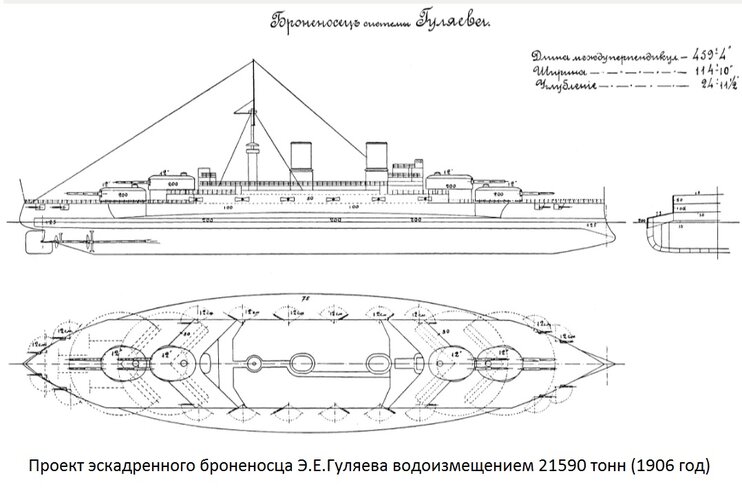
Gulyaev 1906 "all-big-guns", with big underwater protection, 21 590 ton, 4 x 2 x 12" guns:

Admiral Makarov "unarmoured ship", 1895 (?):

3000 ton, 2 x 8 ", 4 x 6 " and 12 x 75 mm guns, 20 knots, range 6000 miles
Gulyaev 1895 "unsinkable" armour vessel:


19 823 ton, 136.6 x 33.7 x 6.1 m, 18 knots, 2 x 2 x 12" guns and 6 x 2 x 6" (?) guns.
Baltic sea monitor project, 1915-1916:


7550 ton, 12 knots, 1 x 3 x 14" and 8 x 6" guns, 3 x 1000 hp diesel engines, 275 mm belt
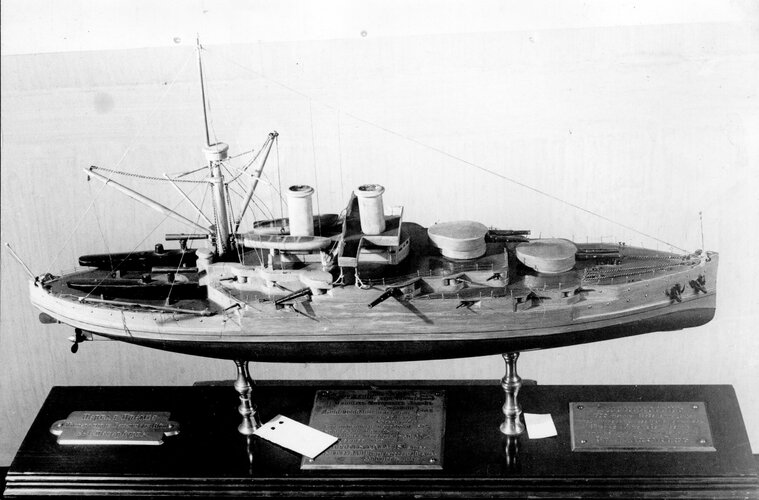
10 000 ton, 15 knots, 2 x 2 and 4 x 1 x 12" guns.
Gulyaev 1906 "all-big-guns", with big underwater protection, 21 590 ton, 4 x 2 x 12" guns:
Admiral Makarov "unarmoured ship", 1895 (?):
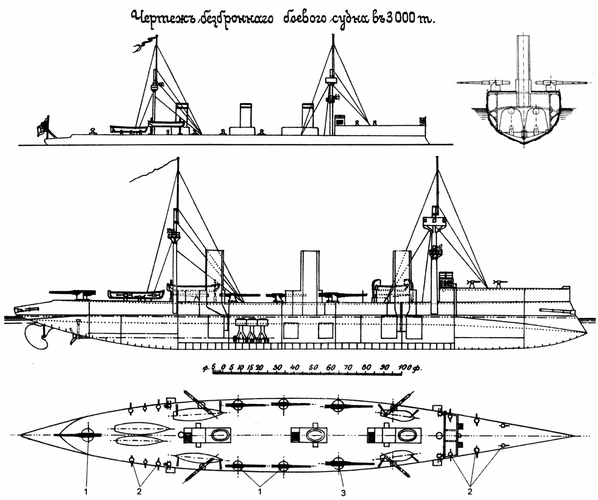
3000 ton, 2 x 8 ", 4 x 6 " and 12 x 75 mm guns, 20 knots, range 6000 miles
Gulyaev 1895 "unsinkable" armour vessel:
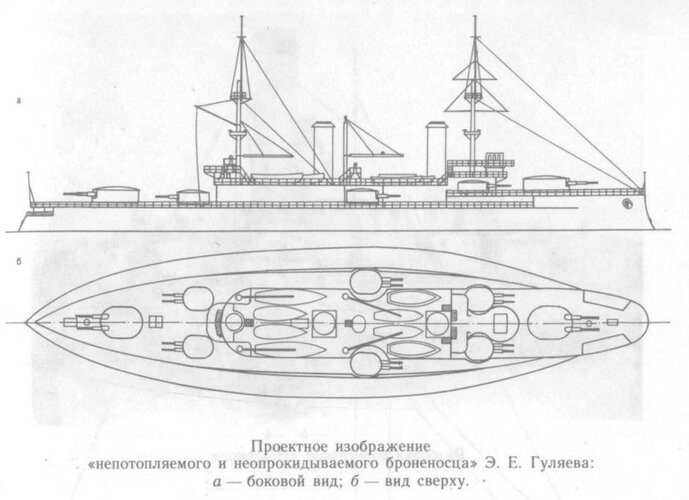
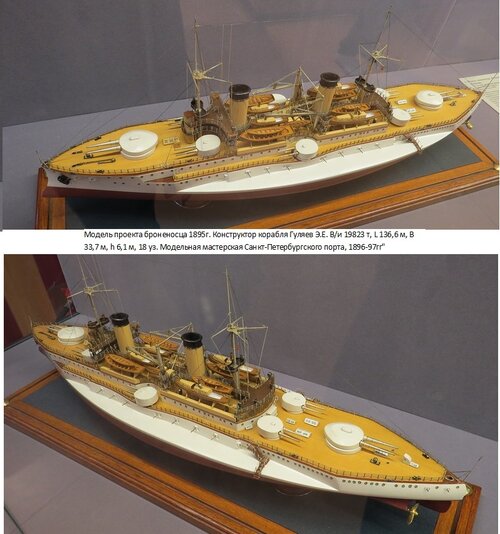
19 823 ton, 136.6 x 33.7 x 6.1 m, 18 knots, 2 x 2 x 12" guns and 6 x 2 x 6" (?) guns.
Baltic sea monitor project, 1915-1916:
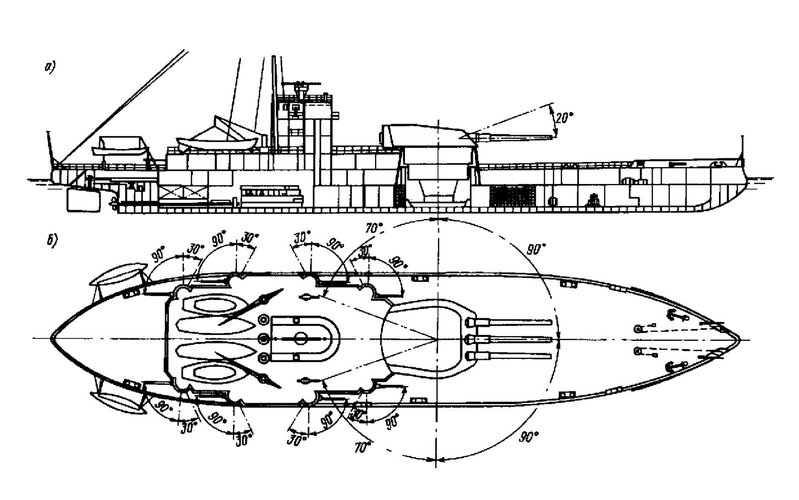
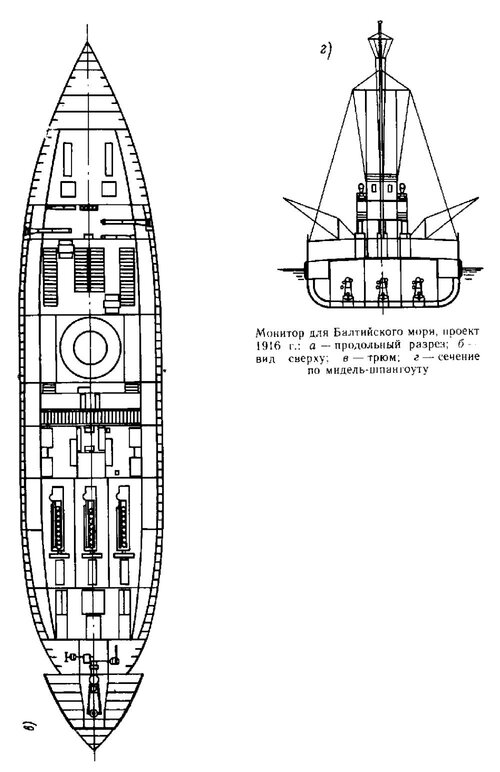
7550 ton, 12 knots, 1 x 3 x 14" and 8 x 6" guns, 3 x 1000 hp diesel engines, 275 mm belt
Last edited:
Godzilla37
ACCESS: Restricted
- Joined
- 16 May 2024
- Messages
- 36
- Reaction score
- 21
Any WW2 cruiser designs for Italy, Germany and France?

- Joined
- 6 September 2006
- Messages
- 5,316
- Reaction score
- 11,544
Have you searched the other threads of this section? I'm pretty sure most of them have been covered before.
As the naval section moderator I feel like this thread is pretty non-productive, it's not really feasible to list every single design in one thread and quite frankly WoWs has become a profit-seeking arcade game, they are not interested in accuracy but gameplay. I'm sure they are more than qualified to do their own research if they were interested, but they don't seem to be, so they make up stuff that looks cool.
As the naval section moderator I feel like this thread is pretty non-productive, it's not really feasible to list every single design in one thread and quite frankly WoWs has become a profit-seeking arcade game, they are not interested in accuracy but gameplay. I'm sure they are more than qualified to do their own research if they were interested, but they don't seem to be, so they make up stuff that looks cool.
Godzilla37
ACCESS: Restricted
- Joined
- 16 May 2024
- Messages
- 36
- Reaction score
- 21
I'm not using the WOWS screenshots for research since most of the "new" ships/designs I found were from Wikipedia, Spring Styles, Warship Projects, Shipbucket, Deviantart and other Secret Naval Projects forums. After finding most of the Secret Naval Projects forums are about post-WW2 designs, I decided to create a new forum. I was using WOWS screenshots to show the bunch of crappy ships WG has been coming up with lately like the Pan-Asian wish.com Yamato and the up-tiered Florida (Project XVI battleship) or to compare designs like the Weimar Republic's 1928 cruiser killer to an in-game ship like the Admiral Schröder.I find it really sad that posting screenshots from World of Warships has become acceptable “research” on this forum.
Here are examples of "new" ships/designs I found from Wikipedia, Spring Styles, Warship Projects, Shipbucket, Deviantart and other Secret Naval Projects forums:
German:
Type 1945 destroyer
P-class cruisers
M-class cruisers
K-class cruisers
L21a design battleship
U.S.:
North Carolina class battleship preliminaries like Project XVI, Scheme A and C
Light cruiser design S-511-2
Light cruiser design S-511-53-A
Light cruiser design S-511-19
USS Northampton (CLC-1)
Design S-511-51 Scheme B-VII destroyer
Heavy cruiser study 1938 (12" gun proposal)
Iowa class battleship aircraft carrier conversion
Preliminary carrier design S-584-201
Italy:
Ansaldo destroyer design 1939
Light cruiser design XII-152
Design 1928 battlecruiser
Design 1933 battlecruiser
Design 45367 battlecruiser
Fernando Cassone's 1921 battlecruiser design
Japan:
Yamato preliminary designs like A-140I and A-140B2
Fuso class battleship preliminary designs like A-57 and A-54
Number 13 battleship preliminary designs like designs D, O and L
Myōkō preliminary designs like C-42
Spain:
Design 138B heavy cruiser
British:
Lion class battleship preliminaries like design 16E-38 and 14B
M3 battleship design
Design B of the 1939 heavy cruiser designs
1939 DNC large cruiser design
Swedish:
Tre Kronor class
Dutch:
Gerard Callenburg class
Soviet:
Project X cruiser
MK 130 mm gun light cruiser designs
Pan-America:
20 de Julio
Acre class
Mendoza class
Marcílio Diaz class
Design 1124a for Venezuela
Design 1124b for Venezuela
Export:
Ansaldo UP90Bis cruiser for Romania
Vickers design 767 light cruiser for the Dutch
Royal Cockatoo yard heavy cruiser for Australia
DNC heavy cruiser design for Greece
Vickers 1904 design for Chile
Vickers Design 758A for Argentina
Vickers 1957 Design for Venezuela
Last edited:
- Joined
- 1 February 2011
- Messages
- 3,341
- Reaction score
- 5,029
I can list the cruisers but that would be a huge list. Though what you require for Italy, France and Germany shortens the list considsrably.
Actually it would be easier for me to just post a link to my excel database:
https://www.deviantart.com/tzoli/art/Excel-Database-of-Warships-of-the-World-542952468Use the download button (better chance finding it on desktop)
Actually it would be easier for me to just post a link to my excel database:
https://www.deviantart.com/tzoli/art/Excel-Database-of-Warships-of-the-World-542952468Use the download button (better chance finding it on desktop)


- Joined
- 22 January 2006
- Messages
- 4,434
- Reaction score
- 2,796
must we sign in at Deviant to access your database?I can list the cruisers but that would be a huge list. Though what you require for Italy, France and Germany shortens the list considsrably.
Actually it would be easier for me to just post a link to my excel database:
https://www.deviantart.com/tzoli/art/Excel-Database-of-Warships-of-the-World-542952468Use the download button (better chance finding it on desktop)
- Joined
- 22 January 2006
- Messages
- 4,434
- Reaction score
- 2,796
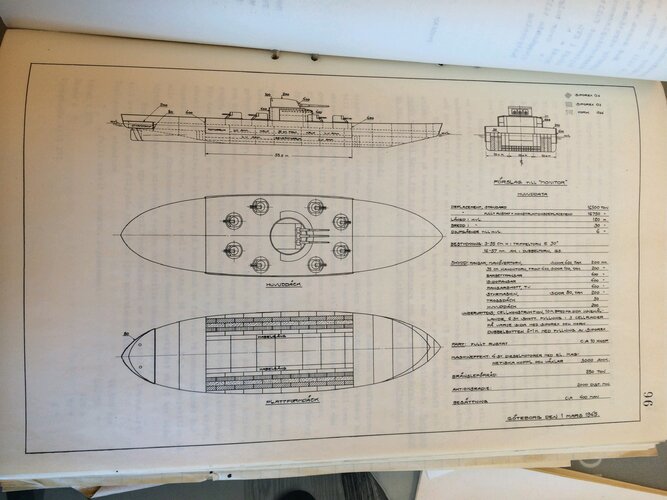
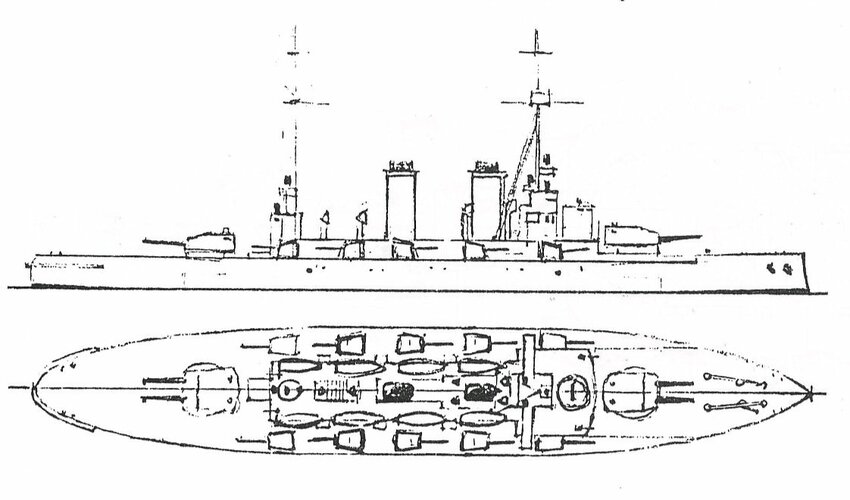
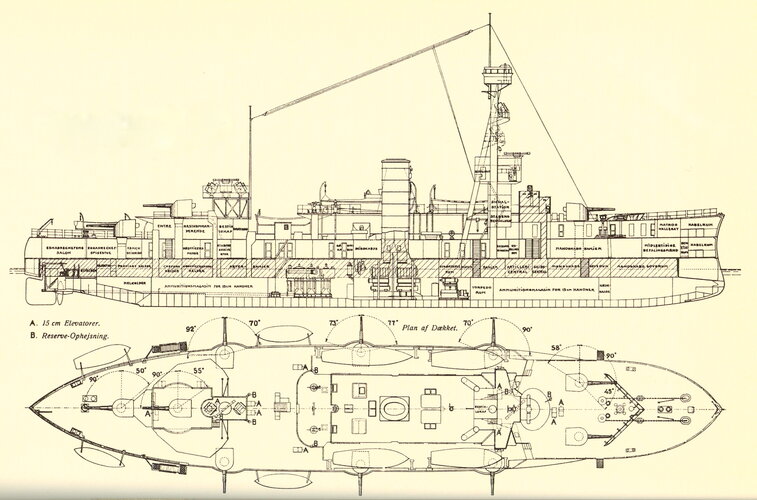
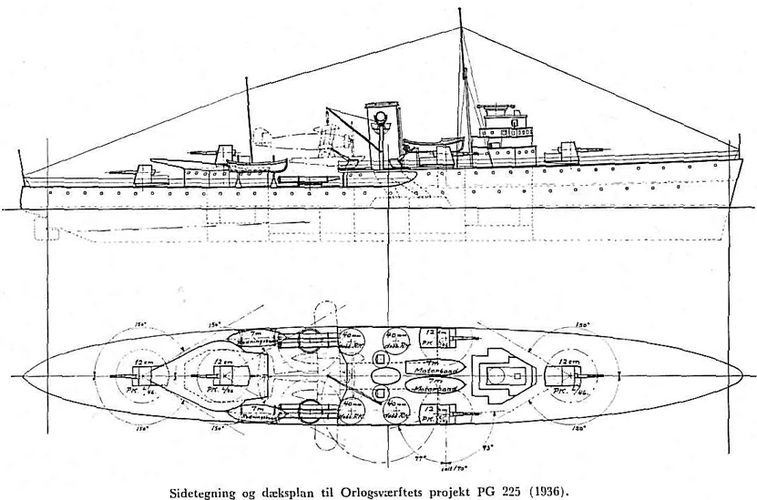
Could you please identify it?So I decided to post some designs that weren't suitable for World of Warships
- Joined
- 1 February 2011
- Messages
- 3,341
- Reaction score
- 5,029
I think it's not necessarymust we sign in at Deviant to access your database?
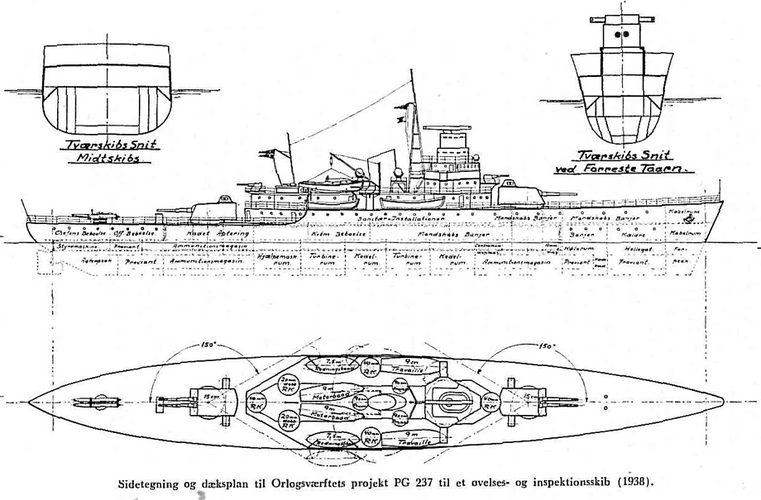
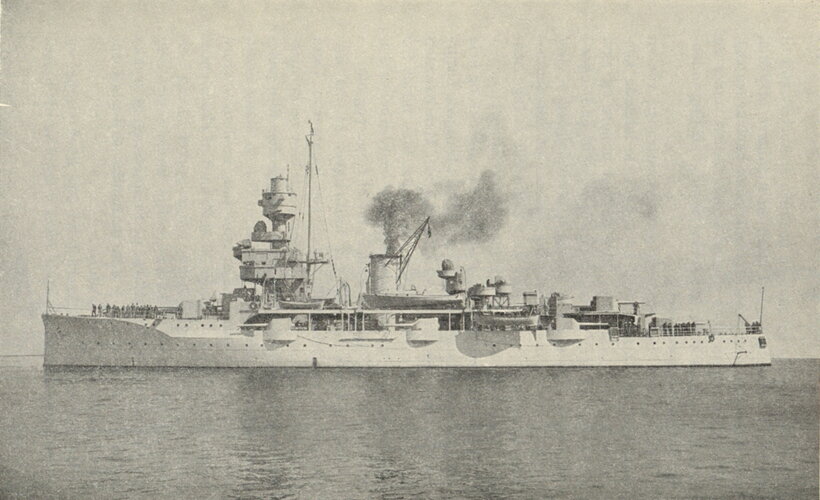
The top two are Swedish coast defense shipsCould you please identify it?
The third should be the Dutch 7,600 ton coastal defense ship of 1912
The following three are all Danish plans,Niels_Juel is a real ship.
_Sarcasticat_
Die Katze.
- Joined
- 16 April 2020
- Messages
- 366
- Reaction score
- 396
German cruiser designs are pretty limited. For WWI, you have the Flottenkreuzer series as one of the biggest examples I can recall at this time. Pre-war you have the Emden preliminary design (4x2 15cm) and its subsequent modernization proposals. You also have the 1926 I/10 "treaty cruiser" sketch. There is also the Kreuzer Q sub-series (of Kreuzer M) and the briefly-existing all-steam initial Kreuzer M pitch as well as the later 17cm armament proposal. Similarly, the Admiral Hipper's early development included the possibility of a 19cm armament and there was some differences between the early plans and what would eventually be built. Also of note is the Kreuzeren K and L (Seydlitz and Lutzow) which had alternative propulsion plant arrangements and, of course, the triple 15cm/55 armament before being changed to 20.3cm/60. You also have the private yard pitches from yards such as Schichau which would yield designs such as Motorkreuzer 1938 (with varying plant proposals) and the rather spectacularly named "Trotz Alledem". From Schichau we have "Amtsentwurf 1938" - possibly a fake design, but I believe it to be real.Any WW2 cruiser designs for Italy, Germany and France?
From the "iffy" end of "cruisers" we have the Spahkreuzer series (1938, 1939, and 1940) and the O-class. While the O-class if officially listed as battleships, they are more equivalent to large cruisers or "unrestricted cruisers" (a term, later classification, that died out due to the emergence of carrier air power before it could gain any traction). I also believe the later "Handelzerstorer" and prior designs (I/M26, I/26, D-lands, Kreuzer P Entwurf AV, Scheme 1/2, Kreuzer P Entwurf O, etc) could fall under the term "heavy cruiser" (as the D-lands would become).
Kriegsmarine cruiser development, due to the short existence of the 3R, was rather sparse compared to that of other nations.
Similar threads
-

-
Suggestions for good never-built warships books
- Started by NobodyOne
- Replies: 20
-
 Preliminary design for Netherlands Cruiser DeRuyter with 8" guns
- Started by ptdockyard
- Replies: 8
-
-
I-400 sized German U-boat projects from WW2?
- Started by Vahe Demirjian
- Replies: 15