Junkers Projects and Prototypes of WW II

That's not true,it was called at first EF.152.

For unknown project,they described it as a looks like early version of Ilyusin Il-2,read the text !.
The EF132 was the last official Dessau "Junkers" design. Anything post that is OKB-1.

What's the source on the single-engine EF?
Sounds very much like the EF82 but with the engine misidentified (BMW801 instead of the correct Jumo 214).

OK,but the aircraft was designed as bomber at first.

The source for it was,Die Deutsche Luftruestung 1933-1945 - Vol.3 - Henschel-Messerschmitt (Bernard&Graefe)
 
OK,but the aircraft was designed as bomber at first.

The source for it was,Die Deutsche Luftruestung 1933-1945 - Vol.3 - Henschel-Messerschmitt (Bernard&Graefe)
I would like a quote from that book in support of your claim.

I have one book that tells the story of Projekt 152: Die Deutsche Luftfahrt - Band 22 - Luftfahrt Ost 1945-1990 by Jürgen Michels and Jochen Werner, Bernard & Graefe 1994; pages 102 through 124.

Michels and Werner are quite clear about the Projekt 152 being developed as an airliner from the start (Google Translate):
Wie schon erwähnt, erhielt eine Gruppe von deutschen »Spezialisten« Ende 1953 in Sawjelowo (nördlich von Moskau) den Auftrag, ein Passagierflugzeug mit Strahl-triebwerken für den Mittelstreckeneinsatz zu entwickeln.
Daraufhin wurde im Dezember 1953 noch in der sowjet-union mit diesem Projekt begonnen. Parallel dazu planten die Technologen für Zelle und Triebwerk die notwendigen Betriebseinrichtungen für die aufzubauenden Entwick-lungs- und Serienwerke. In der Kurzbeschreibung des ersten Projektes heißt es zur Zielsetzung:
»Das Projekt 15.2 wurde entsprechend den technischen Forderungen als Verkehrsflugzeug zur Beförderung von Fluggästen, Gepäck und Post auf inländischen und internationalen Fluglinien entworfen.«
As mentioned before, at the end of 1953 a group of German "specialists" in Savyolovo (north of Moscow) received the order to develop a passenger aircraft with jet engines for medium-haul operations. This project was then started in December 1953 while still in the Soviet Union. At the same time, the cell and engine technologists planned the necessary operating facilities for the development and series production plants to be set up. In the brief description of the first project, the objective is stated as follows: »The Project 15.2 was designed according to the technical requirements as an airliner for the carriage of passengers, luggage and mail on domestic and international airlines.«
Michels and Werner: Projekt 152 was never a Junkers project.
On the 152 number being chosen for the project:

Daß jedoch die Bezeichnung 152 für dieses Flugzeug in der Junkers-Tradition der EF-Reihe (Entwicklungsflugzeug) stand und EF 152 während der Entwicklung hätte heißen können, wurde verschwiegen. Das EF entfiel, da die sowjetische Tradition bei Versuchsflugzeugen eine bloße Zahlenfolge vorsieht. Überraschenderweise findet man auf frühen Papieren die Bezeichnung EW-152.
However, the fact that the designation 152 for this aircraft was in the Junkers tradition of the EF series (development aircraft) and could have been called EF 152 during development was concealed. The EF was dropped because the Soviet tradition for experimental aircraft provides for a mere sequence of numbers. Surprisingly, one finds the designation EW-152 on early papers.
Michels and Werner: Development of the 152 started in the Soviet Union, so a Soviet naming convention was used: 152, without any additions.

Michels and Werner: Projekt 152 built on experience gained in the development of the Type 150 bomber:

»Die grundlegenden Entwurfsberechnungen ergaben, daß ein auf die vorliegenden Forderungen optimal abgestimmtes Flugzeug in den Grundabmessungen in der gleichen Größenordnung wie das seinerzeit von unserem Kollektiv in der SU entwickelte und im praktischen Flugbetrieb erprobte Flugzeugmuster 150 liegt. Zur Herabsetzung der Entwicklungszeit und des Entwicklungsrisikos wurde deshalb angestrebt, den aerodynamischen Gesamtaufbau sowie die wesentlichsten Elemente der Zelle der 150 im Aufbau sowie in der konstruktiven Gestaltung für das vorliegende Projekt zu übernehmen. Hierdurch war es möglich, im großen Umfange prinzipielle Untersuchungen und Vorversuche zur Klärung aerodynamischer, festigkeitsmäßiger und konstruktiver Fragen einzusparen. So stellt das vorliegende Projekt in bezug auf die aerodynamische Gestaltung und konstruktive Durcharbeitung eine Zweitausführung des erprobten Flugzeuges 150 dar, bei der alle bisherigen Entwicklungserfahrungen berücksichtigt werden konnten.

Zur Erfüllung der speziellen Forderungen für das vorliegende Projekt und zur weiteren Verbesserung der mit dem Flugzeug 150 erflogenen Flugleistungen und Flugeigenschaften waren im wesentlichen lediglich folgende größere Umstellungen am Gesamtprojekt gegeben:
1. Eine Vergrößerung der Flügelfläche um etwa 20% (bei gleichzeitiger entsprechender Vergrößerung von Höhen- und Seitenleitwerk) zur Sicherstellung der fürein Passagierflugzeug erhöhten Forderungen in bezug auf die Start- und Landestrecken.
2. Eine Verkleinerung der Pfeilung des Flügels von 35° auf 30°, die infolge der niedrigeren Geschwindigkeiten des Passagierflugzeuges zweckmäßig war.
3. Eine Vergrößerung der Rumpfabmessungen infolge des Raumbedarfs für die geforderten Nutzräume. Um ausreichende Flugsicherheit bei Triebwerksausfall sicherzustellen, wurde der Einbau von 4 Triebwerken projektiert, die so bemessen sind, daß sogar bei Triebwerksausfall während des Startvorganges der Flug fortgesetzt werden kann.«
"The basic design calculations showed that an aircraft optimally adapted to the present requirements is in the same order of magnitude as the aircraft type 150 developed by our collective in the SU and tested in practical flight operations. In order to reduce the development time and the development risk, the aim was therefore to adopt the overall aerodynamic structure and the most important elements of the cell of the 150 in the structure and in the structural design for the present project. This made it possible to save on a large scale in principle investigations and preliminary tests to clarify aerodynamic, strength and design issues. With regard to the aerodynamic design and structural refinement, the present project represents a second version of the tried-and-tested 150 aircraft, in which all previous development experience could be taken into account. In order to meet the special requirements for the present project and to further improve the flight performance and flight characteristics flown with the aircraft 150, the only major changes to the overall project were as follows:
1. An increase in the wing area by about 20% (with a corresponding increase in elevator and vertical tail) to ensure the increased requirements for a passenger aircraft in relation to the take-off and landing distances.
2. A reduction in the sweep of the wing from 35° to 30°, which was expedient due to the lower speeds of passenger aircraft.
3. An increase in the fuselage dimensions as a result of the space required for the required usable spaces. In order to ensure sufficient flight safety in the event of an engine failure, the installation of 4 engines was planned, which are dimensioned in such a way that the flight can be continued even if the engine fails during the take-off process.«
Michels and Werner: bomber development experience was used in the development of the 152, but it was always meant to be an airliner.

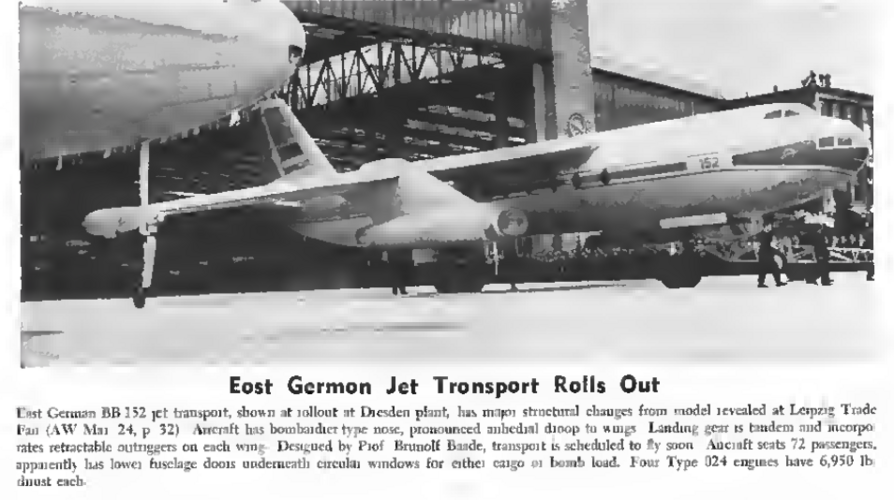
I don't have any other sources about the 152 and its origins. Michels and Werner also write the potential of the 152 to be used as a bomber may find its origin in an Aviation Week image caption, dated May 12 1958:
AW 1958 May 12 p41.png
Der offizielle Name dieses Flugzeugs lautete 152. Die Typenbezeichnung wurde am 23. Juli 1958 vom Chefkonstrukteur Dipl.-lng. Fritz Freytag in der Sächsischen Zeitung bestätigt:
»... Eine Reihe von Vorkommnissen lassen es zweckmäßig erscheinen, einige Ausführungen über die Typenbezeichnung des Flugzeuges 152 zu veröffentlichen. Von seiten des kapitalistischen Auslandes wird immer wieder für die Neuentwicklung unseres Strahlturbinen-Verkehrsflugzeuges 152 die Typenbezeichnung >B-152< oder >BB-152< benutzt. Offizielle Mitteilungen mit derartigen Bezeichnungen sind nicht gemacht worden. Leider wurden sie jedoch auch bei uns mehrfach übernommen. Offensichtlich hat das westliche Ausland - von westdeutscher Seite erschien diese Bezeichnung erstmals in der >Flugwelt< vom November 1956 - ein ganz besonderes Interesse an diesem Namen.
Zur Klärung der Frage, warum diese >Kleinigkeit< so entscheidenden Charakter hat, trägt eine Mitteilung bei, die der amerikanischen Fachzeitschrift >Aviation Week< vom 12. Mai 1958 zu entnehmen ist. Darin wird ganz eindeutig gesagt, daß unsere 152 die typische Rumpfnase eines Bombers habe und auch die Klappen am Rumpfunterteil für Bombenbeladung ausgerüstet seien. Wahrscheinlich wurde absichtlich übersehen, daß der Platz für den Navigator, der bei der ersten Variante der 152 in der Rumpfnase liegt, nicht mit Scheiben für ein Bombenzielgerät ausgestattet ist, wie es bei einem Bombenflugzeug der Fall sein müßte. In gleicher Weise wurden auch die Klappen zum Abdekken der Fahrwerke zu Bombenklappen umgefälscht ...«
The official name of this aircraft was 152. The type designation was given on July 23, 1958 by the chief designer Dipl.-lng. Fritz Freytag confirmed in the Sächsische Zeitung:
»... A number of events make it seem expedient to publish some comments on the type designation of the 152 aircraft. On the part of capitalist foreign countries, the type designation >B-152< or >BB-152< is used again and again for the new development of our jet turbine airliner 152. No official announcements with such designations have been made. Unfortunately, however, they were also taken over by us on several occasions. Apparently western countries - this designation appeared for the first time in the "Flugwelt" from the West German side in November 1956 - have a very special interest in this name. A statement in the American journal Aviation Week of May 12, 1958 helps clarify the question of why this "little thing" is so decisive. It says very clearly that our 152 has the typical nose of a bomber fuselage and that the flaps on the lower fuselage section are also equipped for bomb loading. It was probably deliberately overlooked that the navigator's seat, located in the nose of the fuselage on the first variant of the 152, is not equipped with windows for a bomb sight, as a bomber aircraft should be. In the same way, the flaps covering the landing gear were bamboozled into bomb flaps..."
 
Last edited:
My dears,I still didn't find the source,

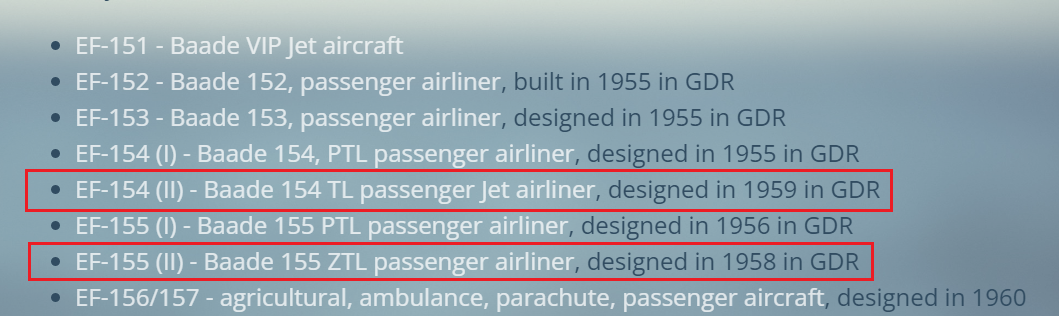
but as I think the Types 151 and 152 could be re-allocated as many 150s series,and in Junkers site,the 151 was VIP executive transport aircraft,although in Flugzeug Classic 2021,the Type 151 was a bomber,also was given the prefix EF.

http://hugojunkers.bplaced.net/baade-veb-flugzeugbau-151.html
 

Attachments

  • 20.png
    20.png
    289.1 KB · Views: 292
  • 21.png
    21.png
    181 KB · Views: 244
  • 40.png
    40.png
    267.9 KB · Views: 202
I am sure about it,just wait.

What was this Project ?.

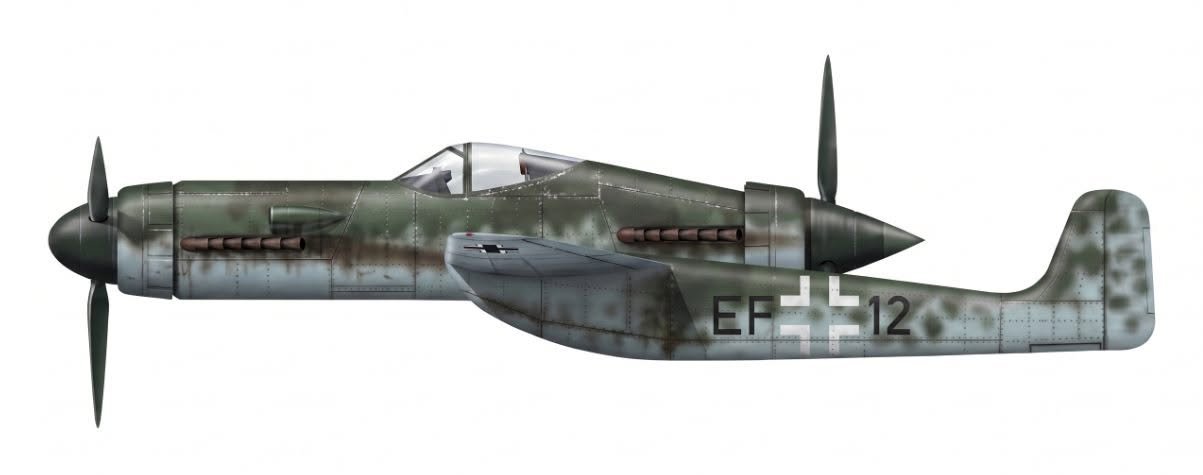
Junkers Project EF

Draft of an attack aircraft with a BMW 801. Planned further development of the Ju 187. As a single-seater, similar in concept to early versions of the Ilyushin Il-2.

There were two Schlachtflugzeug projects,and not one as in my files,can
anyone explain that ?.
 
From this report,

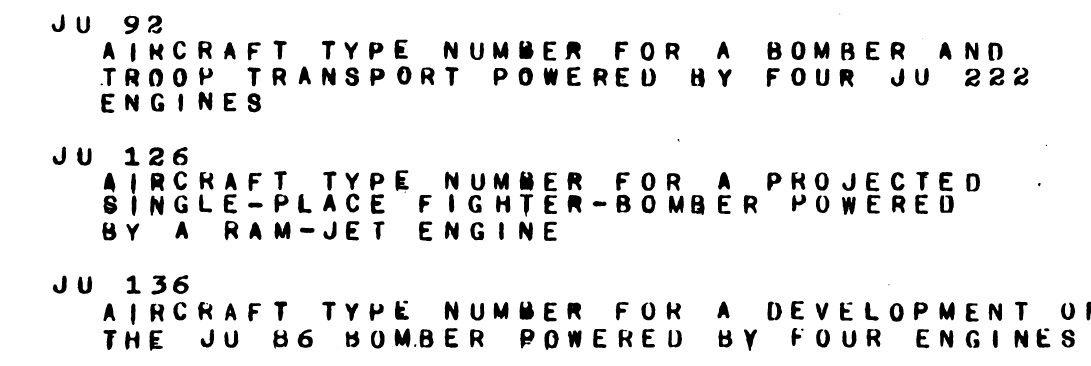
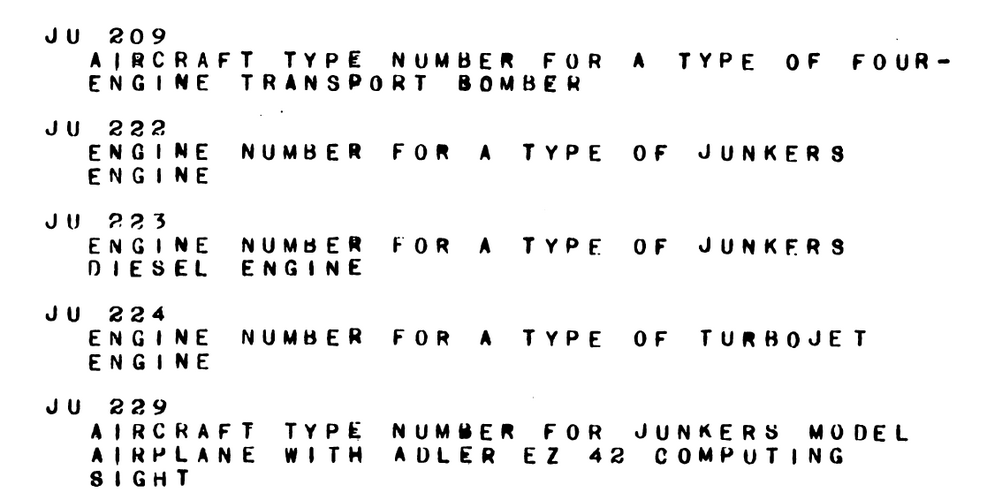
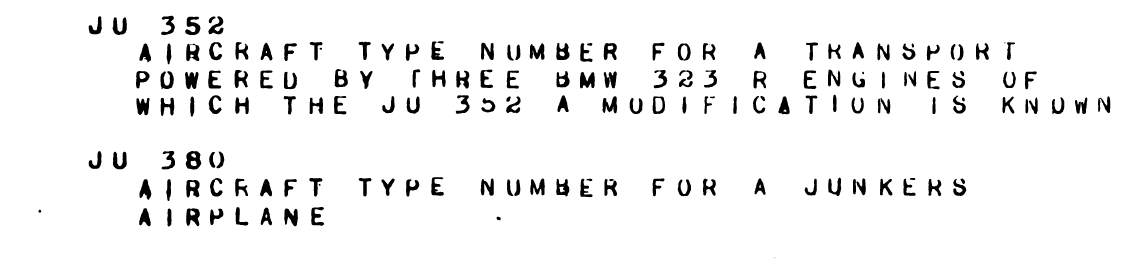
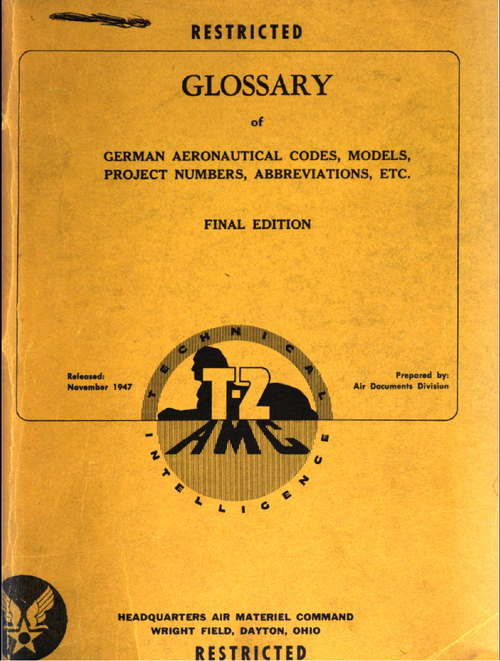
some mysteries,Ju-92,Ju-136,Ju-209,Ju-229 & Ju-380 ?!.
 

Attachments

  • 1.png
    1.png
    43.2 KB · Views: 82
  • 2.png
    2.png
    50.2 KB · Views: 71
  • 3.png
    3.png
    26.1 KB · Views: 78
  • 0.png
    0.png
    1.8 MB · Views: 82
some mysteries,Ju-92,Ju-136,Ju-209,Ju-229 & Ju-380 ?!.

FWIW, these designations and descriptions were mirrored in the Glossary of German aeronautical codes, models, project numbers, abbreviations, etc. published by the USAF Air Matériel Command in Nov. 1947.

Alas, there is a fair bit of nonsense in and amongst - like a "Ju 162 turbojet engine" or Ju 388J "bomber" (with no mention of the Ju 388L or Ju 388K). So, I would take most of this with large lumps of salt.

Ju 92 is included in all sorts of RLM designation lists. Though, that is the first mention I've seen of being powered by Jumo 222s.

That "Junkers 126" would be the EF 126 for the Miniaturjägerprogramm (albeit, with its Argus As 014 pulsejet identified as a "ram-jet engine").

"Junkers 136" is a typo for the proposed 4-engined Ju 186. (8-136 was already in use by Hamburger/Blohm & Voß.)

"Ju 209" is a typo for Ju 290.

Ju 229 - No idea but the mention of the EZ42 gunsight suggests fighter or night-fighter. (BTW: that gyroscopic gunsight is properly an Askania EZ42 Adler.)

Ju 380 - Again, no idea but 8-280 was in use by Heinkel
 
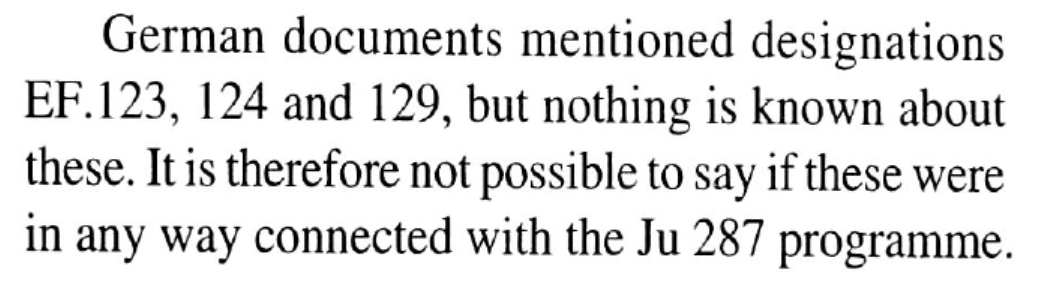
In this book,they mentioned EF.129,as it was appeared in German documents,
but there is no Info about it ?!.
 

Attachments

  • 30.png
    30.png
    180.8 KB · Views: 75
  • 29.png
    29.png
    621.1 KB · Views: 104
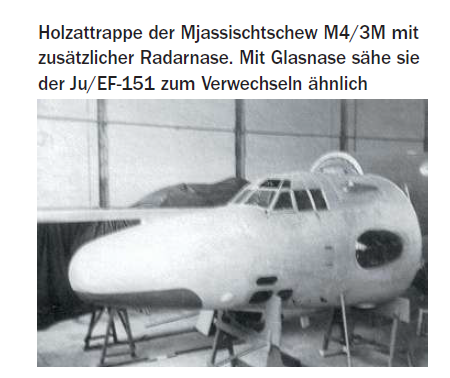
The glassed in navigator’s station - in the nose of the Baade BB-152 airliner was probably to acommodate the sort of drift sight popular on all Soviet transport airplanes. With few electronic navigation aids - and few weather reporting stations - in the vast wastelands of Siberia, Soviet navigators depended upon drift sights to calculate winds aloft.
 
Hi! EF132.
https://alternathistory.ru/nemetski...r-vzglyad-iz-germanii-chast-3-ef140-i-ef-132/

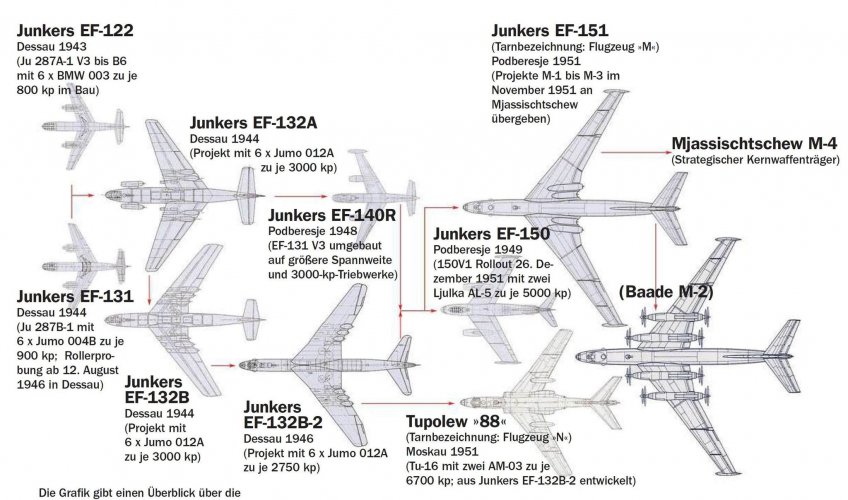
EF 132​

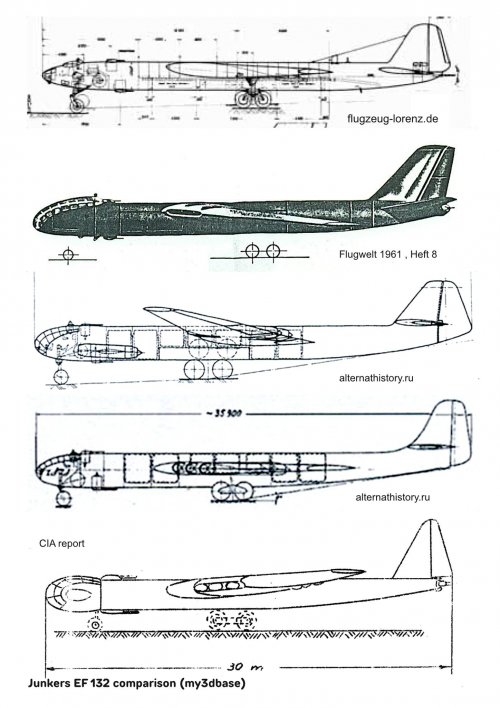
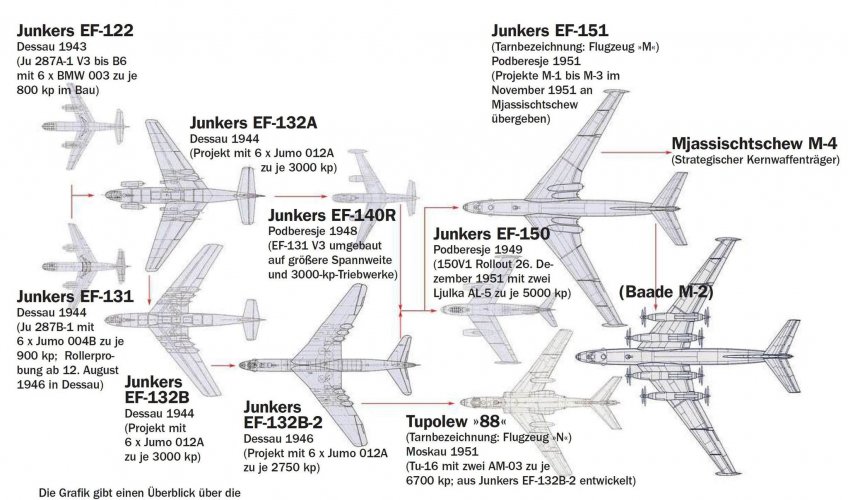
OKB-1's most ambitious project was the EF 132 heavy jet bomber. More than 50 years after its development, the original drawings created by Junkers employees are being published for the first time only thanks to the author's close contacts in modern-day Dubna. These drawings will finally allow the 1950s drawings, which have been widely cited in the literature and were based on unverified information, to be archived. These drawings were even used in Russian specialized literature, as access to the original drawings had been restricted until now.

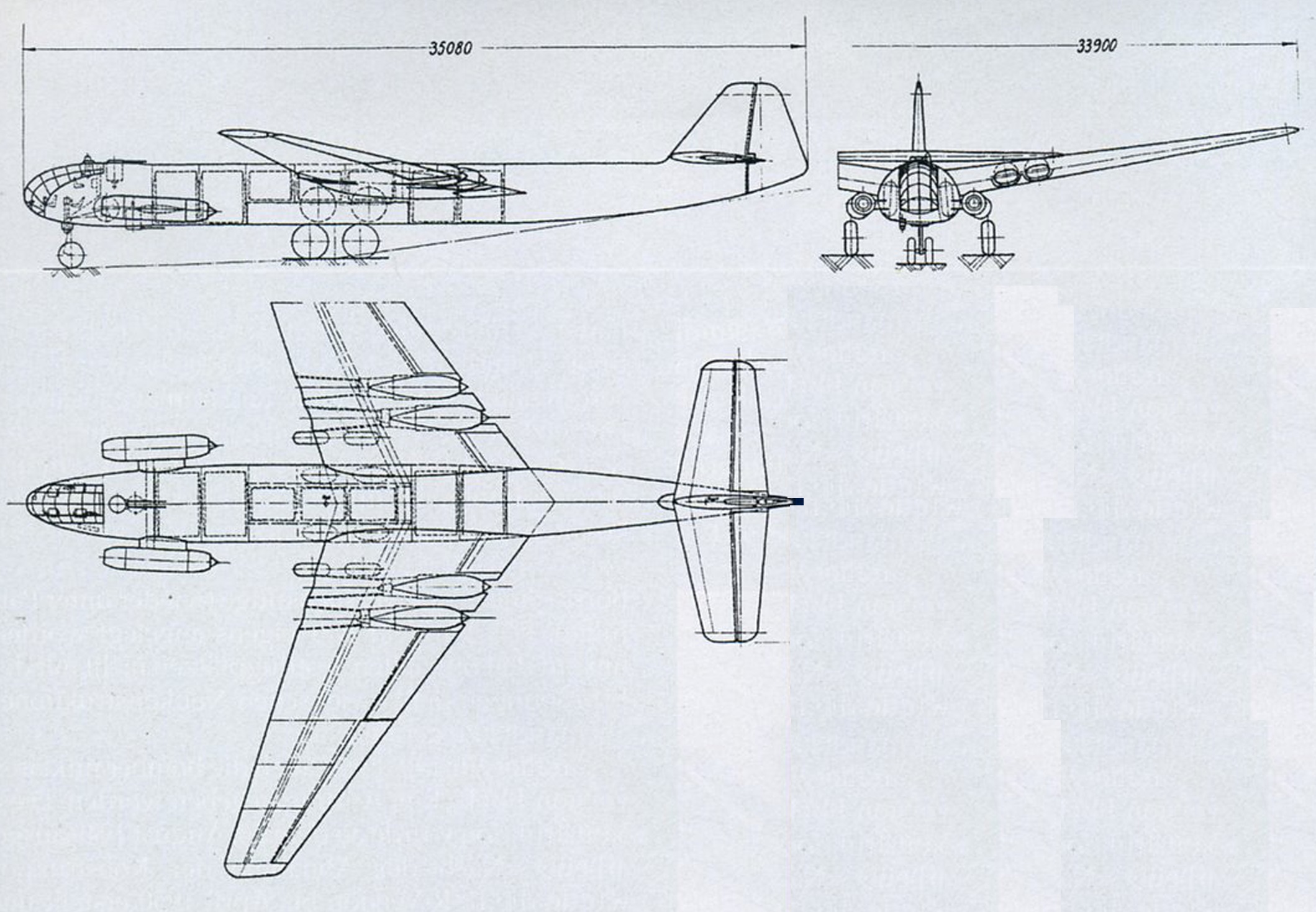
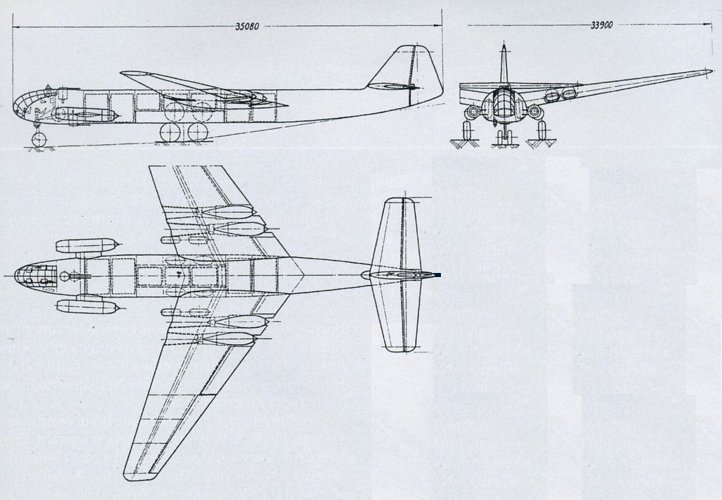
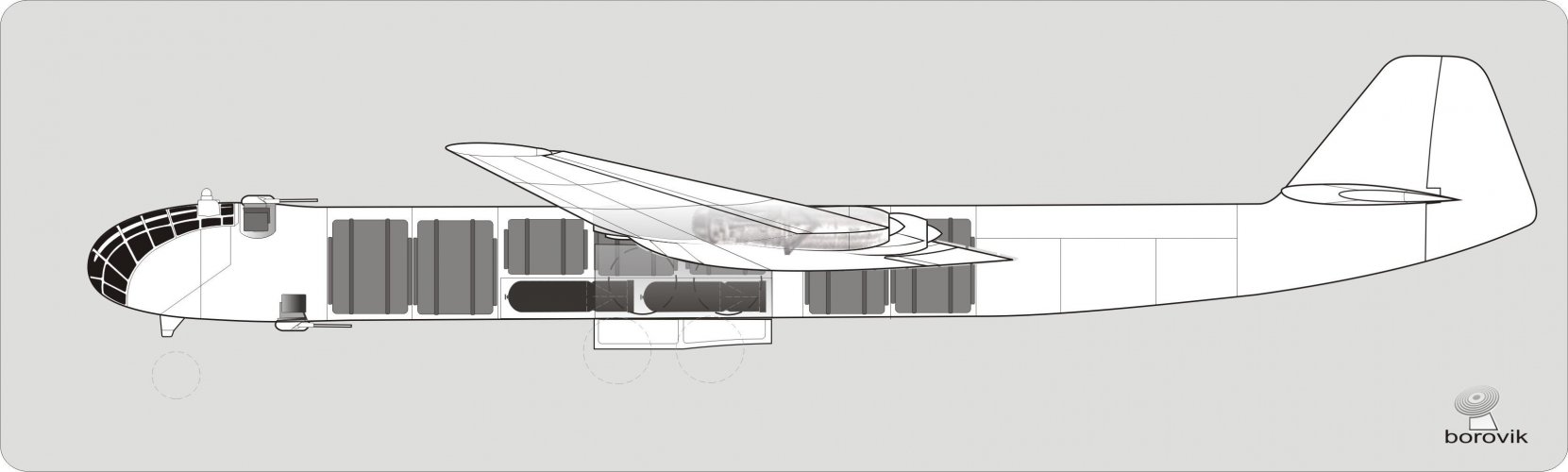
A three-dimensional diagram of the EF 132 A heavy bomber project. Only 50 years later did these original drawings of the previously unknown first version of the EF 132 project become publicly available.
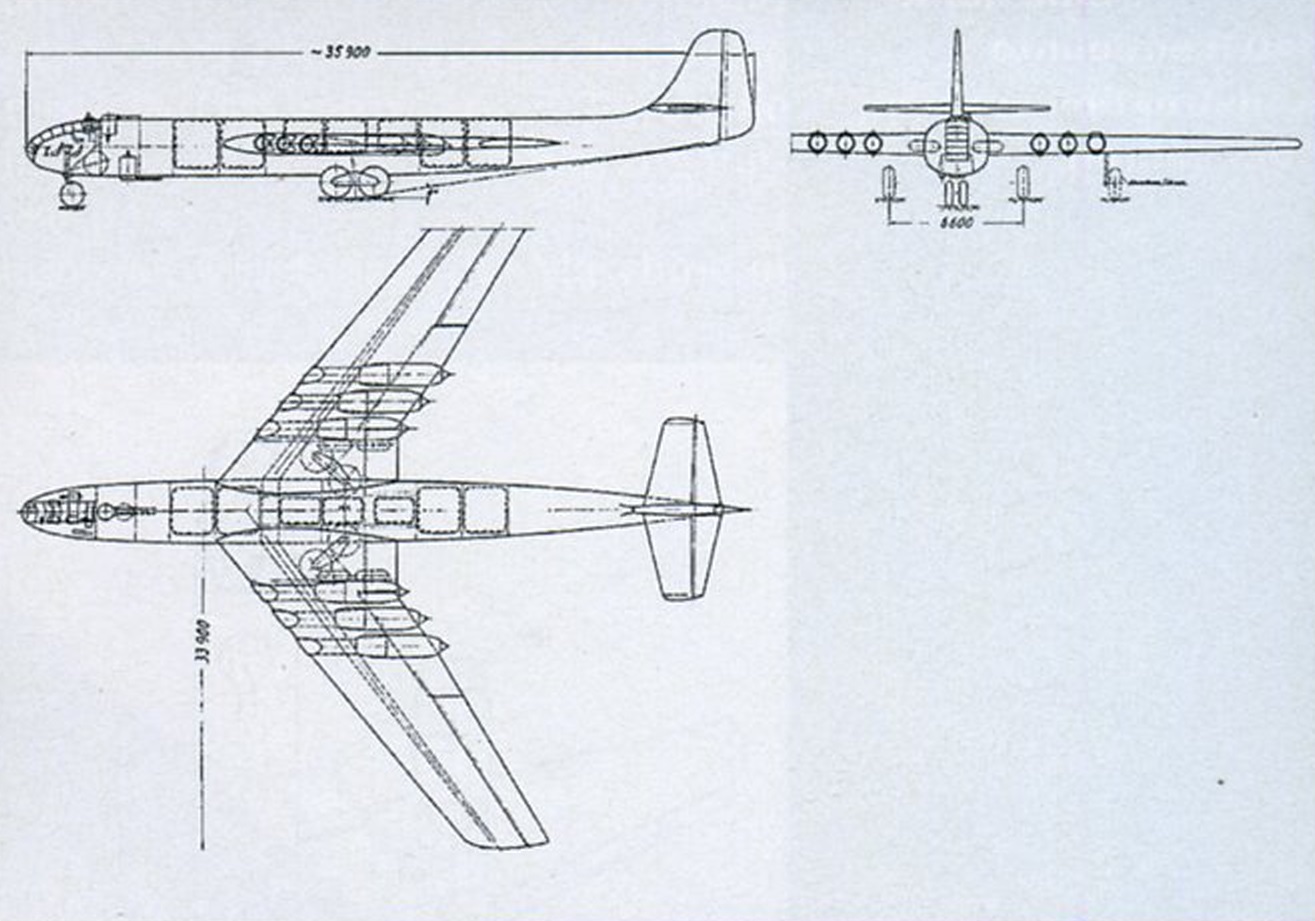
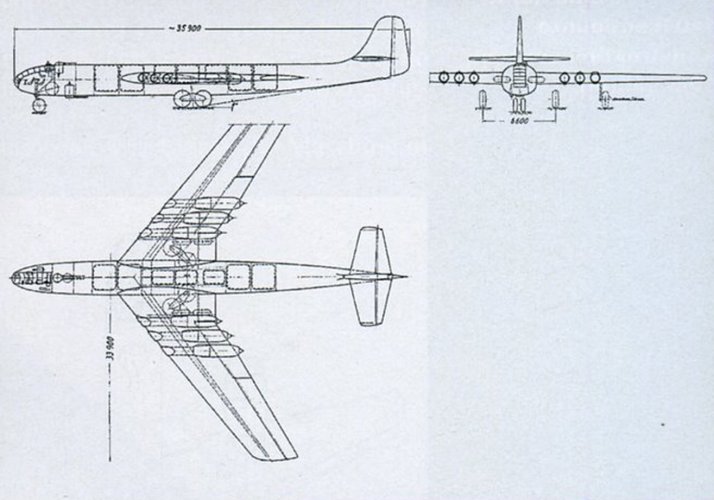
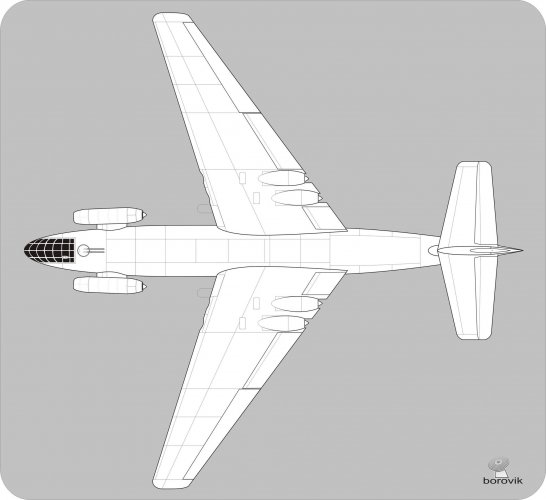
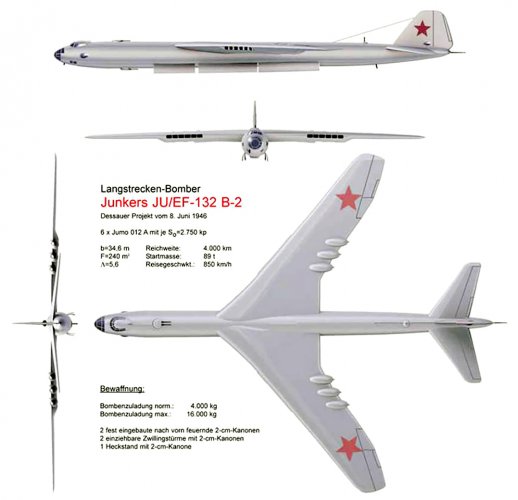
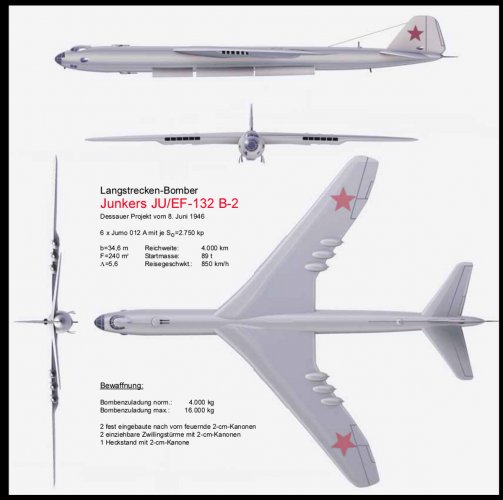
A three-view diagram of the EF 132 B heavy bomber project. Service markings can be seen on this Junkers factory drawing.
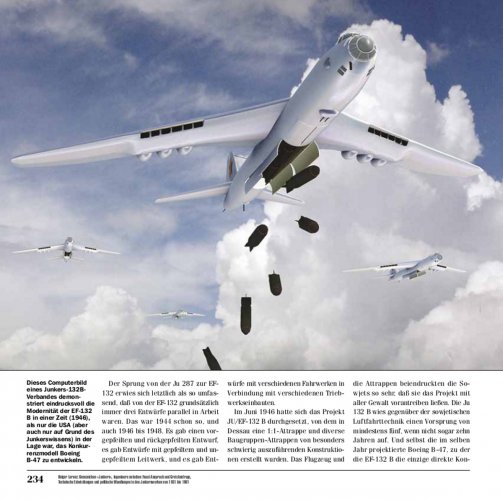
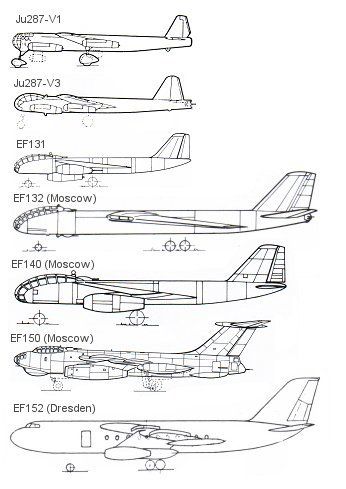
The sensation is that the heavy bomber was designed in two completely different configurations, the first of which was completely unknown until now. Throughout these years, the question has constantly arisen as to why the EF 132 was designed with a wing with a pronounced positive sweep. As is clear from the EF 132 A project, this was not planned from the outset. Essentially, the EF 132 A project was a scaled-up production version of the Ju 287 bomber. This scaling allowed for an aerodynamically clean placement of four of the six engines in the powerplant's wing roots near the fuselage. Two more engines were to be mounted on the sides of the fuselage behind the cockpit. The advantage of mounting all the engines close to the fuselage was that in the event of an engine failure, the yaw moment would be minimal. The powerplant was planned to be powered by six Jumo 012 turbojet engines, which were still under development at the time. The spacious fuselage featured a well-glazed cockpit, familiar from the Ju 287/288, and a non-swept tail. On the other hand, the EF 132 B project was a radically new design. Specifically, it featured a positively swept wing with six Jumo 012 engines recessed close to the wing roots. The fuselage itself resembled that of the EF 132 A. The Junkers drawing clearly showed a non-swept tail. This detail was distorted in all the drawings, which were recreated from memory and are still cited in specialist literature. The engine air intakes also appeared different on the factory drawing than had been assumed for many years. The engine layout is very reminiscent of the later de Havilland Comet passenger airliner, and it appears that information about the EF 132 B project was used in the development of the M-4 Bison heavy long-range bomber at the Myasishchev Design Bureau. In terms of overall dimensions and technical specifications, the EF 132 A and EF 132 B versions were virtually identical. For 1945, these all-jet aircraft were impressively large.

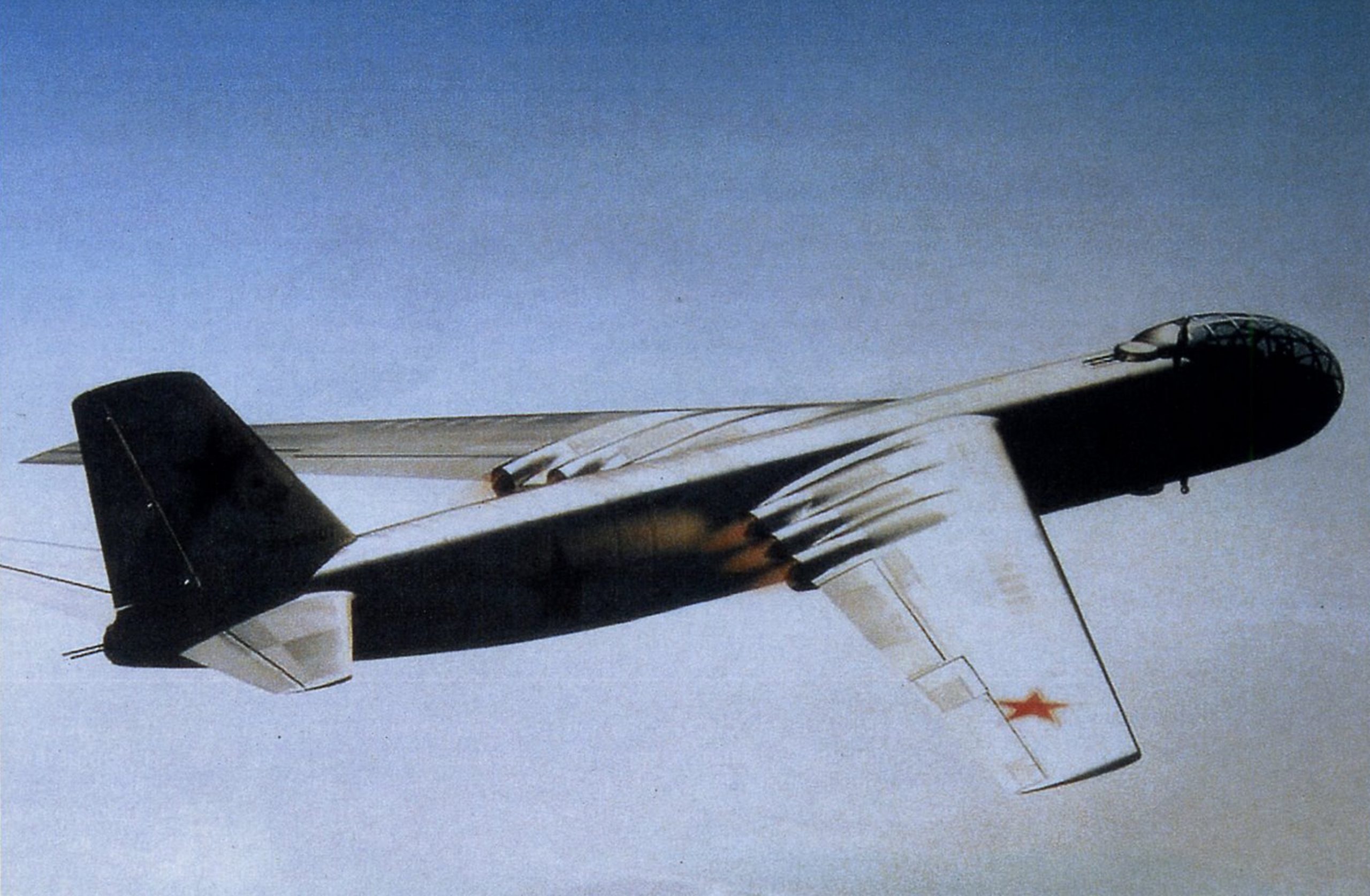
The computer graphics, although based on faulty memories and containing the wrong tail unit, nevertheless make a respectable impression and show what the EF 132 heavy bomber might have looked like in flight.
In Germany, a full-scale wooden mockup of the bomber, complete with technically complex components, was created and approved by a Soviet commission in 1946. Although Russia was extremely interested in a large jet bomber, the project was never realized. In Germany itself, by October 22, 1946, all bridges had been destroyed, as were the resources for such a large-scale project. In Podberez'e (Dubna), specialists were initially to establish themselves and focus on fine-tuning and further improving the already manufactured EF 126, EF 131, and DFS 346. Furthermore, the Jumo 012 engines intended for the EF 132 project were in the early stages of development. Thus, by Order No. 2055-805 of the USSR Council of Ministers dated June 12, 1948, all work on the EF 132 project was terminated.
 

Attachments

  • A three-dimensional diagram of the EF 132 A heavy bomber project..jpg
    A three-dimensional diagram of the EF 132 A heavy bomber project..jpg
    564.1 KB · Views: 48
  • A three-view diagram of the EF 132 B heavy bomber project..jpg
    A three-view diagram of the EF 132 B heavy bomber project..jpg
    214.3 KB · Views: 65

FLIGHT PERFORMANCE CHARACTERISTICS​

Type:EF 131EF 132EF 140 V1EF 140 REF 140 B/R
Purpose:bomberbomberbomberreconnaissance aircraftreconnaissance bomber
Crew, people:35443
Power point:
engine typeJumo 004cJumo 012AM-TRDK-01VK-1VK-1
thrust, kgf6×9006×30002×33002×27002×2700
total thrust, kgf540018,000660054005400
Dimensions:
wingspan, m19.433.919.421.921.0
wing sweep, degrees-20+38-20-20-20
length, m20.4735.919.519.519.5
height, m5.78.05.75.75.7
Weight:
maximum takeoff229558475023,0002554026100
Flight characteristics:
maximum speed, km/h780953904837866
landing speed, km/h190160205205179
flight range, km17104200200036003000
service ceiling, m12500114001170014.10012,000
Armament:
small arms, mm2×134×154×504×234×23
bomb load, kg200040001500No1500
 
Last edited:

Attachments

  • 571264831_4164383260440345_7203863607951404985_n.jpg
    571264831_4164383260440345_7203863607951404985_n.jpg
    222.7 KB · Views: 72
  • 571807630_25746455498289102_2816898948421397200_n.jpg
    571807630_25746455498289102_2816898948421397200_n.jpg
    259.4 KB · Views: 64
  • 571188149_25746444571623528_4848510559882086446_n.jpg
    571188149_25746444571623528_4848510559882086446_n.jpg
    155.1 KB · Views: 56
  • 571116776_25746450718289580_7336008423230429541_n.jpg
    571116776_25746450718289580_7336008423230429541_n.jpg
    120.4 KB · Views: 74

Attachments

  • 1.jpg
    1.jpg
    259.4 KB · Views: 72

Attachments

  • Junkers_232-235-01.jpg
    Junkers_232-235-01.jpg
    560.2 KB · Views: 74
  • Junkers_232-235-02.jpg
    Junkers_232-235-02.jpg
    275.5 KB · Views: 77
  • Junkers_232-235-03.jpg
    Junkers_232-235-03.jpg
    567.1 KB · Views: 77
  • Junkers_232-235-04.jpg
    Junkers_232-235-04.jpg
    592.8 KB · Views: 94
Last edited:
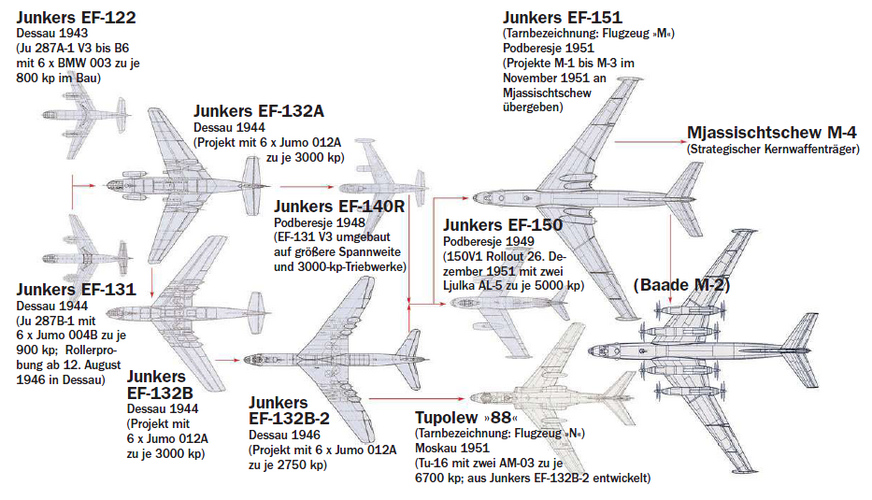
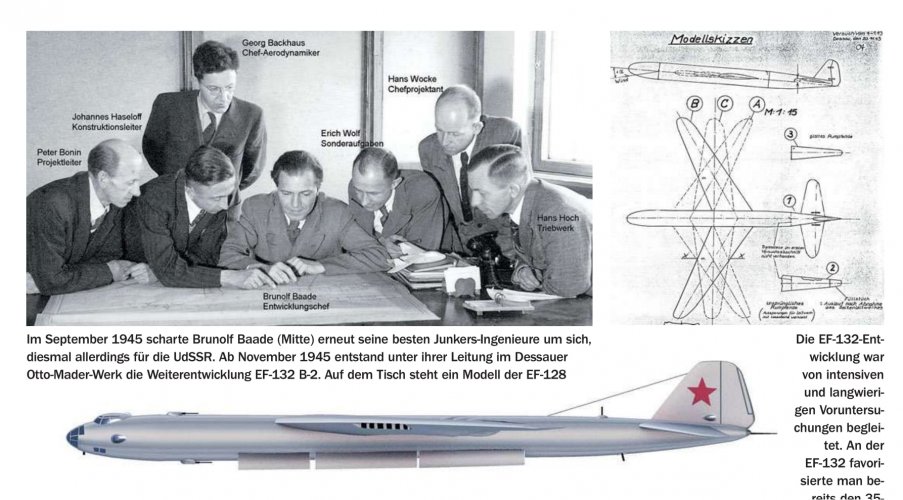
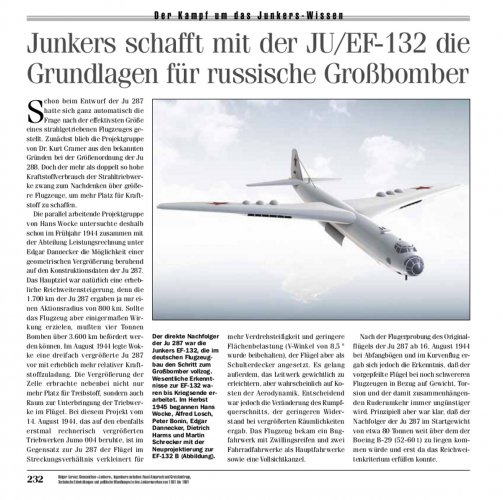
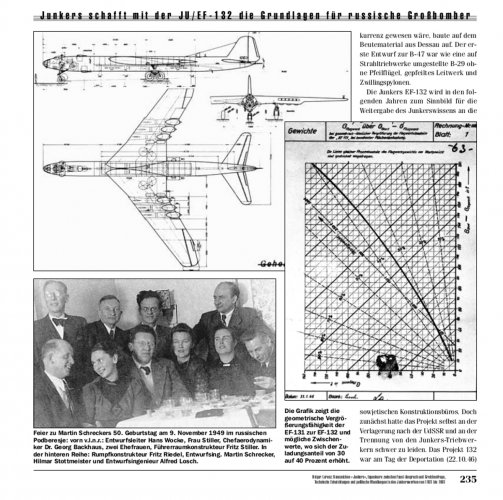
Junkers lays the foundations for Russian heavy bombers with the JU/EF-132

Even during the design of the Ju 287, the question of the most effective size for a jet-powered aircraft arose quite naturally. Initially, Dr. Kurt Cramer's project group, for well-known reasons, stuck with the size of the Ju 288. However, the more than doubled fuel consumption of the jet engines forced a rethink of larger aircraft to create more space for fuel. The parallel project group led by Hans Wocke, together with the Performance Calculation Department under Edgar Dannecker, therefore investigated the possibility of a geometric enlargement based on the Ju 287's design data as early as spring 1944. The main goal was, of course, a significant increase in range, since the Ju 287's 1,700 km range only provided an operational radius of 800 km. If the aircraft was to be of any real effect, it had to be able to carry four tons of bombs over 3,600 km.

In August 1944, Wokke presented a Ju 287 design that was three times larger, with a significantly increased relative fuel payload. The enlarged airframe not only provided more space for fuel but also room to accommodate the engines within the wing. This project, dated August 14, 1944, and based on the Jumo 004 engines (also initially scaled up), differed from the Ju 287 in that the wing's aspect ratio was reduced for greater torsional stiffness and lower wing loading (the dihedral angle of 8.5° was retained). However, the wing was designed as a shoulder-wing monoplane. It was also possible to lighten the empennage, though likely at the expense of aerodynamics. Crucially, the fuselage cross-section was modified, resulting in reduced drag within the larger interior space.

The aircraft was fitted with a nose landing gear with twin tires and two bicycle-style landing gears as main landing gear, as well as a fully glazed cockpit. However, after flight testing of the original Ju 287 wing starting on August 16, 1944, during pull-up maneuvers and turns, it became clear that the forward-swept wing was becoming increasingly disadvantageous in heavier aircraft with regard to weight, torsion, and the associated rudder reversal. In principle, it was clear that the successor to the Ju 287 would have a takeoff weight of approximately 80 tons, significantly exceeding that of the Boeing B-29 (52-60 tons), and only then could it meet the range requirement. The leap from the Ju 287 to the EF 132 ultimately proved so extensive that, in principle, three EF 132 designs were always under development simultaneously.

This was already the case in 1944, and again from 1946 to 1948. There were forward-swept and swept-back designs, designs with swept and unswept tail fins, and designs with various landing gears in conjunction with different engine configurations. In June 1946, the JU/EF-132 B project prevailed, and a 1:1 scale mock-up and various component mock-ups of particularly difficult-to-execute designs were built in Dessau. The aircraft and the mock-ups impressed the Soviets so much that they forced the project forward with all available resources. The Ju 132 B had a lead of at least five, if not ten, years over Soviet aviation technology. And even the Boeing B-47, designed in the same year and the only direct competitor to which the EF-132 B would have been, was based on captured material from Dessau. The initial design for the B-47 was like a B-29 converted to jet engines, without swept wings, a swept tail, and twin pylons. In the following years, the Junkers EF-132 became a symbol of the transfer of Junkers expertise to Soviet design bureaus. However, the project itself initially suffered greatly from its relocation to the USSR and its separation from the Junkers engine specialists. Project 132 was deported on October 22, 1946.

 
9df6a68c1d1855927595989216f76e46.jpg
All -

The EF150 reminds me some, of the IL-28 " Beagle ".


Regards,
357Mag
 

Similar threads

Back
Top Bottom