hesham said:
Hi,

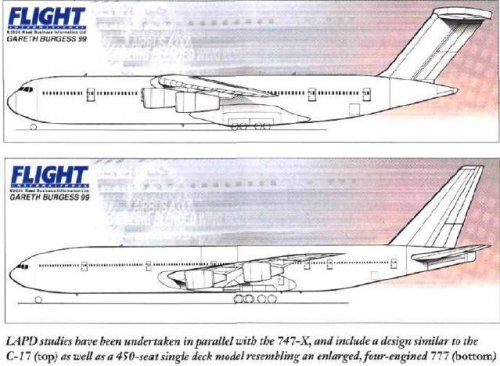
the Boeing developed an airliner project similar to concept of the
Military aircraft,the C-17,Also the company designeda four engined
version of Model-777.
http://www.flightglobal.com/PDFArchive/View/2000/2000%20-%200048.html

These designs were also part of the New Large Airplane (NLA) study. The Large Airplane Product Development (LAPD) team at Boeing also closely evaluated the Antonov An-124, BAE Systems BAe 146, and Boeing/McDonnell Douglas C-17 Globemaster III. Based on this evaluation, they created a high-wing super jumbo design (at top)--the Model 763-241. It was configured with a 69-foot-tall T-tail, a 262-foot span and a length of more than 250 feet.

Source: Norris, Guy and Wagner, Mark Boeing 787 Dreamliner Zenith Press 2009 page 17.

CFE said:
The "enlarged, four-engine 777" reminds me of the Boeing 763 concept. I must admit that the single-deck idea is somewhat fascinating, because it allows for sleeper berths above the seats. The double-deck idea isn't all its cracked up to be if there's no way to directly access the upper deck from the boarding gate.

The design at the bottom is indeed the Model 763-246.
 
I'm looking for information, technical data, 3-line drawings, pictures etc about projects based on C-17 Globemaster III ( for example C-17B ).
 
Re: C-17 Globemaster projects

In 1992, McDonnell Douglas Corp. was talking with British jet-engine builder Rolls-Royce plc about putting Rolls-Royce RB211-535 turbofan engines on the Douglas-built C-17


Source: Luftwaffen-Forum, 01-1993, pages 44-45
 

Attachments

  • MDD_C17_RB211_535_engines_Luftwaffen-Forum_01_1993_page44_810x695.png
    MDD_C17_RB211_535_engines_Luftwaffen-Forum_01_1993_page44_810x695.png
    1.1 MB · Views: 1,969
From AFA:

Two C-17s drop-launched a pair of ballistic target missiles near Wake Island in the Pacific Ocean, supporting a recent Missile Defense Agency test. "High-altitude, heavy weight airdrop is something we're doing a lot of here at Edwards, supporting not only MDA, but NASA with the Orion capsule drops that we've been doing," 418th Flight Test Squadron pilot Capt. Stephen Koether from Edwards AFB, Calif., said in a Dec. 7 release. Edwards pilots initially deployed a Short-Range Air-Launch Target (SRALT) from the C-17's cargo bay, which was detected, tracked, and intercepted by a ground-launched Terminal High Altitude Area Defense (THAAD) missile. The second Globemaster launched a larger Extended Medium-Range Ballistic Missile (EMRBM) minutes later, testing defensive systems' ability to discriminate targets through debris from the first shot. The THAAD system on Wake successfully intercepted the first shot, and although the AEGIS destroyer USS John Paul Jones was able to track the EMRBM, its SM-3 missile failed to engage, according to an MDA release. The Oct. 31 test evaluated both land- and sea-based US missile defense. MDA is investigating the missile interceptor failure.
 
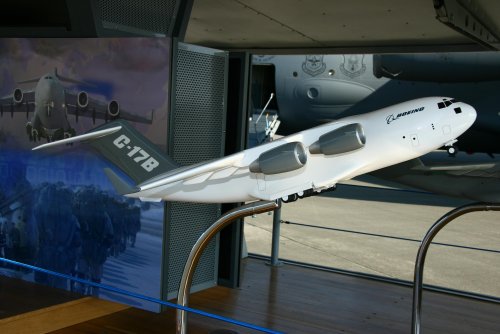
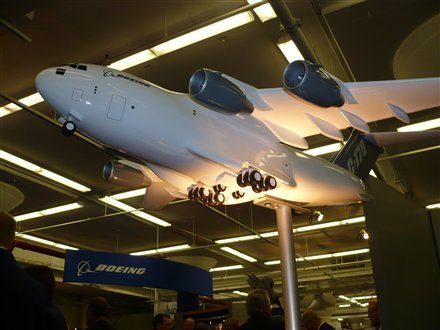
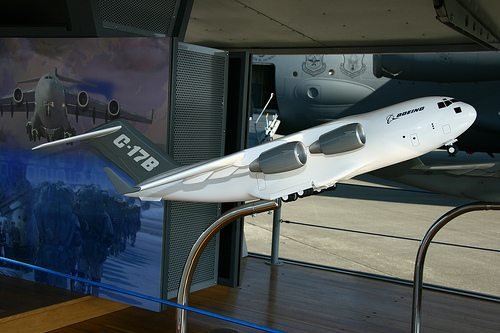
Model of Boeing C-17B

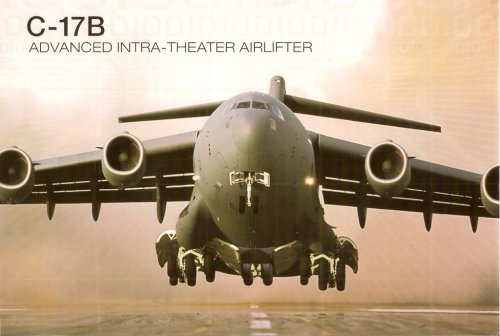
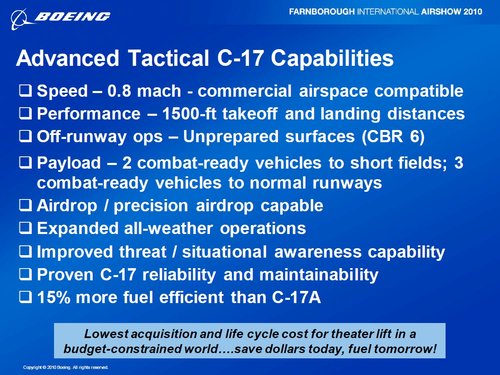
Another potential derivative was the Boeing C-17B. If you ever attended an airlift convention or airshow, you might have even seen a model of the upgraded Globemaster III. The C-17B was pitched as a way to allow landings at truly austere fields in locations where the “A” model couldn’t go. The C-17B featured a center-truck gear, self-deflating tires and double-slotted flaps to allow landing on even shorter distances. This variant was proposed a few times by Boeing in an attempt to extend the production line, the last time publicly in 2008. The “B” model never caught on though. The C-17 was already an expensive plane to operate and by 2008, congress started to reign in the massive defense budget that would have been necessary to fund this new variant. The War on Terror showed off the capabilities of the C-17 but it also exemplified that performance beyond its current capabilities were not required. Most missions did not require landing on a short or unimproved field. Even in poor nations like Afghanistan, most of the cargo could be delivered to a few established fields and transloaded to smaller aircraft like C-130s and/or convoyed to the final destination.

Source:
http://www.avgeekery.com/2015314three-c-17-derivatives-that-never-took-off/
http://bemil.chosun.com/nbrd/gallery/view.html?b_bbs_id=10040&pn=5&num=45696
 

Attachments

  • BEMIL081_45696_1.jpg
    BEMIL081_45696_1.jpg
    467.5 KB · Views: 890
  • BEMIL081_45696_0.jpg
    BEMIL081_45696_0.jpg
    131 KB · Views: 726
  • BEMIL081_45696_2.jpg
    BEMIL081_45696_2.jpg
    32.4 KB · Views: 753
Model of Boeing C-17B

Another potential derivative was the Boeing C-17B. If you ever attended an airlift convention or airshow, you might have even seen a model of the upgraded Globemaster III. The C-17B was pitched as a way to allow landings at truly austere fields in locations where the “A” model couldn’t go. The C-17B featured a center-truck gear, self-deflating tires and double-slotted flaps to allow landing on even shorter distances. This variant was proposed a few times by Boeing in an attempt to extend the production line, the last time publicly in 2008. The “B” model never caught on though. The C-17 was already an expensive plane to operate and by 2008, congress started to reign in the massive defense budget that would have been necessary to fund this new variant. The War on Terror showed off the capabilities of the C-17 but it also exemplified that performance beyond its current capabilities were not required. Most missions did not require landing on a short or unimproved field. Even in poor nations like Afghanistan, most of the cargo could be delivered to a few established fields and transloaded to smaller aircraft like C-130s and/or convoyed to the final destination.

Source:
http://www.avgeekery.com/2015314three-c-17-derivatives-that-never-took-off/http://bemil.chosun.com/nbrd/gallery/view.html?b_bbs_id=10040&pn=5&num=45696

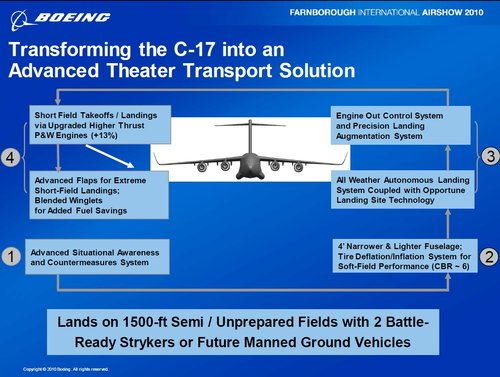
How would the C-17B differed from the C-17A?
 
Thanks! I still need to order the book though, I've been needing to do so for some time. I will order it as soon as possible.
 
How would the C-17B differed from the C-17A?
4 in narrower fuselage?
to lighten or some other purpose?

Not 4 inches, 4 feet (~1.2 meters). That's a pretty dramatic shrink, which would eliminate the ability to haul heavy tanks, but I guess would still accomodate Stryker (and maybe Bradley?). Would certainly be quite a weight and fuel savings, though. Combined with the higher flotation landing gear, it could make the C-17B C-17FE more capable in unprepared runways.

Edit: Realized that those slides likely refer to the FE, not the B.
 
Last edited:
Given the damage to C-130's operating out of "austere" landing locations, I suspect the USAF was loathe to risk a capitol asset to an unseen rock. I would like to poke them in the eye for that, but I can understand the rational.
 
Question....Could the C-17A be stretched like the C-141A was stretched to make the C-141B? Seems like a cheap way to gain some capability at a more reasonable cost than new builds. I dont know if the C-17 cubes out before exceeding weight lifting limits...
 
How would the C-17B differed from the C-17A?
4 in narrower fuselage?
to lighten or some other purpose?

Not 4 inches, 4 feet (~1.2 meters). That's a pretty dramatic shrink, which would eliminate the ability to haul heavy tanks, but I guess would still accomodate Stryker (and maybe Bradley?). Would certainly be quite a weight and fuel savings, though. Combined with the higher flotation landing gear, it could make the C-17B C-17FE more capable in unprepared runways.

Edit: Realized that those slides likely refer to the FE, not the B.
It’s all very Future Combat System vibe-y, the Army and Shinseki really believed they could move a light-mech Brigade in 96 hours and they needed all the lift assets possible. There are some FCS slides floating around showing the need for intra-theater planes.
 
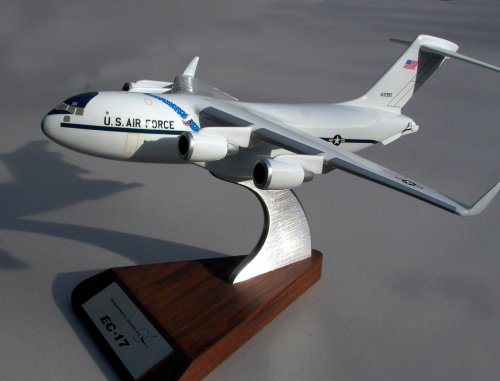
McDonnell Douglas EC-17 tanker, flying command post and electronic warfare platform:
circle-5
Question
If any wants the EC-17 tanker (with boom an with pods in the wing) MCD can build it?
Sad to say, Circle-5 passed away a few years ago.....

As to your question, don't see Boeing offering that option. They'll try to sell you converted 767s instead.

Mark
 
McDonnell Douglas EC-17 tanker, flying command post and electronic warfare platform:
circle-5
Question
If any wants the EC-17 tanker (with boom an with pods in the wing) MCD can build it?

So, obviously, McDonnell Douglas hasn't existed as a separate company in ages and I think the name hasn't even been used since ~2001 or so (I've lost track). It's all Boeing now. Also, Boeing stopped making C-17s in 2015 and then sold the plant to real estate developers in 2019. So not only has the horse left the barn, the barn is being torn down and turned into condos.
 
Last edited:
McDonnell Douglas EC-17 tanker, flying command post and electronic warfare platform:
circle-5
Question
If any wants the EC-17 tanker (with boom an with pods in the wing) MCD can build it?
Sad to say, Circle-5 passed away a few years ago.....

As to your question, don't see Boeing offering that option. They'll try to sell you converted 767s instead.

Mark
My bad
Thanks for you ansewer
 
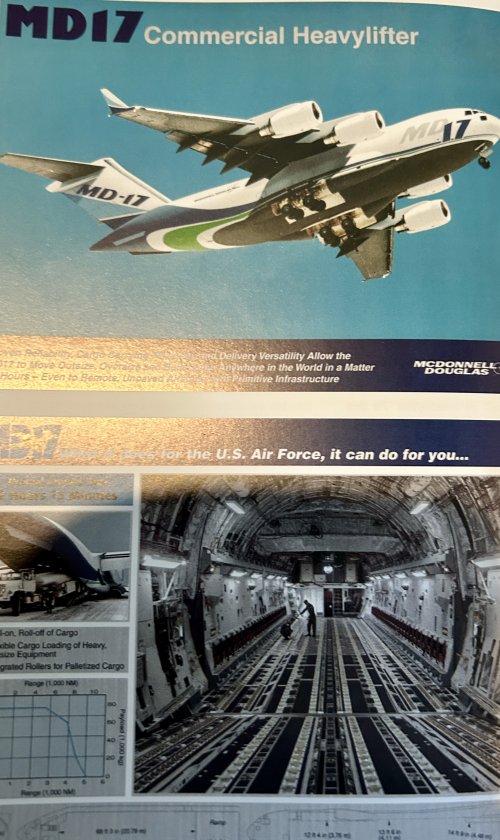
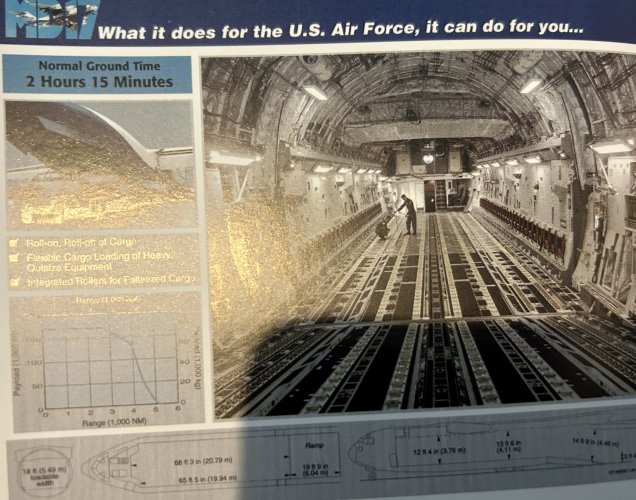
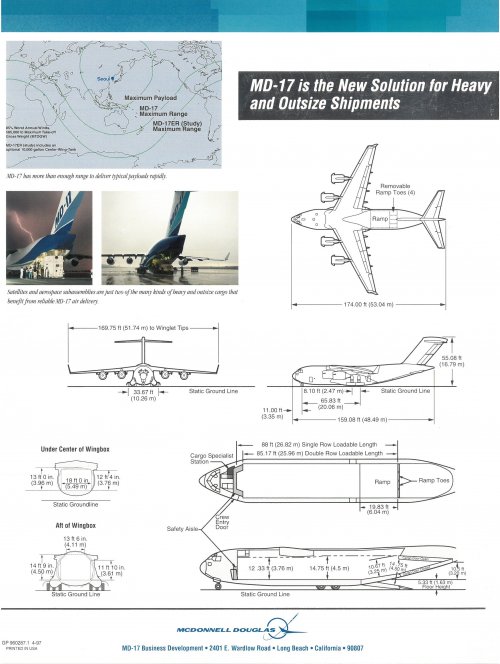
When i started my aviation career quarter of a century ago, in our offices near London Stansted Airport, on the wall nearest my desk was a marketing infograph from then McDonnell Douglas C-17 as a commercial airliner in the early 1990s. I will look through my photos and think theres one of me stood by my desk with said leaflet behind me on the wall but looked similar to this.

cheers
 

Attachments

  • 363337059_10161493422426490_1834163453435837593_n.jpg
    363337059_10161493422426490_1834163453435837593_n.jpg
    42.9 KB · Views: 672
Last edited by a moderator:
When i started my aviation career quarter of a century ago, in our offices near London Stansted Airport, on the wall nearest my desk was a marketing infograph from then McDonnell Douglas C-17 as a commercial airliner in the early 1990s. I will look through my photos and think theres one of me stood by my desk with said leaflet behind me on the wall but looked similar to this.

View attachment 704490


cheers
I don't think a derivative of the C-17 was ever proposed as an airliner (if that means a passenger-carrying aircraft in scheduled service), but as a civil freighter. The design characteristics that suit it for the military airlift role (requiring STOL operations from rough fields, airdropping and carrying heavy equipment) would make in uncompetitive in the regular airfreight business (FedEx, UPS) and it would be limited to specialty carriers, which isn't a big market.
 
I don't think a derivative of the C-17 was ever proposed as an airliner (if that means a passenger-carrying aircraft in scheduled service), but as a civil freighter. The design characteristics that suit it for the military airlift role (requiring STOL operations from rough fields, airdropping and carrying heavy equipment) would make in uncompetitive in the regular airfreight business (FedEx, UPS) and it would be limited to specialty carriers, which isn't a big market.
There is still a large market for outsize freight (mainly centred around the oil and gas industries, but occasionally you see some other things too, Railway locomotives for example). Unfortunately (for Boeing / McDD / whoever) most of that market is sewn up by the former eastern block / CIS countries with hand-me-down antonovs etc. These players could obviously undercut any prospective operation with western derived equipment.

Setting the obvious tragedy of the situation to one side and looking at it dispassionately, it’ll be interesting to see where the market goes to for its outsized lift as the main players (Ukraine and Russia) are effectively removed from the market for the foreseeable future. Certainly I don’t think there’s anything else out there that could replace the An124 & -224 that they offered.
 
I don't think a derivative of the C-17 was ever proposed as an airliner (if that means a passenger-carrying aircraft in scheduled service), but as a civil freighter. The design characteristics that suit it for the military airlift role (requiring STOL operations from rough fields, airdropping and carrying heavy equipment) would make in uncompetitive in the regular airfreight business (FedEx, UPS) and it would be limited to specialty carriers, which isn't a big market.
I seem to remember comments in Flight at the time that the civil derivative was also a stalking horse for a cost reduced ‘2nd line’ version for the UASF, operated by freight carrriers on commercial terms.

One of the reason for it not going ahead was Boeing tried to claim exemption from having to decertify the aircraft to civil standards, going on the notion that the aircraft would also be part of the military fleet, similar to CRAF. This would have been at the height of various attempts to contractorize various parts of the USAF, alongside the original leased tanker initiative.

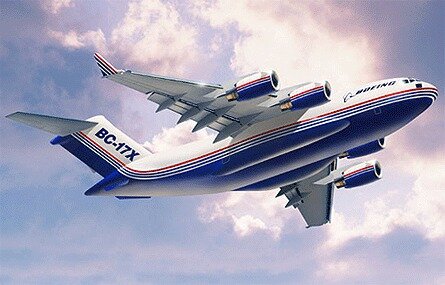
As such, it should come as no surprise to anyone who remember those times to see whose name was tied to the BC17 idea in the following link: https://www.govcon.com/doc/af-boeing-team-up-with-commercial-carriers-to-0002
 
Last edited:
I seem to remember comments in Flight at the time that the civil derivative was also a stalking horse for a cost reduced ‘2nd line’ version for the UASF, operated by freight carrriers on commercial terms.
OK, the linked article is talking about a proposed program to subsidize the operation of BC-17s by commercial carriers in return for a commitment to make them available in national emergencies. Subsidies can make operation profitable, but they don't really make the airplane competitive in any commercial sense.
Also, I contend that the market for outsize air cargo is tiny in comparison to other segments of commercial aviation. It seems to be adequately served globaly by several dozen airframes.
 
Question....Could the C-17A be stretched like the C-141A was stretched to make the C-141B? Seems like a cheap way to gain some capability at a more reasonable cost than new builds. I dont know if the C-17 cubes out before exceeding weight lifting limits...
brownt62, I just found this article in relation to your question:

"The USAF has not expressed any interest in a stretch version, which we have said is possible. The USAF has said to us, 'Why would you want to do that? The C-17 can carry now virtually everything the C-5 can'," says the company.
MDC "-has plans on the drawing board", for various stretched C-17s with fuselage plugs ranging from 3.6m to just over 12m long. Studies have indicated that a C-17 stretched by up to 6.1m could still have its current austere field performance.
A larger fuselage plug would require a longer take-off length and a wider runway (for turning and reversing) and possibly new powerplants in the 200-222kN (45,000-50,000lb)-thrust range.

Source: Flight International, 1996
https://www.flightglobal.com/globemaster-stretch-fails-to-find-favour-with-us-air-force/3964.article
Regards
Pioneer
 
Makes you wonder if they modded say 3 airframes, the tyres and engines would be straightforward to do, the flaps etc a little harder. Handy for those places you never go, if you see what I mean. And would look pretty much like regular C17....
Sounds like a Dale Brown "Dreamland Special" for sure!

especially if you skip the winglet change and don't lower the flaps all the way to not show off the double-slotted flaps where people are looking.
 
In the 2000s I went to an aerospace conference, probably the Air Force Association, and Boeing had a one-page brochure for the C-17B. I remember that it had artwork showing the additional landing gear under the fuselage. Might have had both artwork and a line drawing. (I tossed a lot of my brochures out years ago. Should have donated them to the Smithsonian.)

Does anybody know of other artwork for this C-17B variant? A quick internet search only turned up this photo of a model.
 

Attachments

  • C-17B.jpg
    C-17B.jpg
    34.3 KB · Views: 368
Last edited by a moderator:
I don't think a derivative of the C-17 was ever proposed as an airliner (if that means a passenger-carrying aircraft in scheduled service), but as a civil freighter. The design characteristics that suit it for the military airlift role (requiring STOL operations from rough fields, airdropping and carrying heavy equipment) would make in uncompetitive in the regular airfreight business (FedEx, UPS) and it would be limited to specialty carriers, which isn't a big market.

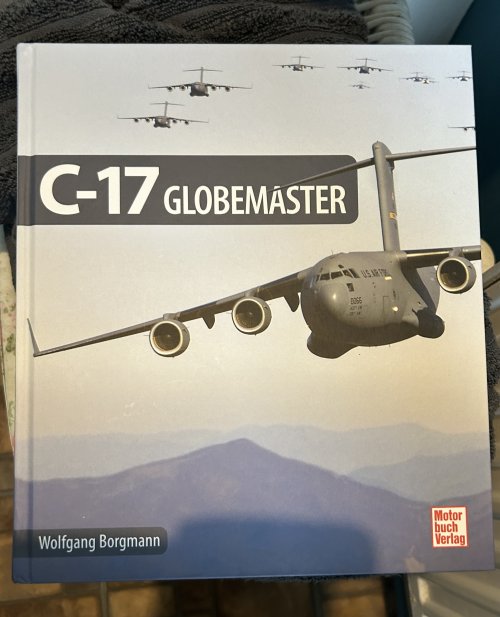
Forgot finally unwrapped my book albeit in German part of the Motor Velug publications

Cheers
 

Attachments

  • IMG_6507.jpeg
    IMG_6507.jpeg
    2 MB · Views: 199
  • IMG_6505.jpeg
    IMG_6505.jpeg
    2.7 MB · Views: 198
  • IMG_6506.jpeg
    IMG_6506.jpeg
    3.1 MB · Views: 218
Last edited by a moderator:
I asked this question in a discord channel, replace the 4 engines with 2 x GE X from the big ass Boeing 777x engines? One of the reasons being future proof for spare parts and my guess it would use less fuel. I know it would take some engineering considering the engine placement and I guess the stol would also get lower ....and ofc the price...but if you would produce enough the amortisation should quite fast
it would look like a big version of the Japabese C-2
It's just me thinking out loud
 
An interesting idea.
To add to the conversation: How much more do the 777 engines weigh compared to two current engines?
Does this require a redesign of the wing?

Thinking of the CH-53K logic I would think that a improved technology wing would be in order anyway.
 
Back
Top Bottom