Nik said:
IIRC, consensus was the UK's Mars Lander ultimately expired due too-thin atmosphere...

AFAIR, situation resembles that near summit of Everest: If jet-stream zags instead of zigs, local pressure drops by ~10% and the fatalities mount...

Wasn't the next NASA lander redesigned as a result ??

No, that was the explanation produced by some for the failure of Beagle 2, but there were so many problems with Beagle 2 that I doubt anybody bought the atmosphere excuse:

http://www.thespacereview.com/article/330/1

Because the Beagle 2 investigation report has disappeared from the UK govt. website (it's probably been moved somewhere else) I have attached it. Note the following on page 6:

"The Commission has concluded that there was no single programmatic error which led to the loss of Beagle 2. The following factors however contributed to increased mission risk:

-Treating Beagle 2 as a 'scientific instrument' rather than as a complex, innovative spacecraft;
-Lack of guaranteed funding during the early phases of development;
-The withdrawal of MBA, the designers of the EDLS,* from the project;
-Lack of an adequate management organisation with the relevant experience;
-Lack of available margins to manage and mitigate risks."

(*EDLS = Entry, Descent & Landing System)

The next NASA Mars lander was not redesigned, and it landed successfully.

I sure hope that the Europeans learned something from the Beagle 2 experience. Considering that they tried to bury the investigation report, I think they got off on the wrong track.
 

Attachments

  • Beagle2.pdf
    160.1 KB · Views: 19
Nik said:
IIRC, consensus was the UK's Mars Lander ultimately expired due too-thin atmosphere...

AFAIR, situation resembles that near summit of Everest: If jet-stream zags instead of zigs, local pressure drops by ~10% and the fatalities mount...

Wasn't the next NASA lander redesigned as a result ??

If you mean the NASA Marslander after Beagle 2,
that was 2007 Phoenix Scout, who was slightly redesigned Mars Polar Lander
but that had nothing to do with too-thin atmosphere...

it's sad that Mars was a disillusion after Mariner 4
I love the Edgar Rice Burroughs and Ray Bradbury version of Mars
had Mars be like that, hell year US had send Manned Missions to Mars long time ago
ironically FAIL:
a Philco Lander on Mars with four Astronauts abstinence over six mounths spaceflight,
besieged by naked orange hotties armed with sword&guns...
;D
 
Nik said:
I stand corrected...

Take a look at the report. It's pretty damning.

The Beagle 2 story is a good one. The guy who was behind it, Colin Pillinger, often used an anti-American theme to fund his mission, claiming that he was doing Mars the "right" way, unlike the dummies at NASA. Many years ago I was told by a senior NASA Mars program manager that eventually somebody spoke to Pillinger about that and told him he needed to ratchet down his rhetoric if he wanted American help on his mission (at the very least he was going to need the Deep Space Network for communications, and he later had engineering support). In the end, it was a review by JPL that identified the many problems with the spacecraft.

The point I made in my article is something that I learned working on the CAIB--an investigation is not very useful if all it does is identify the problems. The conclusions have to be public and widely distributed so that people learn from mistakes.
 
Michel Van said:
it's sad that Mars was a disillusion after Mariner 4


I vaguely remember reading that Mariner 4 gets all the credit, but that in actuality the thinness of the Martian atmosphere was discovered by telescopes in the year or so before that mission. It was pretty widely accepted among space scientists. Mariner 4 merely confirmed it.
 
blackstar said:
Michel Van said:
it's sad that Mars was a disillusion after Mariner 4


I vaguely remember reading that Mariner 4 gets all the credit, but that in actuality the thinness of the Martian atmosphere was discovered by telescopes in the year or so before that mission. It was pretty widely accepted among space scientists. Mariner 4 merely confirmed it.


I was referencing on Mariner 4 picture: no channels or vegetation, but a Lunar like landscape with craters

After discovery of too thin Mars Atmosphere
the Mars lander became Capsule like with rocket engine landing, like NAA 1968 Mars lander
 
Michel Van said:
I was referencing on Mariner 4 picture: no channels or vegetation, but a Lunar like landscape with craters

After discovery of too thin Mars Atmosphere
the Mars lander became Capsule like with rocket engine landing, like NAA 1968 Mars lander

There's a pretty good NASA monograph that discusses how studies of human Mars missions changed substantially after the atmosphere model changed:

http://history.nasa.gov/monograph21/humans_to_Mars.htm

What you describe is also correct. There have been several times during our study of Mars over the past 6+ decades where our understanding of the planet shifted and that shifted the exploration strategies. I believe that once those Mariner 4 pictures showed that Mars was more like the Moon than like our imagination, it decreased general interest in Mars exploration.

Another important one was after Viking. Those missions cost so much, and their failure to discover life was so disappointing, that it made it extremely difficult for the United States to fund further Mars missions. The next one did not fly until the early 1990s, and it failed, which then contributed to yet another shift in the exploration program.
 
I believe that once those Mariner 4 pictures showed that Mars was more like the Moon than like our imagination, it decreased general interest in Mars exploration.

...It inarguably did, and the same effect happened with Venus once it became apparent that underneath all those clouds there wasn't anything resembling a primordial jungle with a perpetual global rainshower. Had either planet shown even the slightest hints of water - if not processes associated with life - then we'd have already landed and probably colonized by now. After almost five decades of studying both planets in detail, the fact that the presence of water locked under the soil has given Mars a clear lion's share of interest and further study.

Who was it that said "follow the water" anyhow? Sagan or Clarke?
 
Semi-OT/Side note, just got done reading the second book in a "new" S.M. Stirling series "In The Court of the Crimson Kings"
It takes place in a "universe-next-door" where High-Tech Galactics took and interest in the Solar System 200-million years ago and "terra-formed" both Venus and Mars as well as transplanting primitive Earth life on both worlds.

The first book, (which I have not yet read) takes place on Venus and is called "The Sky People" dealing with finding a tribe of primitive humans there that are worshiping a "galactic" artifact and (since the cold war is still going on in 2000+) dealing with both the item, the people on Venus and power-struggles on and off Earth.

ITCotCK takes place on Mars and opens with the "live-TV broadcast" of the "Viking" lander(s) in 1962, specifically in the "pro" suite of the 1962 World Science Fiction Convention :)

The premis is since we pretty much KNEW both Venus and Mars has Oxygen atmospheres AND we could see some artificiality on Mars (the Canals) when we and the Soviets went into space we "bypassed" an orbital or Lunar "space-race" for the planets.

All and all a fun read.

Randy
 
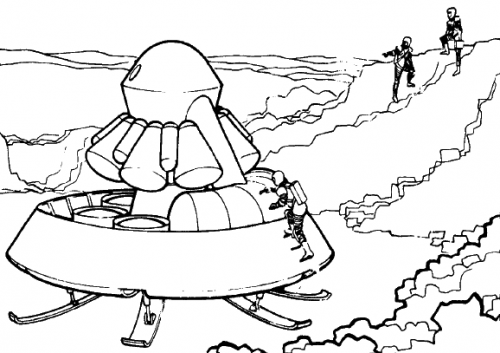
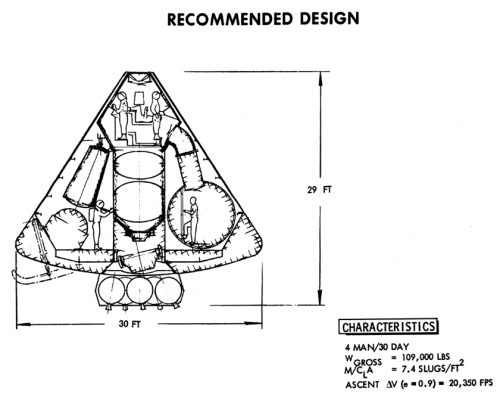
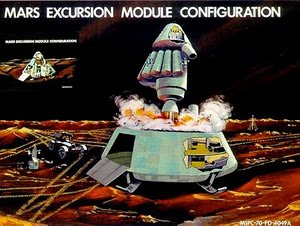
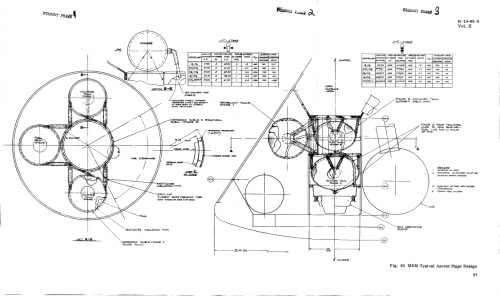
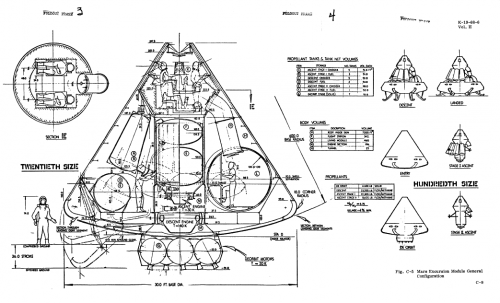
back in 1967 NAA made study NAS9-6464 for MEM for NASA
They look into Lifting Body and Capsule shaped lander. last what was recommended

Total mass of 64000 kg for 4 man 30 day stay on Mars
The descent stage weight is 29207 kg with 13834 kg fuel
The ascent stage weight is 16874 kg with 9480 kg fuel
With 2040 kg scientific payload down, 136 kg payload (soil samples) up.
Power supply by fuel cells.

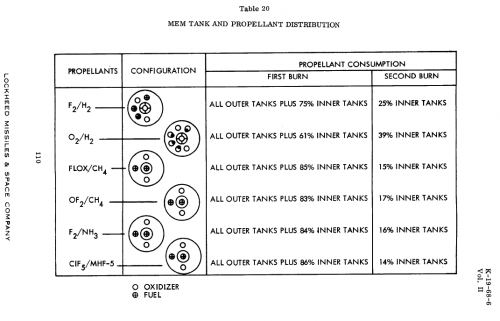
as fuel NAA prosed FLOX/CH4 or FLOX/MMH because LOX/LH2 can not achieve the ascent speed
for rocket engine NAA favored for plug nozzles
RCS system NAA want to use toxic ClF5/MHF-5 fuel !


Got someone more picture on this design ?


Source:
Definition of Experimental Test for a Manned Mars Excursion Module
Final Report Volume IV, November 1967
North American Rockwell Corporation
SD 67-755-4
NAS9-6464
 

Attachments

  • NAA_MEM_001.png
    NAA_MEM_001.png
    21.5 KB · Views: 701
  • NAA_MEM_002.png
    NAA_MEM_002.png
    44.3 KB · Views: 678
Michel Van said:
Got someone more picture on this design ?

Go to NTRS and dig around the late 1960s human Mars mission documents. There's quite a bit there.

I always loved this design since I first saw it, and it has been used in several different proposals and various artwork.

However, it's probably not workable. You can look up Bobby Braun's paper on Mars entry, descent and landing from around five years ago (I think his co-author was Manning). He demonstrated that existing Mars EDL designs were insufficient above about one ton. The Mars Science Laboratory Curiosity, which is currently on its way to Mars, is about the maximum size payload we can land on Mars without developing entirely new technology. That might include hypersonic deceleration rockets and/or large, lightweight reentry shields.

Simply put, something shaped like this landing craft would not slow down sufficiently before it slammed into the surface of Mars.
 
blackstar said:
Go to NTRS and dig around the late 1960s human Mars mission documents. There's quite a bit there.
from ze zillion MEM proposals in NTRS, is only ONE file about NAA MEM !

blackstar said:
I always loved this design since I first saw it, and it has been used in several different proposals and various artwork.
it became Iconicity symbol in 1970 to 1980 for manned mars landing, they even still proposed in 1980s as Lander !
it even end up in comics and movies ! (like germany TV movie "Operation Ganymed" form 1977)

blackstar said:
However, it's probably not workable. You can look up Bobby Braun's paper on Mars entry, descent and landing from around five years ago (I think his co-author was Manning). He demonstrated that existing Mars EDL designs were insufficient above about one ton. The Mars Science Laboratory Curiosity, which is currently on its way to Mars, is about the maximum size payload we can land on Mars without developing entirely new technology. That might include hypersonic deceleration rockets and/or large, lightweight reentry shields.

Simply put, something shaped like this landing craft would not slow down sufficiently before it slammed into the surface of Mars.
yes, your right. this MEM need more fuel for landing or much bigger inflatable heatshield
 
The title of the paper is:

"Mars Exploration Entry, Descent and Landing Challenges"

by Robert Braun and Robert Manning. You can enter that in Google and easily find a pdf. It's an easy read.
 
Thx for PDF Blackstar

the NAA MEM was so popular that even 17 year later in 1985
the Marshall Flight Center overwork the NAA Design
they replace the proposed FLOX/CH4 Fuel and Plug in engine, by conventional hardware and fuels


Source
The Dream Machines, By Ron Miller - ISBN 0-89464-039-9
page 530
 
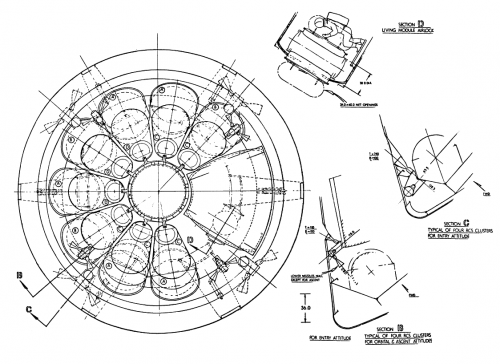
Just found these picture in this PDF


Propellant Selection for Spacecraft Propulsion Systems,
Volume II: Mission and vehicles
Contract NASW-1644
Lockheed, 30 August 1968
 

Attachments

  • NAA_MEM_006.png
    NAA_MEM_006.png
    40.4 KB · Views: 148
  • NAA_MEM_005.png
    NAA_MEM_005.png
    66.9 KB · Views: 342
  • NAA_MEM_004.png
    NAA_MEM_004.png
    87.5 KB · Views: 1,055
  • NAA_MEM_003.png
    NAA_MEM_003.png
    96.6 KB · Views: 1,058
Michel Van said:
they replace the proposed FLOX/CH4 Fuel and Plug in engine, by conventional hardware and fuels

I cannot believe that they were originally proposing carrying FLOX all the way to Mars!

That stuff is nasty even in the best circumstances. Would you really want to rely on it staying contained during the trip to Mars? It's just scary stuff.
 
blackstar said:
I cannot believe that they were originally proposing carrying FLOX all the way to Mars!

That stuff is nasty even in the best circumstances. Would you really want to rely on it staying contained during the trip to Mars? It's just scary stuff.

the Fluorine would create a protective layer on inside of oxidizer tank, therefore consider as long storage fuel.
there only concerned was that FLOX (Fluorine oxygen mixture) would separate and the Engine would suck pure Fluorine.
alternative they look to used Oxygen difluoride
The Picture MEM_005 and 006 show the tanks for this fuels combination

So the Picture MEM_003&004 show a the Lh2/LOX version ?
 
Michel Van said:
the Fluorine would create a protective layer on inside of oxidizer tank, therefore consider as long storage fuel.

40 years later and nobody has ever done that. Fluorine just isn't nice stuff to work with. It's way too dangerous, which is why nobody uses it even for robotic spacecraft.
 
I've been looking at this and trying to figure out how this compares to the Von Braun "Integrated Plan."

The Boeing version shows FIVE NERVA-type rockets. Three at the base, and two stacked on top. But the Von Braun one apparently only had three. I'm not sure what was the last version. Was it the Von Braun one?
 
The IMIS study is pretty exhaustive and is a serious attempt to define a manned interplanetary mission, including both technical and programmatic issues. (The launch vehicle study for me was worth the price of admission.) The STG report and IPP were more about the high-level program visions and some of the mission modeling, but assumed the existence of systems like the NERVA shuttle and the space base without a great deal of technical detail. Here's an example of a von Tiesenhausen-authored report on the various STG missions and components:

http://hdl.handle.net/2060/19700026519

And here's the STG summary report:

http://hdl.handle.net/2060/19710002945

The Boeing study was conducted in 1967-68 (concurrent with the AMLLV study in it's original 75-foot-diameter guise). The STG/IPP was in 1969-1970, concurrent with the incoming Nixon Administration. I don't know of a specific spacecraft configuration study, but there must have been one. Might be worth a look through Beyond Apollo to check the references at the end of Portee's blog entries. The Bellcomm documents have useful references as well, but those titles are somewhat unhelpful so it takes a little digging to find the nuggets of information you need.
 
George Allegrezza said:
The IMIS study is pretty exhaustive and is a serious attempt to define a manned interplanetary mission, including both technical and programmatic issues. (The launch vehicle study for me was worth the price of admission.) The STG report and IPP were more about the high-level program visions and some of the mission modeling, but assumed the existence of systems like the NERVA shuttle and the space base without a great deal of technical detail. Here's an example of a von Tiesenhausen-authored report on the various STG missions and components:

http://hdl.handle.net/2060/19700026519

And here's the STG summary report:

http://ntrs.nasa.gov/archive/nasa/casi.ntrs.nasa.gov/19710002945_1971002945.pdf

The Boeing study was conducted in 1967-68 (concurrent with the AMLLV study in it's original 75-foot-diameter guise). The STG/IPP was in 1969-1970, concurrent with the incoming Nixon Administration. I don't know of a specific spacecraft configuration study, but there must have been one. Might be worth a look through Beyond Apollo to check the references at the end of Portee's blog entries. The Bellcomm documents have useful references as well, but those titles are somewhat unhelpful so it takes a little digging to find the nuggets of information you need.

I got some feedback here:

https://falsesteps.wordpress.com/2012/08/08/mars-expedition-1969-nasas-waterloo/

He wrote:

"The coordinating document is “America’s Next Decades in Space: A Report to the Space Task Group”, but it’s only 84 pages long (and there’s no copies on the web that I’ve ever been able to find). Most of the meat is scattered everywhere, though."

I don't have that document, although they may have it at the NASA History Office and I will contact them. So I get the sense that Boeing did a very detailed study, but they proposed a very big vehicle. Then Von Braun (and probably George Mueller) scaled it down.

The Boeing study is interesting, but they were proposing a pretty massive project. Just looking at the required upgrades to the Cape indicates that they wanted something bigger than Apollo. In the 1968 timeframe that was not realistic at all. They must have been oblivious to the political winds.
 
It's on NTRS. I entered a faulty link to it in my post above. I corrected it there and here it is:

http://hdl.handle.net/2060/19710002945

I concur that the Boeing program wasn't in sync with the likely funding and desire in 1969-70, but of course it had been started in 1967, which means it was probably conceived in 1966, and things were much less bleak then in terns of NASA's future. Also, bureaucracy being what it is, there was probably a certain desire to complete the study as contracted even if there wasn't much of a chance that the program would be implemented.
 
George Allegrezza said:
It's on NTRS. I entered a faulty link to it in my post above. I corrected it there and here it is:

http://hdl.handle.net/2060/19710002945

I concur that the Boeing program wasn't in sync with the likely funding and desire in 1969-70, but of course it had been started in 1967, which means it was probably conceived in 1966, and things were much less bleak then in terns of NASA's future. Also, bureaucracy being what it is, there was probably a certain desire to complete the study as contracted even if there wasn't much of a chance that the program would be implemented.

Thanks. I just found it after I posted.

As for the Boeing study, they did what they were told to do. The problem was the overall mentality, and that was reflected in the Apollo Applications Program as well. They were all thinking way too big. No grounding at all. Now if somebody at the top had approached the subject differently, more realistically, they might have gotten a better outcome. For instance, what if their ground rules were: "Design a minimal system for sending X number of men to the Moon by X date. Minimize new hardware development and ground modifications wherever possible. Keep costs below Apollo program costs." That might have provided a different answer. Perhaps one 4-man spacecraft, instead of two 6-man spacecraft. That's partly why I'm interested in how they went from the big Boeing spacecraft to the smaller version that WvB advocated a short time later. What were the trades that got them down in size?
 
Not to go down the path of one of those dreadful NSF alternative history “discussions”, but with perfect hindsight we can see that had we deferred some things and found a way to maintain the Saturn-Apollo system and the Skylab design, we could have had an austere cislunar infrastructure in the 1970s with even an ability to do flybys of Venus and under certain circumstances, Mars. Both the S-II and S-IVB could have been used as Earth departure stages, Skylab as a habitat, and Apollo in the Orion role as the crew transportation system.

Modest upgrades such as orbital refueling, uprated Saturn engines for an INT-2X, and a LEM-based shelter could have provided an extended surface stay capability.

If a modest increase in the budget had become available, we could have been able to develop a minimal NERVA, and eventually a MEM. A NAC design (Nuclear TMI, Aerodynamic Mars Capture, Chemical Mars departure) and a four-man crew would have had a Saturn-friendly IMLEO and a decent chance at success in the 1980s.

Obviously this all costs money, so the question remains, if the managers of the day had seen the writing on the wall and had been willing to sacrifice the Shuttle and the STG/IPP vision, would these programs have fit under the funding curve for say FY 1970-1985? Perhaps, a major lunar or planetary expedition (but not both) every couple of years and an ongoing BEO presence in Skylabs? Impossible to know, of course, but from a technical perspective it would have been feasible.

Clearly, and again with perfect hindsight, the Shuttle was an unfortunate excursion that required the sacrifice of the BEO infrastructure to build an LEO infrastructure that took 30 years to come to fruition.

And a final note, von Braun himself argued against expensive and ultimately unsustainable programs in his 1962 LOR decision argument (fearing he might have been faced with trying to support Advanced Saturn, Saturn C-8/Nova, and two different versions of Apollo.) It’s well worth the read and a tribute to his pragmatism.
 
I personally don't believe that the Mars proposal was at all realistic, no matter how scaled back from this Boeing proposal or the Integrated Plan version. I do think that it would have been possible to continue a lunar program and maybe a manned space station program, if NASA had made the right pitch and brought the costs down (there was a good discussion on NSF awhile ago about actual plans to reduce Apollo hardware costs, which is something I was never aware of).

I think that one of the things that so fascinates me is how completely unrealistic these ideas were. The Boeing Mars study was really proposing a level of effort that was greater than Apollo. By the time they were performing that study they should have realized that the arrows were going in the other direction. Had they been truly smart, they might have included a "minimal" option that could have formed the basis of a more realistic program.
 
I think the difficulty with anything post-1969 is that the OMB was is the midst of being reorganized and Ehrlichman and Haldeman made it clear that budget cuts were the way to move forward in the Nixon administration. They were looking for a way to keep all costs to a minimum without political fallout, and NASA was the easiest to squeeze -- the general public weren't actually all that interested in space, post-Apollo revisionism to the contrary.

The Shuttle had the advantage of being (at the time) relatively cheap, without putting on Nixon the onus of being the Man Who Killed the Space Program. The costs would have ramped up on the far side of his second administration (post-1976, in other words, Watergate still being a hotel at the time), so "The Berlin Wall" could get it off his worry list and dump the issue on whoever followed him.

(This is off the top of my head here at work, so I am most willing to be corrected on this.)
 
Okay, here are the captions for the slides the Von Braun used for his presentation to the Space Task Group about the Integrated Plan. I think that what I uploaded earlier (I have not read it yet) was the report, and these are the captions that he would have read.

I don't have the images, but some of them have already been posted elsewhere. See NSF, for instance.


UPDATE: Still have not read what I uploaded earlier, but the guy who sent it to me said that he thought it was the draft, and the second group of stuff is the final version. What we still don't have is the study/report/work that these slides are based upon. There must have been something more detailed than this. After all, they went from the monster Boeing spacecraft concept to something smaller, with reusable nuclear tugs, and that would have required some engineering analysis.
 

Attachments

  • VBpresentation.pdf
    630.9 KB · Views: 58
Here more on NAA Mars lander used in Boeing IMIPS study


naa_mem_004-png.145563


naa_mem_003-png.145561


More here
 
Last edited:
Michel Van said:
Here more on NAA Mars lander used in Boeing IMIPS study

That lander is rather cool. But I'm really curious if it was actually practical. The 2006 Braun/Manning paper on Mars entry, descent and landing (you can Google it) indicates that conventional approaches to deceleration and landing like we have used so far cannot scale up above one ton. We've pretty much maxed them out now. So this Apollo capsule shape might have slammed into the ground before it could have slowed down enough to land.
 
blackstar said:
That lander is rather cool. But I'm really curious if it was actually practical. The 2006 Braun/Manning paper on Mars entry, descent and landing (you can Google it) indicates that conventional approaches to deceleration and landing like we have used so far cannot scale up above one ton. We've pretty much maxed them out now. So this Apollo capsule shape might have slammed into the ground before it could have slowed down enough to land.


The Von Braun proposal use the same NAA Mars Lander MEM like Boeing
in fact the design was so good that Marshall Flight Center overwork the MEM Design in 1985 for a Manned Mars Mission proposal


On Landing the NAA Mars lander MEM compare to Curiosity
MEM use a de-orbit engine, means it's much slower as Curiosity on entering the Mars atmosphere coming direct from Earth,
it use a 9 meter ø heatshield vs. 4.75 meter shield used on Curiosity, MEM got almost 4 times more surface.
the MEM use Mars Atmosphere to slow down with 7 G from Mars orbit. Curiosity coming with much higher speed, need 15 G.
MEM deplores a drag chute then a ballute to slow down, Curiosity use a supersonic parachute in 10 km hight and mach 1,7 and slow down the probe with High G force
MEM cut the ballute 3 km over ground and goes on powered descent, Curiosity at 1.8 km hight
MEM got 13834 kg fuel with ISP of 405sec for landing. Curiosity skycrane only 380kg Fuel with ISP of 221 sec. MEM got almost double ISP


of course the ballute is not efficient for Mars, would had be replace by a supersonic parachute
and there is this problem, Contamination that one of reason the Skycrane was used to keep rocket fuel away from Mars surface and the dust low.
MEM design using FLOX/CH4 on decent engine and toxic ClF5/MHF-5 fuel on rcs, would Contaminate the Mars surface on landing site...
 
i forgot some details

Curiosity entering the Mars atmosphere with 5.8 km/sec
While MEM comes entering with 4.6 km/sec

also is the MEM Mars orbit 500km x 32910 km, Why ?
it was a compromise for Mothership to stay in Communication with MEM crew on Mars and study the Mars surface from 500 km hight.

other ideas was enter in 500km x 32910 km around Mars drop MEM at 500 km, then Mothership goes in Mars GEO over MEM landing site
if MEM return in orbit, the Mothership goes back 500km x 32910 km. pick up the crew and soil samples.
for rest of Mars stay the Mothership mapping the Mars surface with high resolution cameras.
 
Michel Van said:
also is the MEM Mars orbit 500km x 32910 km, Why ?
it was a compromise for Mothership to stay in Communication with MEM crew on Mars and study the Mars surface from 500 km hight.

Von Braun also discovered that using an elliptical orbit around Mars instead of a circular one let him drastically reduce the amount of propellant he had to send along. It's one of the major reasons for the differences between the IMIS and the IPP versions of the Mars mission.
 
Interesting stuff. I have been away on travel a lot lately and also busy with work (trying--and failing--to save the nation's civil space program) and so I haven't really gotten back to writing about this subject. I'm going to have to go through this material carefully.

I still wonder how much they did the engineering trades. Reusing the nuclear stages might have seemed like a good idea, but I really wonder about the practicality. There is a performance penalty for that. But it's worth asking if you would really want to bring a hot nuclear reactor back to low Earth orbit. I personally think that the risk of accidental reentry would be very low, but it would not be zero. And the reactors would contain hundreds of pounds of uranium. They'd be a serious menace if they reentered.
 
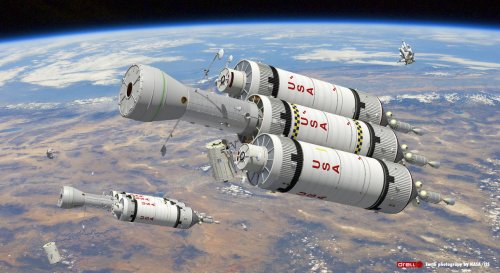
Drell7 on DeviantArt has done some great illustrations of the WvB version of this Mars mission.
 

Attachments

  • argosy_t_minus_20_hours_by_drell_7-d4e4u0i.jpg
    argosy_t_minus_20_hours_by_drell_7-d4e4u0i.jpg
    226.4 KB · Views: 644
Oh that's so good. There's a gallery there http://drell-7.deviantart.com/gallery/34148119 and more galleries there http://drell-7.deviantart.com/gallery/
 
Yes, I should have posted a link to his gallery. Some really nice stuff there.
 
blackstar said:
Drell7 on DeviantArt has done some great illustrations of the WvB version of this Mars mission.

From PMs asking me about my sordid past I know that there's some overlap between the two communities, so I'll mention that Drell7 is Tom Peters. He's a friend of a friend because most of our professional work has been related to the SF role-playing game Traveller -- he as a well-known artist for Digest Group Publications in the 80s and 90s, and myself as a writer slightly later for Steve Jackson Games.

When he isn't drawing SF spaceships he has a very good handle on realistic ones. I believe he worked/works in the telecoms satellite industry as an illustrator.
 
I've been trying to get to writing about this one and am working on trying to bridge the gap between the Boeing study and the proposal that was presented to the Space Task Group in 1969. The question I have is who revised the Boeing study. Was it Wernher von Braun and his team, or George Mueller and his team? I should have some data on that soon. I was told that von Braun had little input to Mueller's "Integrated Plan," but it is possible that von Braun's team handled the Mars stuff and Mueller's team passed on some things like the space tug for them to incorporate into the Mars architecture design.
 
blackstar said:
Reusing the nuclear stages might have seemed like a good idea, but I really wonder about the practicality. There is a performance penalty for that. But it's worth asking if you would really want to bring a hot nuclear reactor back to low Earth orbit. I personally think that the risk of accidental reentry would be very low, but it would not be zero. And the reactors would contain hundreds of pounds of uranium. They'd be a serious menace if they reentered.

Some hindsight at NERVA safety issues here
http://www.wired.com/wiredscience/2012/09/nuclear-flight-system-definition-studies-1971/

Osias postulated a maximum allowable radiation dose for an astronaut from sources other than cosmic rays of between 10 and 25 Roentgen Equivalent Man (REM) per year. Astronauts riding an RNS would, however, receive 10 REM each time its NERVA I engine operated. An astronaut 10 miles behind or to the side of an RNS operating at full power would receive a radiation dose of between 25 and 30 REM per hour. Osias noted that the NFSD contractors had recommended that no piloted spacecraft approach to within 100 miles of an operating NERVA I engine.

A little scary, isn't it ?
 

Similar threads

Back
Top Bottom