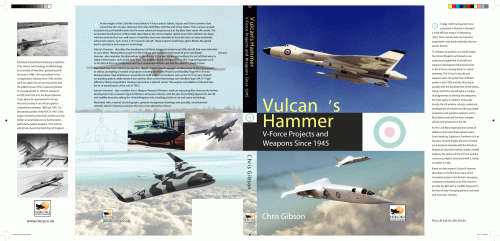
Vulcan’s Hammer
Introduction – Postwar economic, political and military climate. Difficulties in locating targets in the Soviet Union.
Chapter 1 – The Alternative V-Force - Expendable bombers such as Blue Moon and US equivalents. The minimum expendable bomber.
Chapter 2 – The Sons of Vulcan – Bristol RA.4 and RA.6 target marker, OR330: Avro 730, Vickers SP.4 and English Electric P.10 reconnaissance versions. Conversion to bomber aircraft and the problems of weapons delivery at Mach = 2.5. Much new info on the SP.4 and P.10 variants including a fighter. Avro 730 bomber configurations and the Red Drover radar. Decoys and countermeasures for the OR.330 aircraft. Alternatives to the OR.330 including Avro’s supersonic strategic and tactical reconnaissance UAVs.
Chapter 3 – Gravity Bombs – brief look at Britain’s free-fall weapons. Glide bombs and weapons to arm VTOL aircraft. VTOL / STOVL types such as Avro’s 727/730, the Vulcan jump-jet and Wallis’ fluid deterrent.
Chapter 4 – The Steam Engine – Red Cat and Blue Steel. Development of the powered bomb for the V-Force. How Blue Steel evolved and how Avro had planned to improve it, only to be scuppered by an increasingly exasperated Ministries and Air Staff. How the ORs came full circle to turn Blue Steel into Red Cat at the end of the day. The perceptive observations of Mr Chilver.
Chapter 5 – The Long-Range Job – OR.1149 and OR1159 – weapons from Avro, Vickers , HP and EECo and how the requirement for OR.1149 was beyond the state of the art. The switch to OR.1159 and how HMG discovered that Blue Steel Mk.2 wasn’t the same as Avro’s Blue Steel Mk.2.
Chapter 6 – Pofflers – Skybolt as the saviour of the V-Force, how Skybolt was snapped-up by the Air Staff and ministries. How Victor was intended to carry Skybolt from the start, but prevented by economics. Sandys’ (correct) cepticism and the shock on cancellation. The Pofflers including Vulcan Phase 6, HP.114, Vickers VC10, Belfast and HP.117. Why TSR.2 wouldn’t have carried Skybolt. Examines laminar flow control technology research carried out by HP including the HP.113, HP.117, HP.119 and HP.130.
Chapter 7 - Insurance - OR.1182 and seditious talk. The Gap-Filler flap to maintain credibility in the interim period between Blue Steel obsolescence and Polaris deployment. The numerous gap-filler weapons that were proposed and came to naught, including Air-launched Blue Water, Pershing and Polaris. Avro weapons such as more Blue Steel variants such as the Z.122 for TSR.2 and the W.130 and W.140 missiles for Spey Mirage and V-bombers. British ALBMs such and Hatchet and X-12B. All for naught as a Blue Steel modified for low altitude launch became the default option – Red Cat for want of a better description.
Chapter 8 – Exotica – Was Sandys the real villain of the piece? Avro’s ballistic missiles, hypersonic test vehicles, ASATs, Thor-boosted Blue Steels, zip-fuel trials vehicles, the Toblerone missile and the Z.59 with nuclear ramjet propulsion. Avro’s work on satellite launchers including the maglev launched Z.133.
Chapter 9 – Post Polaris – Small weapons for the 80s and 90s including the Vulcan “Red Barrel” ADV with Sea Dart or Phoenix AAMs, the Shrike ARM and Paveway LGBs. Cruise missiles such as the Tomahawk and the RAE’s studies for British Cruise missiles. Potential carriers such as the FLA and how to put a redundant Nimrod AEW to work. A look at the contenders for SR(A).1244 including the ASMP and yet another Grand Slam.
Appendices include Avro Weapons Research Division projects and Project E weapons