Origins of Hit-to-Kill Technology
Discussions of hit-to-kill interceptors date back to ARPA's ProjectDefender which was started soon after ARPA was established in 1958. In aJuly 1960 address to a gathering of representatives of the missile defense community, Dr. Harold N. Beveridge noted that the "quest for a cheap kill in a terminal defense system" had led Project Defender participants to conclude that hit-to-kill systems were feasible:
Computer simulation runs on several types of interceptors weighing about 50 lbs., and using IR homing have resulted in miss distances of one or two feet. This certainly indicates hyper velocity impact kill could be employed. Incidentally, a nose cone travelingat ICBM velocities in collision with one pound of material releases the energy equivalent of 6 pounds of TNT. In a word, the kinetic energy at that velocity exceeds the chemical energy available at that mass.
Within about two years of Beveridge's remarks, LTV Aerospace Corporation conceived the Homing Interceptor-Terminal (HIT). HIT was to be "as mall and lightweight, spin stabilized, optically guided interceptor that achieves hypervelocity direct impact kill of reentry vehicles in the exoatmosphere." In spite of its small size (about fifteen pounds), it was to have "all the features of a large conventional interceptor." Furthermore, HIT's small size meant that several interceptors could be mounted on a single booster, offsetting to some extent the advantage of MIRVed ICBMs. Finally, HIT was to havea fundamentally simple design that involved no moving parts.
HIT's control forces were produced by tubular, solid-propellant impulse motors, each with a nozzle located midway along its tube. A number of these motors were assembled into a tube of tubes, with the motor nozzles pointingoutward. In one version, sixty-four motors were joined to form a motor assembly that also served as the main structure of the interceptor's body. Each ofthese motors provided a single thrust pulse yielding a AV (velocity change) of about 20 feet per second for a total system AV of approximately 1,265 feet per second. Since the HIT vehicle was spin-stabilized, directional changes were accomplished by firing a motor when it was in the proper position to provide the required thrust vector.
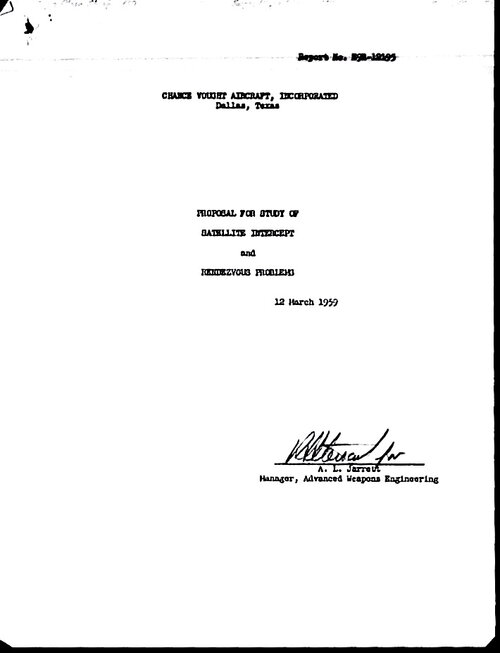
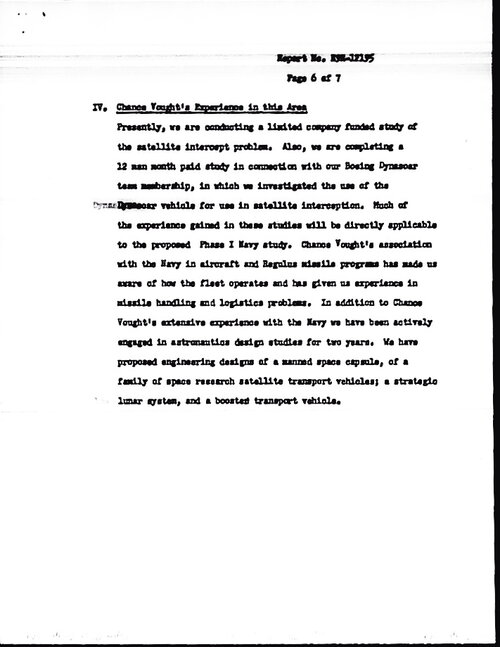
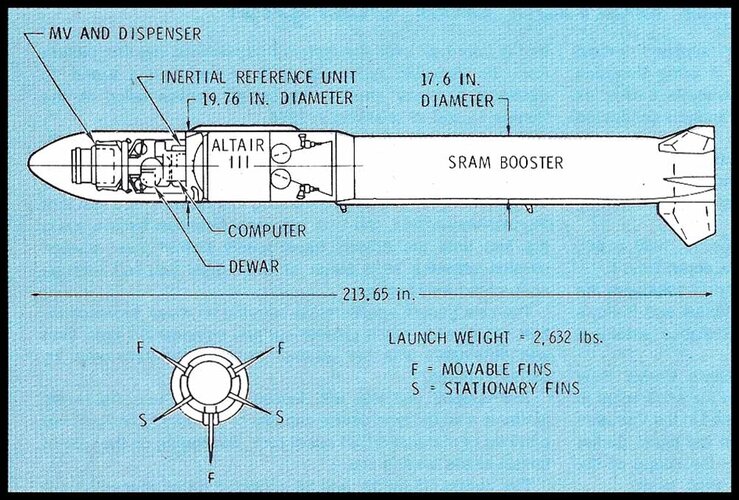
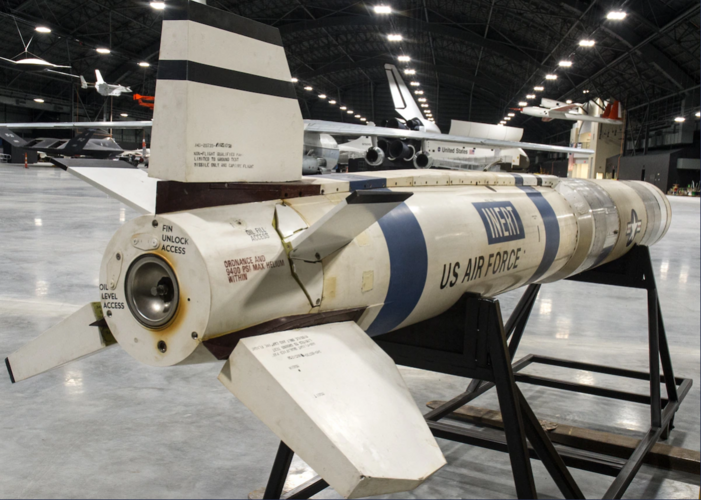
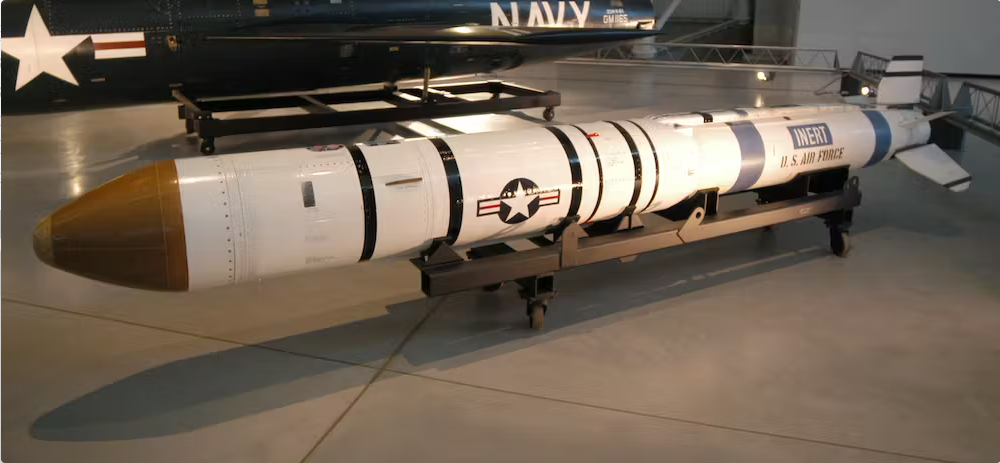
Around 1975, the Vought Corporation began to apply HIT technology to the Miniature System Project that was sponsored by the U.S. Air Force Space and Missile System Organization. This project called for a HIT vehicle similar to the one described above to collide with an orbiting satellite after beinglaunched either by a ground-based or air-based rocket booster, depending onthe orbit of the satellite being attacked. A major milestone in the HIT technology program came on September 13, 1985, when an Air Force antisatellite (ASAT) system launched by an F-15 fighter destroyed an Air Force satellite designated P78-1, known primarily for its principal payload, a gamma ray spectrometer belonging to ARPA. The kill vehicle of this ASAT system was the miniature homing vehicle, which had emerged from the Miniature System Project and was virtually identical to the HIT vehicles developed by LTV and tested in that company's 1976 integrated system tests.